


Clovis point

Encyclopedia
North America
North America is a continent wholly within the Northern Hemisphere and almost wholly within the Western Hemisphere. It is also considered a northern subcontinent of the Americas...
n Clovis culture
Clovis culture
The Clovis culture is a prehistoric Paleo-Indian culture that first appears 11,500 RCYBP , at the end of the last glacial period, characterized by the manufacture of "Clovis points" and distinctive bone and ivory tools...
. They date to the Paleoindian period around 13,500 years ago. Clovis fluted points are named after the city of Clovis, New Mexico
Clovis, New Mexico
Clovis is the county seat of Curry County, New Mexico, United States. Its population was 32,667 at the 2000 census; according to 2010 Census Bureau estimates, the population had risen to 37,775....
, where examples were first found in 1929.
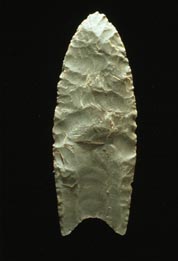
At the right is depicted a typical Clovis, which is a medium to large lanceolate point. Sides are parallel to convex, and exhibit careful pressure flaking along the blade edge. The broadest area is near the midsection or toward the base. The base is distinctly concave with a characteristic flute or channel flake removed from one or, more commonly, both surfaces of the blade. The lower edges of the blade and base are ground to dull edges for hafting. Clovis points also tend to be thicker than the typically thin latter stage Folsom point
Folsom point
Folsom points are a distinct form of chipped stone projectile points associated with the Folsom Tradition of North America. The style of toolmaking was named after Folsom, New Mexico where the first sample was found within the bone structure of a bison in 1927....
s. Length: 4–20 cm/1.5–8 in. Width: 2.5–5 cm/1–2 inches.
Description
Clovis points are thin, fluted projectile points created using bifacial percussion flaking (that is, each face is flaked on both edges alternatively with a percussor). To finish shaping and sharpening the points they are sometimes pressure flakedLithic reduction
Lithic reduction involves the use of a hard hammer precursor, such as a hammerstone, a soft hammer fabricator , or a wood or antler punch to detach lithic flakes from a lump of tool stone called a lithic core . As flakes are detached in sequence, the original mass of stone is reduced; hence the...
along the outer edges. Clovis points are characterized by concave longitudinal shallow grooves called "flutes" on both faces one third or more up from the base to the pointed tip; The grooves may have permitted the points to be fastened (hafted
Hafting
Hafting is a process by which an artifact, often bone, metal, or stone, is attached to a handle or strap. This makes the artifact more useful by allowing it to be fired , thrown , or leveraged more effectively .Hafting is perhaps best known for its use by prehistoric man, but it is still practiced...
) to wooden spears, dart
Dart (missile)
Darts are missile weapons, designed to fly such that a sharp, often weighted point will strike first. They can be distinguished from javelins by fletching and a shaft that is shorter and/or more flexible, and from arrows by the fact that they are not of the right length to use with a normal...
shafts or foreshafts (of wood, bone, etc.) that would have been socketed onto the tip end of a spear or dart. Clovis points could also have been hafted as knives whose handles also served as removable foreshafts of a spear or dart. (This hypothesis is partly based on analogy with aboriginal harpoons that had tethered foreshafts Cotter 1937). There are numerous examples of post-Clovis era points that were hafted to foreshafts, but there is no direct evidence that Clovis people used this type of technological system. Specimens are known to have been made of flint
Flint
Flint is a hard, sedimentary cryptocrystalline form of the mineral quartz, categorized as a variety of chert. It occurs chiefly as nodules and masses in sedimentary rocks, such as chalks and limestones. Inside the nodule, flint is usually dark grey, black, green, white, or brown in colour, and...
, chert
Chert
Chert is a fine-grained silica-rich microcrystalline, cryptocrystalline or microfibrous sedimentary rock that may contain small fossils. It varies greatly in color , but most often manifests as gray, brown, grayish brown and light green to rusty red; its color is an expression of trace elements...
, jasper
Jasper
Jasper, a form of chalcedony, is an opaque, impure variety of silica, usually red, yellow, brown or green in color; and rarely blue. This mineral breaks with a smooth surface, and is used for ornamentation or as a gemstone. It can be highly polished and is used for vases, seals, and at one time for...
, chalcedony
Chalcedony
Chalcedony is a cryptocrystalline form of silica, composed of very fine intergrowths of the minerals quartz and moganite. These are both silica minerals, but they differ in that quartz has a trigonal crystal structure, while moganite is monoclinic...
and other stone of conchoidal fracture
Conchoidal fracture
Conchoidal fracture describes the way that brittle materials break when they do not follow any natural planes of separation. Materials that break in this way include flint and other fine-grained minerals, as well as most amorphous solids, such as obsidian and other types of glass.Conchoidal...
. Ivory and bone atlatl hooks of Clovis age have been archaeologically recovered; known bone and ivory tools associated with Clovis archaeological deposits are not considered effective foreshafts for projectile weapons. The idea of Clovis foreshafts is commonly repeated in the technical literature despite the paucity of archaeological evidence. The assembled multiple piece spear or dart could have been thrown by hand or with the aid of an atlatl
Atlatl
An atlatl or spear-thrower is a tool that uses leverage to achieve greater velocity in dart-throwing.It consists of a shaft with a cup or a spur at the end that supports and propels the butt of the dart. The atlatl is held in one hand, gripped near the end farthest from the cup...
(spear thrower).
Age and cultural affiliations
Whether Clovis toolmaking technology was native to the Americas or originated through influences from elsewhere is a contentious issue among archaeologists. LithicStone tool
A stone tool is, in the most general sense, any tool made either partially or entirely out of stone. Although stone tool-dependent societies and cultures still exist today, most stone tools are associated with prehistoric, particularly Stone Age cultures that have become extinct...
antecedents of Clovis points have not been found in northeast Asia
Asia
Asia is the world's largest and most populous continent, located primarily in the eastern and northern hemispheres. It covers 8.7% of the Earth's total surface area and with approximately 3.879 billion people, it hosts 60% of the world's current human population...
, from where the first human inhabitants of the Americas are believed by the majority of archaeologists to have originated. Strong similarities with points produced by the Solutrean
Solutrean
The Solutrean industry is a relatively advanced flint tool-making style of the Upper Palaeolithic, from around 22,000 to 17,000 BP.-Details:...
culture in the Iberian peninsula have been noted, leading to the controversial Solutrean hypothesis
Solutrean hypothesis
The Solutrean hypothesis proposes that peoples from Europe may have been among the earliest settlers in the Americas, as evidenced by similarities in stone tool technology of the Solutrean culture from prehistoric Europe to that of the later Clovis tool-making culture found in the Americas. It was...
that the technology was introduced by hunters traversing the Atlantic ice-shelf.
Around 10,000 radio carbon years before present
Before Present
Before Present years is a time scale used in archaeology, geology, and other scientific disciplines to specify when events in the past occurred. Because the "present" time changes, standard practice is to use AD 1950 as the origin of the age scale, reflecting the fact that radiocarbon...
, a new type of fluted projectile point called Folsom
Folsom point
Folsom points are a distinct form of chipped stone projectile points associated with the Folsom Tradition of North America. The style of toolmaking was named after Folsom, New Mexico where the first sample was found within the bone structure of a bison in 1927....
appeared in archaeological deposits, and Clovis-style points disappeared from the continental United States. Most Folsom points are shorter in length than Clovis points and exhibit different fluting and pressure flaking patterns. This is particularly easy to see when comparing the unfinished preforms of Clovis and Folsom points.
Besides its function as a tool, Clovis technology may well have been the lithic symbol of a highly mobile culture that exploited a wide range of faunal resources during the Late Pleistocene
Pleistocene
The Pleistocene is the epoch from 2,588,000 to 11,700 years BP that spans the world's recent period of repeated glaciations. The name pleistocene is derived from the Greek and ....
and early Recent. As Clovis technology expanded, its very use may have affected resource availability, being a possible contributor to the extinction
Quaternary extinction event
The Quaternary period saw the extinctions of numerous predominantly larger, especially megafaunal, species, many of which occurred during the transition from the Pleistocene to the Holocene epoch. However, the extinction wave did not stop at the end of the Pleistocene, but continued especially on...
of the megafauna
Megafauna
In terrestrial zoology, megafauna are "giant", "very large" or "large" animals. The most common thresholds used are or...
.
There are different opinions about the emergence of Clovis points. One is that pre-Clovis people in the New World
New World
The New World is one of the names used for the Western Hemisphere, specifically America and sometimes Oceania . The term originated in the late 15th century, when America had been recently discovered by European explorers, expanding the geographical horizon of the people of the European middle...
developed the Clovis tradition independently. Another opinion is that Upper Paleolithic
Upper Paleolithic
The Upper Paleolithic is the third and last subdivision of the Paleolithic or Old Stone Age as it is understood in Europe, Africa and Asia. Very broadly it dates to between 40,000 and 10,000 years ago, roughly coinciding with the appearance of behavioral modernity and before the advent of...
peoples who, after migrating into North America from northeast Asia, reverted back to inherited Clovis-style flaked-stone technology that had been in use prior to their entry into the Americas.
Distribution
Clovis points were first discovered in the city of Clovis, New MexicoClovis, New Mexico
Clovis is the county seat of Curry County, New Mexico, United States. Its population was 32,667 at the 2000 census; according to 2010 Census Bureau estimates, the population had risen to 37,775....
, and have since been found over most of North America and as far south as Venezuela
Venezuela
Venezuela , officially called the Bolivarian Republic of Venezuela , is a tropical country on the northern coast of South America. It borders Colombia to the west, Guyana to the east, and Brazil to the south...
. Significant Clovis finds include the Anzick site in Montana
Montana
Montana is a state in the Western United States. The western third of Montana contains numerous mountain ranges. Smaller, "island ranges" are found in the central third of the state, for a total of 77 named ranges of the Rocky Mountains. This geographical fact is reflected in the state's name,...
; the Blackwater Draw
Blackwater Draw
Blackwater Draw is a dry stream channel about long, heading in Curry County, New Mexico, about southwest of Texico, New Mexico and trending generally southeastward across the Llano Estacado to the city of Lubbock, Texas, where it joins Yellow House Draw to form Yellow House Canyon at the head of...
type site in New Mexico; the Colby site in Wyoming; the Gault site in Texas
Texas
Texas is the second largest U.S. state by both area and population, and the largest state by area in the contiguous United States.The name, based on the Caddo word "Tejas" meaning "friends" or "allies", was applied by the Spanish to the Caddo themselves and to the region of their settlement in...
; the Simon site in Idaho
Idaho
Idaho is a state in the Rocky Mountain area of the United States. The state's largest city and capital is Boise. Residents are called "Idahoans". Idaho was admitted to the Union on July 3, 1890, as the 43rd state....
; the East Wenatchee Clovis Site
East Wenatchee Clovis Site
The East Wenatchee Clovis Site is a deposit of prehistoric Clovis points and other implements, dating to roughly 11,000 radiocarbon years before present or about 13,000 calendar years before present, found near the city of East Wenatchee, Washington in 1987...
in Washington; and the Fenn cache, which came to light in private hands in 1989 and whose place of discovery is unknown. Clovis points have been found northwest of Dallas, Texas
Dallas, Texas
Dallas is the third-largest city in Texas and the ninth-largest in the United States. The Dallas-Fort Worth Metroplex is the largest metropolitan area in the South and fourth-largest metropolitan area in the United States...
.
In early 2009 a major Clovis cache, now called the Mahaffey Cache, was found in Boulder, Colorado
Boulder, Colorado
Boulder is the county seat and most populous city of Boulder County and the 11th most populous city in the U.S. state of Colorado. Boulder is located at the base of the foothills of the Rocky Mountains at an elevation of...
, with 83 Clovis stone tools. The tools were found to have traces of horse and cameloid protein. They were dated to 13,000 to 13,500 YBP, a date confirmed by sediment layers in which the tools were found and the types of protein residues found on the artifacts.
A fluted obsidian point from a site near Rancho San Joaquin, Baja California Sur was found in a private collection in 1993. The point was surface collected several years earlier from an alluvial terrace approximately 14 km. to the south of San Ignacio.
See also
- Bare Island projectile pointBare Island projectile pointthumb|upright|right|360|A Bare Island [[projectile point]] made of [[flint]] from central New York State.Bare Island projectile points are stone projectile points manufactured by Native Americans in what is now the northeastern United States, generally in the time interval of 3000-2000 B.C...
- Cascade pointCascade pointA Cascade point is a projectile point associated with the Cascade phase, an ancient culture of Native Americans that settled in the Pacific Northwest that existed from 9000 or 10000 BC until about 5500 BC....
- Cumberland pointCumberland pointA Cumberland point is a rare stone projectile point whose original purpose was that of a hunting tool. Attached to a wooden spear, these heavy points were intended for use as thrusting weapons and employed by various nomadic mid-Paleo Indians across North America in the killing of large game mammals...
- Eden pointEden pointEden Points are a form of chipped stone projectile points associated with a sub-group of the larger Plano culture. Sometimes also called Yuma points, the first Eden points were discovered in washouts in Yuma County, Colorado. They were first discovered in situ at an ancient buffalo kill site...
- Folsom pointFolsom pointFolsom points are a distinct form of chipped stone projectile points associated with the Folsom Tradition of North America. The style of toolmaking was named after Folsom, New Mexico where the first sample was found within the bone structure of a bison in 1927....
- Greene projectile pointGreene projectile pointthumb|right|360|Greene projectile point from central New York StateGreene projectile points are stone projectile points manufactured by Native Americans what is now the northeastern United States generally in the time interval of 300-800 AD.- Description :...
- Jack's Reef pentagonal projectile pointJack's Reef pentagonal projectile pointthumb|right|360|Jack's Reef pentagonal projectile point from central New York StateJack's Reef pentagonal projectile points are stone projectile points manufactured by Native Americans what is now the northeastern United States generally in the time interval of 600-1200...
- Lamoka projectile pointLamoka projectile pointthumb|right|360|Lamoka projectile points from central New York State. The point on the left is a "stemmed" lamoka point made of quartz. The middle one is a "stemmed" lamoka point made of flint and, the point on the right is a flint "side notched" lamoka point....
- Levanna projectile pointLevanna projectile pointthumb|right|360|Levanna projectile point from central New York StateLevanna projectile points are stone projectile points manufactured by Native Americans what is now the northeastern United States generally in the time interval of 700-1350 AD...
- Naco-Mammoth Kill SiteNaco-Mammoth Kill SiteThe Naco Mammoth Kill Site is an archaeological site in southeast Arizona, near Naco, Arizona. The site was reported to the Arizona State Museum in September 1951 by Marc Navarrete, a local resident, after his father found two Clovis points in Greenbush Draw, while digging out the fossil bones of a...
- Plano pointPlano pointPlano point is a general term used by archaeologists to describe a variety of different chipped stone projectile points used by the various Plano cultures of the North American Great Plains between 9000 BC and 6000 BC....
- Susquehanna broad projectile pointSusquehanna broad projectile pointthumb|upright|Susquehanna broad projectile point from central New York State. Made from [[rhyolite]], probably quarried near [[Gettysburg, Pennsylvania]]....