

Cleveland, England

Encyclopedia
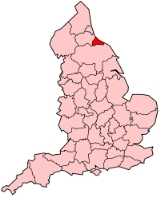
Cleveland is an area in the north east of England
. Its name means literally "cliff-land", referring to its hilly southern areas, which rise to nearly 1500 ft (457.2 m). Historically Cleveland, as a geographic area within the North Riding of Yorkshire
, was located entirely to the south of the River Tees
and its largest town was Guisborough
, until the rise of Middlesbrough
in the 19th century.
A non-metropolitan county
of Cleveland was created in 1974 under the Local Government Act 1972
, named after the historic region, but not covering it all, and also including land north of the River Tees that had until then been in County Durham
. It was based around the Teesside
urban area and included Middlesbrough
, Stockton-on-Tees
, Hartlepool
and Redcar
.
The county was abolished in 1996 with its boroughs becoming unitary authorities
and the Tees re-established as the border between North Yorkshire
and County Durham for ceremonial purposes
only.
boom that led to Middlesbrough growing from a hamlet into a major industrial town in only a few decades. The Cleveland Hills
, in the southern part of the district, were key suppliers of the ironstone
that was essential to the running of the blast furnace
s alongside the River Tees. Middlesbrough's Teesport is still one of the United Kingdom's main ports and the area between Middlesbrough and Redcar is still populated by many heavy industrial plants, although this is much reduced from its 20th century peak.
. Unlike the traditional geographic area, the county was formed around the Tees estuary and included lands on both sides of the river. It excluded the southernmost parts of traditional Cleveland, including much of the Cleveland Hills
, although the original proposal for this county was much larger and covered the coast down including Whitby
and the Whitby Rural District.
The county was called "Cleveland", instead of "Teesside" as originally proposed in the Local Government Bill
, due to fears in areas not part of the old Teesside
county borough
that it represented a takeover. It was formed on 1 April 1974, from the former county borough
s of Teesside
and Hartlepool
, the Stockton Rural District from Durham, and from the North Riding of Yorkshire, the urban districts of Guisborough
, Loftus
, Saltburn and Marske-by-the-Sea and Skelton and Brotton
, along with some parishes from Stokesley Rural District
.
The four districts of the County of Cleveland were Hartlepool
, Langbaurgh-on-Tees, Stockton-on-Tees
, and Middlesbrough
. The county town was Middlesbrough. It had a total area of 225 square miles (583 km²) and an estimated population of 567,600 in 2000. The county bordered County Durham
to the north and North Yorkshire
to the south, and it faced the North Sea
to the east.
. The Commission's final recommendations, accepted by the government, were that each of the districts should be made a unitary authority, and additionally that the Tees should be re-established as a ceremonial border. This was fiercely contested by Cleveland County Council
, who applied for judicial review
over the decision. According to the Minister, David Curry
, in the Commons debate on the order on 11 January 1995, this caused a delay from 1 April 1995 as the reorganisation date to 1 April 1996. The rationale for Cleveland's abolition is widely believed to be due to the fact the name Cleveland became stigmatised due to a misreported child abuse scandal by the local authorities in 1987.
As the first of the Orders to be laid before Parliament, it was done in two stages. The Cleveland (Structural Change) Order 1995 had the main effect of abolishing the County Council, whilst The Cleveland (Further Provision) Order 1995 abolished the actual county, creating four new (non-metropolitan) unitary authorities coterminous with each of the boroughs. A division was forced by the Opposition, on the first Order, with 310 in favour and 223 in opposition. Of Cleveland's 6 MPs, Mo Mowlam
and Frank Cook
(both Labour) voted against, with Tim Devlin
and Michael Bates (both Conservative) voted for. Stuart Bell
and Peter Mandelson
(both Labour) were present at the debate but did not vote.
On 1 April 1996, the Orders came into force. The district of Langbaurgh-on-Tees was renamed Redcar and Cleveland, the County of Cleveland was abolished, and four unitary authorities created. The post of Lord Lieutenant of Cleveland
was abolished, with the area being split between the ceremonial counties
of Durham and North Yorkshire
. However, Cleveland Police
and other institutions covering the four boroughs, were retained. The area (sometimes including Hartlepool) is known as 'Teesside' for some purposes, and with Darlington
the term Tees Valley
is becoming more popular in the press and with local government, although it continues to be generally unused by the actual residents of this area.
The name Cleveland has not been entirely eliminated; these bodies still exist:
Cleveland
is a Church of England
archdeaconry, in the Diocese of York
. It covers a large area including Middlesbrough, Thirsk
, Pickering
and Whitby.
Cleveland was for many years also the name of a constituency for the House of Commons
. The Cleveland constituency
had been created by the Redistribution of Seats Act 1885
, by the division of the North Riding constituency
, and was succeeded by the Cleveland and Whitby
for the February 1974 general election
. The TS postcode area
, which covers much of the former county, is also known officially as the Cleveland postcode area. Cleveland was adopted by the Royal Mail as a postal county
in 1974. The 'TS' implies that the county of Cleveland was originally to be named Teesside or that the postcoding scheme was devised for a larger County Borough of Teesside
than was actually created.
 The area is extremely varied geographically. The Tees estuary is highly industrialised and urbanised. Much of the remainder of the lowland parts of Cleveland is farmland. East Cleveland marks the northern end of the chain of cliffs that runs along the North Yorkshire Heritage Coast. South Cleveland is extremely hilly, forming the escarpment of the North York Moors
. One of the best known symbols of Cleveland is the distinctive hill of Roseberry Topping
, which overlooks Newton under Roseberry
on the Great Ayton
to Guisborough road. Its original roughly conical form was undercut by extensive mining, giving it a jagged appearance that many have thought reminiscent of the Matterhorn
mountain.
England
England is a country that is part of the United Kingdom. It shares land borders with Scotland to the north and Wales to the west; the Irish Sea is to the north west, the Celtic Sea to the south west, with the North Sea to the east and the English Channel to the south separating it from continental...
. Its name means literally "cliff-land", referring to its hilly southern areas, which rise to nearly 1500 ft (457.2 m). Historically Cleveland, as a geographic area within the North Riding of Yorkshire
North Riding of Yorkshire
The North Riding of Yorkshire was one of the three historic subdivisions of the English county of Yorkshire, alongside the East and West Ridings. From the Restoration it was used as a Lieutenancy area. The three ridings were treated as three counties for many purposes, such as having separate...
, was located entirely to the south of the River Tees
River Tees
The River Tees is in Northern England. It rises on the eastern slope of Cross Fell in the North Pennines, and flows eastwards for 85 miles to reach the North Sea between Hartlepool and Redcar.-Geography:...
and its largest town was Guisborough
Guisborough
Guisborough is a market town and civil parish within the unitary authority of Redcar and Cleveland and the ceremonial county of North Yorkshire, England....
, until the rise of Middlesbrough
Middlesbrough
Middlesbrough is a large town situated on the south bank of the River Tees in north east England, that sits within the ceremonial county of North Yorkshire...
in the 19th century.
A non-metropolitan county
Shire county
A non-metropolitan county, or shire county, is a county-level entity in England that is not a metropolitan county. The counties typically have populations of 300,000 to 1.4 million. The term shire county is, however, an unofficial usage. Many of the non-metropolitan counties bear historic names...
of Cleveland was created in 1974 under the Local Government Act 1972
Local Government Act 1972
The Local Government Act 1972 is an Act of Parliament in the United Kingdom that reformed local government in England and Wales on 1 April 1974....
, named after the historic region, but not covering it all, and also including land north of the River Tees that had until then been in County Durham
County Durham
County Durham is a ceremonial county and unitary district in north east England. The county town is Durham. The largest settlement in the ceremonial county is the town of Darlington...
. It was based around the Teesside
Teesside
Teesside is the name given to the conurbation in the north east of England made up of the towns of Middlesbrough, Stockton-on-Tees, Redcar, Billingham and surrounding settlements near the River Tees. It was also the name of a local government district between 1968 and 1974—the County Borough of...
urban area and included Middlesbrough
Middlesbrough
Middlesbrough is a large town situated on the south bank of the River Tees in north east England, that sits within the ceremonial county of North Yorkshire...
, Stockton-on-Tees
Stockton-on-Tees
Stockton-on-Tees is a market town in north east England. It is the major settlement in the unitary authority and borough of Stockton-on-Tees. For ceremonial purposes, the borough is split between County Durham and North Yorkshire as it also incorporates a number of smaller towns including...
, Hartlepool
Hartlepool
Hartlepool is a town and port in North East England.It was founded in the 7th century AD, around the Northumbrian monastery of Hartlepool Abbey. The village grew during the Middle Ages and developed a harbour which served as the official port of the County Palatine of Durham. A railway link from...
and Redcar
Redcar
Redcar is a seaside resort in the north east of England, and a major town in the unitary authority of Redcar and Cleveland in the ceremonial county of North Yorkshire. It lies east-northeast of Middlesbrough by the North Sea coast...
.
The county was abolished in 1996 with its boroughs becoming unitary authorities
Unitary authority
A unitary authority is a type of local authority that has a single tier and is responsible for all local government functions within its area or performs additional functions which elsewhere in the relevant country are usually performed by national government or a higher level of sub-national...
and the Tees re-established as the border between North Yorkshire
North Yorkshire
North Yorkshire is a non-metropolitan or shire county located in the Yorkshire and the Humber region of England, and a ceremonial county primarily in that region but partly in North East England. Created in 1974 by the Local Government Act 1972 it covers an area of , making it the largest...
and County Durham for ceremonial purposes
Ceremonial counties of England
The ceremonial counties are areas of England to which are appointed a Lord Lieutenant, and are defined by the government as counties and areas for the purposes of the Lieutenancies Act 1997 with reference to the metropolitan and non-metropolitan counties of England and Lieutenancies Act 1997...
only.
Heritage
Cleveland has a significant industrial heritage arising from its central role in the 19th century ironIron
Iron is a chemical element with the symbol Fe and atomic number 26. It is a metal in the first transition series. It is the most common element forming the planet Earth as a whole, forming much of Earth's outer and inner core. It is the fourth most common element in the Earth's crust...
boom that led to Middlesbrough growing from a hamlet into a major industrial town in only a few decades. The Cleveland Hills
Cleveland Hills
The Cleveland Hills are a range of hills on the north-west edge of the North York Moors in North Yorkshire, England, overlooking Cleveland and Teesside. They lie entirely within the boundaries of the North York Moors National Park. Part of the long Cleveland Way National Trail runs along the...
, in the southern part of the district, were key suppliers of the ironstone
Ironstone
Ironstone is a sedimentary rock, either deposited directly as a ferruginous sediment or created by chemical repacement, that contains a substantial proportion of an iron compound from which iron either can be or once was smelted commercially. This term is customarily restricted to hard coarsely...
that was essential to the running of the blast furnace
Blast furnace
A blast furnace is a type of metallurgical furnace used for smelting to produce industrial metals, generally iron.In a blast furnace, fuel and ore and flux are continuously supplied through the top of the furnace, while air is blown into the bottom of the chamber, so that the chemical reactions...
s alongside the River Tees. Middlesbrough's Teesport is still one of the United Kingdom's main ports and the area between Middlesbrough and Redcar is still populated by many heavy industrial plants, although this is much reduced from its 20th century peak.
Formation
Between 1974 and 1996 most of Cleveland was incorporated into a non-metropolitan county of the same name, formed from parts of the North Riding of Yorkshire and County DurhamCounty Durham
County Durham is a ceremonial county and unitary district in north east England. The county town is Durham. The largest settlement in the ceremonial county is the town of Darlington...
. Unlike the traditional geographic area, the county was formed around the Tees estuary and included lands on both sides of the river. It excluded the southernmost parts of traditional Cleveland, including much of the Cleveland Hills
Cleveland Hills
The Cleveland Hills are a range of hills on the north-west edge of the North York Moors in North Yorkshire, England, overlooking Cleveland and Teesside. They lie entirely within the boundaries of the North York Moors National Park. Part of the long Cleveland Way National Trail runs along the...
, although the original proposal for this county was much larger and covered the coast down including Whitby
Whitby
Whitby is a seaside town, port and civil parish in the Scarborough borough of North Yorkshire, England. Situated on the east coast of Yorkshire at the mouth of the River Esk, Whitby has a combined maritime, mineral and tourist heritage, and is home to the ruins of Whitby Abbey where Caedmon, the...
and the Whitby Rural District.
The county was called "Cleveland", instead of "Teesside" as originally proposed in the Local Government Bill
Local Government Act 1972
The Local Government Act 1972 is an Act of Parliament in the United Kingdom that reformed local government in England and Wales on 1 April 1974....
, due to fears in areas not part of the old Teesside
Teesside
Teesside is the name given to the conurbation in the north east of England made up of the towns of Middlesbrough, Stockton-on-Tees, Redcar, Billingham and surrounding settlements near the River Tees. It was also the name of a local government district between 1968 and 1974—the County Borough of...
county borough
County borough
County borough is a term introduced in 1889 in the United Kingdom of Great Britain and Ireland , to refer to a borough or a city independent of county council control. They were abolished by the Local Government Act 1972 in England and Wales, but continue in use for lieutenancy and shrievalty in...
that it represented a takeover. It was formed on 1 April 1974, from the former county borough
County borough
County borough is a term introduced in 1889 in the United Kingdom of Great Britain and Ireland , to refer to a borough or a city independent of county council control. They were abolished by the Local Government Act 1972 in England and Wales, but continue in use for lieutenancy and shrievalty in...
s of Teesside
Teesside
Teesside is the name given to the conurbation in the north east of England made up of the towns of Middlesbrough, Stockton-on-Tees, Redcar, Billingham and surrounding settlements near the River Tees. It was also the name of a local government district between 1968 and 1974—the County Borough of...
and Hartlepool
Hartlepool (borough)
Hartlepool is a unitary authority in the ceremonial county of County Durham, north east England. In 2003 it had a resident population of 90,161. It borders the non-metropolitan county of County Durham to the north, Stockton-on-Tees to the south and Redcar and Cleveland to the south-east along the...
, the Stockton Rural District from Durham, and from the North Riding of Yorkshire, the urban districts of Guisborough
Guisborough
Guisborough is a market town and civil parish within the unitary authority of Redcar and Cleveland and the ceremonial county of North Yorkshire, England....
, Loftus
Loftus, North Yorkshire
Loftus is a town and civil parish in the unitary authority of Redcar and Cleveland and the ceremonial county of North Yorkshire, England. It lies in a region between Saltburn-by-the-Sea and the North York Moors...
, Saltburn and Marske-by-the-Sea and Skelton and Brotton
Skelton and Brotton
Skelton and Brotton is a civil parish in the unitary authority of Redcar and Cleveland, England. It consists of the towns of Skelton-in-Cleveland and Brotton, which had a combined population of 18,952 in 2002....
, along with some parishes from Stokesley Rural District
Stokesley Rural District
Stokesley was a rural district in the North Riding of Yorkshire from 1894 to 1974. It was named after the town of Stokesley, which it contained....
.
The four districts of the County of Cleveland were Hartlepool
Hartlepool (borough)
Hartlepool is a unitary authority in the ceremonial county of County Durham, north east England. In 2003 it had a resident population of 90,161. It borders the non-metropolitan county of County Durham to the north, Stockton-on-Tees to the south and Redcar and Cleveland to the south-east along the...
, Langbaurgh-on-Tees, Stockton-on-Tees
Stockton-on-Tees (borough)
Stockton-on-Tees is a unitary authority area and borough in the Tees Valley area of north east England, with a population in 2001 of 178,408, rising to 185,880 in 2005 estimates....
, and Middlesbrough
Middlesbrough
Middlesbrough is a large town situated on the south bank of the River Tees in north east England, that sits within the ceremonial county of North Yorkshire...
. The county town was Middlesbrough. It had a total area of 225 square miles (583 km²) and an estimated population of 567,600 in 2000. The county bordered County Durham
County Durham
County Durham is a ceremonial county and unitary district in north east England. The county town is Durham. The largest settlement in the ceremonial county is the town of Darlington...
to the north and North Yorkshire
North Yorkshire
North Yorkshire is a non-metropolitan or shire county located in the Yorkshire and the Humber region of England, and a ceremonial county primarily in that region but partly in North East England. Created in 1974 by the Local Government Act 1972 it covers an area of , making it the largest...
to the south, and it faced the North Sea
North Sea
In the southwest, beyond the Straits of Dover, the North Sea becomes the English Channel connecting to the Atlantic Ocean. In the east, it connects to the Baltic Sea via the Skagerrak and Kattegat, narrow straits that separate Denmark from Norway and Sweden respectively...
to the east.
Abolition
Cleveland was one of the areas in the first tranche of reviews conducted by the Banham Commission1990s UK local government reform
The structure of local government in the United Kingdom underwent large changes in the 1990s. The system of two-tier local government introduced in the 1970s by the Local Government Act 1972 and the Local Government Act 1973 was abolished in Scotland and Wales on April 1, 1996, and replaced with...
. The Commission's final recommendations, accepted by the government, were that each of the districts should be made a unitary authority, and additionally that the Tees should be re-established as a ceremonial border. This was fiercely contested by Cleveland County Council
County council
A county council is the elected administrative body governing an area known as a county. This term has slightly different meanings in different countries.-United Kingdom:...
, who applied for judicial review
Judicial review
Judicial review is the doctrine under which legislative and executive actions are subject to review by the judiciary. Specific courts with judicial review power must annul the acts of the state when it finds them incompatible with a higher authority...
over the decision. According to the Minister, David Curry
David Curry
David Maurice Curry is a British Conservative Party politician. He was the Member of Parliament for Skipton and Ripon from 1987 to 2010.-Early life:...
, in the Commons debate on the order on 11 January 1995, this caused a delay from 1 April 1995 as the reorganisation date to 1 April 1996. The rationale for Cleveland's abolition is widely believed to be due to the fact the name Cleveland became stigmatised due to a misreported child abuse scandal by the local authorities in 1987.
As the first of the Orders to be laid before Parliament, it was done in two stages. The Cleveland (Structural Change) Order 1995 had the main effect of abolishing the County Council, whilst The Cleveland (Further Provision) Order 1995 abolished the actual county, creating four new (non-metropolitan) unitary authorities coterminous with each of the boroughs. A division was forced by the Opposition, on the first Order, with 310 in favour and 223 in opposition. Of Cleveland's 6 MPs, Mo Mowlam
Mo Mowlam
Marjorie "Mo" Mowlam was a British Labour Party politician. She was the Member of Parliament for Redcar from 1987 to 2001 and served in the Cabinet as Secretary of State for Northern Ireland, Minister for the Cabinet Office and Chancellor of the Duchy of Lancaster.Mowlam's time as Northern...
and Frank Cook
Frank Cook
Francis Cook is a British Independent politician, who was the Labour Party Member of Parliament for Stockton North from 1983 until 2010.- Background :...
(both Labour) voted against, with Tim Devlin
Tim Devlin
Timothy Robert Devlin, known as Tim Devlin, is a former Conservative Party politician in the United Kingdom.He was the Member of Parliament for the Stockton South constituency from 1987, when he defeated Ian Wrigglesworth to 1997, when he lost to Labour's Dari Taylor.He was educated at Dulwich...
and Michael Bates (both Conservative) voted for. Stuart Bell
Stuart Bell
Sir Stuart Bell is a British Labour Party politician, who has been the Member of Parliament for Middlesbrough since 1983.-Early life:...
and Peter Mandelson
Peter Mandelson
Peter Benjamin Mandelson, Baron Mandelson, PC is a British Labour Party politician, who was the Member of Parliament for Hartlepool from 1992 to 2004, served in a number of Cabinet positions under both Tony Blair and Gordon Brown, and was a European Commissioner...
(both Labour) were present at the debate but did not vote.
On 1 April 1996, the Orders came into force. The district of Langbaurgh-on-Tees was renamed Redcar and Cleveland, the County of Cleveland was abolished, and four unitary authorities created. The post of Lord Lieutenant of Cleveland
Lord Lieutenant of Cleveland
This is a list of people who have served as Lord Lieutenant of Cleveland since its creation in 1974 to its abolition in 1996:*1974–1979: Major Cecil Crosthwaite*1979–1981: Colonel John Pounder...
was abolished, with the area being split between the ceremonial counties
Ceremonial counties of England
The ceremonial counties are areas of England to which are appointed a Lord Lieutenant, and are defined by the government as counties and areas for the purposes of the Lieutenancies Act 1997 with reference to the metropolitan and non-metropolitan counties of England and Lieutenancies Act 1997...
of Durham and North Yorkshire
North Yorkshire
North Yorkshire is a non-metropolitan or shire county located in the Yorkshire and the Humber region of England, and a ceremonial county primarily in that region but partly in North East England. Created in 1974 by the Local Government Act 1972 it covers an area of , making it the largest...
. However, Cleveland Police
Cleveland Police
Cleveland Police is the territorial police force responsible for policing the area of former county of Cleveland in north east England. The Cleveland Police area covers approximately and has a population of over 554,000....
and other institutions covering the four boroughs, were retained. The area (sometimes including Hartlepool) is known as 'Teesside' for some purposes, and with Darlington
Darlington (borough)
Darlington is a local government district and borough in North East England. In 2008 it had a resident population of 100,500 It borders County Durham to the north and west, North Yorkshire to the south along the line of the River Tees, and Stockton-on-Tees to the east.-Council:Traditionally part of...
the term Tees Valley
Tees Valley
The Tees Valley is an area in the North East of England. It can be described as "greater Teesside" and consists of the four unitary authorities created by the breakup of the County of Cleveland in 1996: Hartlepool, Middlesbrough, Redcar & Cleveland, and Stockton-On-Tees along with the borough of...
is becoming more popular in the press and with local government, although it continues to be generally unused by the actual residents of this area.
Identity
As a small, recently formed authority, Cleveland was not well known, leaving the post-1996 boroughs effectively unheard of to all but the local population or those with links to the area. Recent investigations into the resident populations opinions as to their own identity reveal that people believe themselves to be part of either 'Cleveland', 'Teesside', 'Yorkshire' or 'Durham'. The age of the interviewee appears to be the defining factor as to which title they identify with.The name Cleveland has not been entirely eliminated; these bodies still exist:
- Cleveland and Teesside Local History Society
- Cleveland Orienteering Klub
- Middlesbrough & Cleveland Harriers
- Cleveland College of Art & Design
- Cleveland Family History SocietyCleveland Family History SocietyThe Cleveland Family History Society, more formally The Cleveland, North Yorkshire and South Durham Family History Society, is a family history society that covers this named part of the North-East of England....
- Cleveland Fire BrigadeCleveland Fire BrigadeCleveland Fire Brigade is the statutory fire and rescue service covering the boroughs of Hartlepool, Middlesbrough, Redcar and Cleveland & Stockton-on-Tees in the North East of England. The name originates from the former county of Cleveland which was abolished in 1996...
- Cleveland PoliceCleveland PoliceCleveland Police is the territorial police force responsible for policing the area of former county of Cleveland in north east England. The Cleveland Police area covers approximately and has a population of over 554,000....
Cleveland
Archdeaconry of Cleveland
The Archdeaconry of Cleveland is an archdeaconry, or subdivision, of the Church of England Diocese of York in the Province of York. It stretches west from Thirsk, north to Middlesbrough, east to Whitby and south to Pickering...
is a Church of England
Church of England
The Church of England is the officially established Christian church in England and the Mother Church of the worldwide Anglican Communion. The church considers itself within the tradition of Western Christianity and dates its formal establishment principally to the mission to England by St...
archdeaconry, in the Diocese of York
Archbishop of York
The Archbishop of York is a high-ranking cleric in the Church of England, second only to the Archbishop of Canterbury. He is the diocesan bishop of the Diocese of York and metropolitan of the Province of York, which covers the northern portion of England as well as the Isle of Man...
. It covers a large area including Middlesbrough, Thirsk
Thirsk
Thirsk is a small market town and civil parish in the Hambleton district of North Yorkshire, England. The local travel links are located a mile from the town centre to Thirsk railway station and to Durham Tees Valley Airport...
, Pickering
Pickering, North Yorkshire
Pickering is an ancient market town and civil parish in the Ryedale district of the county of North Yorkshire, England, on the border of the North York Moors National Park. It sits at the foot of the Moors, overlooking the Vale of Pickering to the south...
and Whitby.
Cleveland was for many years also the name of a constituency for the House of Commons
British House of Commons
The House of Commons is the lower house of the Parliament of the United Kingdom, which also comprises the Sovereign and the House of Lords . Both Commons and Lords meet in the Palace of Westminster. The Commons is a democratically elected body, consisting of 650 members , who are known as Members...
. The Cleveland constituency
Cleveland (UK Parliament constituency)
Cleveland was a county constituency in the North Riding of Yorkshire.-Electorate:It returned one Member of Parliament to the British House of Commons, using the first past the post voting system...
had been created by the Redistribution of Seats Act 1885
Redistribution of Seats Act 1885
The Redistribution of Seats Act 1885 was an Act of the Parliament of the United Kingdom. It was a piece of electoral reform legislation that redistributed the seats in the House of Commons, introducing the concept of equally populated constituencies, in an attempt to equalise representation across...
, by the division of the North Riding constituency
North Riding of Yorkshire (UK Parliament constituency)
North Riding of Yorkshire was a parliamentary constituency in the North Riding of Yorkshire. It returned two Members of Parliament to the House of Commons of the Parliament of the United Kingdom....
, and was succeeded by the Cleveland and Whitby
Cleveland and Whitby (UK Parliament constituency)
Cleveland and Whitby was a parliamentary constituency centred on the town of Whitby in northern England. It returned one Member of Parliament to the House of Commons of the Parliament of the United Kingdom from February 1974 until it was abolished for the 1983 general election.Cleveland and Whitby...
for the February 1974 general election
United Kingdom general election, February 1974
The United Kingdom's general election of February 1974 was held on the 28th of that month. It was the first of two United Kingdom general elections held that year, and the first election since the Second World War not to produce an overall majority in the House of Commons for the winning party,...
. The TS postcode area
TS postcode area
The TS postcode area, also known as the Cleveland postcode area, comprises the postcode districts covering the post towns of Billingham, Guisborough, Hartlepool, Middlesbrough, Redcar, Saltburn-by-the-Sea, Stockton-on-Tees, Trimdon Station, Wingate and Yarm in north east England.-Coverage:The...
, which covers much of the former county, is also known officially as the Cleveland postcode area. Cleveland was adopted by the Royal Mail as a postal county
Postal counties of the United Kingdom
The postal counties of the United Kingdom, now known officially as the former postal counties, were postal subdivisions in routine use by the Royal Mail until 1996. The raison d'être of the postal county – as opposed to any other kind of county – was to aid the sorting of mail by...
in 1974. The 'TS' implies that the county of Cleveland was originally to be named Teesside or that the postcoding scheme was devised for a larger County Borough of Teesside
Teesside
Teesside is the name given to the conurbation in the north east of England made up of the towns of Middlesbrough, Stockton-on-Tees, Redcar, Billingham and surrounding settlements near the River Tees. It was also the name of a local government district between 1968 and 1974—the County Borough of...
than was actually created.
Geography
North York Moors
The North York Moors is a national park in North Yorkshire, England. The moors are one of the largest expanses of heather moorland in the United Kingdom. It covers an area of , and it has a population of about 25,000...
. One of the best known symbols of Cleveland is the distinctive hill of Roseberry Topping
Roseberry Topping
Roseberry Topping is a distinctive hill on the border between North Yorkshire and the borough of Redcar and Cleveland, England. It is situated near Great Ayton and Newton under Roseberry. Its summit has a distinctive half-cone shape with a jagged cliff, which has led to many comparisons with the...
, which overlooks Newton under Roseberry
Newton under Roseberry
Newton under Roseberry is a village in the borough of Redcar and Cleveland and the ceremonial county of North Yorkshire, England. It is on the A173, between Great Ayton and Guisborough and is close to the base of Roseberry Topping....
on the Great Ayton
Great Ayton
Great Ayton is a village and civil parish in the Hambleton district of North Yorkshire on the edge of the North York Moors in England. The name Great Ayton is thought to derive from Ea-tun, tun meaning farm and 'ea' meaning river. It has a population of 4,570....
to Guisborough road. Its original roughly conical form was undercut by extensive mining, giving it a jagged appearance that many have thought reminiscent of the Matterhorn
Matterhorn
The Matterhorn , Monte Cervino or Mont Cervin , is a mountain in the Pennine Alps on the border between Switzerland and Italy. Its summit is 4,478 metres high, making it one of the highest peaks in the Alps. The four steep faces, rising above the surrounding glaciers, face the four compass points...
mountain.
Towns and villages
- BillinghamBillinghamBillingham is a town in the unitary authority of Stockton on Tees, in north east England, with a population of 35,765 . It was founded circa 650 by a group of Saxons known as Billa's people, which is where the name Billingham is thought to have originated...
- BrottonBrottonBrotton is a village in the parish of Skelton and Brotton, in the unitary authority of Redcar and Cleveland and ceremonial county of North Yorkshire, England. It is approximately 2.5 miles southeast of Saltburn-by-the-Sea, 16.7 miles east of Middlesbrough and 16.6 miles northwest of Whitby...
- EstonEstonEston is a town within the Unitary Authority of Redcar and Cleveland, England. Within the Middlesbrough agglomeration it falls inside the Greater Eston initiative...
- GuisboroughGuisboroughGuisborough is a market town and civil parish within the unitary authority of Redcar and Cleveland and the ceremonial county of North Yorkshire, England....
- HartlepoolHartlepoolHartlepool is a town and port in North East England.It was founded in the 7th century AD, around the Northumbrian monastery of Hartlepool Abbey. The village grew during the Middle Ages and developed a harbour which served as the official port of the County Palatine of Durham. A railway link from...
- Ingleby BarwickIngleby BarwickIngleby Barwick is a large private residential estate and civil parish built on what was the southern perimeter of Thornaby airfield in the borough of Stockton-on-Tees and ceremonial county of North Yorkshire, England. The estate is enclosed by water to the west, north and east...
- LoftusLoftus, North YorkshireLoftus is a town and civil parish in the unitary authority of Redcar and Cleveland and the ceremonial county of North Yorkshire, England. It lies in a region between Saltburn-by-the-Sea and the North York Moors...
- Marske-by-the-SeaMarske-by-the-SeaMarske-by-the-Sea is a village in the unitary authority of Redcar and Cleveland and the ceremonial county of North Yorkshire, England.It is located on the coast, in an area sometimes referred to as East Cleveland, between the seaside resorts of Redcar and Saltburn-by-the-Sea although it is not...
- MiddlesbroughMiddlesbroughMiddlesbrough is a large town situated on the south bank of the River Tees in north east England, that sits within the ceremonial county of North Yorkshire...
- RedcarRedcarRedcar is a seaside resort in the north east of England, and a major town in the unitary authority of Redcar and Cleveland in the ceremonial county of North Yorkshire. It lies east-northeast of Middlesbrough by the North Sea coast...
- Saltburn-by-the-SeaSaltburn-by-the-SeaSaltburn-by-the-Sea is a seaside resort in the unitary authority of Redcar and Cleveland and the ceremonial county of North Yorkshire, England. The town is around east of Middlesbrough, and had a population of 5,912 at the 2001 Census.-Old Saltburn:...
- Seaton CarewSeaton CarewSeaton Carew is a small seaside resort within the Borough of Hartlepool, in North East England with a population of 6,018 . It is situated on the North Sea coast between the town of Hartlepool and the mouth of the River Tees...
- Skelton-in-ClevelandSkelton-in-ClevelandSkelton-in-Cleveland is a small town in the civil parish of Skelton and Brotton in the unitary authority of Redcar and Cleveland and the ceremonial county of North Yorkshire in the North East of England. It is situated at the foot of the Cleveland Hills and about east of Middlesbrough. Skelton is...
- Stockton-on-TeesStockton-on-TeesStockton-on-Tees is a market town in north east England. It is the major settlement in the unitary authority and borough of Stockton-on-Tees. For ceremonial purposes, the borough is split between County Durham and North Yorkshire as it also incorporates a number of smaller towns including...
- Thornaby-on-TeesThornaby-on-TeesThornaby-on-Tees is a town and civil parish within the Borough of Stockton-on-Tees, in the ceremonial county of North Yorkshire, England. It is on the south bank of the River Tees, three miles southeast of Stockton-on-Tees, and four miles southwest of Middlesbrough town centre and has a...
- YarmYarmYarm is a small town and civil parish in the borough of Stockton-on-Tees in North East England. It is on the south bank of the River Tees and for ceremonial purposes is in North Yorkshire...
See also
- List of Lord Lieutenants of ClevelandLord Lieutenant of ClevelandThis is a list of people who have served as Lord Lieutenant of Cleveland since its creation in 1974 to its abolition in 1996:*1974–1979: Major Cecil Crosthwaite*1979–1981: Colonel John Pounder...
- List of High Sheriffs of ClevelandHigh Sheriff of ClevelandThe High Sheriff of Cleveland was a High Sheriff title which was in existence from 1974 until 1996, covering Cleveland, England.The county of Cleveland was formed from parts of the North Riding of Yorkshire and County Durham in 1974 by the Local Government Act 1972 and was served by its own High...
- Cleveland BayCleveland BayThe Cleveland Bay is a breed of horse that originated in England during the 17th century, named after its colouring and the Cleveland district of Yorkshire. It is a well-muscled horse, with legs that are strong but short in relation to the body. The horses are always bay in colour, although a...
- Cleveland WayCleveland WayThe Cleveland Way is a National Trail in ancient Cleveland in Northern England. It runs 110 miles from Helmsley to Filey, skirting the North York Moors National Park.-History:The trail was opened in 1969...
- Duke of ClevelandDuke of ClevelandDuke of Cleveland is a title that has been created twice, once in the Peerage of England and once in the Peerage of the United Kingdom. The dukedoms were named after Cleveland in northern England....
- Earl of Cleveland
- East ClevelandLangbaurgh EastLangbaurgh East was a wapentake of the defunct North Riding of Yorkshire, the eastern division of Langbaurgh. The name is presently in use as a local justice area , consisting of the eastern, mostly rural part of the borough of Redcar and Cleveland...
- List of Sites of Special Scientific Interest in Cleveland
External links
- Historic Cleveland, full of useful information about that part of the old North Riding of Yorkshire from the River Tees down to the Moors