

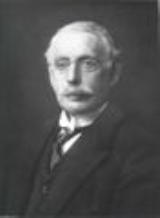
Charles Algernon Parsons

Encyclopedia
Sir Charles Algernon Parsons OM
KCB
FRS (13 June 1854 – 11 February 1931) was an Anglo-Irish
engineer
, best known for his invention of the steam turbine
. He worked as an engineer on dynamo
and turbine
design, and power generation, with great influence on the naval and electrical engineering
fields. He also developed optical equipment, for searchlight
s and telescope
s.
. He attended Trinity College, Dublin
and St. John's College, Cambridge, graduating from the latter in 1877 with a first-class honours degree in mathematics. He then joined the Newcastle
-based engineering firm of W.G. Armstrong
as an apprentice, an unusual step for the son of an earl; then moved to Kitsons
in Yorkshire where he worked on rocket-powered torpedo
es; and then in 1884 moved to Clarke, Chapman and Co.
, ship engine manufacturers near Newcastle, where he was head of their electrical equipment development. He developed a turbine engine there in 1884 and immediately utilized the new engine to drive an electrical generator, which he also designed. Parsons' steam turbine
made cheap and plentiful electricity possible and revolutionised marine transport and naval warfare - the world would never be the same again.
 The best steam turbine at the time, invented by Gustaf de Laval
was an impulse design that subjected the mechanism to huge centrifugal forces and so had limited output due to the weakness of the materials available. Parsons explained that his appreciation of the scaling issue led to his 1884 breakthrough on the compound steam turbine in his 1911 Rede Lecture
:
"It seemed to me that moderate surface velocities and speeds of rotation were essential if the turbine motor was to receive general acceptance as a prime mover. I therefore decided to split up the fall in pressure of the steam into small fractional expansions over a large number of turbines in series, so that the velocity of the steam nowhere should be great...I was also anxious to avoid the well-known cutting action on metal of steam at high velocity."
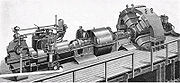 In 1889, he founded C. A. Parsons and Company
in Newcastle to produce turbo-generators
to his design. In the same year he set up the Newcastle and District Electric Lighting Company
. In 1894 he regained certain patent rights from Clarke Chapman
. Although his first turbine was only 1.6% efficient and generated a mere 7.5 kilowatts, rapid incremental improvements in a few years led to his first megawatt turbine built in 1899 for a generating plant at Elberfeld, Germany.
Parsons was also interested in marine applications and founded the Parsons Marine Steam Turbine Company
in Newcastle. Famously, in June 1897, his turbine-powered yacht
, Turbinia
, was exhibited moving at speed at Queen Victoria's Diamond Jubilee
Fleet Review off Portsmouth
, to demonstrate the great potential of the new technology. The Turbinia moved at 34 knots. The fastest Royal Navy ships using other technologies reached 27 knots. Part of the speed improvement was attributable to the slender hull of the Turbinia.
 Within two years, the destroyers HMS Viper and were launched with Parsons' turbines, soon followed by the first turbine powered passenger ship, Clyde steamer
TS King Edward
in 1901; the first turbine transatlantic liners RMS Victorian
and Virginian in 1905, and the first turbine powered battleship, in 1906, all of which were driven by Parsons' turbine engines. Today, Turbinia is housed in a purpose-built gallery at the Discovery Museum, Newcastle.
He was elected a Fellow of the Royal Society in June 1898 and received their Rumford Medal
in 1902, their Copley Medal
in 1928 and delivered their Bakerian Lecture
in 1918. He was knight
ed in 1911 and made a member of the Order of Merit
in 1927.
The Parsons turbine company survives in the Heaton
area of Newcastle and is now part of Siemens
, a German
conglomerate
. Sometimes referred to as Siemens Parsons, the company recently completed a major redevelopment
programme, reducing the size of its site by around three quarters and installing the latest manufacturing
technology. In 1925 Charles Parsons acquired the Grubb Telescope Company and renamed it Grubb Parsons. That company survived in the Newcastle area until 1985.
Parsons' ancestral home at Birr Castle
in Ireland houses a museum detailing the contribution the Parsons family have made to the fields of science and engineering, with part of the museum given over to marine engineering work of Charles Parsons.
Parsons died on 11 February 1931 on board the steamship Duchess of Richmond while on a cruise with his wife, it followed a collapse from an attack of neuritis
. A memorial service was held at Westminster Abbey
on 3 March 1931.
Order of Merit
The Order of Merit is a British dynastic order recognising distinguished service in the armed forces, science, art, literature, or for the promotion of culture...
KCB
Order of the Bath
The Most Honourable Order of the Bath is a British order of chivalry founded by George I on 18 May 1725. The name derives from the elaborate mediæval ceremony for creating a knight, which involved bathing as one of its elements. The knights so created were known as Knights of the Bath...
FRS (13 June 1854 – 11 February 1931) was an Anglo-Irish
Anglo-Irish
Anglo-Irish was a term used primarily in the 19th and early 20th centuries to identify a privileged social class in Ireland, whose members were the descendants and successors of the Protestant Ascendancy, mostly belonging to the Church of Ireland, which was the established church of Ireland until...
engineer
Engineer
An engineer is a professional practitioner of engineering, concerned with applying scientific knowledge, mathematics and ingenuity to develop solutions for technical problems. Engineers design materials, structures, machines and systems while considering the limitations imposed by practicality,...
, best known for his invention of the steam turbine
Steam turbine
A steam turbine is a mechanical device that extracts thermal energy from pressurized steam, and converts it into rotary motion. Its modern manifestation was invented by Sir Charles Parsons in 1884....
. He worked as an engineer on dynamo
Dynamo
- Engineering :* Dynamo, a magnetic device originally used as an electric generator* Dynamo theory, a theory relating to magnetic fields of celestial bodies* Solar dynamo, the physical process that generates the Sun's magnetic field- Software :...
and turbine
Turbine
A turbine is a rotary engine that extracts energy from a fluid flow and converts it into useful work.The simplest turbines have one moving part, a rotor assembly, which is a shaft or drum with blades attached. Moving fluid acts on the blades, or the blades react to the flow, so that they move and...
design, and power generation, with great influence on the naval and electrical engineering
Electrical engineering
Electrical engineering is a field of engineering that generally deals with the study and application of electricity, electronics and electromagnetism. The field first became an identifiable occupation in the late nineteenth century after commercialization of the electric telegraph and electrical...
fields. He also developed optical equipment, for searchlight
Searchlight
A searchlight is an apparatus that combines a bright light source with some form of curved reflector or other optics to project a powerful beam of light of approximately parallel rays in a particular direction, usually constructed so that it can be swiveled about.-Military use:The Royal Navy used...
s and telescope
Telescope
A telescope is an instrument that aids in the observation of remote objects by collecting electromagnetic radiation . The first known practical telescopes were invented in the Netherlands at the beginning of the 1600s , using glass lenses...
s.
Biography
Born in London, Parsons was the youngest son of the famous astronomer William Parsons, 3rd Earl of RosseWilliam Parsons, 3rd Earl of Rosse
William Parsons, 3rd Earl of Rosse, Knight of the Order of St Patrick was an Irish astronomer who had several telescopes built. His 72-inch telescope "Leviathan", built 1845, was the world's largest telescope until the early 20th century.-Life:He was born in Yorkshire, England, in the city of...
. He attended Trinity College, Dublin
Trinity College, Dublin
Trinity College, Dublin , formally known as the College of the Holy and Undivided Trinity of Queen Elizabeth near Dublin, was founded in 1592 by letters patent from Queen Elizabeth I as the "mother of a university", Extracts from Letters Patent of Elizabeth I, 1592: "...we...found and...
and St. John's College, Cambridge, graduating from the latter in 1877 with a first-class honours degree in mathematics. He then joined the Newcastle
Newcastle upon Tyne
Newcastle upon Tyne is a city and metropolitan borough of Tyne and Wear, in North East England. Historically a part of Northumberland, it is situated on the north bank of the River Tyne...
-based engineering firm of W.G. Armstrong
Armstrong Whitworth
Sir W G Armstrong Whitworth & Co Ltd was a major British manufacturing company of the early years of the 20th century. Headquartered in Elswick, Newcastle upon Tyne, Armstrong Whitworth engaged in the construction of armaments, ships, locomotives, automobiles, and aircraft.-History:In 1847,...
as an apprentice, an unusual step for the son of an earl; then moved to Kitsons
Kitson & Co.
Kitson and Company was a locomotive manufacturer based in Hunslet, Leeds, West Yorkshire, England.-Early history:The company started as James Kitson at the Airedale Foundry, off Pearson Street, Hunslet in 1835 with Charles Todd as a partner...
in Yorkshire where he worked on rocket-powered torpedo
Torpedo
The modern torpedo is a self-propelled missile weapon with an explosive warhead, launched above or below the water surface, propelled underwater towards a target, and designed to detonate either on contact with it or in proximity to it.The term torpedo was originally employed for...
es; and then in 1884 moved to Clarke, Chapman and Co.
Clarke Chapman
Clarke Chapman is a British engineering firm based in Gateshead, which was formerly listed on the London Stock Exchange.-History:The company was founded in 1864 in Gateshead by William Clarke...
, ship engine manufacturers near Newcastle, where he was head of their electrical equipment development. He developed a turbine engine there in 1884 and immediately utilized the new engine to drive an electrical generator, which he also designed. Parsons' steam turbine
Steam turbine
A steam turbine is a mechanical device that extracts thermal energy from pressurized steam, and converts it into rotary motion. Its modern manifestation was invented by Sir Charles Parsons in 1884....
made cheap and plentiful electricity possible and revolutionised marine transport and naval warfare - the world would never be the same again.
Gustaf de Laval
Karl Gustaf Patrik de Laval was a Swedish engineer and inventor who made important contributions to the design of steam turbines and dairy machinery.-Life:De Laval was born at Orsa in Dalarna...
was an impulse design that subjected the mechanism to huge centrifugal forces and so had limited output due to the weakness of the materials available. Parsons explained that his appreciation of the scaling issue led to his 1884 breakthrough on the compound steam turbine in his 1911 Rede Lecture
Rede Lecture
The Sir Robert Rede's Lecturer is an annual appointment to give a public lecture, the Sir Robert Rede's Lecture at the University of Cambridge. It is named for Sir Robert Rede, who was Chief Justice of the Common Pleas in the sixteenth century.-Initial series:The initial series of lectures ranges...
:
"It seemed to me that moderate surface velocities and speeds of rotation were essential if the turbine motor was to receive general acceptance as a prime mover. I therefore decided to split up the fall in pressure of the steam into small fractional expansions over a large number of turbines in series, so that the velocity of the steam nowhere should be great...I was also anxious to avoid the well-known cutting action on metal of steam at high velocity."
C. A. Parsons and Company
C. A. Parsons and Company was a British engineering firm which was once one of the largest employers on Tyneside.-History:The Company was founded by Charles Algernon Parsons in 1889 to produce turbo-generators, his own invention. At the beginning of the Twentieth Century, the company was producing...
in Newcastle to produce turbo-generators
Electrical generator
In electricity generation, an electric generator is a device that converts mechanical energy to electrical energy. A generator forces electric charge to flow through an external electrical circuit. It is analogous to a water pump, which causes water to flow...
to his design. In the same year he set up the Newcastle and District Electric Lighting Company
Newcastle and District Electric Lighting Company
The Newcastle and District Electric Lighting Company was a pre-nationalisation, private electricity supply company, based in Newcastle upon Tyne in North East England. The company was set up in 1889 by Charles Algernon Parsons...
. In 1894 he regained certain patent rights from Clarke Chapman
Clarke Chapman
Clarke Chapman is a British engineering firm based in Gateshead, which was formerly listed on the London Stock Exchange.-History:The company was founded in 1864 in Gateshead by William Clarke...
. Although his first turbine was only 1.6% efficient and generated a mere 7.5 kilowatts, rapid incremental improvements in a few years led to his first megawatt turbine built in 1899 for a generating plant at Elberfeld, Germany.
Parsons was also interested in marine applications and founded the Parsons Marine Steam Turbine Company
Parsons Marine Steam Turbine Company
Parsons Marine Steam Turbine Company was a British engineering company based in Wallsend, North England, on the River Tyne.-History:The company was founded by Charles Algernon Parsons in 1897 with £500,000 of capital, and specialised in building the steam turbine engines that he had invented for...
in Newcastle. Famously, in June 1897, his turbine-powered yacht
Yacht
A yacht is a recreational boat or ship. The term originated from the Dutch Jacht meaning "hunt". It was originally defined as a light fast sailing vessel used by the Dutch navy to pursue pirates and other transgressors around and into the shallow waters of the Low Countries...
, Turbinia
Turbinia
Turbinia was the first steam turbine-powered steamship. Built as an experimental vessel in 1894, and easily the fastest ship in the world at that time, Turbinia was demonstrated dramatically at the Spithead Navy Review in 1897 and set the standard for the next generation of steamships, the...
, was exhibited moving at speed at Queen Victoria's Diamond Jubilee
Diamond Jubilee
A Diamond Jubilee is a celebration held to mark a 60th anniversary in the case of a person or a 75th anniversary in the case of an event.- Thailand :...
Fleet Review off Portsmouth
Portsmouth
Portsmouth is the second largest city in the ceremonial county of Hampshire on the south coast of England. Portsmouth is notable for being the United Kingdom's only island city; it is located mainly on Portsea Island...
, to demonstrate the great potential of the new technology. The Turbinia moved at 34 knots. The fastest Royal Navy ships using other technologies reached 27 knots. Part of the speed improvement was attributable to the slender hull of the Turbinia.
Clyde steamer
The era of the Clyde steamer in Scotland began in August 1812 with the very first successful commercial steamboat service in Europe, when Henry Bell's began a passenger service on the River Clyde between Glasgow and Greenock...
TS King Edward
TS King Edward
TS King Edward was an excursion steamer built at Dumbarton for service down the River Clyde to the Firth of Clyde and associated sea lochs on the west coast of Scotland, as far as Campbeltown...
in 1901; the first turbine transatlantic liners RMS Victorian
RMS Victorian
RMS Victorian was an ocean liner of the Allan Line, built for service between Great Britain and North America. Launched in 1904, the ship was the first large civilian ship propelled by steam turbines...
and Virginian in 1905, and the first turbine powered battleship, in 1906, all of which were driven by Parsons' turbine engines. Today, Turbinia is housed in a purpose-built gallery at the Discovery Museum, Newcastle.
He was elected a Fellow of the Royal Society in June 1898 and received their Rumford Medal
Rumford Medal
The Rumford Medal is awarded by the Royal Society every alternating year for "an outstandingly important recent discovery in the field of thermal or optical properties of matter made by a scientist working in Europe". First awarded in 1800, it was created after a 1796 donation of $5000 by the...
in 1902, their Copley Medal
Copley Medal
The Copley Medal is an award given by the Royal Society of London for "outstanding achievements in research in any branch of science, and alternates between the physical sciences and the biological sciences"...
in 1928 and delivered their Bakerian Lecture
Bakerian Lecture
The Bakerian Lecture is a prize lecture of the Royal Society, a lecture on physical sciences.In 1775 Henry Baker left £100 for a spoken lecture by a Fellow on such part of natural history or experimental philosophy as the Society shall determine....
in 1918. He was knight
Knight
A knight was a member of a class of lower nobility in the High Middle Ages.By the Late Middle Ages, the rank had become associated with the ideals of chivalry, a code of conduct for the perfect courtly Christian warrior....
ed in 1911 and made a member of the Order of Merit
Order of Merit
The Order of Merit is a British dynastic order recognising distinguished service in the armed forces, science, art, literature, or for the promotion of culture...
in 1927.
The Parsons turbine company survives in the Heaton
Heaton, Newcastle
Heaton is a residential suburb and is split into two electoral wards located in the east end of Newcastle upon Tyne, England, about from the City Centre. It is bordered by the neighbouring areas of Benton and Cochrane Park to the north, Walker and Walkergate to the east, Byker to the south and...
area of Newcastle and is now part of Siemens
Siemens
Siemens may refer toSiemens, a German family name carried by generations of telecommunications industrialists, including:* Werner von Siemens , inventor, founder of Siemens AG...
, a German
Germany
Germany , officially the Federal Republic of Germany , is a federal parliamentary republic in Europe. The country consists of 16 states while the capital and largest city is Berlin. Germany covers an area of 357,021 km2 and has a largely temperate seasonal climate...
conglomerate
Conglomerate (company)
A conglomerate is a combination of two or more corporations engaged in entirely different businesses that fall under one corporate structure , usually involving a parent company and several subsidiaries. Often, a conglomerate is a multi-industry company...
. Sometimes referred to as Siemens Parsons, the company recently completed a major redevelopment
Redevelopment
Redevelopment is any new construction on a site that has pre-existing uses.-Description:Variations on redevelopment include:* Urban infill on vacant parcels that have no existing activity but were previously developed, especially on Brownfield land, such as the redevelopment of an industrial site...
programme, reducing the size of its site by around three quarters and installing the latest manufacturing
Manufacturing
Manufacturing is the use of machines, tools and labor to produce goods for use or sale. The term may refer to a range of human activity, from handicraft to high tech, but is most commonly applied to industrial production, in which raw materials are transformed into finished goods on a large scale...
technology. In 1925 Charles Parsons acquired the Grubb Telescope Company and renamed it Grubb Parsons. That company survived in the Newcastle area until 1985.
Parsons' ancestral home at Birr Castle
Birr Castle
Birr Castle is a large castle in the town of Birr in County Offaly, Ireland. It is the home of the seventh Earl of Rosse, and as such the residential areas of the castle are not open to the public, though the grounds and gardens of the demesne are publicly accessible.-Ireland's Historic Science...
in Ireland houses a museum detailing the contribution the Parsons family have made to the fields of science and engineering, with part of the museum given over to marine engineering work of Charles Parsons.
Parsons died on 11 February 1931 on board the steamship Duchess of Richmond while on a cruise with his wife, it followed a collapse from an attack of neuritis
Peripheral neuropathy
Peripheral neuropathy is the term for damage to nerves of the peripheral nervous system, which may be caused either by diseases of or trauma to the nerve or the side-effects of systemic illness....
. A memorial service was held at Westminster Abbey
Westminster Abbey
The Collegiate Church of St Peter at Westminster, popularly known as Westminster Abbey, is a large, mainly Gothic church, in the City of Westminster, London, United Kingdom, located just to the west of the Palace of Westminster. It is the traditional place of coronation and burial site for English,...
on 3 March 1931.
See also
- C. A. Parsons and CompanyC. A. Parsons and CompanyC. A. Parsons and Company was a British engineering firm which was once one of the largest employers on Tyneside.-History:The Company was founded by Charles Algernon Parsons in 1889 to produce turbo-generators, his own invention. At the beginning of the Twentieth Century, the company was producing...
- Parsons Marine Steam Turbine CompanyParsons Marine Steam Turbine CompanyParsons Marine Steam Turbine Company was a British engineering company based in Wallsend, North England, on the River Tyne.-History:The company was founded by Charles Algernon Parsons in 1897 with £500,000 of capital, and specialised in building the steam turbine engines that he had invented for...
- TurbiniaTurbiniaTurbinia was the first steam turbine-powered steamship. Built as an experimental vessel in 1894, and easily the fastest ship in the world at that time, Turbinia was demonstrated dramatically at the Spithead Navy Review in 1897 and set the standard for the next generation of steamships, the...
Published Works Online
- E-book: "The Steam Turbine and Other Inventions of Sir Charles Parsons"
- Synthetic HPHT Diamond by Sir Charles Parsons
- The Steam Turbine (Rede Lecture, 1911)