


Cervical vertebrae

Encyclopedia
In vertebrate
s, cervical vertebrae (singular: vertebra) are those vertebrae immediately inferior to the skull
.
Thoracic vertebrae
in all mammalian species are defined as those vertebrae that also carry a pair of rib
s, and lie caudal to the cervical vertebrae. Further caudally follow the lumbar vertebrae, which also belong to the trunk, but do not carry ribs. In reptiles, all trunk vertebrae carry ribs and are called dorsal vertebrae.
In many species, though not in mammals, the cervical vertebrae bear ribs. In many other groups, such as lizard
s and saurischia
n dinosaurs, the cervical ribs are large; in birds, they are small and completely fused to the vertebrae. The transverse processes of mammals are homologous to the cervical ribs of other amniotes.
In humans, cervical vertebrae are the smallest of the true vertebrae, and can be readily distinguished from those of the thoracic
or lumbar
regions by the presence of a foramen
(hole) in each transverse process, through which passes the vertebral artery
.
The remainder of this article focuses upon human anatomy.
 By convention, the cervical vertebrae are numbered, with the first one (C1) located closest to the skull and higher numbered vertebrae (C2-C7) proceeding away from the skull and down the spine.
The general characteristics of the third through sixth cervical vertebrae are described here. The first, second, and seventh vertebrae are extraordinary, and are detailed later.
and extension
at the joint between the atlas and the occipital bone, the atlanto-occipital joint
. However, the cervical spine is comparatively mobile, and some component of this movement is due to flexion and extension of the vertebral column itself.
The movement of shaking or rotating the head left and right happens almost entirely at the joint between the atlas and the axis, the atlanto-axial joint
. A small amount of rotation of the vertebral column itself contributes to the movement.
corresponds to C1.
Teeth (when mouth remains closed) correspond to C2.
Mandible and Hyoid bone
correspond to C3.
The thyroid cartilage
is from C4 to C5.
The cricoid cartilage is from C6 to C7.
If it does occur, however, it may cause death or profound disability, including paralysis of the arms, legs, and diaphragm
, which leads to respiratory failure
.
Common patterns of injury include the odontoid
fracture and the hangman's fracture
, both of which are often treated with immobilization in a cervical collar
or Halo brace.
A common EMS practice is to immobilize a patient's cervical spine to prevent further damage during transport to Medical Aid. This practice has come under review recently as incidence rates of unstable spinal trauma can be as low as 2% in immobilized patients. Canadian studies have developed the Canadian C-Spine Rule (CCR) for physicians to decide who should receive radiological imaging.
Vertebrate
Vertebrates are animals that are members of the subphylum Vertebrata . Vertebrates are the largest group of chordates, with currently about 58,000 species described. Vertebrates include the jawless fishes, bony fishes, sharks and rays, amphibians, reptiles, mammals, and birds...
s, cervical vertebrae (singular: vertebra) are those vertebrae immediately inferior to the skull
Human skull
The human skull is a bony structure, skeleton, that is in the human head and which supports the structures of the face and forms a cavity for the brain.In humans, the adult skull is normally made up of 22 bones...
.
Thoracic vertebrae
Thoracic vertebrae
In human anatomy, twelve thoracic vertebrae compose the middle segment of the vertebral column, between the cervical vertebrae and the lumbar vertebrae. They are intermediate in size between those of the cervical and lumbar regions; they increase in size as one proceeds down the spine, the upper...
in all mammalian species are defined as those vertebrae that also carry a pair of rib
Rib
In vertebrate anatomy, ribs are the long curved bones which form the rib cage. In most vertebrates, ribs surround the chest, enabling the lungs to expand and thus facilitate breathing by expanding the chest cavity. They serve to protect the lungs, heart, and other internal organs of the thorax...
s, and lie caudal to the cervical vertebrae. Further caudally follow the lumbar vertebrae, which also belong to the trunk, but do not carry ribs. In reptiles, all trunk vertebrae carry ribs and are called dorsal vertebrae.
In many species, though not in mammals, the cervical vertebrae bear ribs. In many other groups, such as lizard
Lizard
Lizards are a widespread group of squamate reptiles, with nearly 3800 species, ranging across all continents except Antarctica as well as most oceanic island chains...
s and saurischia
Saurischia
Saurischia meaning 'lizard' and ischion meaning 'hip joint') is one of the two orders, or basic divisions, of dinosaurs. In 1888, Harry Seeley classified dinosaurs into two orders, based on their hip structure...
n dinosaurs, the cervical ribs are large; in birds, they are small and completely fused to the vertebrae. The transverse processes of mammals are homologous to the cervical ribs of other amniotes.
In humans, cervical vertebrae are the smallest of the true vertebrae, and can be readily distinguished from those of the thoracic
Thoracic vertebrae
In human anatomy, twelve thoracic vertebrae compose the middle segment of the vertebral column, between the cervical vertebrae and the lumbar vertebrae. They are intermediate in size between those of the cervical and lumbar regions; they increase in size as one proceeds down the spine, the upper...
or lumbar
Lumbar vertebrae
The lumbar vertebrae are the largest segments of the movable part of the vertebral column, and are characterized by the absence of the foramen transversarium within the transverse process, and by the absence of facets on the sides of the body...
regions by the presence of a foramen
Transverse foramen
The transverse foramen pierces the transverse processes of the seven cervical vertebrae. In the upper six vertebrae, the foramen gives passage to the vertebral artery, vertebral vein, and a plexus of sympathetic nerves. The seventh foramen lacks the artery, but contains the vein and sympathetic...
(hole) in each transverse process, through which passes the vertebral artery
Vertebral artery
The vertebral arteries are major arteries of the neck. They branch from the subclavian arteries and merge to form the single midline basilar artery in a complex called the vertebrobasilar system, which supplies blood to the posterior part of the circle of Willis and thus significant portions of the...
.
The remainder of this article focuses upon human anatomy.
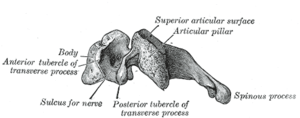
General characteristics (C3-C6)
The general characteristics of the third through sixth cervical vertebrae are described here. The first, second, and seventh vertebrae are extraordinary, and are detailed later.
- The bodyBody of vertebraThe body is the largest part of a vertebra, and is more or less cylindrical in shape. For vertebrates other than humans, this structure is usually called a centrum....
of these four vertebrae is small, and broader from side to side than from front to back.- The anterior and posterior surfaces are flattened and of equal depth; the former is placed on a lower level than the latter, and its inferior border is prolonged downward, so as to overlap the upper and forepart of the vertebra below.
- The upper surface is concave transversely, and presents a projecting lip on either side.
- the lower surface is concave from front to back, convex from side to side, and presents laterally shallow concavities which receive the corresponding projecting lips of the underlying vertebra.
- The pediclesPedicle of vertebral archThe pedicles are two short, thick processes, which project dorsally, one on either side, from the superior part of the vertebral body at the junction of its posterior and lateral surfaces. They connect the body of the spinal vertebra to the arch...
are directed laterally and backward, and are attached to the body midway between its upper and lower borders, so that the superior vertebral notch is as deep as the inferior, but it is, at the same time, narrower.
- The laminaeLamina of the vertebral archThe laminæ are two broad plates, extending dorsally and medially from the pedicles, fusing to complete the roof of the vertebral arch.Their upper borders and the lower parts of their anterior surfaces are rough for the attachment of the ligamenta flava....
are narrow, and thinner above than below; the vertebral foramenVertebral foramenIn a typical vertebra, the vertebral foramen is the foramen formed by the anterior segment , and the posterior part, the vertebral arch....
is large, and of a triangular form.
- The spinous processSpinous processThe spinous process of a vertebra is directed backward and downward from the junction of the laminae , and serves for the attachment of muscles and ligaments. In animals without an erect stance, the process points upward and may slant forward or backward...
is short and bifid, the two divisions being often of unequal size.
- The superior and inferior articular processesArticular processesThe articular processes or zygapophyses of a vertebra, two superior and two inferior, spring from the junctions of the pedicles and laminæ...
of cervical vertebrae have fused on either or both sides to form articular pillars, columns of bone that project laterally from the junction of the pedicle and lamina.
- The articular facetArticular facetAn articular facet is a surface where two anatomical structures meet.-Structures with articular facets:* cricoid cartilage* lateral malleolus* medial malleolus* tubercle of rib...
s are flat and of an oval form:- the superior face backward, upward, and slightly medially.
- the inferior face forward, downward, and slightly laterally.
- The transverse processes are each pierced by the foramen transversarium, which, in the upper six vertebrae, gives passage to the vertebral arteryVertebral arteryThe vertebral arteries are major arteries of the neck. They branch from the subclavian arteries and merge to form the single midline basilar artery in a complex called the vertebrobasilar system, which supplies blood to the posterior part of the circle of Willis and thus significant portions of the...
and veinVertebral veinThe vertebral vein is formed in the suboccipital triangle, from numerous small tributaries which spring from the internal vertebral venous plexuses and issue from the vertebral canal above the posterior arch of the atlas....
, as well as a plexus of sympathetic nerves. Each process consists of an anterior and a posterior part. These two parts are joined, outside the foramen, by a bar of bone that exhibits a deep sulcus on its upper surface for the passage of the corresponding spinal nerveSpinal nerveThe term spinal nerve generally refers to a mixed spinal nerve, which carries motor, sensory, and autonomic signals between the spinal cord and the body...
.- The anterior portion is the homologue of the ribRibIn vertebrate anatomy, ribs are the long curved bones which form the rib cage. In most vertebrates, ribs surround the chest, enabling the lungs to expand and thus facilitate breathing by expanding the chest cavity. They serve to protect the lungs, heart, and other internal organs of the thorax...
in the thoracicThoraxThe thorax is a division of an animal's body that lies between the head and the abdomen.-In tetrapods:...
region, and is therefore named the costal process or costal element. It arises from the side of the body, is directed laterally in front of the foramen, and ends in a tubercle, the anterior tubercle. - The posterior part, the true transverse process, springs from the vertebral arch behind the foramen, and is directed forward and laterally; it ends in a flattened vertical tubercle, the posterior tubercle.
- The anterior portion is the homologue of the rib
Special cervical vertebrae (C1, C2, and C7)
- C1 or atlasAtlas (anatomy)In anatomy, the atlas is the most superior cervical vertebra of the spine.It is named for the Atlas of Greek mythology, because it supports the globe of the head....
: The Atlas is the topmost vertebra, and – along with C2 – forms the joint connecting the skullHuman skullThe human skull is a bony structure, skeleton, that is in the human head and which supports the structures of the face and forms a cavity for the brain.In humans, the adult skull is normally made up of 22 bones...
and spineVertebral columnIn human anatomy, the vertebral column is a column usually consisting of 24 articulating vertebrae, and 9 fused vertebrae in the sacrum and the coccyx. It is situated in the dorsal aspect of the torso, separated by intervertebral discs...
. Its chief peculiarity is that it has no body, and this is due to the fact that the body of the atlas has fused with that of the next vertebra.
- C2 or axisAxis (anatomy)In anatomy, the second cervical vertebra of the spine is named the axis or epistropheus.It forms the pivot upon which the first cervical vertebra , which carries the head, rotates....
: It forms the pivot upon which C1 rotates. The most distinctive characteristic of this boneBoneBones are rigid organs that constitute part of the endoskeleton of vertebrates. They support, and protect the various organs of the body, produce red and white blood cells and store minerals. Bone tissue is a type of dense connective tissue...
is the strong odontoid process (dens) that rises perpendicularly from the upper surface of the body. The body is deeper in front than behind, and prolonged downward anteriorly so as to overlap the upper and front part of the third vertebra.
- C7 or vertebra prominensVertebra prominensVertebra prominens is the proper name for the seventh cervical vertebra. The most distinctive characteristic of this vertebra is the existence of a long and prominent spinous process which is palpable from the skin surface, hence the name...
: The most distinctive characteristic of this vertebra is the existence of a long and prominent spinous process, hence the name vertebra prominens. In some subjects, the seventh cervical vertebra is associated with an abnormal pair of ribs, known as cervical ribCervical ribA cervical rib is a supernumerary rib which arises from the seventh cervical vertebra. It is a congenital abnormality located above the normal first rib. A cervical rib is present in only about 1 in 500 of people; in even rarer cases, an individual may have two cervical ribs...
s. These ribs are usually small, but may occasionally compress blood vessels (such as the subclavian arterySubclavian arteryIn human anatomy, the subclavian arteries are two major arteries of the upper thorax , below the clavicle . They receive blood from the top of the aorta...
) or nerves in the brachial plexusBrachial plexusThe brachial plexus is a network of nerve fibers, running from the spine, formed by the ventral rami of the lower four cervical and first thoracic nerve roots...
, causing ischemic muscle pain, numbness, tingling, and weakness in the upper limb.
Movements of the cervical spine
The movement of nodding the head takes place predominantly through flexionAnatomical terms of motion
The movement of body structures is accomplished by the contraction of muscles. Muscles may move parts of the skeleton relatively to each other, or may move parts of internal organs relatively to each other. All such movements are classified by the directions in which the affected structures are moved...
and extension
Anatomical terms of motion
The movement of body structures is accomplished by the contraction of muscles. Muscles may move parts of the skeleton relatively to each other, or may move parts of internal organs relatively to each other. All such movements are classified by the directions in which the affected structures are moved...
at the joint between the atlas and the occipital bone, the atlanto-occipital joint
Atlanto-occipital joint
The Atlanto-occipital joint consists of a pair of condyloid joints. The atlanto-occipital joint is a synovial joint.-Ligaments:The ligaments connecting the bones are:* Two Articular capsules...
. However, the cervical spine is comparatively mobile, and some component of this movement is due to flexion and extension of the vertebral column itself.
The movement of shaking or rotating the head left and right happens almost entirely at the joint between the atlas and the axis, the atlanto-axial joint
Atlanto-axial joint
The Atlanto-axial joint is of a complicated nature. It consists of no fewer than four distinct joints....
. A small amount of rotation of the vertebral column itself contributes to the movement.
Landmarks
Base of Nose and the Hard palateHard palate
The hard palate is a thin horizontal bony plate of the skull, located in the roof of the mouth. It spans the arch formed by the upper teeth.It is formed by the palatine process of the maxilla and horizontal plate of palatine bone....
corresponds to C1.
Teeth (when mouth remains closed) correspond to C2.
Mandible and Hyoid bone
Hyoid bone
The hyoid bone is a horseshoe-shaped bone situated in the anterior midline of the neck between the chin and the thyroid cartilage. At rest, it lies at the level of the base of the mandible in the front and the third cervical vertebra behind.Unlike other bones, the hyoid is only distantly...
correspond to C3.
The thyroid cartilage
Thyroid cartilage
The thyroid cartilage is the largest of the nine cartilages that make up the laryngeal skeleton, the cartilage structure in and around the trachea that contains the larynx....
is from C4 to C5.
The cricoid cartilage is from C6 to C7.
Clinical significance
Injuries to the cervical spine are common at the level of the second cervical vertebrae, but neurological injury is uncommon.If it does occur, however, it may cause death or profound disability, including paralysis of the arms, legs, and diaphragm
Thoracic diaphragm
In the anatomy of mammals, the thoracic diaphragm, or simply the diaphragm , is a sheet of internal skeletal muscle that extends across the bottom of the rib cage. The diaphragm separates the thoracic cavity from the abdominal cavity and performs an important function in respiration...
, which leads to respiratory failure
Respiratory failure
The term respiratory failure, in medicine, is used to describe inadequate gas exchange by the respiratory system, with the result that arterial oxygen and/or carbon dioxide levels cannot be maintained within their normal ranges. A drop in blood oxygenation is known as hypoxemia; a rise in arterial...
.
Common patterns of injury include the odontoid
Axis (anatomy)
In anatomy, the second cervical vertebra of the spine is named the axis or epistropheus.It forms the pivot upon which the first cervical vertebra , which carries the head, rotates....
fracture and the hangman's fracture
Hangman's fracture
A Hangman's fracture is the colloquial name given to a fracture of both pedicles or pars interarticularis of the axis vertebra .The mechanism of the injury is forcible hyperextension of the head, usually with distraction of the neck. Traditionally this would occur during judicial hanging, when the...
, both of which are often treated with immobilization in a cervical collar
Cervical collar
A cervical collar is an orthopedic medical device used to support a patient's neck and head. It is also used by emergency personnel for victims of traumatic head or neck injuries, and can be used to treat chronic medical conditions....
or Halo brace.
A common EMS practice is to immobilize a patient's cervical spine to prevent further damage during transport to Medical Aid. This practice has come under review recently as incidence rates of unstable spinal trauma can be as low as 2% in immobilized patients. Canadian studies have developed the Canadian C-Spine Rule (CCR) for physicians to decide who should receive radiological imaging.