
All Topics  
Thoracic vertebrae


   Email Print
   Bookmark   Link


Thoracic vertebrae


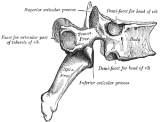
The 12 thoracic vertebrae compose the middle segment of the vertebral column
Vertebral column

In human anatomy, the vertebral column is a column of 24 vertebrae, the sacrum, intervertebral discs, and the coccyx situated in the dorsum aspect of the torso, separated by spinal discs....
, between the cervical vertebrae
Cervical vertebrae

In vertebrates, cervical vertebrae are those vertebrae immediately behind the skull....
 and the lumbar vertebrae
Lumbar vertebrae

The lumbar vertebrae are the largest segments of the movable part of the vertebral column, and are characterized by the absence of the foramen transversarium within the transverse process, and by the absence of facets on the sides of the body....
. They are intermediate in size between those of the cervical and lumbar regions; they increase in size as one proceeds down the spine, the upper vertebrae being much smaller than those in the lower part of the region. They are distinguished by the presence of facets on the sides of the bodies for articulation with the heads of the ribs, and facets on the transverse processes of all, except the eleventh and twelfth, for articulation with the tubercles of the rib
Rib

In vertebrate anatomy, ribs are the long curved bones which form the ribcage. In most vertebrates, ribs surround the chest and protect the lungs, heart, and other internal Organ s of the thorax....
s.

first and ninth through twelfth vertebrae contain certain peculiarities, and are detailed below.

The bodies
Body of vertebra

The body is the largest part of a vertebra, and is more or less cylindrical in shape.Its upper and lower surfaces are flattened and rough, and give attachment to the intervertebral fibrocartilages, and each presents a rim around its circumference....
 in the middle of the thoracic region are heart-shaped, and as broad in the antero-posterior as in the transverse direction.


Discussion
Ask a question about 'Thoracic vertebrae'
Start a new discussion about 'Thoracic vertebrae'
Answer questions from other users
Full Discussion Forum


Encyclopedia


The 12 thoracic vertebrae compose the middle segment of the vertebral column
Vertebral column

In human anatomy, the vertebral column is a column of 24 vertebrae, the sacrum, intervertebral discs, and the coccyx situated in the dorsum aspect of the torso, separated by spinal discs....
, between the cervical vertebrae
Cervical vertebrae

In vertebrates, cervical vertebrae are those vertebrae immediately behind the skull....
 and the lumbar vertebrae
Lumbar vertebrae

The lumbar vertebrae are the largest segments of the movable part of the vertebral column, and are characterized by the absence of the foramen transversarium within the transverse process, and by the absence of facets on the sides of the body....
. They are intermediate in size between those of the cervical and lumbar regions; they increase in size as one proceeds down the spine, the upper vertebrae being much smaller than those in the lower part of the region. They are distinguished by the presence of facets on the sides of the bodies for articulation with the heads of the ribs, and facets on the transverse processes of all, except the eleventh and twelfth, for articulation with the tubercles of the rib
Rib

In vertebrate anatomy, ribs are the long curved bones which form the ribcage. In most vertebrates, ribs surround the chest and protect the lungs, heart, and other internal Organ s of the thorax....
s.

General characteristics


These are the general characteristics of the second through eighth thoracic vertebrae. The first and ninth through twelfth vertebrae contain certain peculiarities, and are detailed below.

The bodies
Body of vertebra

The body is the largest part of a vertebra, and is more or less cylindrical in shape.Its upper and lower surfaces are flattened and rough, and give attachment to the intervertebral fibrocartilages, and each presents a rim around its circumference....
 in the middle of the thoracic region are heart-shaped, and as broad in the antero-posterior as in the transverse direction. At the ends of the thoracic region they resemble respectively those of the cervical and lumbar vertebrae. They are slightly thicker behind than in front, flat above and below, convex from side to side in front, deeply concave behind, and slightly constricted laterally and in front. They present, on either side, two costal demi-facets, one above, near the root of the pedicle, the other below, in front of the inferior vertebral notch; these are covered with cartilage in the fresh state, and, when the vertebrae are articulated with one another, form, with the intervening intervertebral fibrocartilages, oval surfaces for the reception of the heads of the ribs.

The pedicles
Pedicle of vertebral arch

The pedicles are two short, thick processes, which project backward, one on either side, from the upper part of the body, at the junction of its posterior and lateral surfaces....
 are directed backward and slightly upward, and the inferior vertebral notches are of large size, and deeper than in any other region of the vertebral column.

The laminae
Lamina of the vertebral arch

The lamin? are two broad plates, extending dorsally and medially from the Pedicle of vertebral arch, fusing to complete the roof of the vertebral arch....
 are broad, thick, and imbricated — that is to say, they overlap those of subjacent vertebrae like tiles on a roof.

The vertebral foramen
Vertebral foramen

In a typical vertebra, the vertebral foramen is the foramen formed by the anterior segment , and the posterior part, the vertebral arch.The vertebral foramen begins at cervical vertebrae #1 and continues inferior to lumbar vertebrae #5....
 is small, and of a circular form.

The spinous process
Spinous process

The spinous process of a vertebra is directed backward and downward from the junction of the Lamina of the vertebral arch , and serves for the attachment of muscles and ligaments....
 is long, triangular on coronal section, directed obliquely downward, and ends in a tuberculated extremity. These processes overlap from the fifth to the eighth, but are less oblique in direction above and below.

The superior articular processes are thin plates of bone projecting upward from the junctions of the pedicles and laminae; their articular facets are practically flat, and are directed backward and a little lateralward and upward.

The inferior articular processes are fused to a considerable extent with the laminae, and project but slightly beyond their lower borders; their facets are directed forward and a little medialward and downward.

The transverse processes
Transverse processes

The transverse processes of a vertebra, two in number, project one at either side from the point where the Lamina of the vertebral arch joins the Pedicle of vertebral arch, between the superior and inferior articular processes....
 arise from the arch behind the superior articular processes and pedicles; they are thick, strong, and of considerable length, directed obliquely backward and lateralward, and each ends in a clubbed extremity, on the front of which is a small, concave surface, for articulation with the tubercle of a rib. *

Individual thoracic vertebrae


Gray91

First thoracic vertebra

The first thoracic vertebra has, on either side of the body, an entire articular facet for the head of the first rib, and a demi-facet for the upper half of the head of the second rib.

The body is like that of a cervical vertebra, being broad transversely; its upper surface is concave, and lipped on either side.

The superior articular surfaces are directed upward and backward; the spinous process is thick, long, and almost horizontal.

The transverse processes are long, and the upper vertebral notches are deeper than those of the other thoracic vertebrae.

The thoracic spinal nerve 1
Thoracic spinal nerve 1

The thoracic spinal nerve 1 is a spinal nerve of the thoracic segment..It originates from the spinal column from below the thoracic vertebra 1 ....
 (T1) passes out underneath it.

Second thoracic vertebra

The thoracic spinal nerve 2
Thoracic spinal nerve 2

The thoracic spinal nerve 2 is a spinal nerve of the thoracic segment..It originates from the spinal column from below the thoracic vertebra 2 ....
 (T2) passes out underneath it.

Third thoracic vertebra

The thoracic spinal nerve 3
Thoracic spinal nerve 3

The thoracic spinal nerve 3 is a spinal nerve of the thoracic segment..It originates from the spinal column from below the thoracic vertebra 3 ....
 out underneath it.

Fourth thoracic vertebra

The fourth thoracic vertebra, together with the fifth, is at the same level as the sternal angle
Sternal angle

The sternal angle or 'angle of Louis' is the angle formed by the junction of the manubrium and the body of the sternum in the form of a secondary cartilaginous joint ....
.

The thoracic spinal nerve 4
Thoracic spinal nerve 4

The thoracic spinal nerve 4 is a spinal nerve of the thoracic segment..It originates from the spinal column from below the thoracic vertebra 4 ....
 (T4) passes out underneath it.

and at inferior angle of the scapula
Inferior angle of the scapula

The inferior angle of the scapula, thick and rough, is formed by the union of the vertebral and axillary borders; its dorsal surface affords attachment to the Teres major and frequently to a few fibers of the Latissimus dorsi....
, respectively.]]

Fifth thoracic vertebra

The fifth thoracic vertebra, together with the fourth, is at the same level as the sternal angle
Sternal angle

The sternal angle or 'angle of Louis' is the angle formed by the junction of the manubrium and the body of the sternum in the form of a secondary cartilaginous joint ....
.

The thoracic spinal nerve 5
Thoracic spinal nerve 5

The thoracic spinal nerve 5 is a spinal nerve of the thoracic segment..It originates from the spinal column from below the thoracic vertebra 5 ....
 (T5) passes out underneath it.

Sixth thoracic vertebra

The thoracic spinal nerve 6
Thoracic spinal nerve 6

The thoracic spinal nerve 6 is a spinal nerve of the thoracic segment..It originates from the spinal column from below the thoracic vertebra 6 ....
 (T6) passes out underneath it.

Seventh thoracic vertebra

The thoracic spinal nerve 7
Thoracic spinal nerve 7

The thoracic spinal nerve 7 is a spinal nerve of the thoracic segment..It originates from the spinal column from below the thoracic vertebra 7 ....
 (T7) passes out underneath it.

Eighth thoracic vertebra

The eighth thoracis vertebra is, together with the ninth thoracis vertebra, at the same level as the xiphoid process
Xiphoid process

The xiphoid Process , also known as the xiphisternum is a small Cartilage extension to the lower part of the sternum which is usually Ossification in the adult human....
.

The thoracic spinal nerve 8
Thoracic spinal nerve 8

The thoracic spinal nerve 8 is a spinal nerve of the thoracic segment..It originates from the spinal column from below the thoracic vertebra 8 ....
 (T8) passes out underneath it.

Ninth thoracic vertebra


The ninth thoracic vertebra may have no demi-facets below. In some subjects however, it has two demi-facets on either side; when this occurs the tenth has only demi-facets at the upper part.

The thoracic spinal nerve 9
Thoracic spinal nerve 9

The thoracic spinal nerve 9 is a spinal nerve of the thoracic segment..It originates from the spinal column from below the thoracic vertebra 9 ....
 (T9) passes out underneath it.

Tenth thoracic vertebra


The tenth thoracic vertebra has (except in the cases just mentioned) an entire articular facet on either side, which is placed partly on the lateral surface of the pedicle.

The thoracic spinal nerve 10
Thoracic spinal nerve 10

The thoracic spinal nerve 10 is a spinal nerve of the thoracic segment..It originates from the spinal column from below the thoracic vertebra 10 ....
 (T10) passes out underneath it.

Eleventh thoracic vertebra


In the eleventh thoracic vertebrae the body approaches in its form and size to that of the lumbar vertebrae.

The articular facets for the heads of the ribs are of large size, and placed chiefly on the pedicles, which are thicker and stronger in this and the next vertebrae than in any other part of the thoracic region.

The spinous process is short, and nearly horizontal in direction.

The transverse processes are very short, tuberculated at their extremities, and have no articular facets.

The thoracic spinal nerve 11
Thoracic spinal nerve 11

The thoracic spinal nerve 11 is a spinal nerve of the thoracic segment..It originates from the spinal column from below the thoracic vertebra 11 ....
 (T11) passes out underneath it.

Twelfth thoracic vertebra


The twelfth thoracic vertebra has the same general characteristics as the eleventh, but may be distinguished from it by its inferior articular surfaces being convex and directed lateralward, like those of the lumbar vertebrae; by the general form of the body, laminae, and spinous process, in which it resembles the lumbar vertebrae; and by each transverse process being subdivided into three elevations, the superior, inferior, and lateral tubercles: the superior and inferior correspond to the mammillary and accessory processes of the lumbar vertebrae. Traces of similar elevations are found on the transverse processes of the tenth and eleventh thoracic vertebrae.

The thoracic spinal nerve 12
Thoracic spinal nerve 12

The thoracic spinal nerve 12 is a spinal nerve of the thoracic segment..It originates from the spinal column from below the thoracic vertebra 12 ....
 (T12) passes out underneath it.

Additional images


See also

  • Costovertebral articulations
    Costovertebral articulations

    The costovertebral joints are the articulations that connect the heads of the ribs with the bodies of the thoracic vertebrae. Joining of ribs to the vertebrae occurs at two places, the head and the tubercle of the rib....


External links