

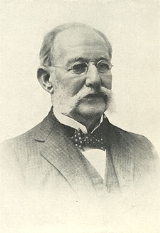
Carlos Finlay

Encyclopedia
Carlos Juan Finlay was a Cuban physician and scientist recognized as a pioneer in yellow fever
research.
(now Camagüey), Cuba, of French
and Scottish
descent. He reversed the order of his given names to "Carlos Juan" later in his life. In 1853 he attended Jefferson Medical College in Philadelphia, Pennsylvania
. He graduated in 1855, and completed his studies in Havana
and in Paris
. Afterwards he settled in Havana and opened a medical practice.
: a mosquito that bites a victim of the disease could subsequently bite and thereby infect a healthy person. A year later Finlay identified a mosquito of the genus
Aedes
as the organism transmitting yellow fever. His theory was followed by the recommendation to control the mosquito population as a way to control the spread of the disease.
 His hypothesis and exhaustive proofs were confirmed nearly twenty years later by the Walter Reed Commission
of 1900. Finlay went on to become the chief health officer of Cuba from 1902 to 1909. Although Dr. Reed received much of the credit in history books for "beating" yellow fever, Reed himself credited Dr. Finlay with the discovery of the yellow fever vector, and thus how it might be controlled. Dr. Reed often cited Finlay's papers in his own articles and gave him credit for the discovery, even in his personal correspondence.
In the words of General Leonard Wood
, a physician and U.S.
military governor of Cuba in 1900: "The confirmation of Dr. Finlay's doctrine is the greatest step forward made in medical science since Jenner
's discovery of the vaccination (of smallpox
)."
This discovery helped William C. Gorgas
reduce the incidence and prevalence of mosquito-borne diseases in Panama
during the American campaign from 1903 onwards to construct the Panama Canal
. Prior to this, about 10% of the workforce died each year from malaria
and yellow fever.
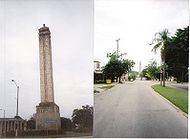
In the town of Marianao
in the Havana area, there is a monument honoring Dr. Finlay. This monument has the shape of a syringe and it is usually referred to as El Obelisco (The Obelisk). Finlay was also commemorated on a 1981 Cuban stamp. A statue commemorating Dr. Finlay is located on the bayfront in Panama City
, near the canal he helped make possible. The UNESCO
Carlos J. Finlay Prize for Microbiology
is named in his honor.
Dr. Finlay was a member of Havana's Royal Academy of Medical, Physical and Natural Sciences. He was fluent in French
, German
, Spanish
, and English
, and could read Latin
. His interests were widespread and he wrote articles on subjects as varied as leprosy
, cholera
, gravity, and plant diseases. But his main interest was yellow fever, and he was the author of 40 articles on this disease. His theory that an intermediary host was responsible for the spread of the disease was treated with ridicule for years. A humane man, he often took on patients who could not afford medical care. As a result of his work, Dr. Finlay was nominated seven times for the Nobel Prize in Physiology or Medicine
, but it was never awarded to him.
in his home in Havana, Cuba.
Yellow fever
Yellow fever is an acute viral hemorrhagic disease. The virus is a 40 to 50 nm enveloped RNA virus with positive sense of the Flaviviridae family....
research.
Early life and education
Finlay was born Juan Carlos Finlay y Barrés, in Puerto PríncipeCamagüey
Camagüey is a city and municipality in central Cuba and is the nation's third largest city. It is the capital of the Camagüey Province.After almost continuous attacks from pirates the original city was moved inland in 1528.The new city was built with a confusing lay-out of winding alleys that made...
(now Camagüey), Cuba, of French
France
The French Republic , The French Republic , The French Republic , (commonly known as France , is a unitary semi-presidential republic in Western Europe with several overseas territories and islands located on other continents and in the Indian, Pacific, and Atlantic oceans. Metropolitan France...
and Scottish
Scotland
Scotland is a country that is part of the United Kingdom. Occupying the northern third of the island of Great Britain, it shares a border with England to the south and is bounded by the North Sea to the east, the Atlantic Ocean to the north and west, and the North Channel and Irish Sea to the...
descent. He reversed the order of his given names to "Carlos Juan" later in his life. In 1853 he attended Jefferson Medical College in Philadelphia, Pennsylvania
Pennsylvania
The Commonwealth of Pennsylvania is a U.S. state that is located in the Northeastern and Mid-Atlantic regions of the United States. The state borders Delaware and Maryland to the south, West Virginia to the southwest, Ohio to the west, New York and Ontario, Canada, to the north, and New Jersey to...
. He graduated in 1855, and completed his studies in Havana
Havana
Havana is the capital city, province, major port, and leading commercial centre of Cuba. The city proper has a population of 2.1 million inhabitants, and it spans a total of — making it the largest city in the Caribbean region, and the most populous...
and in Paris
Paris
Paris is the capital and largest city in France, situated on the river Seine, in northern France, at the heart of the Île-de-France region...
. Afterwards he settled in Havana and opened a medical practice.
Professional career
Finlay's work, carried out during the 1870s, finally came to prominence in 1900. He was the first to theorize, in 1881, that a mosquito was a carrier, now known as a disease vector, of the organism causing yellow feverYellow fever
Yellow fever is an acute viral hemorrhagic disease. The virus is a 40 to 50 nm enveloped RNA virus with positive sense of the Flaviviridae family....
: a mosquito that bites a victim of the disease could subsequently bite and thereby infect a healthy person. A year later Finlay identified a mosquito of the genus
Genus
In biology, a genus is a low-level taxonomic rank used in the biological classification of living and fossil organisms, which is an example of definition by genus and differentia...
Aedes
Aedes
Aedes is a genus of mosquito originally found in tropical and subtropical zones, but now found on all continents excluding Antarctica. Some species have been spread by human activity. Aedes albopictus, a most invasive species was recently spread to the New World, including the U.S., by the used...
as the organism transmitting yellow fever. His theory was followed by the recommendation to control the mosquito population as a way to control the spread of the disease.
Walter Reed
Major Walter Reed, M.D., was a U.S. Army physician who in 1900 led the team that postulated and confirmed the theory that yellow fever is transmitted by a particular mosquito species, rather than by direct contact...
of 1900. Finlay went on to become the chief health officer of Cuba from 1902 to 1909. Although Dr. Reed received much of the credit in history books for "beating" yellow fever, Reed himself credited Dr. Finlay with the discovery of the yellow fever vector, and thus how it might be controlled. Dr. Reed often cited Finlay's papers in his own articles and gave him credit for the discovery, even in his personal correspondence.
In the words of General Leonard Wood
Leonard Wood
Leonard Wood was a physician who served as the Chief of Staff of the United States Army, Military Governor of Cuba and Governor General of the Philippines. Early in his military career, he received the Medal of Honor. Wood also holds officer service #2 in the Regular Army...
, a physician and U.S.
United States
The United States of America is a federal constitutional republic comprising fifty states and a federal district...
military governor of Cuba in 1900: "The confirmation of Dr. Finlay's doctrine is the greatest step forward made in medical science since Jenner
Edward Jenner
Edward Anthony Jenner was an English scientist who studied his natural surroundings in Berkeley, Gloucestershire...
's discovery of the vaccination (of smallpox
Smallpox
Smallpox was an infectious disease unique to humans, caused by either of two virus variants, Variola major and Variola minor. The disease is also known by the Latin names Variola or Variola vera, which is a derivative of the Latin varius, meaning "spotted", or varus, meaning "pimple"...
)."
This discovery helped William C. Gorgas
William C. Gorgas
William Crawford Gorgas KCMG was a United States Army physician and 22nd Surgeon General of the U.S. Army...
reduce the incidence and prevalence of mosquito-borne diseases in Panama
Panama
Panama , officially the Republic of Panama , is the southernmost country of Central America. Situated on the isthmus connecting North and South America, it is bordered by Costa Rica to the northwest, Colombia to the southeast, the Caribbean Sea to the north and the Pacific Ocean to the south. The...
during the American campaign from 1903 onwards to construct the Panama Canal
Panama Canal
The Panama Canal is a ship canal in Panama that joins the Atlantic Ocean and the Pacific Ocean and is a key conduit for international maritime trade. Built from 1904 to 1914, the canal has seen annual traffic rise from about 1,000 ships early on to 14,702 vessels measuring a total of 309.6...
. Prior to this, about 10% of the workforce died each year from malaria
Malaria
Malaria is a mosquito-borne infectious disease of humans and other animals caused by eukaryotic protists of the genus Plasmodium. The disease results from the multiplication of Plasmodium parasites within red blood cells, causing symptoms that typically include fever and headache, in severe cases...
and yellow fever.
In the town of Marianao
Marianao
Marianao is a town and municipality in the province of the city of Havana, Cuba, 6 miles southwest of the original city of Havana, with which it is connected by the Marianao railway. , the municipality had a population of 133,016. Marianao is on a range of hills about 1500 ft. above sea level,...
in the Havana area, there is a monument honoring Dr. Finlay. This monument has the shape of a syringe and it is usually referred to as El Obelisco (The Obelisk). Finlay was also commemorated on a 1981 Cuban stamp. A statue commemorating Dr. Finlay is located on the bayfront in Panama City
Panama City
Panama is the capital and largest city of the Republic of Panama. It has a population of 880,691, with a total metro population of 1,272,672, and it is located at the Pacific entrance of the Panama Canal, in the province of the same name. The city is the political and administrative center of the...
, near the canal he helped make possible. The UNESCO
UNESCO
The United Nations Educational, Scientific and Cultural Organization is a specialized agency of the United Nations...
Carlos J. Finlay Prize for Microbiology
Carlos J. Finlay Prize for Microbiology
The Carlos J. Finlay Prize is a biennal scientific prize sponsored by the Government of Cuba and awarded since 1980 by the United Nations Educational, Scientific and Cultural Organization to people or organizations for their outstanding contributions to microbiology and its applications...
is named in his honor.
Dr. Finlay was a member of Havana's Royal Academy of Medical, Physical and Natural Sciences. He was fluent in French
French language
French is a Romance language spoken as a first language in France, the Romandy region in Switzerland, Wallonia and Brussels in Belgium, Monaco, the regions of Quebec and Acadia in Canada, and by various communities elsewhere. Second-language speakers of French are distributed throughout many parts...
, German
German language
German is a West Germanic language, related to and classified alongside English and Dutch. With an estimated 90 – 98 million native speakers, German is one of the world's major languages and is the most widely-spoken first language in the European Union....
, Spanish
Spanish language
Spanish , also known as Castilian , is a Romance language in the Ibero-Romance group that evolved from several languages and dialects in central-northern Iberia around the 9th century and gradually spread with the expansion of the Kingdom of Castile into central and southern Iberia during the...
, and English
English language
English is a West Germanic language that arose in the Anglo-Saxon kingdoms of England and spread into what was to become south-east Scotland under the influence of the Anglian medieval kingdom of Northumbria...
, and could read Latin
Latin
Latin is an Italic language originally spoken in Latium and Ancient Rome. It, along with most European languages, is a descendant of the ancient Proto-Indo-European language. Although it is considered a dead language, a number of scholars and members of the Christian clergy speak it fluently, and...
. His interests were widespread and he wrote articles on subjects as varied as leprosy
Leprosy
Leprosy or Hansen's disease is a chronic disease caused by the bacteria Mycobacterium leprae and Mycobacterium lepromatosis. Named after physician Gerhard Armauer Hansen, leprosy is primarily a granulomatous disease of the peripheral nerves and mucosa of the upper respiratory tract; skin lesions...
, cholera
Cholera
Cholera is an infection of the small intestine that is caused by the bacterium Vibrio cholerae. The main symptoms are profuse watery diarrhea and vomiting. Transmission occurs primarily by drinking or eating water or food that has been contaminated by the diarrhea of an infected person or the feces...
, gravity, and plant diseases. But his main interest was yellow fever, and he was the author of 40 articles on this disease. His theory that an intermediary host was responsible for the spread of the disease was treated with ridicule for years. A humane man, he often took on patients who could not afford medical care. As a result of his work, Dr. Finlay was nominated seven times for the Nobel Prize in Physiology or Medicine
Nobel Prize in Physiology or Medicine
The Nobel Prize in Physiology or Medicine administered by the Nobel Foundation, is awarded once a year for outstanding discoveries in the field of life science and medicine. It is one of five Nobel Prizes established in 1895 by Swedish chemist Alfred Nobel, the inventor of dynamite, in his will...
, but it was never awarded to him.
Death
Finlay died from heart failure caused by pneumoniaPneumonia
Pneumonia is an inflammatory condition of the lung—especially affecting the microscopic air sacs —associated with fever, chest symptoms, and a lack of air space on a chest X-ray. Pneumonia is typically caused by an infection but there are a number of other causes...
in his home in Havana, Cuba.