

Brassavola

Encyclopedia
Brassavola is a genus
of 20 orchids (family
Orchidaceae). They were named in 1813 by the Scottish botanist Robert Brown. The name comes from the Venetian
nobleman and physician Antonio Musa Brassavola
. This genus is abbreviated B. in trade journals.
These species are native to the lowlands of Central America
and tropical
South America
. They are epiphyte
s, and a few are lithophyte
s. A single, apical and succulent leaf
grows on an elongated pseudobulb
.
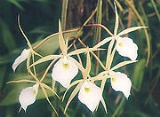
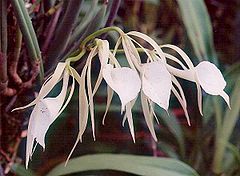
The orchid yields a single white or greenish white flower, or a raceme of a few flowers. The three sepals and two lateral petals are greenish, narrow and long. The base of the broad, sometimes fringed lip
partially enfolds the column
. This column has a pair of falciform ears on each side of the front and contains twelve (sometimes eight) pollinia
.
Most Brassavola orchids are very fragrant, attracting pollinator
s with their citrus
y smell. But they are only fragrant at night, in order to attract the right moth
. Longevity of flowers depends on the species and is between five and thirty days.
In 1698 Brassavola nodosa
was the first tropical orchid to be brought from the Caribbean island Curaçao
to Holland. Thus began the propagation of this orchid and the fascination for orchids in general.
Brassavola is in the same alliance as the genera Cattleya
and Laelia
. They have been used extensively in hybridization and represent the B at the beginning of the names of such crosses. For example, Blc. is Brassolaeliacattleya.
Genus
In biology, a genus is a low-level taxonomic rank used in the biological classification of living and fossil organisms, which is an example of definition by genus and differentia...
of 20 orchids (family
Family (biology)
In biological classification, family is* a taxonomic rank. Other well-known ranks are life, domain, kingdom, phylum, class, order, genus, and species, with family fitting between order and genus. As for the other well-known ranks, there is the option of an immediately lower rank, indicated by the...
Orchidaceae). They were named in 1813 by the Scottish botanist Robert Brown. The name comes from the Venetian
Venice
Venice is a city in northern Italy which is renowned for the beauty of its setting, its architecture and its artworks. It is the capital of the Veneto region...
nobleman and physician Antonio Musa Brassavola
Antonio Musa Brassavola
Antonio Musa Brassavola was an Italian physician and one of the most famous of his time. He studied under Niccolò Leoniceno and Manardi. He was the friend and physician of Ercolo II, the prince of Este...
. This genus is abbreviated B. in trade journals.
These species are native to the lowlands of Central America
Central America
Central America is the central geographic region of the Americas. It is the southernmost, isthmian portion of the North American continent, which connects with South America on the southeast. When considered part of the unified continental model, it is considered a subcontinent...
and tropical
Tropics
The tropics is a region of the Earth surrounding the Equator. It is limited in latitude by the Tropic of Cancer in the northern hemisphere at approximately N and the Tropic of Capricorn in the southern hemisphere at S; these latitudes correspond to the axial tilt of the Earth...
South America
South America
South America is a continent situated in the Western Hemisphere, mostly in the Southern Hemisphere, with a relatively small portion in the Northern Hemisphere. The continent is also considered a subcontinent of the Americas. It is bordered on the west by the Pacific Ocean and on the north and east...
. They are epiphyte
Epiphyte
An epiphyte is a plant that grows upon another plant non-parasitically or sometimes upon some other object , derives its moisture and nutrients from the air and rain and sometimes from debris accumulating around it, and is found in the temperate zone and in the...
s, and a few are lithophyte
Lithophyte
Lithophytes are a type of plant that grows in or on rocks. Lithophytes feed off moss, nutrients in rain water, litter, and even their own dead tissue....
s. A single, apical and succulent leaf
Leaf
A leaf is an organ of a vascular plant, as defined in botanical terms, and in particular in plant morphology. Foliage is a mass noun that refers to leaves as a feature of plants....
grows on an elongated pseudobulb
Pseudobulb
The pseudobulb is a storage organ derived from the part of a stem between two leaf nodes.It applies to the orchid family , specifically certain groups of epiphytic orchids, and may be single or composed of several internodes with evergreen or deciduous leaves along its length.In some species, it is...
.
The orchid yields a single white or greenish white flower, or a raceme of a few flowers. The three sepals and two lateral petals are greenish, narrow and long. The base of the broad, sometimes fringed lip
Labellum
Labellum is the Latin diminutive of labium, meaning lip. These are anatomical terms used descriptively in biology, for example in Entomology and botany.-Botany:...
partially enfolds the column
Column (botany)
The column, or technically the gynostemium, is a reproductive structure that can be found in several plant families: Aristolochiaceae, Orchidaceae, and Stylidiaceae....
. This column has a pair of falciform ears on each side of the front and contains twelve (sometimes eight) pollinia
Pollinium
Pollinium, or plural pollinia, is a coherent mass of pollen grains in a plant.They are the product of only one anther, but are transferred, during pollination, as a single unit. This is regularly seen in plants such as orchids and many species of milkweeds .Most orchids have waxy pollinia...
.
Most Brassavola orchids are very fragrant, attracting pollinator
Pollinator
A pollinator is the biotic agent that moves pollen from the male anthers of a flower to the female stigma of a flower to accomplish fertilization or syngamy of the female gamete in the ovule of the flower by the male gamete from the pollen grain...
s with their citrus
Citrus
Citrus is a common term and genus of flowering plants in the rue family, Rutaceae. Citrus is believed to have originated in the part of Southeast Asia bordered by Northeastern India, Myanmar and the Yunnan province of China...
y smell. But they are only fragrant at night, in order to attract the right moth
Moth
A moth is an insect closely related to the butterfly, both being of the order Lepidoptera. Moths form the majority of this order; there are thought to be 150,000 to 250,000 different species of moth , with thousands of species yet to be described...
. Longevity of flowers depends on the species and is between five and thirty days.
In 1698 Brassavola nodosa
Brassavola nodosa
Brassavola nodosa is a small, tough species of orchid native to Mexico, the West Indies, Venezuela and Peru. It is also known as "Lady of the Night" orchid due to its citrus and gardenia-like fragrance which begins in the early evening...
was the first tropical orchid to be brought from the Caribbean island Curaçao
Curaçao
Curaçao is an island in the southern Caribbean Sea, off the Venezuelan coast. The Country of Curaçao , which includes the main island plus the small, uninhabited island of Klein Curaçao , is a constituent country of the Kingdom of the Netherlands...
to Holland. Thus began the propagation of this orchid and the fascination for orchids in general.
B. sect. Brassavola
This monotypic section, erected by H. G. Jones in 1969, contains the type of the genus:- Brassavola cucullataBrassavola cucullataBrassavola cucullata is a species of orchid. It is the type for the genus Brassavola, and the only member of B. sect. Brassavola. The diploid chromosome number of B. cucullata has been determined as 2n = 40....
- Hooded Brassavola, Daddy Longlegs Orchid (Mexico to N. South America)
B. sect. Sessilabia
This section, erected by Rolfe in 1902, is characterized by narrow labella with fimbriate margins to wider labella with entire margins.- B. duckeana (Brazil)
- B. fasciculata (Brazil)
- B. filifolia (Colombia)
- B. flagellarisBrassavola flagellarisBrassavola flagellaris Barb. Rodr. 1881 is a species of epiphytic orchid of the Cattleya alliance. It grows wild in eastern Brazil, where it fills the evening air with the citrus-like fragrance of its blossoms.-Etymology:...
(Brazil) - B. fragans (Brazil)
- B. gardneri (French Guiana, Brazil)
- B. martianaBrassavola martianaBrassavola martiana is a species of orchid....
(S. Trop. America) - B. perriniiBrassavola tuberculataBrassavola tuberculata is a species of orchid. Its diploid chromosome number has been determined as 2n = 40; its haploid chromosome number has been determined as n = 20.-Footnotes:...
(Brazil to Bolivia and Paraguay) - B. reginae (Argentina, Brazil, Peru)
- B. retusa (Venezuela, N. Brazil to Peru)
- B. revoluta (Brazil)
- B. rhomboglossa (WC. & S. Brazil)
- B. tuberculataBrassavola tuberculataBrassavola tuberculata is a species of orchid. Its diploid chromosome number has been determined as 2n = 40; its haploid chromosome number has been determined as n = 20.-Footnotes:...
(Brazil to Peru, NE. Argentina and Paraguay)
B. sect. Cuneilabia
This section, erected by Rolfe in 1902, is characterized by narrowly constricted labellum bases. The sectional type is B. nodosa- B. gillettei (Trinidad)
- B. grandiflora (C. America to Colombia)
- B. harrisii (Jamaica)
- B. nodosaBrassavola nodosaBrassavola nodosa is a small, tough species of orchid native to Mexico, the West Indies, Venezuela and Peru. It is also known as "Lady of the Night" orchid due to its citrus and gardenia-like fragrance which begins in the early evening...
- Lady-of-the-night Orchid (Mexico to Trop. America: Belize) - B. subulifoliaBrassavola subulifoliaBrassavola subulifolia is a species of orchid....
(Jamaica) - B. venosaBrassavola venosaBrassavola venosa is a species of orchid....
(SE. Mexico to C. America)
B. sect. Lateraliflorae
This section, erected by H.G.Jones in 1975, is characterized by laterally-borne inflorescences. The sectional type is B. acaulis- B. acaulis (C. America: Belize)
- B. lineata
Brassavola is in the same alliance as the genera Cattleya
Cattleya
Cattleya is a genus of 113 species of orchids from Costa Rica to tropical South America. The genus was named in 1824 by John Lindley after Sir William Cattley who received and successfully cultivated specimens of Cattleya labiata that were used as packing material in a shipment of other orchids...
and Laelia
Laelia
Laelia, abbreviated L. in the horticultural trade, is a small genus of 25 species from the orchid family . This is one of the most important and popular orchid genera, because of the beautiful flowers, their genetic properties and because they are fairly easy in culture. It is probably named after...
. They have been used extensively in hybridization and represent the B at the beginning of the names of such crosses. For example, Blc. is Brassolaeliacattleya.
Some Hybrid Greges
- B. Little Stars, a primary hybrid between B. nodosaBrassavola nodosaBrassavola nodosa is a small, tough species of orchid native to Mexico, the West Indies, Venezuela and Peru. It is also known as "Lady of the Night" orchid due to its citrus and gardenia-like fragrance which begins in the early evening...
and B. subulifoliaBrassavola subulifoliaBrassavola subulifolia is a species of orchid.... - Rhynchovola David Sanders, a primary intergeneric hybrid between B. cucullataBrassavola cucullataBrassavola cucullata is a species of orchid. It is the type for the genus Brassavola, and the only member of B. sect. Brassavola. The diploid chromosome number of B. cucullata has been determined as 2n = 40....
and Rhyncholaelia digbyana. Rhyncolaelia digbyana was formerly classified as a Brassavola; its hybrids have now been reclassified. - Brassocattleya Yellow Bird = Bc. Richard Mueller × B. nodosaBrassavola nodosaBrassavola nodosa is a small, tough species of orchid native to Mexico, the West Indies, Venezuela and Peru. It is also known as "Lady of the Night" orchid due to its citrus and gardenia-like fragrance which begins in the early evening...
- Bc. Richard Mueller is a primary intergeneric hybrid between B. nodosaBrassavola nodosaBrassavola nodosa is a small, tough species of orchid native to Mexico, the West Indies, Venezuela and Peru. It is also known as "Lady of the Night" orchid due to its citrus and gardenia-like fragrance which begins in the early evening...
and C. milleri. C. milleri was formerly classified as a LaeliaLaeliaLaelia, abbreviated L. in the horticultural trade, is a small genus of 25 species from the orchid family . This is one of the most important and popular orchid genera, because of the beautiful flowers, their genetic properties and because they are fairly easy in culture. It is probably named after...
until it was transferred into SophronitisSophronitisSophronitis, abbreviated Soph in horticultural trade, is a genus of small, epiphytic or lithophytic orchids, growing in the damp montane forest of eastern Brazil, Paraguay and NE Argentina. Currently, 65 species are recognized....
which was then sunk into CattleyaCattleyaCattleya is a genus of 113 species of orchids from Costa Rica to tropical South America. The genus was named in 1824 by John Lindley after Sir William Cattley who received and successfully cultivated specimens of Cattleya labiata that were used as packing material in a shipment of other orchids...
to avoid confusion.