

Cattleya

Encyclopedia
Cattleya ˈ is a genus
of 113 species of orchids from Costa Rica
to tropical South America
. The genus was named in 1824 by John Lindley
after Sir William Cattley who received and successfully cultivated specimens of Cattleya labiata
that were used as packing material in a shipment of other orchids made by William Swainson. The genus is abbreviated C in trade journals.
They are widely known for their large, showy flower
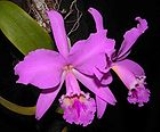
s, and were used extensively in hybridization for the cut-flower trade until quite recently. This genus and the numerous hybrids come close, through their beauty, to the idealized picture we have of the orchids. The flowers of the hybrids can vary in size from 5 cm to 15 cm or more. They occur in all colors except true blue and black.
The typical flower
has three rather narrow sepals and three usually broader petal
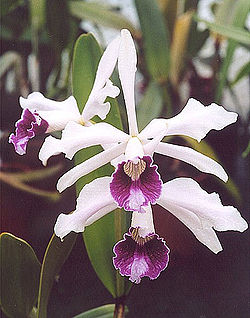
s: two petals are similar to each other, and the third is the quite different conspicuous lip
, featuring various markings and specks and an often frilly margin. At the base, the margins are folded into a tube. Each flower stalk originates from a pseudobulb
. The number of flowers varies; it can be just one or two, or sometimes up to ten.
was merged into Cattleya, adding the following species (some of which belong to the genus Sophronitis sensu MCMXCIX, and many of which belong to the genus Laelia sensu MCMXCIX:

Natural Hybrids
Hybrids
Cattleyas have been hybridized both within the genus and with related genera for more than a century, but the last several decades have seen a remarkable increase in both the quantity and quality of the hybrids within the Cattleya alliance. Among the most popular are the Brassolaeliocattleya (Blc.) and Sophrolaeliocattleya (Slc.) hybrids. The vast majority of the Blc. hybrids have recently been moved into the new nothogenus Rhyncholaeliocattleya (Rlc.); the Slc. mostly into Cattleya, with a few in Laleliocattleya (Lc.)
Laelia
(L.): Breeding with this genus refines the lip of the orchid, producing a more elongated closed "cone" that gracefully opens into the full lip of the blossom. Some species of Laelia also contribute an intense violet shade. Laelia + Cattleya = Laeliocattleya, the basis for many more complex and highly popular hybrids. Most species of Laelia (the "Brasilian Laelias") were merged into Cattleya in the first decade of the third millennium, after a brief sojourn in Sophronitis.
Brassavola
(B.): Most crosses with Brassavola are actually done with the Ryncholaelia digbyana, which was moved out of the Brassavola genus but was still considered such in naming the hybrid for many years. This cross is made in order to effect the fabulous "fringed", "feathered" or "ruffled" lip of the bloom; it also expands the lip of the blossom and the most imposing cattleya hybrids almost always have this species in their ancestry. These are usually the largest of the major cattleya hybrids. Brassavola + Cattleya = Brassocattleya
, Brassavola + Laelia + Cattleya = Brassolaeliocattleya
. Most, but not all, of these hybrids are now placed in Rhyncholaeliocattleya
.
Sophronitis
(Soph.): A tiny, flame-colored orchid that introduces the most intense red color to its descendants. Many crimson and scarlet cattleya hybrids betray sophronitis in their ancestry. Sophronitis is also used to miniaturize cattleya hybrids. Sophronitis + Laelia + Cattleya = Sophrolaeliocattleya
. Sophronitis was recently merged into Cattleya, after being expanded to include most of the Laelia species.
Potinara (Pot.): The combination of all three of the above with a Cattleya. Potinaras are not as popular as Blc's or Slc's, but there are some incredible examples coming in all ranges of colors from light green to magenta. Although it is not a rule, they are generally smaller than Blc's but larger than Slc's. The recent merging of Sophronitis into Cattleya extinguished the nothogenus Potinara; most former Potinaras are now in the nothogenus Rhyncholaeliocattleya (Rlc.)
Yamadara (Yam.): The cross of the Blc combination with an [Epidendrum]. The addition of Epidendrum appears to increase flower yield, and some Yamadaras are intensely colored. With the recent discovery that the first Yamadara was registered as Adamara, the nothogeneric epithet Yamadara has been extinguished and replaced with Adamara.
Hawkinsara (Hknsa.): The Slc combination crossed with Broughtonia
. Smaller, often magenta/reddish flowers. Many of these are now classified in the nothogenus Cattleytonia
(Ctna.)
Cattleyas can be crossed with a large number of other allied genera, including Cattleyopsis, Caularthron
, Schomburgkia
, Tetramicra
, etc. Hybridization can go all the way up to eight parent genera, such as Brassavola x Broughtonia x Cattleya x Cattleyopsis x Caularthron x Epidendrum x Laelia x Sophronitis in Gladysyeeara.
Marcel Proust
External links
(enter "Cattleya" in search box).
Genus
In biology, a genus is a low-level taxonomic rank used in the biological classification of living and fossil organisms, which is an example of definition by genus and differentia...
of 113 species of orchids from Costa Rica
Costa Rica
Costa Rica , officially the Republic of Costa Rica is a multilingual, multiethnic and multicultural country in Central America, bordered by Nicaragua to the north, Panama to the southeast, the Pacific Ocean to the west and the Caribbean Sea to the east....
to tropical South America
South America
South America is a continent situated in the Western Hemisphere, mostly in the Southern Hemisphere, with a relatively small portion in the Northern Hemisphere. The continent is also considered a subcontinent of the Americas. It is bordered on the west by the Pacific Ocean and on the north and east...
. The genus was named in 1824 by John Lindley
John Lindley
John Lindley FRS was an English botanist, gardener and orchidologist.-Early years:Born in Catton, near Norwich, England, John Lindley was one of four children of George and Mary Lindley. George Lindley was a nurseryman and pomologist and ran a commercial nursery garden...
after Sir William Cattley who received and successfully cultivated specimens of Cattleya labiata
Cattleya labiata
Cattleya labiata Lindl., also known as the Crimson Cattleya or Ruby-lipped Cattleya, is the type species of Cattleya, discovered in 1818 in Brazil. The genus was named in honor of Sir William Cattley, a prominent British horticulturist....
that were used as packing material in a shipment of other orchids made by William Swainson. The genus is abbreviated C in trade journals.
They are widely known for their large, showy flower
Flower
A flower, sometimes known as a bloom or blossom, is the reproductive structure found in flowering plants . The biological function of a flower is to effect reproduction, usually by providing a mechanism for the union of sperm with eggs...
s, and were used extensively in hybridization for the cut-flower trade until quite recently. This genus and the numerous hybrids come close, through their beauty, to the idealized picture we have of the orchids. The flowers of the hybrids can vary in size from 5 cm to 15 cm or more. They occur in all colors except true blue and black.
The typical flower
Flower
A flower, sometimes known as a bloom or blossom, is the reproductive structure found in flowering plants . The biological function of a flower is to effect reproduction, usually by providing a mechanism for the union of sperm with eggs...
has three rather narrow sepals and three usually broader petal
Petal
Petals are modified leaves that surround the reproductive parts of flowers. They often are brightly colored or unusually shaped to attract pollinators. Together, all of the petals of a flower are called a corolla. Petals are usually accompanied by another set of special leaves called sepals lying...
s: two petals are similar to each other, and the third is the quite different conspicuous lip
Labellum
Labellum is the Latin diminutive of labium, meaning lip. These are anatomical terms used descriptively in biology, for example in Entomology and botany.-Botany:...
, featuring various markings and specks and an often frilly margin. At the base, the margins are folded into a tube. Each flower stalk originates from a pseudobulb
Pseudobulb
The pseudobulb is a storage organ derived from the part of a stem between two leaf nodes.It applies to the orchid family , specifically certain groups of epiphytic orchids, and may be single or composed of several internodes with evergreen or deciduous leaves along its length.In some species, it is...
. The number of flowers varies; it can be just one or two, or sometimes up to ten.
Species
Originally, the concept Cattleya included a requirement that the pollinarium contain only four pollinia. Starting some time after December, 2000, the Royal Horticultural Society (RHS) began re-organizing the generic boundaries with respect to hybrid registration. This has led to multiple senses of the term Cattleya, not only with respect to species, but also with respect to hybrids.Sensu MCMXCIX
- C. aclandiaeCattleya aclandiaeCattleya aclandiae is a species of orchid from the genus Cattleya, named in honor of Sir Thomas Ackland who was the first European to grow the plant successfully. The genus was named in honour of Sir William Cattley, a prominent British horticulturist.C. aclandiae is found growing on tree...
: Lady Ackland's Cattleya (Brazil) - C. amethystoglossaCattleya amethystoglossaCattleya amethystoglossa is a bifoliate species of orchid from the genus Cattleya.C. amethystoglossa is native to Brazil in the states of Bahia and possibly Espirito Santo, where it is found near sea level in close proximity to the Atlantic Ocean...
: Amethyst-lipped Cattleya (Brazil) - C. araguaiensisCattleyellaCattleyella is a monotypic genus of epiphytic orchids, growing in wet forests in the southeastern border of the amazon in Brazil.- Species :*Cattleyella araguaiensis Van den Berg & M.W.Chase: Araguaia Cattleyella Synonymy:...
: Cattleya from Araguaia river (Brazil)Cattleyella araguaiensis (Pabst) van den Berg & M. W. Chase.
- C. aurantiacaGuarianthe aurantiacaGuarianthe aurantiaca is a species of orchid. The diploid chromosome number of G. aurantiaca has been determined as 2n = 40.-Footnotes:...
: Orange Cattleya (Mexico to C. America) Guarianthe aurantiacaGuarianthe aurantiacaGuarianthe aurantiaca is a species of orchid. The diploid chromosome number of G. aurantiaca has been determined as 2n = 40.-Footnotes:...
, see GuariantheGuariantheGuarianthe, abbreviated Gur. in the horticultural trade, is a small genus of epiphytic orchids, growing in wet forests in Central America and northern South America. It was separated from the bifoliate Cattleyas in 2003, based on phylogenetic studies of nuclear DNA sequence data- Species... - C. aureaCattleya aureaCattleya aurea is a species of labiate Cattleya orchid. The diploid chromosome number of C. aurea has been determinded to be 2n = 40.-Footnotes and External Links:...
: Golden-yellow Cattleya (S. Panama to Colombia). Pseudobulb epiphyte - C. bicolorCattleya bicolorCattleya bicolor is a species of orchid.Chromosome numbers of several C. bicolor individuals have been determined, finding diploid chromosome numbers of both 2n = 40 and 2n = 80 .-Footnotes:...
: Bicolored Cattleya (SE. Brazil)- Cattleya bicolor subsp. bicolor (Brazil). Pseudobulb epiphyte
- Cattleya bicolor subsp. canastrensis (Brazil). Pseudobulb epiphyte
- Cattleya bicolor subsp. minasgeraiensis (Brazil). Pseudobulb epiphyte
- C. bowringianaGuarianthe bowringianaGuarianthe bowringiana is a species of orchid....
: Bowring's Cattleya (Mexico to Honduras) Guarianthe bowringiana, see GuariantheGuariantheGuarianthe, abbreviated Gur. in the horticultural trade, is a small genus of epiphytic orchids, growing in wet forests in Central America and northern South America. It was separated from the bifoliate Cattleyas in 2003, based on phylogenetic studies of nuclear DNA sequence data- Species... - C. candida (Colombia).
- C. dormanianaCattleya dormanianaCattleya dormaniana is a bifoliate Cattleya species of orchid. The diploid chromosome number of C. dormaniana has been determined as 2n = 40.-Footnotes:...
: Dorman's Cattleya (Brazil) - C. dowianaCattleya dowianaCattleya dowiana or Gueria de turrialba is a species of orchid. The diploid chromosome number of C. dowiana has been determined as 2n = 40; the haploid chromosome number has been determined as n = 20.-Footnotes and External Links:...
: Queen of the Cattleyas, Dow's Cattleya (Costa Rica). - C. elongata: Cattleya with the Elongated Stalk (Brazil). 2n = 80
- C. forbesiiCattleya forbesiiThe Forbes' Cattleya is a species of orchid. The diploid chromosome number of C. forbesii has been determined as 2n = 54—60.-Footnotes and External Links:...
: Forbes' Cattleya (Brazil) - C. gaskellianaCattleya gaskellianaCattleya gaskelliana is a labiate Cattleya species of orchid. The diploid chromosome number of C. gaskelliana has been determined as 2n = 40.-References:...
: Gaskell's Cattleya (Colombia to Trinidad). - C. granulosaCattleya granulosaCattleya granulosa is a bifoliate Cattleya species of orchid. The diploid chromosome number of C. granulosa has been determined as 2n = 40.-Footnotes and External Links:...
: Granulose Cattleya (Brazil) - C. guttataCattleya guttataCattleya guttata is a bifoliate Cattleya species of orchid. The diploid chromosome number of C. guttata has been determined as 2n = 40.-Footnotes and External Links:...
: Spotted Cattleya (Brazil). - C. harrisonianaCattleya harrisonianaCattleya harrisoniana is a bifoliate Cattleya species of orchid. The diploid chromosome number of C. harrisoniana has been determined as 2n = 40. The haploid chromosome number of C. harrisoniana has been determined as n = 20.-Footnotes and external links:A...
: Harrison's Cattleya (SE. Brazil). - C. intermediaCattleya intermediaCattleya intermedia is a bifoliate Cattleya species of orchid. The diploid chromosome number of C. intermedia has been determined as 2n = 40.-Footnotes and External Links:...
: Intermediate Cattleya (SE. & S. Brazil, Paraguay, Uruguay).- C. intermediaCattleya intermediaCattleya intermedia is a bifoliate Cattleya species of orchid. The diploid chromosome number of C. intermedia has been determined as 2n = 40.-Footnotes and External Links:...
var. orlata
- C. intermedia
- C. iricolor: Rainbow-colored Cattleya (Ecuador to Peru).
- C. jenmanii: Jenman's Cattleya (Venezuela to Guyana).
- C. kerriiCattleya kerriiCattleya kerrii is a species of orchid....
: Kerr's Cattleya (Brazil). - C. labiataCattleya labiataCattleya labiata Lindl., also known as the Crimson Cattleya or Ruby-lipped Cattleya, is the type species of Cattleya, discovered in 1818 in Brazil. The genus was named in honor of Sir William Cattley, a prominent British horticulturist....
: Crimson Cattleya, Ruby-lipped Cattleya, named for the large labellum (Brazil) - C. lawrenceanaCattleya lawrenceanaCattleya lawrenceana is a species of labiate Cattleya orchid....
: named for Sir Trevor Lawrence (Venezuela, Guyana, N. Brazil). - C. loddigesiiCattleya loddigesiiCattleya loddigesii is a species of orchid.A comparison between C. harrisoniana and C. loddigesii...
: named for the Loddiges brothers (SE. Brazil to NE. Argentina).- Cattleya loddigesii subsp. loddigesii (SE. Brazil to NE. Argentina). Pseudobulb epiphyte
- Cattleya loddigesii subsp. purpurea (Brazil). Pseudobulb epiphyte
- C. lueddemannianaCattleya lueddemannianaCattleya lueddemanniana is a labiate Cattleya species of orchid. The diploid chromosome number of C. lueddemanniana has been determined as 2n = 40.-Footnotes and External Links:...
: Lueddemann's Cattleya (N. Venezuela). - C. luteolaCattleya luteolaCattleya luteola is a species of bifoliate Cattleya orchid, named for the light yellow color of the perianth segments....
: named for the pale yellow flowers (N. Brazil, Ecuador to Bolivia). - C. maximaCattleya maximaCattleya maxima is a species of orchid with a superficial resemblance to the labiate species of Cattleya, but with a closer genetic relationship to the Crispid Laelias .Sometimes referred to as the "peekaboo orchid" or Christmas flower...
: Christmas Flower, named for the large flowers (Venezuela to Peru). - C. mendelii: named for Mendel (NE. Colombia).
- C. mooreana: named for Moore (Peru).
- C. mossiaeCattleya mossiaeCattleya mossiae is a species of labiate Cattleya orchid. It shares the rarely used common name of Easter orchid with C. schroederae. The white-flowered form is sometimes known as Cattleya wagneri. The diploid chromosome number of C. mossiae has been determided as 2n = 40...
: Easter Orchid, named for Mrs. Moss (N. Venezuela) - C. nobiliorCattleya nobiliorCattleya nobilior is a species of orchid...
: More noble Cattleya (WC. Brazil to Bolivia). - C. patinii: named for Patin (Costa Rica to Venezuela, Trinidad) Guarianthe patinii, see GuariantheGuariantheGuarianthe, abbreviated Gur. in the horticultural trade, is a small genus of epiphytic orchids, growing in wet forests in Central America and northern South America. It was separated from the bifoliate Cattleyas in 2003, based on phylogenetic studies of nuclear DNA sequence data- Species...
- C. percivalianaCattleya percivalianaCattleya percivaliana is a species of orchid. It shares the common name of "Christmas Orchid" with C. trianae and Angraecum sesquipedale The diploid chromosome number of C. percivaliana has been determined as 2n = 40...
: Christmas orchid, named for Percival (Colombia to W. Venezuela). - C. porphyroglossa: Purple-lipped Cattleya (Brazil).
- C. rexCattleya rexCattleya rex is a species of labiate Cattleya orchid which grows wild in Peru.-References and external links:...
: King of the Cattleyas (Colombia to N. Peru). - C. schillerianaCattleya schillerianaCattleya schilleriana is a species of bifoliate Cattleya orchid....
: named for Consul Schiller (Brazil). - C. schofieldianaCattleya schofieldianaCattleya schofieldiana is a species of bifoliate Cattleya orchid....
: named for Schofield (Brazil) - C. schroederaeCattleya schroederaeCattleya schroederae is a species of orchid. It shares the rarely used common name of Easter orchid with C. mossiae....
: Easter Orchid, named for Baroness Schröder (NE. Colombia). - C. skinneriGuarianthe skinneriGuarianthe skinneri is a species of orchid....
: Flower of San Sebastian, Skinner's Cattleya (SE. Mexico to C. America) Guarianthe skinneri, see GuariantheGuariantheGuarianthe, abbreviated Gur. in the horticultural trade, is a small genus of epiphytic orchids, growing in wet forests in Central America and northern South America. It was separated from the bifoliate Cattleyas in 2003, based on phylogenetic studies of nuclear DNA sequence data- Species... - C. tenuisCattleya tenuisCattleya tenuis is a species of orchid. It shares the rarely used common name of Easter orchid with C. mossiae and C. schroederae....
: Slender-stemmed Cattleya (NE. Brazil). - C. tigrinaCattleya tigrinaCattleya tigrina is a bifoliate species of Cattleya orchid. The diploid chromosome number of C. tigrina has been determined as 2n = 40.-Footnotes and External Links:...
(SE. & S. Brazil). - C. trianaeCattleya trianaeCattleya trianae , also known as Flor de Mayo or "Christmas Orchid" , is a plant belonging to the Orchidaceae family. It grows as an epiphytic orchid, with succulent leaves, endemic to Colombia where it was nominated as the National Flower in November 1936...
: Dr. Triana's Cattleya (Colombia). - C. velutina: Velvety Cattleya (Brazil) 2n = 40
- C. violaceaCattleya violaceaCattleya violacea common name Superba of the Orinoco, is a bifoliate Cattleya species of orchid....
: Superba of the Orinoco, Brazil, Guyana, Violet Cattleya (S. Trop. America). - C. walkerianaCattleya walkerianaCattleya walkeriana is a species of orchid. It differs from most species of Cattleya by having inflorescences which arise from the rhizome instead of from the apex of the pseudobulb...
: Walker's Cattleya (WC. & SE. Brazil). - C. wallisii: "Wallis' Cattleya" (N. Brazil).
- C. warneriCattleya warneriCattleya warneri is a labiate Cattleya species of orchid. The diploid chromosome number of C. warneri has been determined as 2n = 40.-Footnotes and External Links:...
: Warner's Cattleya (E. Brazil). - C. warscewicziiCattleya warscewicziiCattleya warscewiczii , a labiate Cattleya, is a species of orchid. The diploid chromosome number of C. warscewiczii has been determined as 2n = 40; the haploid chromosome number as n = 20.-Footnotes and External Links:...
: Warscewicz's Cattleya (Colombia).
Sensu MMX
In 2009, the genus SophronitisSophronitis
Sophronitis, abbreviated Soph in horticultural trade, is a genus of small, epiphytic or lithophytic orchids, growing in the damp montane forest of eastern Brazil, Paraguay and NE Argentina. Currently, 65 species are recognized....
was merged into Cattleya, adding the following species (some of which belong to the genus Sophronitis sensu MCMXCIX, and many of which belong to the genus Laelia sensu MCMXCIX:
- C. acuensis (Fowlie) Van den Berg, 2008: Açu Sophronitis (Brazil - Rio de Janeiro).
- C. alaorii (Brieger & Bicalho 1976) Van den Berg 2008: Alaor's Laelia (Brazil - Bahia).
- C. alagoensis (V. P. Castro & Chiron) Van den Berg 2008: (Brazil - Alagoas)
- C. alvaroana (F. E. L. Miranda 1999) Van den Berg 2008: (Brazil - Rio de Janeiro).
- C. angereri (Pabst 1975) Van den Berg 2008: Angerer's Laelia (Brazil - Minas Gerais).
- C. bicalhoi (Rchb.f. 1876) Van den Berg 2008: Day's Laelia (Brazil - S. Minas Gerais to Rio de Janeiro).
- C. blumenscheinii (Pabst 1975) Van den Berg 2008: Blumenschein's Sophronitis (Brazil - Minas Gerais).
- C. bradei (Pabst 1973) Van den Berg 2008: Brade's Laelia (Brazil - Minas Gerais).
- C. brevicaulis (H. G. Jones 1972) Van den Berg 2008: Short stemmed Hoffmannseggella (Brazil).
- C. brevipedunculata ((Cogn. 1902) Fowlie 1972)Van den Berg 2008 : Short-stalked Sophronitis (Brazil - Minas Gerais).
- C. briegeri (Blumensch. ex Pabst 1973) Van den Berg 2008: Laelia Briegeri (Brazil - Minas Gerais).
- C. britoi (K. G. Lacerda & V. P. Castro) Campacci: Brito's Sophronitis (Brazil - Minas Gerais) S. crispata x S. neomirandae
- C. caulescens (Lindl.1841) Van den Berg 2008: Laelia crispilabia (Brazil - Minas Gerais).
- C. cernuaSophronitis cernuaCattleya cernua, commonly known as the Nodding Sophronitis, is a species of orchid occurring from Brazil to northeastern Argentina. It was the type species of the genus Sophronitis until the genus was made synonymous with Cattleya....
(Lindl. 1828) Beer 1854: Sophronitis cernua (Brazil to NE. Argentina). This was the type species for the now defunct genus SophronitisSophronitisSophronitis, abbreviated Soph in horticultural trade, is a genus of small, epiphytic or lithophytic orchids, growing in the damp montane forest of eastern Brazil, Paraguay and NE Argentina. Currently, 65 species are recognized....
- Sophronitis cernua var. alagoensis (Gomes Ferreira 1998) (Brazil - Alagoas).
- Sophronitis cernua Lindl. var. cernua (Brazil to NE. Argentina) Lindley published this in 1828 as Sophronitis modesta.
- C. cinnabarina (Bateman ex Lindl. 1839) Van den Berg 2008: Cinnabar Sophronitis (Brazil - S. Minas Gerais, Rio de Janeiro).
- C. coccineaSophronitis coccineaCattleya coccinea, commonly known as Sophronitis coccinea or Sophronitis grandiflora, is a species of orchid occurring from Brazil to Argentina ....
(Lindl. 1836!) Rchb.f. 1861): Scarlet Cattleya (Brazil to Argentina - Misiones). - C. colnagoi (Chiron & V. P. Castro 2005) Van den Berg 2008: Colnago's Hoffmannseggella (Brazil - Minas Gerais).
- C. conceicionensis (V. P. Castro & Campacci 2002) Van den Berg 2008: Hoffmannseggella of Conceição do Mato Dentro (Brazil - Minas Gerais)
- C. crispaLaelia crispaCattleya crispa is a species of orchid indigenous to the Tijuca Mountains north of Rio de Janeiro, Brazil, noted for its crisped and ruffled petals and lip. It is the type species for both the subgenus Cattleya subg. Crispae and its section Cattleya sect...
(Lindl.! 1828) Rchb.f. 1853: Crisped Laelia (SE. Brazil) - C. crispata (Thunb. 1818) Van den Berg 2008: Crisped Cymbidium (Brazil - Minas Gerais), Accepted for many decades by the RHS as Laelia flava Lindl.1839.
- C. dichroma (F. E. L. Miranda 1991) Van den Berg 2008: Two-colored Sophronitis (Brazil - Rio de Janeiro).
- C. duveenii nom. illeg. (Fowlie 1988) Van den Berg & M. W. Chase: Duveen's Laelia (Brazil - Minas Gerais: Serra do Cipó). This is not to be confused with C. x duveenii Pabst & A .Ferreira (1977) C. guttata x C. harrisoniana
- C. endsfeldzii (Pabst) Van den Berg 2008: Endsfeldz's Laelia (Brazil - Minas Gerais).
- C. esalqueana (Blumensch. ex Pabst 1973) Van den Berg 2008: ESALQ's Laelia (Brazil - Minas Gerais).
- C. fidelensis (Pabst 1967) Van den Berg 2008: São Fidélis Laelia (Brazil - Rio de Janeiro).
- C. flavasulina (F. E. L. Miranda & K. G. Lacerda 2003) Van den Berg 2008: Southern Yellow Hoffmannseggella (Brazil - Minas Gerais)
- C. fournieri (Cogn. 1897) Van den Berg 2008: Fournier's Laelia longipes (Brazil - Minas Gerais)
- C. ghillanyi (Pabst 1973) Van den Berg 2008: Ghilany's Laelia (Brazil - Minas Gerais).
- C. gloedeniana (Hoehne 1934) Van den Berg 2008: Gloeden's Laelia (Brazil - São Paulo).
- C. gracilis (Pabst 1979) Van den Berg 2008: Delicate Laelia (Brazil - Minas Gerais: Serra do Cipó).
- C. grandis (Lindl. 1859) A. A. Chadwick 2006: Large Laelia (Brazil - SE. Bahia to N. Espírito Santo).
- C. harpophylla (Rchb.f. 1873) Van den Berg 2008: Sickle-leaf Laelia (Brazil - Minas Gerais to Espírito Santo).
- C. hispidula (Pabst & A. F. Mello 1978) Van den Berg 2008: Finely Bristled Laelia (Brazil - Minas Gerais).
- C. hoehneiSophronitis mixtaCattleya hoehnei, commonly known as Laelia mixta, is a species of orchid endemic to Espírito Santo, Brazil. It has been renamed as Cattleya hoehnei Van den Berg ....
Van den Berg 2008: Hoehn's Cattleya (Brazil - Espírito Santo). Hoehn originally described this (in 1938) as Laelia mixta - C. itambana (Pabst 1973) Van den Berg 2008: Itambé Laelia (Brazil - Minas Gerais).
- C. jongheanaSophronitis jongheanaCattleya jongheana, commonly known as the Jonghe's Sophronitis, is a species of orchid endemic to Brazil ....
(Rchb.f. 1872) Van den Berg 2008: Jonghe's Laelia (Brazil - Minas Gerais). - C. kautskyana (V. P. Castro & Chiron 2003) Van den Berg 2008: Kaustsky's Hoffmannseggella (Brazil - Espírito Santo).
- C. kettieana (Pabst 1976) Van den Berg & M. W. Chase: Kettie's Laelia (Brazil - Minas Gerais)
- C. lietzelburgii (Schltr. 1921) Van den Berg 2008: Bahian Sophronitis (Bahia Laelia).
- C. liliputana (Pabst 1973) Van den Berg 2008: Dwarf Laelia (Brazil - Minas Gerais: Serra do Ouro Branco).
- C. lobataSophronitis lobataCattleya lobata, commonly known as the Lobed Sophronitis, is a species of orchid endemic to Brazil ....
Lindl. 1848: Lobed Cattleya (SE. Brazil.) Known for decades as Laelia lobata - C. longipes (Rchb.f. 1863) Van den Berg 2008: Long-foot Laelia (SE. Brazil - Serra do Cipó).
- C. lundii (Rchb.f. & Warm. 1881) Van den Berg 2008: Lund's Laelia (Bolivia to Argentina - Misiones, Salta).
- Sophronitis lundii f. alba (L. C. Menezes) Van den Berg & M. W. Chase
- C. mantiqueirae (Fowlie 1972) Van den Berg 2008: Mantiqueira Sophronitis (SE. Brazil).
- C. marcaliana (Campacci & Chiron 2002) Van den Berg 2008: Marçal's Dungsia (Brazil - Bahia).
- C. milleri (Blumensch. ex Pabst 1973) Van den Berg 2008: Miller's Sophronitis (Brazil - Minas Gerais).
- C. munchowiana (F. E. L. Miranda 1999) Van den Berg 2008: Munchow's Laelia (Brazil - Espírito Santo).
- C. mirandae (K. G. Lacerda & V. P. Castro 2005) Vam dem Berg 2008: Miranda's Hoffmannseggella (Brazil - Minas Gerais).
- C. neokautskyi (Pabst 1970) Van den Berg 2008: Kautsky's Laelia (SE. Brazil)
- C. pabstii (F. E. L. Miranda & K. G. Lacerda 2003) Van den Berg 2008: Pabst's Hoffmannseggella (Brazil - Minas Gerais)
- C. pendula (R. C. Mota, P. L. Viana & K. G. Lacerda 2003) Van den Berg 2008: Hanging Hoffmannseggella (Brazil - Minas Gerais)
- C. perriniiSophronitis perriniiCattleya perrinii, commonly known as the Perrin's Sophronitis, is a species of orchid endemic to southeastern Brazil....
Lindl. 1838: Perrin's Cattleya (SE. Brazil) - C. pfisteri (Pabst & Senghas 1975) Van den Berg 2008: Pfister's Laelia (Brazil - Bahia).
- C. praestans (Rchb.f. 1857) Van den Berg 2008: Spectacular Laelia (SE. Brazil)
- C. presidentensis (Campacci 2005) Van den Berg 2008: President's Hoffmannseggella (Brazil - Minas Gerais).
- C. pumilaSophronitis pumilaCattleya pumila, commonly known as the Dwarf Sophronitis, is a species of orchid endemic to southeastern and southern Brazil....
Hook. 1838: Dwarf Cattleya (SE. & S. Brazil) - C. purpurata (Lindl. & PaxtonPaxton-United Kingdom:* Great Paxton, England* Little Paxton, England* Paxton, Scottish Borders, UK* Paxton House, Berwickshire, Scotland* Paxton's Tower, near the National Botanic Garden of Wales in Carmarthenshire, Wales-United States:* Paxton, California...
1852) Van den Berg 2008: Purple Laelia (SE. & S. Brazil) - C. pygmaea (Pabst 1976) Van den Berg 2008: Small Orange Sophronitis (Brazil - Espírito Santo).
- C. reginaeSophronitis reginaeCattleya reginae, often known as Laelia reginae or Sophronitis reginae is a species of orchid endemic to the Serra da Caraça mountains in the state of Minas Gerais of Brazil....
(Pabst 1975) Van den Berg 2008: The Queen's Laelia (Brazil - Minas Gerais). - C. sanguilobaSophronitis sanguilobaCattleya sanguiloba , commonly known as the Laelia sanguiloba, is a species of orchid endemic to the Brazilian state Bahia....
(Withner 1990) Van den Berg 2008: Red-lobed Laelia (Brazil – Bahia) - C. sincorana (Schltr 1917) Van den Berg 2008: Sincorá Laelia (Brazil - Bahia).
- C. tenebrosa (Rolfe 1893) A. A. Chadwick 2006: Dark Laelia (Brazil - SE. Bahia to Espírito Santo).
- C. verboonenii (F. E. L. Miranda 1993) Van den Berg 2008: Verboonen's Laelia (Brazil - Rio de Janeiro).
- C. virens (Lindl. 1844) Van den Berg 2008: Green Laelia (SE. Brazil)
- C. wittigiana (Barb. Rodr. 1878) Van den Berg 2008: Wittig's Sophronitis (Brazil - Espírito Santo).
- C. wittigiana f. candida (Roeth & O. Gruss 2005) Van den Berg 2008
- C. xanthina (Lindl. 1859) Van den Berg 2008: Yellow Laelia (Brazil - Bahia to Espírito Santo).
Natural Hybrids
- Cattleya × brasiliensi (= C. bicolor × C. harrisoniana) (Brazil) .
- Cattleya × brymeriana (= C. violacea × C. wallisii) (N. Brazil).
- Cattleya x calimaniorum Chiron & V.P.Castro (NE Brazil)
- Cattleya × colnagiana (Brazil).
- Cattleya × dayana (= C. forbesii × C. guttata) (Brazil).
- Cattleya × dolosa (= C. loddigesii × C. walkeriana): Dolose Cattleya, Crafty Cattleya, Deceitful Cattleya (Brazil).
- Cattleya × dukeana (C. bicolor × C. guttata) (SE. Brazil).
- Cattleya × duveenii ( = C. guttata × C. harrisoniana) (SE. Brazil).
- Cattleya × gransabanensis (= C. jenmanii × C. lawrenceana) (Venezuela).
- Cattleya × gravesiana (= C. lueddemanniana × C. mossiae) (Venezuela).
- Cattleya × guatemalensis (= C. aurantiaca × C. skinneri) : Guatemalan Cattleya (SE. Mexico to C. America); see GuariantheGuariantheGuarianthe, abbreviated Gur. in the horticultural trade, is a small genus of epiphytic orchids, growing in wet forests in Central America and northern South America. It was separated from the bifoliate Cattleyas in 2003, based on phylogenetic studies of nuclear DNA sequence data- Species...
- Cattleya × hardyana ( = C. dowiana var.aurea × C. warscewiczii): Hardy's Cattleya (Colombia).
- Cattleya × hybrida (= C. guttata × C. loddigesii) (SE. Brazil).
- Cattleya × imperator ( = C. granulata × C. labiata) (NE. Brazil).
- Cattleya × intricata (=. C. intermedia × C. leopoldii) (S. Brazil).
- Cattleya × isabella (.= C. forbesii × C. intermedia) (SE. Brazil).
- Cattleya × itatiayae (SE. Brazil).
- Cattleya × joaquiniana ( = C. bicolor × C. walkeriana) (Brazil) .
- Cattleya × kautskyi (= C. harrisoniana × C. warneri) (SE. Brazil).
- Cattleya × lucieniana ( = C. forbesii × C. granulosa) (SE. Brazil).
- Cattleya × measuresii ( = C. aclandiae × C. walkeriana) (E. Brazil).
- Cattleya × mesquitae ( = C. nobilior × C. walkeriana) (Brazil).
- Cattleya × mixta ( = C. guttata × C. schofieldiana) (Brazil).
- Cattleya × moduloi (C. schofieldiana × C. warneri) (Brazil).
- Cattleya × patrocinii (= C. guttata × C. warneriana): Patrocinio's Cattleya (SE. Brazil).
- Cattleya × picturata ( = C. guttata × C. intermedia) (SE. Brazil).
- Cattleya × resplendens ( = C. granulosa × C. schilleriana) (NE. Brazil)
- Cattleya × scita (= C. intermedia × C. tigrina) (S. Brazil).
- Cattleya × tenuata (= C. elongata × C. tenuis) (Brazil) .
- Cattleya × undulata ( = C. elongata × C. schilleriana) (Brazil).
- Cattleya × venosa (= C. forbesii × C. harrisoniana) (Brazil).
- Cattleya × victoria-regina ( C. guttata × C. labiata) (NE. Brazil).
- Cattleya × wilsoniana ( = C. bicolor × C. intermedia). (Brazil).
- Cattleya × zayrae V.P.Castro & Cath (Bahia, Brazil)
Hybrids
Cattleyas have been hybridized both within the genus and with related genera for more than a century, but the last several decades have seen a remarkable increase in both the quantity and quality of the hybrids within the Cattleya alliance. Among the most popular are the Brassolaeliocattleya (Blc.) and Sophrolaeliocattleya (Slc.) hybrids. The vast majority of the Blc. hybrids have recently been moved into the new nothogenus Rhyncholaeliocattleya (Rlc.); the Slc. mostly into Cattleya, with a few in Laleliocattleya (Lc.)
Laelia
Laelia
Laelia, abbreviated L. in the horticultural trade, is a small genus of 25 species from the orchid family . This is one of the most important and popular orchid genera, because of the beautiful flowers, their genetic properties and because they are fairly easy in culture. It is probably named after...
(L.): Breeding with this genus refines the lip of the orchid, producing a more elongated closed "cone" that gracefully opens into the full lip of the blossom. Some species of Laelia also contribute an intense violet shade. Laelia + Cattleya = Laeliocattleya, the basis for many more complex and highly popular hybrids. Most species of Laelia (the "Brasilian Laelias") were merged into Cattleya in the first decade of the third millennium, after a brief sojourn in Sophronitis.
Brassavola
Brassavola
Brassavola is a genus of 20 orchids . They were named in 1813 by the Scottish botanist Robert Brown. The name comes from the Venetian nobleman and physician Antonio Musa Brassavola. This genus is abbreviated B. in trade journals....
(B.): Most crosses with Brassavola are actually done with the Ryncholaelia digbyana, which was moved out of the Brassavola genus but was still considered such in naming the hybrid for many years. This cross is made in order to effect the fabulous "fringed", "feathered" or "ruffled" lip of the bloom; it also expands the lip of the blossom and the most imposing cattleya hybrids almost always have this species in their ancestry. These are usually the largest of the major cattleya hybrids. Brassavola + Cattleya = Brassocattleya
Brassocattleya
Brassocattleya or Brasso-cattleya, abbreviated Bc. in the horticultural trade, is an intergeneric orchid hybrid including the genera Brassavola and Cattleya....
, Brassavola + Laelia + Cattleya = Brassolaeliocattleya
Brassolaeliocattleya
Brassolaeliocattleya, abbreviated Blc. in the horticultural trade, is the orchid nothogenus for intergeneric hybrid greges containing at least one ancestor species from each of the three ancestral genera Brassavola R.Br, Cattleya Lindl...
. Most, but not all, of these hybrids are now placed in Rhyncholaeliocattleya
Rhyncholaeliocattleya
Rhyncholaeliocattleya, abbreviated Rlc. in the horticultural trade, is the orchid nothogenus for intergeneric hybrid greges containing at least one ancestor species from each of the two ancestral genera Rhyncholaelia Schltr. andCattleya Lindl., and from no other genera.The many greges in this...
.
Sophronitis
Sophronitis
Sophronitis, abbreviated Soph in horticultural trade, is a genus of small, epiphytic or lithophytic orchids, growing in the damp montane forest of eastern Brazil, Paraguay and NE Argentina. Currently, 65 species are recognized....
(Soph.): A tiny, flame-colored orchid that introduces the most intense red color to its descendants. Many crimson and scarlet cattleya hybrids betray sophronitis in their ancestry. Sophronitis is also used to miniaturize cattleya hybrids. Sophronitis + Laelia + Cattleya = Sophrolaeliocattleya
Sophrolaeliocattleya
Sophrolaeliocattleya is a nothogenus of artificial intergeneric orchid hybrids...
. Sophronitis was recently merged into Cattleya, after being expanded to include most of the Laelia species.
Potinara (Pot.): The combination of all three of the above with a Cattleya. Potinaras are not as popular as Blc's or Slc's, but there are some incredible examples coming in all ranges of colors from light green to magenta. Although it is not a rule, they are generally smaller than Blc's but larger than Slc's. The recent merging of Sophronitis into Cattleya extinguished the nothogenus Potinara; most former Potinaras are now in the nothogenus Rhyncholaeliocattleya (Rlc.)
Yamadara (Yam.): The cross of the Blc combination with an [Epidendrum]. The addition of Epidendrum appears to increase flower yield, and some Yamadaras are intensely colored. With the recent discovery that the first Yamadara was registered as Adamara, the nothogeneric epithet Yamadara has been extinguished and replaced with Adamara.
Hawkinsara (Hknsa.): The Slc combination crossed with Broughtonia
Broughtonia
Broughtonia is a genus of orchids of the Greater Antilles. The genus is abbreviated Bro in trade journals.With the inclusion of the genera Cattleyopsis Lem. and Laeliopsis Lindl. & Paxton it consists of 6 species.The haploid chromosome number of one species, B. sanguinea, has been determined...
. Smaller, often magenta/reddish flowers. Many of these are now classified in the nothogenus Cattleytonia
Cattleytonia
Cattleytonia is an intergeneric hybrid of orchids. It is abbreviated Ctna in horticultural trade....
(Ctna.)
Cattleyas can be crossed with a large number of other allied genera, including Cattleyopsis, Caularthron
Caularthron
Caularthron Raf. , abbreviated Cau. in the horticultural trade, is a genus of orchids with 4 species. They are epiphytic orchids with specialized hollow pseudobulbs that house ants. The genus is exclusively found in the neotropics....
, Schomburgkia
Schomburgkia
Schomburgkia is a genus of plants belonging to the family Orchidaceae. This genus is named for Richard Schomburgk, a German botanist who explored British Guiana during the 19th century. Species in this genus are either ephiphytic or lithophytic in their growth habit...
, Tetramicra
Tetramicra
Tetramicra is a genus of flowering plants from the orchid family, Orchidaceae.- References :*Pridgeon, A.M., Cribb, P.J., Chase, M.A. & Rasmussen, F. eds. . Genera Orchidacearum 1. Oxford Univ. Press....
, etc. Hybridization can go all the way up to eight parent genera, such as Brassavola x Broughtonia x Cattleya x Cattleyopsis x Caularthron x Epidendrum x Laelia x Sophronitis in Gladysyeeara.
Marcel Proust
The phrase "to do a cattleya" is used as a cryptic metaphor for lovemaking by the characters Odette and Swann in Marcel ProustMarcel ProustValentin Louis Georges Eugène Marcel Proust was a French novelist, critic, and essayist best known for his monumental À la recherche du temps perdu...
's Remembrance of Things Past.
External links(enter "Cattleya" in search box).
- More info About Orchids Orchids of Costa Rica
- Breeding Cattleya Breeding in Cattleyas
- Painting of a Cattleya by Martin Johnson Heade, 1871 - National Gallery of Art, Washington
- Orchid Picture Gallery
- American Orchid Society - Orchid Web
- Cattleya Orchid Forum
- Fotoplantas (in Portuguese)
- van den Berg, C. and M.W. Chase. 2000. Nomenclatural notes on Laeliinae - I. Lindleyana 15(2): 115-119.