

Swan Lake

Encyclopedia
Swan Lake ballet
, op.
20, by Pyotr Tchaikovsky
, composed 1875–1876. The scenario, initially in four acts, was fashioned from Russian folk tales and tells the story of Odette, a princess turned into a swan by an evil sorcerer's curse. The choreographer of the original production was Julius Reisinger
. The ballet was premièred by the Bolshoi Ballet
on at the Bolshoi Theatre
in Moscow
, billed as The Lake of the Swans. Although it is presented in many different versions, most ballet companies base their stagings both choreographically and musically on the 1895 revival of Marius Petipa
and Lev Ivanov
, first staged for the Imperial Ballet
on January 15, 1895, at the Mariinsky Theatre
in St. Petersburg
. For this revival, Tchaikovsky's score was revised by the St. Petersburg Imperial Theatre's chief conductor and composer Riccardo Drigo
.
, "Der geraubte Schleier" (The Stolen Veil), though this story provides only the general outline of the plot of Swan Lake. The Russian folktale "The White Duck
" also bears some resemblance to the story of the ballet, and may have been another possible source. The contemporaries of Tchaikovsky recalled the composer taking great interest in the life story of Bavarian King Ludwig II, whose tragic life had allegedly been marked by the sign of Swan and who—either consciously or not—was chosen as the prototype of the dreamer Prince Siegfried.
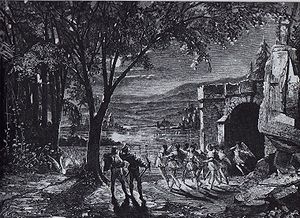
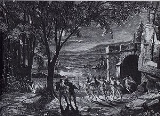
Swan Lake are rather obscured, and since there are very few records concerning the first production of the work to have survived, there can only be speculation about who the author of the original libretto was. The most authoritative theory appears to be that it was written by Vladimir Petrovich Begichev, director of the Moscow Imperial Theatres during the time that the ballet was originally produced, and possibly Vasily Geltser, Danseur of the Moscow Imperial Bolshoi Theatre
. However, Geltser was in all probability merely the first person to copy the scenario for publication, as a surviving copy bears his name. Since the first published libretto of the ballet and the actual music composed by Tchaikovsky do not correspond in many places, we may infer that the first actual published libretto was possibly crafted by a newspaper writer who had viewed the initial rehearsals, as new productions of operas and ballets were always reported in the newspapers of Imperial Russia, along with their respective scenarios.
According to two of Tchaikovsky's relatives—his nephew Yuri Lvovich Davydov and his niece Anna Meck-Davydov—the composer had earlier created a little ballet called The Lake of the Swans at their home in 1871. This ballet featured the famous leitmotif
known as the Swan's Theme (or Song of the Swans ). Begichev commissioned the score of Swan Lake from Tchaikovsky in 1875 for a rather modest fee of 800 ruble
s, and soon Begichev began to choose artists that would participate in the creation of the ballet. The choreographer assigned to the production was the Czech Julius Reisinger
(1827–1892), who had been engaged as balletmaster to the Ballet of the Moscow Imperial Bolshoi Theatre
(today known as the Bolshoi Ballet) since 1873. It is not known what sort of collaborative processes were involved between Tchaikovsky and Reisinger. It seems that initially Tchaikovsky worked without complete knowledge of Reisinger’s specific requirements. Tchaikovsky likely had some form of instruction in composing Swan Lake, as he had to know what sort of dances would be required. But unlike the instructions that Tchaikovsky received for the scores of The Sleeping Beauty and The Nutcracker, no such written instruction is known to have survived. When Reisinger began choreographing after the score was completed, he demanded some changes from Tchaikovsky. Whether by demanding the addition or removal of a dance, Reisinger made it clear that he was to be a very large part in the creation of this piece. Although the two artists were required to collaborate, each seemed to prefer working as independently of each other as possible.
and the Austrian Ludwig Minkus
, before setting to work on Swan Lake. Tchaikovsky had a rather negative opinion of the "specialist" ballet music until he studied it in detail, being impressed by the nearly limitless variety of infectious melodies their scores contained. Tchaikovsky most admired the ballet music of such composers as Léo Delibes
, Adolphe Adam
, and later, Riccardo Drigo
. He would later write to his protégé, the composer Sergei Taneyev
, "I listened to the Delibes ballet 'Sylvia'...what charm, what elegance, what wealth of melody, rhythm, and harmony. I was ashamed, for if I had known of this music then, I would not have written 'Swan Lake'". Tchaikovsky most admired Adam's 1844 score for Giselle
, which featured the use of the technique known as leitmotif
: associating certain themes with certain characters or moods, a technique he would use in Swan Lake, and later, The Sleeping Beauty.
Tchaikovsky drew on previous compositions for his Swan Lake score. He made use of material from The Voyevoda, an opera that he had abandoned in 1868. The Grand adage (a.k.a. the Love Duet) from the second scene of Swan Lake was fashioned from an aria
from that opera, as was the Valse des fiancées from the third scene. Another number which included a theme from The Voyevoda was the Entr'acte of the fourth scene. By April 1876 the score was complete, and rehearsals began. Soon Reisinger began setting certain numbers aside that he dubbed "unsuitable for ballet." Reisinger even began choreographing dances to other composers' music, but Tchaikovsky protested, and his pieces were reinstated.
from August 1875, it was not only his excitement which compelled Tchaikovsky to create it so rapidly, but his wish to finish it as soon as possible, so as to allow him to start on an opera. Respectively, he created scores of the first three numbers of the ballet, then the orchestration in the fall and winter, and was still struggling with the instrumentation in the spring. By April 1876, the work was fully completed. Judging upon Tchaikovsky’s mention of a draft, the presence of some sort of abstract would be plausible. However, no such draft has ever been seen. Tchaikovsky wrote various letters to friends expressing his longstanding desire to work with this type of music, and his excitement concerning his current stimulating, albeit laborious task.
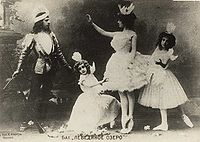 Moscow Première (World Première)
St. Petersburg Première
Other Notable Productions
Original Interpreters
The Russian ballerina Anna Sobeshchanskaya—for whom the original (1877) rôle of Odette was intended — was pulled from the première performance when a governing official in Moscow complained about her, stating that she had accepted several pieces of expensive jewelry from him, only to then marry a fellow danseur and sell the pieces for cash. Sobeshchanskaya was replaced by Pelageya Karpakova who danced the rôle of the Swan Queen until the former was reinstated by Petipa.
The première was not well-received, with near unanimous criticism concerning the dancers, orchestra, and décor. Unfortunately Tchaikovsky's masterful score was lost in the debacle of the poor production, and though there were a few critics who recognized its virtues, most considered it to be far too complicated for ballet. Most of the critics were not themselves familiar with ballet or music but rather with spoken melodrama. Critics considered Tchaikovsky's music "too noisy, too 'Wagnerian' and too symphonic". The critics also found fault with Reisinger's choreography which they thought was "unimaginative and altogether unmemorable".
The production was unsuccessful due to several reasons. The German origins of the story of Swan Lake were "treated with suspicion while the tale itself was regarded as 'stupid' with unpronounceable surnames for its characters". The dancer of Odette (and probably Odile though this has never been proved for certain) was a secondary soloist and "not particularly convincing"
Though the original composition of Swan Lake was initially received negatively, with audiences and critics claiming that the music was too complex to be a ballet piece, currently the work is seen as one of Tchaikovsky’s most valuable, and surged him into the realm of the most important ballet composers.
—Premier Maître de Ballet of the St. Petersburg Imperial Theatres—choreograph a new pas de deux to replace the Pas de six that functioned as the third act's Grand Pas. For a ballerina to request a supplemental pas or variation was standard practice in 19th century ballet, and often these "custom-made" dances quite literally became the legal property of the ballerina they were composed for.
Petipa choreographed Sobeshchanskaya's pas de deux to music composed by Ludwig Minkus
, who held the post of Ballet composer to the St Petersburg Imperial Theatres. The piece was a standard pas de deux classique that consisted of a short entrée, the grand adage, a variation for the dancer, a variation for the ballerina, and a coda.
Word of this change soon found its way to Tchaikovsky, who became very angry, stating that, whether the ballet is good or bad, he alone shall be held responsible for its music. He then agreed to compose a new pas de deux for the ballerina, but soon a problem arose: Sobeshchanskaya had no reservations about performing a pas to Tchaikovsky's new music, but she wanted to retain Petipa's choreography, and she had no wish to travel to St. Petersburg again to have the Ballet Master arrange a new pas for her. In light of this, Tchaikovsky agreed to compose a pas that would correspond to Minkus' music to such a degree that the ballerina would not even be required to rehearse. Sobeshchanskaya was so pleased with Tchaikovsky's new version of the Minkus music that she requested he compose for her an additional variation, which he did.
Until 1953 this pas de deux was thought to be lost, until an accidentally discovered repétiteur
was found in the archives of the Moscow Bolshoi Theatre among the orchestral parts used for Alexander Gorsky's revival of Le Corsaire
(Gorsky had included the piece in his version of Le Corsaire staged in 1912). In 1960 George Balanchine
choreographed a pas de deux to this music for the Ballerina Violette Verdy
, and the Danseur Conrad Ludlow
under the title Tschaikovsky Pas de Deux
, as it is still known and performed today.
. Hansen's version of Swan Lake was given only four times, the final performance being on January 2, 1883, and soon the ballet was dropped from the repertory altogether.
In all, Swan Lake was given a total of forty-one performances between its première and the final performance of 1883—a rather lengthy run for a ballet that was so poorly received upon its premiere. Hansen would go on to become Balletmaster to the Alhambra Theatre
in London, and on December 1, 1884, he presented a one-act ballet titled The Swans, which was inspired by the second scene of Swan Lake. The music was composed by the Alhambra Theatre's chef d'orchestre Georges Jacoby.
The second scene of Swan Lake was then presented on February 21, 1888, in Prague
by the Ballet of the National Theatre
in a version mounted by the Balletmaster August Berger. The ballet was given during two concerts which were conducted by Tchaikovsky. The composer noted in his diary that he experienced "a moment of absolute happiness" when the ballet was performed. Berger's production followed the 1877 libretto, though the names of Prince Siegfried and Benno were changed to Jaroslav and Zdenek, with the rôle of Benno danced by a female dancer en travestie. The rôle of Prince Siegfried was danced by Berger himself with the Ballerina Giulietta Paltriniera-Bergrova as Odette. Berger's production was only given eight performances, and was even planned for production at the Fantasia Garden in Moscow in 1893, but it never materialized.
 During the late 1880s and early 1890s, Petipa and Vsevolozhsky considered reviving Swan Lake and were in talks with Tchaikovsky about doing so. However, Tchaikovsky died on November 6, 1893, just when plans to revive Swan Lake were beginning to come to fruition. It remains uncertain whether Tchaikovsky was even going to revise the music for the prospected revival of Swan Lake. Whatever the case, as a result of Tchaikovsky's death, Drigo
was forced to revise the score himself, but not before receiving approval from Modest
. There are major differences between Drigo's and Tchaikovsky's Swan Lake score. (Today, it is Riccardo Drigo's revision of Tchaikovsky's score as done for Petipa and Ivanov's 1895 revival, and not Tchaikovsky's original score of 1877, that many—though by no means all—ballet companies use when performing Swan Lake.)
 In February 1894, two memorial concerts planned by Vsevolozhsky were given in honor of Tchaikovsky. The production included the second Act of Swan Lake, choreographed Lev Ivanov
, Second Balletmaster to the Imperial Ballet. Ivanov's choreography for the memorial concert was unanimously hailed as wonderful.
The Ballerina who danced Odette and Odile was the Italian virtuosa Pierina Legnani
, and it was because of her great talent that the prospected revival of Swan Lake was planned for her benefit performance in the 1894-1895 season. She had made her début with the Imperial Ballet in Cinderella
, produced in December 1893 (choreographed by Marius Petipa
, Lev Ivanov
, and Enrico Cecchetti
to the music of Baron Boris Fitinhof-Schell
). Her performance demonstrated her phenomenal technique, climaxing in her variation from the final tableau no fewer than thirty-two fouettés en tournant
(the most ever performed at that time) during the grand pas. The dazzled public roared with demands for an encore, and the Ballerina repeated her variation, this time performing twenty-eight fouettés en tournant.
 However, the death of Tsar Alexander III
on November 1, 1894 and the period of official mourning that followed it brought all ballet performances and rehearsals to a close for some time, and as a result all efforts were able to be concentrated on the pre-production of the revival of Swan Lake. Ivanov and Petipa chose to collaborate on the production, with Ivanov retaining his dances for the second Act while choreographing the fourth, and with Petipa staging the first and third Acts.
Tchaikovsky's younger brother Modest
was called upon to make the required changes to the ballet's libretto, the most prominent being his revision of the ballet's finale; instead of the lovers simply drowning at the hand of the wicked Von Rothbart as in the original 1877 scenario, Odette commits suicide by drowning herself, with Prince Siegfried choosing to die as well, rather than live without her, and soon the lovers' spirits are reunited in an apotheosis. Aside from the revision of the libretto the ballet was changed from four acts to three—with Act II becoming Act I-Scene 2.
All was ready by the beginning of 1895, and the ballet had its première on Friday, January 27th. Pierina Legnani danced Odette/Odile, with Pavel Gerdt
as Prince Siegfried, Alexei Bulgakov as Von Rothbart, and Alexander Oblakov as Benno.
The première of the Petipa/Ivanov/Drigo was quite a success, though not as much of one as it has been in modern times. Most of the reviews in the St. Petersburg newspapers were positive.
Unlike the première of The Sleeping Beauty, Swan Lake did not dominate the repertory of the Mariinsky Theatre in its first season. It was given only sixteen performances between the première and the 1895-1896 season, and was not performed at all in 1897. Even more surprising, the ballet was performed only four times in 1898 and 1899. The ballet belonged solely to Legnani until she left St. Petersburg for her native Italy in 1901. After her departure, the ballet was taken over by Mathilde Kschessinskaya, who was as much celebrated in the rôle as was her Italian predecessor.
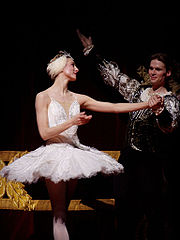 Throughout the long and complex performance history of Swan Lake the 1895 edition of Petipa, Ivanov, and Drigo has served as the version from which many stagings have been based. Nearly every balletmaster or choreographer who has re-staged Swan Lake has sought to make modifications to the ballet's scenario, while still maintaining to a considerable extent the traditional choreography for the dances, which is regarded as virtually sacrosanct. Likewise, over time the rôle of Siegfried has become far more prominent, due largely to the evolution of ballet technique.
Several notable productions have diverged from the original and its 1895 revival:
By 1895 Benno von Sommerstern became just "Benno", and Odette "Queen of the Swans". Also Baron von Stein, his wife, and Freiherr von Schwarzfels and his wife were no longer identified on the program. The sovereign or ruling Princess is often rendered "Queen Mother". Rothbart ("Redbeard") may also be spelled Rotfart.
role. Von Rothbart's daughter Odile is danced by the same ballerina; this explains how Odile is able to trick Prince Siegfried into being unfaithful to Odette. She also appears in many adaptations of the ballet.
Odette is an enchanted princess under a spell of the evil sorcerer Von Rothbart; she has been transformed into a swan
by day and can only regain her human form at night. She has many companions under the same spell, who have made her their queen, hence her title "The Swan Queen." She is forced to live by a lake
that was magically formed by her grieving mother's tears when Rothbart kidnapped her; Rothbart's reasons for kidnapping Odette and enchanting her are unknown in the ballet. The only way for the spell to be broken is by the power of eternal love between Odette and a young man who will remain faithful to her, for if the vow of eternal love is broken, she will remain a swan forever.
One day, the young Prince Siegfried ventures upon the lake while out hunting and sees Odette transform from her swan form back into her human form. He is so struck by her beauty that he falls in love with her at once and when she tells him her story, he promises to love her forever and invites her to a Royal Ball at his castle so he may choose her as his bride. They spend the night dancing together, falling more and more in love with each other until dawn breaks and Odette is forced to return to the lake as a swan, leaving Siegfried alone.
Siegfried waits for Odette at the Ball and believes she has attended when two strangers arrive. But it is actually Rothbart and his daughter Odile in disguise. Rothbart has planned to trick Siegfried into breaking his vow to Odette by magically disguising Odile in Odette's shape and form. Siegfried dances with her and fails to see the real Odette appearing at the window in her swan form to warn him of Rothbart's plot and pleading with him to remain faithful to her. Rothbart's plan is a success when Siegfried declares his eternal love to Odile, thinking she is Odette and Rothbart joyfully reveals that Odette is now forever in his power.
Odette flees back to the lake in distress and Siegfried follows her, begging her to forgive him, which she does but she tells him that she will never be freed from Rothbart's spell. The only way she can be freed is if she dies, for she would rather die than live without Siegfried. Siegfried cannot live without Odette and declares that he will die with her. When Rothbart appears, Odette throws herself into the lake and Siegfried follows her. In the climax of their sacrifice, Rothbart's powers are destroyed and the spell is finally broken; Odette's companions are freed from the enchantment. As the sun rises, Siegfried and Odette ascend into Heaven
together, united in love for all eternity.
Siegfried is a young Prince, full of bright spirit and enthusiasm and seems to have little interest in his role as a Prince. His favourite hobby is hunting and he often hunts with his best friend Benno. He is celebrating his 21st birthday with his friends and tutor, but the celebrations are interrupted and almost ruined by the arrival of his mother, the Queen. After presenting him with a new crossbow, she tells him that it is time for him to settle down and marry. Siegfried, however, has no intention to marry because he is not in love and is enjoying life as it is, but his mother makes it clear that he is expected to choose a bride at an upcoming Royal Ball before she departs, leaving Siegfried depressed by what is expected of him. But suddenly, a flock of swans flies over the castle and Benno urges Siegfried to join him and their friends in a hunting expedition. Armed with his new crossbow, Siegfried heads into the forest with Benno and their companions.
Deep in the forest, Siegfried and his friends arrive at a lake and Siegfried sends his companions away. Suddenly, he spots a beautiful swan wearing a crown swimming towards the lakeside and prepares to shoot but before he can, the swan transforms into a most beautiful young girl. She is Princess Odette, the Queen of the Swans. Struck by her beauty as she is the most beautiful girl he has ever seen, Siegfried falls in love with her. Although she is terrified at first, Odette loses her fear and tells him her story, explaining that she is under a spell of the evil sorcerer Von Rothbart; she has been transformed into a swan by day and can only regain her human form at night. Her companions are also under the same spell and only a vow of eternal love to Odette will free them. When Rothbart appears, Siegfried tries to kill him but Odette intercedes, explaining that Rothbart's death will only make the spell permanent if it is not already broken. Siegfried is able to stop Benno and his other companions from shooting the Swan Maidens and sends them away so he can stay at the lake with Odette. They spend the night dancing together, falling more and more in love and Siegfried vows to love Odette for eternity, promising to save her from Rothbart's evil enchantment. He invites her to attend the Ball at his castle and promises to choose her as his bride. Odette agrees, but warns him that if his vow to her is broken, she will remain a swan forever. When dawn breaks, Odette is forced to return to the lake as a swan, leaving Siegfried alone in despair.
On the night of the Ball, Siegfried is thinking of nothing but Odette. His mother introduces him to various potential brides, but he rejects them all because he is in love with Odette. He continues to wait for her and suddenly, two more guests arrive and Siegfried is joyful to see that Odette has appeared to have arrived. But the mystery guests are actually Rothbart and his daughter Odile in disguise. Rothbart has magically disguised Odile in the shape and form of Odette to trick Siegfried into breaking his vow. Siegfried dances with Odile and she completely beguiles him that he fails to see the real Odette at the window in her swan form trying to warn him of Rothbart's plot and pleading with him to remain faithful to her. Siegfried falls for Rothbart's deception and pledges eternal love to Odile, thinking she is Odette. Triumphant, Rothbart reveals himself and Odile in their true forms and declares that Odette is now forever in his power. Horrified to discover that he has been tricked into breaking his promise to Odette, Siegfried flees from the Ball in search of her.
Odette flees back to the lake in despair over Siegfried's betrayal. He follows her, finds her amongst her companions and begs her to forgive him, swearing that he loves her only. She forgives him, but explains that she is now under Rothbart's spell forever and the only way she can escape the enchantment is if she dies. Rothbart appears to part the lovers and reminds Siegfried of his vow to Odile. Siegfried declares he would rather die with Odette than marry Odile and a fight ensues as Rothbart tries to take Odette away. Unable to live without her Prince, Odette throws herself into the lake and Siegfried follows her. In the climax of their sacrifice, Rothbart and his powers are destroyed and Odette's companions are finally freed from the spell. As the sun rises, Siegfried and Odette ascend into Heaven together, united in love for all eternity.
Rothbart is a powerful sorcerer who casts a spell on Odette that turns her into a swan every day and returns her to human form at night. The reason for Rothbart's curse upon her is not known; several other versions of the ballet, including two feature films, have suggested reasons, but none is typically explained by the ballet.
The story changes in each version, yet when Rothbart realizes that Odette has fallen in love with Prince Siegfried, he tries to intervene by tricking Siegfried into marrying his daughter Odile. The plan succeeds, yet Rothbart's fate is undecided depending on the ballet. In some versions it is presumed that he has survived, while in the original version the love of the two dying lovers breaks the spell and Rothbart is overthrown and destroyed.
In the second American Ballet Theatre
production of Swan Lake, telecast by PBS in 2005 and now out on DVD
, von Rothbart is portrayed by two dancers. One of them depicts him as young and handsome; it is this von Rothbart that is able to lure Odette and transform her into a swan (this is shown during the introduction to the ballet in a danced prologue especially created by choreographer Kevin McKenzie). He is also able to entice the Prince to dance with Odile, and thus seal Odette's doom. The other von Rothbart, a repulsive, reptilian-like creature, reveals himself only after he has performed an evil deed, such as transforming Odette into a swan. In this version, the lovers' joint-suicide inspires the rest of von Rothbart's imprisoned swans to turn on him and overcome his spell, which ultimately kills him.
Swan Lake begins at a royal court. Prince Siegfried, heir to the kingdom, must declare he has chosen a wife at his birthday ball. Upset that he cannot marry for love, Siegfried makes for the forest and escapes into the night. He sees a flock of swan
s flying overhead and sets off in pursuit of them.
Siegfried aims his crossbow at the swans and readies himself for their landing by the lakeside. When one comes into view, however, he stops. Before him is a beautiful creature dressed in white feathers, more woman than swan. Enamoured, the two dance and Siegfried learns that the swan maiden is the princess Odette. An evil sorcerer, von Rothbart, has captured her and used his magic to turn her into a swan by day. Every night, she becomes a woman again.
A retinue of other captured swan-maidens attend Odette in the environs of Swan Lake, which was formed by the tears of her parents when she was kidnapped by von Rothbart. Once Siegfried knows her story, he takes great pity on her and falls in love. As he begins to swear his love to her, an act that will render the sorcerer's spell powerless, von Rothbart himself appears. Siegfried threatens to kill von Rothbart but Odette intercedes. If von Rothbart dies before the spell is broken, it can never be undone.
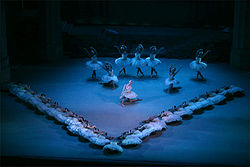 The Prince returns to the castle to attend the ball. Von Rothbart arrives in disguise with his own daughter Odile. He has made Odile identical to Odette in all respects except that she wears black rather than white. The prince mistakes her for Odette, dances with her, and proclaims to the court that he intends to make her his wife. Only a moment too late, Siegfried sees the real Odette and realizes his mistake. (The method in which Odette appears varies. In some versions she arrives at the castle, while in other versions von Rothbart shows Siegfried a magical vision of her.)
Siegfried returns to the lake and finds Odette. He makes a passionate apology and she forgives him. Von Rothbart appears and tries to pull the lovers apart. In the original 1877 ballet, Siegfried struggles with Von Rothbart and tears off one of his wings, thereby destroying his powers. Siegfried has broken the spell of the swan maidens and marries Odette.
In the 1895 Mariinsky revival, Tchaikovsky's brother altered the ending to a tragic one. The lovers realize that the spell cannot be broken because of Siegfried's accidental pledge to Odile. In order to complete and fulfill the pledge initiated in Act 2 by Siegfried to Odette, ultimately making it possible for the lovers to stay together, Odette and Siegfried leap into the lake and drown. This breaks von Rothbart's spell over Odette, causing him to lose his power over them, and he dies as a result.
Video
Video recordings of the ballet:
Scores:
Ballet
Ballet is a type of performance dance, that originated in the Italian Renaissance courts of the 15th century, and which was further developed in France and Russia as a concert dance form. The early portions preceded the invention of the proscenium stage and were presented in large chambers with...
, op.
Opus number
An Opus number , pl. opera and opuses, abbreviated, sing. Op. and pl. Opp. refers to a number generally assigned by composers to an individual composition or set of compositions on publication, to help identify their works...
20, by Pyotr Tchaikovsky
Pyotr Ilyich Tchaikovsky
Pyotr Ilyich Tchaikovsky Pyotr Ilyich Tchaikovsky Pyotr Ilyich Tchaikovsky (Russian: Пётр Ильи́ч Чайко́вский ; often "Peter Ilich Tchaikovsky" in English. His names are also transliterated "Piotr" or "Petr"; "Ilitsch", "Il'ich" or "Illyich"; and "Tschaikowski", "Tschaikowsky", "Chajkovskij"...
, composed 1875–1876. The scenario, initially in four acts, was fashioned from Russian folk tales and tells the story of Odette, a princess turned into a swan by an evil sorcerer's curse. The choreographer of the original production was Julius Reisinger
Julius Reisinger
Vaclav , or Jules or Julius Wentsel Reisinger is paradoxical figure in the history of ballet. This prolific choreographer, author of more than twenty works on various European stages, directed the Moscow company of the Bolshoi Theatre...
. The ballet was premièred by the Bolshoi Ballet
Bolshoi Ballet
The Bolshoi Ballet is an internationally renowned classical ballet company, based at the Bolshoi Theatre in Moscow, Russia. Founded in 1776, the Bolshoi is among the world's oldest ballet companies, however it only achieved worldwide acclaim by the early 20th century, when Moscow became the...
on at the Bolshoi Theatre
Bolshoi Theatre
The Bolshoi Theatre is a historic theatre in Moscow, Russia, designed by architect Joseph Bové, which holds performances of ballet and opera. The Bolshoi Ballet and Bolshoi Opera are amongst the oldest and most renowned ballet and opera companies in the world...
in Moscow
Moscow
Moscow is the capital, the most populous city, and the most populous federal subject of Russia. The city is a major political, economic, cultural, scientific, religious, financial, educational, and transportation centre of Russia and the continent...
, billed as The Lake of the Swans. Although it is presented in many different versions, most ballet companies base their stagings both choreographically and musically on the 1895 revival of Marius Petipa
Marius Petipa
Victor Marius Alphonse Petipa was a French ballet dancer, teacher and choreographer. Petipa is considered to be the most influential ballet master and choreographer of ballet that has ever lived....
and Lev Ivanov
Lev Ivanov
Lev Ivanovich Ivanov was a Russian ballet dancer and choreographer and later, Second Balletmaster of the Imperial Ballet....
, first staged for the Imperial Ballet
Mariinsky Ballet
The Mariinsky Ballet is a classical ballet company based at the Mariinsky Theatre in Saint Petersburg, Russia. Founded in the 18th century and originally known as the Imperial Russian Ballet, the Mariinsky Ballet is one of the world's leading ballet companies...
on January 15, 1895, at the Mariinsky Theatre
Mariinsky Theatre
The Mariinsky Theatre is a historic theatre of opera and ballet in Saint Petersburg, Russia. Opened in 1860, it became the preeminent music theatre of late 19th century Russia, where many of the stage masterpieces of Tchaikovsky, Mussorgsky, and Rimsky-Korsakov received their premieres. The...
in St. Petersburg
Saint Petersburg
Saint Petersburg is a city and a federal subject of Russia located on the Neva River at the head of the Gulf of Finland on the Baltic Sea...
. For this revival, Tchaikovsky's score was revised by the St. Petersburg Imperial Theatre's chief conductor and composer Riccardo Drigo
Riccardo Drigo
Riccardo Eugenio Drigo , a.k.a. Richard Drigo was an Italian composer of ballet music and Italian Opera, a theatrical conductor, and a pianist....
.
Origins of the Swan Lake story
Many critics have disputed the original source of the Swan Lake story. The Russian ballet patriarch Fyodor Lopukhov has called Swan Lake a "national ballet" because of its swans, who originate from Russian lyrically romantic sources, while many of the movements of the corps de ballet originated from Slavonic ring-dances. According to Lopukhov, "both the plot of Swan Lake, the image of the Swan and the very idea of a faithful love are essentially Russian". The libretto is based on a story by the German author Johann Karl August MusäusJohann Karl August Musaus
Johann Karl August Musäus was a German author from Jena. He studied theology at the university of Jena, and would have become the pastor of a parish but for the resistance of some peasants, who objected that he had been known to dance.From 1760–62 Musäus published in three volumes his first...
, "Der geraubte Schleier" (The Stolen Veil), though this story provides only the general outline of the plot of Swan Lake. The Russian folktale "The White Duck
The White Duck
The White Duck is a Russian fairy tale collected by Alexander Afanasyev in Narodnye russkie skazki. Andrew Lang included it in The Yellow Fairy Book.-Synopsis:...
" also bears some resemblance to the story of the ballet, and may have been another possible source. The contemporaries of Tchaikovsky recalled the composer taking great interest in the life story of Bavarian King Ludwig II, whose tragic life had allegedly been marked by the sign of Swan and who—either consciously or not—was chosen as the prototype of the dreamer Prince Siegfried.
Composition history
Origins of the Swan Lake composition
The origins of the balletBallet
Ballet is a type of performance dance, that originated in the Italian Renaissance courts of the 15th century, and which was further developed in France and Russia as a concert dance form. The early portions preceded the invention of the proscenium stage and were presented in large chambers with...
Swan Lake are rather obscured, and since there are very few records concerning the first production of the work to have survived, there can only be speculation about who the author of the original libretto was. The most authoritative theory appears to be that it was written by Vladimir Petrovich Begichev, director of the Moscow Imperial Theatres during the time that the ballet was originally produced, and possibly Vasily Geltser, Danseur of the Moscow Imperial Bolshoi Theatre
Bolshoi Theatre
The Bolshoi Theatre is a historic theatre in Moscow, Russia, designed by architect Joseph Bové, which holds performances of ballet and opera. The Bolshoi Ballet and Bolshoi Opera are amongst the oldest and most renowned ballet and opera companies in the world...
. However, Geltser was in all probability merely the first person to copy the scenario for publication, as a surviving copy bears his name. Since the first published libretto of the ballet and the actual music composed by Tchaikovsky do not correspond in many places, we may infer that the first actual published libretto was possibly crafted by a newspaper writer who had viewed the initial rehearsals, as new productions of operas and ballets were always reported in the newspapers of Imperial Russia, along with their respective scenarios.
According to two of Tchaikovsky's relatives—his nephew Yuri Lvovich Davydov and his niece Anna Meck-Davydov—the composer had earlier created a little ballet called The Lake of the Swans at their home in 1871. This ballet featured the famous leitmotif
Leitmotif
A leitmotif , sometimes written leit-motif, is a musical term , referring to a recurring theme, associated with a particular person, place, or idea. It is closely related to the musical idea of idée fixe...
known as the Swan's Theme (or Song of the Swans ). Begichev commissioned the score of Swan Lake from Tchaikovsky in 1875 for a rather modest fee of 800 ruble
Russian ruble
The ruble or rouble is the currency of the Russian Federation and the two partially recognized republics of Abkhazia and South Ossetia. Formerly, the ruble was also the currency of the Russian Empire and the Soviet Union prior to their breakups. Belarus and Transnistria also use currencies with...
s, and soon Begichev began to choose artists that would participate in the creation of the ballet. The choreographer assigned to the production was the Czech Julius Reisinger
Julius Reisinger
Vaclav , or Jules or Julius Wentsel Reisinger is paradoxical figure in the history of ballet. This prolific choreographer, author of more than twenty works on various European stages, directed the Moscow company of the Bolshoi Theatre...
(1827–1892), who had been engaged as balletmaster to the Ballet of the Moscow Imperial Bolshoi Theatre
Bolshoi Ballet
The Bolshoi Ballet is an internationally renowned classical ballet company, based at the Bolshoi Theatre in Moscow, Russia. Founded in 1776, the Bolshoi is among the world's oldest ballet companies, however it only achieved worldwide acclaim by the early 20th century, when Moscow became the...
(today known as the Bolshoi Ballet) since 1873. It is not known what sort of collaborative processes were involved between Tchaikovsky and Reisinger. It seems that initially Tchaikovsky worked without complete knowledge of Reisinger’s specific requirements. Tchaikovsky likely had some form of instruction in composing Swan Lake, as he had to know what sort of dances would be required. But unlike the instructions that Tchaikovsky received for the scores of The Sleeping Beauty and The Nutcracker, no such written instruction is known to have survived. When Reisinger began choreographing after the score was completed, he demanded some changes from Tchaikovsky. Whether by demanding the addition or removal of a dance, Reisinger made it clear that he was to be a very large part in the creation of this piece. Although the two artists were required to collaborate, each seemed to prefer working as independently of each other as possible.
Tchaikovsky's influences
From around the time of the turn of the 19th century until the beginning of the 1890s, scores for ballets were almost always written by composers known as "specialists": composers who were highly skilled at scoring the light, decorative, melodious, and rhythmically clear music that was at that time in vogue for ballet. Tchaikovsky studied the music of these "specialists", such as the Italian Cesare PugniCesare Pugni
Cesare Pugni was an Italian composer of ballet music, a pianist and a violinist. In his early career he composed operas, symphonies, and various other forms of orchestral music. Pugni is most noted for the ballets he composed while serving as Composer of the Ballet Music to Her Majesty's Theatre...
and the Austrian Ludwig Minkus
Ludwig Minkus
Ludwig Minkus a.k.a. Léon Fyodorovich Minkus was an Austrian composer of ballet music, a violin virtuoso and teacher.Minkus is most noted for the music he composed while serving as Ballet Composer of the St...
, before setting to work on Swan Lake. Tchaikovsky had a rather negative opinion of the "specialist" ballet music until he studied it in detail, being impressed by the nearly limitless variety of infectious melodies their scores contained. Tchaikovsky most admired the ballet music of such composers as Léo Delibes
Léo Delibes
Clément Philibert Léo Delibes was a French composer of ballets, operas, and other works for the stage...
, Adolphe Adam
Adolphe Adam
Adolphe Charles Adam was a French composer and music critic. A prolific composer of operas and ballets, he is best known today for his ballets Giselle and Le corsaire , his operas Le postillon de Lonjumeau , Le toréador and Si j'étais roi , and his Christmas...
, and later, Riccardo Drigo
Riccardo Drigo
Riccardo Eugenio Drigo , a.k.a. Richard Drigo was an Italian composer of ballet music and Italian Opera, a theatrical conductor, and a pianist....
. He would later write to his protégé, the composer Sergei Taneyev
Sergei Taneyev
Sergei Ivanovich Taneyev , was a Russian composer, pianist, teacher of composition, music theorist and author.-Life:...
, "I listened to the Delibes ballet 'Sylvia'...what charm, what elegance, what wealth of melody, rhythm, and harmony. I was ashamed, for if I had known of this music then, I would not have written 'Swan Lake'". Tchaikovsky most admired Adam's 1844 score for Giselle
Giselle
Giselle is a ballet in two acts with a libretto by Jules-Henri Vernoy de Saint-Georges and Théophile Gautier, music by Adolphe Adam, and choreography by Jean Coralli and Jules Perrot. The librettist took his inspiration from a poem by Heinrich Heine...
, which featured the use of the technique known as leitmotif
Leitmotif
A leitmotif , sometimes written leit-motif, is a musical term , referring to a recurring theme, associated with a particular person, place, or idea. It is closely related to the musical idea of idée fixe...
: associating certain themes with certain characters or moods, a technique he would use in Swan Lake, and later, The Sleeping Beauty.
Tchaikovsky drew on previous compositions for his Swan Lake score. He made use of material from The Voyevoda, an opera that he had abandoned in 1868. The Grand adage (a.k.a. the Love Duet) from the second scene of Swan Lake was fashioned from an aria
Aria
An aria in music was originally any expressive melody, usually, but not always, performed by a singer. The term is now used almost exclusively to describe a self-contained piece for one voice usually with orchestral accompaniment...
from that opera, as was the Valse des fiancées from the third scene. Another number which included a theme from The Voyevoda was the Entr'acte of the fourth scene. By April 1876 the score was complete, and rehearsals began. Soon Reisinger began setting certain numbers aside that he dubbed "unsuitable for ballet." Reisinger even began choreographing dances to other composers' music, but Tchaikovsky protested, and his pieces were reinstated.
Composition process
Tchaikovsky's excitement with Swan Lake is evident based on the quick speed with which he composed. Commissioned in the spring of 1875, the piece was created within one full year, however from Tchaikovsky’s letters to Sergei TaneyevSergei Taneyev
Sergei Ivanovich Taneyev , was a Russian composer, pianist, teacher of composition, music theorist and author.-Life:...
from August 1875, it was not only his excitement which compelled Tchaikovsky to create it so rapidly, but his wish to finish it as soon as possible, so as to allow him to start on an opera. Respectively, he created scores of the first three numbers of the ballet, then the orchestration in the fall and winter, and was still struggling with the instrumentation in the spring. By April 1876, the work was fully completed. Judging upon Tchaikovsky’s mention of a draft, the presence of some sort of abstract would be plausible. However, no such draft has ever been seen. Tchaikovsky wrote various letters to friends expressing his longstanding desire to work with this type of music, and his excitement concerning his current stimulating, albeit laborious task.
Performance history
- Date: March 4 (O.S. February 20), 1877
- Place: Bolshoy Theatre, Moscow
- Balletmaster: Julius ReisingerJulius ReisingerVaclav , or Jules or Julius Wentsel Reisinger is paradoxical figure in the history of ballet. This prolific choreographer, author of more than twenty works on various European stages, directed the Moscow company of the Bolshoi Theatre...
- Conductor: Stepan Ryabov
- Scene Designers: Karl Valts (Acts 2 & 4), Ivan Shangin (Act 1), Karl Groppius (Act 3)
St. Petersburg Première
- Date: January 27, 1895
- Place: Mariinsky TheatreMariinsky TheatreThe Mariinsky Theatre is a historic theatre of opera and ballet in Saint Petersburg, Russia. Opened in 1860, it became the preeminent music theatre of late 19th century Russia, where many of the stage masterpieces of Tchaikovsky, Mussorgsky, and Rimsky-Korsakov received their premieres. The...
, St. Petersburg - Balletmaster: Marius PetipaMarius PetipaVictor Marius Alphonse Petipa was a French ballet dancer, teacher and choreographer. Petipa is considered to be the most influential ballet master and choreographer of ballet that has ever lived....
(Acts 1 & 3), Lev IvanovLev IvanovLev Ivanovich Ivanov was a Russian ballet dancer and choreographer and later, Second Balletmaster of the Imperial Ballet....
(Acts 2 & 4) - Conductor: Riccardo DrigoRiccardo DrigoRiccardo Eugenio Drigo , a.k.a. Richard Drigo was an Italian composer of ballet music and Italian Opera, a theatrical conductor, and a pianist....
- Scene Designers: Ivan Andreyev, Mikhail Bocharov, Henrich Levogt
- Costume Designer: Yevgeni Ponomaryov
Other Notable Productions
- 1880 and 1882, Moscow, Bolshoy Theatre, staged by Joseph HansenJoseph Hansen (dancer)Joseph Hansen was a Belgian dancer and choreographer.-Life:Ballet director at the Théâtre de la Monnaie in Brussels from 1865 à 1871, he was its ballet master from 1871 to 1875, putting on the first production of Coppélia on 29 November 1871. He held the same role at the Opéra de Paris during the...
after Reisinger, conductor and designers as in première - 1901, Moscow, Bolshoy Theatre, staged by Aleksandr Gorsky, conducted by Andrey Arends, scenes by Aleksandr Golovin (Act 1), Konstantin KorovinKonstantin KorovinKonstantin Alekseyevich Korovin was a leading Russian Impressionist painter.-Biography:Konstantin was born in Moscow to a merchant family officially registered as "peasants of Vladimir Gubernia". His father, Aleksey Mikhailovich Korovin, earned a university degree and was more interested in arts...
(Acts 2 & 4), N. Klodt (Act 3) - 1911, London, Ballets RussesBallets RussesThe Ballets Russes was an itinerant ballet company from Russia which performed between 1909 and 1929 in many countries. Directed by Sergei Diaghilev, it is regarded as the greatest ballet company of the 20th century. Many of its dancers originated from the Imperial Ballet of Saint Petersburg...
, Sergey DyagilevSergei DiaghilevSergei Pavlovich Diaghilev , usually referred to outside of Russia as Serge, was a Russian art critic, patron, ballet impresario and founder of the Ballets Russes, from which many famous dancers and choreographers would arise.-Early life and career:...
production, choreography by Mikhail FokinMichel FokineMichel Fokine was a groundbreaking Russian choreographer and dancer.-Biography:...
after Petipa-Ivanov, scenes by Golovin and Korovin
Original Interpreters
| Rôle | Moscow 1877 | Moscow 1880 | St. Petersburg 1895 | Moscow 1901 | London 1911 |
|---|---|---|---|---|---|
| Princess | Olga Nikolayeva | Giuseppina Cecchetti | |||
| Siegfried | Victor Gillert | Alfred Bekefi | Pavel Gerdt Pavel Gerdt Pavel Andreyevich Gerdt, also known as Paul Gerdt , was the Premier Danseur Noble of the Imperial Ballet, the Bolshoi Kamenny Theatre, and the Mariinsky Theatre for 56 years, making his debut in 1860, and retiring in 1916... |
Mikhail Mordkin Mikhail Mordkin Mikhail Mordkin graduated from the Bolshoi Ballet School in 1899, and in the same year was appointed ballet master.He joined Diaghilev's ballet in 1909 as a leading dancer. After the first season he remained in Paris to dance with Pavlova... |
Vaslav Nijinsky Vaslav Nijinsky Vaslav Nijinsky was a Russian ballet dancer and choreographer of Polish descent, cited as the greatest male dancer of the 20th century. He grew to be celebrated for his virtuosity and for the depth and intensity of his characterizations... |
| Benno | Sergey Nikitin | Aleksandr Oblakov | |||
| Wolfgang | Wilhelm Wanner | Gillert | |||
| Odette | Pelageya Karpakova | Yevdokiya Kalmїkova | Pierina Legnani Pierina Legnani Pierina Legnani was an Italian ballerina, a terre-à-terre virtuosa extraordinaire, considered one of the greatest ballerinas of all time.-Career:... |
Adelaide Giuri | Mathilde Kschessinska Mathilde Kschessinska Mathilda-Marie Feliksovna Kschessinskaya She was known in the West as Mathilde Kschessinska or Matilda Kshesinskaya.- Life :Kschessinska was born at Ligovo, near Peterhof. Like all her Polish family, to whom she was known as Matylda Krzesińska, Mathilde performed at the Imperial Mariinsky Theatre... |
| Von Rothbart | Sergey Sokolov | Aleksey Bulgakov | K. Kubakin | ||
| Odile | Pierina Legnani | Mathilde Kschessinska |
Original Production of 1877
The première of Swan Lake on Friday, March 4th, 1877, was given as a benefit performance for the ballerina Pelageya Karpakova (also known as Polina Karpakova), who performed the role of Odette, with the Bolshoy Theatre's Première Danseur Victor Gillert as Prince Siegfried. Karpakova likely also danced the part Odile, although it is not known for certain.The Russian ballerina Anna Sobeshchanskaya—for whom the original (1877) rôle of Odette was intended — was pulled from the première performance when a governing official in Moscow complained about her, stating that she had accepted several pieces of expensive jewelry from him, only to then marry a fellow danseur and sell the pieces for cash. Sobeshchanskaya was replaced by Pelageya Karpakova who danced the rôle of the Swan Queen until the former was reinstated by Petipa.
The première was not well-received, with near unanimous criticism concerning the dancers, orchestra, and décor. Unfortunately Tchaikovsky's masterful score was lost in the debacle of the poor production, and though there were a few critics who recognized its virtues, most considered it to be far too complicated for ballet. Most of the critics were not themselves familiar with ballet or music but rather with spoken melodrama. Critics considered Tchaikovsky's music "too noisy, too 'Wagnerian' and too symphonic". The critics also found fault with Reisinger's choreography which they thought was "unimaginative and altogether unmemorable".
The production was unsuccessful due to several reasons. The German origins of the story of Swan Lake were "treated with suspicion while the tale itself was regarded as 'stupid' with unpronounceable surnames for its characters". The dancer of Odette (and probably Odile though this has never been proved for certain) was a secondary soloist and "not particularly convincing"
Though the original composition of Swan Lake was initially received negatively, with audiences and critics claiming that the music was too complex to be a ballet piece, currently the work is seen as one of Tchaikovsky’s most valuable, and surged him into the realm of the most important ballet composers.
Tchaikovsky Pas de Deux 1877
In spite of the poor reaction to the première, the ballet nevertheless continued being performed. On April 26, 1877 the prima ballerina of the Moscow Imperial Bolshoi Theatre Anna Sobeshchanskaya made her début as Odette/Odile in Swan Lake, and from the start she was completely dissatisfied with the production of the ballet, but most of all with Reisinger's choreography and Tchaikovsky's music. Sobeshchanskaya travelled to St. Petersburg to have Marius PetipaMarius Petipa
Victor Marius Alphonse Petipa was a French ballet dancer, teacher and choreographer. Petipa is considered to be the most influential ballet master and choreographer of ballet that has ever lived....
—Premier Maître de Ballet of the St. Petersburg Imperial Theatres—choreograph a new pas de deux to replace the Pas de six that functioned as the third act's Grand Pas. For a ballerina to request a supplemental pas or variation was standard practice in 19th century ballet, and often these "custom-made" dances quite literally became the legal property of the ballerina they were composed for.
Petipa choreographed Sobeshchanskaya's pas de deux to music composed by Ludwig Minkus
Ludwig Minkus
Ludwig Minkus a.k.a. Léon Fyodorovich Minkus was an Austrian composer of ballet music, a violin virtuoso and teacher.Minkus is most noted for the music he composed while serving as Ballet Composer of the St...
, who held the post of Ballet composer to the St Petersburg Imperial Theatres. The piece was a standard pas de deux classique that consisted of a short entrée, the grand adage, a variation for the dancer, a variation for the ballerina, and a coda.
Word of this change soon found its way to Tchaikovsky, who became very angry, stating that, whether the ballet is good or bad, he alone shall be held responsible for its music. He then agreed to compose a new pas de deux for the ballerina, but soon a problem arose: Sobeshchanskaya had no reservations about performing a pas to Tchaikovsky's new music, but she wanted to retain Petipa's choreography, and she had no wish to travel to St. Petersburg again to have the Ballet Master arrange a new pas for her. In light of this, Tchaikovsky agreed to compose a pas that would correspond to Minkus' music to such a degree that the ballerina would not even be required to rehearse. Sobeshchanskaya was so pleased with Tchaikovsky's new version of the Minkus music that she requested he compose for her an additional variation, which he did.
Until 1953 this pas de deux was thought to be lost, until an accidentally discovered repétiteur
Répétiteur
Répétiteur , repetitore , or Korrepetitor / Repetitor , originally from the French verb répéter meaning "to repeat, to go over, to learn, to rehearse"....
was found in the archives of the Moscow Bolshoi Theatre among the orchestral parts used for Alexander Gorsky's revival of Le Corsaire
Le Corsaire
Le Corsaire is a ballet typically presented in three acts, with a libretto originally created by Jules-Henri Vernoy de Saint-Georges loosely based on the poem The Corsair by Lord Byron. Originally choreographed by Joseph Mazilier to the music of Adolphe Adam, it was first presented by the ballet of...
(Gorsky had included the piece in his version of Le Corsaire staged in 1912). In 1960 George Balanchine
George Balanchine
George Balanchine , born Giorgi Balanchivadze in Saint Petersburg, Russia, to a Georgian father and a Russian mother, was one of the 20th century's most famous choreographers, a developer of ballet in the United States, co-founder and balletmaster of New York City Ballet...
choreographed a pas de deux to this music for the Ballerina Violette Verdy
Violette Verdy
Violette Verdy is a French ballerina who has worked as a director of dance companies and in other related capacities since her retirement from performing in the late 1970s. Verdy began dance training as a small child and performed with Les Ballets des Champs-Elysées beginning in 1945...
, and the Danseur Conrad Ludlow
Conrad Ludlow
Conrad Ludlow is a former principal dancer with New York City Ballet under George Balanchine. He also danced at San Francisco Ballet and founded and directed Ballet Oklahoma...
under the title Tschaikovsky Pas de Deux
Tschaikovsky Pas de Deux
The Tschaikovsky Pas de Deux is a ballet made by New York City Ballet co-founder and founding choreographer George Balanchine to an excerpt from Swan Lake, Op. 20, Act III, by Pyotr Ilyich Tchaikovsky...
, as it is still known and performed today.
Subsequent productions 1879-1894
Julius Reisinger left Moscow in 1879, and his successor as Balletmaster was Joseph Peter Hansen. Hansen made considerable efforts throughout the late 1870s/early 1880s to salvage Swan Lake, and on January 13, 1880, he presented a new production of the ballet for his own benefit performance. The part of Odette/Odile was danced by Evdokia Kalmykova, a student of the Moscow Imperial Ballet School, with Alfred Bekefi as Prince Siegfried. This production was far more well-received than the original, though it was by no means a great success. Hansen presented another version of Swan Lake on October 28, 1882, again with Kalmykova as Odette/Odile. For this production Hansen arranged a Grand Pas for the ballroom scene which he titled La Cosmopolitana. This was taken from the European section of the Grand Pas d'action known as The Allegory of the Continents from Marius Petipa's 1875 ballet The Bandits to the music of Ludwig MinkusLudwig Minkus
Ludwig Minkus a.k.a. Léon Fyodorovich Minkus was an Austrian composer of ballet music, a violin virtuoso and teacher.Minkus is most noted for the music he composed while serving as Ballet Composer of the St...
. Hansen's version of Swan Lake was given only four times, the final performance being on January 2, 1883, and soon the ballet was dropped from the repertory altogether.
In all, Swan Lake was given a total of forty-one performances between its première and the final performance of 1883—a rather lengthy run for a ballet that was so poorly received upon its premiere. Hansen would go on to become Balletmaster to the Alhambra Theatre
Alhambra Theatre
The Alhambra was a popular theatre and music hall located on the east side of Leicester Square, in the West End of London. It was built originally as The Royal Panopticon of Science and Arts opening on 18 March 1854. It was closed after two years and reopened as the Alhambra. The building was...
in London, and on December 1, 1884, he presented a one-act ballet titled The Swans, which was inspired by the second scene of Swan Lake. The music was composed by the Alhambra Theatre's chef d'orchestre Georges Jacoby.
The second scene of Swan Lake was then presented on February 21, 1888, in Prague
Prague
Prague is the capital and largest city of the Czech Republic. Situated in the north-west of the country on the Vltava river, the city is home to about 1.3 million people, while its metropolitan area is estimated to have a population of over 2.3 million...
by the Ballet of the National Theatre
National Theatre (Prague)
The National Theatre in Prague is known as the Alma Mater of Czech opera, and as the national monument of Czech history and art.The National Theatre belongs to the most important Czech cultural institutions, with a rich artistic tradition which was created and maintained by the most distinguished...
in a version mounted by the Balletmaster August Berger. The ballet was given during two concerts which were conducted by Tchaikovsky. The composer noted in his diary that he experienced "a moment of absolute happiness" when the ballet was performed. Berger's production followed the 1877 libretto, though the names of Prince Siegfried and Benno were changed to Jaroslav and Zdenek, with the rôle of Benno danced by a female dancer en travestie. The rôle of Prince Siegfried was danced by Berger himself with the Ballerina Giulietta Paltriniera-Bergrova as Odette. Berger's production was only given eight performances, and was even planned for production at the Fantasia Garden in Moscow in 1893, but it never materialized.
Petipa-Ivanov-Drigo revival of 1895
Riccardo Drigo
Riccardo Eugenio Drigo , a.k.a. Richard Drigo was an Italian composer of ballet music and Italian Opera, a theatrical conductor, and a pianist....
was forced to revise the score himself, but not before receiving approval from Modest
Modest Ilyich Tchaikovsky
Modest Ilyich Tchaikovsky was a Russian dramatist, opera librettist and translator.-Early life:Modest Ilyich was born in Alapayevsk, the younger brother of the future composer Pyotr Ilyich Tchaikovsky. He graduated from the School of Jurisprudence with a degree in law...
. There are major differences between Drigo's and Tchaikovsky's Swan Lake score. (Today, it is Riccardo Drigo's revision of Tchaikovsky's score as done for Petipa and Ivanov's 1895 revival, and not Tchaikovsky's original score of 1877, that many—though by no means all—ballet companies use when performing Swan Lake.)
Lev Ivanov
Lev Ivanovich Ivanov was a Russian ballet dancer and choreographer and later, Second Balletmaster of the Imperial Ballet....
, Second Balletmaster to the Imperial Ballet. Ivanov's choreography for the memorial concert was unanimously hailed as wonderful.
The Ballerina who danced Odette and Odile was the Italian virtuosa Pierina Legnani
Pierina Legnani
Pierina Legnani was an Italian ballerina, a terre-à-terre virtuosa extraordinaire, considered one of the greatest ballerinas of all time.-Career:...
, and it was because of her great talent that the prospected revival of Swan Lake was planned for her benefit performance in the 1894-1895 season. She had made her début with the Imperial Ballet in Cinderella
Cinderella (Fitinhof-Schell)
Cinderella - ballet-féerie in 3 Acts, with choreography by Enrico Cecchetti and Lev Ivanov , with the production being supervised under the counsel and instruction of Marius Petipa. Music by Baron Boris Vietinghoff-Scheel...
, produced in December 1893 (choreographed by Marius Petipa
Marius Petipa
Victor Marius Alphonse Petipa was a French ballet dancer, teacher and choreographer. Petipa is considered to be the most influential ballet master and choreographer of ballet that has ever lived....
, Lev Ivanov
Lev Ivanov
Lev Ivanovich Ivanov was a Russian ballet dancer and choreographer and later, Second Balletmaster of the Imperial Ballet....
, and Enrico Cecchetti
Enrico Cecchetti
Enrico Cecchetti was an Italian ballet dancer, mime, and founder of the Cecchetti method. The son of two dancers from Civitanova Marche, he was born in the costuming room of the Teatro Tordinona in Rome. After an illustrious career as a dancer in Europe, he went to dance for the Imperial Ballet in...
to the music of Baron Boris Fitinhof-Schell
Baron Boris Fitinhof-Schell
Baron Boris Vietinghoff-Scheel, a.k.a. Fitinhof-Schell was a Russian composer....
). Her performance demonstrated her phenomenal technique, climaxing in her variation from the final tableau no fewer than thirty-two fouettés en tournant
32 fouettés en tournant
32 fouettés en tournant is a movement in classical ballet.-Movement:A fouetté rond de jambe en tournant is an action where the dancer stands momentarily on flat foot with the supporting knee bent as the other "working" leg is whipped around to the side, creating the impetus to spin one turn...
(the most ever performed at that time) during the grand pas. The dazzled public roared with demands for an encore, and the Ballerina repeated her variation, this time performing twenty-eight fouettés en tournant.
Alexander III of Russia
Alexander Alexandrovich Romanov , historically remembered as Alexander III or Alexander the Peacemaker reigned as Emperor of Russia from until his death on .-Disposition:...
on November 1, 1894 and the period of official mourning that followed it brought all ballet performances and rehearsals to a close for some time, and as a result all efforts were able to be concentrated on the pre-production of the revival of Swan Lake. Ivanov and Petipa chose to collaborate on the production, with Ivanov retaining his dances for the second Act while choreographing the fourth, and with Petipa staging the first and third Acts.
Tchaikovsky's younger brother Modest
Modest Ilyich Tchaikovsky
Modest Ilyich Tchaikovsky was a Russian dramatist, opera librettist and translator.-Early life:Modest Ilyich was born in Alapayevsk, the younger brother of the future composer Pyotr Ilyich Tchaikovsky. He graduated from the School of Jurisprudence with a degree in law...
was called upon to make the required changes to the ballet's libretto, the most prominent being his revision of the ballet's finale; instead of the lovers simply drowning at the hand of the wicked Von Rothbart as in the original 1877 scenario, Odette commits suicide by drowning herself, with Prince Siegfried choosing to die as well, rather than live without her, and soon the lovers' spirits are reunited in an apotheosis. Aside from the revision of the libretto the ballet was changed from four acts to three—with Act II becoming Act I-Scene 2.
All was ready by the beginning of 1895, and the ballet had its première on Friday, January 27th. Pierina Legnani danced Odette/Odile, with Pavel Gerdt
Pavel Gerdt
Pavel Andreyevich Gerdt, also known as Paul Gerdt , was the Premier Danseur Noble of the Imperial Ballet, the Bolshoi Kamenny Theatre, and the Mariinsky Theatre for 56 years, making his debut in 1860, and retiring in 1916...
as Prince Siegfried, Alexei Bulgakov as Von Rothbart, and Alexander Oblakov as Benno.
The première of the Petipa/Ivanov/Drigo was quite a success, though not as much of one as it has been in modern times. Most of the reviews in the St. Petersburg newspapers were positive.
Unlike the première of The Sleeping Beauty, Swan Lake did not dominate the repertory of the Mariinsky Theatre in its first season. It was given only sixteen performances between the première and the 1895-1896 season, and was not performed at all in 1897. Even more surprising, the ballet was performed only four times in 1898 and 1899. The ballet belonged solely to Legnani until she left St. Petersburg for her native Italy in 1901. After her departure, the ballet was taken over by Mathilde Kschessinskaya, who was as much celebrated in the rôle as was her Italian predecessor.
Later productions
Several notable productions have diverged from the original and its 1895 revival:
- Illusions Like "Swan Lake" 1976: John NeumeierJohn NeumeierJohn Neumeier is a well-known American ballet dancer, choreographer, and director. He has been the director and chief choreographer of the Hamburg Ballet since 1973. 5 years later he founded the Hamburg Ballet School, which also includes a boarding school...
Hamburg Ballet, Neumeier interpolated the story of Ludwig II of BavariaLudwig II of BavariaLudwig II was King of Bavaria from 1864 until shortly before his death. He is sometimes called the Swan King and der Märchenkönig, the Fairy tale King...
into the Swan Lake plot, via Ludwig's fascination with swans. Much of the original score was used with additional Tchaikovsky material and the choreography combined the familiar Petipa/Ivanov material with new dances and scenes by Neumeier. The ballet finishes with Ludwig’s death by drowning while confined to an asylum, set to the dramatic music for the Act Three conclusion. With the theme of the unhappy royal being forced into heterosexual marriage for reasons of state and also the cross reference to the personal lives of actual royalty, this work anticipated both Bourne’s and Murphy’s interpretation. Illusions Like "Swan Lake" remains in the repertoire of major German ballet companies.
- Matthew Bourne'sMatthew BourneMatthew Bourne OBE is a British classical and contemporary ballet and dance choreographer.-Biography:Matthew Bourne was born in Hackney, London in 1960. He went to William Fitt and Sir George Monoux School in Walthamstow, London...
Swan LakeMatthew Bourne's Swan LakeMatthew Bourne's Swan Lake is a piece of ballet-influenced contemporary dance choreographed by Matthew Bourne that was first staged at Sadler's Wells theatre in London in 1995. The longest running ballet in London's West End and on Broadway, it has enjoyed two successful tours in the UK and...
departed from the traditional ballet by replacing the female corps de ballet with male dancers. Since its inception in 1995, Matthew Bourne's production has never been off the stage for more than a few months (but one could say the same of Swan Lake after 1895 in general). It has toured the United Kingdom and returned to London several times. It has been performed on extended tours in Greece, Israel, Turkey, Australia, Italy, Japan, Korea, Russia, France, Germany, the Netherlands, and the United States, in addition to the United Kingdom.
- The 2000 American Ballet TheatreAmerican Ballet TheatreAmerican Ballet Theatre , based in New York City, was one of the foremost ballet companies of the 20th century. It continues as a leading dance company in the world today...
version (taped for television in 2005), rather than having the curtain down as the slow introduction is played, used this music to accompany a new prologue in which the audience is shown how Von Rothbart first transforms Odette into a swan. This prologue is similar to the Vladimir Burmeister's production of the "Swan Lake" (firstly staged in Stanislavsky Theatre in Moscow, 1953) but has some differences. Von Rothbart in this production is played by two dancers; one appears as a handsome young man who is easily able to lure Odette in the new prologue, and the other dancer is covered in sinister "monster makeup" which reveals the magician's true self. (in the film Black SwanBlack SwanThe Black Swan is a large waterbird, a species of swan, which breeds mainly in the southeast and southwest regions of Australia. The species was hunted to extinction in New Zealand, but later reintroduced. Within Australia they are nomadic, with erratic migration patterns dependent upon climatic...
, Natalie PortmanNatalie PortmanNatalie Hershlag , better known by her stage name Natalie Portman, is an actress with dual American and Israeli citizenship. Her first role was as an orphan taken in by a hitman in the 1994 French action film Léon, but major success came when she was cast as Padmé Amidala in the Star Wars prequel...
, as Nina, dreams this in the film's opening sequence). About half-an-hour of the complete score is omitted from this production.
- Graeme MurphyGraeme MurphyGraeme Murphy is an Australian dance choreographer. Together with his fellow dancer Janet Vernon, he has guided Sydney Dance Company to become one of Australia's most successful and well-known dance companies....
's Swan Lake was first performed in 2002, and was loosely based on the breakdown of the marriage of Lady Diana to Prince Charles and his relationship with Camilla Parker Bowles. It combined the rôles of Von Rothbart and Odile into that of a Baroness, and the focus of the story is a love triangle.
- In 2010, Black Swan, a film starring Natalie Portman and Mila KunisMila KunisMilena "Mila" Kunis is an American actress. Her work includes the role of Jackie Burkhart on the TV series That '70s Show and the voice of Meg Griffin on the animated series Family Guy...
, featured sequences from Swan Lake.
Instrumentation
Swan Lake is scored for the typical late 19th-century large orchestra:- Strings: violinViolinThe violin is a string instrument, usually with four strings tuned in perfect fifths. It is the smallest, highest-pitched member of the violin family of string instruments, which includes the viola and cello....
s I and II; violaViolaThe viola is a bowed string instrument. It is the middle voice of the violin family, between the violin and the cello.- Form :The viola is similar in material and construction to the violin. A full-size viola's body is between and longer than the body of a full-size violin , with an average...
s, violoncellos; double bassDouble bassThe double bass, also called the string bass, upright bass, standup bass or contrabass, is the largest and lowest-pitched bowed string instrument in the modern symphony orchestra, with strings usually tuned to E1, A1, D2 and G2...
es - Woodwinds: piccoloPiccoloThe piccolo is a half-size flute, and a member of the woodwind family of musical instruments. The piccolo has the same fingerings as its larger sibling, the standard transverse flute, but the sound it produces is an octave higher than written...
; 2 fluteWestern concert fluteThe Western concert flute is a transverse woodwind instrument made of metal or wood. It is the most common variant of the flute. A musician who plays the flute is called a flautist, flutist, or flute player....
s; 2 oboeOboeThe oboe is a double reed musical instrument of the woodwind family. In English, prior to 1770, the instrument was called "hautbois" , "hoboy", or "French hoboy". The spelling "oboe" was adopted into English ca...
s; 2 clarinetClarinetThe clarinet is a musical instrument of woodwind type. The name derives from adding the suffix -et to the Italian word clarino , as the first clarinets had a strident tone similar to that of a trumpet. The instrument has an approximately cylindrical bore, and uses a single reed...
s in B, A and C; 2 bassoonBassoonThe bassoon is a woodwind instrument in the double reed family that typically plays music written in the bass and tenor registers, and occasionally higher. Appearing in its modern form in the 19th century, the bassoon figures prominently in orchestral, concert band and chamber music literature...
s - Brass: 4 hornHorn (instrument)The horn is a brass instrument consisting of about of tubing wrapped into a coil with a flared bell. A musician who plays the horn is called a horn player ....
s in F; 2 cornetCornetThe cornet is a brass instrument very similar to the trumpet, distinguished by its conical bore, compact shape, and mellower tone quality. The most common cornet is a transposing instrument in B. It is not related to the renaissance and early baroque cornett or cornetto.-History:The cornet was...
s in A and B; 2 trumpetTrumpetThe trumpet is the musical instrument with the highest register in the brass family. Trumpets are among the oldest musical instruments, dating back to at least 1500 BCE. They are played by blowing air through closed lips, producing a "buzzing" sound which starts a standing wave vibration in the air...
s in F, D, and E; 3 tromboneTromboneThe trombone is a musical instrument in the brass family. Like all brass instruments, sound is produced when the player’s vibrating lips cause the air column inside the instrument to vibrate...
s (2 tenor, 1 bass); tubaTubaThe tuba is the largest and lowest-pitched brass instrument. Sound is produced by vibrating or "buzzing" the lips into a large cupped mouthpiece. It is one of the most recent additions to the modern symphony orchestra, first appearing in the mid-19th century, when it largely replaced the... - Percussion: timpaniTimpaniTimpani, or kettledrums, are musical instruments in the percussion family. A type of drum, they consist of a skin called a head stretched over a large bowl traditionally made of copper. They are played by striking the head with a specialized drum stick called a timpani stick or timpani mallet...
; snare drumSnare drumThe snare drum or side drum is a melodic percussion instrument with strands of snares made of curled metal wire, metal cable, plastic cable, or gut cords stretched across the drumhead, typically the bottom. Pipe and tabor and some military snare drums often have a second set of snares on the bottom...
; cymbalCymbalCymbals are a common percussion instrument. Cymbals consist of thin, normally round plates of various alloys; see cymbal making for a discussion of their manufacture. The greater majority of cymbals are of indefinite pitch, although small disc-shaped cymbals based on ancient designs sound a...
s; bass drumBass drumBass drums are percussion instruments that can vary in size and are used in several musical genres. Three major types of bass drums can be distinguished. The type usually seen or heard in orchestral, ensemble or concert band music is the orchestral, or concert bass drum . It is the largest drum of...
; triangleTriangle (instrument)The triangle is an idiophone type of musical instrument in the percussion family. It is a bar of metal, usually steel but sometimes other metals like beryllium copper, bent into a triangle shape. The instrument is usually held by a loop of some form of thread or wire at the top curve...
; tambourineTambourineThe tambourine or marine is a musical instrument of the percussion family consisting of a frame, often of wood or plastic, with pairs of small metal jingles, called "zils". Classically the term tambourine denotes an instrument with a drumhead, though some variants may not have a head at all....
; castanetCastanetCastanets are a percussion instrument , used in Moorish, Ottoman, ancient Roman, Italian, Spanish, Sephardic Music, and Portuguese music. The instrument consists of a pair of concave shells joined on one edge by a string. They are held in the hand and used to produce clicks for rhythmic accents or...
s; tam-tam; glockenspielGlockenspielA glockenspiel is a percussion instrument composed of a set of tuned keys arranged in the fashion of the keyboard of a piano. In this way, it is similar to the xylophone; however, the xylophone's bars are made of wood, while the glockenspiel's are metal plates or tubes, and making it a metallophone... - Other: harpHarpThe harp is a multi-stringed instrument which has the plane of its strings positioned perpendicularly to the soundboard. Organologically, it is in the general category of chordophones and has its own sub category . All harps have a neck, resonator and strings...
Roles
- The Sovereign Princess
- Prince Siegfried, her son
- Wolfgang, his tutor
- Benno von Sommerstern, the Prince's friend
- Odette, the Swan Princess
- von Rothbart, an evil genius, by appearance a guest
- Odile, his daughter, who resembles Odette
- Master of Batons
- Baron von Stein
- The Baroness, his wife
- Freiherr von Schwarzfels
- His wife
- A herald
- A footman
- Court gentlemen and ladies, friends of the prince, heralds, guests, pages, villagers, servants, swans, cygnets
By 1895 Benno von Sommerstern became just "Benno", and Odette "Queen of the Swans". Also Baron von Stein, his wife, and Freiherr von Schwarzfels and his wife were no longer identified on the program. The sovereign or ruling Princess is often rendered "Queen Mother". Rothbart ("Redbeard") may also be spelled Rotfart.
Odette
Princess Odette is the lead ballerinaBallerina
A ballerina is a title used to describe a principal female professional ballet dancer in a large company; the male equivalent to this title is danseur or ballerino...
role. Von Rothbart's daughter Odile is danced by the same ballerina; this explains how Odile is able to trick Prince Siegfried into being unfaithful to Odette. She also appears in many adaptations of the ballet.
Odette is an enchanted princess under a spell of the evil sorcerer Von Rothbart; she has been transformed into a swan
Swan
Swans, genus Cygnus, are birds of the family Anatidae, which also includes geese and ducks. Swans are grouped with the closely related geese in the subfamily Anserinae where they form the tribe Cygnini. Sometimes, they are considered a distinct subfamily, Cygninae...
by day and can only regain her human form at night. She has many companions under the same spell, who have made her their queen, hence her title "The Swan Queen." She is forced to live by a lake
Lake
A lake is a body of relatively still fresh or salt water of considerable size, localized in a basin, that is surrounded by land. Lakes are inland and not part of the ocean and therefore are distinct from lagoons, and are larger and deeper than ponds. Lakes can be contrasted with rivers or streams,...
that was magically formed by her grieving mother's tears when Rothbart kidnapped her; Rothbart's reasons for kidnapping Odette and enchanting her are unknown in the ballet. The only way for the spell to be broken is by the power of eternal love between Odette and a young man who will remain faithful to her, for if the vow of eternal love is broken, she will remain a swan forever.
One day, the young Prince Siegfried ventures upon the lake while out hunting and sees Odette transform from her swan form back into her human form. He is so struck by her beauty that he falls in love with her at once and when she tells him her story, he promises to love her forever and invites her to a Royal Ball at his castle so he may choose her as his bride. They spend the night dancing together, falling more and more in love with each other until dawn breaks and Odette is forced to return to the lake as a swan, leaving Siegfried alone.
Siegfried waits for Odette at the Ball and believes she has attended when two strangers arrive. But it is actually Rothbart and his daughter Odile in disguise. Rothbart has planned to trick Siegfried into breaking his vow to Odette by magically disguising Odile in Odette's shape and form. Siegfried dances with her and fails to see the real Odette appearing at the window in her swan form to warn him of Rothbart's plot and pleading with him to remain faithful to her. Rothbart's plan is a success when Siegfried declares his eternal love to Odile, thinking she is Odette and Rothbart joyfully reveals that Odette is now forever in his power.
Odette flees back to the lake in distress and Siegfried follows her, begging her to forgive him, which she does but she tells him that she will never be freed from Rothbart's spell. The only way she can be freed is if she dies, for she would rather die than live without Siegfried. Siegfried cannot live without Odette and declares that he will die with her. When Rothbart appears, Odette throws herself into the lake and Siegfried follows her. In the climax of their sacrifice, Rothbart's powers are destroyed and the spell is finally broken; Odette's companions are freed from the enchantment. As the sun rises, Siegfried and Odette ascend into Heaven
Heaven
Heaven, the Heavens or Seven Heavens, is a common religious cosmological or metaphysical term for the physical or transcendent place from which heavenly beings originate, are enthroned or inhabit...
together, united in love for all eternity.
Siegfried
Prince Siegfried is the lead male ballet dancer role. Like Odette and Von Rothbart, he also appears in many adaptations of the ballet, although an interesting fact of his rôle in the ballet's adaptations is that he has a different name in almost every one, although he retains some or all of his characteristics.Siegfried is a young Prince, full of bright spirit and enthusiasm and seems to have little interest in his role as a Prince. His favourite hobby is hunting and he often hunts with his best friend Benno. He is celebrating his 21st birthday with his friends and tutor, but the celebrations are interrupted and almost ruined by the arrival of his mother, the Queen. After presenting him with a new crossbow, she tells him that it is time for him to settle down and marry. Siegfried, however, has no intention to marry because he is not in love and is enjoying life as it is, but his mother makes it clear that he is expected to choose a bride at an upcoming Royal Ball before she departs, leaving Siegfried depressed by what is expected of him. But suddenly, a flock of swans flies over the castle and Benno urges Siegfried to join him and their friends in a hunting expedition. Armed with his new crossbow, Siegfried heads into the forest with Benno and their companions.
Deep in the forest, Siegfried and his friends arrive at a lake and Siegfried sends his companions away. Suddenly, he spots a beautiful swan wearing a crown swimming towards the lakeside and prepares to shoot but before he can, the swan transforms into a most beautiful young girl. She is Princess Odette, the Queen of the Swans. Struck by her beauty as she is the most beautiful girl he has ever seen, Siegfried falls in love with her. Although she is terrified at first, Odette loses her fear and tells him her story, explaining that she is under a spell of the evil sorcerer Von Rothbart; she has been transformed into a swan by day and can only regain her human form at night. Her companions are also under the same spell and only a vow of eternal love to Odette will free them. When Rothbart appears, Siegfried tries to kill him but Odette intercedes, explaining that Rothbart's death will only make the spell permanent if it is not already broken. Siegfried is able to stop Benno and his other companions from shooting the Swan Maidens and sends them away so he can stay at the lake with Odette. They spend the night dancing together, falling more and more in love and Siegfried vows to love Odette for eternity, promising to save her from Rothbart's evil enchantment. He invites her to attend the Ball at his castle and promises to choose her as his bride. Odette agrees, but warns him that if his vow to her is broken, she will remain a swan forever. When dawn breaks, Odette is forced to return to the lake as a swan, leaving Siegfried alone in despair.
On the night of the Ball, Siegfried is thinking of nothing but Odette. His mother introduces him to various potential brides, but he rejects them all because he is in love with Odette. He continues to wait for her and suddenly, two more guests arrive and Siegfried is joyful to see that Odette has appeared to have arrived. But the mystery guests are actually Rothbart and his daughter Odile in disguise. Rothbart has magically disguised Odile in the shape and form of Odette to trick Siegfried into breaking his vow. Siegfried dances with Odile and she completely beguiles him that he fails to see the real Odette at the window in her swan form trying to warn him of Rothbart's plot and pleading with him to remain faithful to her. Siegfried falls for Rothbart's deception and pledges eternal love to Odile, thinking she is Odette. Triumphant, Rothbart reveals himself and Odile in their true forms and declares that Odette is now forever in his power. Horrified to discover that he has been tricked into breaking his promise to Odette, Siegfried flees from the Ball in search of her.
Odette flees back to the lake in despair over Siegfried's betrayal. He follows her, finds her amongst her companions and begs her to forgive him, swearing that he loves her only. She forgives him, but explains that she is now under Rothbart's spell forever and the only way she can escape the enchantment is if she dies. Rothbart appears to part the lovers and reminds Siegfried of his vow to Odile. Siegfried declares he would rather die with Odette than marry Odile and a fight ensues as Rothbart tries to take Odette away. Unable to live without her Prince, Odette throws herself into the lake and Siegfried follows her. In the climax of their sacrifice, Rothbart and his powers are destroyed and Odette's companions are finally freed from the spell. As the sun rises, Siegfried and Odette ascend into Heaven together, united in love for all eternity.
Odile
Odile is the daughter of Von Rothbart and is willing to follow in her father's footsteps. She is magically disguised as Odette so that the spell on Odette can never be broken. In Swan Lake, she is the Black Swan and the rival of Odette (Odile appears only in the third act.)Von Rothbart
Von Rothbart is the central antagonist in Swan Lake. Rothbart is rarely seen in human form in most productions as he appears as an evil bird for most of the ballet. His human form is seen once in the scene with his daughter Odile, when she dances with the Prince Siegfried.Rothbart is a powerful sorcerer who casts a spell on Odette that turns her into a swan every day and returns her to human form at night. The reason for Rothbart's curse upon her is not known; several other versions of the ballet, including two feature films, have suggested reasons, but none is typically explained by the ballet.
The story changes in each version, yet when Rothbart realizes that Odette has fallen in love with Prince Siegfried, he tries to intervene by tricking Siegfried into marrying his daughter Odile. The plan succeeds, yet Rothbart's fate is undecided depending on the ballet. In some versions it is presumed that he has survived, while in the original version the love of the two dying lovers breaks the spell and Rothbart is overthrown and destroyed.
In the second American Ballet Theatre
American Ballet Theatre
American Ballet Theatre , based in New York City, was one of the foremost ballet companies of the 20th century. It continues as a leading dance company in the world today...
production of Swan Lake, telecast by PBS in 2005 and now out on DVD
DVD
A DVD is an optical disc storage media format, invented and developed by Philips, Sony, Toshiba, and Panasonic in 1995. DVDs offer higher storage capacity than Compact Discs while having the same dimensions....
, von Rothbart is portrayed by two dancers. One of them depicts him as young and handsome; it is this von Rothbart that is able to lure Odette and transform her into a swan (this is shown during the introduction to the ballet in a danced prologue especially created by choreographer Kevin McKenzie). He is also able to entice the Prince to dance with Odile, and thus seal Odette's doom. The other von Rothbart, a repulsive, reptilian-like creature, reveals himself only after he has performed an evil deed, such as transforming Odette into a swan. In this version, the lovers' joint-suicide inspires the rest of von Rothbart's imprisoned swans to turn on him and overcome his spell, which ultimately kills him.
Synopsis
Swan Lake is generally presented in either four Acts, four Scenes (primarily outside Russia and Eastern Europe) or three Acts, four Scenes (primarily in Russia and Eastern Europe).Act I
A magnificent park before a castle.Swan Lake begins at a royal court. Prince Siegfried, heir to the kingdom, must declare he has chosen a wife at his birthday ball. Upset that he cannot marry for love, Siegfried makes for the forest and escapes into the night. He sees a flock of swan
Swan
Swans, genus Cygnus, are birds of the family Anatidae, which also includes geese and ducks. Swans are grouped with the closely related geese in the subfamily Anserinae where they form the tribe Cygnini. Sometimes, they are considered a distinct subfamily, Cygninae...
s flying overhead and sets off in pursuit of them.
Act 2
A mountainous wild place, surrounded by forest. In the distance a lake, on the right side of which are ruins. A moonlit night.Siegfried aims his crossbow at the swans and readies himself for their landing by the lakeside. When one comes into view, however, he stops. Before him is a beautiful creature dressed in white feathers, more woman than swan. Enamoured, the two dance and Siegfried learns that the swan maiden is the princess Odette. An evil sorcerer, von Rothbart, has captured her and used his magic to turn her into a swan by day. Every night, she becomes a woman again.
A retinue of other captured swan-maidens attend Odette in the environs of Swan Lake, which was formed by the tears of her parents when she was kidnapped by von Rothbart. Once Siegfried knows her story, he takes great pity on her and falls in love. As he begins to swear his love to her, an act that will render the sorcerer's spell powerless, von Rothbart himself appears. Siegfried threatens to kill von Rothbart but Odette intercedes. If von Rothbart dies before the spell is broken, it can never be undone.
Act 3
An opulent hall in the castle.Act 4
Same scene by the lake as in Act 2.Siegfried returns to the lake and finds Odette. He makes a passionate apology and she forgives him. Von Rothbart appears and tries to pull the lovers apart. In the original 1877 ballet, Siegfried struggles with Von Rothbart and tears off one of his wings, thereby destroying his powers. Siegfried has broken the spell of the swan maidens and marries Odette.
In the 1895 Mariinsky revival, Tchaikovsky's brother altered the ending to a tragic one. The lovers realize that the spell cannot be broken because of Siegfried's accidental pledge to Odile. In order to complete and fulfill the pledge initiated in Act 2 by Siegfried to Odette, ultimately making it possible for the lovers to stay together, Odette and Siegfried leap into the lake and drown. This breaks von Rothbart's spell over Odette, causing him to lose his power over them, and he dies as a result.
Alternative endings
Many different endings exist, ranging from romantic to tragic. Some performed in recent years include:- In a version which has an ending very close to the 1895 Mariinsky revival, danced by American Ballet TheatreAmerican Ballet TheatreAmerican Ballet Theatre , based in New York City, was one of the foremost ballet companies of the 20th century. It continues as a leading dance company in the world today...
in 2005, Siegfried's mistaken pledge of fidelity to Odile consigns Odette to remain a swan forever. After realizing that her last moment of humanity is at hand, Odette commits suicide by throwing herself into the lake. The Prince does so as well. This act of sacrifice and love breaks von Rothbart's power, and he is destroyed. In the final tableau, the lovers are seen rising together to heaven in apotheosisApotheosisApotheosis is the glorification of a subject to divine level. The term has meanings in theology, where it refers to a belief, and in art, where it refers to a genre.In theology, the term apotheosis refers to the idea that an individual has been raised to godlike stature...
. - In a version danced by the Mariinsky BalletMariinsky BalletThe Mariinsky Ballet is a classical ballet company based at the Mariinsky Theatre in Saint Petersburg, Russia. Founded in the 18th century and originally known as the Imperial Russian Ballet, the Mariinsky Ballet is one of the world's leading ballet companies...
in 2006, Siegfried and Odette's true love defeats von Rothbart, who dies after the prince breaks one of his wings. Odette is restored to human form to unite happily with the prince. This version is close to the 1877 original and has often been used by Russian and Chinese ballet companies. A similar ending was used in The Swan PrincessThe Swan PrincessThe Swan Princess is a 1994 American animated film based on the ballet "Swan Lake". Starring the voice talents of Jack Palance, John Cleese, Steven Wright, and Sandy Duncan, the film is directed by a former Disney animation director, Richard Rich, with a music score by Lex de Azevedo...
. - In a version danced by New York City BalletNew York City BalletNew York City Ballet is a ballet company founded in 1948 by choreographer George Balanchine and Lincoln Kirstein. Leon Barzin was the company's first music director. Balanchine and Jerome Robbins are considered the founding choreographers of the company...
in 2006 (with choreography by Peter MartinsPeter MartinsPeter Martins is a Danish ballet dancer and choreographer. Martins was named man of the year by Danish American Society, 1980...
after Lev Ivanov, Marius Petipa, and George BalanchineGeorge BalanchineGeorge Balanchine , born Giorgi Balanchivadze in Saint Petersburg, Russia, to a Georgian father and a Russian mother, was one of the 20th century's most famous choreographers, a developer of ballet in the United States, co-founder and balletmaster of New York City Ballet...
), the Prince's declaration that he wishes to marry Odile constitutes a betrayal that condemns Odette to remain a swan forever. Odette is called away into swan form, and Siegfried is left alone in grief as the curtain falls. - In a version danced by San Francisco BalletSan Francisco BalletThe San Francisco Ballet is a ballet company, founded in 1933 as the San Francisco Opera Ballet. The company is currently based in the War Memorial Opera House, San Francisco, under the direction of Helgi Tomasson. SFB is the first professional ballet company in the United States...
in 2009, Siegfried and Odette throw themselves into the lake, as in the 1895 Mariinsky revival, and von Rothbart is destroyed. Two swans, implied to be the lovers, are then seen flying past the Moon. - In a version danced by National Ballet of CanadaNational Ballet of CanadaThe National Ballet of Canada is Canada's largest ballet troupe. It was founded by Celia Franca in 1951 and is based in Toronto, Ontario. Based upon the unity of Canadian trained dancers in the tradition and style of England's Royal Ballet, The National is regarded as one of the premier classical...
in 2010, Odette forgives Siegfried for his betrayal and the promise of reconciliation shines momentarily before Rothbart summons forth a violent storm. Rothbart and Siegfried struggle. When the storm subsides, Odette is left alone to mourn the dead Siegfried. - In the 1986 version Rudolf NureyevRudolf NureyevRudolf Khametovich Nureyev was a Russian dancer, considered one of the most celebrated ballet dancers of the 20th century. Nureyev's artistic skills explored expressive areas of the dance, providing a new role to the male ballet dancer who once served only as support to the women.In 1961 he...
choreographed for the Paris Opera BalletParis Opera BalletThe Paris Opera Ballet is the oldest national ballet company in the world, and many European and international ballet companies can trace their origins to it...
, Rothbart fights with Siegfried, who is overcome and dies, leaving Rothbart to take Odette triumphantly up to the heavens.
Structure
The score used in this comparison is Tchaikovsky's score, which may be different from Drigo's score, which is commonly performed today. The titles for each number are taken from the original published score. Some of the numbers are titled simply as musical indications, those that are not are translated from their original French titles.Act I
- No. 1 Scène: Allegro giusto
- No. 2 Waltz: Tempo di valse
- No. 3 Scène: Allegro moderato
- No. 4 Pas de trois
- I. Intrada (or Entrée): Allegro
- II. Andante sostenuto
- III. Variation: Allegro semplice, Presto
- IV. Variation: Moderato
- V. Variation: Allegro
- VI. Coda: Allegro vivace
- No. 5 Pas de deux for Two Merry-makers (this number was later fashioned into the Black Swan Pas de Deux)
- No. 6 Pas d'action: Andantino quasi moderato – Allegro
- No. 7 Sujet (Introduction to the Dance with Goblets)
- No. 8 Dance with Goblets: Tempo di polacca
- No. 9 Finale: Sujet, Andante
Act II
- No. 10 Scène: Moderato
- No. 11 Scène: Allegro moderato, Moderato, Allegro vivo
- No. 12 Scène: Allegro, Moderato assai quasi andante
- No. 13 Dances of the Swans
- I. Tempo di valse
- II. Moderato assai
- III. Tempo di valse
- IV. Allegro moderato (this number later became the famous Dance of the Little SwansDanse des petits cygnesDanse des petits cygnes is a famous dance from the ballet Swan Lake by Tchaikovsky, from the ballet’s second act, the fourth movement of the No. 13 piece, but has become synonymous with the choreography by Lev Ivanov...
) - V. Pas d'action: Andante, Andante non troppo, Allegro (material borrowed from UndinaUndina (Tchaikovsky)Undina is an opera in 3 acts by Pyotr Ilyich Tchaikovsky. The work was composed in 1869. The libretto was written by Vladimir Sollogub, and is based on Vasily Zhukovsky's translation of Friedrich de la Motte Fouqué's Ondine.The opera was composed during the months of January to July, 1869, but...
) - VI. Tempo di valse
- VII. Coda: Allegro vivo
- No. 14 Scène: Moderato
Act III
- No. 15 Scène: March – Allegro giusto
- No. 16 Ballabile: Dance of the Corps de Ballet and the Dwarves: Moderato assai, Allegro vivo
- No. 17 Entrance of the Guests and Waltz: Allegro, Tempo di valse
- No. 18 Scène: Allegro, Allegro giusto
- No. 19 Grand Pas de six.
- I. Intrada (or Entrée): Moderato assai
- II. Variation 1: Allegro
- III. Variation 2: Andante con moto
- IV. Variation 3: Moderato
- V. Variation 4: Allegro
- VI. Variation 5: Moderato, Allegro semplice
- VII. Grand Coda: Allegro molto
Appendix I
Pas de deux for Mme. Anna Sobeshchanskaya fashioned from the original music by Léon Minkus (AKA the Tchaikovsky Pas de Deux)- No. 20 Hungarian Dance: Czardas – Moderato assai, Allegro moderato, Vivace
Apendix II
- No. 20a Russian Dance for Mlle. Pelageya Karpakova: Moderato, Andante semplice, Allegro vivo, Presto
- No. 21 Spanish Dance: Allegro non troppo (Tempo di bolero)
- No. 22 Neapolitan/Venetian Dance: Allegro moderato, Andantino quasi moderato, Presto
- No. 23 Mazurka: Tempo di mazurka
- No. 24 Scène: Allegro, Tempo di valse, Allegro vivo
Act IV
- No. 25 Entr'acte: Moderato
- No. 26 Scène: Allegro non troppo
- No. 27 Dance of the Little Swans: Moderato
- No. 28 Scène: Allegro agitato, Molto meno mosso, Allegro vivace
- No. 29 Scène finale: Andante, Allegro, Alla breve, Moderato e maestoso, Moderato
Live action film
- The opening credits for the 1931 version of DraculaDracula (1931 film)Dracula is a 1931 vampire-horror film directed by Tod Browning and starring Bela Lugosi as the title character. The film was produced by Universal and is based on the stage play of the same name by Hamilton Deane and John L...
starring Béla LugosiBéla LugosiBéla Ferenc Dezső Blaskó , commonly known as Bela Lugosi, was a Hungarian actor of stage and screen. He was best known for having played Count Dracula in the Broadway play and subsequent film version, as well as having starred in several of Ed Wood's low budget films in the last years of his...
includes a modified version of the Swan Theme from Act II. The same piece was later used for the credits of The MummyThe Mummy (1932 film)The Mummy is a 1932 horror film from Universal Studios directed by Karl Freund and starring Boris Karloff as a revived ancient Egyptian priest. The movie also features Zita Johann, David Manners and Edward Van Sloan...
and is often used as a backing track for the silent film, "Phantom of the OperaThe Phantom of the Opera (1925 film)The Phantom of the Opera is a 1925 American silent horror film adaptation of the Gaston Leroux novel of the same title directed by Rupert Julian. The film featured Lon Chaney in the title role as the deformed Phantom who haunts the Paris Opera House, causing murder and mayhem in an attempt to force...
". - The 1940 film I Was an AdventuressI Was an AdventuressI Was an Adventuress is a 1940 Drama directed by Gregory Ratoff, starring Vera Zorina, Richard Greene, Erich von Stroheim and Peter Lorre. Actress/ballerina Countess Tanya Vronsky is a phony countess, working in concert with two international con artists Andre Desormeaux and Polo .-Cast:* Vera...
featured a long sequence from the ballet. - In Brain DonorsBrain DonorsBrain Donors is an American comedy movie released by Paramount Pictures, loosely based on the Marx Brothers comedy, A Night at the Opera...
(19921992 in filmThe year 1992 in film involved many significant films. -Top grossing films:-Awards:Academy AwardsGolden Globe AwardsNational Film Awards...
), the three main characters try and succeed in sabotaging a fictional production of the ballet. - Darren AronofskyDarren AronofskyDarren Aronofsky is an American film director, screenwriter and film producer. He attended Harvard University to study film theory and the American Film Institute to study both live-action and animation filmmaking...
's 2010 film2010 in filmThe year 2010 saw many new films released worldwide. 2010 saw a dramatic increase and prominence in the use of 3D-technology in filmmaking and film releases after the success of Avatar in the format, with releases such as Alice in Wonderland, Clash of the Titans, Jackass 3D, all animated films and...
Black SwanBlack Swan (film)Black Swan is a 2010 American psychological thriller film directed by Darren Aronofsky and starring Natalie Portman, Vincent Cassel and Mila Kunis. Its plot revolves around a production of Tchaikovsky's Swan Lake ballet by a prestigious New York City company. The production requires a ballerina to...
focuses on two characters from Swan Lake - the Swan Princess Odette, sometimes called the White Swan, and her evil duplicate, the Black Swan, and takes its inspiration from the ballet's story, although it does not literally follow it.
Acrobatic
- The Great Chinese State Circus has made an acrobatic version of the ballet, which is on tour around the world. Set to excerpts from Tchaikovsky's suite, it contains such acrobatic moves as Odette doing a pirouette on top of Siegfried's head, without any supports.
Animated theatrical and direct-to-video productions
- Swan LakeSwan Lake (1981 film)is an anime film based on the ballet Swan Lake by Pyotr Tchaikovsky. The film was released in Japan on 14 March 1981 by Toei.The film was produced by the Japanese company Toei Animation and directed by Kimio Yabuki. The adaptation uses Tchaikovsky's score and remains relatively faithful to the story...
(1981) is a feature-length animeAnimeis the Japanese abbreviated pronunciation of "animation". The definition sometimes changes depending on the context. In English-speaking countries, the term most commonly refers to Japanese animated cartoons....
produced by the Japanese company Toei AnimationToei AnimationToei Animation Co., Ltd. is a Japanese animation studio owned by Toei Co., Ltd. The studio was founded in 1948 as Japan Animated Films . In 1956, Toei purchased the studio and it was reincorporated under its current name...
and directed by Koro Yabuki. The adaptation uses Tchaikovsky's score and remains relatively faithful to the story. Two separate English dubs were made, one featuring regular voice actors, and one using celebrities as the main principals (Pam DawberPam DawberPam Dawber is an American actress best known for her lead television sitcom roles as Mindy McConnell in Mork & Mindy and Samantha Russell in My Sister Sam .-Life and career:...
as Odette, Christopher AtkinsChristopher AtkinsChristopher Atkins is an American actor, who became famous with his costarring debut role in the 1980 film The Blue Lagoon.-Early life:...
as Siegfried, Kay LenzKay LenzKay Ann Lenz is an American actress.A former child performer, Lenz has worked primarily in television and has won two Emmy Awards.-Background:...
as Odile, and David HemmingsDavid HemmingsDavid Edward Leslie Hemmings was an English film, theatre and television actor as well as a film and television director and producer....
as Rothbart). The second dub aired on The Disney Channel in the early 1990s. It is presently distributed in France and the United Kingdom by Rouge Citron Production. - The Swan PrincessThe Swan PrincessThe Swan Princess is a 1994 American animated film based on the ballet "Swan Lake". Starring the voice talents of Jack Palance, John Cleese, Steven Wright, and Sandy Duncan, the film is directed by a former Disney animation director, Richard Rich, with a music score by Lex de Azevedo...
(1994) is a Nest Entertainment film based on the Swan Lake story. It stays fairly close to the original story, apart from the addition of sidekicks Puffin, Speed, and Jean-Bob, renaming the Prince Derek instead of Siegfried, and allowing both Odette and Derek to survive as humans once Rothbart is defeated. It has two sequels, The Swan Princess II: Escape from Castle MountainThe Swan Princess II: Escape from Castle MountainThe Swan Princess: Escape from Castle Mountain is the first sequel to the animated film The Swan Princess. It was directed by Richard Rich and released in 1997....
and The Swan Princess: The Mystery of the Enchanted KingdomThe Swan Princess: The Mystery of the Enchanted KingdomThe Swan Princess III and the Mystery of the Enchanted Treasure is the second and final sequel to the animated film The Swan Princess...
. The films do not feature Tchaikovsky's music. - Barbie of Swan LakeBarbie of Swan LakeBarbie of Swan Lake is a 2003 direct-to-DVD Barbie movie directed by Owen Hurley. It is the third computer animated movie of Barbie film series. Barbie and Odette is voiced by Kelly Sheridan. The story is an adaptation from "Swan Lake".-Plot:...
(2003) is a direct-to-videoDirect-to-videoDirect-to-video is a term used to describe a film that has been released to the public on home video formats without being released in film theaters or broadcast on television...
children's movie featuring motion captureMotion captureMotion capture, motion tracking, or mocap are terms used to describe the process of recording movement and translating that movement on to a digital model. It is used in military, entertainment, sports, and medical applications, and for validation of computer vision and robotics...
from the New York City Ballet. Some character's names do not correspond with those in the ballet.
Computer games
- The 1990 LucasArtsLucasArtsLucasArts Entertainment Company, LLC is an American video game developer and publisher. The company was once famous for its innovative line of graphic adventure games, the critical and commercial success of which peaked in the mid 1990s...
adventure game Loom used a major portion of the Swan Lake suite for its audio track, as well as incorporating a major swan theme into the storyline. It otherwise bore no resemblance to the original ballet.
Literature
- Amiri & Odette (2009) is a verse retelling by Walter Dean MyersWalter Dean MyersWalter Dean Myers is an African American author of young adult literature. Myers has written over fifty books, including novels and nonfiction works. He has won the Coretta Scott King Award for African American authors five times...
with illustrations by Javaka Steptoe. Myers sets the story in the Swan Lake Projects of a large city. Amiri is a basketball-playing “Prince of the Night”, a champion of the asphalt courts in the park. Odette belongs to Big Red, a dealer, a power on the streets. - The Black Swan (1999) is a fantasy novel written by Mercedes LackeyMercedes LackeyMercedes "Misty" Lackey is a best-selling American author of fantasy novels. Many of her novels and trilogies are interlinked and set in the world of Velgarth, mostly in and around the country of Valdemar...
that re-imagines the original story and focuses heavily on Odile. Von Rothbart's daughter is a sorceress in her own right who comes to sympathize with Odette. - Swan Lake (1989) is a children's novel written by Mark HelprinMark HelprinMark Helprin is an American novelist, journalist, and conservative commentator.-Background:Helprin was raised on the Hudson River and in the British West Indies, and holds degrees from Harvard College and Harvard's Graduate School of Arts and Sciences. His postgraduate work was done at Princeton...
and illustrated by Chris van AllsburgChris Van AllsburgChris Van Allsburg is an American author and illustrator of children's books. He twice won the Caldecott Medal, for Jumanji and The Polar Express , both of which he wrote and illustrated, and both of which were later adapted into successful motion pictures...
, which re-creates the original story as a tale about political strife in an unnamed Eastern EuropeEastern EuropeEastern Europe is the eastern part of Europe. The term has widely disparate geopolitical, geographical, cultural and socioeconomic readings, which makes it highly context-dependent and even volatile, and there are "almost as many definitions of Eastern Europe as there are scholars of the region"...
an country. In it, Odette becomes a princess hidden from birth by the puppetmaster (and eventually usurper) behind the throne, with the story being retold to her child.
Musicals
- Odette – The Dark Side of Swan Lake, a musical written by Alexander S. BermangeAlexander S. BermangeAlexander S. Bermange is an English musical theatre composer and lyricist. He has often served as musical director and pianist for his own productions. He is also a regular broadcaster on UK radio.-Career:...
and Murray Woodfield, was staged at the Bridewell Theatre, London in October 2007. - In Radio City Christmas SpectacularRadio City Christmas SpectacularThe Radio City Christmas Spectacular is an annual musical holiday stage show presented at Radio City Music Hall in New York City. The show features over 140 performers, lavish sets and costumes and an original musical score. The 90 minute revue combines singing, dancing and humor with traditional...
, The RockettesThe RockettesThe Rockettes are a precision dance company performing out of the Radio City Music Hall in Manhattan, New York City. During the Christmas season, the Rockettes have performed five shows a day, seven days a week, for 77 years...
do a short homage to Swan Lake during the performance of the Twelve Days of Christmas (Rock and Dance Version), with the line "Seven Swans A-Swimming." - Billy Elliot the MusicalBilly Elliot the MusicalBilly Elliot the Musical is a musical based on the 2000 film Billy Elliot. The music is by Sir Elton John, and book and lyrics are by Lee Hall, who wrote the film's screenplay. The plot revolves around motherless Billy, who trades boxing gloves for ballet shoes...
incorporates the most famous section of Swan Lake in a dance number, in which the main character dances while shadowed by his future, adult self. - German singer Jeanette BiedermannJeanette BiedermannJeanette Biedermann , also known by her stage name Jeanette, is a German recording artist, actress and television personality. Born and raised in Berlin, Biedermann began performing as a member of a troupe of acrobats in a children's circus at the age of six...
uses the Swan Lake melody structure for her 2001 single release How It's Got To Be.
Television
- The 2002 animeAnimeis the Japanese abbreviated pronunciation of "animation". The definition sometimes changes depending on the context. In English-speaking countries, the term most commonly refers to Japanese animated cartoons....
Princess TutuPrincess Tutuis a magical girl anime series created by Ikuko Itoh in 2002 for animation studio Hal Film Maker. It was adapted as a 2-volume manga illustrated by Mizuo Shinonome...
(2002) frequently alludes to Swan Lake. The heroine, Ahiru, whose costume design is reminiscent of Odette's, is a duckDuckDuck is the common name for a large number of species in the Anatidae family of birds, which also includes swans and geese. The ducks are divided among several subfamilies in the Anatidae family; they do not represent a monophyletic group but a form taxon, since swans and geese are not considered...
transformed by a sorcerer into a girl (rather than the other way around), while her antagonist, Rue, dressed as Odile, is a girl who had been raised to believe she is a ravenRavenRaven is the common name given to several larger-bodied members of the genus Corvus—but in Europe and North America the Common Raven is normally implied...
. The score of Swan Lake, along with that of The NutcrackerThe NutcrackerThe Nutcracker is a two-act ballet, originally choreographed by Marius Petipa and Lev Ivanov with a score by Pyotr Ilyich Tchaikovsky. The libretto is adapted from E.T.A. Hoffmann's story "The Nutcracker and the Mouse King". It was given its première at the Mariinsky Theatre in St...
, features heavily throughout, as does, occasionally the Petipa choreographySwan Lake (1895)The 1895 Petipa/Ivanov/Drigo revival of Swan Lake is a famous version of the ballet Swan Lake. Swan Lake is a ballet by Pyotr Ilyich Tchaikovsky presented in either four acts, four scenes , or three acts, four scenes , and is based on...
, most notably in episode 13, where Ahiru dances the climactic Pas de Deux alone, complete with failed lifts and catches. - In the second season of the anime Kaleido StarKaleido Staris an anime series produced by Japanese studio Gonzo Digimation Holding. The series was created by Junichi Sato, who also directed the first season, and written by Reiko Yoshida...
, a circus adaptation of Swan Lake becomes one of the Kaleido Stage's most important and successful shows. Main character Sora Naegino plays Princess Odette, with characters Leon Oswald as Prince Siegfried and May Wong as Odile. - In the Japanese tokusatsuTokusatsuis a Japanese term that applies to any live-action film or television drama that usually features superheroes and makes considerable use of special effects ....
show Kamen Rider Den-OKamen Rider Den-Ois the seventeenth installment in the popular Kamen Rider Series of tokusatsu programs. It is a joint collaboration between Ishimori Productions and Toei. It premiered January 28, 2007 on TV Asahi, and concluded airing on January 20, 2008...
, the main protagonist has the ability to take different forms, based on the "imagin" that possess him. One of the imagin, known as Sieg, is analogous to the legend of Swan Lake. - In Episode 213 of The Muppet ShowThe Muppet ShowThe Muppet Show is a British television programme produced by American puppeteer Jim Henson and featuring Muppets. After two pilot episodes were produced in 1974 and 1975, the show premiered on 5 September 1976 and five series were produced until 15 March 1981, lasting 120 episodes...
, Rudolf NureyevRudolf NureyevRudolf Khametovich Nureyev was a Russian dancer, considered one of the most celebrated ballet dancers of the 20th century. Nureyev's artistic skills explored expressive areas of the dance, providing a new role to the male ballet dancer who once served only as support to the women.In 1961 he...
performs "Swine Lake" with a giant ballerina pig. - Swan Lake was heard in two episodes of the Playhouse DisneyPlayhouse DisneyPlayhouse Disney was Disney Channel's television block for programs aimed at entertaining preschool aged children, often airing as its own channel outside the United States. It was introduced in 1997 after Disney Channel's move to basic cable from premium cable, with a target audience of children...
series Little EinsteinsLittle EinsteinsLittle Einsteins is an animated television series on Disney Junior. The educational preschool series was developed for television by Douglas Wood who created the concept and characters, and a subsequent team headed by Emmy Award-winning director Olexa Hewryk and Dora the Explorer co-creator Eric...
. The episodes were "Quincy and the Magic Instruments" and "The Blue Footed Boobey Bird Ballot".
Selected discography
Audio- 1954, Antal DorátiAntal DorátiAntal Doráti, KBE was a Hungarian-born conductor and composer who became a naturalized American citizen in 1947.-Biography:...
(conductor), Minneapolis Symphony Orchestra (first complete recording, available only in mono) - 1975 (approx.), Andre PrevinAndré PrevinAndré George Previn, KBE is an American pianist, conductor, and composer. He is considered one of the most versatile musicians in the world, and is the winner of four Academy Awards for his film work and ten Grammy Awards for his recordings. -Early Life:Previn was born in...
(conductor), London Symphony OrchestraLondon Symphony OrchestraThe London Symphony Orchestra is a major orchestra of the United Kingdom, as well as one of the best-known orchestras in the world. Since 1982, the LSO has been based in London's Barbican Centre.-History:... - 1982, John LanchberyJohn LanchberyJohn Arthur Lanchbery OBE was an English, later Australian, composer and conductor, famous for his ballet arrangements.-Life:...
(conductor), Philharmonia OrchestraPhilharmonia OrchestraThe Philharmonia Orchestra is one of the leading orchestras in Great Britain, based in London. Since 1995, it has been based in the Royal Festival Hall. In Britain it is also the resident orchestra at De Montfort Hall, Leicester and the Corn Exchange, Bedford, as well as The Anvil, Basingstoke... - 1988, Yevgeny Svetlanov (conductor), Russian State Symphony OrchestraState Academic Symphony Orchestra of the Russian FederationThe State Academic Symphony Orchestra of the Russian Federation is a Russian orchestra based in Moscow...
- 1990, Michael Tilson ThomasMichael Tilson ThomasMichael Tilson Thomas is an American conductor, pianist and composer. He is currently music director of the San Francisco Symphony, and artistic director of the New World Symphony Orchestra.-Early years:...
(conductor), London Symphony OrchestraLondon Symphony OrchestraThe London Symphony Orchestra is a major orchestra of the United Kingdom, as well as one of the best-known orchestras in the world. Since 1982, the LSO has been based in London's Barbican Centre.-History:... - 1992, Charles DutoitCharles DutoitCharles Édouard Dutoit, is a Swiss conductor, particularly noted for his interpretations of French and Russian 20th century music...
(conductor), Montreal Symphony OrchestraMontreal Symphony OrchestraOrchestre symphonique de Montréal is a symphony orchestra based in Montréal, Québec, Canada, with Montréal's Place des Arts as its home.-History:... - 2006, Valery GergievValery GergievValery Abisalovich Gergiev is a Russian conductor and opera company director. He is general director and artistic director of the Mariinsky Theatre, principal conductor of the London Symphony Orchestra, and artistic director of the White Nights Festival in St. Petersburg.- Early life :Gergiev,...
(conductor), Orchestra of the Mariinsky TheatreMariinsky TheatreThe Mariinsky Theatre is a historic theatre of opera and ballet in Saint Petersburg, Russia. Opened in 1860, it became the preeminent music theatre of late 19th century Russia, where many of the stage masterpieces of Tchaikovsky, Mussorgsky, and Rimsky-Korsakov received their premieres. The...
Video
- 1966, John Lanchbery (conductor), Wiener Symphoniker, Ballet of the Wiener Staatsoper, Rudolf NureyevRudolf NureyevRudolf Khametovich Nureyev was a Russian dancer, considered one of the most celebrated ballet dancers of the 20th century. Nureyev's artistic skills explored expressive areas of the dance, providing a new role to the male ballet dancer who once served only as support to the women.In 1961 he...
(Siegfried), Margot FonteynMargot FonteynDame Margot Fonteyn de Arias, DBE , was an English ballerina of the 20th century. She is widely regarded as one of the greatest classical ballet dancers of all time...
(Odette / Odile) - 1968, Viktor Fedotov (conductor), Kirov Ballet, Yelena Yevteyeva, John Markovsky, Makhmud Esambayev
- 1976, Algis Zhuraitis (conductor), Bolshoi BalletBolshoi BalletThe Bolshoi Ballet is an internationally renowned classical ballet company, based at the Bolshoi Theatre in Moscow, Russia. Founded in 1776, the Bolshoi is among the world's oldest ballet companies, however it only achieved worldwide acclaim by the early 20th century, when Moscow became the...
, Aleksandr Bogatirev, Maya Plisetskaya (centennial anniversary performance). - 1982, Ashley Lawrence (conductor), Sadler's Wells Orchestra, Royal Ballet, Natalia Makarova (Odette / Odile), Anthony Dowell (Siegfried)
- 1983, Algis Zhuraitis (conductor), Bolshoi Ballet, Aleksandr Bogatirev, Natalya Bessmertnova
- 1989, Algis Zhuraitis (conductor), Bolshoi Ballet, Yuri Vasyuchenko (Siegfried), Alla Mikhalchenko (Odette / Odile)
- 1990, Viktor Fedotov (conductor), Kirov Ballet, Igor Zelensky (Siegfried), Yuliya Makhalina (Odette / Odile)
- 2002, Michel Queval (conductor), Orchestra and Ballet of the Royal Opera of StockholmRoyal Swedish OperaKungliga Operan is Sweden's national stage for opera and ballet.-Location and Environment:...
, Anders Nordström (Siegfried), Nathalie Nordquist (Odette / Odile) - 2004, James Tuggle (conductor), Scala de Milan, Roberto BolleRoberto BolleRoberto Bolle is an Italian ballet dancer. He is currently a principal dancer with American Ballet Theatre and also holds guest artist status with The Royal Ballet and La Scala Theatre Ballet, making regular appearances with both companies.- Overview :...
(Siegfried), Svetlana Zakharova (Odette / Odile) - 2005, Jonathan DarlingtonJonathan DarlingtonJonathan Darlington is a British conductor and the Music Director of the Duisburg Philharmonic Orchestra and Vancouver Opera...
(conductor), Opéra de Paris, Patrick Dupond (Siegfried), Marie-Claude Pietragalla (Odette / Odile) - 2005, Ormsby Wilkins (conductor), American Ballet TheatreAmerican Ballet TheatreAmerican Ballet Theatre , based in New York City, was one of the foremost ballet companies of the 20th century. It continues as a leading dance company in the world today...
, Angel Corella (Siegfried), Gillian Murphy (Odette / Odile) - 2007, Valery GergievValery GergievValery Abisalovich Gergiev is a Russian conductor and opera company director. He is general director and artistic director of the Mariinsky Theatre, principal conductor of the London Symphony Orchestra, and artistic director of the White Nights Festival in St. Petersburg.- Early life :Gergiev,...
(conductor), Kirov/Mariinsky Ballet, Danila Korsuntsev (Siegfried), Ulyana LopatkinaUlyana LopatkinaUlyana Vyacheslavovna Lopatkina is a principal dancer at the Kirov Ballet/Mariinsky Theatre in St Petersburg. She studied at the Vaganova Academy with Natalia Dudinskaya. Upon graduation Lopatkina joined the Kirov/Mariinsky Theatre Ballet in 1991, and was promoted to principal dancer in 1995...
(Odette / Odile)
External links
Background- Swan Lake: From Planning to Performance at the Royal Opera House, about the Royal Ballet's production of 'Swan Lake'
- Rudolf Nureyev's choreography of Swan Lake
Video recordings of the ballet:
- Swan Lake (2005) Murphy and Corella (ABT) (1957) (1967) (1996)
- The Ballet Soloist (aka Russian Ballerina) – 1947 Soviet musical film with scenes from Tchaikovsky's Swan Lake and The Sleeping Beauty. With subtitles in Esperanto.
Scores: