

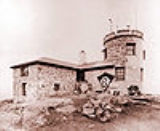
Blue Hill Meteorological Observatory

Encyclopedia
The Blue Hill Meteorological Observatory, also known as Great Blue Hill Weather Observatory, Blue Hill Weather Observatory, or simply the Blue Hill Observatory, in Milton, Massachusetts
is the foremost structure associated with the history of weather observations in the United States. Located atop Great Blue Hill
at the junction of Interstate and Route
 about 10 miles (16 km) south of Boston
, Massachusetts
, it is home to the oldest continuous weather record in North America
, and was the location of the earliest kite soundings of the atmosphere in North America in the 1890s, as well as the development of the radiosonde
in the 1930s.
Founded by Abbott Lawrence Rotch
in 1884, the observatory took a leading role in the newly emerging science of meteorology and was the scene of many of the first scientific measurements of upper atmosphere weather conditions, using kites to carry weather instruments aloft. Knowledge of wind velocities, air temperature and relative humidity at various levels came into use as vital elements in weather prediction due to techniques developed at this site. By 1895 the observatory was the source of weather forecasts of remarkable accuracy. During the Great New England Hurricane of 1938, the observatory measured the strongest wind gust ever recorded in a hurricane at 186 mph (299 km/h).
The observatory remains active to this day, continuing to add to its data base of weather observations now more than one hundred years old, and stands as a monument to the science of meteorology in the United States.
in 1884, Rotch had conceived and carried into execution his plans for the erection of a meteorological observatory on the summit of the Great Blue Hill, ten miles south of Boston, Massachusetts in the Blue Hills Reservation
, a 6,000-acre (24 km²) public park managed by the Massachusetts Department of Conservation and Recreation
.
Rotch chose the site because the elevation of 635 feet was the highest point within ten miles of the Atlantic Ocean, on the East Coast south of central Maine. The Observatory was founded as a weather station and research facility. This location afforded early weather scientists a unique opportunity for recording extremes of weather and experimenting with weather-recording instruments.
The observatory building was completed by the end of 1884 and the first regular observations were begun on February 1, 1885. Rotch became the first director of the observatory and maintained it at his own expense until his death in 1912 when he bequeathed it to Harvard University
with an endowment of $50,000.
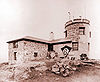 Construction of the observatory was started by Rotch in 1884 using his own private funds, and designed by architects Rotch & Tilden
. The original structure consisted of a two-story circular tower and an adjoining housing unit which contained two bedrooms, a dining room and a kitchen. In 1889, a two-story east wing was added to provide additional working space for research, domestic chores, and the library. In 1902, a two-story west wing containing a new library was added to provide additional work space. A steel fire door and brick wall connect the library to the earlier masonry structure. A timbrel vault (18 by 35 ft) of cohesive tiles spans the library. The timbrel vault tile roof is believed to have been installed by the Guastavino Company using an extremely tenacious mortar developed by Rafael Guastavino
, the founder of the firm.
Native stone, gathered from the summit of the Great Blue Hill, was used for the two-story tower, adjoining housing unit, and the east and west wings. Copper sheathing was used for roofing. A stone wall and iron fence were erected in 1905 to provide security for the building and instruments and privacy for the staff. The original stone tower eventually proved to be unsuitable. Wind-driven rain penetrated its walls, damaging the instruments and records. Vibration from the instruments on masts atop the tower contributed to the structural problems.
In 1908, the original tower was demolished and a new reinforced three-story late Gothic Revival concrete tower, 20 feet 6 inches wide and 32 feet 8 inches high was constructed in its place. The concrete construction of the tower was chosen specifically to provide the maximum amount of stability and durability in the event of high winds. The tower has a crenelated top and a cornice containing dentils. The windows are double-hung sash with a shallow recessed arch over the windows on the first and second floors.
The new tower provided the durable weather-resistant, vibration-free environment necessary for accurate instrument readings. The first floor of the tower contains the director's office. The weather bureau is on the second floor and a laboratory and access to the roof are found on the third floor. Various wind gauges and other meteorological recording instruments are attached to the roof of the tower. The observatory still retains barometers and other instrumentation dating from the late 19th century. These instruments are used to calibrate the modern instrumentation to preserve the accuracy and integrity of the data base dating back to 1885.
In 1962, a metal tower containing a siderostat
for collecting the sun's rays and directing them by mirrors to an optical bench inside the observatory, was erected adjacent to the west wing for studies related to the upper atmosphere. This project was abandoned after a few years. This tower, with its mirrors still present, is no longer in use.
The observatory has been neglected for a number of years. Although the structure is generally weather-tight, due to both solid construction and a copper roof, the reinforced concrete tower is plagued by the elements. The frost-thaw cycle has caused some cracking and spalling of the concrete.
In 1980, the building was listed in the National Register of Historic Places
as "Great Blue Hill Weather Observatory", as part of a multiple property nomination by the Commonwealth of Massachusetts entitled "Prehistoric and Historic Resources of the Blue Hills and Neponset River Reservations and Selected Adjacent Lands".
In 1981, the Metropolitan District Commission transferred responsibility for the observatory to the Blue Hill Weather Club, a local group of supporters, who plan to restore the observatory and establish a weather museum on the site. The observatory will be kept open to continue its record of continuous weather observations. The National Weather Service
continues to operate an automated weather station in the building.
A white marble stone containing a summary record of climatological data from 1885 to 1984 and dedicated to the memory of Abbott Lawrence Rotch is located on the front yard of the building.
It was declared a National Historic Landmark
in 1989 with name "Blue Hill Meteorological Observatory".
Rotch continued to work at the Blue Hill Observatory until his death on April 7, 1912. Under the terms of his will, the observatory was given to Harvard University with an endowment of $50,000 for operating costs. Harvard operated the observatory until 1971 when it disassociated itself from the site. The Rotch endowment was kept by Harvard.
After 1912, the Blue Hill Meteorological Observatory continued to operate as an active meteorological observatory. Weather observations and recordings have continued to this day, providing modern meteorologists with a record of uninterrupted climatological observations that is unique in the world.
Since these recordings were obtained from the same site with virtually no environmental change, they provide an important index to climate change
. This information is of special importance to students of climatic change, in an age where so many weather records are flawed by environmental and procedural changes, and by repeated moves of the observing site over a number of years. For this reason, the National Oceanic and Atmospheric Administration
designated the Blue Hill Observatory one of 26 International Benchmark stations within the United States
.
During the 1950s, the site housed a research group that used radar
to scan approaching thunder storms as far away as western New York State, as part of an inquiry into the causes of lightning. Findings by this group were instrumental in the development of the US weather radar
program. The installation consisted of a steel tower supporting a second-hand military radar set, several Quonset hut
s and box trailers, surrounded by a chain-link fence. Group members were on call to monitor the radar whenever severe storms could be observed. Data were also collected from a network of amateur co-operative observers who corresponded by mail. This era coincided with the end of the long career of the famous Director of the Observatory, Dr. Charles Brooks, said to be one of the few who accurately forecast the path of the destructive Hurricane of September, 1938
.
Milton, Massachusetts
Milton is a town in Norfolk County, Massachusetts, United States and part of the Greater Boston area. The population was 27,003 at the 2010 census. Milton is the birthplace of former U.S. President George H. W. Bush and architect Buckminster Fuller. Milton also has the highest percentage of...
is the foremost structure associated with the history of weather observations in the United States. Located atop Great Blue Hill
Great Blue Hill
Great Blue Hill is a hill of 635 feet located within the Blue Hills Reservation in the eastern part of the U.S. state of Massachusetts, 10 miles southwest of Boston. It is the highest point in Norfolk County...
at the junction of Interstate
and Route about 10 miles (16 km) south of BostonBoston
Boston is the capital of and largest city in Massachusetts, and is one of the oldest cities in the United States. The largest city in New England, Boston is regarded as the unofficial "Capital of New England" for its economic and cultural impact on the entire New England region. The city proper had...
, Massachusetts
Massachusetts
The Commonwealth of Massachusetts is a state in the New England region of the northeastern United States of America. It is bordered by Rhode Island and Connecticut to the south, New York to the west, and Vermont and New Hampshire to the north; at its east lies the Atlantic Ocean. As of the 2010...
, it is home to the oldest continuous weather record in North America
North America
North America is a continent wholly within the Northern Hemisphere and almost wholly within the Western Hemisphere. It is also considered a northern subcontinent of the Americas...
, and was the location of the earliest kite soundings of the atmosphere in North America in the 1890s, as well as the development of the radiosonde
Radiosonde
A radiosonde is a unit for use in weather balloons that measures various atmospheric parameters and transmits them to a fixed receiver. Radiosondes may operate at a radio frequency of 403 MHz or 1680 MHz and both types may be adjusted slightly higher or lower as required...
in the 1930s.
Founded by Abbott Lawrence Rotch
Abbott Lawrence Rotch
Abbott Lawrence Rotch was an American meteorologist and founder of the Blue Hill Meteorological Observatory, the longest continually operating observation site in the United States and an important site for world climatology....
in 1884, the observatory took a leading role in the newly emerging science of meteorology and was the scene of many of the first scientific measurements of upper atmosphere weather conditions, using kites to carry weather instruments aloft. Knowledge of wind velocities, air temperature and relative humidity at various levels came into use as vital elements in weather prediction due to techniques developed at this site. By 1895 the observatory was the source of weather forecasts of remarkable accuracy. During the Great New England Hurricane of 1938, the observatory measured the strongest wind gust ever recorded in a hurricane at 186 mph (299 km/h).
The observatory remains active to this day, continuing to add to its data base of weather observations now more than one hundred years old, and stands as a monument to the science of meteorology in the United States.
Site
The Blue Hill Meteorological Observatory was founded by American meteorologist Abbott Lawrence Rotch (1861–1912) in 1884. By the time he graduated from the Massachusetts Institute of TechnologyMassachusetts Institute of Technology
The Massachusetts Institute of Technology is a private research university located in Cambridge, Massachusetts. MIT has five schools and one college, containing a total of 32 academic departments, with a strong emphasis on scientific and technological education and research.Founded in 1861 in...
in 1884, Rotch had conceived and carried into execution his plans for the erection of a meteorological observatory on the summit of the Great Blue Hill, ten miles south of Boston, Massachusetts in the Blue Hills Reservation
Blue Hills Reservation
Blue Hills Reservation is a state park in Norfolk County, Massachusetts. Managed by the Massachusetts Department of Conservation and Recreation, it extends into Milton, Quincy, Braintree, Canton, Randolph, and Dedham south of Boston.-Description:...
, a 6,000-acre (24 km²) public park managed by the Massachusetts Department of Conservation and Recreation
Department of Conservation and Recreation (Massachusetts)
The Department of Conservation and Recreation is a state agency of the Commonwealth of Massachusetts, situated in the Executive Office of Energy and Environmental Affairs. It is best known for its parks and parkways. As of May 24, 2011 the Commissioner of the DCR is Edward M. Lambert, Jr...
.
Rotch chose the site because the elevation of 635 feet was the highest point within ten miles of the Atlantic Ocean, on the East Coast south of central Maine. The Observatory was founded as a weather station and research facility. This location afforded early weather scientists a unique opportunity for recording extremes of weather and experimenting with weather-recording instruments.
The observatory building was completed by the end of 1884 and the first regular observations were begun on February 1, 1885. Rotch became the first director of the observatory and maintained it at his own expense until his death in 1912 when he bequeathed it to Harvard University
Harvard University
Harvard University is a private Ivy League university located in Cambridge, Massachusetts, United States, established in 1636 by the Massachusetts legislature. Harvard is the oldest institution of higher learning in the United States and the first corporation chartered in the country...
with an endowment of $50,000.
The building
Rotch & Tilden
Rotch & Tilden was an American architectural firm active in Boston, Massachusetts from 1880 through 1895.The firm was organized by partners Arthur Rotch and George Thomas Tilden...
. The original structure consisted of a two-story circular tower and an adjoining housing unit which contained two bedrooms, a dining room and a kitchen. In 1889, a two-story east wing was added to provide additional working space for research, domestic chores, and the library. In 1902, a two-story west wing containing a new library was added to provide additional work space. A steel fire door and brick wall connect the library to the earlier masonry structure. A timbrel vault (18 by 35 ft) of cohesive tiles spans the library. The timbrel vault tile roof is believed to have been installed by the Guastavino Company using an extremely tenacious mortar developed by Rafael Guastavino
Rafael Guastavino
Rafael Guastavino Moreno was a Valencian architect and builder, creator of the Guastavino tile, a "Tile Arch System" patented in the US in 1885. It is a technique for constructing robust, self-supporting arches and architectural vaults using interlocking terracotta tiles and layers of mortar...
, the founder of the firm.
Native stone, gathered from the summit of the Great Blue Hill, was used for the two-story tower, adjoining housing unit, and the east and west wings. Copper sheathing was used for roofing. A stone wall and iron fence were erected in 1905 to provide security for the building and instruments and privacy for the staff. The original stone tower eventually proved to be unsuitable. Wind-driven rain penetrated its walls, damaging the instruments and records. Vibration from the instruments on masts atop the tower contributed to the structural problems.
In 1908, the original tower was demolished and a new reinforced three-story late Gothic Revival concrete tower, 20 feet 6 inches wide and 32 feet 8 inches high was constructed in its place. The concrete construction of the tower was chosen specifically to provide the maximum amount of stability and durability in the event of high winds. The tower has a crenelated top and a cornice containing dentils. The windows are double-hung sash with a shallow recessed arch over the windows on the first and second floors.
The new tower provided the durable weather-resistant, vibration-free environment necessary for accurate instrument readings. The first floor of the tower contains the director's office. The weather bureau is on the second floor and a laboratory and access to the roof are found on the third floor. Various wind gauges and other meteorological recording instruments are attached to the roof of the tower. The observatory still retains barometers and other instrumentation dating from the late 19th century. These instruments are used to calibrate the modern instrumentation to preserve the accuracy and integrity of the data base dating back to 1885.
In 1962, a metal tower containing a siderostat
Heliostat
A heliostat is a device that includes a mirror, usually a plane mirror, which turns so as to keep reflecting sunlight toward a predetermined target, compensating for the sun's apparent motions in the sky. The target may be a physical object, distant from the heliostat, or a direction in space...
for collecting the sun's rays and directing them by mirrors to an optical bench inside the observatory, was erected adjacent to the west wing for studies related to the upper atmosphere. This project was abandoned after a few years. This tower, with its mirrors still present, is no longer in use.
The observatory has been neglected for a number of years. Although the structure is generally weather-tight, due to both solid construction and a copper roof, the reinforced concrete tower is plagued by the elements. The frost-thaw cycle has caused some cracking and spalling of the concrete.
In 1980, the building was listed in the National Register of Historic Places
National Register of Historic Places
The National Register of Historic Places is the United States government's official list of districts, sites, buildings, structures, and objects deemed worthy of preservation...
as "Great Blue Hill Weather Observatory", as part of a multiple property nomination by the Commonwealth of Massachusetts entitled "Prehistoric and Historic Resources of the Blue Hills and Neponset River Reservations and Selected Adjacent Lands".
In 1981, the Metropolitan District Commission transferred responsibility for the observatory to the Blue Hill Weather Club, a local group of supporters, who plan to restore the observatory and establish a weather museum on the site. The observatory will be kept open to continue its record of continuous weather observations. The National Weather Service
National Weather Service
The National Weather Service , once known as the Weather Bureau, is one of the six scientific agencies that make up the National Oceanic and Atmospheric Administration of the United States government...
continues to operate an automated weather station in the building.
A white marble stone containing a summary record of climatological data from 1885 to 1984 and dedicated to the memory of Abbott Lawrence Rotch is located on the front yard of the building.
It was declared a National Historic Landmark
National Historic Landmark
A National Historic Landmark is a building, site, structure, object, or district, that is officially recognized by the United States government for its historical significance...
in 1989 with name "Blue Hill Meteorological Observatory".
History of its operations
Under Rotch's leadership, the Blue Hill Meteorological Observatory quickly became famous for its pioneering studies of the upper atmosphere. The study of cloud heights, directions and velocities that Rotch carried out at the Blue Hill Observatory made significant contributions to the knowledge of clouds in the early years of this century.Rotch continued to work at the Blue Hill Observatory until his death on April 7, 1912. Under the terms of his will, the observatory was given to Harvard University with an endowment of $50,000 for operating costs. Harvard operated the observatory until 1971 when it disassociated itself from the site. The Rotch endowment was kept by Harvard.
After 1912, the Blue Hill Meteorological Observatory continued to operate as an active meteorological observatory. Weather observations and recordings have continued to this day, providing modern meteorologists with a record of uninterrupted climatological observations that is unique in the world.
Since these recordings were obtained from the same site with virtually no environmental change, they provide an important index to climate change
Climate change
Climate change is a significant and lasting change in the statistical distribution of weather patterns over periods ranging from decades to millions of years. It may be a change in average weather conditions or the distribution of events around that average...
. This information is of special importance to students of climatic change, in an age where so many weather records are flawed by environmental and procedural changes, and by repeated moves of the observing site over a number of years. For this reason, the National Oceanic and Atmospheric Administration
National Oceanic and Atmospheric Administration
The National Oceanic and Atmospheric Administration , pronounced , like "noah", is a scientific agency within the United States Department of Commerce focused on the conditions of the oceans and the atmosphere...
designated the Blue Hill Observatory one of 26 International Benchmark stations within the United States
United States
The United States of America is a federal constitutional republic comprising fifty states and a federal district...
.
During the 1950s, the site housed a research group that used radar
Radar
Radar is an object-detection system which uses radio waves to determine the range, altitude, direction, or speed of objects. It can be used to detect aircraft, ships, spacecraft, guided missiles, motor vehicles, weather formations, and terrain. The radar dish or antenna transmits pulses of radio...
to scan approaching thunder storms as far away as western New York State, as part of an inquiry into the causes of lightning. Findings by this group were instrumental in the development of the US weather radar
Weather radar
Weather radar, also called weather surveillance radar and Doppler weather radar, is a type of radar used to locate precipitation, calculate its motion, estimate its type . Modern weather radars are mostly pulse-Doppler radars, capable of detecting the motion of rain droplets in addition to the...
program. The installation consisted of a steel tower supporting a second-hand military radar set, several Quonset hut
Quonset hut
A Quonset hut is a lightweight prefabricated structure of corrugated galvanized steel having a semicircular cross section. The design was based on the Nissen hut developed by the British during World War I...
s and box trailers, surrounded by a chain-link fence. Group members were on call to monitor the radar whenever severe storms could be observed. Data were also collected from a network of amateur co-operative observers who corresponded by mail. This era coincided with the end of the long career of the famous Director of the Observatory, Dr. Charles Brooks, said to be one of the few who accurately forecast the path of the destructive Hurricane of September, 1938
New England Hurricane of 1938
The New England Hurricane of 1938 was the first major hurricane to strike New England since 1869...
.