

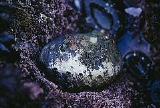
Black Abalone

Encyclopedia
The black abalone, Haliotis cracherodii, is a species
of large edible sea snail
, a marine
gastropod mollusk in the family Haliotidae, the abalones.
This species is relatively small compared with most of the other abalone species from the eastern Pacific, and it has a relatively smooth dark shell.
This used to be the most abundant large marine mollusk on the west coast of North America
, but now, because of overfishing
and the Withering Syndrome
, it has much declined in population.
:
 The coloration is dark brown, dark green, dark blue or almost black. The silvery interior of the shell shows a pale pinkish and greenish iridescence
. The exterior of the shell is smoother than most abalones, or may have low obsolete coarse spiral lirae and lines of growth. The shell is oval, evenly convex, the two sides equally curved. The back of the shell is regularly convex, with little algal growth. The shell is not carinated at the row of holes. The spire
is near the margin. The cavity of the spire is minute, concealed or nearly so. The muscle scar is generally not distinct. There are usually five to seven small, open respiratory holes, or pores, along the left side of the shell and the rims of the holes are flush with the rest of the shell. The columellar plate is not truncate below, sloping inward, its face concave. The rear of the shell is spiralled, and the mantle, foot and tentacles are black. The interior of the shell is pearly with pink and green iridescence.
The black abalone's shell length can reach a maximum of 20 cm, being typically 10–14 cm long.
In the living animal, the tentacles on the epipodium, the mantle, and the foot are black.
to Cabo San Lucas
, Baja California
, Mexico
.
Prehistoric distribution has been confirmed along much of this range from archaeological recovery at a variety of Pacific
coast
al Native American
sites. For example, Chumash peoples in central California were known to have been harvesting black abalone approximately a millennium earlier in the Morro Bay area.
The subspecies
Haliotis cracherodii californiensis is found around Guadalupe Island
, off Baja California
(Mexico
).
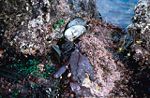 Black abalones cling to rocky surfaces in the low intertidal zone, up to 6 m deep. They can typically be found wedged into crevices, cracks, and holes during low tide
. They generally occur in areas of moderate to high surf. Juveniles tend to reside in crevices to reduce their risk of predation, but the larger adults will move out onto rock surfaces.
into their adult form, develop a shell and settle onto a rock. Juveniles do not tend to disperse great distances, and current populations of black abalone are generally composed of individuals that were spawned locally. Juveniles settle in crevices and remain hidden until they reach approximately 4 inches in length. At that point, adults congregate in more exposed areas such as rocks and in tide pools. They are thought to be able to live for between 25 and 75 years, and will begin to reproduce between three and seven years.
. Their primary food species depend on the habitat. In southern California habitats, black abalones are thought to feed on the giant kelp (Macrocystis pyrifera
) and feather boa kelp (Egregia menziesii
), while in central and northern California habitats they feed on the bull kelp (Nereocystis leutkeana).
s (such as the southern sea otter, Enhydra lutris), fish (such as the California sheephead, Semicossyphus pulcher) and invertebrate
s, including crustacean
s such as the striped shore crab, Pachygrapsus crassipes, and spiny lobster
s. Competition for space with other species (such as the sea urchins Strongylocentrotus purpuratus
and Strongylocentrotus franciscanus) is also frequent.
as Critically Endangered
(CR A4e). On June 23, 1999, the U.S. National Marine Fisheries Service (NMFS) designated the black abalone as a candidate for protection under the Endangered Species Act (64 FR 33466). On December 21, 2006, the Center for Biological Diversity submitted a petition to NMFS to list the black abalone. On January 11, 2008, NMFS completed their status review of the species and proposed that it be listed as endangered (73 FR 1986). Black abalone were listed as endangered on January 14, 2009 (74 FR 1937). The NMFS proposed a critical habitat of 390 square kilometers for the endangered black abalone on September 28, 2010. The State of California has introduced an Abalone Recovery Management Plan to guide conservation efforts.
Black abalone have dramatically declined in numbers throughout their historical range, and are locally extirpated in certain areas. This decline was initiated by overfishing. Following World War II, the California abalone fishery was not managed for individual species. Therefore, it resulted in a systematic depletion of various abalone species as the fishery over-harvested one species and then moved on to the next in an attempt to meet demand. Black abalone were the last to be targeted, with the peak harvest occurring in the 1970s. Additionally, improved harvesting technologies that expanded the harvesting areas and supported larger harvests per unit effort were not initiated. Now, all abalone fisheries in California are managed by the California Department of Fish and Game
, which restricts the size of abalones caught, and the season in which harvesting can take place. In Mexico, there is a total allowable catch limit for black abalones. Even though harvesting black abalone is regulated in California, poaching still occurs. Other threats include coastal development for residential areas, harbours and waste discharges, compounded by commercial and recreational fishing of the black abalone.
The depleted stocks of black abalone were further reduced by Withering syndrome
, first discovered in 1985, when commercial fishermen reported large numbers of empty shells and dying abalones on the shores of several of the Californian Channel Islands
(including the islands of Santa Cruz
, Anacapa
, Santa Rosa
, Santa Barbara
, San Miguel
, and San Clemente
). This disease impairs the production of digestive enzymes, effectively starving the abalone to death. Following onset of symptoms, the animal usually quickly dies. In many locations, percentages greater than 90% of individuals have been lost, and in some places, a total loss of the black abalone population occurred. The disease spread from the Channel Islands to the mainland coast in 1992, where it devastated most populations in warmer waters south of Point Conception or in locally warmer waters further north.
Species
In biology, a species is one of the basic units of biological classification and a taxonomic rank. A species is often defined as a group of organisms capable of interbreeding and producing fertile offspring. While in many cases this definition is adequate, more precise or differing measures are...
of large edible sea snail
Snail
Snail is a common name applied to most of the members of the molluscan class Gastropoda that have coiled shells in the adult stage. When the word is used in its most general sense, it includes sea snails, land snails and freshwater snails. The word snail without any qualifier is however more often...
, a marine
Marine (ocean)
Marine is an umbrella term. As an adjective it is usually applicable to things relating to the sea or ocean, such as marine biology, marine ecology and marine geology...
gastropod mollusk in the family Haliotidae, the abalones.
This species is relatively small compared with most of the other abalone species from the eastern Pacific, and it has a relatively smooth dark shell.
This used to be the most abundant large marine mollusk on the west coast of North America
North America
North America is a continent wholly within the Northern Hemisphere and almost wholly within the Western Hemisphere. It is also considered a northern subcontinent of the Americas...
, but now, because of overfishing
Overfishing
Overfishing occurs when fishing activities reduce fish stocks below an acceptable level. This can occur in any body of water from a pond to the oceans....
and the Withering Syndrome
Withering Abalone Syndrome
Withering abalone syndrome is a disease of the abalone shellfish, primarily found in the black and red abalone species.First described in 1986, it is caused by the bacterium "Candidatus Xenohaliotis californiensis", which attacks the lining of the abalone's digestive tract, inhibiting the...
, it has much declined in population.
Taxonomy
Haliotis cracherodii comprises two subspeciesSubspecies
Subspecies in biological classification, is either a taxonomic rank subordinate to species, ora taxonomic unit in that rank . A subspecies cannot be recognized in isolation: a species will either be recognized as having no subspecies at all or two or more, never just one...
:
- Haliotis cracherodii californiensis Swainson, 1822
- Haliotis cracherodii cracherodii Leach, 1814
Description
Iridescence
Iridescence is generally known as the property of certain surfaces which appear to change color as the angle of view or the angle of illumination changes...
. The exterior of the shell is smoother than most abalones, or may have low obsolete coarse spiral lirae and lines of growth. The shell is oval, evenly convex, the two sides equally curved. The back of the shell is regularly convex, with little algal growth. The shell is not carinated at the row of holes. The spire
Spire (mollusc)
A spire is a descriptive term for part of the coiled shell of mollusks. The word is a convenient aid in describing shells, but it does not refer to a very precise part of shell anatomy: the spire consists of all of the whorls except for the body whorl...
is near the margin. The cavity of the spire is minute, concealed or nearly so. The muscle scar is generally not distinct. There are usually five to seven small, open respiratory holes, or pores, along the left side of the shell and the rims of the holes are flush with the rest of the shell. The columellar plate is not truncate below, sloping inward, its face concave. The rear of the shell is spiralled, and the mantle, foot and tentacles are black. The interior of the shell is pearly with pink and green iridescence.
The black abalone's shell length can reach a maximum of 20 cm, being typically 10–14 cm long.
In the living animal, the tentacles on the epipodium, the mantle, and the foot are black.
Distribution
Black abalones can be found along the Pacific coast of the USA from Mendocino County, CaliforniaMendocino County, California
Mendocino County is a county located on the north coast of the U.S. state of California, north of the greater San Francisco Bay Area and west of the Central Valley. As of the 2010 census, the population was 87,841, up from 86,265 at the 2000 census...
to Cabo San Lucas
Cabo San Lucas
Cabo San Lucas , commonly called Cabo, is a city at the southern tip of the Baja California peninsula, in the municipality of Los Cabos in the Mexican state of Baja California Sur. As of the 2010 census, the population was 68,463 people...
, Baja California
Baja California
Baja California officially Estado Libre y Soberano de Baja California is one of the 31 states which, with the Federal District, comprise the 32 Federal Entities of Mexico. It is both the northernmost and westernmost state of Mexico. Before becoming a state in 1953, the area was known as the North...
, Mexico
Mexico
The United Mexican States , commonly known as Mexico , is a federal constitutional republic in North America. It is bordered on the north by the United States; on the south and west by the Pacific Ocean; on the southeast by Guatemala, Belize, and the Caribbean Sea; and on the east by the Gulf of...
.
Prehistoric distribution has been confirmed along much of this range from archaeological recovery at a variety of Pacific
Pacific Ocean
The Pacific Ocean is the largest of the Earth's oceanic divisions. It extends from the Arctic in the north to the Southern Ocean in the south, bounded by Asia and Australia in the west, and the Americas in the east.At 165.2 million square kilometres in area, this largest division of the World...
coast
Coast
A coastline or seashore is the area where land meets the sea or ocean. A precise line that can be called a coastline cannot be determined due to the dynamic nature of tides. The term "coastal zone" can be used instead, which is a spatial zone where interaction of the sea and land processes occurs...
al Native American
Indigenous peoples of the Americas
The indigenous peoples of the Americas are the pre-Columbian inhabitants of North and South America, their descendants and other ethnic groups who are identified with those peoples. Indigenous peoples are known in Canada as Aboriginal peoples, and in the United States as Native Americans...
sites. For example, Chumash peoples in central California were known to have been harvesting black abalone approximately a millennium earlier in the Morro Bay area.
The subspecies
Subspecies
Subspecies in biological classification, is either a taxonomic rank subordinate to species, ora taxonomic unit in that rank . A subspecies cannot be recognized in isolation: a species will either be recognized as having no subspecies at all or two or more, never just one...
Haliotis cracherodii californiensis is found around Guadalupe Island
Guadalupe Island
Guadalupe Island, or Isla Guadalupe is a volcanic island located 241 kilometers off the west coast of Mexico's Baja California peninsula and some 400 kilometers southwest of the city of Ensenada in Baja California state, in the Pacific Ocean...
, off Baja California
Baja California
Baja California officially Estado Libre y Soberano de Baja California is one of the 31 states which, with the Federal District, comprise the 32 Federal Entities of Mexico. It is both the northernmost and westernmost state of Mexico. Before becoming a state in 1953, the area was known as the North...
(Mexico
Mexico
The United Mexican States , commonly known as Mexico , is a federal constitutional republic in North America. It is bordered on the north by the United States; on the south and west by the Pacific Ocean; on the southeast by Guatemala, Belize, and the Caribbean Sea; and on the east by the Gulf of...
).
Habitat
Tide
Tides are the rise and fall of sea levels caused by the combined effects of the gravitational forces exerted by the moon and the sun and the rotation of the Earth....
. They generally occur in areas of moderate to high surf. Juveniles tend to reside in crevices to reduce their risk of predation, but the larger adults will move out onto rock surfaces.
Life cycle
Black abalone reach sexual maturity at 3 years and can live 30 years or more. Spawning occurs in spring and early summer; occasionally, a second spawn occurs in the fall. Black abalone are broadcast spawners, and successful spawning requires that individuals be grouped closely together. Larvae are free-swimming for between 5 and 14 days before they settle onto hard substrate, usually near larger individuals,, where they then metamorphoseMetamorphosis
Metamorphosis is a biological process by which an animal physically develops after birth or hatching, involving a conspicuous and relatively abrupt change in the animal's body structure through cell growth and differentiation...
into their adult form, develop a shell and settle onto a rock. Juveniles do not tend to disperse great distances, and current populations of black abalone are generally composed of individuals that were spawned locally. Juveniles settle in crevices and remain hidden until they reach approximately 4 inches in length. At that point, adults congregate in more exposed areas such as rocks and in tide pools. They are thought to be able to live for between 25 and 75 years, and will begin to reproduce between three and seven years.
Feeding habits
Black abalones are herbivorous gastropods, and feed mostly on drift algae and kelpKelp
Kelps are large seaweeds belonging to the brown algae in the order Laminariales. There are about 30 different genera....
. Their primary food species depend on the habitat. In southern California habitats, black abalones are thought to feed on the giant kelp (Macrocystis pyrifera
Macrocystis pyrifera
Macrocystis pyrifera, commonly known as Giant kelp or Giant bladder kelp, is a species of kelp , and one of four species in the genus Macrocystis...
) and feather boa kelp (Egregia menziesii
Egregia menziesii
Egregia menziesii is a species of kelp known commonly as feather boa kelp. It is native to the coastline of western North America from Alaska to Baja California, where it is a common kelp of the intertidal zone. It is dark brown in color, shiny and bumpy in texture, and may reach over five meters...
), while in central and northern California habitats they feed on the bull kelp (Nereocystis leutkeana).
Interspecific relationships
Predators of this species other than mankind are sea otterSea Otter
The sea otter is a marine mammal native to the coasts of the northern and eastern North Pacific Ocean. Adult sea otters typically weigh between 14 and 45 kg , making them the heaviest members of the weasel family, but among the smallest marine mammals...
s (such as the southern sea otter, Enhydra lutris), fish (such as the California sheephead, Semicossyphus pulcher) and invertebrate
Invertebrate
An invertebrate is an animal without a backbone. The group includes 97% of all animal species – all animals except those in the chordate subphylum Vertebrata .Invertebrates form a paraphyletic group...
s, including crustacean
Crustacean
Crustaceans form a very large group of arthropods, usually treated as a subphylum, which includes such familiar animals as crabs, lobsters, crayfish, shrimp, krill and barnacles. The 50,000 described species range in size from Stygotantulus stocki at , to the Japanese spider crab with a leg span...
s such as the striped shore crab, Pachygrapsus crassipes, and spiny lobster
Spiny lobster
Spiny lobsters, also known as langouste or rock lobsters, are a family of about 45 species of achelate crustaceans, in the Decapoda Reptantia...
s. Competition for space with other species (such as the sea urchins Strongylocentrotus purpuratus
Strongylocentrotus purpuratus
The purple sea urchin, Strongylocentrotus purpuratus, lives along the eastern edge of the Pacific Ocean extending from Ensenada, Mexico to British Columbia, Canada. This sea urchin species is deep purple in color and lives in lower intertidal and nearshore subtidal communities...
and Strongylocentrotus franciscanus) is also frequent.
Human uses
Humans have harvested black abalones along the California Coast for at least 10,000 years. On San Miguel Island, archaeological evidence shows that the Island Chumash people and their ancestors ate black abalone for millennia and also used the shells to make fishhooks, beads, and ornaments. After the Chumash and other California Indians were devastated by European diseases, and sea otters were nearly eradicated from California waters by the historic fur trade, black abalone populations rebounded and attracted an intensive intertidal fishery conducted primarily by Chinese immigrants from the 1850s to about 1900.Conservation status
Black abalone are listed on the International Union for Conservation of Nature's Red ListIUCN Red List
The IUCN Red List of Threatened Species , founded in 1963, is the world's most comprehensive inventory of the global conservation status of biological species. The International Union for Conservation of Nature is the world's main authority on the conservation status of species...
as Critically Endangered
Critically Endangered
Critically Endangered is the highest risk category assigned by the IUCN Red List for wild species. Critically Endangered means that a species' numbers have decreased, or will decrease, by 80% within three generations....
(CR A4e). On June 23, 1999, the U.S. National Marine Fisheries Service (NMFS) designated the black abalone as a candidate for protection under the Endangered Species Act (64 FR 33466). On December 21, 2006, the Center for Biological Diversity submitted a petition to NMFS to list the black abalone. On January 11, 2008, NMFS completed their status review of the species and proposed that it be listed as endangered (73 FR 1986). Black abalone were listed as endangered on January 14, 2009 (74 FR 1937). The NMFS proposed a critical habitat of 390 square kilometers for the endangered black abalone on September 28, 2010. The State of California has introduced an Abalone Recovery Management Plan to guide conservation efforts.
Black abalone have dramatically declined in numbers throughout their historical range, and are locally extirpated in certain areas. This decline was initiated by overfishing. Following World War II, the California abalone fishery was not managed for individual species. Therefore, it resulted in a systematic depletion of various abalone species as the fishery over-harvested one species and then moved on to the next in an attempt to meet demand. Black abalone were the last to be targeted, with the peak harvest occurring in the 1970s. Additionally, improved harvesting technologies that expanded the harvesting areas and supported larger harvests per unit effort were not initiated. Now, all abalone fisheries in California are managed by the California Department of Fish and Game
California Department of Fish and Game
The California Department of Fish and Game is a department within the government of California, falling under its parent California Natural Resources Agency. The Department of Fish and Game manages and protects the state's diverse fish, wildlife, plant resources, and native habitats...
, which restricts the size of abalones caught, and the season in which harvesting can take place. In Mexico, there is a total allowable catch limit for black abalones. Even though harvesting black abalone is regulated in California, poaching still occurs. Other threats include coastal development for residential areas, harbours and waste discharges, compounded by commercial and recreational fishing of the black abalone.
The depleted stocks of black abalone were further reduced by Withering syndrome
Withering Abalone Syndrome
Withering abalone syndrome is a disease of the abalone shellfish, primarily found in the black and red abalone species.First described in 1986, it is caused by the bacterium "Candidatus Xenohaliotis californiensis", which attacks the lining of the abalone's digestive tract, inhibiting the...
, first discovered in 1985, when commercial fishermen reported large numbers of empty shells and dying abalones on the shores of several of the Californian Channel Islands
Channel Islands of California
The Channel Islands of California are a chain of eight islands located in the Pacific Ocean off the coast of Southern California along the Santa Barbara Channel in the United States of America...
(including the islands of Santa Cruz
Santa Cruz Island
Santa Cruz Island was the largest privately owned island off the continental United States, but is currently part-owned by the National Park service . The island, located off the coast of California, is long and from wide...
, Anacapa
Anacapa Island
Anacapa Island is a small volcanic island located about off the coast of Port Hueneme, California, in Ventura County. The Island is composed of a series of narrow islets six miles long, running in a mostly east-west orientation, five miles east of Santa Cruz Island...
, Santa Rosa
Santa Rosa Island, California
Santa Rosa Island is the second largest of the Channel Islands of California at 53,195 acres . Defined by the United States Census Bureau as Block 3009, Block Group 3, Census Tract 29.10 of Santa Barbara County, California, the 2000 census showed an official population of 2 persons. It is part of...
, Santa Barbara
Santa Barbara Island
Santa Barbara Island is a small island of the Channel Islands archipelago in California. It is located about off the Southern California coast from the Palos Verdes Peninsula, near Los Angeles in Ventura County, California....
, San Miguel
San Miguel Island
San Miguel Island is the westernmost of California's Channel Islands, located across the Santa Barbara Channel in the Pacific Ocean, within Santa Barbara County, California. San Miguel is the sixth-largest of the eight Channel Islands at , including offshore islands and rocks. Prince Island, off...
, and San Clemente
San Clemente Island
San Clemente Island is the southernmost of the Channel Islands of California. It is owned and operated by the United States Navy, and is a part of Los Angeles County. Defined by the United States Census Bureau as Block Group 2 of Census Tract 5991 of Los Angeles County, California, it is long and...
). This disease impairs the production of digestive enzymes, effectively starving the abalone to death. Following onset of symptoms, the animal usually quickly dies. In many locations, percentages greater than 90% of individuals have been lost, and in some places, a total loss of the black abalone population occurred. The disease spread from the Channel Islands to the mainland coast in 1992, where it devastated most populations in warmer waters south of Point Conception or in locally warmer waters further north.
Further reading
- Geiger D.L. & Poppe G.T. (2000). A Conchological Iconography: The family Haliotidae. Conchbooks, Hackenheim Germany. 135 pp., 83 pls.