

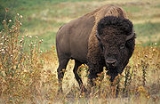
Plains Bison

Encyclopedia
The Plains Bison or Common bison is one of two subspecies
/ecotype
s of the American Bison
, the other being the Wood Bison
(Bison bison athabascae). Furthermore, it has been suggested that the Plains Bison consists of a northern (Bison bison montanae) and a southern subspecies, bringing the total to three. However, this is generally not supported.
. Bison taken from this transplant were also introduced to other Alaska
locations, including Farewell and Chitina
. The Delta Junction herd has fared best, with a population of multiple hundreds throughout the late 20th century. This herd is popular with hunters interested in hundreds of pounds of high quality meat, but has been a problem for farming operations in the area.
In 2006, Plains Bison from Elk Island National Park
in Alberta
were released into Grasslands National Park
in Saskatchewan
. This marks the first time Plains Bison have wandered the shortgrass prairie
s of Canada since their near-extinction at the turn of the 20th century.
A herd of approximately 550 of these animals lives in, and can be seen at, the Wichita Mountains Wildlife Refuge near Lawton, Oklahoma
. The herd was started in 1907 with stock from the Bronx Zoo
. Fifteen animals were shipped to Oklahoma, where they had already become extinct due to excessive hunting and over harvesting
by non-Native commercial buffalo hunters from 1874 to 1878.
s, beads, berry pounders, hide scrapers, hoes, needles from bones; spoons from the horns; bow strings and thread from the sinew; waterproof containers from the bladder; paint brushes from the tail and bones with intact marrow; cooking oil from grease. Skulls can be used ceremonially as altars. Rawhide is used for parfleche
s, shield covers, and moccasin
soles. Hides with the fur is used for blankets, wraps, and warm clothing. Tanned hides, the finest of which are tanned with the animal's brains and then smoked, are used in clothing, moccasins, tipi
covers, calendars, and artwork.
Subspecies
Subspecies in biological classification, is either a taxonomic rank subordinate to species, ora taxonomic unit in that rank . A subspecies cannot be recognized in isolation: a species will either be recognized as having no subspecies at all or two or more, never just one...
/ecotype
Ecotype
In evolutionary ecology, an ecotype,Greek: οίκος = home and τύπος = type, coined by Göte Turesson in 1922 sometimes called ecospecies, describes a genetically distinct geographic variety, population or race within species , which is adapted to specific environmental conditions.Typically, ecotypes...
s of the American Bison
American Bison
The American bison , also commonly known as the American buffalo, is a North American species of bison that once roamed the grasslands of North America in massive herds...
, the other being the Wood Bison
Wood Bison
The Wood Bison, Bison bison athabascae, also called Mountain Bison, Wood Buffalo or Mountain Buffalo, is a distinct northern subspecies or ecotype of the American Bison...
(Bison bison athabascae). Furthermore, it has been suggested that the Plains Bison consists of a northern (Bison bison montanae) and a southern subspecies, bringing the total to three. However, this is generally not supported.
Reintroduction of herds
Plains Bison have been introduced into a number of locations around North America. The farthest north introduction occurred in 1928 when the Alaska Game Commission brought bison to the area of present day Delta JunctionDelta Junction, Alaska
Delta Junction is a city in the Southeast Fairbanks Census Area, Alaska, United States. According to 2005 Census Bureau estimates, the population of the city is 897. The city is located a short distance south of the confluence of the Delta River with the Tanana River, which is at Big Delta...
. Bison taken from this transplant were also introduced to other Alaska
Alaska
Alaska is the largest state in the United States by area. It is situated in the northwest extremity of the North American continent, with Canada to the east, the Arctic Ocean to the north, and the Pacific Ocean to the west and south, with Russia further west across the Bering Strait...
locations, including Farewell and Chitina
Chitina, Alaska
Chitina is a census-designated place in Valdez-Cordova Census Area, Alaska, United States. At the 2000 census the population was 123.-Geography:Chitina is located at ....
. The Delta Junction herd has fared best, with a population of multiple hundreds throughout the late 20th century. This herd is popular with hunters interested in hundreds of pounds of high quality meat, but has been a problem for farming operations in the area.
In 2006, Plains Bison from Elk Island National Park
Elk Island National Park
Elk Island National Park , is one of 43 national parks and park reserves administered by the Parks Canada Agency. This “island of conservation” is located 35 km east of Edmonton, Alberta along the Yellowhead Highway, which nearly bisects the park...
in Alberta
Alberta
Alberta is a province of Canada. It had an estimated population of 3.7 million in 2010 making it the most populous of Canada's three prairie provinces...
were released into Grasslands National Park
Grasslands National Park
Grasslands National Park is one of Canada's newer national parks, located in southern Saskatchewan, and one of 43 parks and park reserves in Canada's national park system...
in Saskatchewan
Saskatchewan
Saskatchewan is a prairie province in Canada, which has an area of . Saskatchewan is bordered on the west by Alberta, on the north by the Northwest Territories, on the east by Manitoba, and on the south by the U.S. states of Montana and North Dakota....
. This marks the first time Plains Bison have wandered the shortgrass prairie
Shortgrass prairie
The shortgrass prairie ecosystem of the North American Great Plains is a prairie that includes lands from the eastern foothills of the Rocky Mountains east to Nebraska and Saskatchewan, including rangelands in Alberta, Wyoming, Montana, North, South Dakota, and Kansas, and extending to the south...
s of Canada since their near-extinction at the turn of the 20th century.
A herd of approximately 550 of these animals lives in, and can be seen at, the Wichita Mountains Wildlife Refuge near Lawton, Oklahoma
Lawton, Oklahoma
The city of Lawton is the county seat of Comanche County, in the U.S. state of Oklahoma. Located in the southwestern region of Oklahoma approximately southwest of Oklahoma City, it is the principal city of the Lawton Oklahoma Metropolitan Statistical Area...
. The herd was started in 1907 with stock from the Bronx Zoo
Bronx Zoo
The Bronx Zoo is located in the Bronx borough of New York City, within Bronx Park. It is the largest metropolitan zoo in the United States, comprising of park lands and naturalistic habitats, through which the Bronx River flows....
. Fifteen animals were shipped to Oklahoma, where they had already become extinct due to excessive hunting and over harvesting
Overexploitation
Overexploitation, also called overharvesting, refers to harvesting a renewable resource to the point of diminishing returns. Sustained overexploitation can lead to the destruction of the resource...
by non-Native commercial buffalo hunters from 1874 to 1878.
Uses
Besides using the meat, fat, and organs for food, Plains tribes have traditionally created a wide variety of tools and items from bison. These include arrow points, awlStitching awl
A stitching awl is a simple tool with which holes can be punctured in a variety of materials, or existing holes can be enlarged. It is also used for sewing heavy materials, such as leather or canvas. It is a thin, tapered metal shaft, coming to a sharp point, either straight or slightly bent....
s, beads, berry pounders, hide scrapers, hoes, needles from bones; spoons from the horns; bow strings and thread from the sinew; waterproof containers from the bladder; paint brushes from the tail and bones with intact marrow; cooking oil from grease. Skulls can be used ceremonially as altars. Rawhide is used for parfleche
Parfleche
A parfleche is a Native American rawhide bag, typically used for holding dried meats and pemmican.The word was originally used by French fur traders...
s, shield covers, and moccasin
Moccasin
A Moccasin is a form of shoe worn by Native Americans, as well as by hunters, traders, and settlers in the frontier regions of North America.Moccasin may also refer to:* Moccasin , an American Thoroughbred racehorse-Places:...
soles. Hides with the fur is used for blankets, wraps, and warm clothing. Tanned hides, the finest of which are tanned with the animal's brains and then smoked, are used in clothing, moccasins, tipi
Tipi
A tipi is a Lakota name for a conical tent traditionally made of animal skins and wooden poles used by the nomadic tribes and sedentary tribal dwellers of the Great Plains...
covers, calendars, and artwork.