


Binary logarithm

Encyclopedia
Mathematics
Mathematics is the study of quantity, space, structure, and change. Mathematicians seek out patterns and formulate new conjectures. Mathematicians resolve the truth or falsity of conjectures by mathematical proofs, which are arguments sufficient to convince other mathematicians of their validity...
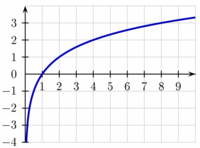
, the binary logarithm (log2 n) is the logarithm
Logarithm
The logarithm of a number is the exponent by which another fixed value, the base, has to be raised to produce that number. For example, the logarithm of 1000 to base 10 is 3, because 1000 is 10 to the power 3: More generally, if x = by, then y is the logarithm of x to base b, and is written...
to the base 2
Binary numeral system
The binary numeral system, or base-2 number system, represents numeric values using two symbols, 0 and 1. More specifically, the usual base-2 system is a positional notation with a radix of 2...
. It is the inverse function
Inverse function
In mathematics, an inverse function is a function that undoes another function: If an input x into the function ƒ produces an output y, then putting y into the inverse function g produces the output x, and vice versa. i.e., ƒ=y, and g=x...
of n ↦ 2n. The binary logarithm of n is the power to which the number 2 must be raised to obtain the value n. This makes the binary logarithm useful for anything involving powers of 2, i.e. doubling. For example, the binary logarithm of 1 is 0, the binary logarithm of 2 is 1, the binary logarithm of 4 is 2, the binary logarithm of 8 is 3, the binary logarithm of 16 is 4 and the binary logarithm of 32 is 5.
Information theory
The binary logarithm is often used in computer scienceComputer science
Computer science or computing science is the study of the theoretical foundations of information and computation and of practical techniques for their implementation and application in computer systems...
and information theory
Information theory
Information theory is a branch of applied mathematics and electrical engineering involving the quantification of information. Information theory was developed by Claude E. Shannon to find fundamental limits on signal processing operations such as compressing data and on reliably storing and...
because it is closely connected to the binary numeral system
Binary numeral system
The binary numeral system, or base-2 number system, represents numeric values using two symbols, 0 and 1. More specifically, the usual base-2 system is a positional notation with a radix of 2...
. It is frequently written ld n, from Latin
Latin
Latin is an Italic language originally spoken in Latium and Ancient Rome. It, along with most European languages, is a descendant of the ancient Proto-Indo-European language. Although it is considered a dead language, a number of scholars and members of the Christian clergy speak it fluently, and...
logarithmus duālis, or lg n, although the ISO
ISO 31-11
ISO 31-11 was the part of international standard ISO 31 that defines mathematical signs and symbols for use in physical sciences and technology...
specification is that it should be lb (n), lg (n) being reserved for log10 n. The number of digits (bit
Bit
A bit is the basic unit of information in computing and telecommunications; it is the amount of information stored by a digital device or other physical system that exists in one of two possible distinct states...
s) in the binary representation of a positive integer n is the integral part of 1 + lb n, i.e.

In information theory, the definition of the amount of self-information
Self-information
In information theory, self-information is a measure of the information content associated with the outcome of a random variable. It is expressed in a unit of information, for example bits,nats,or...
and information entropy
Information entropy
In information theory, entropy is a measure of the uncertainty associated with a random variable. In this context, the term usually refers to the Shannon entropy, which quantifies the expected value of the information contained in a message, usually in units such as bits...
involves the binary logarithm; this is needed because the unit of information, the bit, refers to information resulting from an occurrence of one of two equally probable alternatives.
Computational complexity
The binary logarithm also frequently appears in the analysis of algorithmsAnalysis of algorithms
To analyze an algorithm is to determine the amount of resources necessary to execute it. Most algorithms are designed to work with inputs of arbitrary length...
. If a number n greater than 1 is divided by 2 repeatedly, the number of iterations needed to get a value at most 1 is again the integral part of lb n. This idea is used in the analysis of several algorithm
Algorithm
In mathematics and computer science, an algorithm is an effective method expressed as a finite list of well-defined instructions for calculating a function. Algorithms are used for calculation, data processing, and automated reasoning...
s and data structure
Data structure
In computer science, a data structure is a particular way of storing and organizing data in a computer so that it can be used efficiently.Different kinds of data structures are suited to different kinds of applications, and some are highly specialized to specific tasks...
s. For example, in binary search, the size of the problem to be solved is halved with each iteration, and therefore roughly lb n iterations are needed to obtain a problem of size 1, which is solved easily in constant time. Similarly, a perfectly balanced binary search tree
Binary search tree
In computer science, a binary search tree , which may sometimes also be called an ordered or sorted binary tree, is a node-based binary tree data structurewhich has the following properties:...
containing n elements has height lb n + 1.
However, the running time of an algorithm is usually expressed in big O notation
Big O notation
In mathematics, big O notation is used to describe the limiting behavior of a function when the argument tends towards a particular value or infinity, usually in terms of simpler functions. It is a member of a larger family of notations that is called Landau notation, Bachmann-Landau notation, or...
, ignoring constant factors. Since log2 n = (1/logk 2)logk n, where k can be any number greater than 1, algorithms that run in O(log2 n) time can also be said to run in, say, O(log13 n) time. The base of the logarithm in expressions such as O(log n) or O(n log n) is therefore not important.
In other contexts, though, the base of the logarithm needs to be specified. For example O(2lb n) is not the same as O(2ln n) because the former is equal to O(n) and the latter to O(n0.6931...).
Algorithms with running time n lb n are sometimes called linearithmic. Some examples of algorithms with running time O(lb n) or O(n lb n) are:
- average time quicksort
- binary search treeBinary search treeIn computer science, a binary search tree , which may sometimes also be called an ordered or sorted binary tree, is a node-based binary tree data structurewhich has the following properties:...
s - merge sortMerge sortMerge sort is an O comparison-based sorting algorithm. Most implementations produce a stable sort, meaning that the implementation preserves the input order of equal elements in the sorted output. It is a divide and conquer algorithm...
- Monge arrayMonge arrayIn computer science, Monge arrays, or Monge matrices, are mathematical objects named for their discoverer, the French mathematician Gaspard Monge....
calculation
Using calculators
An easy way to calculate the log2(n) on calculatorCalculator
An electronic calculator is a small, portable, usually inexpensive electronic device used to perform the basic operations of arithmetic. Modern calculators are more portable than most computers, though most PDAs are comparable in size to handheld calculators.The first solid-state electronic...
s that do not have a log2-function is to use the natural logarithm
Natural logarithm
The natural logarithm is the logarithm to the base e, where e is an irrational and transcendental constant approximately equal to 2.718281828...
"ln" or the common logarithm
Common logarithm
The common logarithm is the logarithm with base 10. It is also known as the decadic logarithm, named after its base. It is indicated by log10, or sometimes Log with a capital L...
"log" functions, which are found on most "scientific calculators". The specific change of logarithm base formulae for this are:
- log2(n) = ln(n)/ln(2) = log(n)/log(2)
so
- log2(n) = loge(n)×1.442695... = log10(n)×3.321928...
and this produces the curiosity that log2(n) is within 0.6% of loge(n) + log10(n). loge(n)+log10(n) is actually log2.0081359...(n) where the base is e1/(1+log10e) = 101/(1 + loge10) ≈ 2.00813 59293 46243 95422 87563 25191 0 to (32 significant figures). Of course, log1010 = logee = 1.
Integer
For integer domainDomain (mathematics)
In mathematics, the domain of definition or simply the domain of a function is the set of "input" or argument values for which the function is defined...
and range
Range (mathematics)
In mathematics, the range of a function refers to either the codomain or the image of the function, depending upon usage. This ambiguity is illustrated by the function f that maps real numbers to real numbers with f = x^2. Some books say that range of this function is its codomain, the set of all...
, the binary logarithm can be computed rounding
Rounding
Rounding a numerical value means replacing it by another value that is approximately equal but has a shorter, simpler, or more explicit representation; for example, replacing $23.4476 with $23.45, or the fraction 312/937 with 1/3, or the expression √2 with 1.414.Rounding is often done on purpose to...
up or down. These two forms of integer binary logarithm are related by this formula:

The definition can be extended by defining
 . This function is related to the number of leading zeros of the 32-bit unsigned binary representation of x, nlz(x).
The following example code, slightly altered, in the C language
C (programming language)
C is a general-purpose computer programming language developed between 1969 and 1973 by Dennis Ritchie at the Bell Telephone Laboratories for use with the Unix operating system....
computes the binary logarithm (rounding down) of an integer. The operator
>> Logical shift
In computer science, a logical shift is a bitwise operation that shifts all the bits of its operand. Unlike an arithmetic shift, a logical shift does not preserve a number's sign bit or distinguish a number's exponent from its mantissa; every bit in the operand is simply moved a given number of bit...
". The rounding down form of binary logarithm is identical to computing the position of the most significant 1 bit.
/**
* Returns the floor form of binary logarithm for a 32 bit integer.
* −1 is returned if n is 0.
*/
int floorLog2(unsigned int n) {
if (n 0)
return -1;
int pos = 0;
if (n >= (1 <<16)) { n >>= 16; pos += 16; }
if (n >= (1 << 8)) { n >>= 8; pos += 8; }
if (n >= (1 << 4)) { n >>= 4; pos += 4; }
if (n >= (1 << 2)) { n >>= 2; pos += 2; }
if (n >= (1 << 1)) { pos += 1; }
return pos;
}
Real number
For a general positive real number, the binary logarithm may be computed in two parts:- Compute the integerIntegerThe integers are formed by the natural numbers together with the negatives of the non-zero natural numbers .They are known as Positive and Negative Integers respectively...
part,
- Compute the fractional part
Computing the integral part is straightforward. For any x > 0, there exists a unique integer n such that 2n ≤ x < 2n+1, or equivalently 1 ≤ 2−nx < 2. Now the integral part of the logarithm is simply n, and the fractional part is lb(2−nx). In other words:

The fractional part of the result is
 , and can be computed recursively
Recursion
Recursion is the process of repeating items in a self-similar way. For instance, when the surfaces of two mirrors are exactly parallel with each other the nested images that occur are a form of infinite recursion. The term has a variety of meanings specific to a variety of disciplines ranging from...
, using only elementary multiplication and division. To compute the fractional part:
- We start with a real number
 . If
. If  , then we are done and the fractional part is zero.
 - Otherwise, square
 repeatedly until the result is
  . Let
. Let  be the number of squarings needed. That is,
  with
with  chosen such that
  .
. - Taking the logarithm of both sides and doing some algebra:

- Notice that
 is once again a real number in the interval
  .
. - Return to step 1, and compute the binary logarithm of
 using the same method recursively.
The result of this is expressed by the following formulas, in which is the number of squarings required in the i-th recursion of the algorithm:
In the special case where the fractional part in step 1 is found to be zero, this is a finite sequence terminating at some point. Otherwise, it is an infinite series which converges according to the ratio test, since each term is strictly less than the previous one (since every ). For practical use, this infinite series must be truncated to reach an approximate result. If the series is truncated after the i-th term, then the error in the result is less than
  .
.
Example code
The following PythonPython (programming language)Python is a general-purpose, high-level programming language whose design philosophy emphasizes code readability. Python claims to "[combine] remarkable power with very clear syntax", and its standard library is large and comprehensive...
program computes the binary logarithm using the recursive method outlined above, showing the steps along the way:
(This code fails when finding the binary logarithm of any number 2^n where n is any integer.)
def lg(x):
ip = 0
rem = x
# Integer part
while rem<1:
ip -= 1
rem *= 2
while rem>=2:
ip += 1
rem /= 2
print("lg(%g) = %d + lg(%g)" % (x, ip, rem)) # Brackets required for Python 3
# Fractional part
res = ip + frac_lg(rem)
return res
def frac_lg(x, fp=1.0, tol=1e-10):
assert 1<=x<2
# terminate the recursion if we're close enough
if fp
# square until >= 2
rem = x
m = 0
while rem < 2:
m += 1
fp /= 2
rem *= rem
# now:
# rem = x**2**m, fp = 2**-m
# => lg(rem) = lg(x)*2**m = lg(x)/fp
# => lg(x) = fp * ( lg(rem/2) + 1 )
# = fp + fp*lg(rem/2)
# time for recursion!
print("lg(x=%g) \t= 2**%d * ( 1 + lg(%g) )" % (x, -m, rem/2))
return fp + frac_lg(rem/2, fp)
if __name__ '__main__':
value = 4.5
print " X =", value
result = lg(value)
print("lg(X) =", result)# Brackets required for Python 3
- Sample output
- $ python log2.py
- X = 4.5
- lg(4.5) = 2 + lg(1.125)
- lg(x=1.125) = 2**-3 * ( 1 + lg(1.28289) )
- lg(x=1.28289) = 2**-2 * ( 1 + lg(1.35435) )
- lg(x=1.35435) = 2**-2 * ( 1 + lg(1.68226) )
- lg(x=1.68226) = 2**-1 * ( 1 + lg(1.415) )
- lg(x=1.415) = 2**-1 * ( 1 + lg(1.00111) )
- lg(x=1.00111) = 2**-10 * ( 1 + lg(1.55742) )
- lg(x=1.55742) = 2**-1 * ( 1 + lg(1.21278) )
- lg(x=1.21278) = 2**-2 * ( 1 + lg(1.08166) )
- lg(x=1.08166) = 2**-4 * ( 1 + lg(1.75563) )
- lg(x=1.75563) = 2**-1 * ( 1 + lg(1.54113) )
- lg(x=1.54113) = 2**-1 * ( 1 + lg(1.18753) )
- lg(x=1.18753) = 2**-3 * ( 1 + lg(1.97759) )
- lg(x=1.97759) = 2**-1 * ( 1 + lg(1.95543) )
- lg(x=1.95543) = 2**-1 * ( 1 + lg(1.91185) )
- lg(x=1.91185) = 2**-1 * ( 1 + lg(1.82758) )
- lg(X) = 2.16992500139
Since Python does not optimize tail recursion, this can be implemented more efficiently with iterationIterationIteration means the act of repeating a process usually with the aim of approaching a desired goal or target or result. Each repetition of the process is also called an "iteration," and the results of one iteration are used as the starting point for the next iteration.-Mathematics:Iteration in...
. Here is an iterative version of the same algorithm in PerlPerlPerl is a high-level, general-purpose, interpreted, dynamic programming language. Perl was originally developed by Larry Wall in 1987 as a general-purpose Unix scripting language to make report processing easier. Since then, it has undergone many changes and revisions and become widely popular...
:
sub lg {
my $x = shift;
my $tol = shift || 1e-13;
my $res = 0.0;
while ($x < 1) {
$res -= 1;
$x *= 2;
}
while ($x >= 2) {
$res += 1;
$x /= 2;
}
my $fp = 1.0;
while ($fp >= $tol) {
$fp /= 2;
$x *= $x;
if ($x >= 2) {
$x /= 2;
$res += $fp;
}
}
$res
}
printf "x = %g\nlg(x) = %g\n", 4.5, lg(4.5);
See also
- Natural logarithmNatural logarithmThe natural logarithm is the logarithm to the base e, where e is an irrational and transcendental constant approximately equal to 2.718281828...
(base eE (mathematical constant)The mathematical constant ' is the unique real number such that the value of the derivative of the function at the point is equal to 1. The function so defined is called the exponential function, and its inverse is the natural logarithm, or logarithm to base...
) - Common logarithmCommon logarithmThe common logarithm is the logarithm with base 10. It is also known as the decadic logarithm, named after its base. It is indicated by log10, or sometimes Log with a capital L...
(base 10)
- Notice that