
Home      Discussion      Topics      Dictionary      Almanac
Signup       Login
Calculator

Calculator

Overview
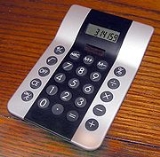
An electronic calculator is a small, portable, usually inexpensive electronic device used to perform the basic operations of arithmetic
Arithmetic
Arithmetic or arithmetics is the oldest and most elementary branch of mathematics, used by almost everyone, for tasks ranging from simple day-to-day counting to advanced science and business calculations. It involves the study of quantity, especially as the result of combining numbers...

. Modern calculators are more portable than most computer
Computer
A computer is a programmable machine designed to sequentially and automatically carry out a sequence of arithmetic or logical operations. The particular sequence of operations can be changed readily, allowing the computer to solve more than one kind of problem...

s, though most PDAs are comparable in size to handheld calculators.
Discussion
Ask a question about 'Calculator'
Start a new discussion about 'Calculator'
Answer questions from other users
Full Discussion Forum
 
Unanswered Questions
Recent Discussions
Encyclopedia
An electronic calculator is a small, portable, usually inexpensive electronic device used to perform the basic operations of arithmetic
Arithmetic
Arithmetic or arithmetics is the oldest and most elementary branch of mathematics, used by almost everyone, for tasks ranging from simple day-to-day counting to advanced science and business calculations. It involves the study of quantity, especially as the result of combining numbers...

. Modern calculators are more portable than most computer
Computer
A computer is a programmable machine designed to sequentially and automatically carry out a sequence of arithmetic or logical operations. The particular sequence of operations can be changed readily, allowing the computer to solve more than one kind of problem...

s, though most PDAs are comparable in size to handheld calculators.

The first solid-state electronic calculator was created in the 1960s, building on the history of tools such as the abacus, developed around 2000 BC; and the mechanical calculator
Mechanical calculator
A mechanical calculator is a device used to perform the basic operations of arithmetic. Mechanical calculators are comparable in size to small desktop computers and have been rendered obsolete by the advent of the electronic calculator....

, developed in the 17th century. It was developed in parallel with the analog computer
Analog computer
An analog computer is a form of computer that uses the continuously-changeable aspects of physical phenomena such as electrical, mechanical, or hydraulic quantities to model the problem being solved...

s of the day.

Pocket-sized devices become available in the 1970s, especially after the invention of the microprocessor
Intel 4004
The Intel 4004 was a 4-bit central processing unit released by Intel Corporation in 1971. It was the first complete CPU on one chip, and also the first commercially available microprocessor...

 developed serendipitously by Intel for a Busicom
Busicom
Busicom was a Japanese company that owned the rights to the first microprocessor, the Intel 4004, which they created in partnership with Intel in 1970....

 calculator.

Modern electronic calculators vary from cheap, give-away, credit-card sized models to sturdy desktop models with built-in printers. They became popular in the mid 1970's as integrated circuit
Integrated circuit
An integrated circuit or monolithic integrated circuit is an electronic circuit manufactured by the patterned diffusion of trace elements into the surface of a thin substrate of semiconductor material...

s made their size and cost small. By the end of that decade, calculator prices had reduced to a point where a basic calculator was affordable to most and they became common in schools.

Computer operating systems as far back as early Unix
Ancient UNIX Systems
Ancient UNIX is a term coined by Santa Cruz Operation, to describe early releases of the Unix code base released prior to Unix System III, particularly the Research Unix releases prior to and including Version 7 .After the publication of the Lions' book, work was undertaken to release the earlier...

 have included interactive calculator programs such as dc
Dc (Unix)
dc is a cross-platform reverse-polish desk calculator which supports arbitrary-precision arithmetic. It is one of the oldest Unix utilities, predating even the invention of the C programming language; like other utilities of that vintage, it has a powerful set of features but an extremely terse...

 and hoc
Hoc (programming language)
hoc, an acronym for High Order Calculator, is an interpreted programming language that was used in the 1984 book The Unix Programming Environment to demonstrate how to build interpreters using Yacc....

, and calculator functions are included in almost all PDA-type
Personal digital assistant
A personal digital assistant , also known as a palmtop computer, or personal data assistant, is a mobile device that functions as a personal information manager. Current PDAs often have the ability to connect to the Internet...

 devices (save a few dedicated address book and dictionary devices).

In addition to general purpose calculators, there are those designed for specific markets; for example, there are scientific calculator
Scientific calculator
A scientific calculator is a type of electronic calculator, usually but not always handheld, designed to calculate problems in science, engineering, and mathematics...

s which include trigonometric
Trigonometry
Trigonometry is a branch of mathematics that studies triangles and the relationships between their sides and the angles between these sides. Trigonometry defines the trigonometric functions, which describe those relationships and have applicability to cyclical phenomena, such as waves...

 and statistical
Statistics
Statistics is the study of the collection, organization, analysis, and interpretation of data. It deals with all aspects of this, including the planning of data collection in terms of the design of surveys and experiments....

 calculations. Some calculators even have the ability to do computer algebra. Graphing calculator
Graphing calculator
A graphing calculator typically refers to a class of handheld calculators that are capable of plotting graphs, solving simultaneous equations, and performing numerous other tasks with variables...

s can be used to graph functions defined on the real line, or higher dimensional Euclidean space
Euclidean space
In mathematics, Euclidean space is the Euclidean plane and three-dimensional space of Euclidean geometry, as well as the generalizations of these notions to higher dimensions...

.

In 1986, calculators still represented an estimated 41% of the world's general-purpose hardware capacity to compute information. This diminished to less than 0.05% by 2007.

Design


Modern electronic calculators contain a keyboard with buttons for digits and arithmetical operations. Some even contain 00 and 000 buttons to make large numbers easier to enter.

Fractions such as are displayed as decimal approximations, for example rounded to . Also, some fractions such as which is (to 14 significant figures
Significant figures
The significant figures of a number are those digits that carry meaning contributing to its precision. This includes all digits except:...

) can be difficult to recognize in decimal form; as a result, many scientific calculators are able to work in vulgar fractions and/or mixed numbers.

In most countries, student
Student
A student is a learner, or someone who attends an educational institution. In some nations, the English term is reserved for those who attend university, while a schoolchild under the age of eighteen is called a pupil in English...

s use calculators for schoolwork. There was some initial resistance to the idea out of fear that basic arithmetic skills
Elementary arithmetic
Elementary arithmetic is the simplified portion of arithmetic which is considered necessary and appropriate during primary education. It includes the operations of addition, subtraction, multiplication, and division. It is taught in elementary school....

 would suffer. There remains disagreement about the importance of the ability to perform calculations "in the head", with some curricula restricting calculator use until a certain level of proficiency has been obtained, while others concentrate more on teaching estimation
Estimation
Estimation is the calculated approximation of a result which is usable even if input data may be incomplete or uncertain.In statistics,*estimation theory and estimator, for topics involving inferences about probability distributions...

 techniques and problem-solving. Research suggests that inadequate guidance in the use of calculating tools can restrict the kind of mathematical thinking that students engage in. Others have argued that calculator use can even cause core mathematical skills to atrophy, or that such use can prevent understanding of advanced algebraic concepts.

Internal working


In general, a basic electronic calculator consists of the following components:
  • Power source (battery and/or solar cell)
  • Keypad - consists of keys used to input numbers and function commands (addition, multiplication, square-root, etc.)
  • Processor chip (microprocessor
    Microprocessor
    A microprocessor incorporates the functions of a computer's central processing unit on a single integrated circuit, or at most a few integrated circuits. It is a multipurpose, programmable device that accepts digital data as input, processes it according to instructions stored in its memory, and...

    ) contains:
    • Scanning unit - when a calculator is powered on, it scans the keypad waiting to pick up an electrical signal when a key is pressed.
    • Encoder
      Encoder
      An encoder is a device, circuit, transducer, software program, algorithm or person that converts information from one format or code to another, for the purposes of standardization, speed, secrecy, security, or saving space by shrinking size.-Media:...

       unit
      - converts the numbers and functions into binary code
      Binary code
      A binary code is a way of representing text or computer processor instructions by the use of the binary number system's two-binary digits 0 and 1. This is accomplished by assigning a bit string to each particular symbol or instruction...

      .
    • X register and Y register - They are number stores where numbers are stored temporarily while doing calculations. All numbers go into the X register first. The number in the X register is shown on the display.
    • Flag register - The function for the calculation is stored here until the calculator needs it.
    • Permanent memory (ROM)- The instructions for in-built functions (arithmetic operations, square roots, percentages, trigonometry etc.) are stored here in binary form. These instructions are "programs" stored permanently. Permanent memory cannot be erased.
    • User memory (RAM) - The store where numbers can be stored by the user. User memory contents can be changed or erased by the user.
    • Arithmetic logic unit
      Arithmetic logic unit
      In computing, an arithmetic logic unit is a digital circuit that performs arithmetic and logical operations.The ALU is a fundamental building block of the central processing unit of a computer, and even the simplest microprocessors contain one for purposes such as maintaining timers...

       (ALU)
      - The ALU executes all arithmetic and logic instructions, and provides the results in binary coded form.
    • Decoder
      Decoder
      A decoder is a device which does the reverse operation of an encoder, undoing the encoding so that the original information can be retrieved. The same method used to encode is usually just reversed in order to decode...

       unit
      - converts binary code into "decimal" numbers which can be displayed on the display unit.
  • Display panel - displays input numbers, commands and results. Seven stripes (segments) are used to represent each digit in a basic calculator.

Example


A basic explanation as to how calculations are performed in a simple 4-function calculator:
To perform the calculation 25 + 9, one presses keys in the following sequence on most calculators: [2] [5] [+] [9] [=].
  • When 25 is entered, it is picked up by the scanning unit, the number 25 is encoded and sent to the X register.
  • Next, when the [+] key is pressed, the "addition" instruction is also encoded and sent to the flag register.
  • The second number 9 is encoded and sent to the X register. This "pushes" the first number (25) out into the Y register.
  • When [=] is pressed, a "message" from the flag register tells the permanent memory that the operation to be done is "addition".
  • The numbers in the X and Y registers are then loaded into the ALU and the calculation is carried out following instructions from the permanent memory.
  • The answer, 34 is sent back to the X register. From there it is converted by the decoder unit into a decimal number (usually binary-coded decimal
    Binary-coded decimal
    In computing and electronic systems, binary-coded decimal is a digital encoding method for numbers using decimal notation, with each decimal digit represented by its own binary sequence. In BCD, a numeral is usually represented by four bits which, in general, represent the decimal range 0 through 9...

    ), and then shown on the display panel.


All other functions are usually carried out using repeated additions. Where calculators have additional functions such as square root, or trigonometric functions, software algorithm
Algorithm
In mathematics and computer science, an algorithm is an effective method expressed as a finite list of well-defined instructions for calculating a function. Algorithms are used for calculation, data processing, and automated reasoning...

s are required to produce high precision results. Sometimes significant design effort is required to fit all the desired functions in the limited memory space available in the calculator chip, with acceptable calculation time.

Calculators versus computers


The fundamental difference between a calculator and computer
Computer
A computer is a programmable machine designed to sequentially and automatically carry out a sequence of arithmetic or logical operations. The particular sequence of operations can be changed readily, allowing the computer to solve more than one kind of problem...

 is that a computer can be programmed
Computer program
A computer program is a sequence of instructions written to perform a specified task with a computer. A computer requires programs to function, typically executing the program's instructions in a central processor. The program has an executable form that the computer can use directly to execute...

 in a way that allows the program to take different branches according to intermediate results, while calculators are pre-designed with specific functions such as addition, multiplication, and logarithms built in. The distinction is not clear-cut: some devices classed as programmable calculators have programming functionality, sometimes with support for programming languages such as RPL
RPL programming language
The RPL programming language is a handheld calculator system and application programming language used on Hewlett-Packard's engineering graphing RPN calculators of the HP-28, HP-48, HP-49 and HP-50 series, but it is also usable on non-RPN calculators, such as the HP-39...

 or TI-BASIC
TI-BASIC
TI-BASIC is the unofficial name of a BASIC-like language built into Texas Instruments 's graphing calculators, including the TI-83 series, TI-84 Plus series, TI-89 series, TI-92 series , TI-73, and TI-Nspire...

.

Typically the user buys the least expensive model having a specific feature set, but does not care much about speed (since speed is constrained by how fast the user can press the buttons). Thus designers of calculators strive to minimize the number of logic elements on the chip, not the number of clock cycles needed to do a computation.

For instance, instead of a hardware multiplier, a calculator might implement floating point
Floating point
In computing, floating point describes a method of representing real numbers in a way that can support a wide range of values. Numbers are, in general, represented approximately to a fixed number of significant digits and scaled using an exponent. The base for the scaling is normally 2, 10 or 16...

 mathematics with code in ROM
Read-only memory
Read-only memory is a class of storage medium used in computers and other electronic devices. Data stored in ROM cannot be modified, or can be modified only slowly or with difficulty, so it is mainly used to distribute firmware .In its strictest sense, ROM refers only...

, and compute trigonometric functions with the CORDIC
CORDIC
CORDIC is a simple and efficient algorithm to calculate hyperbolic and trigonometric functions...

 algorithm because CORDIC does not require hardware floating-point. Bit serial logic designs are more common in calculators whereas bit parallel designs dominate general-purpose computers, because a bit serial design minimizes chip complexity, but takes many more clock cycles. (Again, the line blurs with high-end calculators, which use processor chips associated with computer and embedded systems design, particularly the Z80, MC68000, and ARM
ARM architecture
ARM is a 32-bit reduced instruction set computer instruction set architecture developed by ARM Holdings. It was named the Advanced RISC Machine, and before that, the Acorn RISC Machine. The ARM architecture is the most widely used 32-bit ISA in numbers produced...

 architectures, as well as some custom designs specifically made for the calculator market.)

Precursors to the electronic calculator


The first known tool used in the aid of arithmetic calculation was the Abacus
Abacus
The abacus, also called a counting frame, is a calculating tool used primarily in parts of Asia for performing arithmetic processes. Today, abaci are often constructed as a bamboo frame with beads sliding on wires, but originally they were beans or stones moved in grooves in sand or on tablets of...

, devised by Sumerian and Egypt before 2000 BC. Except for Antikythera mechanism
Antikythera mechanism
The Antikythera mechanism is an ancient mechanical computer designed to calculate astronomical positions. It was recovered in 1900–1901 from the Antikythera wreck. Its significance and complexity were not understood until decades later. Its time of construction is now estimated between 150 and 100...

, an "out of the time" device, development of computing tools arrived in start of XVII century: Geometric-military compass
Sector (instrument)
The sector, also known as a proportional compass or military compass, was a major calculating instrument in use from the end of the sixteenth century until the nineteenth century. It is an instrument consisting of two rulers of equal length which are joined by a hinge. A number of scales are...

 by Galileo
Galileo Galilei
Galileo Galilei , was an Italian physicist, mathematician, astronomer, and philosopher who played a major role in the Scientific Revolution. His achievements include improvements to the telescope and consequent astronomical observations and support for Copernicanism...

, Logarithms and Napier Bones by Napier
John Napier
John Napier of Merchiston – also signed as Neper, Nepair – named Marvellous Merchiston, was a Scottish mathematician, physicist, astronomer & astrologer, and also the 8th Laird of Merchistoun. He was the son of Sir Archibald Napier of Merchiston. John Napier is most renowned as the discoverer...

, slide rule
Slide rule
The slide rule, also known colloquially as a slipstick, is a mechanical analog computer. The slide rule is used primarily for multiplication and division, and also for functions such as roots, logarithms and trigonometry, but is not normally used for addition or subtraction.Slide rules come in a...

 by Edmund Gunter
Edmund Gunter
Edmund Gunter , English mathematician, of Welsh descent, was born in Hertfordshire in 1581.He was educated at Westminster School, and in 1599 was elected a student of Christ Church, Oxford. He took orders, became a preacher in 1614, and in 1615 proceeded to the degree of bachelor in divinity...

.

In the same century arrived first machines performing automatically arithmetic operations, i.e. first prototypes of actual calculators. 1623 saw the invention of the first mechanical adding machine
Mechanical calculator
A mechanical calculator is a device used to perform the basic operations of arithmetic. Mechanical calculators are comparable in size to small desktop computers and have been rendered obsolete by the advent of the electronic calculator....

 by Wilhelm Schickard
Wilhelm Schickard
Wilhelm Schickard was a German polymath who designed a calculating machine in 1623, twenty years before the Pascaline of Blaise Pascal. Unfortunately a fire destroyed the machine as it was being built in 1624 and Schickard decided to abandon his project...

, followed in 1642 by the famous Pascaline of Blaise Pascal
Blaise Pascal
Blaise Pascal , was a French mathematician, physicist, inventor, writer and Catholic philosopher. He was a child prodigy who was educated by his father, a tax collector in Rouen...

 in France
France
The French Republic , The French Republic , The French Republic , (commonly known as France , is a unitary semi-presidential republic in Western Europe with several overseas territories and islands located on other continents and in the Indian, Pacific, and Atlantic oceans. Metropolitan France...

; and, in 1673, by the first 4-operations machine invented by Gottfried Leibniz
Gottfried Leibniz
Gottfried Wilhelm Leibniz was a German philosopher and mathematician. He wrote in different languages, primarily in Latin , French and German ....

.

In the 18th century some interesting improvements arrived (e.g. by Morland
Samuel Morland
Sir Samuel Morland, 1st Baronet , or Moreland, was a notable English academic, diplomat, spy, inventor and mathematician of the 17th century, a polymath credited with early developments in relation to computing, hydraulics and steam power.-Education:The son of Thomas Morland, the rector of...

 and by Poleni
Giovanni Poleni
Giovanni Poleni was a Marquess, physicist, and antiquarian; the son of Marquess Jacopo Poleni. He studied the classics, philosophy, theology, mathematics, and physics. He was appointed, at the age of twenty-five, professor of astronomy at Padua...

), but machines was almost always one of the kind. We had to wait until the 19th century and the Industrial Revolution
Industrial Revolution
The Industrial Revolution was a period from the 18th to the 19th century where major changes in agriculture, manufacturing, mining, transportation, and technology had a profound effect on the social, economic and cultural conditions of the times...

 to see a real and quick development and diffusion of adding machines and mechanical calculators. These two devices (2-operations and 4-operations machines) was considered absolutely different since the origin (Pascal vs. Leibniz) until 1950s.

But it wasn't until 1902 that the familiar push-button user interface was developed, with the introduction of the Dalton Adding Machine, developed by James L. Dalton in the United States
United States
The United States of America is a federal constitutional republic comprising fifty states and a federal district...

.

The Curta calculator
Curta calculator
The Curta is a small, hand-cranked mechanical calculator introduced in 1948. It has an extremely compact design: a small cylinder that fits in the palm of the hand. It can be used to perform addition, subtraction, multiplication, division, and — with more difficulty — square roots and other...

 was developed in 1948 and, although costly, became popular for its portability. This purely mechanical hand-held device could do addition, subtraction, multiplication and division. By the early 1970s electronic pocket calculators ended manufacture of mechanical calculators, although the Curta remains a popular collectable item.

The development of electronic calculators


The first mainframe
Mainframe computer
Mainframes are powerful computers used primarily by corporate and governmental organizations for critical applications, bulk data processing such as census, industry and consumer statistics, enterprise resource planning, and financial transaction processing.The term originally referred to the...

 computers, using firstly vacuum tube
Vacuum tube
In electronics, a vacuum tube, electron tube , or thermionic valve , reduced to simply "tube" or "valve" in everyday parlance, is a device that relies on the flow of electric current through a vacuum...

s and later transistor
Transistor
A transistor is a semiconductor device used to amplify and switch electronic signals and power. It is composed of a semiconductor material with at least three terminals for connection to an external circuit. A voltage or current applied to one pair of the transistor's terminals changes the current...

s in the logic circuits, appeared in the 1940s and 1950s. This technology was to provide a stepping stone to the development of electronic calculators.

In 1954 IBM
IBM
International Business Machines Corporation or IBM is an American multinational technology and consulting corporation headquartered in Armonk, New York, United States. IBM manufactures and sells computer hardware and software, and it offers infrastructure, hosting and consulting services in areas...

, in the U.S., demonstrated a large all-transistor
Transistor
A transistor is a semiconductor device used to amplify and switch electronic signals and power. It is composed of a semiconductor material with at least three terminals for connection to an external circuit. A voltage or current applied to one pair of the transistor's terminals changes the current...

 calculator and, in 1957, the company released the first commercial all-transistor calculator, the IBM 608
IBM 608
The IBM 608 was the first IBM product to use transistor circuits without any vacuum tubes and is believed to be the world's first all-transistorized calculator to be manufactured for the commercial market.Pugh, Emerson W.; Johnson, Lyle R.; Palmer, John H.; . IBM's 360 and early 370 systems. MIT...

, though it was housed in several cabinets and cost about $80,000.

The Casio Computer Company
Casio
is a multinational electronic devices manufacturing company founded in 1946, with its headquarters in Shibuya, Tokyo, Japan. Casio is best known for its electronic products, such as calculators, audio equipment, PDAs, cameras, musical instruments, and watches...

, in Japan
Japan
Japan is an island nation in East Asia. Located in the Pacific Ocean, it lies to the east of the Sea of Japan, China, North Korea, South Korea and Russia, stretching from the Sea of Okhotsk in the north to the East China Sea and Taiwan in the south...

, released the Model 14-A calculator in 1957, which was the world's first all-electric (relatively) "compact" calculator. It did not use electronic logic but was based on relay
Relay
A relay is an electrically operated switch. Many relays use an electromagnet to operate a switching mechanism mechanically, but other operating principles are also used. Relays are used where it is necessary to control a circuit by a low-power signal , or where several circuits must be controlled...

 technology, and was built into a desk.
In October 1961 the world's first all-electronic desktop calculator, the British Bell Punch
Bell Punch
The Bell Punch Company was a British company manufacturing a variety of business machines, most notably several generations of public transport ticket machines and the worlds first desktop electronic calculator, the Sumlock ANITA.-History:...

/Sumlock Comptometer ANITA
Sumlock ANITA calculator
The ANITA Mark VII and ANITA Mark VIII calculators were launched simultaneously in late 1961 as the world's first all-electronic desktop calculators. Designed and built by the Bell Punch Co...

 (A New Inspiration To Arithmetic/Accounting) was announced. This machine used vacuum tube
Vacuum tube
In electronics, a vacuum tube, electron tube , or thermionic valve , reduced to simply "tube" or "valve" in everyday parlance, is a device that relies on the flow of electric current through a vacuum...

s, cold-cathode tubes and Dekatron
Dekatron
In electronics, a Dekatron is a gas-filled decade counting tube. Dekatrons were used in computers, calculators and other counting-related products during the 1950s and 1960s...

s in its circuits, with 12 cold-cathode "Nixie"
Nixie tube
A nixie tube is an electronic device for displaying numerals or other information. The glass tube contains a wire-mesh anode and multiple cathodes. In most tubes, the cathodes are shaped like numerals. Applying power to one cathode surrounds it with an orange glow discharge...

 tubes for its display. Two models were displayed, the Mk VII for continental Europe and the Mk VIII for Britain and the rest of the world, both for delivery from early 1962. The Mk VII was a slightly earlier design with a more complicated mode of multiplication, and was soon dropped in favour of the simpler Mark VIII. The ANITA had a full keyboard, similar to mechanical comptometer
Comptometer
The comptometer was the first commercially successful key-driven mechanical calculator, patented in the USA by Dorr E. Felt in 1887.A key-driven calculator is extremely fast because each key adds or subtracts its value to the accumulator as soon as it is pressed and a skilled operator can enter all...

s of the time, a feature that was unique to it and the later Sharp
Sharp Corporation
is a Japanese multinational corporation that designs and manufactures electronic products. Headquartered in Abeno-ku, Osaka, Japan, Sharp employs more than 55,580 people worldwide as of June 2011. The company was founded in September 1912 and takes its name from one of its founder's first...

 CS-10A among electronic calculators. Bell Punch had been producing key-driven mechanical calculators of the comptometer type under the names "Plus" and "Sumlock", and had realised in the mid-1950s that the future of calculators lay in electronics. They employed the young graduate Norbert Kitz, who had worked on the early British Pilot ACE
Pilot ACE
The Pilot ACE was one of the first computers built in the United Kingdom, at the National Physical Laboratory in the early 1950s.It was a preliminary version of the full ACE, which had been designed by Alan Turing. After Turing left NPL , James H...

 computer project, to lead the development. The ANITA
Sumlock ANITA calculator
The ANITA Mark VII and ANITA Mark VIII calculators were launched simultaneously in late 1961 as the world's first all-electronic desktop calculators. Designed and built by the Bell Punch Co...

 sold well since it was the only electronic desktop calculator available, and was silent and quick.

The tube technology of the ANITA
Sumlock ANITA calculator
The ANITA Mark VII and ANITA Mark VIII calculators were launched simultaneously in late 1961 as the world's first all-electronic desktop calculators. Designed and built by the Bell Punch Co...

 was superseded in June 1963 by the U.S. manufactured Friden
Friden, Inc.
Friden Calculating Machine Company was an American manufacturer of typewriters and electronic calculators. It was founded by Carl Friden in San Leandro, California in 1934. Friden electromechanical calculators were robust and popular....

 EC-130, which had an all-transistor design, a stack of four 13-digit numbers displayed on a 5 inches (12.7 cm) CRT
Cathode ray tube
The cathode ray tube is a vacuum tube containing an electron gun and a fluorescent screen used to view images. It has a means to accelerate and deflect the electron beam onto the fluorescent screen to create the images. The image may represent electrical waveforms , pictures , radar targets and...

, and introduced reverse Polish notation
Reverse Polish notation
Reverse Polish notation is a mathematical notation wherein every operator follows all of its operands, in contrast to Polish notation, which puts the operator in the prefix position. It is also known as Postfix notation and is parenthesis-free as long as operator arities are fixed...

 (RPN) to the calculator market for a price of $2200, which was about three times the cost of an electromechanical calculator of the time. Like Bell Punch, Friden was a manufacturer of mechanical calculators that had decided that the future lay in electronics. In 1964 more all-transistor electronic calculators were introduced: Sharp
Sharp Corporation
is a Japanese multinational corporation that designs and manufactures electronic products. Headquartered in Abeno-ku, Osaka, Japan, Sharp employs more than 55,580 people worldwide as of June 2011. The company was founded in September 1912 and takes its name from one of its founder's first...

 introduced the CS-10A, which weighed 25 kg (55 lb) and cost 500,000 yen (~US$2500), and Industria Macchine Elettroniche of Italy introduced the IME 84, to which several extra keyboard and display units could be connected so that several people could make use of it (but apparently not at the same time).

There followed a series of electronic calculator models from these and other manufacturers, including Canon, Mathatronics, Olivetti
Olivetti
Olivetti S.p.A. is an Italian manufacturer of computers, printers and other business machines.- Founding :The company was founded as a typewriter manufacturer in 1908 in Ivrea, near Turin, by Camillo Olivetti. The firm was mainly developed by his son Adriano Olivetti...

, SCM (Smith-Corona-Marchant), Sony, Toshiba, and Wang. The early scalculators used hundreds of germanium transistors, which were cheaper than silicon transistors, on multiple circuit boards. Display types used were CRT
Cathode ray tube
The cathode ray tube is a vacuum tube containing an electron gun and a fluorescent screen used to view images. It has a means to accelerate and deflect the electron beam onto the fluorescent screen to create the images. The image may represent electrical waveforms , pictures , radar targets and...

, cold-cathode Nixie tube
Nixie tube
A nixie tube is an electronic device for displaying numerals or other information. The glass tube contains a wire-mesh anode and multiple cathodes. In most tubes, the cathodes are shaped like numerals. Applying power to one cathode surrounds it with an orange glow discharge...

s, and filament lamps. Memory technology was usually based on the delay line memory
Delay line memory
Delay line memory was a form of computer memory used on some of the earliest digital computers. Like many modern forms of electronic computer memory, delay line memory was a refreshable memory, but as opposed to modern random-access memory, delay line memory was serial-access...

 or the magnetic core memory
Magnetic core memory
Magnetic-core memory was the predominant form of random-access computer memory for 20 years . It uses tiny magnetic toroids , the cores, through which wires are threaded to write and read information. Each core represents one bit of information...

, though the Toshiba "Toscal" BC-1411 appears to have used an early form of dynamic RAM built from discrete components. Already there was a desire for smaller and less power-hungry machines.

The Olivetti
Olivetti
Olivetti S.p.A. is an Italian manufacturer of computers, printers and other business machines.- Founding :The company was founded as a typewriter manufacturer in 1908 in Ivrea, near Turin, by Camillo Olivetti. The firm was mainly developed by his son Adriano Olivetti...

 Programma 101
Programma 101
The Programma 101 was the first commercially produced "desktop computer". Launched by Olivetti at the 1964 New York World's Fair, volume production started in 1965. A futuristic design for its time, the Programma 101 was priced at $3,200...

 was introduced in late 1965; it was a stored program machine which could read and write magnetic cards and displayed results on its built-in printer. Memory, implemented by an acoustic delay line, could be partitioned between program steps, constants, and data registers. Programming allowed conditional testing and programs could also be overlaid by reading from magnetic cards. It is regarded as the first personal computer produced by a company (that is, a desktop electronic calculating machine programmable by non-specialists for personal use). The Olivetti
Olivetti
Olivetti S.p.A. is an Italian manufacturer of computers, printers and other business machines.- Founding :The company was founded as a typewriter manufacturer in 1908 in Ivrea, near Turin, by Camillo Olivetti. The firm was mainly developed by his son Adriano Olivetti...

 Programma 101 won many industrial design awards.

The Monroe Epic
Monroe Epic
The Monroe EPIC was a programmable calculator that came on the market in the 1960s. It consisted of a large desktop unit which attached to a floor-standing logic tower, and was capable of being programmed to perform many computer-like functions...

programmable calculator came on the market in 1967. A large, printing, desk-top unit, with an attached floor-standing logic tower, it could be programmed to perform many computer-like functions. However, the only branch instruction was an implied unconditional branch (GOTO) at the end of the operation stack, returning the program to its starting instruction. Thus, it was not possible to include any conditional branch (IF-THEN-ELSE) logic. During this era, the absence of the conditional branch was sometimes used to distinguish a programmable calculator from a computer.

The first handheld calculator was developed by Texas Instruments
Texas Instruments
Texas Instruments Inc. , widely known as TI, is an American company based in Dallas, Texas, United States, which develops and commercializes semiconductor and computer technology...

 in 1967. It could add, multiply, subtract, and divide, and its output device was a paper tape.

1970s to mid-1980s


The electronic calculators of the mid-1960s were large and heavy desktop machines due to their use of hundreds of transistors on several circuit boards with a large power consumption that required an AC power supply. There were great efforts to put the logic required for a calculator into fewer and fewer integrated circuits (chips) and calculator electronics was one of the leading edges of semiconductor
Semiconductor
A semiconductor is a material with electrical conductivity due to electron flow intermediate in magnitude between that of a conductor and an insulator. This means a conductivity roughly in the range of 103 to 10−8 siemens per centimeter...

 development. U.S. semiconductor manufacturers led the world in Large Scale Integration (LSI) semiconductor development, squeezing more and more functions into individual integrated circuits. This led to alliances between Japanese calculator manufacturers and U.S. semiconductor companies: Canon Inc. with Texas Instruments
Texas Instruments
Texas Instruments Inc. , widely known as TI, is an American company based in Dallas, Texas, United States, which develops and commercializes semiconductor and computer technology...

, Hayakawa Electric
Sharp Corporation
is a Japanese multinational corporation that designs and manufactures electronic products. Headquartered in Abeno-ku, Osaka, Japan, Sharp employs more than 55,580 people worldwide as of June 2011. The company was founded in September 1912 and takes its name from one of its founder's first...

 (later known as Sharp Corporation) with North-American Rockwell Microelectronics
Rockwell International
Rockwell International was a major American manufacturing conglomerate in the latter half of the 20th century, involved in aircraft, the space industry, both defense-oriented and commercial electronics, automotive and truck components, printing presses, valves and meters, and industrial automation....

, Busicom
Busicom
Busicom was a Japanese company that owned the rights to the first microprocessor, the Intel 4004, which they created in partnership with Intel in 1970....

 with Mostek
Mostek
Mostek was an integrated circuit manufacturer, founded in 1969 by ex-employees of Texas Instruments. Initially their products were manufactured in Worcester, Massachusetts, however by 1974 most of its manufacturing was done in the Carrollton, Texas facility on Crosby Road...

 and Intel, and General Instrument
General Instrument
General Instrument was an electronics manufacturer based in Horsham, PA specializing in semiconductors and cable television equipment. The company was active until 1997, when it split into which was later acquired by Vishay Intertechnology in 2001, CommScope and NextLevel Systems General...

 with Sanyo
Sanyo
is a major electronics company and member of the Fortune 500 whose headquarters is located in Moriguchi, Osaka prefecture, Japan. Sanyo targets the middle of the market and has over 230 Subsidiaries and Affiliates....

.

Pocket calculators


By 1970, a calculator could be made using just a few chips of low power consumption, allowing portable models powered from rechargeable batteries. The first portable calculators appeared in Japan in 1970, and were soon marketed around the world. These included the Sanyo
Sanyo
is a major electronics company and member of the Fortune 500 whose headquarters is located in Moriguchi, Osaka prefecture, Japan. Sanyo targets the middle of the market and has over 230 Subsidiaries and Affiliates....

 ICC-0081 "Mini Calculator", the Canon Pocketronic, and the Sharp
Sharp Corporation
is a Japanese multinational corporation that designs and manufactures electronic products. Headquartered in Abeno-ku, Osaka, Japan, Sharp employs more than 55,580 people worldwide as of June 2011. The company was founded in September 1912 and takes its name from one of its founder's first...

 QT-8B
Sharp QT-8B
The Sharp QT-8B Micro Compet, a portable electronic desktop calculator, was the first mass-produced calculator to be battery-powered. Introduced in mid-1970, it was based on its immediate predecessor, the QT-8D introduced in late 1969, but it replaced the QT-8D's integrated power supply with a...

 "micro Compet". The Canon Pocketronic was a development of the "Cal-Tech" project which had been started at Texas Instruments
Texas Instruments
Texas Instruments Inc. , widely known as TI, is an American company based in Dallas, Texas, United States, which develops and commercializes semiconductor and computer technology...

 in 1965 as a research project to produce a portable calculator. The Pocketronic has no traditional display; numerical output is on thermal paper tape. As a result of the "Cal-Tech" project, Texas Instruments was granted master patents on portable calculators.

Sharp put in great efforts in size and power reduction and introduced in January 1971 the Sharp EL-8
Sharp EL-8
The Sharp EL-8, also known as the ELSI-8, was one of the earliest mass-produced hand-held electronic calculators and the first hand-held calculator to be made by Sharp...

, also marketed as the Facit 1111, which was close to being a pocket calculator. It weighed about one pound, had a vacuum fluorescent display, rechargeable NiCad batteries, and initially sold for $395.

However, the efforts in integrated circuit development
Integrated circuit development
The integrated circuit development process is complex and arduous. The high level process for developing an integrated circuit starts with defining product requirements, progresses through architectural definition, implementation, bringup and finally productization. The various phases of the...

 culminated in the introduction in early 1971 of the first "calculator on a chip", the MK6010 by Mostek
Mostek
Mostek was an integrated circuit manufacturer, founded in 1969 by ex-employees of Texas Instruments. Initially their products were manufactured in Worcester, Massachusetts, however by 1974 most of its manufacturing was done in the Carrollton, Texas facility on Crosby Road...

, followed by Texas Instruments later in the year. Although these early hand-held calculators were very expensive, these advances in electronics, together with developments in display technology (such as the vacuum fluorescent display
Vacuum fluorescent display
A vacuum fluorescent display is a display device used commonly on consumer-electronics equipment such as video cassette recorders, car radios, and microwave ovens. Invented in Japan in 1967, the displays became common on calculators and other consumer electronics devices...

, LED
LEd
LEd is a TeX/LaTeX editing software working under Microsoft Windows. It is a freeware product....

, and LCD), lead within a few years to the cheap pocket calculator available to all.

In 1971 Pico Electronics. and General Instrument
General Instrument
General Instrument was an electronics manufacturer based in Horsham, PA specializing in semiconductors and cable television equipment. The company was active until 1997, when it split into which was later acquired by Vishay Intertechnology in 2001, CommScope and NextLevel Systems General...

 also introduced their first collaboration in ICs, a complete single chip calculator IC for the Monroe Royal Digital III calculator. Pico was a spinout by five GI design engineers whose vision was to create single chip calculator ICs. Pico and GI went on to have significant success in the burgeoning handheld calculator market.

The first truly pocket-sized electronic calculator was the Busicom
Busicom
Busicom was a Japanese company that owned the rights to the first microprocessor, the Intel 4004, which they created in partnership with Intel in 1970....

 LE-120A "HANDY", which was marketed early in 1971. Made in Japan, this was also the first calculator to use an LED
LEd
LEd is a TeX/LaTeX editing software working under Microsoft Windows. It is a freeware product....

 display, the first hand-held calculator to use a single integrated circuit (then proclaimed as a "calculator on a chip"), the Mostek
Mostek
Mostek was an integrated circuit manufacturer, founded in 1969 by ex-employees of Texas Instruments. Initially their products were manufactured in Worcester, Massachusetts, however by 1974 most of its manufacturing was done in the Carrollton, Texas facility on Crosby Road...

 MK6010, and the first electronic calculator to run off replaceable batteries. Using four AA-size cells the LE-120A measures 4.9x2.8x0.9 in (124x72x24 mm).

The first American-made pocket-sized calculator, the Bowmar 901B (popularly referred to as The Bowmar Brain), measuring 5.2 × 3.0 × 1.5 in (131 × 77 × 37 mm), came out in the fall of 1971, with four functions and an eight-digit red LED
Light-emitting diode
A light-emitting diode is a semiconductor light source. LEDs are used as indicator lamps in many devices and are increasingly used for other lighting...

 display, for $240, while in August 1972 the four-function Sinclair Executive
Sinclair Executive
The Sinclair Executive was Clive Sinclair's first venture into the pocket calculator market. The Executive was the world's first "slimline" pocket calculator. It was variously described as "a piece of personal jewelry" and "at once a conversation piece, a rich man's plaything and a functional...

 became the first slimline pocket calculator measuring 5.4 × 2.2 × 0.35 in (138 × 56 × 9 mm) and weighing 2.5 oz (70g). It retailed for around $150 (£79). By the end of the decade, similar calculators were priced less than $10 (£5).

The first Soviet-made pocket-sized calculator, the "Elektronika B3-04" was developed by the end of 1973 and sold at the beginning of 1974.


One of the first low-cost calculators was the Sinclair Cambridge
Sinclair Cambridge
The Sinclair Cambridge was a small pocket-sized calculator manufactured from summer 1973 by UK company Sinclair Radionics. It was available both as a kit to be assembled by the purchaser, and assembled...

, launched in August 1973. It retailed for £29.95, or £5 less in kit form. The Sinclair calculators were successful because they were far cheaper than the competition; however, their design was flawed and their accuracy in some functions was questionable. The scientific programmable models were particularly poor in this respect, with the programmability comings at a heavy price in Transcendental function
Transcendental function
A transcendental function is a function that does not satisfy a polynomial equation whose coefficients are themselves polynomials, in contrast to an algebraic function, which does satisfy such an equation...

 accuracy.

Meanwhile Hewlett Packard (HP) had been developing a pocket calculator. Launched in early 1972 it was unlike the other basic four-function pocket calculators then available in that it was the first pocket calculator with scientific functions that could replace a slide rule
Slide rule
The slide rule, also known colloquially as a slipstick, is a mechanical analog computer. The slide rule is used primarily for multiplication and division, and also for functions such as roots, logarithms and trigonometry, but is not normally used for addition or subtraction.Slide rules come in a...

. The $395 HP-35
HP-35
The HP-35 was Hewlett-Packard's first pocket calculator and the world's first scientific pocket calculator . Like some of HP's desktop calculators it used reverse Polish notation. Introduced at US$395, the HP-35 was available from 1972 to 1975.Market studies at the time had shown no market for...

, along with nearly all later HP engineering calculators, used reverse Polish notation
Reverse Polish notation
Reverse Polish notation is a mathematical notation wherein every operator follows all of its operands, in contrast to Polish notation, which puts the operator in the prefix position. It is also known as Postfix notation and is parenthesis-free as long as operator arities are fixed...

 (RPN), also called postfix notation. A calculation like "8 plus 5" is, using RPN, performed by pressing "8", "Enter↑", "5", and "+"; instead of the algebraic infix notation
Infix notation
Infix notation is the common arithmetic and logical formula notation, in which operators are written infix-style between the operands they act on . It is not as simple to parse by computers as prefix notation or postfix notation Infix notation is the common arithmetic and logical formula notation,...

: "8", "+", "5", "=").

The first Soviet scientific pocket-sized calculator the "B3-18" was completed by the end of 1975.

In 1973, Texas Instruments
Texas Instruments
Texas Instruments Inc. , widely known as TI, is an American company based in Dallas, Texas, United States, which develops and commercializes semiconductor and computer technology...

(TI) introduced the SR-10, (SR signifying slide rule
Slide rule
The slide rule, also known colloquially as a slipstick, is a mechanical analog computer. The slide rule is used primarily for multiplication and division, and also for functions such as roots, logarithms and trigonometry, but is not normally used for addition or subtraction.Slide rules come in a...

) an algebraic entry pocket calculator using scientific notation
Scientific notation
Scientific notation is a way of writing numbers that are too large or too small to be conveniently written in standard decimal notation. Scientific notation has a number of useful properties and is commonly used in calculators and by scientists, mathematicians, doctors, and engineers.In scientific...

 for $150. Shortly after the SR-11 featured an additional key for entering "π"
Pi
' is a mathematical constant that is the ratio of any circle's circumference to its diameter. is approximately equal to 3.14. Many formulae in mathematics, science, and engineering involve , which makes it one of the most important mathematical constants...

. It was followed the next year by the SR-50
TI SR-50
The SR-50 was Texas Instruments' first scientific pocket calculator with trigonometric and logarithm functions. It enhanced their earlier SR-10 and SR-11 calculators, introduced in 1973, which had featured scientific notation, squares, square root, and reciprocals, but had no trig or log functions....

 which added log and trig functions to compete with the HP-35, and in 1977 the mass-marketed TI-30
TI-30
The TI-30 was a scientific calculator manufactured by Texas Instruments, the first model of which was introduced in 1976. While the original TI-30 left production in 1983 after several design revisions, TI maintains the TI-30 designation as a branding for its low and mid-range scientific...

 line which is still produced.

In 1978 a new company, Calculated Industries
Calculated Industries
Calculated Industries, sometimes referred to as CI, is a company that specializes in industry specific calculators. Calculated Industries was incorporated in California in early 1978. The ownership changed that same year, when two brothers, Fred and Ken Alexander, took control...

, came onto the scene, focusing on specific markets. Their first calculator, the Loan Arranger (1978) was a pocket calculator marketed to the Real Estate industry with preprogrammed functions to simplify the process of calculating payments and future values. In 1985, CI launched a calculator for the construction industry called the Construction Master which came preprogrammed with common construction calculations (such as angles, stairs, roofing math, pitch, rise, run, and feet-inch fraction conversions). This would be the first in a line of construction related calculators.

Programmable calculators


The first desktop programmable calculators were produced in the mid-1960s by Mathatronics and Casio
Casio
is a multinational electronic devices manufacturing company founded in 1946, with its headquarters in Shibuya, Tokyo, Japan. Casio is best known for its electronic products, such as calculators, audio equipment, PDAs, cameras, musical instruments, and watches...

 (AL-1000). These machines were, however, very heavy and expensive. The first programmable pocket calculator was the HP-65
HP-65
The HP-65 was the first magnetic card-programmable handheld calculator. Introduced by Hewlett-Packard in 1974 at an MSRP of $795, it featured nine storage registers and room for 100 keystroke instructions. It also included a magnetic card reader/writer to save and load programs...

, in 1974; it had a capacity of 100 instructions, and could store and retrieve programs with a built-in magnetic card reader. Two years later the HP-25C introduced continuous memory, i.e. programs and data were retained in CMOS
CMOS
Complementary metal–oxide–semiconductor is a technology for constructing integrated circuits. CMOS technology is used in microprocessors, microcontrollers, static RAM, and other digital logic circuits...

 memory during power-off. In 1979, HP released the first alphanumeric
Alphanumeric
Alphanumeric is a combination of alphabetic and numeric characters, and is used to describe the collection of Latin letters and Arabic digits or a text constructed from this collection. There are either 36 or 62 alphanumeric characters. The alphanumeric character set consists of the numbers 0 to...

, programmable, expandable calculator, the HP-41
HP-41
The HP-41C series are programmable, expandable, continuous memory handheld RPN calculators made by Hewlett-Packard from 1979 to 1990. The original model, HP-41C, was the first of its kind to offer alphanumeric display capabilities...

C. It could be expanded with RAM (memory) and ROM
Read-only memory
Read-only memory is a class of storage medium used in computers and other electronic devices. Data stored in ROM cannot be modified, or can be modified only slowly or with difficulty, so it is mainly used to distribute firmware .In its strictest sense, ROM refers only...

 (software) modules, as well as peripherals like bar code readers, microcassette
Microcassette
A Microcassette is an audio storage medium introduced by Olympus in 1969. It uses the same width of magnetic tape as the Compact Cassette but in a much smaller container. By using thinner tape and half or a quarter the tape speed, microcassettes can offer comparable recording time to the compact...

 and floppy disk
Floppy disk
A floppy disk is a disk storage medium composed of a disk of thin and flexible magnetic storage medium, sealed in a rectangular plastic carrier lined with fabric that removes dust particles...

 drives, paper-roll thermal printer
Thermal printer
A thermal printer produces a printed image by selectively heating coated thermochromic paper, or thermal paper as it is commonly known, when the paper passes over the thermal print head. The coating turns black in the areas where it is heated, producing an image...

s, and miscellaneous communication interfaces (RS-232
RS-232
In telecommunications, RS-232 is the traditional name for a series of standards for serial binary single-ended data and control signals connecting between a DTE and a DCE . It is commonly used in computer serial ports...

, HP-IL
HP-IL
The HP-IL , was a short-range interconnection bus or network introduced by Hewlett-Packard in the early 1980s. It enabled several devices such as printers, floppy disk drives, tape readers, etc...

, HP-IB).

The first Soviet programmable desktop calculator ISKRA 123, powered by the power grid, was released at the beginning of the 1970s. The first Soviet pocket battery-powered programmable calculator, Elektronika
Elektronika
Electronika is the brand name used for many different electronic products such as calculators, electronic watches, portable games and radios in the Soviet Union and, nowadays, in Russia...

 "B3-21", was developed by the end of 1977 and released at the beginning of 1978. The successor of B3-21, the Elektronika B3-34
Elektronika B3-34
Elektronika B3-34 was a very popular Soviet programmable calculator. It was released in 1980 and was sold for 85 rubles.B3-34 used Reverse Polish notation and had 98 bytes of instruction memory, 4 stack user registers and 14 addressable registers...

 wasn't backward compatible with B3-21, even if it kept the reverse Polish notation
Reverse Polish notation
Reverse Polish notation is a mathematical notation wherein every operator follows all of its operands, in contrast to Polish notation, which puts the operator in the prefix position. It is also known as Postfix notation and is parenthesis-free as long as operator arities are fixed...

 (RPN). Thus B3-34 defined a new command set, which later was used in a series of later programmable Soviet calculators. Despite very limited capabilities (98 bytes of instruction memory and about 19 stack and addressable registers), people managed to write all kinds of programs for them, including adventure game
Adventure game
An adventure game is a video game in which the player assumes the role of protagonist in an interactive story driven by exploration and puzzle-solving instead of physical challenge. The genre's focus on story allows it to draw heavily from other narrative-based media such as literature and film,...

s and libraries of calculus-related functions for engineers. Hundreds, perhaps thousands, of programs were written for these machines, from practical scientific and business software, which were used in real-life offices and labs, to fun games for children. The Elektronika MK-52 calculator (using the extended B3-34 command set, and featuring internal EEPROM
EEPROM
EEPROM stands for Electrically Erasable Programmable Read-Only Memory and is a type of non-volatile memory used in computers and other electronic devices to store small amounts of data that must be saved when power is removed, e.g., calibration...

 memory for storing programs and external interface for EEPROM cards and other periphery) was used in Soviet spacecraft program (for Soyuz TM-7
Soyuz TM-7
-Mission parameters:*Mass: 7,000 kg 15,400 lb*Perigee: 194 km *Apogee: 235 km *Inclination: 51.6°*Period: 88.8 minutes-Mission highlights:...

 flight) as a backup of the board computer.

This series of calculators was also noted for a large number of highly counter-intuitive mysterious undocumented features, somewhat similar to "synthetic programming" of the American HP-41
HP-41
The HP-41C series are programmable, expandable, continuous memory handheld RPN calculators made by Hewlett-Packard from 1979 to 1990. The original model, HP-41C, was the first of its kind to offer alphanumeric display capabilities...

, which were exploited by applying normal arithmetic operations to error messages, jumping to non-existent addresses and other techniques. A number of respected monthly publications, including the popular science magazine "Наука и жизнь
Nauka i Zhizn
Nauka i Zhizn is a science magazine first issued during the years 1890-1900 in Imperial Russia, and then since 1934 in the Soviet Union ....

" ("Science and Life"), featured special columns, dedicated to optimization techniques for calculator programmers and updates on undocumented features for hackers, which grew into a whole esoteric science with many branches, known as "eggogology" ("еггогология"). The error messages on those calculators appear as a Russian word "EGGOG" ("ЕГГОГ") which, unsurprisingly, is translated to "Error".

A similar hacker culture in the USA revolved around the HP-41
HP-41
The HP-41C series are programmable, expandable, continuous memory handheld RPN calculators made by Hewlett-Packard from 1979 to 1990. The original model, HP-41C, was the first of its kind to offer alphanumeric display capabilities...

, which was also noted for a large number of undocumented features and was much more powerful than B3-34.

Technical improvements


Through the 1970s the hand-held electronic calculator underwent rapid development. The red LED and blue/green vacuum fluorescent display
Vacuum fluorescent display
A vacuum fluorescent display is a display device used commonly on consumer-electronics equipment such as video cassette recorders, car radios, and microwave ovens. Invented in Japan in 1967, the displays became common on calculators and other consumer electronics devices...

s consumed a lot of power and the calculators either had a short battery life (often measured in hours, so rechargeable nickel-cadmium batteries
Nickel-cadmium battery
The nickel–cadmium battery ' is a type of rechargeable battery using nickel oxide hydroxide and metallic cadmium as electrodes....

 were common) or were large so that they could take larger, higher capacity batteries. In the early 1970s liquid crystal displays (LCDs) were in their infancy and there was a great deal of concern that they only had a short operating lifetime. Busicom introduced the Busicom LE-120A "HANDY" calculator, the first pocket-sized calculator and the first with an LED
LEd
LEd is a TeX/LaTeX editing software working under Microsoft Windows. It is a freeware product....

 display, and announced the Busicom LC with LCD display. However, there were problems with this display and the calculator never went on sale. The first successful calculators with LCDs were manufactured by Rockwell International
Rockwell International
Rockwell International was a major American manufacturing conglomerate in the latter half of the 20th century, involved in aircraft, the space industry, both defense-oriented and commercial electronics, automotive and truck components, printing presses, valves and meters, and industrial automation....

 and sold from 1972 by other companies under such names as: Dataking LC-800, Harden DT/12, Ibico 086, Lloyds 40, Lloyds 100, Prismatic 500 (aka P500), Rapid Data Rapidman 1208LC. The LCDs were an early form using the Dynamic Scattering Mode DSM with the numbers appearing as bright against a dark background. To present a high-contrast display these models illuminated the LCD using a filament lamp and solid plastic light guide, which negated the low power consumption of the display. These models appear to have been sold only for a year or two.

A more successful series of calculators using a reflective DSM-LCD was launched in 1972 by Sharp Inc with the Sharp EL-805, which was a slim pocket calculator. This, and another few similar models, used Sharp's "COS" (Calculator On Substrate) technology. An extension of one glass plate needed for the Liquid Crystal Display was used as a substrate to mount the required chips based on a new hybrid technology. The "COS" technology may have been too expensive since it was only used in a few models before Sharp reverted to conventional circuit boards.

In the mid-1970s the first calculators appeared with field-effect, Twisted Nematic TN LCDs with dark numerals against a grey background, though the early ones often had a yellow filter over them to cut out damaging ultraviolet
Ultraviolet
Ultraviolet light is electromagnetic radiation with a wavelength shorter than that of visible light, but longer than X-rays, in the range 10 nm to 400 nm, and energies from 3 eV to 124 eV...

 rays. The advantage of LCDs is that they are passive light modulators reflecting light, which require much less power than light-emitting displays such as LEDs or VFDs. This led the way to the first credit-card-sized calculators, such as the Casio
Casio
is a multinational electronic devices manufacturing company founded in 1946, with its headquarters in Shibuya, Tokyo, Japan. Casio is best known for its electronic products, such as calculators, audio equipment, PDAs, cameras, musical instruments, and watches...

 Mini Card LC-78 of 1978, which could run for months of normal use on button cells.

There were also improvements to the electronics inside the calculators. All of the logic functions of a calculator had been squeezed into the first "Calculator on a chip" integrated circuits in 1971, but this was leading edge technology of the time and yields were low and costs were high. Many calculators continued to use two or more integrated circuits (ICs), especially the scientific and the programmable ones, into the late 1970s.

The power consumption of the integrated circuits was also reduced, especially with the introduction of CMOS
CMOS
Complementary metal–oxide–semiconductor is a technology for constructing integrated circuits. CMOS technology is used in microprocessors, microcontrollers, static RAM, and other digital logic circuits...

 technology. Appearing in the Sharp "EL-801" in 1972, the transistors in the logic cells of CMOS ICs only used any appreciable power when they changed state. The LED
LEd
LEd is a TeX/LaTeX editing software working under Microsoft Windows. It is a freeware product....

 and VFD
Vacuum fluorescent display
A vacuum fluorescent display is a display device used commonly on consumer-electronics equipment such as video cassette recorders, car radios, and microwave ovens. Invented in Japan in 1967, the displays became common on calculators and other consumer electronics devices...

 displays often required additional driver transistors or ICs, whereas the LCD displays were more amenable to being driven directly by the calculator IC itself.

With this low power consumption came the possibility of using solar cells as the power source, realised around 1978 by such calculators as the Royal Solar 1, Sharp EL-8026, and Teal Photon.

A pocket calculator for everyone


At the beginning of the 1970s hand-held electronic calculators were very expensive, costing two or three weeks' wages, and so were a luxury item. The high price was due to their construction requiring many mechanical and electronic components which were expensive to produce, and production runs were not very large. Many companies saw that there were good profits to be made in the calculator business with the margin on these high prices. However, the cost of calculators fell as components and their production techniques improved, and the effect of economies of scale were felt.

By 1976 the cost of the cheapest 4-function pocket calculator had dropped to a few dollars, about one 20th of the cost five years earlier. The consequences of this were that the pocket calculator was affordable, and that it was now difficult for the manufacturers to make a profit out of calculators, leading to many companies dropping out of the business or closing down altogether. The companies that survived making calculators tended to be those with high outputs of higher quality calculators, or producing high-specification scientific and programmable calculators.

Mid-1980s to present


The first calculator capable of symbolic computation was the HP-28C, released in 1987. It was able to, for example, solve quadratic equations symbolically. The first graphing calculator
Graphing calculator
A graphing calculator typically refers to a class of handheld calculators that are capable of plotting graphs, solving simultaneous equations, and performing numerous other tasks with variables...

 was the Casio
Casio
is a multinational electronic devices manufacturing company founded in 1946, with its headquarters in Shibuya, Tokyo, Japan. Casio is best known for its electronic products, such as calculators, audio equipment, PDAs, cameras, musical instruments, and watches...

 FX-7000G
Casio fx-7000G
The Casio fx-7000G is notable for being the world's first graphing calculator.It came with 422 bytes of memory and it was possible to store up to ten programs in 10 program slots. 422 bytes is not much by today's standards, but with its heavily tokenised programming language, programs performing...

 released in 1985.

The two leading manufacturers, HP and TI, released increasingly feature-laden calculators during the 1980s and 1990s. At the turn of the millennium, the line between a graphing calculator and a handheld computer was not always clear, as some very advanced calculators such as the TI-89, the Voyage 200
TI-92 series
The TI-92 series of graphing calculators are a line of calculators produced by Texas Instruments. They include: the TI-92 , the TI-92 Plus , and the Voyage 200 . The design of these relatively large calculators includes a QWERTY keyboard...

 and HP-49G could differentiate
Derivative
In calculus, a branch of mathematics, the derivative is a measure of how a function changes as its input changes. Loosely speaking, a derivative can be thought of as how much one quantity is changing in response to changes in some other quantity; for example, the derivative of the position of a...

 and integrate
Integral
Integration is an important concept in mathematics and, together with its inverse, differentiation, is one of the two main operations in calculus...

 function
Function (mathematics)
In mathematics, a function associates one quantity, the argument of the function, also known as the input, with another quantity, the value of the function, also known as the output. A function assigns exactly one output to each input. The argument and the value may be real numbers, but they can...

s, solve differential equation
Differential equation
A differential equation is a mathematical equation for an unknown function of one or several variables that relates the values of the function itself and its derivatives of various orders...

s, run word processing
Word processing
Word processing is the creation of documents using a word processor. It can also refer to advanced shorthand techniques, sometimes used in specialized contexts with a specially modified typewriter.-External links:...

 and PIM
Personal information manager
A personal information manager is a type of application software that functions as a personal organizer. The acronym PIM is now, more commonly, used in reference to Personal information management as a field of study...

 software, and connect by wire or IR
Infrared
Infrared light is electromagnetic radiation with a wavelength longer than that of visible light, measured from the nominal edge of visible red light at 0.74 micrometres , and extending conventionally to 300 µm...

 to other calculators/computers.

The HP 12c financial calculator is still produced. It was introduced in 1981 and is still being made with few changes. The HP 12c featured the reverse Polish notation
Reverse Polish notation
Reverse Polish notation is a mathematical notation wherein every operator follows all of its operands, in contrast to Polish notation, which puts the operator in the prefix position. It is also known as Postfix notation and is parenthesis-free as long as operator arities are fixed...

 mode of data entry. In 2003 several new models were released, including an improved version of the HP 12c, the "HP 12c platinum edition" which added more memory, more built-in functions, and the addition of the algebraic mode of data entry.

Calculated Industries
Calculated Industries, sometimes referred to as CI, is a company that specializes in industry specific calculators. Calculated Industries was incorporated in California in early 1978. The ownership changed that same year, when two brothers, Fred and Ken Alexander, took control...

 competed with the HP 12c in the mortgage and real estate markets by differentiating the key labeling; changing the “I”, “PV”, “FV” to easier labeling terms such as "Int", "Term", "Pmt", and not using the reverse Polish notation
Reverse Polish notation
Reverse Polish notation is a mathematical notation wherein every operator follows all of its operands, in contrast to Polish notation, which puts the operator in the prefix position. It is also known as Postfix notation and is parenthesis-free as long as operator arities are fixed...

. However, CI's more successful calculators involved a line of construction calculators, which evolved and expanded in the 1990s to present. According to Mark Bollman, a mathematics and calculator historian and associate professor of mathematics at Albion College, the "Construction Master is the first in a long and profitable line of CI construction calculators" which carried them through the 1980s, 1990s, and to the present.

Personal computers often come with a calculator utility program that emulates the appearance and functionality of a calculator, using the graphical user interface
Graphical user interface
In computing, a graphical user interface is a type of user interface that allows users to interact with electronic devices with images rather than text commands. GUIs can be used in computers, hand-held devices such as MP3 players, portable media players or gaming devices, household appliances and...

 to portray a calculator. One such example is Windows Calculator. Most personal data assistants (PDA) and smartphone
Smartphone
A smartphone is a high-end mobile phone built on a mobile computing platform, with more advanced computing ability and connectivity than a contemporary feature phone. The first smartphones were devices that mainly combined the functions of a personal digital assistant and a mobile phone or camera...

s also have such a feature.

Manufacturers


These are some of the manufacturers which made a notable contribution to calculator development:
  • APF - U.S.A.
  • Aurora - China
  • Bell Punch Company / ANITA - UK.
  • Bowmar - U.S.A.
  • Brunsviga - Germany
  • Burroughs - U.S.A.
  • Busicom - Japan.
  • Canon - Japan
  • Casio - Japan
  • Commodore / CBM - Canada/U.S.A.
  • Comptometer / Felt & Tarrant - U.S.A.
  • Compucorp - U.S.A.
  • Elektronika - U.S.S.R.
  • Facit - Sweden.
  • Felt & Tarrant - U.S.A. →Comptometer.
  • Friden - U.S.A.
  • General Instrument - U.S.A.
  • Hewlett Packard - U.S.A.
  • Hitachi - Japan.
  • IME - Italy.
  • Litronix - U.S.A.
  • Lloyd's - U.S.A.
  • Marchant - U.S.A.
  • Monroe - U.S.A.
  • National Semiconductor - U.S.A.
  • Nippon Calculating Machine / NCM - Japan. →Busicom.
  • Novus - U.S.A. →National Semiconductor.
  • Odhner - Russia and Sweden.
  • Olivetti - Italy.
  • Rapid Data - Canada.
  • Rockwell - U.S.A.
  • Sanyo - Japan.
  • Sharp - Japan.
  • Sinclair - UK.
  • Singer-Friden - U.S.A. →Friden.
  • Sumlock Anita - UK. →Bell Punch Company / ANITA.
  • Summit - U.S.A.
  • Teal - Japan and U.S.A.
  • Texas Instruments - U.S.A.
  • Toshiba - Japan.
  • Unicom - U.S.A. →Rockwell.
  • Victor - U.S.A.
  • Wang - U.S.A.

  • Current major manufacturers

    • Aurora Office Equipment Company (China)
    • Casio Computer Co., Ltd. (Japan)
    • Citizen Systems Japan Co., Ltd. (Japan)
    • Hewlett-Packard Development Company, L.P. (U.S.A.)
    • Sharp Corporation (Japan)
    • Texas Instruments Inc. (U.S.A.)

    See also


    • History of computing hardware
      History of computing hardware
      The history of computing hardware is the record of the ongoing effort to make computer hardware faster, cheaper, and capable of storing more data....

    • Beghilos
    • Formula calculator
      Formula calculator
      A formula calculator is a software calculator that can perform a calculation in two steps:1. Enter the calculation by typing it in from the keyboard.2...

    • Software calculator
    • List of HP calculators

    Further reading

    Complex computerG. R. Stibitz
    George Stibitz
    George Robert Stibitz is internationally recognized as one of the fathers of the modern digital computer...

    , Bell Laboratories, 1954 (filed 1941, refiled 1944), electromechanical (relay) device that could calculate complex numbers, record, and print results by teletype – Miniature electronic calculatorJ. S. Kilby
    Jack Kilby
    Jack St. Clair Kilby was an American physicist who took part in the invention of the integrated circuit while working at Texas Instruments in 1958. He was awarded the Nobel Prize in physics in 2000. He is credited with the invention of the integrated circuit or microchip...

    , Texas Instruments
    Texas Instruments
    Texas Instruments Inc. , widely known as TI, is an American company based in Dallas, Texas, United States, which develops and commercializes semiconductor and computer technology...

    , 1974 (originally filed 1967), handheld (3 lb, 1.4 kg) battery operated electronic device with thermal printer
      • The Japanese Patent Office granted a patent in June 1978 to Texas Instruments (TI) based on US patent 3819921, notwithstanding objections from 12 Japanese calculator manufacturers. This gave TI the right to claim royalties retroactively to the original publication of the Japanese patent application in August 1974. A TI spokesman said that it would actively seek what was due, either in cash or technology cross-licensing agreements. 19 other countries, including the United Kingdom, had already granted a similar patent to Texas Instruments. – New Scientist, 17 August 1978 p455, and Practical Electronics (British publication), October 1978 p1094. – Floating Point Calculator With RAM Shift Register - 1977 (originally filed GB March 1971, US July 1971), very early single chip calculator claim. – Extended Numerical Keyboard with Structured Data-Entry Capability – J. H. Redin, 1997 (originally filed 1996), Usage of Verbal Numerals as a way to enter a number.
    • European Patent Office Database - Many patents about mechanical calculators are in classifications G06C15/04, G06C15/06, G06G3/02, G06G3/04
    • ^ Collectors Guide to Pocket Calculators. by Guy Ball and Bruce Flamm, 1997, ISBN 1888840145 - includes an extensive history of early pocket calculators as well as highlights over 1500 different models from the early 1970s. Book still in print.

    External links