


Bicycle helmet

Encyclopedia
A bicycle helmet is a helmet
intended to be worn while riding a bicycle
. They are designed to attenuate impacts to the skull
of a cyclist
in falls while minimizing side effects such as interference with peripheral vision. There is an active scientific debate, with no consensus, on whether helmets are useful for cyclists in general, and on whether any benefits are outweighed by their disadvantages. The debate on whether helmet use should be enforced by law
is intense and occasionally bitter, often based not only on differing interpretations of the academic literature, but also on differing assumptions and interests on the two sides.
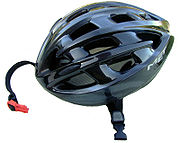
 A cycle helmet should generally be light in weight and provide ample ventilation, because cycling can be an intense aerobic
activity which significantly raises body temperature, and the head in particular needs to be able to regulate its temperature. The dominant form of helmet up to the 1970s was the leather "hairnet" style. This offered acceptable protection from scrapes and cuts, but only minimal impact protection, and was mainly used by racing cyclists
. More widespread use of helmets began in the U.S. in the 1970s. After many decades, when bicycles were regarded only as children's toys, many American adults took up cycling during and after the bike boom
of the 1970s. Two of the first modern bicycle helmets were made by MSR
, a manufacturer of mountaineering
equipment, and Bell Sports, a manufacturer of helmets for auto racing and motorcycles. These helmets were a spin-off from the development of expanded polystyrene
foam liners for motorcycling and motorsport helmets, and had hard polycarbonate
plastic shells. The bicycle helmet arm of Bell was split off in 1991 as Bell Sports Inc., having completely overtaken the motorcycle and motor sports helmet business.
The first commercially successful purpose-designed bicycle helmet was the Bell Biker, a polystyrene-lined hard shell released in 1975. At the time there was no appropriate standard; the only applicable one, from Snell, would be passed only by a light open-face motorcycle helmet. Over time the design was refined and by 1983 Bell were making the V1-Pro, the first polystyrene helmet intended for racing use. In 1984 Bell produced the Li'l Bell Shell, a no-shell children's helmet. These early helmets had little ventilation.
In 1985, Snell B85 was introduced, the first widely adopted standard for bicycle helmets; this has subsequently been refined into B90 and B95 (see Standards below). At this time helmets were almost all either hard-shell or no-shell (perhaps with a vacuum-formed plastic cover). Ventilation was still minimal due mainly to technical limitations of the foams and shells in use.
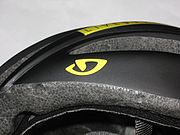 Around 1990 a new construction technique was invented: in-mould microshell. A very thin shell was incorporated during the moulding process. This rapidly became the dominant technology, allowing for larger vents and more complex shapes than hard shells.
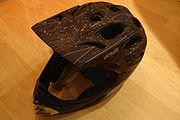
Use of hard shells declined rapidly among the general cyclist population during the 1990s, almost disappearing by the end of the decade, but remain popular with BMX riders
as well as inline skaters and skateboarders.
The late 1990s and early 2000s saw advances in retention and fitting systems, replacing the old system of varying thickness pads with cradles which adjust quite precisely to the rider's head. This has also resulted in the back of the head being less covered by the helmet; impacts to this region are rare, but it does make a modern bike helmet much less suitable for activities such as unicycling, skateboarding and inline skating, where falling over backward is relatively common. Other helmets will be more suitable for these activities.
Since more advanced helmets began being used in the Tour de France
, carbon fiber
inserts have started to be used to increase strength and protection of the helmet. The Giro
Atmos and Ionos, as well as the Bell
Alchera were among the first to use carbon fiber.
Some modern racing bicycle helmets have a long tapering back end for streamlining
. This type of helmet is mainly dedicated to time trial
racing as they lack significant ventilation, making them uncomfortable for long races.
 In the United States
the Snell Memorial Foundation
, an organization initially established to create standards for motorcycle and auto-racing helmets, implemented one of the first standards, since updated. Snell's standard includes testing of random samples. In 1990 the Consumers' Association
(UK) market survey showed that around 90 % of helmets on sale were Snell B90 certified. By their 1998 survey the number of Snell certified helmets was around zero. There are two main types of helmet: hard shell and soft/micro shell (no-shell helmets are now rare). Hard shells declined rapidly among the general cyclist population over this period, almost disappearing by the end of the decade, but remained more popular with BMX
riders as well as inline skaters and skateboarders.
The American National Standards Institute
(ANSI) created a standard called ANSI Z80.4 in 1984. Later, the United States Consumer Product Safety Commission
(CPSC) created its own mandatory standard for all bicycle helmets sold in the United States
, which took effect in March 1999.
In the European Union
(EU) the currently applicable standard is EN 1078
:1997.
In the UK
the current standard is BS EN 1078:1997, which is identical to the EU standard, and which replaced BS 6863:1989 in 1997.
In Australia
and New Zealand
, the current legally-required standard is AS/NZS 2063. The performance requirements of this standard are slightly less strict than the Snell B95 standard but incorporate a quality assurance requirement. As a result, the AS/NZS can be argued to be safer. SAI Global (a profit-making arm of the Standards Australia organisation]) runs a marketing program based on the AS/NZS 2063 standard, in which manufacturers pay royalties and fees to affix a "5 ticks" certification trademark sticker on helmets.
The CPSC and EN1078 standards are lower than the Snell B95 (and B90) standard; Snell helmet standards are externally verified, with each helmet traceable by unique serial number. EN 1078 is also externally validated, but lacks Snell's traceability. The most common standard in the US, CPSC, is self-certified by the manufacturers. It is generally true to say that Snell standards are more exacting than other standards, and most helmets on sale these days will not meet them (currently, Specialized is the only bicycle helmet brand in the world to meet the Snell standard. All of their helmets are Snell certified.)
 Although helmet standards have weakened over time there are no data on which to base an assessment of how this has affected the design goal of mitigating minor injuries. Minor injuries are substantially under-reported, and it is difficult to measure such injuries validly in any large population.
In brief, the primary design goal of a helmet is to decelerate the skull (and by implication, the brain inside it) more gently than would be the case if no helmet were worn. A helmet's ability to manage linear deceleration of the skull could be improved by providing a greater thickness of expanded polystyrene
foam and also by making this foam softer, but this would make the entire helmet bulkier, heavier, and hotter to wear. Another concern is that a thicker helmet increases the risk of rotational-type brain injuries (discussed in more detail below). Ultimately, every helmet design represents some sort of compromise.
The trend is toward thinner helmets with many large vents. This trend to lower standards has been noted in some of the studies. It is relatively common for helmets to fail on test, and some helmets on sale are not certified to any accepted standard.
to the head due to impact, as a stiff liner made of expanded polystyrene is crushed against the head.
Standards involve the use of an instrumented headform which is dropped, wearing a helmet, onto various anvils. The speed of impact is designed to simulate the effect of a rider's head falling from approximately usual riding height, without rotational energy and without impact from another vehicle.
Collision energy varies with the square of impact speed
. A typical helmet is designed to absorb the energy of a head falling from a bicycle, hence an impact speed of around 12 mph or 20 km/h. This will only reduce the energy of a 30 mph or 50 km/h impact to the equivalent of 27.5 mph or 45 km/h, and even this will be compromised if the helmet fails. As a subsidiary effect, they should also spread point impacts over a wider area of the skull. Hard shell helmets may do this better, but are heavier and less well ventilated. They are more common among stunt riders
than road riders
or mountain bikers
. Additionally, the helmet should reduce superficial injuries to the scalp. Hard shell helmets may also reduce the likelihood of penetrating impacts, although these are very rare.
In real accidents, while broken helmets are common, it is extremely unusual to see any helmet that has compressed foam and thus may have performed as intended.
Most helmets provide no protection against rotational injury and may make it worse:
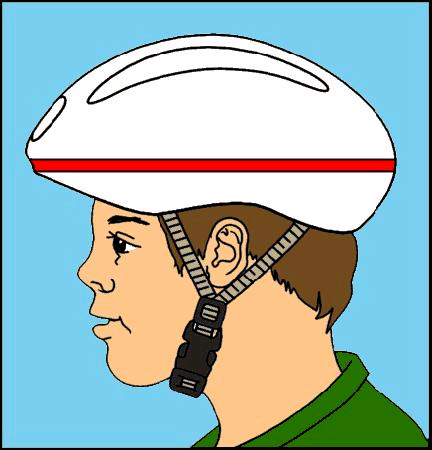 It is important that a helmet should fit the cyclist properly – in one study of children and adolescents aged 4 to 18 years, 96 % were found to be incorrectly fitted. Efficacy of incorrectly fitted helmets is reckoned to be much lower; one estimate states that risk is increased almost twofold.
Most manufacturers provide a range of sizes ranging from child
ren's to adult
with additional variations from small to medium to large. The correct size is important. Some adjustment can usually be made using different thickness foam pads. Helmets are held on the head with nylon
straps, which must be adjusted to fit the individual. This can be difficult to achieve, depending on the design. Most helmets will have multiple adjustment points on the strap to allow both strap and helmet to be correctly positioned. Additionally, some helmets have adjustable cradles which fit the helmet to the occipital region of the skull. These provide no protection, only fit, so helmets with this type of adjustment are unsuitable for roller skating, stunts, skateboarding and unicycling. In general, the more skull coverage a helmet provides, the more effectively it can be fitted to the head and hence the better it will remain on the head in an accident.
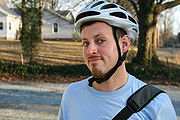
The helmet should sit level on the cyclist's head with only a couple of finger-widths between eyebrow and the helmet brim. The strap should sit at the back of the lower jaw, against the throat, and be sufficiently tight that the helmet does not move on the head. It should not be possible to insert more than one finger's thickness between the strap and the throat.
Newer helmets for toddlers and children feature flat backs that prevent the helmet from tilting too far forward when worn while riding in a trailer or child seat with a headrest.
The Snell Memorial Foundation
recommends that any helmet that has sustained a substantial blow should be discarded and replaced, including any helmet involved in a crash in which the head has hit a hard surface or in which a fall has resulted in marks on the shell. Because some helmet materials deteriorate with age, the Snell Memorial Foundation recommends that a helmet be replaced at least every 5 years, or sooner if the manufacturer recommends it.
and children are much less likely to wear helmets unless compelled.
(UCI), did not require helmet use, leaving the matter to individual preferences and local traffic laws. The majority of professional cyclists chose not to wear helmets, citing discomfort and claiming that helmet weight would put them in a disadvantage during uphill sections of the race.
The first serious attempt by the UCI to introduce compulsory helmet use in 1991 was met with strong opposition from the riders. An attempt to enforce the rule at the 1991 Paris–Nice race resulted in a riders' strike, forcing the UCI to abandon the idea.
While voluntary helmet use in professional ranks rose somewhat in the 1990s, the turning point in helmet policy was the March 2003 death of Kazakh Andrei Kivilev
. The new rules were introduced on May 5, 2003, with the 2003 Giro d'Italia
being the first major race affected. The 2003 rules allowed for discarding the helmets during final climbs of at least 5 kilometres in length; subsequent revisions made helmet use mandatory at all times.
No studies have been published yet into whether injuries to racers have reduced as a result, but modern helmets can help to decrease aerodynamic drag by approximately 2% over a rider with no helmet, giving a competitive edge in a bicycle race.
Cycling is good for health. On average, regular cyclists live longer because the health benefits far outweigh the risk of crashes.
s have been done on the subject.
Authors do not agree on how studies should be selected for analysis, nor on what summary statistics are most relevant. Potential weaknesses of this type of study include: simultaneous changes in the road environment (e.g. drink-drive campaigns); inaccuracy of exposure estimates (numbers cycling, distance cycled etc.), changes in the definitions of the data collected, failure to analyse control groups, failure to analyse long-term trends, and the ecological fallacy
.
Robinson's reviews of cyclists and control groups in jurisdictions where helmet use increased by 40% or more following compulsion conclude that enforced helmet laws discourage cycling but produce no obvious response in percentage of head injuries. These studies have been the subject of vigorous debate. A more recent review, by Macpherson and Spinks, includes two original papers (neither of which meet the criteria for inclusion in Robinson's review) and concludes that "Bicycle helmet legislation appears to be effective in increasing helmet use and decreasing head injury rates in the populations for which it is implemented. However, there are very few high-quality evaluative studies that measure these outcomes, and none that reported data on an (sic) possible declines in bicycle use."
There are many other studies. The largest, covering eight million cyclist injuries over 15 years, showed no effect on serious injuries and a small but significant increase in risk of fatality. Although the head injury rate in the US rose in this study by 40 % as helmet use rose from 18 % to 50 %, this is a time-trend analysis with the potential weaknesses mentioned above; the correlation may not be causal. Association with increased risk has been reported in other studies. Different analyses of the same data can produce different results. For example, Scuffham analysed data on the increase of voluntary wearing in New Zealand to 1995; he concluded that, after taking into account long-term trends, helmets had no measurable effect. His subsequent re-analysis without accounting for the long-term trends suggested a small benefit. Scuffham's later cost-benefit analysis of the New Zealand helmet law showed that the cost of helmets outweighed the savings in injuries, even taking the most optimistic estimate of injuries prevented.
of five case-control studies found that helmets reduce the risk of head injury in a collision by 63-88% and injury to the upper and mid face by 65%. Ascertainment bias (a minority of cyclists with non-head injuries claiming that they had worn helmets when in fact they had not) could therefore also account for these findings. Other case-control studies show similar results.
The most widely quoted case-control study, by Thompson, Rivara, and Thompson, reported an 85% reduction in the risk of head injury by using a helmet. There are many criticisms of this study. Its figures of 85% and 88% protection from helmets are based on a simple misunderstanding of odds ratios, but are widely quoted. The positive findings have been attributed to confounding because the helmet wearers were a very different social group to the non-wearers. Cyclists on the streets at the time had about the same helmet-wearing rate as the cyclists with head injuries; cyclists with non-head injuries reported a higher rate of helmet use.
According to a review of studies published in 2011, correcting for biases reduces the apparent effect on head injuries, and no overall effect of bicycle helmets could be found when injuries to head, face or neck are considered as a whole.
Bicycle use has large long-term health benefits. In effect, regular cyclists live longer. A reduction in the number of cyclists is likely to harm the health of the population more than any possible protection from injury. UK figures show that it takes at least 8000 years of average cycling to produce one clinically severe head injury and 22,000 years for one death. Because cycling is more healthy than dangerous, helmet laws appear to offer net health benefit only in dangerous bicycling environments under optimistic assumptions of the efficacy of helmets.
Papers denying that helmet promotion has a deterrent effect on cycling have tended to ignore evidence to the contrary. It has been suggested that a fall in the number of bicyclists in the 1990s may reflect an increase of in-line skating or other (unhelmeted) recreational activities.
A reduction in cycling may lead to an increased risk for the cyclists remaining on the road, due to a "safety in numbers
" effect. According to one source, the probability of an individual cyclist being struck by a motorist declines with the 0.6 power of the number of cyclists on the road. This means that if the number of cyclists on the road doubles, then the average individual cyclist can ride for an additional 50% of the time without increasing the probability of being struck. It is thought that the increased frequency of motorist-cyclist interaction creates more aware motorists.
Several mechanisms by which cycle helmet promotion or compulsion may deter cycling have been suggested. Helmets and their promotion may reinforce the misconception that bicycling is more dangerous than traveling by passenger car. Referring to the use of "human skull" images in a campaign, the CTC suggests that "this macabre imagery, with its associations of hospitals and death, is likely to reduce cycle use, thereby undermining efforts to realize the health and other benefits of increased cycling". Bicycle helmets are an additional expense and may make cycling less convenient; they are bulky and often cannot be stored securely
with bikes.
Bicycle helmets are seen as incompatible with some hairstyle
s, forcing bicycle users to recreate their hairstyle after each journey. Finally, bicycle helmets and other "safety" equipment have, in the past, occasionally been seen as vexatious and ridiculous.
and is consistent with other road safety interventions such as seat belt
s and anti-lock braking system
s.
In tests, adults accustomed to wearing helmets cycled faster when wearing a helmet than without, indicating a higher tolerance for risk. Tests also show that children go faster and take more risks when wearing safety gear (including helmets), and that parents allow children to be more risky when using safety gear.
Motorists may also alter their behavior toward helmeted cyclists. One small study from England found that vehicles passed a helmeted cyclist with measurably less clearance (8.5 cm) than that given to the same cyclist unhelmeted (out of an average total passing distance of 1.2 to 1.3 metres).
Rodgers re-analysed data which supposedly showed helmets to be effective; he found data errors and methodological weaknesses so serious that in fact the data showed "bicycle-related fatalities are positively and significantly associated with increased helmet use". A range of theories have been proposed to explain why helmet use might indirectly translate into more or worse accidents. In short, the analysis of helmet effectiveness is confounded by changes in human behaviour apparently induced by the presence of protective headgear.
after head injury may be torsional
forces leading to diffuse axonal injury
(DAI), a form of injury which usual helmets cannot mitigate and may make worse. Helmets may increase the torsional
forces by increasing the distance from the centre of the spine to the outside of the helmet, compared to the distance to the scalp without a helmet: "Bicycle helmet crash simulation experiments carried out as part of this project indicated very high rotational accelerations for a fall over the handlebars at 45 km/h. The rotational accelerations were found to be 30 percent higher than those found in similar tests using a full face polymer motorcycle helmet." A 1991 study by Hodgson, in which bicycle helmets were tested for ease of skidding, found that adding facial protection to a standard bicycle helmet (in effect making the helmet full-face) brought the benefit of reduced twisting forces on the brain.
A bicycle helmet with its own synthetic "scalp" has been designed with the aim of mitigating rotational injury. This is one of several slip-plane-type designs that are intended to reduce rotational acceleration on the brain during an oblique impact. Although many bicycle helmets are designed with rounded, smooth shells that slide easily along pavement, adding a slip plane to such an already-good design may be valuable in situations where the helmet impacts obliquely against a high-friction surface. The concept of slip planes is not new, but the implementation in production bicycle helmets is.
by the straps of their bicycle helmets.
As a result, European Standard EN 1080 was developed, which uses a weak retention system designed to open under load.
Such helmets are not intended for use anywhere motor vehicles are present. To avoid serious accidents, parents and carers should take care to ensure that children do not wear bicycle helmets during unsupervised play, or when using climbing equipment.
and the American National Safety Council. In 2005 the British Medical Association
wrote, and in 2005 formally adopted, a position calling on the UK government to introduce cycle helmet legislation. U.S.-based cycling activist John Forester suggests that helmet wearing could prevent 300 deaths a year in the US out of a total of 1530 preventable deaths, behind Effective Cycling
at 500 but ahead of all other interventions. Public Health Law
Research reports that there is enough evidence to establish that bicycle helmet laws are an effective public health intervention aimed at reducing head-related morbidity and mortality. By the 2000s, almost all mountain bikers wore helmets (and other protective gear).
Significant helmet promotion preceded epidemiological studies evaluating the effectiveness of bicycle helmets in bicycle crashes.
Received opinion in some English-speaking countries is that bicycle helmets are useful and that every cyclist should wear one; helmets had become a ‘ “Mom and apple pie” issue’ in the United States by 1991 according to the League of American Bicyclists. Professional bodies elsewhere have agreed, such as the Swiss Council for Accident Prevention. The Dutch Institute for Road Safety Research (SWOV) finds contradictory evidence but on balance concludes "that a bicycle helmet is an effective means of protecting cyclists against head and brain injury", however the Dutch Government does not support compulsion or promotion.
, a transport and road safety analyst from the UK, does not support the use of helmets, reasoning that they are of very limited value in the event of a collision with a car, that risk compensation negates their protective effect and because he feels their promotion implicitly shifts responsibility of care to the cyclist. He also cautions against placing the recommendations of surgeons above other expert opinion in the debate, comparing it to drawing conclusions on whether it is worthwhile to buy lottery tickets by sampling only a group of prizewinners. The prominent UK-based cycling activist John Franklin
is skeptical of the merits of helmets, regarding proactive measures including bike maintenance and riding skills as being more important. Cyclists' representative groups complain that focus on helmets diverts attention from other issues which are much more important for improving bicycle safety, such as road danger reduction, training, roadcraft, and bicycle maintenance. Of 28 publicly funded cycle safety interventions listed in a report in 2002, 24 were helmet promotions. For context, one evaluation of the relative merits of different cycle safety interventions estimated that 27% of cyclist casualties could be prevented by various measures, of which just 1% could be achieved through a combination of bicycle engineering and helmet use.
In 1998 the European Cyclists' Federation adopted a position paper rejecting compulsory helmet laws as being likely to have greater negative rather than positive health effects. The UK's largest cyclists' organisation, the CTC
, believes that the "overall health effects of compulsory helmets are negative." The British National Children's Bureau
has said "The 2004 BMA statement announcing its decision to support compulsory cycle helmets shows how the uncritical use of accident statistics can lead to poor conclusions." The same report estimated that, at most, universal helmet use would save the lives of three children aged 0 to 15 each year. That figure "assumes universal and correct use of helmets, it assumes that risk compensation does not occur and it assumes that no children die as a result of strangulation or other injuries caused by helmet use. These assumptions are most unlikely to be correct in the real world."
The Norwegian Government has eschewed recommending bicycle helmets. Their review did not find conclusive scientific evidence about helmet use. It stated that although helmets may reduce the incidence of facial, cranial and brain injuries, compulsory use may also reduce cycling participation and may increase the risk per distance cycled.
, in at least one jurisdiction, for either minors only, or for all riders: Australia, Canada, Czech Republic, Finland, Iceland, New Zealand, Sweden, and the United States. Spain requires helmets on interurban routes. In the U.S. 21 states have state-wide mandatory helmet laws for minors of varying ages, and 37 states have mandatory helmet laws for varying age groups in varying jurisdictions. Nearly 9 in 10 American adults support helmet laws for children. Israel's helmet law was never enforced or obeyed, and the adult element has been revoked; Mexico City has repealed its helmet law.
Although the link is not causal, it is observed that the countries with the best cycle safety records (Denmark
and the Netherlands
) have among the lowest levels of helmet use. Their bicycle safety record is generally attributed to public awareness and understanding of cyclists, safety in numbers
, education, and to some extent separation from motor traffic
. A study of cycling in major streets of Boston, Paris and Amsterdam illustrates the variation in cycling culture: Boston had far higher rates of helmet-wearing (32% of cyclists, versus 2.4% in Paris and 0.1% in Amsterdam), Amsterdam had far more cyclists (242 passing bicycles per hour, versus 74 in Paris and 55 in Boston). Cycle helmet wearing rates in the Netherlands and Denmark are very low. An Australian journalist writes: "Rarities in Amsterdam seem to be stretch-fabric-clad cyclists and fat cyclists. Helmets are non-existent, and when people asked me where I was from, they would grimace and mutter: "Ah, yes, helmet laws." These had gained international notoriety on a par with our deadly sea animals. Despite the lack of helmets, cycling in the Netherlands is safer than in any other country, and the Dutch have one-third the number of cycling fatalities (per 100,000 people) that Australia has." The UK's CTC say that cycling in the Netherlands and Denmark is perceived as a "normal" activity requiring no special clothing or equipment. Pucher and Buehler state: "The Dutch cycling experts and planners interviewed for this paper adamantly opposed the use of helmets, claiming that helmets discourage cycling by making it less convenient, less comfortable, and less fashionable. They also mention the possibility that helmets would make cycling more dangerous by giving cyclists a false sense of safety and thus encouraging riskier riding behavior."
Helmet
A helmet is a form of protective gear worn on the head to protect it from injuries.Ceremonial or symbolic helmets without protective function are sometimes used. The oldest known use of helmets was by Assyrian soldiers in 900BC, who wore thick leather or bronze helmets to protect the head from...
intended to be worn while riding a bicycle
Bicycle
A bicycle, also known as a bike, pushbike or cycle, is a human-powered, pedal-driven, single-track vehicle, having two wheels attached to a frame, one behind the other. A person who rides a bicycle is called a cyclist, or bicyclist....
. They are designed to attenuate impacts to the skull
Human skull
The human skull is a bony structure, skeleton, that is in the human head and which supports the structures of the face and forms a cavity for the brain.In humans, the adult skull is normally made up of 22 bones...
of a cyclist
Cycling
Cycling, also called bicycling or biking, is the use of bicycles for transport, recreation, or for sport. Persons engaged in cycling are cyclists or bicyclists...
in falls while minimizing side effects such as interference with peripheral vision. There is an active scientific debate, with no consensus, on whether helmets are useful for cyclists in general, and on whether any benefits are outweighed by their disadvantages. The debate on whether helmet use should be enforced by law
Bicycle helmet laws
Some countries and lower jurisdictions have passed laws which make riding without a helmet illegal. The scope and details of such laws vary.-Introduction:...
is intense and occasionally bitter, often based not only on differing interpretations of the academic literature, but also on differing assumptions and interests on the two sides.
History of designs
Aerobic exercise
Aerobic exercise is physical exercise of relatively low intensity that depends primarily on the aerobic energy-generating process. Aerobic literally means "living in air", and refers to the use of oxygen to adequately meet energy demands during exercise via aerobic metabolism...
activity which significantly raises body temperature, and the head in particular needs to be able to regulate its temperature. The dominant form of helmet up to the 1970s was the leather "hairnet" style. This offered acceptable protection from scrapes and cuts, but only minimal impact protection, and was mainly used by racing cyclists
Bicycle racing
Bicycle racing is a competition sport in which various types of bicycles are used. There are several categories of bicycle racing including road bicycle racing, cyclo-cross, mountain bike racing, track cycling, BMX, bike trials, and cycle speedway. Bicycle racing is recognised as an Olympic sport...
. More widespread use of helmets began in the U.S. in the 1970s. After many decades, when bicycles were regarded only as children's toys, many American adults took up cycling during and after the bike boom
Bike boom
Bike boom or bicycle craze refers to several different times when, for a period of a few years, many people in many parts of Europe and North America wanted to buy and ride a bicycle. In brief, they occurred in 1819, 1868, the decade of the 1890s, and the 1970s...
of the 1970s. Two of the first modern bicycle helmets were made by MSR
Mountain Safety Research
Mountain Safety Research, or MSR, is an American corporation located in Seattle, Washington, and owned by Cascade Designs. It was founded in 1969 by Larry Penberthy because he was not pleased with the safety and reliability of outdoor equipment....
, a manufacturer of mountaineering
Mountaineering
Mountaineering or mountain climbing is the sport, hobby or profession of hiking, skiing, and climbing mountains. While mountaineering began as attempts to reach the highest point of unclimbed mountains it has branched into specialisations that address different aspects of the mountain and consists...
equipment, and Bell Sports, a manufacturer of helmets for auto racing and motorcycles. These helmets were a spin-off from the development of expanded polystyrene
Polystyrene
Polystyrene ) also known as Thermocole, abbreviated following ISO Standard PS, is an aromatic polymer made from the monomer styrene, a liquid hydrocarbon that is manufactured from petroleum by the chemical industry...
foam liners for motorcycling and motorsport helmets, and had hard polycarbonate
Polycarbonate
PolycarbonatePhysical PropertiesDensity 1.20–1.22 g/cm3Abbe number 34.0Refractive index 1.584–1.586FlammabilityV0-V2Limiting oxygen index25–27%Water absorption – Equilibrium0.16–0.35%Water absorption – over 24 hours0.1%...
plastic shells. The bicycle helmet arm of Bell was split off in 1991 as Bell Sports Inc., having completely overtaken the motorcycle and motor sports helmet business.
The first commercially successful purpose-designed bicycle helmet was the Bell Biker, a polystyrene-lined hard shell released in 1975. At the time there was no appropriate standard; the only applicable one, from Snell, would be passed only by a light open-face motorcycle helmet. Over time the design was refined and by 1983 Bell were making the V1-Pro, the first polystyrene helmet intended for racing use. In 1984 Bell produced the Li'l Bell Shell, a no-shell children's helmet. These early helmets had little ventilation.
In 1985, Snell B85 was introduced, the first widely adopted standard for bicycle helmets; this has subsequently been refined into B90 and B95 (see Standards below). At this time helmets were almost all either hard-shell or no-shell (perhaps with a vacuum-formed plastic cover). Ventilation was still minimal due mainly to technical limitations of the foams and shells in use.
Use of hard shells declined rapidly among the general cyclist population during the 1990s, almost disappearing by the end of the decade, but remain popular with BMX riders
BMX
Bicycle motocross or BMX refers to the sport in which the main goal is extreme racing on bicycles in motocross style on tracks with inline start and expressive obstacles, and it is also the term that refers to the bicycle itself that is designed for dirt and motocross cycling.- History :BMX started...
as well as inline skaters and skateboarders.
The late 1990s and early 2000s saw advances in retention and fitting systems, replacing the old system of varying thickness pads with cradles which adjust quite precisely to the rider's head. This has also resulted in the back of the head being less covered by the helmet; impacts to this region are rare, but it does make a modern bike helmet much less suitable for activities such as unicycling, skateboarding and inline skating, where falling over backward is relatively common. Other helmets will be more suitable for these activities.
Since more advanced helmets began being used in the Tour de France
Tour de France
The Tour de France is an annual bicycle race held in France and nearby countries. First staged in 1903, the race covers more than and lasts three weeks. As the best known and most prestigious of cycling's three "Grand Tours", the Tour de France attracts riders and teams from around the world. The...
, carbon fiber
Carbon fiber
Carbon fiber, alternatively graphite fiber, carbon graphite or CF, is a material consisting of fibers about 5–10 μm in diameter and composed mostly of carbon atoms. The carbon atoms are bonded together in crystals that are more or less aligned parallel to the long axis of the fiber...
inserts have started to be used to increase strength and protection of the helmet. The Giro
Giro (company)
Giro is a U.S. manufacturer of helmets, sunglasses, goggles and softgoods for cycling, skiing and snowboarding. The company was founded in 1985 by Jim Gentes and is headquartered in the Santa Cruz, California area....
Atmos and Ionos, as well as the Bell
Bell Sports Inc.
Bell Sports, a division of Easton-Bell Sports, is a manufacturer of bicycle, auto racing, and motorcycle helmets. Easton-Bell Sports also owns the Riddell football helmet and Giro bicycle helmet brands....
Alchera were among the first to use carbon fiber.
Some modern racing bicycle helmets have a long tapering back end for streamlining
Streamliner
A streamliner is a vehicle incorporating streamlining in a shape providing reduced air resistance. The term is applied to high-speed railway trainsets of the 1930s to 1950s, and to their successor "bullet trains". Less commonly, the term is applied to fully faired recumbent bicycles...
. This type of helmet is mainly dedicated to time trial
Individual time trial
An individual time trial is a road bicycle race in which cyclists race alone against the clock . There are also track-based time trials where riders compete in velodromes, and team time trials...
racing as they lack significant ventilation, making them uncomfortable for long races.
History of standards
United States
The United States of America is a federal constitutional republic comprising fifty states and a federal district...
the Snell Memorial Foundation
Snell Memorial Foundation
The Snell Memorial Foundation is a not-for-profit organization created to provide a high quality standard of safety for helmets. Founded in 1957, SMF is named after William "Pete" Snell, a popular sports car racer who died in 1956 of head injuries he received when the racing helmet he wore failed...
, an organization initially established to create standards for motorcycle and auto-racing helmets, implemented one of the first standards, since updated. Snell's standard includes testing of random samples. In 1990 the Consumers' Association
Consumers' Association
The Consumers' Association is the umbrella organisation that houses the trading arm Which? Ltd. The Consumers' Association is a charity, registered in England and Wales No 296072. Which? Ltd is its wholly owned trading subsidiary....
(UK) market survey showed that around 90 % of helmets on sale were Snell B90 certified. By their 1998 survey the number of Snell certified helmets was around zero. There are two main types of helmet: hard shell and soft/micro shell (no-shell helmets are now rare). Hard shells declined rapidly among the general cyclist population over this period, almost disappearing by the end of the decade, but remained more popular with BMX
BMX
Bicycle motocross or BMX refers to the sport in which the main goal is extreme racing on bicycles in motocross style on tracks with inline start and expressive obstacles, and it is also the term that refers to the bicycle itself that is designed for dirt and motocross cycling.- History :BMX started...
riders as well as inline skaters and skateboarders.
The American National Standards Institute
American National Standards Institute
The American National Standards Institute is a private non-profit organization that oversees the development of voluntary consensus standards for products, services, processes, systems, and personnel in the United States. The organization also coordinates U.S. standards with international...
(ANSI) created a standard called ANSI Z80.4 in 1984. Later, the United States Consumer Product Safety Commission
Consumer Product Safety Commission
The United States Consumer Product Safety Commission is an independent agency of the United States government created in 1972 through the Consumer Product Safety Act to protect "against unreasonable risks of injuries associated with consumer products." The CPSC is an independent agency that does...
(CPSC) created its own mandatory standard for all bicycle helmets sold in the United States
United States
The United States of America is a federal constitutional republic comprising fifty states and a federal district...
, which took effect in March 1999.
In the European Union
European Union
The European Union is an economic and political union of 27 independent member states which are located primarily in Europe. The EU traces its origins from the European Coal and Steel Community and the European Economic Community , formed by six countries in 1958...
(EU) the currently applicable standard is EN 1078
EN 1078
EN 1078, entitled Helmets for pedal cyclists and for users of skateboards and roller skates, is a European standard published in 1997. It is the basis of the identical British Standard BS EN 1078:1997...
:1997.
In the UK
United Kingdom
The United Kingdom of Great Britain and Northern IrelandIn the United Kingdom and Dependencies, other languages have been officially recognised as legitimate autochthonous languages under the European Charter for Regional or Minority Languages...
the current standard is BS EN 1078:1997, which is identical to the EU standard, and which replaced BS 6863:1989 in 1997.
In Australia
Australia
Australia , officially the Commonwealth of Australia, is a country in the Southern Hemisphere comprising the mainland of the Australian continent, the island of Tasmania, and numerous smaller islands in the Indian and Pacific Oceans. It is the world's sixth-largest country by total area...
and New Zealand
New Zealand
New Zealand is an island country in the south-western Pacific Ocean comprising two main landmasses and numerous smaller islands. The country is situated some east of Australia across the Tasman Sea, and roughly south of the Pacific island nations of New Caledonia, Fiji, and Tonga...
, the current legally-required standard is AS/NZS 2063. The performance requirements of this standard are slightly less strict than the Snell B95 standard but incorporate a quality assurance requirement. As a result, the AS/NZS can be argued to be safer. SAI Global (a profit-making arm of the Standards Australia organisation]) runs a marketing program based on the AS/NZS 2063 standard, in which manufacturers pay royalties and fees to affix a "5 ticks" certification trademark sticker on helmets.
The CPSC and EN1078 standards are lower than the Snell B95 (and B90) standard; Snell helmet standards are externally verified, with each helmet traceable by unique serial number. EN 1078 is also externally validated, but lacks Snell's traceability. The most common standard in the US, CPSC, is self-certified by the manufacturers. It is generally true to say that Snell standards are more exacting than other standards, and most helmets on sale these days will not meet them (currently, Specialized is the only bicycle helmet brand in the world to meet the Snell standard. All of their helmets are Snell certified.)
In brief, the primary design goal of a helmet is to decelerate the skull (and by implication, the brain inside it) more gently than would be the case if no helmet were worn. A helmet's ability to manage linear deceleration of the skull could be improved by providing a greater thickness of expanded polystyrene
Polystyrene
Polystyrene ) also known as Thermocole, abbreviated following ISO Standard PS, is an aromatic polymer made from the monomer styrene, a liquid hydrocarbon that is manufactured from petroleum by the chemical industry...
foam and also by making this foam softer, but this would make the entire helmet bulkier, heavier, and hotter to wear. Another concern is that a thicker helmet increases the risk of rotational-type brain injuries (discussed in more detail below). Ultimately, every helmet design represents some sort of compromise.
The trend is toward thinner helmets with many large vents. This trend to lower standards has been noted in some of the studies. It is relatively common for helmets to fail on test, and some helmets on sale are not certified to any accepted standard.
Design intentions and standards
Both are intended to reduce accelerationAcceleration
In physics, acceleration is the rate of change of velocity with time. In one dimension, acceleration is the rate at which something speeds up or slows down. However, since velocity is a vector, acceleration describes the rate of change of both the magnitude and the direction of velocity. ...
to the head due to impact, as a stiff liner made of expanded polystyrene is crushed against the head.
Standards involve the use of an instrumented headform which is dropped, wearing a helmet, onto various anvils. The speed of impact is designed to simulate the effect of a rider's head falling from approximately usual riding height, without rotational energy and without impact from another vehicle.
Collision energy varies with the square of impact speed
Speed
In kinematics, the speed of an object is the magnitude of its velocity ; it is thus a scalar quantity. The average speed of an object in an interval of time is the distance traveled by the object divided by the duration of the interval; the instantaneous speed is the limit of the average speed as...
. A typical helmet is designed to absorb the energy of a head falling from a bicycle, hence an impact speed of around 12 mph or 20 km/h. This will only reduce the energy of a 30 mph or 50 km/h impact to the equivalent of 27.5 mph or 45 km/h, and even this will be compromised if the helmet fails. As a subsidiary effect, they should also spread point impacts over a wider area of the skull. Hard shell helmets may do this better, but are heavier and less well ventilated. They are more common among stunt riders
BMX
Bicycle motocross or BMX refers to the sport in which the main goal is extreme racing on bicycles in motocross style on tracks with inline start and expressive obstacles, and it is also the term that refers to the bicycle itself that is designed for dirt and motocross cycling.- History :BMX started...
than road riders
Road bicycle
The term road bicycle is used to describe bicycles built for traveling at speed on paved roads. Some sources use the term to mean racing bicycle...
or mountain bikers
Mountain biking
Mountain biking is a sport which consists of riding bicycles off-road, often over rough terrain, using specially adapted mountain bikes. Mountain bikes share similarities with other bikes, but incorporate features designed to enhance durability and performance in rough terrain.Mountain biking can...
. Additionally, the helmet should reduce superficial injuries to the scalp. Hard shell helmets may also reduce the likelihood of penetrating impacts, although these are very rare.
Criticism of current standards; new designs
Some helmet liners may be too stiff to be effective. Standards require the use of headforms heavier and more rigid than the human head; these are more capable of crushing foam than is the human head. In real accidents,very little crushing of the liner foam was usually evident... What in fact happens in a real crash impact is that the human head deforms elastically on impact. The standard impact attenuation test making use of a solid headform does not consider the effect of human head deformation with the result that all acceleration attenuation occurs in compression of the liner. Since the solid headform is more capable of crushing helmet padding, manufacturers have had to provide relatively stiff foam in the helmet so that it would pass the impact attenuation test... As the results in Figure 15 illustrate, the child skull is far from being solid and will deform readily on impact. This fact is well known in the medical field and is largely why a child who has had a rather modest impact to the head is usually admitted to hospital for observation. The substantial elastic deformation of the child head that can occur during impact can result in quite extensive diffuse brain damage.
In real accidents, while broken helmets are common, it is extremely unusual to see any helmet that has compressed foam and thus may have performed as intended.
Another source of field experience is our experience with damaged helmets returned to customer service... I collected damaged infant/toddler helmets for several months in 1995. Not only did I not see bottomed out helmets, I didn’t see any helmet showing signs of crushing on the inside.
Most helmets provide no protection against rotational injury and may make it worse:
"The major discovery is that the skull plays an important role in protecting against rotational acceleration," says Phillips. He says almost all head injuries involve not just a direct blow to the skull but also damage to blood vessels caused by the brain rotating within the skull.
In mechanical terms, the head is an elliptical spheroid with a single universal joint, the neck. It is therefore almost impossible to hit it without causing it to rotate. The head tries to dampen these forces using a combination of built-in defences: the scalp, the hard skull and the cerebrospinal fluid beneath it. During an impact, the scalp acts as rotational shock absorber by both compressing and sliding over the skull. This absorbs energy from the impact.
Fit and care
Most manufacturers provide a range of sizes ranging from child
Child
Biologically, a child is generally a human between the stages of birth and puberty. Some vernacular definitions of a child include the fetus, as being an unborn child. The legal definition of "child" generally refers to a minor, otherwise known as a person younger than the age of majority...
ren's to adult
Adult
An adult is a human being or living organism that is of relatively mature age, typically associated with sexual maturity and the attainment of reproductive age....
with additional variations from small to medium to large. The correct size is important. Some adjustment can usually be made using different thickness foam pads. Helmets are held on the head with nylon
Nylon
Nylon is a generic designation for a family of synthetic polymers known generically as polyamides, first produced on February 28, 1935, by Wallace Carothers at DuPont's research facility at the DuPont Experimental Station...
straps, which must be adjusted to fit the individual. This can be difficult to achieve, depending on the design. Most helmets will have multiple adjustment points on the strap to allow both strap and helmet to be correctly positioned. Additionally, some helmets have adjustable cradles which fit the helmet to the occipital region of the skull. These provide no protection, only fit, so helmets with this type of adjustment are unsuitable for roller skating, stunts, skateboarding and unicycling. In general, the more skull coverage a helmet provides, the more effectively it can be fitted to the head and hence the better it will remain on the head in an accident.
The helmet should sit level on the cyclist's head with only a couple of finger-widths between eyebrow and the helmet brim. The strap should sit at the back of the lower jaw, against the throat, and be sufficiently tight that the helmet does not move on the head. It should not be possible to insert more than one finger's thickness between the strap and the throat.
Newer helmets for toddlers and children feature flat backs that prevent the helmet from tilting too far forward when worn while riding in a trailer or child seat with a headrest.
The Snell Memorial Foundation
Snell Memorial Foundation
The Snell Memorial Foundation is a not-for-profit organization created to provide a high quality standard of safety for helmets. Founded in 1957, SMF is named after William "Pete" Snell, a popular sports car racer who died in 1956 of head injuries he received when the racing helmet he wore failed...
recommends that any helmet that has sustained a substantial blow should be discarded and replaced, including any helmet involved in a crash in which the head has hit a hard surface or in which a fall has resulted in marks on the shell. Because some helmet materials deteriorate with age, the Snell Memorial Foundation recommends that a helmet be replaced at least every 5 years, or sooner if the manufacturer recommends it.
History of use
Helmets use varies greatly between populations and between groups. Downhill mountain bikers and amateur sportive cyclists normally wear helmets, and helmet use is enforced in professional cycle sport and in a few legal jurisdictions. Utility cyclistsUtility cycling
Utility cycling encompasses any cycling not done primarily for fitness, recreation such as cycle touring, or sport such as cycle racing, but simply as a means of transport...
and children are much less likely to wear helmets unless compelled.
Required helmet use in cycling sport
Historically, road cycling regulations set by the sport's ruling body, Union Cycliste InternationaleUnion Cycliste Internationale
Union Cycliste Internationale is the world governing body for sports cycling and oversees international competitive cycling events. The UCI is based in Aigle, Switzerland....
(UCI), did not require helmet use, leaving the matter to individual preferences and local traffic laws. The majority of professional cyclists chose not to wear helmets, citing discomfort and claiming that helmet weight would put them in a disadvantage during uphill sections of the race.
The first serious attempt by the UCI to introduce compulsory helmet use in 1991 was met with strong opposition from the riders. An attempt to enforce the rule at the 1991 Paris–Nice race resulted in a riders' strike, forcing the UCI to abandon the idea.
While voluntary helmet use in professional ranks rose somewhat in the 1990s, the turning point in helmet policy was the March 2003 death of Kazakh Andrei Kivilev
Andrei Kivilev
Andrei Kivilev was a professional road bicycle racer from Taldykorgan, Kazakhstan. In March 2003, he fell heavily during the Paris–Nice race and subsequently died of his injuries...
. The new rules were introduced on May 5, 2003, with the 2003 Giro d'Italia
2003 Giro d'Italia
The 2003 Giro d'Italia of cycling, the 86th running of the race, was held from 10 May to 1 June 2003, consisting of 21 stages for a total of 3,472 km, ridden at an average speed of 38.828 km/h. It was won by Gilberto Simoni....
being the first major race affected. The 2003 rules allowed for discarding the helmets during final climbs of at least 5 kilometres in length; subsequent revisions made helmet use mandatory at all times.
No studies have been published yet into whether injuries to racers have reduced as a result, but modern helmets can help to decrease aerodynamic drag by approximately 2% over a rider with no helmet, giving a competitive edge in a bicycle race.
Is ordinary cycling risky enough to require helmets?
Per mile, in the United Kingdom, cycling has an overall risk of injury and death similar to walking but higher than driving. Measured per hour, the risk of driving, cycling and walking are similar. It has been suggested that low individual risk is not relevant to the issue of helmet compulsion.Cycling is good for health. On average, regular cyclists live longer because the health benefits far outweigh the risk of crashes.
Are helmets useful? Desirable effects of helmet use
The protective effect of cycle helmets has been studied mainly through case-control studies and time-trend analyses. Case-control studies usually show a large protective effect on head injuries while time-trend analyses usually show no protective effect at all. No randomized controlled trialRandomized controlled trial
A randomized controlled trial is a type of scientific experiment - a form of clinical trial - most commonly used in testing the safety and efficacy or effectiveness of healthcare services or health technologies A randomized controlled trial (RCT) is a type of scientific experiment - a form of...
s have been done on the subject.
Time-trend analyses
Time-trend analyses compare changes in helmet use and injury rates in populations over time. This type of study usually shows that as helmet-use increases, head injury rates among cyclists do not fall faster than for road users without helmets such as pedestrians and motorists.Authors do not agree on how studies should be selected for analysis, nor on what summary statistics are most relevant. Potential weaknesses of this type of study include: simultaneous changes in the road environment (e.g. drink-drive campaigns); inaccuracy of exposure estimates (numbers cycling, distance cycled etc.), changes in the definitions of the data collected, failure to analyse control groups, failure to analyse long-term trends, and the ecological fallacy
Ecological fallacy
An ecological fallacy is a logical fallacy in the interpretation of statistical data in an ecological study, whereby inferences about the nature of specific individuals are based solely upon aggregate statistics collected for the group to which those individuals belong...
.
Robinson's reviews of cyclists and control groups in jurisdictions where helmet use increased by 40% or more following compulsion conclude that enforced helmet laws discourage cycling but produce no obvious response in percentage of head injuries. These studies have been the subject of vigorous debate. A more recent review, by Macpherson and Spinks, includes two original papers (neither of which meet the criteria for inclusion in Robinson's review) and concludes that "Bicycle helmet legislation appears to be effective in increasing helmet use and decreasing head injury rates in the populations for which it is implemented. However, there are very few high-quality evaluative studies that measure these outcomes, and none that reported data on an (sic) possible declines in bicycle use."
There are many other studies. The largest, covering eight million cyclist injuries over 15 years, showed no effect on serious injuries and a small but significant increase in risk of fatality. Although the head injury rate in the US rose in this study by 40 % as helmet use rose from 18 % to 50 %, this is a time-trend analysis with the potential weaknesses mentioned above; the correlation may not be causal. Association with increased risk has been reported in other studies. Different analyses of the same data can produce different results. For example, Scuffham analysed data on the increase of voluntary wearing in New Zealand to 1995; he concluded that, after taking into account long-term trends, helmets had no measurable effect. His subsequent re-analysis without accounting for the long-term trends suggested a small benefit. Scuffham's later cost-benefit analysis of the New Zealand helmet law showed that the cost of helmets outweighed the savings in injuries, even taking the most optimistic estimate of injuries prevented.
Case-control studies
In a case-control study, hospitalised cyclists are divided up into those with head injuries (cases) and those without (controls). This type of study usually shows that helmets have a large protective effect. A Cochrane reviewCochrane Collaboration
The Cochrane Collaboration is a group of over 28,000 volunteers in more than 100 countries who review the effects of health care interventions tested in biomedical randomized controlled trials. A few more recent reviews have also studied the results of non-randomized, observational studies...
of five case-control studies found that helmets reduce the risk of head injury in a collision by 63-88% and injury to the upper and mid face by 65%. Ascertainment bias (a minority of cyclists with non-head injuries claiming that they had worn helmets when in fact they had not) could therefore also account for these findings. Other case-control studies show similar results.
The most widely quoted case-control study, by Thompson, Rivara, and Thompson, reported an 85% reduction in the risk of head injury by using a helmet. There are many criticisms of this study. Its figures of 85% and 88% protection from helmets are based on a simple misunderstanding of odds ratios, but are widely quoted. The positive findings have been attributed to confounding because the helmet wearers were a very different social group to the non-wearers. Cyclists on the streets at the time had about the same helmet-wearing rate as the cyclists with head injuries; cyclists with non-head injuries reported a higher rate of helmet use.
According to a review of studies published in 2011, correcting for biases reduces the apparent effect on head injuries, and no overall effect of bicycle helmets could be found when injuries to head, face or neck are considered as a whole.
Are helmets harmful? Undesirable effects of helmet use
Concerns have been raised that enforced mandatory bicycle helmet laws appear to lead to a reduction in the number of cyclists, and increased helmet use may lead to increased risks due to the psychological effect of motor vehicle drivers being more cautious when encountering a large density of pedestrians and cyclists.Less bicycle use
When mandatory bicycle helmet laws were enacted in Australia, slightly more than one third of bare-headed cyclists ceased to ride their bicycles frequently. In the UK between 1994 and 1996, in areas where cyclist counts dropped, wearing rates increased and where the number of cyclists increased, helmet wearing rates fell.Bicycle use has large long-term health benefits. In effect, regular cyclists live longer. A reduction in the number of cyclists is likely to harm the health of the population more than any possible protection from injury. UK figures show that it takes at least 8000 years of average cycling to produce one clinically severe head injury and 22,000 years for one death. Because cycling is more healthy than dangerous, helmet laws appear to offer net health benefit only in dangerous bicycling environments under optimistic assumptions of the efficacy of helmets.
Papers denying that helmet promotion has a deterrent effect on cycling have tended to ignore evidence to the contrary. It has been suggested that a fall in the number of bicyclists in the 1990s may reflect an increase of in-line skating or other (unhelmeted) recreational activities.
A reduction in cycling may lead to an increased risk for the cyclists remaining on the road, due to a "safety in numbers
Safety in numbers
Safety in numbers is the hypothesis that, by being part of a large physical group or mass, an individual is proportionally less likely to be the victim of a mishap, accident, attack, or other bad event...
" effect. According to one source, the probability of an individual cyclist being struck by a motorist declines with the 0.6 power of the number of cyclists on the road. This means that if the number of cyclists on the road doubles, then the average individual cyclist can ride for an additional 50% of the time without increasing the probability of being struck. It is thought that the increased frequency of motorist-cyclist interaction creates more aware motorists.
Several mechanisms by which cycle helmet promotion or compulsion may deter cycling have been suggested. Helmets and their promotion may reinforce the misconception that bicycling is more dangerous than traveling by passenger car. Referring to the use of "human skull" images in a campaign, the CTC suggests that "this macabre imagery, with its associations of hospitals and death, is likely to reduce cycle use, thereby undermining efforts to realize the health and other benefits of increased cycling". Bicycle helmets are an additional expense and may make cycling less convenient; they are bulky and often cannot be stored securely
Bicycle stand
A bicycle stand,also called a bike rack, is a device to which bicycles may be securely attached. It may be free standing or securely attached to the ground or some stationary object such as a building. Indoor bike racks are commonly used for private bicycle parking, while outdoor bike racks are...
with bikes.
Bicycle helmets are seen as incompatible with some hairstyle
Hairstyle
A hairstyle, hairdo, or haircut refers to the styling of hair, usually on the human head. The fashioning of hair can be considered an aspect of personal grooming, fashion, and cosmetics, although practical, cultural, and popular considerations also influence some hairstyles.-History of...
s, forcing bicycle users to recreate their hairstyle after each journey. Finally, bicycle helmets and other "safety" equipment have, in the past, occasionally been seen as vexatious and ridiculous.
Risk compensation
Wearing helmets may make cyclists feel safer and thus take more risks. This effect is known as risk compensationRisk compensation
In ethology, risk compensation is an effect whereby individual people may tend to adjust their behavior in response to perceived changes in risk. It is seen as self-evident that individuals will tend to behave in a more cautious manner if their perception of risk or danger increases...
and is consistent with other road safety interventions such as seat belt
Seat belt
A seat belt or seatbelt, sometimes called a safety belt, is a safety harness designed to secure the occupant of a vehicle against harmful movement that may result from a collision or a sudden stop...
s and anti-lock braking system
Anti-lock braking system
An anti-lock braking system is a safety system that allows the wheels on a motor vehicle to continue interacting tractively with the road surface as directed by driver steering inputs while braking, preventing the wheels from locking up and therefore avoiding skidding.An ABS generally offers...
s.
In tests, adults accustomed to wearing helmets cycled faster when wearing a helmet than without, indicating a higher tolerance for risk. Tests also show that children go faster and take more risks when wearing safety gear (including helmets), and that parents allow children to be more risky when using safety gear.
Motorists may also alter their behavior toward helmeted cyclists. One small study from England found that vehicles passed a helmeted cyclist with measurably less clearance (8.5 cm) than that given to the same cyclist unhelmeted (out of an average total passing distance of 1.2 to 1.3 metres).
Rodgers re-analysed data which supposedly showed helmets to be effective; he found data errors and methodological weaknesses so serious that in fact the data showed "bicycle-related fatalities are positively and significantly associated with increased helmet use". A range of theories have been proposed to explain why helmet use might indirectly translate into more or worse accidents. In short, the analysis of helmet effectiveness is confounded by changes in human behaviour apparently induced by the presence of protective headgear.
Rotational injury
It has been suggested that the major causes of permanent intellectual disablement and deathDeath
Death is the permanent termination of the biological functions that sustain a living organism. Phenomena which commonly bring about death include old age, predation, malnutrition, disease, and accidents or trauma resulting in terminal injury....
after head injury may be torsional
Torque
Torque, moment or moment of force , is the tendency of a force to rotate an object about an axis, fulcrum, or pivot. Just as a force is a push or a pull, a torque can be thought of as a twist....
forces leading to diffuse axonal injury
Diffuse axonal injury
Diffuse axonal injury is one of the most common and devastating types of traumatic brain injury, meaning that damage occurs over a more widespread area than in focal brain injury. DAI, which refers to extensive lesions in white matter tracts, is one of the major causes of unconsciousness and...
(DAI), a form of injury which usual helmets cannot mitigate and may make worse. Helmets may increase the torsional
Torque
Torque, moment or moment of force , is the tendency of a force to rotate an object about an axis, fulcrum, or pivot. Just as a force is a push or a pull, a torque can be thought of as a twist....
forces by increasing the distance from the centre of the spine to the outside of the helmet, compared to the distance to the scalp without a helmet: "Bicycle helmet crash simulation experiments carried out as part of this project indicated very high rotational accelerations for a fall over the handlebars at 45 km/h. The rotational accelerations were found to be 30 percent higher than those found in similar tests using a full face polymer motorcycle helmet." A 1991 study by Hodgson, in which bicycle helmets were tested for ease of skidding, found that adding facial protection to a standard bicycle helmet (in effect making the helmet full-face) brought the benefit of reduced twisting forces on the brain.
A bicycle helmet with its own synthetic "scalp" has been designed with the aim of mitigating rotational injury. This is one of several slip-plane-type designs that are intended to reduce rotational acceleration on the brain during an oblique impact. Although many bicycle helmets are designed with rounded, smooth shells that slide easily along pavement, adding a slip plane to such an already-good design may be valuable in situations where the helmet impacts obliquely against a high-friction surface. The concept of slip planes is not new, but the implementation in production bicycle helmets is.
Accidental hanging by helmet straps
There are cases of young children playing (on or near bunk beds, trees, clothes lines, play equipment etc.) suffering death or severe brain damage as a result of hangingHanging
Hanging is the lethal suspension of a person by a ligature. The Oxford English Dictionary states that hanging in this sense is "specifically to put to death by suspension by the neck", though it formerly also referred to crucifixion and death by impalement in which the body would remain...
by the straps of their bicycle helmets.
As a result, European Standard EN 1080 was developed, which uses a weak retention system designed to open under load.
Such helmets are not intended for use anywhere motor vehicles are present. To avoid serious accidents, parents and carers should take care to ensure that children do not wear bicycle helmets during unsupervised play, or when using climbing equipment.
Supporters
Use of cycling helmets is supported by numerous groups in the United States, including the American Medical AssociationAmerican Medical Association
The American Medical Association , founded in 1847 and incorporated in 1897, is the largest association of medical doctors and medical students in the United States.-Scope and operations:...
and the American National Safety Council. In 2005 the British Medical Association
British Medical Association
The British Medical Association is the professional association and registered trade union for doctors in the United Kingdom. The association does not regulate or certify doctors, a responsibility which lies with the General Medical Council. The association’s headquarters are located in BMA House,...
wrote, and in 2005 formally adopted, a position calling on the UK government to introduce cycle helmet legislation. U.S.-based cycling activist John Forester suggests that helmet wearing could prevent 300 deaths a year in the US out of a total of 1530 preventable deaths, behind Effective Cycling
Effective Cycling
Effective Cycling is a trademarked cycling educational program designed by John Forester, which was the national education program of the League of American Wheelmen for a number of years until Forester withdrew permission for them to use the name...
at 500 but ahead of all other interventions. Public Health Law
Public health law
Law is an important public health tool that plays a critical role in reducing illness and premature death. Public health law examines the authority of the government at various jurisdictional levels to improve the health of the general population within societal limits and norms.Public health law...
Research reports that there is enough evidence to establish that bicycle helmet laws are an effective public health intervention aimed at reducing head-related morbidity and mortality. By the 2000s, almost all mountain bikers wore helmets (and other protective gear).
Significant helmet promotion preceded epidemiological studies evaluating the effectiveness of bicycle helmets in bicycle crashes.
Received opinion in some English-speaking countries is that bicycle helmets are useful and that every cyclist should wear one; helmets had become a ‘ “Mom and apple pie” issue’ in the United States by 1991 according to the League of American Bicyclists. Professional bodies elsewhere have agreed, such as the Swiss Council for Accident Prevention. The Dutch Institute for Road Safety Research (SWOV) finds contradictory evidence but on balance concludes "that a bicycle helmet is an effective means of protecting cyclists against head and brain injury", however the Dutch Government does not support compulsion or promotion.
Opponents
Robinson reviewed data from jurisdictions where helmet use increased following legislation, and concluded that helmet use did not demonstrably reduce cyclists' head injuries. Mayer HillmanMayer Hillman
Mayer Hillman is a Senior Fellow Emeritus since 1992 at the Policy Studies Institute, University of Westminster.A qualified architect and town planner, he completed a doctoral thesis on transport, planning and environmental issues in 1970 at the University of Edinburgh.Hillman co-authored a 1990...
, a transport and road safety analyst from the UK, does not support the use of helmets, reasoning that they are of very limited value in the event of a collision with a car, that risk compensation negates their protective effect and because he feels their promotion implicitly shifts responsibility of care to the cyclist. He also cautions against placing the recommendations of surgeons above other expert opinion in the debate, comparing it to drawing conclusions on whether it is worthwhile to buy lottery tickets by sampling only a group of prizewinners. The prominent UK-based cycling activist John Franklin
John Franklin (cyclist)
John Franklin is a British cyclist and road safety expert.-Expert witness:Franklin is a registered expert witness on cycling matters including cycling on roads, design of cycling facilities, cycling accidents and cycle helmets.-Bibliography:...
is skeptical of the merits of helmets, regarding proactive measures including bike maintenance and riding skills as being more important. Cyclists' representative groups complain that focus on helmets diverts attention from other issues which are much more important for improving bicycle safety, such as road danger reduction, training, roadcraft, and bicycle maintenance. Of 28 publicly funded cycle safety interventions listed in a report in 2002, 24 were helmet promotions. For context, one evaluation of the relative merits of different cycle safety interventions estimated that 27% of cyclist casualties could be prevented by various measures, of which just 1% could be achieved through a combination of bicycle engineering and helmet use.
In 1998 the European Cyclists' Federation adopted a position paper rejecting compulsory helmet laws as being likely to have greater negative rather than positive health effects. The UK's largest cyclists' organisation, the CTC
Cyclists' Touring Club
CTC and the UK's national cyclists' organisation are the trading names of the Cyclists' Touring Club.CTC is the United Kingdom's largest cycling membership organisation. It also has member groups in the Republic of Ireland...
, believes that the "overall health effects of compulsory helmets are negative." The British National Children's Bureau
National Children's Bureau
The National Children's Bureau is a children's charity based in Islington, London. It was founded in 1963 The National Children's Bureau (NCB) is a children's charity based in Islington, London. It was founded in 1963 The National Children's Bureau (NCB) is a children's charity based in Islington,...
has said "The 2004 BMA statement announcing its decision to support compulsory cycle helmets shows how the uncritical use of accident statistics can lead to poor conclusions." The same report estimated that, at most, universal helmet use would save the lives of three children aged 0 to 15 each year. That figure "assumes universal and correct use of helmets, it assumes that risk compensation does not occur and it assumes that no children die as a result of strangulation or other injuries caused by helmet use. These assumptions are most unlikely to be correct in the real world."
The Norwegian Government has eschewed recommending bicycle helmets. Their review did not find conclusive scientific evidence about helmet use. It stated that although helmets may reduce the incidence of facial, cranial and brain injuries, compulsory use may also reduce cycling participation and may increase the risk per distance cycled.
Legislation and culture
The following countries have mandatory helmet lawsBicycle helmet laws
Some countries and lower jurisdictions have passed laws which make riding without a helmet illegal. The scope and details of such laws vary.-Introduction:...
, in at least one jurisdiction, for either minors only, or for all riders: Australia, Canada, Czech Republic, Finland, Iceland, New Zealand, Sweden, and the United States. Spain requires helmets on interurban routes. In the U.S. 21 states have state-wide mandatory helmet laws for minors of varying ages, and 37 states have mandatory helmet laws for varying age groups in varying jurisdictions. Nearly 9 in 10 American adults support helmet laws for children. Israel's helmet law was never enforced or obeyed, and the adult element has been revoked; Mexico City has repealed its helmet law.
Although the link is not causal, it is observed that the countries with the best cycle safety records (Denmark
Denmark
Denmark is a Scandinavian country in Northern Europe. The countries of Denmark and Greenland, as well as the Faroe Islands, constitute the Kingdom of Denmark . It is the southernmost of the Nordic countries, southwest of Sweden and south of Norway, and bordered to the south by Germany. Denmark...
and the Netherlands
Netherlands
The Netherlands is a constituent country of the Kingdom of the Netherlands, located mainly in North-West Europe and with several islands in the Caribbean. Mainland Netherlands borders the North Sea to the north and west, Belgium to the south, and Germany to the east, and shares maritime borders...
) have among the lowest levels of helmet use. Their bicycle safety record is generally attributed to public awareness and understanding of cyclists, safety in numbers
Safety in numbers
Safety in numbers is the hypothesis that, by being part of a large physical group or mass, an individual is proportionally less likely to be the victim of a mishap, accident, attack, or other bad event...
, education, and to some extent separation from motor traffic
Traffic
Traffic on roads may consist of pedestrians, ridden or herded animals, vehicles, streetcars and other conveyances, either singly or together, while using the public way for purposes of travel...
. A study of cycling in major streets of Boston, Paris and Amsterdam illustrates the variation in cycling culture: Boston had far higher rates of helmet-wearing (32% of cyclists, versus 2.4% in Paris and 0.1% in Amsterdam), Amsterdam had far more cyclists (242 passing bicycles per hour, versus 74 in Paris and 55 in Boston). Cycle helmet wearing rates in the Netherlands and Denmark are very low. An Australian journalist writes: "Rarities in Amsterdam seem to be stretch-fabric-clad cyclists and fat cyclists. Helmets are non-existent, and when people asked me where I was from, they would grimace and mutter: "Ah, yes, helmet laws." These had gained international notoriety on a par with our deadly sea animals. Despite the lack of helmets, cycling in the Netherlands is safer than in any other country, and the Dutch have one-third the number of cycling fatalities (per 100,000 people) that Australia has." The UK's CTC say that cycling in the Netherlands and Denmark is perceived as a "normal" activity requiring no special clothing or equipment. Pucher and Buehler state: "The Dutch cycling experts and planners interviewed for this paper adamantly opposed the use of helmets, claiming that helmets discourage cycling by making it less convenient, less comfortable, and less fashionable. They also mention the possibility that helmets would make cycling more dangerous by giving cyclists a false sense of safety and thus encouraging riskier riding behavior."