

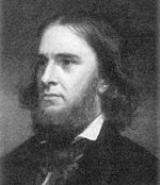
Benjamin Peirce

Encyclopedia
Benjamin Peirce was an American
mathematician
who taught at Harvard University
for approximately 50 years. He made contributions to celestial mechanics
, statistics
, number theory
, algebra
, and the philosophy of mathematics
.
He was the son of Benjamin Peirce (1778–1881), later librarian of Harvard, and Lydia Ropes Nichols Peirce (1781–1868).
After graduating from Harvard, he remained as a tutor
(1829), and was subsequently appointed professor
of mathematics in 1831. He added astronomy
to his portfolio in 1842, and remained as Harvard professor until his death. In addition, he was instrumental in the development of Harvard's science curriculum
, served as the college librarian
, and was director of the U.S. Coast Survey from 1867 to 1874.
with fewer than four prime factor
s.
In algebra, he was notable for the study of associative algebra
s. He first introduced the terms idempotent and nilpotent
in 1870 to describe elements of these algebras, and he also introduced the Peirce decomposition
.
.
Like George Boole
, Peirce believed that mathematics could be used to study logic
. These ideas were developed by Charles Sanders Peirce, who noted that logic also includes the study of faulty reasoning.
In contrast, the later logicist program of Gottlob Frege
and Bertrand Russell
attempted to base mathematics on logic.
for the statistical treatment of outlier
s, that is, of apparently extreme observations. His ideas were developed by Charles Sanders Peirce.
Peirce was an expert witness
in the Howland will forgery trial
, where he was assisted by his son Charles Sanders Peirce. Their analysis of the questioned signature showed that it resembled another particular handwriting example so closely that the chances of such a match were statistically extremely remote.
He married Sarah Hunt Mills, the daughter of U.S. Senator Elijah Hunt Mills. Peirce and his wife had four sons and one daughter:

crater
Peirce
is named for Peirce.
United States
The United States of America is a federal constitutional republic comprising fifty states and a federal district...
mathematician
Mathematician
A mathematician is a person whose primary area of study is the field of mathematics. Mathematicians are concerned with quantity, structure, space, and change....
who taught at Harvard University
Harvard University
Harvard University is a private Ivy League university located in Cambridge, Massachusetts, United States, established in 1636 by the Massachusetts legislature. Harvard is the oldest institution of higher learning in the United States and the first corporation chartered in the country...
for approximately 50 years. He made contributions to celestial mechanics
Celestial mechanics
Celestial mechanics is the branch of astronomy that deals with the motions of celestial objects. The field applies principles of physics, historically classical mechanics, to astronomical objects such as stars and planets to produce ephemeris data. Orbital mechanics is a subfield which focuses on...
, statistics
Statistics
Statistics is the study of the collection, organization, analysis, and interpretation of data. It deals with all aspects of this, including the planning of data collection in terms of the design of surveys and experiments....
, number theory
Number theory
Number theory is a branch of pure mathematics devoted primarily to the study of the integers. Number theorists study prime numbers as well...
, algebra
Algebra
Algebra is the branch of mathematics concerning the study of the rules of operations and relations, and the constructions and concepts arising from them, including terms, polynomials, equations and algebraic structures...
, and the philosophy of mathematics
Philosophy of mathematics
The philosophy of mathematics is the branch of philosophy that studies the philosophical assumptions, foundations, and implications of mathematics. The aim of the philosophy of mathematics is to provide an account of the nature and methodology of mathematics and to understand the place of...
.
He was the son of Benjamin Peirce (1778–1881), later librarian of Harvard, and Lydia Ropes Nichols Peirce (1781–1868).
After graduating from Harvard, he remained as a tutor
Tutor
A tutor is a person employed in the education of others, either individually or in groups. To tutor is to perform the functions of a tutor.-Teaching assistance:...
(1829), and was subsequently appointed professor
Professor
A professor is a scholarly teacher; the precise meaning of the term varies by country. Literally, professor derives from Latin as a "person who professes" being usually an expert in arts or sciences; a teacher of high rank...
of mathematics in 1831. He added astronomy
Astronomy
Astronomy is a natural science that deals with the study of celestial objects and phenomena that originate outside the atmosphere of Earth...
to his portfolio in 1842, and remained as Harvard professor until his death. In addition, he was instrumental in the development of Harvard's science curriculum
Curriculum
See also Syllabus.In formal education, a curriculum is the set of courses, and their content, offered at a school or university. As an idea, curriculum stems from the Latin word for race course, referring to the course of deeds and experiences through which children grow to become mature adults...
, served as the college librarian
Librarian
A librarian is an information professional trained in library and information science, which is the organization and management of information services or materials for those with information needs...
, and was director of the U.S. Coast Survey from 1867 to 1874.
Research
Benjamin Peirce is often regarded as the earliest American scientist whose research was recognized as world class.Mathematics
In number theory, he proved there is no odd perfect numberPerfect number
In number theory, a perfect number is a positive integer that is equal to the sum of its proper positive divisors, that is, the sum of its positive divisors excluding the number itself . Equivalently, a perfect number is a number that is half the sum of all of its positive divisors i.e...
with fewer than four prime factor
Prime factor
In number theory, the prime factors of a positive integer are the prime numbers that divide that integer exactly, without leaving a remainder. The process of finding these numbers is called integer factorization, or prime factorization. A prime factor can be visualized by understanding Euclid's...
s.
In algebra, he was notable for the study of associative algebra
Associative algebra
In mathematics, an associative algebra A is an associative ring that has a compatible structure of a vector space over a certain field K or, more generally, of a module over a commutative ring R...
s. He first introduced the terms idempotent and nilpotent
Nilpotent
In mathematics, an element x of a ring R is called nilpotent if there exists some positive integer n such that xn = 0....
in 1870 to describe elements of these algebras, and he also introduced the Peirce decomposition
Peirce decomposition
In algebra, a Peirce decomposition is a decomposition of an algebra as a sum of eigenspaces of commuting idempotents.The Peirce decomposition for associative algebras was introduced by...
.
Definition of mathematics
In the philosophy of mathematics, he became known for the statement that "Mathematics is the science that draws necessary conclusions". Peirce's definition of mathematics was credited by Charles Sanders Peirce as helping to initiate the consequentialist philosophy of pragmatismPragmatism
Pragmatism is a philosophical tradition centered on the linking of practice and theory. It describes a process where theory is extracted from practice, and applied back to practice to form what is called intelligent practice...
.
Like George Boole
George Boole
George Boole was an English mathematician and philosopher.As the inventor of Boolean logic—the basis of modern digital computer logic—Boole is regarded in hindsight as a founder of the field of computer science. Boole said,...
, Peirce believed that mathematics could be used to study logic
Logic
In philosophy, Logic is the formal systematic study of the principles of valid inference and correct reasoning. Logic is used in most intellectual activities, but is studied primarily in the disciplines of philosophy, mathematics, semantics, and computer science...
. These ideas were developed by Charles Sanders Peirce, who noted that logic also includes the study of faulty reasoning.
In contrast, the later logicist program of Gottlob Frege
Gottlob Frege
Friedrich Ludwig Gottlob Frege was a German mathematician, logician and philosopher. He is considered to be one of the founders of modern logic, and made major contributions to the foundations of mathematics. He is generally considered to be the father of analytic philosophy, for his writings on...
and Bertrand Russell
Bertrand Russell
Bertrand Arthur William Russell, 3rd Earl Russell, OM, FRS was a British philosopher, logician, mathematician, historian, and social critic. At various points in his life he considered himself a liberal, a socialist, and a pacifist, but he also admitted that he had never been any of these things...
attempted to base mathematics on logic.
Statistics
Peirce proposed what came to be known as Peirce's CriterionPeirce's criterion
In robust statistics, Peirce's criterion is a rule for eliminating outliers from data sets, which was devised by Benjamin Peirce.-The problem of outliers:...
for the statistical treatment of outlier
Outlier
In statistics, an outlier is an observation that is numerically distant from the rest of the data. Grubbs defined an outlier as: An outlying observation, or outlier, is one that appears to deviate markedly from other members of the sample in which it occurs....
s, that is, of apparently extreme observations. His ideas were developed by Charles Sanders Peirce.
Peirce was an expert witness
Expert witness
An expert witness, professional witness or judicial expert is a witness, who by virtue of education, training, skill, or experience, is believed to have expertise and specialised knowledge in a particular subject beyond that of the average person, sufficient that others may officially and legally...
in the Howland will forgery trial
Howland will forgery trial
The Howland will forgery trial was a U.S. court case in 1868 to decide Henrietta Howland Robinson's contest of the will of Sylvia Ann Howland. It is famous for the forensic use of mathematics by Benjamin Peirce as an expert witness.-History:...
, where he was assisted by his son Charles Sanders Peirce. Their analysis of the questioned signature showed that it resembled another particular handwriting example so closely that the chances of such a match were statistically extremely remote.
Private life
He was devoutly religious, though he seldom published his theological thoughts. Peirce credited God as shaping nature in ways that account for the efficacy of pure mathematics in describing empirical phenomena. Peirce viewed "mathematics as study of God's work by God's creatures", according to an encyclopedia.He married Sarah Hunt Mills, the daughter of U.S. Senator Elijah Hunt Mills. Peirce and his wife had four sons and one daughter:
- James Mills Peirce (1834–1906), who also taught mathematics at Harvard and succeeded to his father's professorship,
- Charles Sanders Peirce (1839–1914), a famous logician and polymath,
- Benjamin Mills Peirce (1844–1870), who worked as a mining engineer before an early death,
- Helen Huntington Peirce Ellis (1845–1923), who married William Rogers Ellis, and
- Herbert Henry Davis Peirce (1849–1916), who pursued a career in the Foreign Service.
Eponyms
The lunarMoon
The Moon is Earth's only known natural satellite,There are a number of near-Earth asteroids including 3753 Cruithne that are co-orbital with Earth: their orbits bring them close to Earth for periods of time but then alter in the long term . These are quasi-satellites and not true moons. For more...
crater
Impact crater
In the broadest sense, the term impact crater can be applied to any depression, natural or manmade, resulting from the high velocity impact of a projectile with a larger body...
Peirce
Peirce (crater)
Peirce is a small lunar crater, named in honor of the mathematician Benjamin Peirce, which lies in the western part of Mare Crisium. That dark, circular lunar mare is located in the east-northeasterly part of the Moon's near side. Peirce lies to the north of the craters Yerkes and Picard, and...
is named for Peirce.
Works
- An Elementary Treatise on Plane and Solid Geometry, Boston: James Munroe and Company. Google Eprints of successive editions 1837–1873.
- An Elementary Treatise on Plane and Spherical Trigonometry, Boston: James Munroe and Company. Google Eprints of successive editions 1840–1862.
- Physical and Celestial Mechanics, Boston: Little, Brown and CompanyLittle, Brown and CompanyLittle, Brown and Company is a publishing house established by Charles Coffin Little and his partner, James Brown. Since 2006 it has been a constituent unit of Hachette Book Group USA.-19th century:...
. Google Eprint of 1855 edition. - Linear Associative Algebra, lithograph by Peirce 1872. New edition with corrections, notes, and an added 1875 paper by Peirce, plus notes by his son Charles Sanders Peirce, published in the American Journal of Mathematics v. 4, 1881, Johns Hopkins University, pp. 221–226, Google Eprint and as an extract, D. Van Nostrand, 1882, Google Eprint.
External links
- Grattan-Guinness, IvorIvor Grattan-GuinnessIvor Grattan-Guinness, born 23 June 1941, in Bakewell, in England, is a historian of mathematics and logic.He gained his Bachelor degree as a Mathematics Scholar at Wadham College, Oxford, got an M.Sc in Mathematical Logic and the Philosophy of Science at the London School of Economics in 1966...
, and Walsh, Alison (2005), "Benjamin Peirce", Stanford Encyclopedia of PhilosophyStanford Encyclopedia of PhilosophyThe Stanford Encyclopedia of Philosophy is a freely-accessible online encyclopedia of philosophy maintained by Stanford University. Each entry is written and maintained by an expert in the field, including professors from over 65 academic institutions worldwide...
, Edward N. ZaltaEdward N. ZaltaEdward N. Zalta is a Senior research scholar at the Center for the Study of Language and Information. He received his Ph.D. in philosophy from the University of Massachusetts - Amherst in 1980. Zalta has taught courses at Stanford University, Rice University, the University of Salzburg, and the...
(ed.), Eprint. - O'Connor, John J., and Robertson, Edmund F. (2005), "Benjamin Peirce", MacTutor History of Mathematics ArchiveMacTutor History of Mathematics archiveThe MacTutor History of Mathematics archive is a website maintained by John J. O'Connor and Edmund F. Robertson and hosted by the University of St Andrews in Scotland...
, Eprint. - Hogan, Edward R. (2008), Of the Human Heart: A Biography of Benjamin Peirce, Lehigh University Press, catalog page discussion of Peirce.