

Battle off Texel

Encyclopedia
The Battle off Texel, also known as the Action off Texel or the Action of 17 October 1914, was a naval battle
off the coast of the Dutch
island of Texel
during the First World War
where a British squadron consisting of one light cruiser
and four destroyer
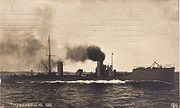
s on a routine patrol encountered the remnants of the German 7th Half Flotilla of torpedo-boats,Note: Some sources state that the German vessels were destroyers, however all destroyer like vessels were officially termed torpedo boats by the German Navy during World War One. which was en route to the British coast on a mission to lay minefields. The British forces attacked and sank the entire German flotilla of four torpedo-boats. Heavily outgunned, the German force attempted to flee and then fought a desperate and ineffective action against the British force.
The battle resulted in the loss of an entire German torpedo-boat squadron, and prevented the mining of heavily trafficked shipping lanes, such as the mouth of the Thames River. The British in exchange took only light casualties and little damage to their vessels. The outcome of the battle also greatly influenced the tactics
and deployments of the remaining German torpedo boat flotillas in the North Sea area, as the loss greatly shook the faith of the commanders in the effectiveness of the force.
s, the North Sea
became dominated by the Royal Navy
which regularly patrolled the area. Despite the lack of action by German capital ships, light forces still operated regularly in North Sea. At 13:50 onn 17 October 1914, one such routine patrol by the 3rd Destroyer Flotilla Harwich Force
consisting of the light cruiser
under Captain Cecil Fox and four Laforey-class
destroyer
s, , , , and , was cruising off the coast of the island of Texel
when they encountered a waiting German squadron
of torpedo boat
s consisting of the remaining vessels of the 7th Half Flotilla under Georg Thiele
: , , , and .S116 had also been a member of the 7th Half Flotilla, but was sunk by a British submarine some time before the Battle off Texel. S119 was the lead ship of the torpedo boat flotilla and was personally commanded by Korvettenkapitan Thiele himself. The German ships made no attempt to challenge or threaten the approaching British ship
s nor did they at first attempt to flee the scene, and it was assumed by the British that they were waiting for more German vessels to arrive and had mistaken the British ships for friendly vessels. In reality the German flotilla had been sent out of Ems on a mission to mine the southern coast of Britain
including the mouth of the Thames and had been intercepted before reaching its targeted area of operations.
The British squadron heavily outgunned the German 7th Half Flotilla. The British Commander, Captain Cecil Fox's vessel Undaunted—an Arethusa-class light cruiser
—was armed with two 6 in (152.4 mm) gun
s and seven 4 in (101.6 mm) gun
s, all in single mounts and nearly all without gun shield
s. Undaunted at the time of the engagement was also experimentally armed with an additional pair of 2-pounder
anti-aircraft gun
s, something most of her class lacked. In addition to her guns, the cruiser was also armed with eight torpedo tubes and at best speed could make 28.5 kn (34.7 mph; 55.9 km/h). The four British Laforey-class destroyer
s were much less powerful vessels in comparison to the cruiser being only armed with two torpedo tube
s, three 4-inch} gun
s and a singe 2-pounder gun. The destroyers were slightly faster than the cruiser and could make about 29 kn (35.3 mph; 56.8 km/h) at full power. The German vessels were entirely inferior to the British in many areas. Not only was the 7th Half Flotilla outnumbered and antiquated, but it was also lightly armed. The four boats were of the aging Großes Torpedoboot 1898 class and had been completed in 1904. In terms of speed, the German boats were nearly equal to the British at 28 kn (34.1 mph; 54.9 km/h). Each of the German vessels was armed with three 50 mm (1.97 in) guns, significantly fewer than the British destroyers. These weapons were also of shorter range and throwing weight than the British guns. The biggest danger to the British squadron was the torpedo tubes carried by the German boats, as each boat carried three 450 mm (17.7 in) torpedo tubes with five torpedoes per boat.
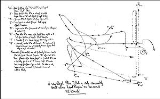
 Upon closer approach, the German vessels realized the approaching vessels were British and began to scatter and flee while Undaunted—which was closer to the Germans than the destroyers—opened fire upon the nearest torpedo boat. This German vessel managed to dodge the incoming fire
from Undaunted by changing course but by doing so lost enough speed that the British force caught up with them. In an attempt to protect Undaunted from torpedo attack and to destroy the Germans as quickly as possible, Captain Fox—the squadron commander aboard Undaunted—gave orders for the squadron to split up into two divisions. Lance and Lennox proceeded to chase S115 and S119 while Legion and Loyal went after S117 and S118. Combined fire from Legion, Loyal, and Undaunted damaged S118 so badly that the torpedo boat's entire bridge was blown off the deck of the vessel, sinking her at 15:17. Meanwhile, HMS Lance and Lennox engaged S115 disabling her steering gear and causing the German vessel to circle. Lennoxs fire was so effective at this point that, as had occurred with S118, the bridge of S115 was completely destroyed. Despite the damage the German torpedo-boat still did not strike her colours
and vainly continued the action.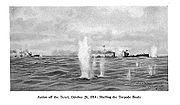 The two centre-most boats in the German flotilla—S117 and the flotilla leader
S119—then made an attempt at engaging Undaunted with torpedoes. Despite the torpedo attack, Undaunted was able to outmaneuver the German boats and remained unscathed. Legion and Loyal who had been finishing off S118 came to Undaunteds aid and engaged Undaunteds two attackers. Legion assaulted S117, but the torpedo boat fired her last three torpedoes at the destroyer and afterword continued to resist with her guns. This vain attempt failed and Legion pulverized S117 damaging her steering mechanism which forced her to circle before she was finally sunk at 15:30. At the same time as Legion was battling S117, Lance and Lennox had damaged S115 to the point where only one of the destroyers was still needed to counter the vessel. Lance soon left the battle with S115 to join Loyal in pummeling S119 with lyddite shells. S119 managed to get off a successful torpedo run against Lance, hitting the destroyer amidships, but the torpedo failed to detonate. S119 was then sunk at 15:35 by combined gunfire from Lance and Loyal, taking the German flotilla commander down with it. The last remaining torpedo boat S115 continued to stay afloat despite constant attacks from Lennox. The British destroyer eventually boarded the vessel finding her a complete wreck
with only one German onboard who happily surrender
ed. Thirty other Germans were eventually plucked from the sea and captured by the British vessels. The action finally ended at 4:30 PM with gunfire from Undaunted finishing off the abandoned hulk of S115 with heavy gunfire.
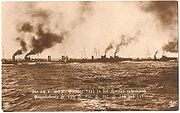 The German Seventh Half Flotilla was completely annihilated by Harwich force, with all four of its remaining vessels sunk and over two hundred sailors killed including the commanding officer
. Despite the odds no German vessel struck her colours and the entire Flotilla went down fighting to the end. The British casualties were extremely light in comparison with only four men wounded and superficial damage to three of the destroyers. Legion took one 4 lb (1.8 kg) shell hit and had one man wounded by machine gun fire. Loyal took two shell hits and had three or four men wounded as a result. Lance took some superficial machine gun damage and the other two vessels were unscathed. Thirty-one surviving German sailors were taken out of the water and off the sinking hulk
s and made prisoners
, but one captured officer soon after died of the wounds he had received during the action. Two other German sailors were later plucked from the water by a neutral vessel. The battle was seen as a great boost of morale for the British at the time, as two days previous to the action off Texel they had suffered the loss of the cruiser due to a U-boat
attack. The effect on British morale the battle had is reflected in its fictionalized and nationalistic inclusion in the 1915 dime novel The Boy Allies Under Two Flags, by Robert L. Drake. Some controversy arose in Germany from the battle because the German hospital ship , which had been sent out to rescue survivors from the sunken boats, was seized by the British for violating the Hague Convention
's rules on the use of hospital ship
s. Although the boats of the sunken flotilla were older and some casualties were expected, the loss of an entire squadron of torpedo boats changed the tactics of the German forces displaced in the English Channel
and along the coast of Flanders
drastically. As a direct result there were very few further sorties into the Channel and the torpedo boat force was delegated to coastal patrol and rescuing downed pilots
for fear of similar losses. An unexpected boon for the British came as a result of the action, when on 30 November a British fishing trawler working the area pulled up an sealed chest that had been thrown off S119 by Captain Thiele during the action so as to avoid its capture. The chest contained a German codebook
used by the German light forces stationed on the coast, allowing the British to decipher intercepted German communications long after the action had ended.
, destroyer, destroyer, destroyer, destroyer
German Navy:, torpedo boat, flagship, torpedo boat, torpedo boat, torpedo boat
Naval battle
A naval battle is a battle fought using boats, ships or other waterborne vessels. Most naval battles have occurred at sea, but a few have taken place on lakes or rivers. The earliest recorded naval battle took place in 1210 BC near Cyprus...
off the coast of the Dutch
Netherlands
The Netherlands is a constituent country of the Kingdom of the Netherlands, located mainly in North-West Europe and with several islands in the Caribbean. Mainland Netherlands borders the North Sea to the north and west, Belgium to the south, and Germany to the east, and shares maritime borders...
island of Texel
Texel
Texel is a municipality and an island in the Netherlands, in the province of North Holland. It is the biggest and most populated of the Frisian Islands in the Wadden Sea, and also the westernmost of this archipelago, which extends to Denmark...
during the First World War
World War I
World War I , which was predominantly called the World War or the Great War from its occurrence until 1939, and the First World War or World War I thereafter, was a major war centred in Europe that began on 28 July 1914 and lasted until 11 November 1918...
where a British squadron consisting of one light cruiser
Light cruiser
A light cruiser is a type of small- or medium-sized warship. The term is a shortening of the phrase "light armored cruiser", describing a small ship that carried armor in the same way as an armored cruiser: a protective belt and deck...
and four destroyer
Destroyer
In naval terminology, a destroyer is a fast and maneuverable yet long-endurance warship intended to escort larger vessels in a fleet, convoy or battle group and defend them against smaller, powerful, short-range attackers. Destroyers, originally called torpedo-boat destroyers in 1892, evolved from...
s on a routine patrol encountered the remnants of the German 7th Half Flotilla of torpedo-boats,Note: Some sources state that the German vessels were destroyers, however all destroyer like vessels were officially termed torpedo boats by the German Navy during World War One. which was en route to the British coast on a mission to lay minefields. The British forces attacked and sank the entire German flotilla of four torpedo-boats. Heavily outgunned, the German force attempted to flee and then fought a desperate and ineffective action against the British force.
The battle resulted in the loss of an entire German torpedo-boat squadron, and prevented the mining of heavily trafficked shipping lanes, such as the mouth of the Thames River. The British in exchange took only light casualties and little damage to their vessels. The outcome of the battle also greatly influenced the tactics
Naval tactics
Naval tactics is the collective name for methods of engaging and defeating an enemy ship or fleet in battle at sea during naval warfare, the naval equivalent of military tactics on land....
and deployments of the remaining German torpedo boat flotillas in the North Sea area, as the loss greatly shook the faith of the commanders in the effectiveness of the force.
Background
After the opening naval Battle of Heligoland Bight the German High Seas Fleet was ordered to avoid confrontations with larger opposing forces in an effort to avoid costly and demoralizing reverses. Thus outside of occasional German raidRaid (military)
Raid, also known as depredation, is a military tactic or operational warfare mission which has a specific purpose and is not normally intended to capture and hold terrain, but instead finish with the raiding force quickly retreating to a previous defended position prior to the enemy forces being...
s, the North Sea
North Sea
In the southwest, beyond the Straits of Dover, the North Sea becomes the English Channel connecting to the Atlantic Ocean. In the east, it connects to the Baltic Sea via the Skagerrak and Kattegat, narrow straits that separate Denmark from Norway and Sweden respectively...
became dominated by the Royal Navy
Royal Navy
The Royal Navy is the naval warfare service branch of the British Armed Forces. Founded in the 16th century, it is the oldest service branch and is known as the Senior Service...
which regularly patrolled the area. Despite the lack of action by German capital ships, light forces still operated regularly in North Sea. At 13:50 onn 17 October 1914, one such routine patrol by the 3rd Destroyer Flotilla Harwich Force
Harwich Force
The Harwich Force was a squadron of the Royal Navy, formed during the First World War, that went on to play a significant role in the war.-History:...
consisting of the light cruiser
Light cruiser
A light cruiser is a type of small- or medium-sized warship. The term is a shortening of the phrase "light armored cruiser", describing a small ship that carried armor in the same way as an armored cruiser: a protective belt and deck...
under Captain Cecil Fox and four Laforey-class
Laforey class destroyer (1913)
The Laforey class was a class of 22 torpedo boat destroyers of the Royal Navy, twenty of which were built under the Naval Programme of 1912 - 1913 and a further two under the War Emergency Programme of 1914. As such they were the last pre-war British destroyer design. All served during World War I...
destroyer
Destroyer
In naval terminology, a destroyer is a fast and maneuverable yet long-endurance warship intended to escort larger vessels in a fleet, convoy or battle group and defend them against smaller, powerful, short-range attackers. Destroyers, originally called torpedo-boat destroyers in 1892, evolved from...
s, , , , and , was cruising off the coast of the island of Texel
Texel
Texel is a municipality and an island in the Netherlands, in the province of North Holland. It is the biggest and most populated of the Frisian Islands in the Wadden Sea, and also the westernmost of this archipelago, which extends to Denmark...
when they encountered a waiting German squadron
Squadron (naval)
A squadron, or naval squadron, is a unit of 3-4 major warships, transport ships, submarines, or sometimes small craft that may be part of a larger task force or a fleet...
of torpedo boat
Torpedo boat
A torpedo boat is a relatively small and fast naval vessel designed to carry torpedoes into battle. The first designs rammed enemy ships with explosive spar torpedoes, and later designs launched self-propelled Whitehead torpedoes. They were created to counter battleships and other large, slow and...
s consisting of the remaining vessels of the 7th Half Flotilla under Georg Thiele
Georg Thiele
Georg Max Thiele was an Imperial German Navy officer killed during World War I. During World War I he commanded the Seventh Half Flotilla of torpedo boats, based out of Flanders...
: , , , and .S116 had also been a member of the 7th Half Flotilla, but was sunk by a British submarine some time before the Battle off Texel. S119 was the lead ship of the torpedo boat flotilla and was personally commanded by Korvettenkapitan Thiele himself. The German ships made no attempt to challenge or threaten the approaching British ship
Ship
Since the end of the age of sail a ship has been any large buoyant marine vessel. Ships are generally distinguished from boats based on size and cargo or passenger capacity. Ships are used on lakes, seas, and rivers for a variety of activities, such as the transport of people or goods, fishing,...
s nor did they at first attempt to flee the scene, and it was assumed by the British that they were waiting for more German vessels to arrive and had mistaken the British ships for friendly vessels. In reality the German flotilla had been sent out of Ems on a mission to mine the southern coast of Britain
Great Britain
Great Britain or Britain is an island situated to the northwest of Continental Europe. It is the ninth largest island in the world, and the largest European island, as well as the largest of the British Isles...
including the mouth of the Thames and had been intercepted before reaching its targeted area of operations.
The British squadron heavily outgunned the German 7th Half Flotilla. The British Commander, Captain Cecil Fox's vessel Undaunted—an Arethusa-class light cruiser
Arethusa class cruiser (1913)
The Arethusa-class cruisers were a class of eight oil-fired light cruisers of the Royal Navy all ordered in September 1912, primarily for service in the North Sea. They had three funnels with the middle one somewhat larger in diameter than the others. All served in World War I...
—was armed with two 6 in (152.4 mm) gun
BL 6 inch Mk XII naval gun
The BL 6 inch Gun Mark XII was a British 45 calibres naval gun which was mounted as primary armament on light cruisers and secondary armament on dreadnought battleships commissioned in the period 1914 - 1926, and remained in service on many warships until the end of World War II.-Design:This was a...
s and seven 4 in (101.6 mm) gun
QF 4 inch Mk V naval gun
The QF 4 inch Mk V gun was a Royal Navy gun of World War I which was adapted on HA mountings to the heavy anti-aircraft role both at sea and on land, and was also used as a coast defence gun.-Naval service:...
s, all in single mounts and nearly all without gun shield
Gun shield
thumb|A [[United States Marine Corps|U.S. Marine]] manning an [[M240 machine gun]] equipped with a gun shieldA gun shield is a flat piece or section of armor designed to be mounted on a crew-served weapon such as a machine gun or artillery piece, or, more rarely, to be used with an assault rifle...
s. Undaunted at the time of the engagement was also experimentally armed with an additional pair of 2-pounder
QF 2 pounder naval gun
The 2-pounder gun, officially designated the QF 2-pounder and universally known as the pom-pom, was a 1.575 inch British autocannon, used famously as an anti-aircraft gun by the Royal Navy. The name came from the sound that the original models make when firing...
anti-aircraft gun
Anti-aircraft warfare
NATO defines air defence as "all measures designed to nullify or reduce the effectiveness of hostile air action." They include ground and air based weapon systems, associated sensor systems, command and control arrangements and passive measures. It may be to protect naval, ground and air forces...
s, something most of her class lacked. In addition to her guns, the cruiser was also armed with eight torpedo tubes and at best speed could make 28.5 kn (34.7 mph; 55.9 km/h). The four British Laforey-class destroyer
Laforey class destroyer (1913)
The Laforey class was a class of 22 torpedo boat destroyers of the Royal Navy, twenty of which were built under the Naval Programme of 1912 - 1913 and a further two under the War Emergency Programme of 1914. As such they were the last pre-war British destroyer design. All served during World War I...
s were much less powerful vessels in comparison to the cruiser being only armed with two torpedo tube
Torpedo tube
A torpedo tube is a device for launching torpedoes. There are two main types of torpedo tube: underwater tubes fitted to submarines and some surface ships, and deck-mounted units installed aboard surface vessels...
s, three 4-inch} gun
QF 4 inch naval gun Mk IV, XII, XXII
The QF 4-inch gun Mk IV was introduced in 1911 as a faster-loading light gun successor to the BL 4 inch Mk VIII gun, and was the main gun on most Royal Navy and British Empire destroyers in World War I.-Mk IV gun:...
s and a singe 2-pounder gun. The destroyers were slightly faster than the cruiser and could make about 29 kn (35.3 mph; 56.8 km/h) at full power. The German vessels were entirely inferior to the British in many areas. Not only was the 7th Half Flotilla outnumbered and antiquated, but it was also lightly armed. The four boats were of the aging Großes Torpedoboot 1898 class and had been completed in 1904. In terms of speed, the German boats were nearly equal to the British at 28 kn (34.1 mph; 54.9 km/h). Each of the German vessels was armed with three 50 mm (1.97 in) guns, significantly fewer than the British destroyers. These weapons were also of shorter range and throwing weight than the British guns. The biggest danger to the British squadron was the torpedo tubes carried by the German boats, as each boat carried three 450 mm (17.7 in) torpedo tubes with five torpedoes per boat.
Battle
Evasive Action
An evasive action is a maneuver aimed at avoiding an object or opponent. It may also refer to:*Evasive Action *Evasive Action, an older computer game *Evasive Action...
from Undaunted by changing course but by doing so lost enough speed that the British force caught up with them. In an attempt to protect Undaunted from torpedo attack and to destroy the Germans as quickly as possible, Captain Fox—the squadron commander aboard Undaunted—gave orders for the squadron to split up into two divisions. Lance and Lennox proceeded to chase S115 and S119 while Legion and Loyal went after S117 and S118. Combined fire from Legion, Loyal, and Undaunted damaged S118 so badly that the torpedo boat's entire bridge was blown off the deck of the vessel, sinking her at 15:17. Meanwhile, HMS Lance and Lennox engaged S115 disabling her steering gear and causing the German vessel to circle. Lennoxs fire was so effective at this point that, as had occurred with S118, the bridge of S115 was completely destroyed. Despite the damage the German torpedo-boat still did not strike her colours
Striking the colors
Striking the colors is the universally recognized indication of surrender, particularly for ships at sea. Surrender is dated from the time the ensign is struck.-In international law:# "Colors. A national flag . The colors . ....
and vainly continued the action.
Flotilla leader
A flotilla leader was a warship suitable for commanding a flotilla of destroyers or other small warships, typically a small cruiser or a large destroyer...
S119—then made an attempt at engaging Undaunted with torpedoes. Despite the torpedo attack, Undaunted was able to outmaneuver the German boats and remained unscathed. Legion and Loyal who had been finishing off S118 came to Undaunteds aid and engaged Undaunteds two attackers. Legion assaulted S117, but the torpedo boat fired her last three torpedoes at the destroyer and afterword continued to resist with her guns. This vain attempt failed and Legion pulverized S117 damaging her steering mechanism which forced her to circle before she was finally sunk at 15:30. At the same time as Legion was battling S117, Lance and Lennox had damaged S115 to the point where only one of the destroyers was still needed to counter the vessel. Lance soon left the battle with S115 to join Loyal in pummeling S119 with lyddite shells. S119 managed to get off a successful torpedo run against Lance, hitting the destroyer amidships, but the torpedo failed to detonate. S119 was then sunk at 15:35 by combined gunfire from Lance and Loyal, taking the German flotilla commander down with it. The last remaining torpedo boat S115 continued to stay afloat despite constant attacks from Lennox. The British destroyer eventually boarded the vessel finding her a complete wreck
Shipwreck
A shipwreck is what remains of a ship that has wrecked, either sunk or beached. Whatever the cause, a sunken ship or a wrecked ship is a physical example of the event: this explains why the two concepts are often overlapping in English....
with only one German onboard who happily surrender
Surrender (military)
Surrender is when soldiers, nations or other combatants stop fighting and eventually become prisoners of war, either as individuals or when ordered to by their officers. A white flag is a common symbol of surrender, as is the gesture of raising one's hands empty and open above one's head.When the...
ed. Thirty other Germans were eventually plucked from the sea and captured by the British vessels. The action finally ended at 4:30 PM with gunfire from Undaunted finishing off the abandoned hulk of S115 with heavy gunfire.
Aftermath
Commanding officer
The commanding officer is the officer in command of a military unit. Typically, the commanding officer has ultimate authority over the unit, and is usually given wide latitude to run the unit as he sees fit, within the bounds of military law...
. Despite the odds no German vessel struck her colours and the entire Flotilla went down fighting to the end. The British casualties were extremely light in comparison with only four men wounded and superficial damage to three of the destroyers. Legion took one 4 lb (1.8 kg) shell hit and had one man wounded by machine gun fire. Loyal took two shell hits and had three or four men wounded as a result. Lance took some superficial machine gun damage and the other two vessels were unscathed. Thirty-one surviving German sailors were taken out of the water and off the sinking hulk
Hulk (ship)
A hulk is a ship that is afloat, but incapable of going to sea. Although sometimes used to describe a ship that has been launched but not completed, the term most often refers to an old ship that has had its rigging or internal equipment removed, retaining only its flotational qualities...
s and made prisoners
Prisoner of war
A prisoner of war or enemy prisoner of war is a person, whether civilian or combatant, who is held in custody by an enemy power during or immediately after an armed conflict...
, but one captured officer soon after died of the wounds he had received during the action. Two other German sailors were later plucked from the water by a neutral vessel. The battle was seen as a great boost of morale for the British at the time, as two days previous to the action off Texel they had suffered the loss of the cruiser due to a U-boat
U-boat
U-boat is the anglicized version of the German word U-Boot , itself an abbreviation of Unterseeboot , and refers to military submarines operated by Germany, particularly in World War I and World War II...
attack. The effect on British morale the battle had is reflected in its fictionalized and nationalistic inclusion in the 1915 dime novel The Boy Allies Under Two Flags, by Robert L. Drake. Some controversy arose in Germany from the battle because the German hospital ship , which had been sent out to rescue survivors from the sunken boats, was seized by the British for violating the Hague Convention
Hague Conventions (1899 and 1907)
The Hague Conventions were two international treaties negotiated at international peace conferences at The Hague in the Netherlands: The First Hague Conference in 1899 and the Second Hague Conference in 1907...
's rules on the use of hospital ship
Hospital ship
A hospital ship is a ship designated for primary function as a floating medical treatment facility or hospital; most are operated by the military forces of various countries, as they are intended to be used in or near war zones....
s. Although the boats of the sunken flotilla were older and some casualties were expected, the loss of an entire squadron of torpedo boats changed the tactics of the German forces displaced in the English Channel
English Channel
The English Channel , often referred to simply as the Channel, is an arm of the Atlantic Ocean that separates southern England from northern France, and joins the North Sea to the Atlantic. It is about long and varies in width from at its widest to in the Strait of Dover...
and along the coast of Flanders
Flanders
Flanders is the community of the Flemings but also one of the institutions in Belgium, and a geographical region located in parts of present-day Belgium, France and the Netherlands. "Flanders" can also refer to the northern part of Belgium that contains Brussels, Bruges, Ghent and Antwerp...
drastically. As a direct result there were very few further sorties into the Channel and the torpedo boat force was delegated to coastal patrol and rescuing downed pilots
Search and rescue
Search and rescue is the search for and provision of aid to people who are in distress or imminent danger.The general field of search and rescue includes many specialty sub-fields, mostly based upon terrain considerations...
for fear of similar losses. An unexpected boon for the British came as a result of the action, when on 30 November a British fishing trawler working the area pulled up an sealed chest that had been thrown off S119 by Captain Thiele during the action so as to avoid its capture. The chest contained a German codebook
Codebook
A codebook is a type of document used for gathering and storing codes. Originally codebooks were often literally books, but today codebook is a byword for the complete record of a series of codes, regardless of physical format.-Cryptography:...
used by the German light forces stationed on the coast, allowing the British to decipher intercepted German communications long after the action had ended.
Order of battle
Royal Navy:, light cruiser, flagshipFlagship
A flagship is a vessel used by the commanding officer of a group of naval ships, reflecting the custom of its commander, characteristically a flag officer, flying a distinguishing flag...
, destroyer, destroyer, destroyer, destroyer
German Navy:, torpedo boat, flagship, torpedo boat, torpedo boat, torpedo boat