
All Topics  
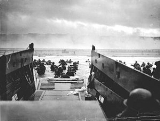
Omaha Beach

 
Omaha Beach

   Email Print
   Bookmark   Link


Omaha Beach


Omaha Beach was the code name
Code name

A code name or cryptonym is a word or name used clandestinely to refer to another name or word. Code names are often used for military purposes, or in espionage....
 for one of the main landing points of the Allied
Allies of World War II

The Allies of World War II were the countries officially opposed to the Axis powers of World War II during the World War II. Within the ranks of the Allies powers, the British Empire, the Soviet Union, and the United States of America were known as "The Big Three"....
 invasion of German-occupied France in the Normandy landings
Battle of Normandy

The Invasion of Normandy was the invasion and establishment of Western Allies forces in Normandy, France, during Operation Overlord in World War II....
 on June 6 1944, during World War II
World War II

World War II, or the Second World War , was a global military conflict which involved a Participants in World War II, including all of the great powers, organised into two opposing military alliances: the Allies of World War II and the Axis powers....
. The beach was located on the northern coast of France, facing the English Channel
English Channel

The English Channel is an Arm of the Atlantic Ocean that separates England from northern France, and joins the North Sea to the Atlantic. It is about long and varies in width from at its widest, to only in the Strait of Dover....
, and was 5 miles (8 km) long, from (coming from the sea) east of Sainte-Honorine-des-Pertes
Sainte-Honorine-des-Pertes

Sainte-Honorine-des-Pertes is a Communes of France in the Departments of France of Calvados in the Basse-Normandie Regions of France in northern France....
 to west of Vierville-sur-Mer
Vierville-sur-Mer

Vierville-sur-Mer is a Communes of France in the Calvados Departments of France in the Basse-Normandie Regions of France in northern France.Its postal code is 14710....
 on the right bank of the Douve river estuary.


Discussion
Ask a question about 'Omaha Beach'
Start a new discussion about 'Omaha Beach'
Answer questions from other users
Full Discussion Forum


Encyclopedia


Allied Invasion Force
Omaha Beach was the code name
Code name

A code name or cryptonym is a word or name used clandestinely to refer to another name or word. Code names are often used for military purposes, or in espionage....
 for one of the main landing points of the Allied
Allies of World War II

The Allies of World War II were the countries officially opposed to the Axis powers of World War II during the World War II. Within the ranks of the Allies powers, the British Empire, the Soviet Union, and the United States of America were known as "The Big Three"....
 invasion of German-occupied France in the Normandy landings
Battle of Normandy

The Invasion of Normandy was the invasion and establishment of Western Allies forces in Normandy, France, during Operation Overlord in World War II....
 on June 6 1944, during World War II
World War II

World War II, or the Second World War , was a global military conflict which involved a Participants in World War II, including all of the great powers, organised into two opposing military alliances: the Allies of World War II and the Axis powers....
. The beach was located on the northern coast of France, facing the English Channel
English Channel

The English Channel is an Arm of the Atlantic Ocean that separates England from northern France, and joins the North Sea to the Atlantic. It is about long and varies in width from at its widest, to only in the Strait of Dover....
, and was 5 miles (8 km) long, from (coming from the sea) east of Sainte-Honorine-des-Pertes
Sainte-Honorine-des-Pertes

Sainte-Honorine-des-Pertes is a Communes of France in the Departments of France of Calvados in the Basse-Normandie Regions of France in northern France....
 to west of Vierville-sur-Mer
Vierville-sur-Mer

Vierville-sur-Mer is a Communes of France in the Calvados Departments of France in the Basse-Normandie Regions of France in northern France.Its postal code is 14710....
 on the right bank of the Douve river estuary. Landings here were necessary in order to link up the British landings to the east with the American landing to the west at Utah beach, thus providing a continuous lodgement
Lodgement

A lodgement is an enclave made by increasing the size of a bridgehead, beachhead or airhead.Although many references state that Operation Neptune refers to the naval operations in support of Operation Overlord, the most reliable references make it clear that Overlord refers to the establishment of a large-scale lodgement in Normandy...
 on the Normandy coast of the Bay of the Seine. Taking Omaha was to be the responsibility of United States Army
United States Army

The United States Army is the branch of the United States Armed Forces responsible for Army operations. It is the largest and oldest established branch of the U.S....
 troops, with sea transport provided by the U.S. Navy and elements of the Royal Navy
Royal Navy

The Royal Navy of the United Kingdom is the oldest of the British Armed Forces . From the mid-18th century until well into the 20th century, it was the most powerful navy in the world, playing a key part in establishing the British Empire as the dominant world power from 1815 until the early 1940s....
.

On D-Day
D-Day

D-Day is a term often used in military parlance to denote the day on which a combat attack or operation is to be initiated. "D-Day" often represents a variable , designating the day upon which some significant event will occur or has occurred; see Military designation of days and hours for similar terms....
, the untested 29th Infantry Division, joined by eight companies of U.S. Army Rangers redirected from Pointe du Hoc
Pointe du Hoc

Pointe du Hoc is a clifftop location on the coast of Normandy in northern France. It lies 4 miles west of Omaha Beach, and stands on 100 foot tall cliffs overlooking the sea....
, were to assault the western half of the beach. The battle-hardened 1st Infantry Division was given the eastern half. The initial assault waves, consisting of tanks, infantry and combat engineer forces, were carefully planned to reduce the coastal defences and allow the larger ships of the follow-up waves to land. The primary objective at Omaha was to secure a beachhead
Beachhead

Beachhead is a military term used to describe the line created when a unit reaches a beach, and begins to defend that area of beach, while other reinforcements help out, until a unit large enough to begin advancing has arrived....
 of some five miles (eight kilometers) depth, between Port-en-Bessin and the Vire River
Vire River

The Vire is a river in Normandy in France whose 128 km course crosses the d?partements of France of Calvados and Manche, flowing through the towns of Vire, Saint-L? and Isigny-sur-Mer, finally flowing out into the English Channel....
, linking with the British landings at Gold Beach
Gold Beach

Gold Beach was the code name for one of the central D-Day landing beaches that Allies of World War II used to invade German occupation of France during World War II on June 6, 1944, during World War II....
 to the east, and reaching the area of Isigny
Isigny

Isigny may refer to:* Isigny-le-Buat, in the Manche d?partement* Isigny-sur-Mer, in the Calvados d?partement...
 to the west to link up with VII Corps landing at Utah Beach
Utah Beach

Utah Beach was the codename for one of the Allies of World War II landing beaches during the D-Day invasion of Normandy, as part of Operation Overlord on 6 June 1944....
. Opposing the landings was the German 352nd Infantry Division
German 352nd Infantry Division

The 352nd Infantry Division was an infantry division of the German Wehrmacht during World War II. A western front unit, the 352nd became notable for its tenacious defense of Omaha Beach on D-Day, 6 June 1944....
, largely deployed in strongpoints along the coast — the German strategy was based on defeating any seaborne assault at the water line.

Very little went as planned during the landing at Omaha Beach. Difficulties in navigation caused the majority of landing craft
Landing craft

Landing craft are boats and seagoing vehicles used to convey a landing force from the sea to the shore during an Amphibious warfare. Most renowned are those used to storm the beaches of Normandy, the Mediterranean, and many Pacific islands during World War II....
 to miss their targets throughout the day. The defenses were unexpectedly strong, and inflicted heavy casualties on landing US troops. Under heavy fire, the engineers struggled to clear the beach obstacles; later landings bunched up around the few channels that were cleared. Weakened by the casualties taken just in landing, the surviving assault troops could not clear the heavily defended exits off the beach. This caused further problems and consequent delays for later landings. Small penetrations were eventually achieved by groups of survivors making improvised assaults, scaling the bluffs between the most heavily defended points. By the end of the day, two small isolated footholds had been won which were subsequently exploited against weaker defenses further inland, achieving the original D-Day objectives over the following days.

"Omaha Beach"


Terrain and defenses


Bound at either end by rocky cliffs, the Omaha Beach crescent presented a gently sloping tidal area averaging 300 yards (275 m) between low and highwater marks. Above the tide line was a bank of shingle
Shingle beach

A shingle beach is a beach which is armor with pebbles or small to medium sized cobbles. Typically the stone composition may grade from characteristic sizes ranging from two to 200 millimeters in diameter....
 8 feet (2.4 m) high and up to 15 yards (14 m) wide in some places. At the western end the shingle bank rested against a stone (further east becoming wood) constructed sea wall which ranged from 4–12 feet (1.5–4 m) in height. For the remaining two thirds of the beach after the seawall ended the shingle lay against a low sand embankment. Behind the sand embankment and sea wall lay a level shelf of sand, narrow at either end and extending up to 200 yards (180 m) inland in the center. Steep escarpments or bluffs then rose 100–170 feet (30–50 m), dominating the whole beach and cut into by small wooded valleys or draws at five points along the beach, codenamed west to east D-1, D-3, E-1, E-3 and F-1.

The German defensive preparations and the lack of any defense in depth indicated that their plan was to stop the invasion at the beaches. Four lines of obstacles were constructed in the water. The first, a non-contiguous line with a small gap in the middle of Dog White sector and a larger gap across the whole of Easy Red sector, was 270 yards (250 m) out from the highwater line and consisted of 200 Belgian Gates
Cointet-element

The Cointet-element, also known as a Belgian Gate or C-element, was a heavy steel fence of about three meters wide and two meters high, typically mounted on rollers, and used as an anti-tank Fortification....
 with mines
Land mine

A land mine is an explosive device designed to be placed on or in the ground to explode when triggered by an operator or the proximity of a vehicle, person, or animal....
 lashed to the uprights. Some 32 yards (30 m) behind these was a continuous line of logs driven into the sand pointing seaward, every third one capped with an anti-tank mine
Anti-tank mine

An anti-tank mine, , is a type of land mine designed to damage or destroy vehicles including tanks and armoured fighting vehicles.Compared to anti-personnel mines, anti-tank mines typically have a much larger explosive charge, and a Fuse #Munition fuzes designed only to be triggered by vehicles or, in some cases, tampering with the mine....
. This method was not as effective as the Germans would have wished. Another 32 yards (30 m) shoreward of this line was a continuous line of 450 ramps sloping towards the shore, also with mines attached and designed to force flat-bottomed landing craft to ride up and either flip or detonate the mine. The final line of obstacles was a continuous line of hedgehogs
Czech hedgehog

The Czech hedgehog was a static anti-tank obstacle defence made of angled iron deployed during World War II by various combatants.The hedgehog is very effective in keeping tanks from getting through a line of defence....
 165 yards (150 m) from the shoreline. The area between the shingle bank and the bluffs was both wired and mined, and mines were also scattered on the bluff slopes.

Coastal troop deployments, comprising five companies
Company (military unit)

A company is a military unit, typically consisting of 75-200 soldiers. Most companies are formed of three to five platoons although the exact number may vary by country, unit type, and structure....
 of infantry
Infantry

Infantry are soldiers who are primarily trained for the role of fighting on foot. A soldier in the infantry is known as an infantryman. Infantry units have more physically demanding training than other branches of armies, and place a greater emphasis on fitness, physical strength and aggression....
, were concentrated mostly at 15 strongpoints called Widerstandsnester ("resistance nests"), numbered WN-60 in the east to WN-74 near Vierville
Vierville-sur-Mer

Vierville-sur-Mer is a Communes of France in the Calvados Departments of France in the Basse-Normandie Regions of France in northern France.Its postal code is 14710....
 in the west, located primarily around the entrances to the draws and protected by minefields and wire. Positions within each strongpoint were interconnected by trenches and tunnels. As well as the basic weaponry of rifles and machine guns, a total of over 60 light artillery
Artillery

Artillery is a military Combat Arms which employs any apparatus, machine, an assortment of tools or instruments, a system or systems used as weapons for the discharge of large projectiles in combat as a major contribution of fire power within the overall military capability of an armed force....
 pieces were deployed at these strongpoints. The heaviest pieces were located in eight gun casemates and four open positions whilst the lighter guns were housed in 35 pillbox
Bunker

A military bunker is a hardened shelter, often buried partly or fully underground, designed to protect the inhabitants from falling bombs or other attacks....
es. A further 18 anti-tank guns completed the disposition of artillery targeting the beach. Areas between the strongpoints were less lightly manned with occasional trenches, rifle pits and a further 85 machine gun emplacements. No area of the beach was left uncovered, and the disposition of weapons meant that flanking fire
Enfilade and defilade

Enfilade and defilade are concepts in military tactics used to describe a military formation's exposure to enemy fire. In addition, enfilade fire is used to describe gunfire directed against an "enfiladed" formation or position....
 could be brought to bear anywhere along the beach.

Allied intelligence identified the coastal defenses as being manned by a reinforced battalion
Battalion

A battalion is a military unit of around 500-1500 men usually consisting of between two and seven company and typically commanded by a Lieutenant Colonel....
 (800 – 1000 men) of the 716th Infantry Division
German 716th Static Infantry Division

The 716th Static Infantry Division was raised in May 1941 for occupation duties in France. After various deployments within France between 1941 - 1943 it was finally stationed along the Normandy coastline, defending the area between the mouth of the River Orne and the Carentan Estuary....
. This was a static defensive division
Division (military)

A division is a large military unit or Formation usually consisting of between ten to thirty thousand soldiers. In most armies, a division is composed of several regiments or brigades, and in turn several divisions make up a corps....
 estimated to contain up to 50% of non-Germanic troops, mostly Russian volunteers and German Volksdeutsche
Volksdeutsche

Volksdeutsche is a historical term which arose in the early 20th century to describe ethnic Germans living outside of the Reich. This is in contrast to Imperial Germans , German citizens living within Germany....
. The recently activated, but capable 352nd Infantry Division
German 352nd Infantry Division

The 352nd Infantry Division was an infantry division of the German Wehrmacht during World War II. A western front unit, the 352nd became notable for its tenacious defense of Omaha Beach on D-Day, 6 June 1944....
 was identified as being located 20 miles (30 km) inland at St. Lo and was regarded as the most likely force to be committed to a counter attack. However, as part of Rommel's
Erwin Rommel

Erwin Johannes Eugen Rommel , was perhaps the most famous Germany Generalfeldmarschall of World War II. He was the commander of the Afrika Korps and became known for the skillful military campaigns he waged on behalf of the Wehrmacht in North Africa....
 strategy to concentrate defenses at the water's edge the 352nd was ordered forward in March, taking over responsibility for the defense of the Normandy coast in which Omaha Beach was located. As part of this reorganization the 352nd also took under command the two battalions of the 726th Grenadier Regiment as well as the 439th Ost battalion that had been attached to the 726th. Omaha beach fell mostly within 'Coast Defense Sector 2', stretching westwards from Colleville and allocated to the 916th Grenadier Regiment
German 916th Grenadier Regiment

Grenadier Regiment 916 was an infantry regiment of the Wehrmacht from 1943 until 1945.It was set up in the area around St. Lo and then sent to Omaha Beach in December 1943....
 with the third battalion 726th Grenadier Regiment attached. Two companies of the 726th manned strongpoints in the Vierville area whilst two companies of the 916th occupied the St. Laurent
Saint-Laurent-sur-Mer

Saint-Laurent-sur-Mer is a Communes of France in the Calvados Departments of France in the Basse-Normandie Regions of France in northern France....
 area strongpoints in the center of Omaha. These positions were supported by the artillery of the first and fourth battalions of the 352nd Artillery Regiment (twelve 105 mm and four 150 mm howitzers respectively). The two remaining companies of the 916th formed a reserve at Formigny
Formigny

Formigny is a Communes of the Calvados d?partement in the d?partement in France of Calvados in the Basse-Normandie r?gion in France of France....
 two miles (4 km) inland. East of Colleville 'Coast Defense Sector 3' was the responsibility of the remainder of the 726th Grenadier Regiment. Two companies were deployed at the coast, one in the most easterly series of strongpoints, with artillery support provided by the third battalion of the 352nd Artillery Regiment. The area reserve, comprising the two battalions of the 915th Grenadier Regiment and known as 'Kampfgruppe
Kampfgruppe

In military history and military slang, the German language term Kampfgruppe can refer to a combat formation of any kind, but most usually to that employed by the Germany Wehrmacht and its Tripartite Pact during World War II and, to a lesser extent, in World War I....
 Meyer', was located south east of Bayeux
Bayeux

Bayeux is a Communes of France in the Calvados Departments of France in Normandy in northwestern France.Bayeux is the home of the Bayeux Tapestry, one of the oldest surviving complete tapestries in the world....
 outside of the immediate Omaha area.

The failure to identify the reorganization of the defenses was a rare intelligence breakdown for the allies. Post–action reports still documented the original estimate and assumed that the 352nd had been deployed to the coastal defences by chance only a few days previously as part of an anti-invasion exercise.

Plan of attack


Omaha was divided into ten sectors, codenamed (from west to east): Able, Baker, Charlie, Dog Green, Dog White, Dog Red, Easy Green, Easy Red, Fox Green, and Fox Red. The initial assault was to be made by two Regimental Combat Team
Regimental combat team

A regimental combat team was a provisional major infantry unit of the United States Army during the Second World War and Korean War. The regimental combat team, or "R.C.T.", was formed by augmenting a regular infantry regiment with smaller tank, artillery, combat engineer, mechanized_warfare cavalry, reconnaissance, Signals , Anti-aircraft wa...
s (RCT), supported by two tank
Tank

A tank is a Continuous track, armoured fighting vehicle designed for front-line combat which combines operational mobility and Military tactics Offensive and defence capabilities....
 battalions and with two battalions of Rangers
United States Army Rangers

The United States Army Rangers or simply Army Rangers are specialized, elite American Light Infantry special operations forces capable of conducting Direct action operations....
 attached. The infantry regiment
Regiment

A regiment is a military unit, composed of variable numbers of battalions, commanded by a Colonel. Depending on the nation, military branch, mission, and organization, a modern regiment resembles a brigade, in that both range in size from a few hundred to 5,000 soldiers ....
s were organized into three battalions each of around 1,000 men. Each battalion was organized as three rifle companies each of up to 240 men, and a support company of up to 190 men. Infantry companies A through D belonged to the 1st battalion of a regiment, E through H to the 2nd, I through M to the 3rd; the letter ‘J’ was not used. (Individual companies will be referred to in this article by company and regiment, e.g. Company A of the 116th RCT will be A/116). In addition, each battalion had a headquarters company of up to 180 men. The tank battalions consisted of three companies, A through C, each of 16 tanks, whilst the Ranger battalions were organized into six companies, A through F, of around 65 men per company.

The 116th RCT
116th Infantry Brigade Combat Team (United States)

The 116th Infantry Brigade Combat Team was formerly known as the 1st Brigade, 29th Infantry Division . It is currently assigned to the Virginia Army National Guard....
 of the 29th Infantry Division was to land two battalions in the western four sectors, to be followed 30 minutes later by the third battalion. Their landings were to be supported by the tanks of the 743rd Tank Battalion; two companies swimming ashore in amphibious DD tank
DD tank

DD tanks were amphibious vehicle swimming tanks developed during the Second World War. The phrase is mostly used for the M4 Sherman tank used by the Allies in the opening phases of the Battle of Normandy in 1944....
s and the remaining company landing directly onto the beach from assault craft. To the left of the 116th RCT the 16th RCT
16th Infantry Regiment (United States)

The 16th Infantry Regiment is a regiment in the United States Army....
 of the 1st Infantry Division was also to land two battalions with the third following 30 minutes after, on Easy Red and Fox Green at the eastern end of Omaha. Their tank support was to be provided by the 741st Tank Battalion, again two companies swimming ashore and the third landed conventionally. Three companies of the 2nd Ranger Battalion were to take a fortified battery
Artillery battery

In military organizations, an artillery battery is a unit of guns, mortar s, or rockets, so grouped in order to facilitate better battlefield communication and command and control, as well as to provide dispersion for its constituent gunnery crews and their systems....
 at Pointe du Hoc
Pointe du Hoc

Pointe du Hoc is a clifftop location on the coast of Normandy in northern France. It lies 4 miles west of Omaha Beach, and stands on 100 foot tall cliffs overlooking the sea....
, three miles (5 km) to the west of Omaha. Meanwhile C company 2nd Rangers was to land on the right of the 116th RCT and take the positions at Pointe de la Percée. The remaining companies of 2nd Rangers and the 5th Ranger Battalion were to follow up at Pointe du Hoc if that action proved to be successful, otherwise they were to follow the 116th into Dog Green and proceed to Pointe du Hoc overland.

The landings were scheduled to start at 06:30, "H-Hour", on a flooding tide, preceded by a 40-minute naval and 30-minute aerial bombardment
Bombardment

A bombardment is an attack by artillery fire directed against fortifications, troops or towns and buildings. In its strict sense the term is only applied to the bombardment of defenceless or undefended objects, houses, public buildings, etc., by an assailant with the object of disheartening his opponent, and specially to force the civil popul...
 of the beach defenses, with the DD tanks arriving five minutes before H-Hour. The infantry were organized into specially equipped assault sections, 32 men strong, one section to a landing craft, with each section assigned specific objectives in reducing the beach defenses. Immediately behind the first landings the Special Engineer Task Force was to land with the mission of clearing and marking lanes through the beach obstacles. This would allow the larger ships of the follow up landings to get through safely at high tide. The landing of artillery support was scheduled to start at H+90 minutes whilst the main build up of vehicles was to start at H+180 minutes. At H+195 minutes two further Regimental Combat Teams, the 115th RCT of the 29th Infantry Division and the 18th RCT of the 1st Infantry Division were to land, with the 26th RCT of the 1st Infantry Division to be landed on the orders of the V Corps commander.

The objective was for the beach defenses to be cleared by H+2 hours, whereupon the assault sections were to reorganize, continuing the battle in battalion formations. The draws were to be opened to allow traffic to exit the beach by H+3 hours. By the end of the day, the forces at Omaha were to have established a bridgehead
Bridgehead

A 'bridgehead' is a military fortification that protects the end of a bridge that is closest to the enemy. The term has been generalized in news coverage and the vernacular to also mean any kind of defended area that is extended into hostile territory , in particular the area on the farside of a 'defended river bank' or a segment of a lake o...
 five miles (8 km) deep, linked up with the British XXX Corps
British XXX Corps

XXX Corps , was a Corps within the British Army during World War II. Its insignia was a Heraldry boar....
 landed at Gold beach
Gold Beach

Gold Beach was the code name for one of the central D-Day landing beaches that Allies of World War II used to invade German occupation of France during World War II on June 6, 1944, during World War II....
 to the east, and be in position to move on Isigny
Isigny-sur-Mer

Isigny-sur-Mer is a Communes of France in the Calvados Departments of France in the Basse-Normandie Regions of France in northern France....
 the next day, linking up with the American VII Corps at Utah beach
Utah Beach

Utah Beach was the codename for one of the Allies of World War II landing beaches during the D-Day invasion of Normandy, as part of Operation Overlord on 6 June 1944....
 to the west.

The assault force expected to execute this plan totaled over 34,000 men and 3,300 vehicles, with naval support provided by two battleship
Battleship

A battleship is a large, heavily armour warship with a main artillery battery consisting of the largest calibre of guns. Battleships were larger, better armed, and better armored than cruisers and destroyers....
s, three cruiser
Cruiser

A cruiser is a large type of warship, which had its prime period from the late 19th century to the end of the Cold War. The first cruisers were intended for individual raiding and protection missions on the seas....
s, 12 destroyer
Destroyer

In navy terminology, a destroyer is a fast and maneuverable yet long-endurance warship intended to escort larger vessels in a Naval fleet, convoy or battle group and defend them against smaller, short-range but powerful attackers ....
s and 105 other ships. These were provided predominantly by the US Navy, but also included British and Free French warships. The 16th RCT (swollen by 3,502 men and 295 vehicles attached only for the beach landing) numbered 9,828 troops, 919 vehicles and 48 tanks. To move this force required 2 transport ships, 6 Landing Ships, Tank (LSTs), 53 LCTs
Landing craft tank

The Landing Craft, Tank was an amphibious assault ship for landing tanks on beachheads. The first examples appeared during the Second World War....
, 5 Landing Craft Infantry (Large)
Landing Craft Infantry

The Landing craft, Infantry or LCI were several classes of sea-going amphibious assault ships of the Second World War utilized to land large numbers of infantry directly onto beaches....
 (LCI/(L)s), 81 LCVP
LCVP

The Landing Craft, Vehicle, Personnel or Higgins boat was a landing craft used extensively in World War II. The craft was designed by Andrew Higgins of Louisiana, United States based on boats made for operating in swamps and marshes....
s, 18 LCAs
Landing Craft Assault

The Landing Craft Assault was the British and Commonwealth landing craft of the Second World War. It was the main small landing craft used to put troops ashore on Omaha Beach, Utah Beach, Juno Beach, Gold Beach and Sword Beaches....
, 13 other landing craft, and about 64 DUKW
DUKW

The DUKW is a six-wheel-drive amphibious vehicle that was designed by General Motors Corporation during World War II for transporting goods and troops over land and water and for use approaching and crossing beaches in amphibious warfare attacks....
s. Assault craft were crewed by the US Navy, US Coast Guard and the British Royal Navy
Royal Navy

The Royal Navy of the United Kingdom is the oldest of the British Armed Forces . From the mid-18th century until well into the 20th century, it was the most powerful navy in the world, playing a key part in establishing the British Empire as the dominant world power from 1815 until the early 1940s....
.

Initial assault

Despite these preparations, very little went according to plan. Ten landing craft were lost before they even reached the beach, swamped by the rough seas. Several other craft stayed afloat only because their passengers quickly bailed water with their helmets. Seasickness was also prevalent among the troops waiting offshore. On the 16th RCT front, the landing boats found themselves passing struggling men in life preservers, and on rafts, survivors of the DD tanks which had sunk. Navigation of the assault craft was made more difficult by the smoke and mist obscuring the landmarks they were to use in guiding themselves in, while a heavy current pushed them continually eastward.

As the boats approached within a few hundred yards of the shore, they came under increasingly heavy fire from automatic weapons and artillery. The force discovered only then the ineffectiveness of the pre-landing bombardment. Delayed by the weather, and attempting to avoid the landing craft as they ran in, the bombers had laid their ordnance too far inland, having no real effect on the coastal defenses.

Tank landings

Because sea conditions were too rough, the decision was made for the 116th RCT to carry the DD tanks of the 743rd Battalion all the way to the beach. Coming in opposite the heavily defended Vierville draw, company B of the 743rd tank battalion lost all but one of its officers, and half of its tanks. However, the other two companies landed to the left of B/743 without initial loss. On the 16th RCT front, the two DD tanks that had survived the swim ashore were joined by three others that were landed directly onto the beach because of their LCT's damaged ramp. The remaining tank company managed to land 14 of its 16 tanks (although three of these were quickly knocked out).

Infantry landings


Of the nine companies landing in the first wave, only Company A of the 116th RCT at Dog Green and the Rangers to their right landed where intended. E/116, aiming for Easy Green, ended up scattered across the two sectors of the 16th RCT beach. G/116, aiming for Dog White, opened up a 1,000 yard (900 m) gap between themselves and A/116 to their right when they landed at Easy Green instead. I/16 drifted so far east it did not land for another hour and a half.

As infantry disembarked from the landing craft, they found themselves almost everywhere on sandbars 50 to 100 yards (45 to 90 m) out. Before they could even reach the beach they would have to wade through water sometimes neck deep, and they still had 200 yards (180 m) or more to go when they did reach shore. Those that made it to the shingle did so at a walk, because they were so heavily laden. Most sections had to brave the full weight of fire from small arms, mortars
Mortar (weapon)

A mortar is a Muzzleloader indirect fire weapon that fires shell at low velocities, short ranges, and high-arcing Ballistics trajectories. It typically has a barrel length less than 15 times its caliber....
, artillery, and the heavy interlocking fields of machine gun fire. Where the naval bombardment had set grass fires burning, as it had at Dog Red opposite the Les Moulins strongpoint, the resulting smoke obscured the landing troops and prevented effective fire from being laid down by the defenders. Some sections of G/116 and F/116 were able to reach the shingle bank relatively unscathed, though the latter became disorganized after the loss of their officers. G/116 was able to retain some cohesion, but this was soon lost as they made their way westwards under fire along the shingle, in an attempt to reach their assigned objectives. The scattering of the boats was most evident on the 16th RCT front, where parts of E/16, F/16 and E/116 had intermingled, making it difficult for sections to come together to improvise company assaults that might have retrieved the situation caused by the mis-landings. Those scattered sections of E/116 landing at Easy Red were able to escape heavy casualties, although, having encountered a deep runnel after being landed on a sandbank, they were forced to discard most of their weapons to make the swim ashore.

Casualties were heaviest amongst the troops landing at either end of Omaha. In the east at Fox Green and the adjacent stretch of Easy Red, scattered elements of three companies were reduced to half strength by the time they gained the relative safety of the shingle, many of them having crawled the 300 yards (270 m) of beach just ahead of the incoming tide. Within 15 minutes of landing at Dog Green on the western end of the beach, A/116 had been cut to pieces, the leaders among the 120 or so casualties, the survivors reduced to seeking cover at the water's edge or behind obstacles. The smaller Ranger company to their right had fared a little better, having made the shelter of the bluffs, but were also down to half strength.

L/16 eventually landed, 30 minutes late, to the left of Fox Green, taking casualties as the boats ran in and more as they crossed the 200 yards (180 m) of beach. The terrain at the very eastern end of Omaha, however, gave them enough protection to allow the 125 survivors to organize and begin an assault of the bluffs. They were the only company in the first wave able to operate as a unit. All the other companies were, at best, disorganized, mostly leaderless and pinned down behind the shingle with no hope of carrying out their assault missions. At worst, they had simply ceased to exist as fighting units. Nearly all had landed at least a few hundred yards off target, and in an intricately planned operation where each section on each boat had been assigned a specific task, this was enough to throw the whole plan off.

Engineer landings

Like the infantry, the engineers had been pushed off their targets, and only five of the 16 teams arrived at their assigned locations. Three teams came in where there were no infantry or armor to cover them. Working under heavy fire, the engineers set about their task of clearing gaps through the beach obstacles — work made more difficult by loss of equipment, and by infantry passing through or taking cover behind the obstacles they were trying to blow. They also suffered heavy casualties as enemy fire set off the explosives they were working with. Eight men of one team were dragging their pre-loaded rubber boat off the LCM when artillery hit; only one survived the resulting detonation of their supplies. Another team had just finished laying their explosives when the area was struck by mortar fire. The premature explosion of the charges killed or wounded 19 engineers, as well as some nearby infantry. Nevertheless, the engineers succeeded in clearing six gaps, one each at Dog White and Easy Green on the 116th RCT front, the other four at Easy Red on the 16th RCT front. However, they had suffered over forty percent casualties.

Second assault wave

With the initial assault missions unaccomplished the second and larger wave of assault landings, designed to bring in reinforcements, support weapons and headquarter elements, started coming ashore at 07:00 to similar conditions experienced by the first. Some relief against the largely unsuppressed defensive fire was gained simply by virtue of the fact that with more troops landing the concentration of fire was spread more about the many targets available. The survivors amongst the initial forces were not however able to give much covering fire, and the landing troops still suffered in places the same high casualty rates as those in the first wave. The failure to clear sufficient paths through the beach obstacles added to the difficulties of the second wave now that the tide was beginning to cover those obstacles. The loss of landing craft as they hit these defenses before they reached the shore began to feature in the rate of attrition. As in the initial landings, difficulties in navigation and the consequent mis-landings proved most disruptive, serving to scatter the infantry and to separate headquarters elements from their units.

On the 116th RCT front the remainder of the 1st battalion; B/116, C/116 and D/116, were due to land in support of A/116 at Dog Green. Three boats carrying the battalion’s headquarters elements and Dog Green beach master group landed too far west, under the cliffs. There are no exact details of the casualties they took getting across the beach, but the one-third to one-half that did make it spent the rest of day pinned down by sniper
Sniper

A sniper is usually a highly trained marksman that shoots targets from Concealment positions or distances exceeding the capabilities of regular personnel....
s. Dog Green remained a lethal sector. Not all sections of the badly scattered B/116 landed there, but those that did quickly joined the survivors of A/116 in their fight for survival at the water’s edge. Two companies of 2nd Rangers coming in later on the edge of Dog Green did manage to reach the sea wall, but it cost them half their strength to do so.

To the left of Dog Green the Dog White sector sitting between the Vierville and Les Moulins strongpoints (defending the draws codenamed D-1 and D-3 respectively) was a different story. As a result of earlier mis-landings and now because of their own mis-landing, the troops of C/116 found themselves alone there, only a handful of tanks from the first wave in sight. The smoke from the grass fires covered their advance up the beach, and they gained the sea wall with few casualties and in better shape than any unit on the 116th RCT front so far. Whilst the 1st battalion was effectively disarmed of its heavy weapons when D/116 suffered a disastrous landing, the build up at Dog White continued when C/116 was joined by the 5th Ranger battalion pretty much in its entirety. The Ranger commander, recognizing the situation at Dog Green on the run in, ordered the assault craft to divert into Dog White (the 2nd Rangers still got caught out on the right flank of the Ranger landing). This was also the sector where the 116th RCT regimental command group, including the 29th Division assistant commander Brigadier General Norman Cota
Norman Cota

Norman Daniel "Dutch" Cota, Sr. was a United States General during World War II. Cota was heavily involved in the planning and execution of the invasion of France, codenamed Operation Neptune, and the subsequent Battle of Normandy....
 was able to land relatively unscathed.

Further east a similar picture of the effectiveness of the strongpoint defenses emerges. On the Dog Red/Easy Green boundary the defenses around the Les Moulins strongpoint took a heavy toll as the remainder of the 2nd battalion; H/116 and headquarters elements, struggled ashore there. The survivors joined the remnants of F/116 behind the shingle where the battalion commander was able to organize 50 men in an improvised advance across the shingle. A further advance up the bluffs just east of Les Moulins was too weak to have any effect and was forced back down. To their left, mainly between the draws on the Easy Green/Easy Red boundary, the 116th RCT support battalion landed without too much loss, though in the process becoming scattered and too disorganized to play any immediate part in an assault against the bluffs.

On the 16th RCT front, the eastern end of Easy Red was another area between strongpoints that allowed G/16 and the support battalion to escape destruction in the advance up the beach. Nevertheless, most of G/16’s 63 casualties for the day were suffered before this company reached the shingle. The other 2nd battalion company landing in the second wave; H/16 came in a few hundred yards to the left opposite the E-3 draw and suffered for it, being put out of action for the next few hours.

The situation on the eastern most beach (Fox Green) where elements of five different companies had become mixed up was little improved by the equally disorganized landings of the second wave. Two more companies of the third battalion joined the melee, and I/16, part of the first wave that had drifted east, finally made a traumatic landing there at 08:00. A captain from this company found himself senior officer in charge of the badly out of shape 3rd battalion.

American situation

Infantry were not the only troops to be landed in the second wave. Supporting arms began to arrive and experienced the same chaos and destruction as the rifle companies. Combat engineers tasked with clearing the exits and marking beaches landed without their equipment and off target. The half tracks, jeeps and trucks that did not founder in deep water became jammed up on the narrowing beach, easy targets for German defenders. The loss of the majority of radios made the task of organizing the scattered and dispirited troops even more difficult, and those command groups that did make the shore were limited in their effect to their immediate locality. With the exception of a few surviving tanks or a heavy weapons squad here or there, the assault troops had only their personal weapons, and these invariably required cleaning first after having been dragged through surf and sand.

The survivors at the shingle, their first time in combat for many, were relatively well-protected from small arms fire, but were still exposed to artillery and mortars. To their front lay exposed and mined flats, and the bluffs above were still active with enemy fire. Morale was a problem. Many groups were without leaders and were able to witness the fate of neighboring troops and the landings coming in behind them. Wounded men out on the beach were drowning as the tide came in, and out to sea landing craft were being pounded and set ablaze.

German situation

As late as 13:35 the German 352nd division was reporting that the assault had been hurled back into the sea. From their vantage point at Pointe de la Percée overlooking the whole of the beach from the western end the German perception was that the assault had been stopped at the beach. An officer there noted that troops were seeking cover behind obstacles and counted ten tanks burning. However, as early as 07:35 the third battalion 726th Grenadier Regiment, defending Draw F-1 on Fox Green beach, was reporting that 100–200 American troops had penetrated its front, with enemy inside the wire at WN-62 and WN-61 under attack from the rear. Casualties amongst the defenders were mounting and at the same time that the 916th regiment, defending the centre of the 352nd zone, was reporting that the landings had been frustrated, it was also requesting reinforcement. The request could not be met because the situation elsewhere in Normandy
Battle of Normandy

The Invasion of Normandy was the invasion and establishment of Western Allies forces in Normandy, France, during Operation Overlord in World War II....
 was becoming more urgent for the defenders. The reserve regiment, the 915th of the 352nd division, which had earlier been ordered against the American airborne landings
American airborne landings in Normandy

The American airborne landings in Normandy were the first United States combat operations of Operation Overlord, the Battle of Normandy by the Allies of World War II on June 6, 1944....
 to the west of Omaha, was diverted to the Gold beach
Gold Beach

Gold Beach was the code name for one of the central D-Day landing beaches that Allies of World War II used to invade German occupation of France during World War II on June 6, 1944, during World War II....
 zone east of Omaha when the defenses there crumbled.

Breakthrough


One key feature of the landings was to influence the next phase of the battle: the draws, as natural conduits off the beaches, were the main targets in the initial assault plan. The strong defenses concentrated around these however meant that the troops landing near them quickly ended up in no shape to carry the assault against them. It was only in the intervals between the draws, at the bluffs, where units were able to land in greater strength and defenses were weaker, that advances could be made.

The other key aspect of the next few hours was leadership. The original plan was in tatters, units were mis-landed, disorganized and scattered, commanders had mostly fallen or were absent, and there were few means of communication more than the shouted command available to those that were left. In places small groups of men sometimes scratched together from different companies, in some cases from different divisions, were "…inspired, encouraged or bullied…" from the relative safety of the shingle to start the task of reducing the defenses at the top of the bluffs.

Assaulting the bluffs

As early as 07:30 survivors of C company 2nd Rangers, who had landed 45 minutes earlier on the right flank of Omaha in the first wave, had scaled the cliffs near Dog White and the Vierville draw. Joined later by a mis-landed section from B/116 this group spent the better part of the day tying up and eventually taking WN-73 defending draw D-1 at Vierville.

At 07:50 C/116 led the way off Dog White between WN-68 and WN-70, forcing gaps in the wire with a Bangalore torpedo
Bangalore torpedo

A Bangalore torpedo is an explosive charge placed on the end of a long, extendible tube. It is used by combat engineers to clear obstacles that would otherwise require them to approach directly, possibly under fire....
 and wire cutters. More gaps were blown by 5th Rangers when they joined the advance 20 minutes later. The command party established themselves at the top of the bluff where elements of G/116 and H/116 joined them following their lateral move along the beach earlier, and the narrow front was widened to the east before 09:00 when small parties from F/116 and B/116 crested just east of Dog White. The right flank of this penetration was covered by the survivors of the 2nd Rangers’ A and B companies who had fought their way to the top independently between 08:00 and 08:30, taking WN-70 which had already been heavily damaged by naval shellfire, and joining the 5th Rangers for the move inland. By 09:00 more than 600 American troops in groups ranging from a few men to company sized had reached the top of the bluff opposite Dog White and were moving inland.

The 3rd battalion 116th RCT forced its way across the flats and up the bluff between WN-66 defending the D-3 draw at Les Moulins and WN-65 defending the E-1 draw. The advance was made in small groups, supported by the heavy weapons of M/116 who were held at the base of the bluff. Progress was slowed by mines on the bluff slopes but elements of all three rifle companies, as well as a stray section of G/116, gained the top by 09:00, causing the defenders in WN-62 to mistakenly report that WN-65 and WN-66 had been taken.

Between 07:30 and 08:30 elements of G/16, E/16, and E/116 came together and climbed the bluffs at Easy Red between WN-64 defending the E-1 draw and WN-62 defending the E-3 draw. At 09:05 German observers reported the loss of WN-61 and that only one machine gun was still firing from WN-62. Having reached the top hampered more by minefields than enemy fire 150 men, mostly from G/16, continued south to attack the WN-63 command post on the edge of Colleville. Meanwhile E/16, led by Lieutenant Spalding
John M. Spalding

John M. Spalding was an officer in the U.S. 1st Infantry Division during World War II.He is famous as one of the first officers to make it up to the top of bloody Omaha Beach and clear out Axis Powers defences from behind....
 turned westward along the top of the bluffs and engaged in a two hour battle against WN-64. His small group of just three men effectively neutralized this point by mid morning, taking 21 prisoners and just in time to prevent it from engaging fresh landings below. On the beach below, the 16th RCT commander, Colonel George Taylor
George A. Taylor

George A. Taylor was an officer in the U.S. 1st Infantry Division during World War II.His famous quote from Omaha Beach:He arrived on the beach in a later wave, about 0800....
 had landed at 08:15. With the words "Two kinds of people are staying on this beach, the dead and those who are going to die-now let's get the hell out of here." he started to organize groups of men regardless of their unit, putting them under the command of the nearest non-commissioned officer
Non-commissioned officer

A non-commissioned officer , also known as an NCO or Noncom, is an enlisted rank member of an armed force who has been given authority by a officer ....
 and sending them through the area opened up by G/16. By 09:30 the regimental command post was set up just below the bluff crest, and the 1st and 2nd battalions of the 16th RCT reaching the crest were being sent inland.

On Fox Green, at the eastern end of Omaha, four sections of L/16 had survived their landing intact and they now led elements of I/16, K/16 and E/116 up the slopes. With supporting fire from the heavy weapons of M/16, tanks and destroyers, this force eliminated WN-60 defending the draw at F-1 by 09:00, and the 3rd battalion 16th RCT commenced its move inland.

Naval support

Uss Frankford 0549703
The only artillery support available to the troops in making these tentative advances came from the navy. With targets difficult to spot, and because of the fear of hitting their own troops, the big guns of the battleship
Battleship

A battleship is a large, heavily armour warship with a main artillery battery consisting of the largest calibre of guns. Battleships were larger, better armed, and better armored than cruisers and destroyers....
s and cruiser
Cruiser

A cruiser is a large type of warship, which had its prime period from the late 19th century to the end of the Cold War. The first cruisers were intended for individual raiding and protection missions on the seas....
s concentrated on targets at each flank of the Omaha beaches. The destroyers, however, were able to get in close and from 08:00 were engaging their own targets. At 09:50, two minutes after the McCook
USS McCook (DD-496)

USS McCook , a Gleaves class destroyer destroyer, was the second ship of the United States Navy to be named for Commander Roderick S. McCook , who was an officer in the Union Navy during the American Civil War....
 destroyed a 75 mm gun position in WN-74, the destroyers were ordered to get as close in as possible. Some approached as close as 1000 yards (900 m) several times, scraping bottom and risking running aground. An engineer who had landed in the first wave at Fox Red watched the Frankford steaming in to shore, thinking she had been hit and was being subsequently beached. Instead, she turned parallel to the beach and cruised westwards, guns blazing at targets of opportunity. Thinking she was going to turn back out to sea, the engineer realized that she had started to back up, still firing. At one point the gunners aboard the Frankford observed an immobilized tank at the water’s edge still firing. They watched its fall of shot and followed it up with a salvo of their own. For the next few minutes the tank acted in this manner as the ship’s fire control party.

German defenses inland

Whilst the coastal defenses had not succeeded in fully halting the invasion at the beach they did have the effect of breaking up and weakening the assault formations as they struggled through them. The German emphasis on devoting resources to this Main Line of Resistance
Main Line of Resistance

Main Line of Resistance, or MLR is a military term describing the most important defensive position of an army facing an opposing force over an extended front....
 (MLR) meant that defenses further inland were significantly weaker and based on small pockets of prepared positions less than company sized in strength. This tactic was however enough to disrupt American advances inland, causing difficulties even in reaching assembly areas, let alone achieving D-Day objectives. As an example of the effectiveness of this defense despite its weakness in numbers, the 5th Ranger battalion was halted in its advance inland by a single machine gun position hidden in a hedgerow. The attempt by one platoon
Platoon

A platoon is a military unit typically composed of two to four Section or squads and containing about 30 to 50 soldiers. Platoons are organised into a company , which typically consists of three, four or five platoons....
 to outflank the position ran into another machine gun position to the left of the first. A second platoon dispatched to take this new position on ran into a third machine gun position, and attempts to deal with this ran into fire from a fourth position. The success of the MLR in blocking the movement of heavy weapons off the beach meant that after four hours the Rangers were forced to give up on their attempts to move any further inland.

Beachhead

Despite penetrations inland the key beach objectives had not been achieved. The draws necessary for the movement of vehicles off the beach had not been opened, and the strongpoints defending these were still putting up a spirited resistance. The failure to significantly clear the beach obstacles tended to force subsequent landings to concentrate in the Easy Green and Easy Red sectors.

Where vehicles were landing they found only a narrow strip of beach with no shelter from enemy fire and around 08:30 the decision was taken to suspend all such landings. The closure of the beach to vehicles resulted in a jam of landing craft out to sea. The DUKW’s had a particularly hard time of it in the rough conditions. The experiences of the 111th Field Artillery battalion of the 116th RCT are indicative of the general situation these craft faced. Of the 13 DUKW’s being used to carry this unit in, five were swamped soon after disembarking from the LCT, four were lost as they circled in the rendezvous area waiting to land and one capsized as they turned for the beach. Two were destroyed by enemy fire as they approached the beach and the lone survivor managed to offload its howitzer to a passing craft before it also succumbed to the sea. This one gun eventually landed in the afternoon.

The official record of Omaha reports that "…the tanks were leading a hard life…". According to the commander of the 2nd battalion 116th RCT the tanks "…saved the day. They shot the hell out of the Germans, and got the hell shot out of them." As the morning progressed the beach defenses were gradually being reduced, often by tanks. Scattered along the length of the beach, trapped between the sea and the impassable shingle embankment and with no operating radios amongst the commanders, tanks had to be controlled individually. This was perilous work. The commanding officer of the 111th Field Artillery who had landed ahead of his unit was killed as he tried to direct the fire of one tank, the command group of the 741st tank battalion lost three out their group of five in their efforts, and the commander of the 743rd tank battalion became a casualty as he approached one of his tanks with orders. When naval gunfire was brought to bear against the strongpoints defending the E-3 draw, a decision was made to try to force this exit with tanks. Colonel Taylor ordered all available tanks into action against this point at 11:00. Only three were able to reach the rallying point and two were knocked out as they attempted to go up the draw, forcing the remaining tank to back off.

Reinforcement regiments were due to land by battalion, beginning with the 18th RCT at 09:30 on Easy Red. The first battalion to land; 2/18, arrived at the E-1 draw 30 minutes late after a difficult passage through the congestion off shore. Casualties were light, though despite the existence of a narrow channel through the beach obstacles the ramps and mines there accounted for the loss 22 LCVP’s, 2 LCI(L)’s and 4 LCT’s. Supported by tank and subsequently naval fire the newly arrived troops took the surrender at 11:30 of the last strongpoint defending the entrance to the E-1 draw. Although a usable exit was finally opened, congestion prevented an early exploitation inland. The three battalions of the 115th RCT, scheduled to land from 10:30 on Dog Red and Easy Green came in together and on top of the 18th RCT landings at Easy Red. The confusion prevented the remaining two battalions of the 18th RCT from landing until 13:00 and delayed the move off the beach of all but 2/18, which had exited the beach further east before noon, until 14:00. Even then, this movement was hampered by mines and enemy positions still in action further up the draw.

By early afternoon the strongpoint guarding the D-1 draw at Vierville was silenced by the navy, but without enough force on the ground to mop up the remaining defenders the exit could not be opened. Traffic was eventually able to use this route by nightfall and the surviving tanks of the 743rd tank battalion spent the night near Vierville.

The advance of the 18th RCT cleared away the last remnants of the force defending the E-1 draw. When engineers cut a road up the western side of this draw it became the main route inland off the beaches. With the congestion on the beaches thus relieved they were re-opened for the landing of vehicles by 14:00. Further congestion on this route caused by continued resistance just inland at St. Laurent was bypassed with a new route and at 17:00 the surviving tanks of the 741st tank battalion were ordered inland via the E-1 draw.

The F-1 draw, initially considered too steep for use, was also eventually opened when engineers laid down a new road. In the absence of any real progress opening the D-3 and E-3 draws landing schedules were revised to take advantage of this route and a company of tanks from the 745th tank battalion were able to reach the high ground by 20:00.

Approaches to the exits were also cleared, with minefields lifted and holes blown in the embankment to permit the passage of vehicles. As the tide receded engineers were also able to resume their work of clearing the beach obstacles and by the end of the evening 13 gaps were opened and marked.

German reactions

Observing the build up of shipping off the beach and in an attempt to contain what was regarded as minor penetrations at Omaha, a battalion was detached from the 915th regiment being deployed against the British to the east. Along with an anti-tank company, this force was attached to the 916th regiment and committed to a counter attack in the Colleville area in the early afternoon. It was stopped by "firm American resistance" and reported heavy losses. The strategic situation in Normandy precluded the reinforcement of the weakened 352nd division. The main threat was perceived by the Germans to be the British beachheads to the east of Omaha, and these received the most attention from the German mobile reserves in the immediate area of Normandy. Preparations were made to bring up units stationed for the defense of Brittany
Brittany

Brittany is a former independent Celtic nations monarchy and duchy, now incorporated into France. It is also, more generally, the name of the cultural area whose limits correspond to the historic province and independent duchy....
, southwest of Normandy, but these would not arrive quickly and would be subject to losses inflicted in transit by overwhelming Allied air superiority. The last reserve of the 352nd division, an engineer battalion, was attached to the 916th regiment in the evening. It was deployed to defend against the expected attempt to breakout of the Colleville-St. Laurent beachhead established on the 16th RCT front. At midnight General Dietrich Kraiss
Dietrich Kraiss

Dietrich Kraiss was a Germany Generalleutnant during World War II, awarded the German Cross in Gold and the Knight's Cross of the Iron Cross with Oak Leaves....
, commander of the 352nd division, reporting the total loss of men and equipment in the coastal positions, advised that he had sufficient forces to contain the Americans on D+1 but that he would need reinforcements thereafter, only to be told that there were no more reserves available.

End of the day


Following the penetrations inland, confused hard fought individual actions pushed the foothold out barely a mile and a half (2.5 km) deep in the Colleville area to the east, less than that west of St. Laurent, and an isolated penetration in the Vierville area. Pockets of enemy resistance still fought on behind the American front line, and the whole beachhead remained under artillery fire. At 21:00 the landing of the 26th RCT completed the planned landing of infantry, but losses in equipment were high, including 26 artillery pieces, over 50 tanks, about 50 landing craft and 10 larger vessels. Of the 2,400 tons of supplies scheduled to be landed on D-Day, only 100 tons actually landed. Casualties for V Corps were estimated at 3,000 killed, wounded and missing. The heaviest casualties were taken by the infantry, tanks and engineers in the first landings. The 16th and 116th RCT’s lost about 1,000 men each. Only five tanks of the 741st tank battalion were ready for action the next day. The German 352nd division suffered 1,200 killed, wounded and missing; about 20% of its strength. Its deployment at the beach caused such problems that General Bradley, commander of the U.S. First Army, at one stage considered evacuating Omaha, whilst Field Marshal Montgomery considered the possibility of diverting V Corps forces through Gold beach
Gold Beach

Gold Beach was the code name for one of the central D-Day landing beaches that Allies of World War II used to invade German occupation of France during World War II on June 6, 1944, during World War II....
.

Aftermath

The foothold gained on D-Day at Omaha Beach, itself two isolated pockets, was the most tenuous across all the D-Day beaches. With the original objective yet to be achieved, the priority for the allies was to link up all the Normandy beachheads. During the course of June 7, whilst still under random shellfire, the beach was prepared as a supply area. Surplus cargo ships were deliberately sunk to form an artificial breakwater and, whilst still less than planned, 1,429 tons of stores were landed that day.

With the beach assault phase completed the RCT’s reorganized into infantry regiments and battalions and over the course of the next two days achieved the original D-Day objectives. On the 1st divisional front the 18th Infantry Regiment blocked an attempt by two companies from the 916th and 726th Grenadiers to break out of WN-63 and Colleville, both of which were subsequently taken by the 16th Infantry Regiment which also moved on Port-en-Bessin. The main advance was made by the 18th Infantry Regiment, with the 3rd battalion of the 26th Infantry Regiment attached, south and south eastwards. The heaviest opposition was encountered at Formigny where troops of the 2nd battalion 915th Grenadiers had reinforced the headquarters troops of 2nd battalion 916th Grenadiers. Attempts by 3/26 and B/18 with support from the tanks of B/745 were held off and the town didn’t fall until the morning of June 8. The threat of an armored counter attack kept the 18th Infantry Regiment on the defensive for the rest of June 8. The 26th Infantry Regiment’s three battalions, having been attached to the 16th, 18th and 115th Regiments the previous day, spent June 8 reassembling before pushing eastwards, forcing the 1st battalion of the German 726th Grenadiers to spend the night extricating itself from the pocket thus forming between Bayeux and Port-en-Bessin. By the morning of June 9 the 1st Division had established contact with the British XXX Corps, thus linking Omaha with Gold Beach.

On the 29th divisional front two battalions of the 116th Infantry Regiment cleared the last defenders from the bluffs whilst the remaining 116th battalion joined the Rangers in their move west along the coast. This force relieved the 2nd Ranger companies who were holding Pointe du Hoc on June 8 and subsequently forced the German 914th Grenadiers and the 439th Ost battalion to withdraw from the Grandcamp
Grandcamp-Maisy

Grandcamp-Maisy is a Communes of France in the Calvados Departments of France in the Basse-Normandie Regions of France in northern France....
 area which lay further to the west. Early on June 7 WN-69 defending St. Laurent was abandoned and the 115th Infantry Regiment was therefore able to push inland to the south west, reaching the Formigny area on the June 7 and the original D-Day phase line
Phase line

In mathematics, a phase line is a diagram which shows the behaviour of an Autonomous system ordinary differential equation. The term is also used in histogeographic maps and military maps to show some positional dependency or relation to the passage of time....
 the following day. The third regiment of 29th Division; the 175th, started landing on June 7. By the morning of June 9 this regiment had taken Isigny and on the evening of the following day forward patrols established contact with the 101st Airborne Division
101st Airborne Division

The 101st Airborne Division ? the "Screaming Eagles"? is a U.S. Army modular infantry division trained for air assault military operation....
, thus linking Omaha with Utah Beach.

In the meantime, the original defender at Omaha; the 352nd Division, was being steadily reduced. By the morning of June 9 the division was reported as having been "...reduced to 'small groups'..." whilst the 726th Grenadier Regiment had "...practically disappeared." By June 11 the effectiveness of the 352nd was regarded as "very slight", and by June 14 the German corps command was reporting the 352nd as completely used up and needing to be removed from the line.

Once the beachhead had been secured Omaha Beach became the location of one of the two Mulberry harbors
Mulberry harbour

A Mulberry harbour was a type of temporary harbour developed in World War II to offload cargo on the beaches during the Battle of Normandy.Two prefabricated or artificial military harbours were taken across the English Channel from UK with the invading army in sections and assembled off the coast of Normandy as part of the D-Day invasi...
, prefabricated artificial harbors towed in pieces across the English Channel and assembled just off shore. Construction of 'Mulberry A' at Omaha began the day after D-Day with the scuttling of ships to form a breakwater. By D+10 the harbor became operational when the first pier was completed; LST 342 docking and unloading 78 vehicles in 38 minutes. Three days later the worst storm to hit Normandy in 40 years began to blow, raging for three days and not abating until the night of June 22. The harbor was so completely wrecked that the decision was taken not to repair it; supplies being subsequently landed directly on the beach until fixed port facilities were captured. In the few days that the harbor was operational 11,000 troops, 2,000 vehicles and 9,000 tons of equipment and supplies were brought ashore. Over the 100 days following D-Day more than 1,000,000 tons of supplies, 100,000 vehicles and 600,000 men were landed, and 93,000 casualties were evacuated, via Omaha Beach.

Today at Omaha jagged remains of the harbor can be seen at low tide. The shingle bank is no longer there, cleared by engineers in the days following D-Day to facilitate the landing of supplies. The beachfront is more built up and the beach road extended, villages have grown and merged, but the geography of the beach remains as it was and the remains of the coastal defences can still be visited. At the top of the bluff overlooking Omaha near Colleville is the American cemetery.

Footnotes


External links

  • , Official Army report