

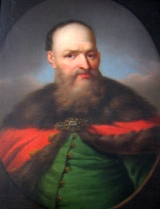
Stefan Czarniecki

Encyclopedia
Stefan Czarniecki AUD or Stefan Łodzia de Czarnca Czarniecki (1599 – 16 February 1665) Polish-Lithuanian Commonwealth
general and nobleman
. Field Hetman
of the Crown of the Polish Kingdom
. He was a military commander, regarded as a Polish national hero. His status in Polish
history is acknowledged by a mention of his name in the Polish national anthem.
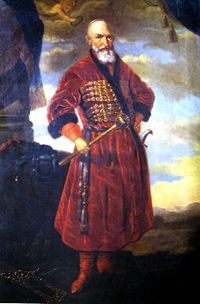 Stefan Czarniecki was born in 1599 in the family estate of Czarnca
by Włoszczowa in southern Poland in an impoverished szlachta
(nobility) family.
He learned the art of war serving with the Lisowczycy
mercenaries in 1610s. Already an officer at the age of eighteen, he took part in the battle of Chocim (Khotyn) in 1621
, where the Commonwealth army stopped the Ottomans and ended the Polish-Ottoman War (1620–1621)
.
Later he served under hetman
Stanisław Koniecpolski in the campaigns against the Tatars
in 1624 (battle of Martynów), and later against Gustavus Adolphus (1626–1629) (part of the Polish-Swedish War), and under Władysław IV in the Smolensk War
against Muscovy in 1632–1634. In 1637 he fought against the rebellious Cossacks under Pavel Mikhnovych
(battle of Kumejki). In 1644 under Koniecpolski he took part in the battle of Ochmatów where Commonwealth forces dealt a crushing defeat to Toğay bey
's (Tuhaj Bej) Tatars.
On the May 16, 1648 he was one of the many noble Polish prisoners who fell into the hands of Bohdan Khmelnytsky
at the battle of Zhovti Vody
and was sent in chains to the Crimea
, whence he was ransomed in 1649. He took an active part in the battles against the Cossacks in the Khmelnytsky Uprising
. He fought at the Battle of Berestechko
of 1651 as well as at the Battle of Batoh
(1652).
He was nearly killed in the defeat that followed the latter. He was said to have hidden in a haystack, witnessing the Tatars massacring the defeated forces. This scene made him reject the notions that a compromise with the enemies of the Commonwealth is a likely or desired outcome in such conflicts.
When Charles X of Sweden invaded Poland in 1655, Czarniecki distinguished himself by his defence of Kraków
. He led guerrilla warfare
against Swedish troops of Charles X. The mobile Swedish forces, even with their significant firepower, were proven to be rather vulnerable to Czarniecki's guerrilla-style warfare. Czarniecki inflicted serious defeats upon the Swedes, notably at Jarosław and at Kozienice
in 1656, but he was also soundly defeated the same year against a much smaller Swedish force at Chojnice
. Under his direction the popular rising against the Swedish troops ultimately proved successful. Czarniecki helped bring King John II Casimir of Poland
back from exile and enabled him to regain his lost kingdom. It was against his advice that the Battle of Warsaw
was fought, and his subsequent strategy neutralized the ill effects of this defeat.
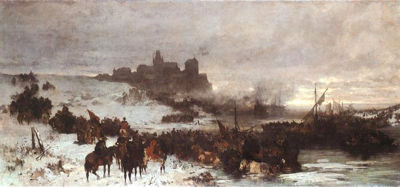 On the retirement of the Swedes from Kraków
and Warsaw
, and the conclusion of the Treaty of Copenhagen with the Danes
, he commanded the army corps sent to drive the troops of Charles X out of Jutland
and contributed to the ultimate success of the Allies
. On the conclusion of the Peace of Oliwa, which adjusted the long outstanding differences between Poland and Sweden, Czarniecki was transferred to the eastern frontier where the war with Russia was still raging. In the campaign of 1660 he won the victories of Połonka and Lachowicza.
In 1661, Czarniecki ordererd to burn down and to pillage the Cossack town of Subotiv
which previously belonged to Bohdan Khmelnytsky and where he was buried. Czarniecki destroyed the tombs of Bohdan Khmelnytsky and his son, Timosh, and let their remains to be thrown on the local market.
In the same year, Polish Parliament (Sejm
) publicly thanked him for his services; the King John II Casimir heaped honours and riches upon him, and in 1665 he was appointed Field Hetman
of the Crown (of Poland). However, he died on 16 February 1665, six weeks after receiving this supreme distinction, from a bullet wound received in the siege of Stavysche
(a town whose population he had ordered to massacre for its resistance).
Czarniecki is regarded as one of the most famous of Poland's captains, and to him belongs the chief merit of extricating her from the difficulties which threatened to overwhelm her during the reign of John Casimir.
He is interred in the tomb chapel of the church founded by him in Czarnca
.
, was commemorated in the Polish national anthem
, the "Dąbrowski's Mazurka
", with the words:
Polish-Lithuanian Commonwealth
The Polish–Lithuanian Commonwealth was a dualistic state of Poland and Lithuania ruled by a common monarch. It was the largest and one of the most populous countries of 16th- and 17th‑century Europe with some and a multi-ethnic population of 11 million at its peak in the early 17th century...
general and nobleman
Szlachta
The szlachta was a legally privileged noble class with origins in the Kingdom of Poland. It gained considerable institutional privileges during the 1333-1370 reign of Casimir the Great. In 1413, following a series of tentative personal unions between the Grand Duchy of Lithuania and the Kingdom of...
. Field Hetman
Hetmans of Polish-Lithuanian Commonwealth
Hetmans of the Polish–Lithuanian Commonwealth were the highest-ranking military officers, second only to the King, in the Polish–Lithuanian Commonwealth. The first Polish title of Grand Crown Hetman was created in 1505. The title of hetman was given to the leader of Polish Army and till 1581 it was...
of the Crown of the Polish Kingdom
Crown of the Polish Kingdom
The Crown of the Kingdom of Poland , or simply the Crown , is the name for the unit of administrative division, the territories under direct administration of Polish nobility from middle-ages to late 18th century...
. He was a military commander, regarded as a Polish national hero. His status in Polish
Poland
Poland , officially the Republic of Poland , is a country in Central Europe bordered by Germany to the west; the Czech Republic and Slovakia to the south; Ukraine, Belarus and Lithuania to the east; and the Baltic Sea and Kaliningrad Oblast, a Russian exclave, to the north...
history is acknowledged by a mention of his name in the Polish national anthem.
Biography
Czarnca
Czarnca is a village in the administrative district of Gmina Włoszczowa, within Włoszczowa County, Świętokrzyskie Voivodeship, in south-central Poland. It lies approximately south-west of Włoszczowa and west of the regional capital Kielce. The village has a population of 730.Historically, the...
by Włoszczowa in southern Poland in an impoverished szlachta
Szlachta
The szlachta was a legally privileged noble class with origins in the Kingdom of Poland. It gained considerable institutional privileges during the 1333-1370 reign of Casimir the Great. In 1413, following a series of tentative personal unions between the Grand Duchy of Lithuania and the Kingdom of...
(nobility) family.
He learned the art of war serving with the Lisowczycy
Lisowczycy
Lisowczycy or chorągiew elearska ; or in singular form: Lisowczyk or elear) - the name of an early 17th century irregular unit of Polish–Lithuanian Commonwealth light cavalry. The Lisowczycy took part in many battles across Europe and the historical accounts of the period characterized them as...
mercenaries in 1610s. Already an officer at the age of eighteen, he took part in the battle of Chocim (Khotyn) in 1621
Battle of Khotyn (1621)
The Battle of Khotyn was a battle fought between a Polish-Lithuanian Commonwealth army and an invading Ottoman Imperial army. Here, for a whole month , the Commonwealth forces halted the Ottoman advance...
, where the Commonwealth army stopped the Ottomans and ended the Polish-Ottoman War (1620–1621)
Polish-Ottoman War (1620–1621)
The Polish-Ottoman War or First Polish-Ottoman War was a conflict between the Polish–Lithuanian Commonwealth and the Ottoman Empire over the control of Moldavia...
.
Later he served under hetman
Hetman
Hetman was the title of the second-highest military commander in 15th- to 18th-century Poland and the Grand Duchy of Lithuania, which together, from 1569 to 1795, comprised the Polish-Lithuanian Commonwealth, or Rzeczpospolita....
Stanisław Koniecpolski in the campaigns against the Tatars
Tatars
Tatars are a Turkic speaking ethnic group , numbering roughly 7 million.The majority of Tatars live in the Russian Federation, with a population of around 5.5 million, about 2 million of which in the republic of Tatarstan.Significant minority populations are found in Uzbekistan, Kazakhstan,...
in 1624 (battle of Martynów), and later against Gustavus Adolphus (1626–1629) (part of the Polish-Swedish War), and under Władysław IV in the Smolensk War
Smolensk War
The Smolensk War was a conflict fought between the Polish-Lithuanian Commonwealth and Russia.Hostilities began in October 1632 when Tsar forces tried to recapture the city of Smolensk, a former Russian possession. Small military engagements produced mixed results for both sides, but the surrender...
against Muscovy in 1632–1634. In 1637 he fought against the rebellious Cossacks under Pavel Mikhnovych
Pavel Mikhnovych
Pavlo Mikhnovych was a colonel in Registered Cossacks аnd self-appointed hetman, as well as a leader of a peasant rebellion in Left-bank Ukraine and Zaporizhia....
(battle of Kumejki). In 1644 under Koniecpolski he took part in the battle of Ochmatów where Commonwealth forces dealt a crushing defeat to Toğay bey
Togay bey
Tugay Bey sometimes also spelled as Tugai Bey was a notable military leader and politician of the Crimean Tatars.Toğay descended from the Arğıns - one of noble Crimean families, and his full name is Arğın Doğan Toğay bey...
's (Tuhaj Bej) Tatars.
On the May 16, 1648 he was one of the many noble Polish prisoners who fell into the hands of Bohdan Khmelnytsky
Bohdan Khmelnytsky
Bohdan Zynoviy Mykhailovych Khmelnytsky was a hetman of the Zaporozhian Cossack Hetmanate of Polish–Lithuanian Commonwealth . He led an uprising against the Commonwealth and its magnates which resulted in the creation of a Cossack state...
at the battle of Zhovti Vody
Battle of Zhovti Vody
Battle of Zhovti Vody , was the first significant battle of the Khmelnytsky Uprising. The name of the battle derived from a nearby river.-Scope:...
and was sent in chains to the Crimea
Crimea
Crimea , or the Autonomous Republic of Crimea , is a sub-national unit, an autonomous republic, of Ukraine. It is located on the northern coast of the Black Sea, occupying a peninsula of the same name...
, whence he was ransomed in 1649. He took an active part in the battles against the Cossacks in the Khmelnytsky Uprising
Khmelnytsky Uprising
The Khmelnytsky Uprising, was a Cossack rebellion in the Ukraine between the years 1648–1657 which turned into a Ukrainian war of liberation from Poland...
. He fought at the Battle of Berestechko
Battle of Berestechko
The Battle of Berestechko was fought between rebellious Zaporozhian Cossacks, led by Hetman Bohdan Khmelnytsky, aided by their Crimean Tatar allies, and a Polish-Lithuanian Commonwealth army under King John II Casimir. It was the largest land battle of 17th century.Lasting from June 28 to June 30,...
of 1651 as well as at the Battle of Batoh
Battle of Batoh
The Battle of Batoh was a battle in 1652 in which Polish forces under Marcin Kalinowski were defeated by Cossacks commanded by Hetman Bohdan Khmelnytsky. About 8,000 Polish soldiers were taken prisoners and massacred after the battle, including Samuel Jerzy Kalinowski, Zygmunt Przyjemski, Jan...
(1652).
He was nearly killed in the defeat that followed the latter. He was said to have hidden in a haystack, witnessing the Tatars massacring the defeated forces. This scene made him reject the notions that a compromise with the enemies of the Commonwealth is a likely or desired outcome in such conflicts.
When Charles X of Sweden invaded Poland in 1655, Czarniecki distinguished himself by his defence of Kraków
Kraków
Kraków also Krakow, or Cracow , is the second largest and one of the oldest cities in Poland. Situated on the Vistula River in the Lesser Poland region, the city dates back to the 7th century. Kraków has traditionally been one of the leading centres of Polish academic, cultural, and artistic life...
. He led guerrilla warfare
Guerrilla warfare
Guerrilla warfare is a form of irregular warfare and refers to conflicts in which a small group of combatants including, but not limited to, armed civilians use military tactics, such as ambushes, sabotage, raids, the element of surprise, and extraordinary mobility to harass a larger and...
against Swedish troops of Charles X. The mobile Swedish forces, even with their significant firepower, were proven to be rather vulnerable to Czarniecki's guerrilla-style warfare. Czarniecki inflicted serious defeats upon the Swedes, notably at Jarosław and at Kozienice
Kozienice
Kozienice is a town in central Poland with 21,500 inhabitants . It is the capital of Kozienice County .-Description:...
in 1656, but he was also soundly defeated the same year against a much smaller Swedish force at Chojnice
Battle of Chojnice (1656)
The Battle of Chojnice was a surprise nighttime attack followed by a run-and-chase battle during The Deluge.-Prelude:...
. Under his direction the popular rising against the Swedish troops ultimately proved successful. Czarniecki helped bring King John II Casimir of Poland
John II Casimir of Poland
John II Casimir was King of Poland and Grand Duke of Lithuania during the era of the Polish–Lithuanian Commonwealth, Duke of Opole in Upper Silesia, and titular King of Sweden 1648–1660. In Poland, he is known and commonly referred as Jan Kazimierz. His parents were Sigismund III Vasa and...
back from exile and enabled him to regain his lost kingdom. It was against his advice that the Battle of Warsaw
Battle of Warsaw (1656)
The Battle of Warsaw was a battle which took place near Warsaw on , between the armies of the Polish-Lithuanian Commonwealth on the one hand and of Sweden and Brandenburg on the other. It was a major battle in the Second Northern War between Poland and Sweden in the period 1655–1660, also known as...
was fought, and his subsequent strategy neutralized the ill effects of this defeat.
Kraków
Kraków also Krakow, or Cracow , is the second largest and one of the oldest cities in Poland. Situated on the Vistula River in the Lesser Poland region, the city dates back to the 7th century. Kraków has traditionally been one of the leading centres of Polish academic, cultural, and artistic life...
and Warsaw
Warsaw
Warsaw is the capital and largest city of Poland. It is located on the Vistula River, roughly from the Baltic Sea and from the Carpathian Mountains. Its population in 2010 was estimated at 1,716,855 residents with a greater metropolitan area of 2,631,902 residents, making Warsaw the 10th most...
, and the conclusion of the Treaty of Copenhagen with the Danes
Denmark
Denmark is a Scandinavian country in Northern Europe. The countries of Denmark and Greenland, as well as the Faroe Islands, constitute the Kingdom of Denmark . It is the southernmost of the Nordic countries, southwest of Sweden and south of Norway, and bordered to the south by Germany. Denmark...
, he commanded the army corps sent to drive the troops of Charles X out of Jutland
Jutland
Jutland , historically also called Cimbria, is the name of the peninsula that juts out in Northern Europe toward the rest of Scandinavia, forming the mainland part of Denmark. It has the North Sea to its west, Kattegat and Skagerrak to its north, the Baltic Sea to its east, and the Danish–German...
and contributed to the ultimate success of the Allies
Allies
In everyday English usage, allies are people, groups, or nations that have joined together in an association for mutual benefit or to achieve some common purpose, whether or not explicit agreement has been worked out between them...
. On the conclusion of the Peace of Oliwa, which adjusted the long outstanding differences between Poland and Sweden, Czarniecki was transferred to the eastern frontier where the war with Russia was still raging. In the campaign of 1660 he won the victories of Połonka and Lachowicza.
In 1661, Czarniecki ordererd to burn down and to pillage the Cossack town of Subotiv
Subotiv
Subotiv is a village in central Ukraine. It is located in the Chyhyrynskyi Raion of the Cherkasy Oblast , near Chyhyryn city....
which previously belonged to Bohdan Khmelnytsky and where he was buried. Czarniecki destroyed the tombs of Bohdan Khmelnytsky and his son, Timosh, and let their remains to be thrown on the local market.
In the same year, Polish Parliament (Sejm
Sejm
The Sejm is the lower house of the Polish parliament. The Sejm is made up of 460 deputies, or Poseł in Polish . It is elected by universal ballot and is presided over by a speaker called the Marshal of the Sejm ....
) publicly thanked him for his services; the King John II Casimir heaped honours and riches upon him, and in 1665 he was appointed Field Hetman
Hetman
Hetman was the title of the second-highest military commander in 15th- to 18th-century Poland and the Grand Duchy of Lithuania, which together, from 1569 to 1795, comprised the Polish-Lithuanian Commonwealth, or Rzeczpospolita....
of the Crown (of Poland). However, he died on 16 February 1665, six weeks after receiving this supreme distinction, from a bullet wound received in the siege of Stavysche
Stavysche
Stavishche is a town in the Kiev Oblast of central Ukraine, on the Hnylyi Tikych river. It's the administrative center of Stavyschenskyi Raion. Population is 7,929 .. It was first mentioned in historical documents in 1622, when it was under Polish rule. In 1635 it was granted the rights of...
(a town whose population he had ordered to massacre for its resistance).
Czarniecki is regarded as one of the most famous of Poland's captains, and to him belongs the chief merit of extricating her from the difficulties which threatened to overwhelm her during the reign of John Casimir.
He is interred in the tomb chapel of the church founded by him in Czarnca
Czarnca
Czarnca is a village in the administrative district of Gmina Włoszczowa, within Włoszczowa County, Świętokrzyskie Voivodeship, in south-central Poland. It lies approximately south-west of Włoszczowa and west of the regional capital Kielce. The village has a population of 730.Historically, the...
.
Legacy
Czarniecki is remembered as one of the most able Polish commanders of all times. His pursuit of the retreating Swedes to Pomerania and Denmark (1658-1659), particularly his crossing with his entire army to the Danish isle of AlsenAlsen
Alsen may refer to:Places:* Als Island, Denmark; called Alsen under Prussian/German administration * Alsen, North Dakota, United States* Alsen, South Dakota, United States...
, was commemorated in the Polish national anthem
National anthem
A national anthem is a generally patriotic musical composition that evokes and eulogizes the history, traditions and struggles of its people, recognized either by a nation's government as the official national song, or by convention through use by the people.- History :Anthems rose to prominence...
, the "Dąbrowski's Mazurka
Dabrowski's Mazurka
Mazurek Dąbrowskiego is the national anthem of Poland. It is also known by its original title, Pieśń Legionów Polskich we Włoszech , or by its incipit, Jeszcze Polska nie zginęła ....
", with the words:
Further reading
- Adam Kersten, Stefan Czarniecki 1599-1665, I ed. Warszawa 1963, II ed. Wydawnictwo Uniwersytetu Marii Curie-Skłodowskiej, Lublin 2005, ISBN 8322725450
- Waldemar Kowalski, Stefan Czarniecki: zonierz, Obywatel, Polityk, Kieleckie Towarzystwo Naukowe, 1999, ISBN 8386006285
- Leszek PodhorodeckiLeszek PodhorodeckiLeszek Podhorodecki , was a Polish historian and writer. Teacher in secondary school, he has published over 40 different books about history of Poland, as well as dozens of academic articles and other publications....
, Stefan Czarniecki, I ed. Warszawa, Książka i Wiedza, 1966, II ed. Warszawa, Wydawn. MADA, 1998, ISBN 8386170360 - Zdzisław Spieralski, Stefan Czarniecki, 1604-1665, Warszawa, Wydawn. Ministerstwa Obrony Narodowej, 1974
- Historya Stefana na Czarncy Czanieckiego Wojewody kijowskiego hetmana polnego koronnego przez Ks. Michała Krajewskiego s.p.
- Hetmani Rzeczypospolitej Obojga Narodów, Warsaw, Bellona, 1994, ISBN 83-11-08275-8.
External links
- Stefan Czarniecki (1599-1665) - biography at Poland.gov.pl
- The Memoir of Stefan Czarniecki by Witold GombrowiczWitold GombrowiczWitold Marian Gombrowicz was a Polish novelist and dramatist. His works are characterized by deep psychological analysis, a certain sense of paradox and an absurd, anti-nationalist flavor...
. Translated from the Polish by Christopher Makosa