

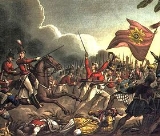
Battle of Assaye

Encyclopedia
The Battle of Assaye was a major battle of the Second Anglo-Maratha War
fought between the Maratha Confederacy and the British East India Company
. It occurred on 23 September 1803 near Assaye
in western India
where an outnumbered Indian and British force under the command of Major General Arthur Wellesley
(who later became the Duke of Wellington) defeated a combined Confederacy army of Daulat Scindia and the Raja of Berar
. The battle was the Duke of Wellington's first major victory and one he later described as his finest accomplishment on the battlefield.
From August 1803, Wellesley's army and a separate force under the command of his subordinate Colonel James Stevenson
had been pursuing the Maratha cavalry
-based army which threatened to raid south into Hyderabad
. After several weeks of pursuit and countermarching, Scindia reinforced the combined Maratha army with his Europeanised infantry and artillery as the British forces closed in on his position.
Wellesley received intelligence indicating the location of the Maratha encampment on 21 September and devised a plan whereby his two armies would converge on the Maratha position three days later. Wellesley's force, however, encountered the Maratha army – which was under the command of Colonel Anthony Pohlmann
– 6 miles (9.7 km) farther south than he anticipated. Although outnumbered, Wellesley resolved to attack at once, believing that the Maratha army would soon move off. Both sides suffered heavily in the ensuing battle; Maratha artillery
caused large numbers of casualties among Wellesley's troops but the vast numbers of Maratha cavalry proved largely ineffective. A combination of bayonet
and cavalry charges eventually forced the Maratha army to retreat with the loss of most of their guns, but Wellesley's army was too battered and exhausted to pursue.
Wellesley's victory at Assaye, preceded by the capture of Ahmednagar and followed by victories at Argaon and Gawilghur
, resulted in the defeat of Scindia and Berar's armies in the Deccan. Wellesley's progress in the Deccan was matched by Lieutenant General Gerard Lake
's successful campaigns in Northern India and led to the British becoming the dominant power in the heartlands of India.
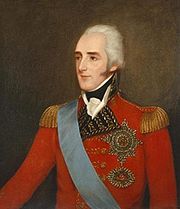 Feuding between the two dominant powers within the Maratha Confederacy, Yashwant Rao Holkar
and Daulat Rao Scindia, led to civil war at the turn of the 19th century. The hostilities culminated in the Battle of Poona
in October 1802 where Holkar defeated a combined army of Scindia and Baji Rao II
– the Peshwa
and nominal overlord of the Confederacy. Scindia retreated into his dominions to the north, but Baji Rao was driven from his territory and sought refuge with the East India Company
at Bassein. He appealed to the Company for assistance, offering to accept its authority if he were restored to his principality at Poona. Lord Mornington
, the ambitious Governor-General
of British India, seized on the opportunity to extend Company influence into the Confederacy which he perceived as the final obstacle to British paramountcy over the Indian subcontinent
. The Treaty of Bassein
was signed in December 1802 whereby the Company agreed to restore Baji Rao in return for control over his foreign affairs and a garrison of 6,000 Company troops permanently stationed in Poona. The restoration was commanded by Lord Mornington’s younger brother, Major General Arthur Wellesley
, who in March 1803 marched on Poona from Mysore with 15,000 Company troops and 9,000 Hyderabad
allies. Wellesley entered Poona without opposition on 20 April, and Baji Rao was formally restored to his throne on 13 May.
The treaty gave offence to the other Maratha leaders, who deemed that the system of subsidiary alliance
s with the British was an unwarranted interference into their affairs and fatal to the independent Maratha states. The Maratha leaders refused to submit to the Peshwa's authority and tensions were raised further when Holkar raided into Hyderabad in May, claiming that the Nizam of Hyderabad
(a British ally) owed him money. Mornington consequently engaged the various Maratha chieftains in negotiations. Lieutenant Colonel John Collins was sent to Scindia's camp to discuss his objections and propose a defensive alliance. However, Scindia had formed a military alliance with the Rajah of Berar
with a view to bringing the Maratha leaders into a coalition against the British, and had begun to mass his forces on the Nizam's border. Wellesley, who had been given control over the Company's military and political affairs in central India in June, demanded Scindia declare his intentions and withdraw his forces or face the prospect of war. After a protracted period of negotiations, Collins reported to Wellesley on 3 August that Scindia refused to give an answer and would not withdraw his troops. Wellesley's response was to declare war on Scindia and Berar "in order to secure the interests of the British government and its allies".
attacked the two principal Maratha forces of Scindia and the Raja of Berar
from the north and the south. Of the other Maratha leaders, Holkar
was hesitant to enter the war in cooperation with his rival, Scindia, and remained aloof from the hostilities, and the Gaekwad
of Baroda placed himself under British protection. Operations in the north were directed by Lieutenant General Gerard Lake
who entered Maratha territory from Cawnpore to face Scindia's main army which was commanded by the French mercenary, Pierre Perron
. A second British force under the command of Major General Wellesley
confronted a combined army of Scindia and Berar in the Deccan
. Wellesley was determined to gain the initiative through offensive action and told his senior subordinate, Colonel James Stevenson
, that "a long defensive war would ruin us and will answer no purpose whatever".
The Maratha army in the Deccan was largely composed of fast-moving cavalry able to live off the land. Consequently, Wellesley planned to work in conjunction with a separate force under Colonel Stevenson to enable his slower troops to out-manoeuvre the Maratha army and force it into a position where it could not avoid a pitched battle
. Stevenson was despatched from Hyderabad with an army of some 10,000 men to Jafarabad
to deny Scindia and Berar the chance to raid east into the Nizam's territory. In the meantime, Wellesley moved north from his camp near the Godavari River
on 8 August with some 13,500 troops and headed towards Scindia's nearest stronghold – the walled town and fort at Ahmednuggur. The bulk of his forces were Company troops from Mysore
: five sepoy
infantry battalion
s of the Madras Native Infantry and three squadrons of Madras Native Cavalry. A contingent of European troops were supplied by the British Army
and included cavalry from the 19th Light Dragoons
and two battalions of Scottish infantry from the 74th
and 78th Regiment of Foot. Irregular
light cavalry were also provided by the Company's Mysore and Maratha
allies.
Wellesley reached Ahmednuggur later the same day after a 7 miles (11.3 km) march and immediately ordered an escalade
assault on the town rather than enter into a time-consuming siege. The walled town, which was garrisoned by 1,000 Arab mercenaries, upwards of 60 cannon and one of Scindia’s infantry battalions under the command of French officers, was captured with minimal losses after a brief action. The adjacent fort's defenders capitulated four days later once the walls were breached by British artillery. With the fortification providing a logistics base and point of support for future operations into Maratha territory, Wellesley installed a garrison and headed north towards the Nizam's city of Aurungabad. Along the way he captured Scindia’s other possessions south of the Godavari and established a series of guarded bridges and ferries along the river to maintain his communication
and supply lines
.
which he took by storm. Scindia learned of Wellesley's intentions and returned to a position north of Jalna. Unable to make a clean break from the pursuing British he abandoned plans to raid into Hyderabad and instead assembled his infantry and artillery. The combined Maratha army was around 50,000 strong, the core of which was 10,800 well equipped regular
infantry organised into three brigade
s, trained and commanded by European adventurer and mercenary officers. Colonel Anthony Pohlmann
, a Hanoverian
and former East India Company sergeant, commanded the largest brigade with eight battalions. A further brigade with five battalions was provided by Begum Samru, and was commanded on her behalf by a Frenchman, Colonel Jean Saleur. The third brigade had four battalions and was commanded by Dutchman, Major John James Dupont. In addition, the Maratha force included 10,000–20,000 of Berar's irregular infantry, some 30,000–40,000 irregular light cavalry
and over 100 guns ranging in size from one to 18-pounders.
After several weeks of chasing down the Maratha army, Wellesley and Stevenson met at Budnapoor
on 21 September and received intelligence that the Maratha army was at Borkardan
, around 30 miles (48.3 km) to the north. They agreed a plan by which their two armies – moving separately along either side of a range of hills with Wellesley to the east and Stevenson to the west – would converge on Borkardan on 24 September. Wellesley's force reached Paugy on the afternoon of 22 September and departed camp before dawn. By noon, the army had marched 14 miles (22.5 km) to Naulniah, a small town 12 miles (19.3 km) south of Borkardan, where they intended to rest before joining Stevenson to attack the Maratha army the next day. At this point, Wellesley received further intelligence that rather than being at Borkardan, the Maratha army was camped just 5 miles (8 km) north, but their cavalry had moved off and the infantry were about to follow.
At about 13:00, Wellesley went forward with a cavalry escort to reconnoitre the Maratha position. The rest of his army followed closely behind apart from a battalion of sepoys left at Naulniah to guard the baggage. In all, Wellesley had 4,500 troops at his disposal plus 5,000 Mysore and Maratha horse and 17 cannon. Aware that the British were nearby, The Maratha chiefs had positioned their army in a strong defensive position along a tongue of land stretching east from Borkardan between the Kailna River and its tributary the Juah. However, Scindia and Berar did not believe Wellesley would attack with his small force and had moved off from the area in the morning. Command of their army was given to Pohlmann, who had positioned his infantry to the east of the Maratha camp in the plains around the village of Assaye
on the southern bank of the Juah.
To his surprise, Wellesley found the entire combined army before him. Nevertheless, he resolved to attack at once, believing that if he waited for Stevenson, the Marathas would have the chance to slip away and force the pursuit to drag on. Wellesley was also eager to forge a reputation for himself, and despite his numerical disadvantage, he was confident that the Maratha’s irregular forces would be swept aside by his disciplined troops, and only Scindia’s regular infantry could be expected to stand and fight.
struck camp and deployed his infantry battalions in a line facing southwards behind the steep banks of the Kailna with his cannon arrayed directly in front. The great mass of Maratha cavalry was kept on the right flank and Berar's
irregular infantry garrisoned Assaye
to the rear. The only observable crossing point over the river was a small ford directly ahead of the Maratha position. Pohlmann's strategy was to funnel the British and Madras troops across the ford into the mouth of his cannon, and then on to the massed infantry and cavalry behind. Wellesley's
local guides assured him that no other ford existed nearby, but he quickly discarded the option of a frontal assault as suicide. While reconnoitring he had noticed two unguarded villages, Peepulgaon and Waroor, one on each bank of the Kailna beyond the Maratha left. On the assumption that a ford must exist between the two villages, Wellesley ordered the area to be further reconnoitred by his Chief Engineer, Captain John Johnson, who reported that there was indeed a ford at that spot. Thus Wellesley led his army east to the crossing in an attempt to launch an attack on Pohlmann's left flank.
At around 15:00, the British crossed to the northern bank of the Kaitna unopposed apart from a distant harassing fire from the Maratha cannon which was largely inaccurate but succeeded in decapitating Wellesley's dragoon orderly. Once across, Wellesley ordered his six infantry battalions to form into two lines, with his cavalry as a reserve in a third. His allied Maratha and Mysore
cavalry were ordered to remain south of the Kaitna to keep in check a large body of Maratha cavalry which hovered around the British rear. Pohlmann soon recognised Wellesley’s intentions and swung his infantry and guns through 90 degrees to establish a new line spread approximately 1 miles (1.6 km) across the isthmus with their right flank on the Kaitna and the left on Assaye. Although the new position secured the Maratha flanks, it restricted Pohlmann from bringing his superior numbers into action.
The Maratha redeployment was swifter and more efficient than Wellesley had anticipated and he immediately reacted by extending his front to deny Pohlmann the opportunity to out-flank him. A battalion of pickets and the 74th Highlanders
, which formed the right of the first and second lines, were ordered to move obliquely to the right. This allowed the 78th to anchor the left flank and Madras infantry battalions (the 1/10th, 1/8th, 1/4th and 2/12th) to form the centre of the British line. Wellesley's intention was to force back the Marathas from their guns and then – operating by his left to avoid the heavily defended Assaye – throw them back on the Juah and complete their destruction with his cavalry.
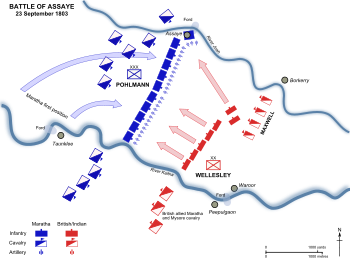 The Maratha cannonade intensified as the British redeployed. Although British artillery was brought forward to counter, it was ineffective against the mass firepower of the Maratha guns and quickly disabled through the weight of shot directed against it. British casualties mounted as the Maratha guns turned their attention to the infantry and subjected them to a barrage of canister
, grape
and round shot
. Wellesley decided that his only option to neutralise the artillery and get his men out of the killing field
was to advance directly into the mouth of the Maratha artillery. He ordered his cannon to be abandoned and gave the command for his infantry to march forward with bayonet
s fixed.
The Maratha cannonade punched holes in the British line, but the infantry maintained a steady pace, closing up the gaps in their ranks as they advanced. The 78th Highlanders were the first to reach the enemy in the southern sector next to the River Kailna. They paused 50 yards (45.7 m) from the Maratha gunners and unleashed a volley of musket
fire before launching into a bayonet charge. The four battalions of Madras infantry to the right of the 78th, accompanied by the Madras Pioneers
, reached Pohlmann's line shortly afterwards and attacked in the same fashion. The gunners stood by their cannon but were no match for the bayonets of the British and Madras troops who swiftly pressed on towards the Maratha infantry. However, instead of meeting the charge, the Maratha right broke and fled northwards towards the Juah, causing the rest of the southern half of the line to follow. The officers of the Madras battalions temporarily lost control as the sepoy
s, encouraged by their success, pushed too far pursuit. Maratha cavalry momentarily threatened to charge but were checked by the 78th who remained in order and re-formed to face the danger.
In the northern sector of the battle field however, Wellesley's right flank was in turmoil. The commander of the pickets, Lieutenant Colonel William Orrock, had mistaken his orders and continued his oblique path directly towards Assaye. Major Samuel Swinton of the 74th regiment was ordered to support the pickets and followed close behind. This created a large gap in the centre of the British line, and brought the two battalions under a barrage of cannonade from the artillery around the village and the Maratha left. The two battalions began to fall back in disarray and Pohlmann ordered his remaining infantry and cavalry forward to attack. The Marathas gave no quarter; the pickets were virtually annihilated but the remnants of the 74th were able to form a rough square
behind hastily piled bodies of dead. Realising that the destruction of his right would leave his army exposed and out-flanked, Wellesley ordered a detachment of British cavalry under Colonel Patrick Maxwell consisting of the 19th Light Dragoons
and elements of the 4th and 5th Madras Native Cavalry into action. From their position at the rear, the cavalry dashed directly towards the 74th's square, crashed into the swarming attackers and routed them. Maxwell pressed his advantage and continued his charge into the Maratha infantry and guns on the left, driving them backwards and across the Juah "with great slaughter".
While Wellesley was preoccupied with re-taking the gun line, Pohlmann rallied his infantry and redeployed them into a semicircle with their backs to the Juah; their right flank across the river and their left in Assaye. However, most of the Maratha cannon, which had inflicted heavy losses on Wellesley's infantry, had been captured or lay abandoned on the battlefield. Reluctant to join the fray, the Maratha cavalry lingered in the distance to the west. Most were Pindarries
: loosely organised and lightly armed horsemen whose traditional role was to cut down fleeing enemy troops, harass convoy
lines and carry out raids into enemy territory. They were not trained to attack well-formed infantry or heavily armed European cavalry, and did not play a further part in the battle.
With the remanned Maratha artillery silenced, Wellesley turned his attention to Pohlmann's reformed infantry. Although Maxwell had suffered heavy losses, he had rallied his cavalry and returned to the field of battle. Wellesley ordered him to charge the Maratha left flank, while the infantry moved forward as a single line to meet the centre and right. The cavalry spurred forward but were met with a volley of canister shot which struck Maxwell, killing him instantly. Their momentum lost, the cavalry did not complete their charge but veered away from the Maratha line at the last moment. The British and Madras infantry marched on against the Maratha position but Pohlmann's men, their morale low, did not wait for the attack and instead retreated northwards across the Juah. Descriptions differ as to the manner of their departure: Maratha sources claim the line marched away from the battlefield in an orderly manner on Pohlmann's orders but British accounts claim the Maratha infantry fled in an uncontrolled panic. Berar's irregulars inside Assaye, now leaderless and having witnessed the fate of the regular infantry, abandoned the village and marched off northwards at around 18:00, followed shortly afterwards by the Maratha cavalry. Wellesley's troops, however, were exhausted and in no condition to pursue and the native allied cavalry which had remained on the south bank of the Kailna and had not been engaged, refused to pursue without the support of the British and Madras cavalry.
and British Army
casualties amounted to 428 killed, 1138 wounded and 18 missing; a total of 1,584 – over a third of the force engaged in combat. The 74th
and the picket battalion were decimated; from a strength of about 500, the 74th lost ten officers killed and seven wounded, and 124 other ranks killed and 270 wounded. The pickets lost all their officers except their commander, Lieutenant Colonel William Orrock, and had only about 75 men remaining. Of the ten officers forming the general's staff, eight were wounded or had their horses killed. Wellesley
himself lost two horses; the first was shot from underneath him and the second was speared as he led the charge to re-capture the Maratha gun line. The number of Maratha casualties is more difficult to ascertain. Despatches from British officers give a figure of 1,200 dead and many more wounded but some modern historians have estimated a total of 6,000 dead and wounded. The Marathas also surrendered seven stands of colours, large amounts of stores and ammunition and 98 cannon – most of which were later taken into service by the East India Company. Although Scindia and Berar's
army was not finished as a fighting force, several of Scindia's regular infantry battalion
s and artillery crews had been destroyed. Their command structure had also been damaged: many of their European officers, including Colonel Pohlmann
and Major Dupont, surrendered to the Company – which had offered amnesty to Europeans in the service of the Maratha armies – or deserted and sought employment with other native chieftains.
The sound of the guns at Assaye was heard by Stevenson
who immediately broke up his camp 10 miles (16.1 km) miles to the west in an attempt to join the battle. However, he was misled by his guide and marched first on Borkardan
before he reached the battlefield on the evening of 24 September. Suspecting that his guide had intentionally led him astray, Stevenson later had him hanged. He remained with Wellesley to assist with the wounded – troops were still being carried from the battlefield four days after the engagement – until ordered to recommence the pursuit of the Maratha army on 26 September. Wellesley remained to the south while he established a hospital at Ajanta
and awaited reinforcements from Poona. Two months later, he combined with Stevenson to rout Scindia and Berar's demoralised and weakened army at Argaon, and shortly afterwards stormed Berar's fortress at Gawilghur
. These victories, coupled with Lieutenant General Lake
's successful campaign in the north, induced the two Maratha chiefs to sue for peace.
.jpg) Wellesley later told Stevenson that "I should not like to see again such a loss as I sustained on the 23rd September, even if attended by such a gain", and in later life he referred to Assaye as "the bloodiest for the numbers that I ever saw". Lieutenant Colonel Thomas Munro, the Company's district collector
Wellesley later told Stevenson that "I should not like to see again such a loss as I sustained on the 23rd September, even if attended by such a gain", and in later life he referred to Assaye as "the bloodiest for the numbers that I ever saw". Lieutenant Colonel Thomas Munro, the Company's district collector
at Mysore, was critical of the high proportion of casualties and questioned Wellesley's decision not to wait for Stevenson. He wrote to Wellesley: "I am tempted to think that you did it with a view of sharing the glory with the smallest numbers". In response, Wellesley politely rebuffed Munro's accusations and defended his action as necessary because he had received and acted upon incorrect intelligence regarding the Maratha position. Assaye was 34-year-old Wellesley's first major success and despite his anguish over the heavy losses, it was a battle he always held in the highest estimation. After his retirement from active military service, the Duke of Wellington
(as he later became known) considered Assaye the finest thing he ever did in the way of fighting even when compared to his later military career.
Lord Mornington
and his Council
lauded the battle as a "most brilliant and important victory", and presented each of the Madras units and British regiments involved in the engagement with a set of honorary colours. The British regiments and native units were also awarded the Assaye battle honour
and most were later given permission to adopt an Assaye elephant as part of their insignia. A public monument was also erected by the East India Company at Fort William, Calcutta to commemorate the victory. The 74th Regiment of foot later became known as the Assaye regiment due to their stand at the battle and their modern-day successors, the Royal Highland Fusiliers
(2 SCOTS), still celebrate the anniversary of the battle each year. Of the native infantry battalions, only the Madras Sappers survive in their original form in the Indian Army
but they no longer celebrate Assaye as it has been declared a repugnant battle honour
by the Government of India
.
Second Anglo-Maratha War
The Second Anglo-Maratha War was the second conflict between the British East India Company and the Maratha Empire in India.-Background:...
fought between the Maratha Confederacy and the British East India Company
British East India Company
The East India Company was an early English joint-stock company that was formed initially for pursuing trade with the East Indies, but that ended up trading mainly with the Indian subcontinent and China...
. It occurred on 23 September 1803 near Assaye
Assaye
Assaye is a small village in the Jalna district of the state of Maharashtra in western India. The village was the location of the Battle of Assaye in 1803, fought between the Maratha Confederacy and the British East India Company....
in western India
India
India , officially the Republic of India , is a country in South Asia. It is the seventh-largest country by geographical area, the second-most populous country with over 1.2 billion people, and the most populous democracy in the world...
where an outnumbered Indian and British force under the command of Major General Arthur Wellesley
Arthur Wellesley, 1st Duke of Wellington
Field Marshal Arthur Wellesley, 1st Duke of Wellington, KG, GCB, GCH, PC, FRS , was an Irish-born British soldier and statesman, and one of the leading military and political figures of the 19th century...
(who later became the Duke of Wellington) defeated a combined Confederacy army of Daulat Scindia and the Raja of Berar
Raghoji II Bhonsle
Raghoji II Bhonsle was the Maratha ruler of the Kingdom of Nagpur in Central India from 1788 to 1816.Raghoji was adopted as an infant by his uncle Janoji to be his chosen heir...
. The battle was the Duke of Wellington's first major victory and one he later described as his finest accomplishment on the battlefield.
From August 1803, Wellesley's army and a separate force under the command of his subordinate Colonel James Stevenson
James Stevenson (soldier)
Major General James Stevenson was a British East India Company cavalry officer who saw extensive service throughout India. He commanded a cavalry squadron at the battles of Seringapatam and Mallavelly, and in late 1800 he was temporarily appointed as district governor of Mysore...
had been pursuing the Maratha cavalry
Cavalry
Cavalry or horsemen were soldiers or warriors who fought mounted on horseback. Cavalry were historically the third oldest and the most mobile of the combat arms...
-based army which threatened to raid south into Hyderabad
Hyderabad State
-After Indian independence :When India gained independence in 1947 and Pakistan came into existence in 1947, the British left the local rulers of the princely states the choice of whether to join one of the new dominions or to remain independent...
. After several weeks of pursuit and countermarching, Scindia reinforced the combined Maratha army with his Europeanised infantry and artillery as the British forces closed in on his position.
Wellesley received intelligence indicating the location of the Maratha encampment on 21 September and devised a plan whereby his two armies would converge on the Maratha position three days later. Wellesley's force, however, encountered the Maratha army – which was under the command of Colonel Anthony Pohlmann
Anthony Pohlmann
Anthony Pohlmann was a Hanoverian soldier who served in the armies of the British East India Company and Daulat Scindia. Pohlmann arrived in India as a sergeant in a Hanoverian regiment serving the East India Company in Madras. He deserted his regiment in 1792 or 1793 and took employment in the...
– 6 miles (9.7 km) farther south than he anticipated. Although outnumbered, Wellesley resolved to attack at once, believing that the Maratha army would soon move off. Both sides suffered heavily in the ensuing battle; Maratha artillery
Artillery
Originally applied to any group of infantry primarily armed with projectile weapons, artillery has over time become limited in meaning to refer only to those engines of war that operate by projection of munitions far beyond the range of effect of personal weapons...
caused large numbers of casualties among Wellesley's troops but the vast numbers of Maratha cavalry proved largely ineffective. A combination of bayonet
Bayonet
A bayonet is a knife, dagger, sword, or spike-shaped weapon designed to fit in, on, over or underneath the muzzle of a rifle, musket or similar weapon, effectively turning the gun into a spear...
and cavalry charges eventually forced the Maratha army to retreat with the loss of most of their guns, but Wellesley's army was too battered and exhausted to pursue.
Wellesley's victory at Assaye, preceded by the capture of Ahmednagar and followed by victories at Argaon and Gawilghur
Gawilghur
Gawilghur was a well-fortified mountain stronghold of the Maratha Empire north of the Deccan Plateau, in the vicinity of Melghat Tiger Reserve, Amravati District, Maharashtra. It was successfully assaulted by an Anglo-Indian force commanded by Arthur Wellesley on the 15 December 1803 during the...
, resulted in the defeat of Scindia and Berar's armies in the Deccan. Wellesley's progress in the Deccan was matched by Lieutenant General Gerard Lake
Gerard Lake, 1st Viscount Lake
General Gerard Lake, 1st Viscount Lake was a British general. He commanded British forces during the Irish Rebellion of 1798 and later served as Commander-in-Chief of the military in British India.-Background:...
's successful campaigns in Northern India and led to the British becoming the dominant power in the heartlands of India.
Background
Yashwantrao Holkar
H. H. Maharajadhiraj Raj Rajeshwar Sawai Shrimant Yashwant Rao Holkar Bahadur, Nusrat Jang, Maharaja of Maratha Empire, was born on 3 December 1776...
and Daulat Rao Scindia, led to civil war at the turn of the 19th century. The hostilities culminated in the Battle of Poona
Battle of Poona
The Battle of Poona took place on 25 October 1802 near Pune between the rival factions of the Maratha Confederacy. The forces of the Scindia and the Peshwa Bajirao II were attacked by the Holkars...
in October 1802 where Holkar defeated a combined army of Scindia and Baji Rao II
Baji Rao II
Baji Rao II was the last Peshwa of the Maratha Confederacy, and governed from 1796 to 1818. His reign was marked by confrontations with the British.-Biography:...
– the Peshwa
Peshwa
A Peshwa is the titular equivalent of a modern Prime Minister. Emporer Shivaji created the Peshwa designation in order to more effectively delegate administrative duties during the growth of the Maratha Empire. Prior to 1749, Peshwas held office for 8-9 years and controlled the Maratha army...
and nominal overlord of the Confederacy. Scindia retreated into his dominions to the north, but Baji Rao was driven from his territory and sought refuge with the East India Company
East India Company
The East India Company was an early English joint-stock company that was formed initially for pursuing trade with the East Indies, but that ended up trading mainly with the Indian subcontinent and China...
at Bassein. He appealed to the Company for assistance, offering to accept its authority if he were restored to his principality at Poona. Lord Mornington
Richard Wellesley, 1st Marquess Wellesley
Richard Colley Wesley, later Wellesley, 1st Marquess Wellesley, KG, PC, PC , styled Viscount Wellesley from birth until 1781, was an Anglo-Irish politician and colonial administrator....
, the ambitious Governor-General
Governor-General of India
The Governor-General of India was the head of the British administration in India, and later, after Indian independence, the representative of the monarch and de facto head of state. The office was created in 1773, with the title of Governor-General of the Presidency of Fort William...
of British India, seized on the opportunity to extend Company influence into the Confederacy which he perceived as the final obstacle to British paramountcy over the Indian subcontinent
Indian subcontinent
The Indian subcontinent, also Indian Subcontinent, Indo-Pak Subcontinent or South Asian Subcontinent is a region of the Asian continent on the Indian tectonic plate from the Hindu Kush or Hindu Koh, Himalayas and including the Kuen Lun and Karakoram ranges, forming a land mass which extends...
. The Treaty of Bassein
Treaty of Bassein (1802)
The Treaty of Bassein was a pact signed on December 31, 1802 between the British East India Company and Baji Rao II, the Maratha peshwa of Pune in India after the Battle of Poona...
was signed in December 1802 whereby the Company agreed to restore Baji Rao in return for control over his foreign affairs and a garrison of 6,000 Company troops permanently stationed in Poona. The restoration was commanded by Lord Mornington’s younger brother, Major General Arthur Wellesley
Arthur Wellesley, 1st Duke of Wellington
Field Marshal Arthur Wellesley, 1st Duke of Wellington, KG, GCB, GCH, PC, FRS , was an Irish-born British soldier and statesman, and one of the leading military and political figures of the 19th century...
, who in March 1803 marched on Poona from Mysore with 15,000 Company troops and 9,000 Hyderabad
Hyderabad State
-After Indian independence :When India gained independence in 1947 and Pakistan came into existence in 1947, the British left the local rulers of the princely states the choice of whether to join one of the new dominions or to remain independent...
allies. Wellesley entered Poona without opposition on 20 April, and Baji Rao was formally restored to his throne on 13 May.
The treaty gave offence to the other Maratha leaders, who deemed that the system of subsidiary alliance
Subsidiary alliance
A subsidiary alliance is an alliance between a dominant nation and a nation that it dominates.-British policy in India:The doctrine of subsidiary alliance was introduced by Marquess Wellesley, British Governor-General of India from 1798 to 1805...
s with the British was an unwarranted interference into their affairs and fatal to the independent Maratha states. The Maratha leaders refused to submit to the Peshwa's authority and tensions were raised further when Holkar raided into Hyderabad in May, claiming that the Nizam of Hyderabad
Ali Khan Asaf Jah II
Nawab Mir Nizam Ali Khan Siddiqi Bahadur Asaf Jah II was the Nizam of Hyderabad State in South India between 1762 and 1803.-Official name:...
(a British ally) owed him money. Mornington consequently engaged the various Maratha chieftains in negotiations. Lieutenant Colonel John Collins was sent to Scindia's camp to discuss his objections and propose a defensive alliance. However, Scindia had formed a military alliance with the Rajah of Berar
Raghoji II Bhonsle
Raghoji II Bhonsle was the Maratha ruler of the Kingdom of Nagpur in Central India from 1788 to 1816.Raghoji was adopted as an infant by his uncle Janoji to be his chosen heir...
with a view to bringing the Maratha leaders into a coalition against the British, and had begun to mass his forces on the Nizam's border. Wellesley, who had been given control over the Company's military and political affairs in central India in June, demanded Scindia declare his intentions and withdraw his forces or face the prospect of war. After a protracted period of negotiations, Collins reported to Wellesley on 3 August that Scindia refused to give an answer and would not withdraw his troops. Wellesley's response was to declare war on Scindia and Berar "in order to secure the interests of the British government and its allies".
Prelude
The East India CompanyEast India Company
The East India Company was an early English joint-stock company that was formed initially for pursuing trade with the East Indies, but that ended up trading mainly with the Indian subcontinent and China...
attacked the two principal Maratha forces of Scindia and the Raja of Berar
Raghoji II Bhonsle
Raghoji II Bhonsle was the Maratha ruler of the Kingdom of Nagpur in Central India from 1788 to 1816.Raghoji was adopted as an infant by his uncle Janoji to be his chosen heir...
from the north and the south. Of the other Maratha leaders, Holkar
Yashwantrao Holkar
H. H. Maharajadhiraj Raj Rajeshwar Sawai Shrimant Yashwant Rao Holkar Bahadur, Nusrat Jang, Maharaja of Maratha Empire, was born on 3 December 1776...
was hesitant to enter the war in cooperation with his rival, Scindia, and remained aloof from the hostilities, and the Gaekwad
Gaekwad
The Gaekwad or Gaikwad was a Maratha dynasty that ruled the princely state of Baroda in western India from the mid-18th century until 1947...
of Baroda placed himself under British protection. Operations in the north were directed by Lieutenant General Gerard Lake
Gerard Lake, 1st Viscount Lake
General Gerard Lake, 1st Viscount Lake was a British general. He commanded British forces during the Irish Rebellion of 1798 and later served as Commander-in-Chief of the military in British India.-Background:...
who entered Maratha territory from Cawnpore to face Scindia's main army which was commanded by the French mercenary, Pierre Perron
Pierre Cuillier-Perron
Pierre Cuillier-Perron , French military adventurer in India, whose name was originally Pierre Cuillier, was born at Luceau near Château-du-Loir in France, the son of a cloth merchant....
. A second British force under the command of Major General Wellesley
Arthur Wellesley, 1st Duke of Wellington
Field Marshal Arthur Wellesley, 1st Duke of Wellington, KG, GCB, GCH, PC, FRS , was an Irish-born British soldier and statesman, and one of the leading military and political figures of the 19th century...
confronted a combined army of Scindia and Berar in the Deccan
Deccan Plateau
The Deccan Plateau is a large plateau in India, making up the majority of the southern part of the country. It rises a hundred meters high in the north, rising further to more than a kilometers high in the south, forming a raised triangle nested within the familiar downward-pointing triangle of...
. Wellesley was determined to gain the initiative through offensive action and told his senior subordinate, Colonel James Stevenson
James Stevenson (soldier)
Major General James Stevenson was a British East India Company cavalry officer who saw extensive service throughout India. He commanded a cavalry squadron at the battles of Seringapatam and Mallavelly, and in late 1800 he was temporarily appointed as district governor of Mysore...
, that "a long defensive war would ruin us and will answer no purpose whatever".
The Maratha army in the Deccan was largely composed of fast-moving cavalry able to live off the land. Consequently, Wellesley planned to work in conjunction with a separate force under Colonel Stevenson to enable his slower troops to out-manoeuvre the Maratha army and force it into a position where it could not avoid a pitched battle
Pitched battle
A pitched battle is a battle where both sides choose to fight at a chosen location and time and where either side has the option to disengage either before the battle starts, or shortly after the first armed exchanges....
. Stevenson was despatched from Hyderabad with an army of some 10,000 men to Jafarabad
Jafrabad, Jalna
Jafrabad is a city and a tehsil in Jalna subdivision of Jalna district in the state of Maharashtra, India....
to deny Scindia and Berar the chance to raid east into the Nizam's territory. In the meantime, Wellesley moved north from his camp near the Godavari River
Godavari River
The Godavari is a river that runs from western to southern India and is considered to be one of the big river basins in India. With a length of 1465 km, it is the second longest river in India , that runs within the country and also the longest river in South India...
on 8 August with some 13,500 troops and headed towards Scindia's nearest stronghold – the walled town and fort at Ahmednuggur. The bulk of his forces were Company troops from Mysore
Kingdom of Mysore
The Kingdom of Mysore was a kingdom of southern India, traditionally believed to have been founded in 1399 in the vicinity of the modern city of Mysore. The kingdom, which was ruled by the Wodeyar family, initially served as a vassal state of the Vijayanagara Empire...
: five sepoy
Sepoy
A sepoy was formerly the designation given to an Indian soldier in the service of a European power. In the modern Indian Army, Pakistan Army and Bangladesh Army it remains in use for the rank of private soldier.-Etymology and Historical usage:...
infantry battalion
Battalion
A battalion is a military unit of around 300–1,200 soldiers usually consisting of between two and seven companies and typically commanded by either a Lieutenant Colonel or a Colonel...
s of the Madras Native Infantry and three squadrons of Madras Native Cavalry. A contingent of European troops were supplied by the British Army
British Army
The British Army is the land warfare branch of Her Majesty's Armed Forces in the United Kingdom. It came into being with the unification of the Kingdom of England and Scotland into the Kingdom of Great Britain in 1707. The new British Army incorporated Regiments that had already existed in England...
and included cavalry from the 19th Light Dragoons
19th Light Dragoons
The 19th Light Dragoons was a cavalry regiment of the British Army created in 1781 for service in British India. The regiment served in India until 1806, and in North America during the War of 1812, and was disbanded in Britain in 1821.-Formation:...
and two battalions of Scottish infantry from the 74th
74th (Highland) Regiment of Foot
The 74th Regiment of Foot was a British Army line infantry regiment. During the Childers Reforms it was united with the 71st Regiment of Foot to form the Highland Light Infantry.-Service history:...
and 78th Regiment of Foot. Irregular
Irregular military
Irregular military refers to any non-standard military. Being defined by exclusion, there is significant variance in what comes under the term. It can refer to the type of military organization, or to the type of tactics used....
light cavalry were also provided by the Company's Mysore and Maratha
Maratha
The Maratha are an Indian caste, predominantly in the state of Maharashtra. The term Marāthā has three related usages: within the Marathi speaking region it describes the dominant Maratha caste; outside Maharashtra it can refer to the entire regional population of Marathi-speaking people;...
allies.
Wellesley reached Ahmednuggur later the same day after a 7 miles (11.3 km) march and immediately ordered an escalade
Escalade
Escalade is the act of scaling defensive walls or ramparts with the aid of ladders, and was a prominent feature of siege warfare in medieval times...
assault on the town rather than enter into a time-consuming siege. The walled town, which was garrisoned by 1,000 Arab mercenaries, upwards of 60 cannon and one of Scindia’s infantry battalions under the command of French officers, was captured with minimal losses after a brief action. The adjacent fort's defenders capitulated four days later once the walls were breached by British artillery. With the fortification providing a logistics base and point of support for future operations into Maratha territory, Wellesley installed a garrison and headed north towards the Nizam's city of Aurungabad. Along the way he captured Scindia’s other possessions south of the Godavari and established a series of guarded bridges and ferries along the river to maintain his communication
Line of communication
A line of communication is the route that connects an operating military unit with its supply base. Supplies and reinforcements are transported along the line of communication. Therefore, a secure and open line of communication is vital for any military force to continue to operate effectively...
and supply lines
Military Supply Chain Management
Military supply chain management is a cross-functional approach to procuring, producing and delivering products and services. The broad management scope includes sub-suppliers, suppliers, internal information and funds flow.-Supply:...
.
Maratha reinforcements
The Marathas slipped past Stevenson and advanced on Hyderabad. After receiving reports of their movement on 30 August, Wellesley hurried east down to the Godavari to intercept. Stevenson, meanwhile, marched westwards to the Maratha city of JalnaJalna (city)
Jalna is a city and a municipal council in Jalna district in the Indian state of Maharashtra. Jalna was formerly a part of Nizam State as a tahsil of Aurangabad district....
which he took by storm. Scindia learned of Wellesley's intentions and returned to a position north of Jalna. Unable to make a clean break from the pursuing British he abandoned plans to raid into Hyderabad and instead assembled his infantry and artillery. The combined Maratha army was around 50,000 strong, the core of which was 10,800 well equipped regular
Regular Army
The Regular Army of the United States was and is the successor to the Continental Army as the country's permanent, professional military establishment. Even in modern times the professional core of the United States Army continues to be called the Regular Army...
infantry organised into three brigade
Brigade
A brigade is a major tactical military formation that is typically composed of two to five battalions, plus supporting elements depending on the era and nationality of a given army and could be perceived as an enlarged/reinforced regiment...
s, trained and commanded by European adventurer and mercenary officers. Colonel Anthony Pohlmann
Anthony Pohlmann
Anthony Pohlmann was a Hanoverian soldier who served in the armies of the British East India Company and Daulat Scindia. Pohlmann arrived in India as a sergeant in a Hanoverian regiment serving the East India Company in Madras. He deserted his regiment in 1792 or 1793 and took employment in the...
, a Hanoverian
Electorate of Hanover
The Electorate of Brunswick-Lüneburg was the ninth Electorate of the Holy Roman Empire of the German Nation...
and former East India Company sergeant, commanded the largest brigade with eight battalions. A further brigade with five battalions was provided by Begum Samru, and was commanded on her behalf by a Frenchman, Colonel Jean Saleur. The third brigade had four battalions and was commanded by Dutchman, Major John James Dupont. In addition, the Maratha force included 10,000–20,000 of Berar's irregular infantry, some 30,000–40,000 irregular light cavalry
Light cavalry
Light cavalry refers to lightly armed and lightly armored troops mounted on horses, as opposed to heavy cavalry, where the riders are heavily armored...
and over 100 guns ranging in size from one to 18-pounders.
After several weeks of chasing down the Maratha army, Wellesley and Stevenson met at Budnapoor
Badnapur
Badnapur is a town and a tehsil in Jalna subdivision of Jalna district in the state of Maharashtra, India.It has a railway station on the Manmad - Aurangabad - Hyderabad route.-History:...
on 21 September and received intelligence that the Maratha army was at Borkardan
Bhokardan
Bhokardan is a city and a municipal council in Jalna district in the state of Maharashtra, India.-History:Bhokardan has been identified by the modern historians with the ancient city of Bhogavardhana. During the Satavahana period, this city was located on the trade route from Ujjayini to...
, around 30 miles (48.3 km) to the north. They agreed a plan by which their two armies – moving separately along either side of a range of hills with Wellesley to the east and Stevenson to the west – would converge on Borkardan on 24 September. Wellesley's force reached Paugy on the afternoon of 22 September and departed camp before dawn. By noon, the army had marched 14 miles (22.5 km) to Naulniah, a small town 12 miles (19.3 km) south of Borkardan, where they intended to rest before joining Stevenson to attack the Maratha army the next day. At this point, Wellesley received further intelligence that rather than being at Borkardan, the Maratha army was camped just 5 miles (8 km) north, but their cavalry had moved off and the infantry were about to follow.
At about 13:00, Wellesley went forward with a cavalry escort to reconnoitre the Maratha position. The rest of his army followed closely behind apart from a battalion of sepoys left at Naulniah to guard the baggage. In all, Wellesley had 4,500 troops at his disposal plus 5,000 Mysore and Maratha horse and 17 cannon. Aware that the British were nearby, The Maratha chiefs had positioned their army in a strong defensive position along a tongue of land stretching east from Borkardan between the Kailna River and its tributary the Juah. However, Scindia and Berar did not believe Wellesley would attack with his small force and had moved off from the area in the morning. Command of their army was given to Pohlmann, who had positioned his infantry to the east of the Maratha camp in the plains around the village of Assaye
Assaye
Assaye is a small village in the Jalna district of the state of Maharashtra in western India. The village was the location of the Battle of Assaye in 1803, fought between the Maratha Confederacy and the British East India Company....
on the southern bank of the Juah.
To his surprise, Wellesley found the entire combined army before him. Nevertheless, he resolved to attack at once, believing that if he waited for Stevenson, the Marathas would have the chance to slip away and force the pursuit to drag on. Wellesley was also eager to forge a reputation for himself, and despite his numerical disadvantage, he was confident that the Maratha’s irregular forces would be swept aside by his disciplined troops, and only Scindia’s regular infantry could be expected to stand and fight.
Initial manoeuvres
PohlmannAnthony Pohlmann
Anthony Pohlmann was a Hanoverian soldier who served in the armies of the British East India Company and Daulat Scindia. Pohlmann arrived in India as a sergeant in a Hanoverian regiment serving the East India Company in Madras. He deserted his regiment in 1792 or 1793 and took employment in the...
struck camp and deployed his infantry battalions in a line facing southwards behind the steep banks of the Kailna with his cannon arrayed directly in front. The great mass of Maratha cavalry was kept on the right flank and Berar's
Raghoji II Bhonsle
Raghoji II Bhonsle was the Maratha ruler of the Kingdom of Nagpur in Central India from 1788 to 1816.Raghoji was adopted as an infant by his uncle Janoji to be his chosen heir...
irregular infantry garrisoned Assaye
Assaye
Assaye is a small village in the Jalna district of the state of Maharashtra in western India. The village was the location of the Battle of Assaye in 1803, fought between the Maratha Confederacy and the British East India Company....
to the rear. The only observable crossing point over the river was a small ford directly ahead of the Maratha position. Pohlmann's strategy was to funnel the British and Madras troops across the ford into the mouth of his cannon, and then on to the massed infantry and cavalry behind. Wellesley's
Arthur Wellesley, 1st Duke of Wellington
Field Marshal Arthur Wellesley, 1st Duke of Wellington, KG, GCB, GCH, PC, FRS , was an Irish-born British soldier and statesman, and one of the leading military and political figures of the 19th century...
local guides assured him that no other ford existed nearby, but he quickly discarded the option of a frontal assault as suicide. While reconnoitring he had noticed two unguarded villages, Peepulgaon and Waroor, one on each bank of the Kailna beyond the Maratha left. On the assumption that a ford must exist between the two villages, Wellesley ordered the area to be further reconnoitred by his Chief Engineer, Captain John Johnson, who reported that there was indeed a ford at that spot. Thus Wellesley led his army east to the crossing in an attempt to launch an attack on Pohlmann's left flank.
At around 15:00, the British crossed to the northern bank of the Kaitna unopposed apart from a distant harassing fire from the Maratha cannon which was largely inaccurate but succeeded in decapitating Wellesley's dragoon orderly. Once across, Wellesley ordered his six infantry battalions to form into two lines, with his cavalry as a reserve in a third. His allied Maratha and Mysore
Kingdom of Mysore
The Kingdom of Mysore was a kingdom of southern India, traditionally believed to have been founded in 1399 in the vicinity of the modern city of Mysore. The kingdom, which was ruled by the Wodeyar family, initially served as a vassal state of the Vijayanagara Empire...
cavalry were ordered to remain south of the Kaitna to keep in check a large body of Maratha cavalry which hovered around the British rear. Pohlmann soon recognised Wellesley’s intentions and swung his infantry and guns through 90 degrees to establish a new line spread approximately 1 miles (1.6 km) across the isthmus with their right flank on the Kaitna and the left on Assaye. Although the new position secured the Maratha flanks, it restricted Pohlmann from bringing his superior numbers into action.
The Maratha redeployment was swifter and more efficient than Wellesley had anticipated and he immediately reacted by extending his front to deny Pohlmann the opportunity to out-flank him. A battalion of pickets and the 74th Highlanders
74th (Highland) Regiment of Foot
The 74th Regiment of Foot was a British Army line infantry regiment. During the Childers Reforms it was united with the 71st Regiment of Foot to form the Highland Light Infantry.-Service history:...
, which formed the right of the first and second lines, were ordered to move obliquely to the right. This allowed the 78th to anchor the left flank and Madras infantry battalions (the 1/10th, 1/8th, 1/4th and 2/12th) to form the centre of the British line. Wellesley's intention was to force back the Marathas from their guns and then – operating by his left to avoid the heavily defended Assaye – throw them back on the Juah and complete their destruction with his cavalry.
British infantry attack
Canister shot
Canister shot is a kind of anti-personnel ammunition used in cannons. It was similar to the naval grapeshot, but fired smaller and more numerous balls, which did not have to punch through the wooden hull of a ship...
, grape
Grapeshot
In artillery, a grapeshot is a type of shot that is not a one solid element, but a mass of small metal balls or slugs packed tightly into a canvas bag. It was used both in land and naval warfare. When assembled, the balls resembled a cluster of grapes, hence the name...
and round shot
Round shot
Round shot is a solid projectile without explosive charge, fired from a cannon. As the name implies, round shot is spherical; its diameter is slightly less than the bore of the gun it is fired from.Round shot was made in early times from dressed stone, but by the 17th century, from iron...
. Wellesley decided that his only option to neutralise the artillery and get his men out of the killing field
Killing field
A killing field, in military science, is an area in front of a defensive position that the enemy must cross during an assault and is specifically intended to allow the defending troops to incapacitate a large number of the enemy. Defensive emplacements such as anti-tank obstacles, barbed wire and...
was to advance directly into the mouth of the Maratha artillery. He ordered his cannon to be abandoned and gave the command for his infantry to march forward with bayonet
Bayonet
A bayonet is a knife, dagger, sword, or spike-shaped weapon designed to fit in, on, over or underneath the muzzle of a rifle, musket or similar weapon, effectively turning the gun into a spear...
s fixed.
The Maratha cannonade punched holes in the British line, but the infantry maintained a steady pace, closing up the gaps in their ranks as they advanced. The 78th Highlanders were the first to reach the enemy in the southern sector next to the River Kailna. They paused 50 yards (45.7 m) from the Maratha gunners and unleashed a volley of musket
Musket
A musket is a muzzle-loaded, smooth bore long gun, fired from the shoulder. Muskets were designed for use by infantry. A soldier armed with a musket had the designation musketman or musketeer....
fire before launching into a bayonet charge. The four battalions of Madras infantry to the right of the 78th, accompanied by the Madras Pioneers
Madras Engineer Group
Madras Engineer Group are a regiment of the Corps of Engineers of the Indian Army. The Madras Sappers draw their origin from the erstwhile Madras Presidency army of the British Raj. This regiment has its HQ in Bangalore...
, reached Pohlmann's line shortly afterwards and attacked in the same fashion. The gunners stood by their cannon but were no match for the bayonets of the British and Madras troops who swiftly pressed on towards the Maratha infantry. However, instead of meeting the charge, the Maratha right broke and fled northwards towards the Juah, causing the rest of the southern half of the line to follow. The officers of the Madras battalions temporarily lost control as the sepoy
Sepoy
A sepoy was formerly the designation given to an Indian soldier in the service of a European power. In the modern Indian Army, Pakistan Army and Bangladesh Army it remains in use for the rank of private soldier.-Etymology and Historical usage:...
s, encouraged by their success, pushed too far pursuit. Maratha cavalry momentarily threatened to charge but were checked by the 78th who remained in order and re-formed to face the danger.
In the northern sector of the battle field however, Wellesley's right flank was in turmoil. The commander of the pickets, Lieutenant Colonel William Orrock, had mistaken his orders and continued his oblique path directly towards Assaye. Major Samuel Swinton of the 74th regiment was ordered to support the pickets and followed close behind. This created a large gap in the centre of the British line, and brought the two battalions under a barrage of cannonade from the artillery around the village and the Maratha left. The two battalions began to fall back in disarray and Pohlmann ordered his remaining infantry and cavalry forward to attack. The Marathas gave no quarter; the pickets were virtually annihilated but the remnants of the 74th were able to form a rough square
Infantry square
An infantry square is a combat formation an infantry unit forms in close order when threatened with cavalry attack.-Very early history:The formation was described by Plutarch and used by the Romans, and was developed from an earlier circular formation...
behind hastily piled bodies of dead. Realising that the destruction of his right would leave his army exposed and out-flanked, Wellesley ordered a detachment of British cavalry under Colonel Patrick Maxwell consisting of the 19th Light Dragoons
19th Light Dragoons
The 19th Light Dragoons was a cavalry regiment of the British Army created in 1781 for service in British India. The regiment served in India until 1806, and in North America during the War of 1812, and was disbanded in Britain in 1821.-Formation:...
and elements of the 4th and 5th Madras Native Cavalry into action. From their position at the rear, the cavalry dashed directly towards the 74th's square, crashed into the swarming attackers and routed them. Maxwell pressed his advantage and continued his charge into the Maratha infantry and guns on the left, driving them backwards and across the Juah "with great slaughter".
Culmination
A number of Maratha gunners who had feigned death when the British advanced over their position re-manned their guns and began to pour cannon fire into the rear of the 74th and Madras infantry. Wellesley ordered his four sepoy battalions to re-form and ward off any threat from the Maratha infantry and cavalry while the 78th were sent back to retake the Maratha gun line. Wellesley, meanwhile, galloped back to 7th Madras Native Cavalry, which had been held back in reserve to the east, and led a cavalry charge from the opposite direction. The gunners again stood their ground but were eventually driven from their guns and this time it was ensured that all those who remained were dead.While Wellesley was preoccupied with re-taking the gun line, Pohlmann rallied his infantry and redeployed them into a semicircle with their backs to the Juah; their right flank across the river and their left in Assaye. However, most of the Maratha cannon, which had inflicted heavy losses on Wellesley's infantry, had been captured or lay abandoned on the battlefield. Reluctant to join the fray, the Maratha cavalry lingered in the distance to the west. Most were Pindarries
Pindari
The Pendharis or Free Companions were dispersed throughout the Maratha states and were countenanced and protected by the Maratha chiefs to whom they acted as agents for supplying all the commissariat required by their armies. They were composed of different tribes who congregated together solely...
: loosely organised and lightly armed horsemen whose traditional role was to cut down fleeing enemy troops, harass convoy
Convoy
A convoy is a group of vehicles, typically motor vehicles or ships, traveling together for mutual support and protection. Often, a convoy is organized with armed defensive support, though it may also be used in a non-military sense, for example when driving through remote areas.-Age of Sail:Naval...
lines and carry out raids into enemy territory. They were not trained to attack well-formed infantry or heavily armed European cavalry, and did not play a further part in the battle.
With the remanned Maratha artillery silenced, Wellesley turned his attention to Pohlmann's reformed infantry. Although Maxwell had suffered heavy losses, he had rallied his cavalry and returned to the field of battle. Wellesley ordered him to charge the Maratha left flank, while the infantry moved forward as a single line to meet the centre and right. The cavalry spurred forward but were met with a volley of canister shot which struck Maxwell, killing him instantly. Their momentum lost, the cavalry did not complete their charge but veered away from the Maratha line at the last moment. The British and Madras infantry marched on against the Maratha position but Pohlmann's men, their morale low, did not wait for the attack and instead retreated northwards across the Juah. Descriptions differ as to the manner of their departure: Maratha sources claim the line marched away from the battlefield in an orderly manner on Pohlmann's orders but British accounts claim the Maratha infantry fled in an uncontrolled panic. Berar's irregulars inside Assaye, now leaderless and having witnessed the fate of the regular infantry, abandoned the village and marched off northwards at around 18:00, followed shortly afterwards by the Maratha cavalry. Wellesley's troops, however, were exhausted and in no condition to pursue and the native allied cavalry which had remained on the south bank of the Kailna and had not been engaged, refused to pursue without the support of the British and Madras cavalry.
Aftermath
East India CompanyEast India Company
The East India Company was an early English joint-stock company that was formed initially for pursuing trade with the East Indies, but that ended up trading mainly with the Indian subcontinent and China...
and British Army
British Army
The British Army is the land warfare branch of Her Majesty's Armed Forces in the United Kingdom. It came into being with the unification of the Kingdom of England and Scotland into the Kingdom of Great Britain in 1707. The new British Army incorporated Regiments that had already existed in England...
casualties amounted to 428 killed, 1138 wounded and 18 missing; a total of 1,584 – over a third of the force engaged in combat. The 74th
74th (Highland) Regiment of Foot
The 74th Regiment of Foot was a British Army line infantry regiment. During the Childers Reforms it was united with the 71st Regiment of Foot to form the Highland Light Infantry.-Service history:...
and the picket battalion were decimated; from a strength of about 500, the 74th lost ten officers killed and seven wounded, and 124 other ranks killed and 270 wounded. The pickets lost all their officers except their commander, Lieutenant Colonel William Orrock, and had only about 75 men remaining. Of the ten officers forming the general's staff, eight were wounded or had their horses killed. Wellesley
Arthur Wellesley, 1st Duke of Wellington
Field Marshal Arthur Wellesley, 1st Duke of Wellington, KG, GCB, GCH, PC, FRS , was an Irish-born British soldier and statesman, and one of the leading military and political figures of the 19th century...
himself lost two horses; the first was shot from underneath him and the second was speared as he led the charge to re-capture the Maratha gun line. The number of Maratha casualties is more difficult to ascertain. Despatches from British officers give a figure of 1,200 dead and many more wounded but some modern historians have estimated a total of 6,000 dead and wounded. The Marathas also surrendered seven stands of colours, large amounts of stores and ammunition and 98 cannon – most of which were later taken into service by the East India Company. Although Scindia and Berar's
Raghoji II Bhonsle
Raghoji II Bhonsle was the Maratha ruler of the Kingdom of Nagpur in Central India from 1788 to 1816.Raghoji was adopted as an infant by his uncle Janoji to be his chosen heir...
army was not finished as a fighting force, several of Scindia's regular infantry battalion
Battalion
A battalion is a military unit of around 300–1,200 soldiers usually consisting of between two and seven companies and typically commanded by either a Lieutenant Colonel or a Colonel...
s and artillery crews had been destroyed. Their command structure had also been damaged: many of their European officers, including Colonel Pohlmann
Anthony Pohlmann
Anthony Pohlmann was a Hanoverian soldier who served in the armies of the British East India Company and Daulat Scindia. Pohlmann arrived in India as a sergeant in a Hanoverian regiment serving the East India Company in Madras. He deserted his regiment in 1792 or 1793 and took employment in the...
and Major Dupont, surrendered to the Company – which had offered amnesty to Europeans in the service of the Maratha armies – or deserted and sought employment with other native chieftains.
The sound of the guns at Assaye was heard by Stevenson
James Stevenson (soldier)
Major General James Stevenson was a British East India Company cavalry officer who saw extensive service throughout India. He commanded a cavalry squadron at the battles of Seringapatam and Mallavelly, and in late 1800 he was temporarily appointed as district governor of Mysore...
who immediately broke up his camp 10 miles (16.1 km) miles to the west in an attempt to join the battle. However, he was misled by his guide and marched first on Borkardan
Bhokardan
Bhokardan is a city and a municipal council in Jalna district in the state of Maharashtra, India.-History:Bhokardan has been identified by the modern historians with the ancient city of Bhogavardhana. During the Satavahana period, this city was located on the trade route from Ujjayini to...
before he reached the battlefield on the evening of 24 September. Suspecting that his guide had intentionally led him astray, Stevenson later had him hanged. He remained with Wellesley to assist with the wounded – troops were still being carried from the battlefield four days after the engagement – until ordered to recommence the pursuit of the Maratha army on 26 September. Wellesley remained to the south while he established a hospital at Ajanta
Ajantha
Ajantha is a multilingual film shot in Tamil, Hindi, Telugu, Kannada and Malayalam. It was directed by Kataka Thirumavalavan and was released on October 30, 2009.-Cast:...
and awaited reinforcements from Poona. Two months later, he combined with Stevenson to rout Scindia and Berar's demoralised and weakened army at Argaon, and shortly afterwards stormed Berar's fortress at Gawilghur
Gawilghur
Gawilghur was a well-fortified mountain stronghold of the Maratha Empire north of the Deccan Plateau, in the vicinity of Melghat Tiger Reserve, Amravati District, Maharashtra. It was successfully assaulted by an Anglo-Indian force commanded by Arthur Wellesley on the 15 December 1803 during the...
. These victories, coupled with Lieutenant General Lake
Gerard Lake, 1st Viscount Lake
General Gerard Lake, 1st Viscount Lake was a British general. He commanded British forces during the Irish Rebellion of 1798 and later served as Commander-in-Chief of the military in British India.-Background:...
's successful campaign in the north, induced the two Maratha chiefs to sue for peace.
District collector
The District Collector is the district head of administration of the bureaucracy in a state of India. Though he/she is appointed and is under general supervision of the state government, he/she has to be a member of the elite IAS recruited by the Central Government...
at Mysore, was critical of the high proportion of casualties and questioned Wellesley's decision not to wait for Stevenson. He wrote to Wellesley: "I am tempted to think that you did it with a view of sharing the glory with the smallest numbers". In response, Wellesley politely rebuffed Munro's accusations and defended his action as necessary because he had received and acted upon incorrect intelligence regarding the Maratha position. Assaye was 34-year-old Wellesley's first major success and despite his anguish over the heavy losses, it was a battle he always held in the highest estimation. After his retirement from active military service, the Duke of Wellington
Duke of Wellington
The Dukedom of Wellington, derived from Wellington in Somerset, is a hereditary title in the senior rank of the Peerage of the United Kingdom. The first holder of the title was Arthur Wellesley, 1st Duke of Wellington , the noted Irish-born career British Army officer and statesman, and...
(as he later became known) considered Assaye the finest thing he ever did in the way of fighting even when compared to his later military career.
Lord Mornington
Richard Wellesley, 1st Marquess Wellesley
Richard Colley Wesley, later Wellesley, 1st Marquess Wellesley, KG, PC, PC , styled Viscount Wellesley from birth until 1781, was an Anglo-Irish politician and colonial administrator....
and his Council
Council of India
The Council of India was the name given at different times to two separate bodies associated with British rule in India.The original Council of India was established by the Regulating Act of 1773 as a council of four formal advisors to the Governor-General at Fort William...
lauded the battle as a "most brilliant and important victory", and presented each of the Madras units and British regiments involved in the engagement with a set of honorary colours. The British regiments and native units were also awarded the Assaye battle honour
Assaye (battle honour)
.The Assaye battle honour was awarded by the Governor General of British India to all East India Company battalions and British Army regiments that took part of the Battle of Assaye...
and most were later given permission to adopt an Assaye elephant as part of their insignia. A public monument was also erected by the East India Company at Fort William, Calcutta to commemorate the victory. The 74th Regiment of foot later became known as the Assaye regiment due to their stand at the battle and their modern-day successors, the Royal Highland Fusiliers
Royal Highland Fusiliers
The Royal Highland Fusiliers, 2nd Battalion, The Royal Regiment of Scotland is an infantry battalion of the Royal Regiment of Scotland....
(2 SCOTS), still celebrate the anniversary of the battle each year. Of the native infantry battalions, only the Madras Sappers survive in their original form in the Indian Army
Indian Army
The Indian Army is the land based branch and the largest component of the Indian Armed Forces. With about 1,100,000 soldiers in active service and about 1,150,000 reserve troops, the Indian Army is the world's largest standing volunteer army...
but they no longer celebrate Assaye as it has been declared a repugnant battle honour
Repugnant battle honours of the Indian Army
Some battle honours earned by Indian Army units, which are descended from erstwhile units of the British East India Company, and later the British Raj, have been declared as repugnant by the Government of India. Indian Army units do not inscribe these battle honours on their colours and do not...
by the Government of India
Government of India
The Government of India, officially known as the Union Government, and also known as the Central Government, was established by the Constitution of India, and is the governing authority of the union of 28 states and seven union territories, collectively called the Republic of India...
.
In fiction
- Cornwell, BernardBernard CornwellBernard Cornwell OBE is an English author of historical novels. He is best known for his novels about Napoleonic Wars rifleman Richard Sharpe which were adapted into a series of Sharpe television films.-Biography:...
, Sharpe's Triumph: Richard Sharpe and the Battle of Assaye, September 1803, HarperCollins, 1998, ISBN 0-00-225630-4.