

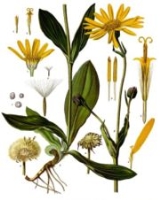
Arnica montana

Encyclopedia
Arnica montana, known commonly as leopard's bane, wolf's bane, mountain tobacco and mountain arnica, is a Europe
an flowering plant
with large yellow capitula
.
It has been used in herbal medicine, but lacks any evidence of statistically demonstrated benefits in rigorous (e.g., double-blind) studies.
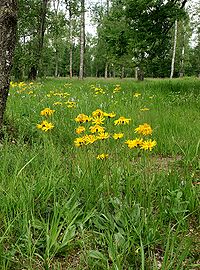 Arnica montana is endemic to Europe, from southern Iberia
to southern Scandinavia
and the Carpathians
. It is absent from the British Isles
and the Italian
and Balkan
Peninsula
s. A. montana grows in nutrient-poor silicaceous meadows up to nearly 3000 metres (9,842.5 ft). It is rare overall, but may be locally abundant. It is becoming rarer, particularly in the north of its distribution, largely due to increasingly intensive agriculture. In more upland regions, it may also be found on nutrient-poor moors
and heaths
.
. Most of the leaves are in a basal rosette
, but one or two pairs may be found on the stem and are, unusually for composites
, opposite. The flower heads are yellow, approximately 5 cm in diameter
, and appear from May to August.
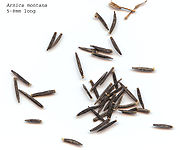 Arnica montana is sometimes grown in herb gardens and has long been used medicinally. It contains the toxin helenalin
, which can be poisonous if large amounts of the plant are eaten. It produces severe gastroenteritis
and internal bleeding of the digestive tract if enough material is ingested. Contact with the plant can also cause skin irritation. The roots contain derivatives of thymol
, which are used as fungicide
s and preservative
s and may have some anti-inflammatory effect. When used topical
ly in a gel
, arnica was found to have the same effect as compared to using an ibuprofen
gel in treating the symptoms of hand osteoarthritis
.
A scientific study found that the application of topical arnica had no better effect than a placebo in the treatment of laser-induced bruising. Studies in the treatment of topical arnica gel on osteoarthritis of the knee found that 76% of patients would use the treatment again for reducing pain and stiffness.
Europe
Europe is, by convention, one of the world's seven continents. Comprising the westernmost peninsula of Eurasia, Europe is generally 'divided' from Asia to its east by the watershed divides of the Ural and Caucasus Mountains, the Ural River, the Caspian and Black Seas, and the waterways connecting...
an flowering plant
Flowering plant
The flowering plants , also known as Angiospermae or Magnoliophyta, are the most diverse group of land plants. Angiosperms are seed-producing plants like the gymnosperms and can be distinguished from the gymnosperms by a series of synapomorphies...
with large yellow capitula
Head (botany)
The capitulum is considered the most derived form of inflorescence. Flower heads found outside Asteraceae show lesser degrees of specialization....
.
It has been used in herbal medicine, but lacks any evidence of statistically demonstrated benefits in rigorous (e.g., double-blind) studies.
Distribution and habitat
Iberian Peninsula
The Iberian Peninsula , sometimes called Iberia, is located in the extreme southwest of Europe and includes the modern-day sovereign states of Spain, Portugal and Andorra, as well as the British Overseas Territory of Gibraltar...
to southern Scandinavia
Scandinavia
Scandinavia is a cultural, historical and ethno-linguistic region in northern Europe that includes the three kingdoms of Denmark, Norway and Sweden, characterized by their common ethno-cultural heritage and language. Modern Norway and Sweden proper are situated on the Scandinavian Peninsula,...
and the Carpathians
Carpathian Mountains
The Carpathian Mountains or Carpathians are a range of mountains forming an arc roughly long across Central and Eastern Europe, making them the second-longest mountain range in Europe...
. It is absent from the British Isles
British Isles
The British Isles are a group of islands off the northwest coast of continental Europe that include the islands of Great Britain and Ireland and over six thousand smaller isles. There are two sovereign states located on the islands: the United Kingdom of Great Britain and Northern Ireland and...
and the Italian
Italian Peninsula
The Italian Peninsula or Apennine Peninsula is one of the three large peninsulas of Southern Europe , spanning from the Po Valley in the north to the central Mediterranean Sea in the south. The peninsula's shape gives it the nickname Lo Stivale...
and Balkan
Balkans
The Balkans is a geopolitical and cultural region of southeastern Europe...
Peninsula
Peninsula
A peninsula is a piece of land that is bordered by water on three sides but connected to mainland. In many Germanic and Celtic languages and also in Baltic, Slavic and Hungarian, peninsulas are called "half-islands"....
s. A. montana grows in nutrient-poor silicaceous meadows up to nearly 3000 metres (9,842.5 ft). It is rare overall, but may be locally abundant. It is becoming rarer, particularly in the north of its distribution, largely due to increasingly intensive agriculture. In more upland regions, it may also be found on nutrient-poor moors
Moorland
Moorland or moor is a type of habitat, in the temperate grasslands, savannas, and shrublands biome, found in upland areas, characterised by low-growing vegetation on acidic soils and heavy fog...
and heaths
Heath (habitat)
A heath or heathland is a dwarf-shrub habitat found on mainly low quality acidic soils, characterised by open, low growing woody vegetation, often dominated by plants of the Ericaceae. There are some clear differences between heath and moorland...
.
Form
A. montana has tall stems, 20–60 cm (7.9–23.6 ) high, supporting usually a single flower headHead (botany)
The capitulum is considered the most derived form of inflorescence. Flower heads found outside Asteraceae show lesser degrees of specialization....
. Most of the leaves are in a basal rosette
Rosette (botany)
In botany, a rosette is a circular arrangement of leaves, with all the leaves at a single height.Though rosettes usually sit near the soil, their structure is an example of a modified stem.-Function:...
, but one or two pairs may be found on the stem and are, unusually for composites
Asteraceae
The Asteraceae or Compositae , is an exceedingly large and widespread family of vascular plants. The group has more than 22,750 currently accepted species, spread across 1620 genera and 12 subfamilies...
, opposite. The flower heads are yellow, approximately 5 cm in diameter
Diameter
In geometry, a diameter of a circle is any straight line segment that passes through the center of the circle and whose endpoints are on the circle. The diameters are the longest chords of the circle...
, and appear from May to August.
Uses and toxicity
Helenalin
Helenalin is a sesquiterpene lactone with potent anti-inflammatory and antitumor effects found in Arnica montana and Arnica chamissonis foliosa...
, which can be poisonous if large amounts of the plant are eaten. It produces severe gastroenteritis
Gastroenteritis
Gastroenteritis is marked by severe inflammation of the gastrointestinal tract involving both the stomach and small intestine resulting in acute diarrhea and vomiting. It can be transferred by contact with contaminated food and water...
and internal bleeding of the digestive tract if enough material is ingested. Contact with the plant can also cause skin irritation. The roots contain derivatives of thymol
Thymol
Thymol is a natural monoterpene phenol derivative of cymene, C10H14O, isomeric with carvacrol, found in oil of thyme, and extracted from Thymus vulgaris and various other kinds of plants as a white crystalline substance of a pleasant aromatic odor and strong antiseptic properties...
, which are used as fungicide
Fungicide
Fungicides are chemical compounds or biological organisms used to kill or inhibit fungi or fungal spores. Fungi can cause serious damage in agriculture, resulting in critical losses of yield, quality and profit. Fungicides are used both in agriculture and to fight fungal infections in animals...
s and preservative
Preservative
A preservative is a naturally occurring or synthetically produced substance that is added to products such as foods, pharmaceuticals, paints, biological samples, wood, etc. to prevent decomposition by microbial growth or by undesirable chemical changes....
s and may have some anti-inflammatory effect. When used topical
Topical
In medicine, a topical medication is applied to body surfaces such as the skin or mucous membranes such as the vagina, anus, throat, eyes and ears.Many topical medications are epicutaneous, meaning that they are applied directly to the skin...
ly in a gel
Gel
A gel is a solid, jelly-like material that can have properties ranging from soft and weak to hard and tough. Gels are defined as a substantially dilute cross-linked system, which exhibits no flow when in the steady-state...
, arnica was found to have the same effect as compared to using an ibuprofen
Ibuprofen
Ibuprofen is a nonsteroidal anti-inflammatory drug used for relief of symptoms of arthritis, fever, as an analgesic , especially where there is an inflammatory component, and dysmenorrhea....
gel in treating the symptoms of hand osteoarthritis
Osteoarthritis
Osteoarthritis also known as degenerative arthritis or degenerative joint disease, is a group of mechanical abnormalities involving degradation of joints, including articular cartilage and subchondral bone. Symptoms may include joint pain, tenderness, stiffness, locking, and sometimes an effusion...
.
A scientific study found that the application of topical arnica had no better effect than a placebo in the treatment of laser-induced bruising. Studies in the treatment of topical arnica gel on osteoarthritis of the knee found that 76% of patients would use the treatment again for reducing pain and stiffness.
External links
- Royal Society of Medicine Article concerning testing involving Arnica (RSM)
- Botanica.com Arnica