


Armand Philippon

Encyclopedia
Armand Philippon sometimes called Phillipon, was a French soldier during the French Revolution
and the subsequent First French Empire
.
Despite enlisting in the army as a private soldier, Philippon rose to the rank of Général de Division
during the Peninsular War
, and was created Baron in 1809. He was Governor of Badajoz
between 1811 and 1812, when he was captured by the British following the Battle of Badajoz
. After his capture, Philippon was taken to the UK
, but he broke his parole and returned to France and the Grande Armée
before retiring from military service on 15 January 1814.
on 27 August 1761, and enlisted as a soldier in the Regiment of Lorraine
on 15 April 1778. He was promoted to Corporal
on 16 April 1785, Sergeant
in November 1786 and Sergeant Major
on 15 April 1790. He received his commission on 9 August 1792, when he was named Captain in the 7th battalion
of Bec-d'Ambès
. He spent 1792–93 campaigning with the Armée du Nord
, under the command of Generals Joseph Servan and Léonard Muller, before joining the Armée des Pyrénées occidentales under General Moncey
. While serving on the Spanish border, Philippon distinguished himself by capturing a fort at Irursum, defended by 2,500 Spanish troops, with only 600 men. This act of bravery resulted in Philippon's promotion to Adjutant-General and provisional Chef de brigade
.
Philippon was transferred to the Army of the West in Year IV
(1795–1796), then posted to the Army of the Danube in Year VII (1798–1799) where he was given command of the 87th demi-Brigade. The years IX–XI (1800–1803) were spent campaigning in Grisons
, Valais
, Switzerland and Italy, and in October 1803 he became Colonel of the 54th Line regiment
.
After moving to the French Army of Hanover, Philippon was made a member of the Légion d'honneur
on 19 Frimaire Year XII (November 1803) and an officer of that order on 25 Prairial (14 June 1804). He served in Spain during the Peninsular War
from 1808, was created a baron
in 1809, and saw action with General Pierre Lapisse's division of Marshal Victor's
I Corps at the Battle of Talavera and the Siege of Cádiz
. Philippon's conduct at Cádiz resulted in his promotion to Brigadier General (Général de Brigade) on 25 June 1810.
Philippon took part in Marshal Soult's
expedition into Extremadura
in 1811, and distinguished himself again at the Battle of the Gebora
. Following the capture by the French of the important fortress town of Badajoz
after the first siege of Badajoz, Philippon was named Governor of the town on 11 March 1811, and he made his name defending the fortress through the second siege. While Sir William Beresford
, the commander of the Allied Anglo–Spanish–Portuguese corps besieging Badajoz, was defending against Soult's attempt to relieve the siege at the Battle of Albuera
, Philippon led a sally from Badajoz and destroyed much of the abandoned siege-works, and continued to offer resistance to Allies until the siege was lifted on 20 June.
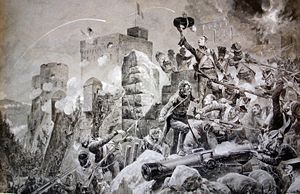 In recognition of his defence of Badajoz, Philippon was promoted to Major General (Général de Division) on 9 July 1811, and he remained in command of the fortress's garrison. When the Allies returned to lay siege to the town in 1812, Philippon's defences once more obstructed attempts to capture it. The obstructions he constructed made the breaches in the fortress's walls impregnable, and Badajoz was only captured following the unexpected success of a diversionary escalade. When the town fell to the Allies on 6 April, following the Battle of Badajoz
, Philippon retreated to the outlying fort at San Cristóbal, across the Guadiana
river, but was forced to surrender the following day. He was taken first to Lisbon
, and then shipped to England where he took up residence in Oswestry
. In July 1812, however, he broke his parole
, left Oswestry, and with the help of smugglers returned to France.
Having returned to the Grande Armée in August 1812, Philippon was given command of the 1st Division, 1 Corps on 23 March 1813. In April of that year, he transferred to 11 Corps, and campaigned with Vandamme
in Bohemia
. It was Philippon's skilled manoeuvring following the Battle of Kulm
that allowed the remnants of the Vandamme's army to retreat to Dresden
, where Philippon was made prisoner along with Laurent Gouvion Saint-Cyr's Corps.
Returning to France at the time of the First Restoration, Philippon was created a Knight of Saint Louis
, retired from military service on 15 January 1814, and died on 4 May 1836.
French Revolution
The French Revolution , sometimes distinguished as the 'Great French Revolution' , was a period of radical social and political upheaval in France and Europe. The absolute monarchy that had ruled France for centuries collapsed in three years...
and the subsequent First French Empire
First French Empire
The First French Empire , also known as the Greater French Empire or Napoleonic Empire, was the empire of Napoleon I of France...
.
Despite enlisting in the army as a private soldier, Philippon rose to the rank of Général de Division
Divisional General
Divisional General is a rank used in many armies to denote a rank of general, corresponding to command of a division. For convenience Divisional General is almost always translated into English as Major-General, the equivalent rank used by the UK, USA, etc., although this translation is, strictly...
during the Peninsular War
Peninsular War
The Peninsular War was a war between France and the allied powers of Spain, the United Kingdom, and Portugal for control of the Iberian Peninsula during the Napoleonic Wars. The war began when French and Spanish armies crossed Spain and invaded Portugal in 1807. Then, in 1808, France turned on its...
, and was created Baron in 1809. He was Governor of Badajoz
Badajoz
Badajoz is the capital of the Province of Badajoz in the autonomous community of Extremadura, Spain, situated close to the Portuguese border, on the left bank of the river Guadiana, and the Madrid–Lisbon railway. The population in 2007 was 145,257....
between 1811 and 1812, when he was captured by the British following the Battle of Badajoz
Battle of Badajoz (1812)
In the Battle of Badajoz , the Anglo-Portuguese Army, under the Earl of Wellington, besieged Badajoz, Spain and forced the surrender of the French garrison....
. After his capture, Philippon was taken to the UK
United Kingdom of Great Britain and Ireland
The United Kingdom of Great Britain and Ireland was the formal name of the United Kingdom during the period when what is now the Republic of Ireland formed a part of it....
, but he broke his parole and returned to France and the Grande Armée
La Grande Armée
The Grande Armée first entered the annals of history when, in 1805, Napoleon I renamed the army that he had assembled on the French coast of the English Channel for the proposed invasion of Britain...
before retiring from military service on 15 January 1814.
Biography
Philippon was born in RouenRouen
Rouen , in northern France on the River Seine, is the capital of the Haute-Normandie region and the historic capital city of Normandy. Once one of the largest and most prosperous cities of medieval Europe , it was the seat of the Exchequer of Normandy in the Middle Ages...
on 27 August 1761, and enlisted as a soldier in the Regiment of Lorraine
Lorraine (région)
Lorraine is one of the 27 régions of France. The administrative region has two cities of equal importance, Metz and Nancy. Metz is considered to be the official capital since that is where the regional parliament is situated...
on 15 April 1778. He was promoted to Corporal
Corporal
Corporal is a rank in use in some form by most militaries and by some police forces or other uniformed organizations. It is usually equivalent to NATO Rank Code OR-4....
on 16 April 1785, Sergeant
Sergeant
Sergeant is a rank used in some form by most militaries, police forces, and other uniformed organizations around the world. Its origins are the Latin serviens, "one who serves", through the French term Sergent....
in November 1786 and Sergeant Major
Sergeant Major
Sergeants major is a senior non-commissioned rank or appointment in many militaries around the world. In Commonwealth countries, Sergeants Major are usually appointments held by senior non-commissioned officers or warrant officers...
on 15 April 1790. He received his commission on 9 August 1792, when he was named Captain in the 7th battalion
Battalion
A battalion is a military unit of around 300–1,200 soldiers usually consisting of between two and seven companies and typically commanded by either a Lieutenant Colonel or a Colonel...
of Bec-d'Ambès
Gironde
For the Revolutionary party, see Girondists.Gironde is a common name for the Gironde estuary, where the mouths of the Garonne and Dordogne rivers merge, and for a department in the Aquitaine region situated in southwest France.-History:...
. He spent 1792–93 campaigning with the Armée du Nord
L'Armée du Nord
The Army of the North or Armée du Nord is a name given to several historical units of the French Army. The first was one of the French Revolutionary Armies that fought with distinction against the First Coalition from 1792 to 1795...
, under the command of Generals Joseph Servan and Léonard Muller, before joining the Armée des Pyrénées occidentales under General Moncey
Bon Adrien Jeannot de Moncey
Bon-Adrien Jeannot de Moncey , 1st Duke of Conegliano, 1st Baron of Conegliano, Peer of France , Marshal of France, was a prominent soldier in the Revolutionary and Napoleonic Wars....
. While serving on the Spanish border, Philippon distinguished himself by capturing a fort at Irursum, defended by 2,500 Spanish troops, with only 600 men. This act of bravery resulted in Philippon's promotion to Adjutant-General and provisional Chef de brigade
Chef de brigade
Chef de brigade was a military rank, equivalent to colonel, in the French Revolutionary army, in command of a demi-brigade. Both that unit and that rank were created at the same time, in 1793. The two designations disappeared just before the institution of the French Empire, in 1803, with the...
.
Philippon was transferred to the Army of the West in Year IV
French Republican Calendar
The French Republican Calendar or French Revolutionary Calendar was a calendar created and implemented during the French Revolution, and used by the French government for about 12 years from late 1793 to 1805, and for 18 days by the Paris Commune in 1871...
(1795–1796), then posted to the Army of the Danube in Year VII (1798–1799) where he was given command of the 87th demi-Brigade. The years IX–XI (1800–1803) were spent campaigning in Grisons
Graubünden
Graubünden or Grisons is the largest and easternmost canton of Switzerland. The canton shares borders with the cantons of Ticino, Uri, Glarus and St. Gallen and international borders with Italy, Austria and Liechtenstein...
, Valais
Valais
The Valais is one of the 26 cantons of Switzerland in the southwestern part of the country, around the valley of the Rhône from its headwaters to Lake Geneva, separating the Pennine Alps from the Bernese Alps. The canton is one of the drier parts of Switzerland in its central Rhône valley...
, Switzerland and Italy, and in October 1803 he became Colonel of the 54th Line regiment
54th Infantry Regiment (France)
The 54th Infantry Regiment is a line infantry regiment of the French Army.-Early service:It was formed in 1657 during the Ancien Régime as the régiment Mazarin-Catalans, being renamed the régiment Royal Catalan in 1661 then the régiment Royal Roussillon in 1667...
.
After moving to the French Army of Hanover, Philippon was made a member of the Légion d'honneur
Légion d'honneur
The Legion of Honour, or in full the National Order of the Legion of Honour is a French order established by Napoleon Bonaparte, First Consul of the Consulat which succeeded to the First Republic, on 19 May 1802...
on 19 Frimaire Year XII (November 1803) and an officer of that order on 25 Prairial (14 June 1804). He served in Spain during the Peninsular War
Peninsular War
The Peninsular War was a war between France and the allied powers of Spain, the United Kingdom, and Portugal for control of the Iberian Peninsula during the Napoleonic Wars. The war began when French and Spanish armies crossed Spain and invaded Portugal in 1807. Then, in 1808, France turned on its...
from 1808, was created a baron
Nobility of the First French Empire
Napoleon Bonaparte created titles of nobility to institute a stable elite in the First French Empire, after the instability resulting from the French Revolution....
in 1809, and saw action with General Pierre Lapisse's division of Marshal Victor's
Claude Victor-Perrin, duc de Belluno
Claude Victor-Perrin, First Duc de Belluno was a French soldier and military commander during the French Revolutionary and Napoleonic Wars...
I Corps at the Battle of Talavera and the Siege of Cádiz
Siege of Cádiz
The Siege of Cádiz was a siege of the large Spanish naval base of Cádiz by a French army from February 5, 1810 to August 24, 1812 during the Peninsular War. Following the occupation of Madrid on March 23, 1808, Cádiz became the Spanish seat of power, and was targeted by 60,000 French troops under...
. Philippon's conduct at Cádiz resulted in his promotion to Brigadier General (Général de Brigade) on 25 June 1810.
Philippon took part in Marshal Soult's
Nicolas Jean de Dieu Soult
Nicolas Jean-de-Dieu Soult, 1st Duke of Dalmatia , the Hand of Iron, was a French general and statesman, named Marshal of the Empire in 1804. He was one of only six officers in French history to receive the distinction of Marshal General of France...
expedition into Extremadura
Extremadura
Extremadura is an autonomous community of western Spain whose capital city is Mérida. Its component provinces are Cáceres and Badajoz. It is bordered by Portugal to the west...
in 1811, and distinguished himself again at the Battle of the Gebora
Battle of the Gebora
The Battle of the Gebora was a minor battle of the Peninsular War between Spanish and French armies. It occurred on 19 February 1811, near Badajoz, Spain, where an outnumbered French force routed and nearly destroyed the Spanish Army of Extremadura....
. Following the capture by the French of the important fortress town of Badajoz
Badajoz
Badajoz is the capital of the Province of Badajoz in the autonomous community of Extremadura, Spain, situated close to the Portuguese border, on the left bank of the river Guadiana, and the Madrid–Lisbon railway. The population in 2007 was 145,257....
after the first siege of Badajoz, Philippon was named Governor of the town on 11 March 1811, and he made his name defending the fortress through the second siege. While Sir William Beresford
William Beresford, 1st Viscount Beresford
General William Carr Beresford, 1st Viscount Beresford, 1st Marquis of Campo Maior, GCB, GCH, GCTE, PC , was a British soldier and politician...
, the commander of the Allied Anglo–Spanish–Portuguese corps besieging Badajoz, was defending against Soult's attempt to relieve the siege at the Battle of Albuera
Battle of Albuera
The Battle of Albuera was an indecisive battle during the Peninsular War. A mixed British, Spanish and Portuguese corps engaged elements of the French Armée du Midi at the small Spanish village of Albuera, about 20 kilometres south of the frontier fortress-town of Badajoz, Spain.From...
, Philippon led a sally from Badajoz and destroyed much of the abandoned siege-works, and continued to offer resistance to Allies until the siege was lifted on 20 June.
Battle of Badajoz (1812)
In the Battle of Badajoz , the Anglo-Portuguese Army, under the Earl of Wellington, besieged Badajoz, Spain and forced the surrender of the French garrison....
, Philippon retreated to the outlying fort at San Cristóbal, across the Guadiana
Guadiana
The Guadiana , or Odiana, is an international river located on the Portuguese–Spanish border, separating Extremadura and Andalucia from Alentejo and Algarve...
river, but was forced to surrender the following day. He was taken first to Lisbon
Lisbon
Lisbon is the capital city and largest city of Portugal with a population of 545,245 within its administrative limits on a land area of . The urban area of Lisbon extends beyond the administrative city limits with a population of 3 million on an area of , making it the 9th most populous urban...
, and then shipped to England where he took up residence in Oswestry
Oswestry
Oswestry is a town and civil parish in Shropshire, England, close to the Welsh border. It is at the junction of the A5, A483, and A495 roads....
. In July 1812, however, he broke his parole
Parole
Parole may have different meanings depending on the field and judiciary system. All of the meanings originated from the French parole . Following its use in late-resurrected Anglo-French chivalric practice, the term became associated with the release of prisoners based on prisoners giving their...
, left Oswestry, and with the help of smugglers returned to France.
Having returned to the Grande Armée in August 1812, Philippon was given command of the 1st Division, 1 Corps on 23 March 1813. In April of that year, he transferred to 11 Corps, and campaigned with Vandamme
Dominique Vandamme
General Dominique-Joseph René Vandamme, Count of Unseburg was a French military officer, who fought in the Napoleonic Wars....
in Bohemia
Bohemia
Bohemia is a historical region in central Europe, occupying the western two-thirds of the traditional Czech Lands. It is located in the contemporary Czech Republic with its capital in Prague...
. It was Philippon's skilled manoeuvring following the Battle of Kulm
Battle of Kulm
The Battle of Kulm was a battle near the town Kulm and the village Přestanov in northern Bohemia. It was fought on 29–30 August 1813, during the War of the Sixth Coalition...
that allowed the remnants of the Vandamme's army to retreat to Dresden
Dresden
Dresden is the capital city of the Free State of Saxony in Germany. It is situated in a valley on the River Elbe, near the Czech border. The Dresden conurbation is part of the Saxon Triangle metropolitan area....
, where Philippon was made prisoner along with Laurent Gouvion Saint-Cyr's Corps.
Returning to France at the time of the First Restoration, Philippon was created a Knight of Saint Louis
Order of Saint Louis
The Royal and Military Order of Saint Louis was a military Order of Chivalry founded on 5 April 1693 by Louis XIV and named after Saint Louis . It was intended as a reward for exceptional officers, and is notable as the first decoration that could be granted to non-nobles...
, retired from military service on 15 January 1814, and died on 4 May 1836.