

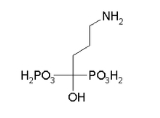
Alendronate

Encyclopedia
Alendronic acid or alendronate sodium (USAN
) — sold as Fosamax by Merck
— is a bisphosphonate
drug
used for osteoporosis
and several other bone diseases. It is marketed alone as well as in combination with vitamin D
(2,800 IU and 5600 IU, under the name Fosamax+D). Merck's U.S.
patent on alendronate expired in 2008 and Merck lost a series of appeals to block a generic version of the drug from being certified by the U.S. Food and Drug Administration (FDA).
On February 6, 2008, the US FDA approved the first generic versions of alendronate, which were marketed by Barr Pharmaceuticals
and Teva Pharmaceuticals USA. Teva Pharmaceuticals manufactures generic alendronate in 5-milligram, 10-milligram, and 40-milligram daily doses, and in 35-milligram and 70-milligram weekly doses, while Barr made generic alendronate in 70-milligram tablets, which were taken once weekly. Barr pharmaceuticals were subsequently acquired by Teva in July 2008.
-mediated bone-resorption. Like all bisphosphonates, it is chemically related to inorganic pyrophosphate
, the endogenous regulator of bone turnover. But while pyrophosphate inhibits both osteoclastic bone resorption
and the mineralization of the bone newly formed by osteoblast
s, alendronate specifically inhibits bone resorption without any effect on mineralization at pharmacologically achievable doses. Its inhibition of bone-resorption is dose-dependent and approximately 1,000 times stronger than the equimolar effect of the first bisphosphonate drug, etidronate. Under therapy, normal bone tissue develops, and alendronate is deposited in the bone-matrix in pharmacologically inactive form. For optimal action, enough calcium and vitamin D are needed in the body in order to promote normal bone development. Hypocalcemia should, therefore, be corrected before starting therapy.
Etidronate has the same disadvantage as pyrophosphate in inhibiting mineralization, but all of the potent N
-containing bisphosphonates including Alendronate and also risedronate
, ibandronate, and zoledronate
, do not.
The risk of esophageal irritation places special requirements on how one takes this oral drug. The patient should take the drug only upon rising for the day with three swallows of water, not to exceed 6-8 oz., and stand, walk, or sit, and remain fasting for 30–45 minutes afterwards, then eat breakfast. Lying down or reclining after taking the drug and prior to eating breakfast may cause gastroesophageal reflux and esophageal irritation.
(ONJ) in cancer patients treated with intravenous (IV) bisphopshonates, either IV pamidronate (Aredia) or IV zoledronate
(Zometa).
At the 2004 ODAC meeting the number of spontaneous reports had increased since 2000, and although almost all of the reports remained in cancer patients treated with one of the IV bisphosphonates 13 of the reports were in patients taking oral alendronate or risedronate, most of which were reported on September 24, 2004, in the Journal of Oral and Maxillofacial Surgery. Although this small number of reports does not remotely indicate causality, given the millions of patients who have been treated with alendronate and risedronate, in order to be cautious the FDA asked the manufacturers of the oral bisphosphonates to issue a warning to healthcare professionals of the potential that bisphosphonates might increase the risk of ONJ.
Despite the fact that no data links the oral bisphosphonates causally to ONJ, product liability attorneys immediately filed suit maintaining that their claimants' ONJ is a direct result of the use of alendronate. Merck
has stated the "underlying cause" of osteonecrosis of the jaw is "uncertain", though it might be triggered by a traumatic event like tooth extraction or oral surgery. As of May 13, 2007, hundreds of cases had been filed against Merck alleging Fosamax-induced ONJ. The first case is set to be tried in late 2008.
, given its name after workers in match factories working with white phosphorus developed osteonecrosis of the jaw.
United States Adopted Name
United States Adopted Names are unique nonproprietary names assigned to pharmaceuticals marketed in the United States. Each name is assigned by the USAN Council, which is co-sponsored by the American Medical Association , the United States Pharmacopeial Convention , and the American Pharmacists...
) — sold as Fosamax by Merck
Merck & Co.
Merck & Co., Inc. , also known as Merck Sharp & Dohme or MSD outside the United States and Canada, is one of the largest pharmaceutical companies in the world. The Merck headquarters is located in Whitehouse Station, New Jersey, an unincorporated area in Readington Township...
— is a bisphosphonate
Bisphosphonate
Bisphosphonates are a class of drugs that prevent the loss of bone mass, used to treat osteoporosis and similar diseases...
drug
Medication
A pharmaceutical drug, also referred to as medicine, medication or medicament, can be loosely defined as any chemical substance intended for use in the medical diagnosis, cure, treatment, or prevention of disease.- Classification :...
used for osteoporosis
Osteoporosis
Osteoporosis is a disease of bones that leads to an increased risk of fracture. In osteoporosis the bone mineral density is reduced, bone microarchitecture is deteriorating, and the amount and variety of proteins in bone is altered...
and several other bone diseases. It is marketed alone as well as in combination with vitamin D
Vitamin D
Vitamin D is a group of fat-soluble secosteroids. In humans, vitamin D is unique both because it functions as a prohormone and because the body can synthesize it when sun exposure is adequate ....
(2,800 IU and 5600 IU, under the name Fosamax+D). Merck's U.S.
United States
The United States of America is a federal constitutional republic comprising fifty states and a federal district...
patent on alendronate expired in 2008 and Merck lost a series of appeals to block a generic version of the drug from being certified by the U.S. Food and Drug Administration (FDA).
On February 6, 2008, the US FDA approved the first generic versions of alendronate, which were marketed by Barr Pharmaceuticals
Barr Pharmaceuticals
Barr Pharmaceuticals was a global specialty pharmaceutical company that operated in more than 30 countries worldwide. Barr were engaged in the development, manufacture and marketing of generic and proprietary pharmaceuticals, biopharmaceuticals and active pharmaceutical ingredients.-History:Barr...
and Teva Pharmaceuticals USA. Teva Pharmaceuticals manufactures generic alendronate in 5-milligram, 10-milligram, and 40-milligram daily doses, and in 35-milligram and 70-milligram weekly doses, while Barr made generic alendronate in 70-milligram tablets, which were taken once weekly. Barr pharmaceuticals were subsequently acquired by Teva in July 2008.
Pharmacokinetics
As with all potent bisphosphonates, the systemic bioavailability after oral dosing is low, averaging only 0.6–0.7% in women and in men under fasting conditions. Intake together with meals and beverages other than water further reduces the bioavailability. The absorbed drug rapidly partitions, with approximately 50% binding to the exposed bone surface; the remainder is excreted unchanged by the kidneys. Unlike most drugs, the strong negative charge on the two phosphonate moieties limits oral bioavailability, and, in turn, the exposure to tissues other than bone is very low. After absorption in the bone, alendronate has an estimated terminal half-life of 10 years.Pharmacology
Alendronate inhibits osteoclastOsteoclast
An osteoclast is a type of bone cell that removes bone tissue by removing its mineralized matrix and breaking up the organic bone . This process is known as bone resorption. Osteoclasts were discovered by Kolliker in 1873...
-mediated bone-resorption. Like all bisphosphonates, it is chemically related to inorganic pyrophosphate
Pyrophosphate
In chemistry, the anion, the salts, and the esters of pyrophosphoric acid are called pyrophosphates. Any salt or ester containing two phosphate groups is called a diphosphate. As a food additive, diphosphates are known as E450.- Chemistry :...
, the endogenous regulator of bone turnover. But while pyrophosphate inhibits both osteoclastic bone resorption
Bone resorption
Bone resorption is the process by which osteoclasts break down bone and release the minerals, resulting in a transfer of calcium from bone fluid to the blood....
and the mineralization of the bone newly formed by osteoblast
Osteoblast
Osteoblasts are mononucleate cells that are responsible for bone formation; in essence, osteoblasts are specialized fibroblasts that in addition to fibroblastic products, express bone sialoprotein and osteocalcin.Osteoblasts produce a matrix of osteoid, which is composed mainly of Type I collagen...
s, alendronate specifically inhibits bone resorption without any effect on mineralization at pharmacologically achievable doses. Its inhibition of bone-resorption is dose-dependent and approximately 1,000 times stronger than the equimolar effect of the first bisphosphonate drug, etidronate. Under therapy, normal bone tissue develops, and alendronate is deposited in the bone-matrix in pharmacologically inactive form. For optimal action, enough calcium and vitamin D are needed in the body in order to promote normal bone development. Hypocalcemia should, therefore, be corrected before starting therapy.
Etidronate has the same disadvantage as pyrophosphate in inhibiting mineralization, but all of the potent N
Nitrogen
Nitrogen is a chemical element that has the symbol N, atomic number of 7 and atomic mass 14.00674 u. Elemental nitrogen is a colorless, odorless, tasteless, and mostly inert diatomic gas at standard conditions, constituting 78.08% by volume of Earth's atmosphere...
-containing bisphosphonates including Alendronate and also risedronate
Risedronate
Risedronic acid or risedronate sodium is a bisphosphonate used to strengthen bone, treat or prevent osteoporosis, and treat Paget's disease of bone. It is produced and marketed by Warner Chilcott, Sanofi-Aventis, and in Japan by Takeda under the trade names Actonel, Atelvia, and Benet...
, ibandronate, and zoledronate
Zoledronate
Zoledronic acid or zoledronate is a bisphosphonate. Zometa is used to prevent skeletal fractures in patients with cancers such as multiple myeloma and prostate cancer, as well as for treating osteoporosis...
, do not.
Clinical data
Treatment of post-menopausal women with Fosamax has demonstrated normalization of the rate of bone turnover, significant increase in BMD (bone mineral density) of the spine, hip, wrist and total body, and significant reductions in the risk of vertebral (spine) fractures, wrist fractures, hip fractures, and all non-vertebral fractures. In the women with the highest risk of fracture (by virtue of pre-existing vertebral fractures) in the Fracture Intervention Trial, treatment with Fosamax 5 mg/day for two years followed by 10 mg/day for the third year (plus calcium and vitamin D) resulted in approximately 50% reductions in fractures of the spine, hip, and wrist compared with the control group taking placebos plus calcium and vitamin D.Uses
- Prophylaxis and treatment of female osteoporosisOsteoporosisOsteoporosis is a disease of bones that leads to an increased risk of fracture. In osteoporosis the bone mineral density is reduced, bone microarchitecture is deteriorating, and the amount and variety of proteins in bone is altered...
- Treatment of male osteoporosis
- Prevention and treatment of corticosteroid-associated osteoporosis together with supplements of calcium and vitamin D
- Paget's diseasePaget's diseaseSir James Paget, a surgeon and pathologist, described several diseases, including:* Paget's disease of bone * Paget's disease of the breast* Paget-Schroetter disease* Extramammary Paget's disease...
Contraindications and precautions
- Acute inflammations of the gastrointestinal tract (esophagitis, gastritis, ulcerations)
- Clinically manifest osteomalaciaOsteomalaciaOsteomalacia is the softening of the bones caused by defective bone mineralization secondary to inadequate amounts of available phosphorus and calcium, or because of overactive resorption of calcium from the bone as a result of hyperparathyroidism...
- Certain malformations and malfunctions of the esophagus (strictures, achalasia)
- Inability to stand, walk, or sit for 30 minutes after oral administration
- Renal impairment with a creatinine clearance below 30ml/min
- Hypersensitivity to alendronate or another ingredient
- Hypocalcemia
- Pregnancy and breastfeeding
- Patients below 18 yrs. of age, as no clinical data exists
Side-effects
- Gastrointestinal tract: ulcerationPeptic ulcerA peptic ulcer, also known as PUD or peptic ulcer disease, is the most common ulcer of an area of the gastrointestinal tract that is usually acidic and thus extremely painful. It is defined as mucosal erosions equal to or greater than 0.5 cm...
of the esophagusEsophagusThe esophagus is an organ in vertebrates which consists of a muscular tube through which food passes from the pharynx to the stomach. During swallowing, food passes from the mouth through the pharynx into the esophagus and travels via peristalsis to the stomach...
; this may require hospitalization and intensive treatment. Gastric and duodenal ulceration may also occur. On December 31, 2008, a letter in the New England Journal of Medicine cited a finding by the U.S. Food and Drug Administration that 23 cases of esophageal cancer, possibly linked to the use of the drug, have been seen since Fosamax's 1995 market debut. - General: infrequent cases of skin rash, rarely manifesting as Stevens–Johnson syndrome and toxic epidermal necrolysisToxic epidermal necrolysisToxic epidermal necrolysis is a rare, life-threatening dermatological condition that is usually induced by a reaction to medications...
, eye problems (uveitisUveitisUveitis specifically refers to inflammation of the middle layer of the eye, termed the "uvea" but in common usage may refer to any inflammatory process involving the interior of the eye....
, scleritisScleritisScleritis is a serious inflammatory disease that affects the white outer coating of the eye, known as the sclera. The disease is often contracted through association with other diseases of the body, such as Wegener's granulomatosis or rheumatoid arthritis; it can also be attained through disorders...
) and generalized muscle, joint, and bone pain (rarely severe) have been seen. In laboratory tests decreased calcium and phosphate values may be obtained but reflect action of the drug and are harmless. - Osteonecrosis of the JawOsteonecrosis of the jawOsteonecrosis of the jaw is a severe bone disease that affects the maxilla and the mandible. Various forms of ONJ have been described over the last 160 years, and a number of causes have been suggested in the literature...
- Deterioration of the Temporomandibular JointTemporomandibular jointThe temporomandibular joint is the joint of the jaw and is frequently referred to as TMJ. There are two TMJs, one on either side, working in unison. The name is derived from the two bones which form the joint: the upper temporal bone which is part of the cranium , and the lower jaw bone called the...
(TMJ) may occur while on this drug, if dental work of any kind is carried out. Although osteonecrosis is uncommon, it occurs primarily in patients being administered intravenous biphosphonates, with most cases being reported in cancerCancerCancer , known medically as a malignant neoplasm, is a large group of different diseases, all involving unregulated cell growth. In cancer, cells divide and grow uncontrollably, forming malignant tumors, and invade nearby parts of the body. The cancer may also spread to more distant parts of the...
patients. - Neurological: Rare instances of auditory hallucinations and visual disturbances have been associated with alendronate and other bisphosphonates.
- Bone: Alendronate has been linked in long-term users to the development of low-impact femoral fractures. Further, studies suggest that users of alendronate have an increase in the numbers of osteoclastOsteoclastAn osteoclast is a type of bone cell that removes bone tissue by removing its mineralized matrix and breaking up the organic bone . This process is known as bone resorption. Osteoclasts were discovered by Kolliker in 1873...
s and develop giant, more multinucleated osteoclasts; the significance of this development is unclear. Fosamax has been linked to a rare type of leg fracture that cuts straight across the upper thigh bone after little or no trauma. (Subtrochanteric fractures) This is because Fosamax makes the thigh bone more brittle and stops the cells in the body that remodel the bone. Studies are showing that people who have taken Fosamax for more than five years are at risk for developing these kind of fractures. In some cases, patients have reported that, after weeks or months of unexplained aching, their thigh bones simply snapped while they were walking or standing. One doctor reports that a 59-year old previously healthy woman visiting New York City was riding a subway train one morning when the train jolted. She shifted all her weight to one leg, felt a bone snap, and fell to the floor of the train. An x-ray in a local emergency room revealed a comminuted spiral fracture involving the upper half of the right femur. She had been taking Fosamax for 7 years. On Oct. 13, 2010 the Food and Drug Administration issued a warning about these fractures.
Interactions
- Milk, diet, and drugs containing high amounts of calcium, magnesium or aluminium (antacids): the resorption of alendronate is decreased. At least half an hour should pass after intake of alendronate before taking the supplement or drug.
- Highly active vitamin D analogues or fluorides: no data is available. Concomitant treatment should be avoided.
- The additional beneficial effect of HRTHormone replacement therapy (menopause)Hormone replacement therapy is a system of medical treatment for surgically menopausal, perimenopausal and to a lesser extent postmenopausal women...
(hormone replacement therapy) with estrogens/progestins or raloxifeneRaloxifeneRaloxifene is an oral selective estrogen receptor modulator that has estrogenic actions on bone and anti-estrogenic actions on the uterus and breast...
in postmenopausal women remains to be elucidated, but no interactions have been seen. The combination is therefore possible. - Intravenous ranitidineRanitidineRanitidine is a histamine H2-receptor antagonist that inhibits stomach acid production. It is commonly used in treatment of peptic ulcer disease and gastroesophageal reflux disease . Ranitidine is also used alongside fexofenadine and other antihistamines for the treatment of skin conditions...
increases the oral bioavailability of alendronate. No clinical consequences are known. - The combination of NSAIDNon-steroidal anti-inflammatory drugNonsteroidal anti-inflammatory drugs, usually abbreviated to NSAIDs or NAIDs, but also referred to as nonsteroidal anti-inflammatory agents/analgesics or nonsteroidal Anti-inflammatory medicines , are drugs with analgesic and antipyretic effects and which have, in higher doses, anti-inflammatory...
s and alendroate may increase the risk of gastric ulcers. Both these drugs have the potential to irritate the upper gastro-intestinal mucosa.
Dosage
- Prophylaxis of osteoporosis in women: 5–10 mg daily or 35–70 mg weekly.
- Therapy of osteoporosis in women and men : 10 mg daily or 70 mg weekly.
- Osteoporosis under corticosteroids: 5–10 mg daily or 35–70 mg weekly in men and premenopausal women or those receiving concomitant HRT. In postmenopausal women not receiving HRT, the recommended dose is 10 mg daily or 70 mg weekly.
- Paget's Disease: 40 mg daily for 6 months.
The risk of esophageal irritation places special requirements on how one takes this oral drug. The patient should take the drug only upon rising for the day with three swallows of water, not to exceed 6-8 oz., and stand, walk, or sit, and remain fasting for 30–45 minutes afterwards, then eat breakfast. Lying down or reclining after taking the drug and prior to eating breakfast may cause gastroesophageal reflux and esophageal irritation.
Dosage forms
- Fosamax solution 70 mg/75ml
- Fosamax tablets 5 mg, 10 mg, 35 mg, 40 mg, and 70 mg
Litigation
By 2000, the FDA had received 139 spontaneous reports through the MedWatch system of osteonecrosis of the jawOsteonecrosis of the jaw
Osteonecrosis of the jaw is a severe bone disease that affects the maxilla and the mandible. Various forms of ONJ have been described over the last 160 years, and a number of causes have been suggested in the literature...
(ONJ) in cancer patients treated with intravenous (IV) bisphopshonates, either IV pamidronate (Aredia) or IV zoledronate
Zoledronate
Zoledronic acid or zoledronate is a bisphosphonate. Zometa is used to prevent skeletal fractures in patients with cancers such as multiple myeloma and prostate cancer, as well as for treating osteoporosis...
(Zometa).
At the 2004 ODAC meeting the number of spontaneous reports had increased since 2000, and although almost all of the reports remained in cancer patients treated with one of the IV bisphosphonates 13 of the reports were in patients taking oral alendronate or risedronate, most of which were reported on September 24, 2004, in the Journal of Oral and Maxillofacial Surgery. Although this small number of reports does not remotely indicate causality, given the millions of patients who have been treated with alendronate and risedronate, in order to be cautious the FDA asked the manufacturers of the oral bisphosphonates to issue a warning to healthcare professionals of the potential that bisphosphonates might increase the risk of ONJ.
Despite the fact that no data links the oral bisphosphonates causally to ONJ, product liability attorneys immediately filed suit maintaining that their claimants' ONJ is a direct result of the use of alendronate. Merck
Merck
Merck may refer to:* Merck KGaA, , a German-based chemical and pharmaceutical company.** Merck Serono , the pharmaceutical division of Merck KGaA...
has stated the "underlying cause" of osteonecrosis of the jaw is "uncertain", though it might be triggered by a traumatic event like tooth extraction or oral surgery. As of May 13, 2007, hundreds of cases had been filed against Merck alleging Fosamax-induced ONJ. The first case is set to be tried in late 2008.
Bis-phossy jaw
The term given by scientists to the link between bisphosphonates and jaw necrosis is 'bis-phossy jaw.' This is derived from the 19th-century term phossy jawPhossy jaw
Phossy jaw, formally phosphorus necrosis of the jaw, is an occupational disease of those who work with white phosphorus, also known as yellow phosphorus, without proper safeguards. It was most commonly seen in workers in the match industry in the 19th and early 20th century...
, given its name after workers in match factories working with white phosphorus developed osteonecrosis of the jaw.