

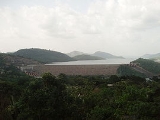
Akosombo Dam

Encyclopedia
The Akosombo Dam is a hydroelectric dam on the Volta River
in southeastern Ghana
in the Akosombo gorge and part of the Volta River Authority
. The construction of the dam flooded part of the Volta River Basin, and the subsequent creation of Lake Volta
. Lake Volta is the world's largest man-made lake, covering 8502 square kilometres (3,282.6 sq mi), which is 3.6% of Ghana's land area.
The primary purpose of the Akosombo Dam was to provide electricity for the aluminum industry. The Akosombo Dam was called "the largest single investment in the economic development plans of Ghana." Its original electrical output was 912 MW, which was upgraded to 1,020 MW in a retrofit project that was completed in 2006.
The flooding that created the Lake Volta reservoir displaced many people and had a significant impact on the environment.
, but no plans were drawn until the 1940s. The development of the Volta River
Basin was proposed in 1949, but because there was not sufficient funds, the American company Volta Aluminum Company
(Valco) loaned money to Ghana so that the dam could be constructed. Kwame Nkrumah
adopted the Volta River hydropower project.
The final proposal outlined the building of an aluminum smelter at Tema
, a dam constructed at Akosombo to power the smelter, and a network of power lines installed through southern Ghana. The aluminum smelter was expected to eventually provide the revenue necessary for establishing local bauxite
mining and refining, which would allow aluminum production without importing foreign alumina. Development of the aluminum industry within Ghana was dependent upon the proposed hydroelectric power. The proposed project's aluminum smelter was overseen by the American company, Kaiser Aluminum
, and is operated by Valco. The smelter received its financial investment from Valco shareholders, with the support of the Export-Import Bank of Washington. However, Valco did not invest without first requiring insurances from Ghana's government, such as company exemptions from taxes on trade and discounted purchases of electricity. The estimated total cost of the project, in its entirety, was estimated at $258 million.
In 1961, the Volta River Authority
(VRA) was established by Ghana's Parliament through the passage of the Volta River Development Act. The VRA's fundamental operations were structured by six Board members and Kwame Nkrumah as chairman. The VRA's primary task is to manage the development of the Volta River Basin, which included the construction and supervision of the dam, the power station and the power transmission network. The VRA is responsible for the reservoir impounded by the dam, the fishing within the lake, lake transportation and communication, and the welfare of those surrounding the lake.
The dam was built between 1961 and 1965. Its development was undertaken by the Ghanaian government and funded 25% by the International Bank for Reconstruction and Development
of the World Bank
, the United States
, and the United Kingdom
.
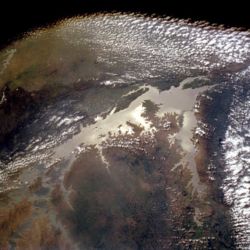
The construction of the Akosombo dam resulted in the flooding of part of the Volta River Basin and its upstream fields, and in the creation of Lake Volta
which covers 3.6% of Ghana's total land area. Lake Volta was formed between the years of 1962 and 1966, and necessitated the relocation of about 80,000 people, that represented 1% of the population. People of 700 villages were relocated into 52 resettlement villages two years prior to the lake's completion; the resettlement program was under the direction of the VRA. Two percent of the resettlement population were riparian fishers and most were subsistence farmers. The Eastern Region
of Ghana and the populations incorporated within its districts, was most subject to the project’s effects.
In the beginning of 2007, there were concerns over the electricity supply from the dam due to low water levels in the Lake Volta reservoir. Some sources said this was due to problems with drought that are a consequence of global warming. During the latter half of 2007 much of this concern was abated when heavy rain fell in the catchment area of Volta River. In 2010 the highest ever water level was recorded at the dam. This necessitated the opening of the flood gates at a reservoir elevation of 84.45 m (277 ft), and for several weeks water was spilled from the lake causing some flooding downstream.
. It has a base width of 366 m (1,200.8 ft) and a structural volume of 7900000 m³ (10,332,809.9 cu yd). The reservoir
created by the dam, Lake Volta, has a capacity of 148 cubic kilometre and a surface area of 8502 km² (3,282.6 sq mi). The lake is 400 km² (154.4 sq mi) long. Maximum lake level is 84.73 m (278 ft) and minimum is 73.15 m (240 ft). On the east side of the dam are two adjacent spillway
s that can discharge approximately 34000 m3/s of water. Each spillway contains six 11.5 m (37.7 ft) wide and 13.7 m (44.9 ft) tall steel floodgate
s. The dam's power plant contains six 170 MW Francis turbine
s. Each turbine is supplied with water via a 112 metre long and 7.2 m (23.6 ft) diameter penstock
with a maximum of 68.8 m (225.7 ft) of hydraulic head
afforded.
and Benin
.
Initially 20% of Akosombo Dam's electric output (serving 70% of national demand) was provided to Ghanains in the form of electricity, the remaining 80% was generated for the American-owned Volta Aluminium Company (VALCO). The Ghana Government was compelled, by contract, to pay for over 50% of the cost of Akosombo’s construction, but the country was allowed only 20% of the power generated. Some commentators are concerned that this is an example of neo-colonialism. In recent years the production from the VALCO plant has declined with the vast majority of additional capacity in Akosombo used to service growing domestic demand.
and Benin
. Ghana’s industrial and economic expansion triggered a higher demand for power, beyond the Akosombo's power plant capabilities. By 1981, a smaller dam was built at the town of Kpong
, downstream from Akosombo and further upgrades to Akosombo have become necessary for maintaining hydropower output. Initially, the dam’s power production capabilities greatly overreached the actual demand; while, the demand since the dam’s inception has resulted in the doubling of hydropower production. Increasing demands for power exceed what can be provided by the current infrastructure. Power demands, along with unforeseen environmental trends, have resulted in rolling blackouts and major power outages. An overall trend of lower lake levels has been observed, sometimes below the requirement for operation of the Akosombo Dam.
 In the time following the construction of the dam at Akosombo, there has been a steady decline in agricultural productivity along the lake and the associated tributaries. The land surrounding Lake Volta
is not nearly as fertile as the formerly cultivated land residing underneath the lake, and heavy agricultural activity has since exhausted the already inadequate soils. Upstream agricultural systems are losing soil fertility without the periodic floodings that brought nutrients to the soil before the natural river flow was halted by the dam. The growth of commercially intensive agriculture has produced a rise in fertilizer run-off into the river. This, along with run-off from nearby cattle stocks and sewage pollution, has caused eutrophication
of the river waters. The nutrient enrichment, in combination with the low water movement, has allowed for the invasion of aquatic weeds (Ceratophyllum
). These weeds have become a formidable challenge to water navigation and transportation.
. Since the installment of the dam, these diseases have increased remarkably. In particular, resettlement villages have showed an increase in disease prevalence since the establishment of Lake Volta
, and a village’s likelihood of infection corresponds to its proximity to the lake. Children and fishermen have been especially hard hit by this rise of disease prevalence. Additionally, the degradation of aquatic habitat has resulted in the decline of shrimp and clam populations. The physical health of local communities has been diminished from this loss of shellfish populations, as they provided an essential source of dietary protein. Likewise, the rural and industrial economies have experienced the financial losses associated with the decimation of river aquaculture
.
and has since led to its heightened prevalence within Volta Basin communities. The districts of Manya Krobo and Yilo Krobo, which lie within the southwest portion of the Volta Basin, are predominately indigenous communities that have attained a disproportionate prevalence of HIV
. The situation underlines the strength of the local factors upon these districts. Commercial sex work was established in response to the thousands of male workers that were in the area for building the dam. Ten percent of the child-bearing females from these two districts migrated out of their districts during this time. In 1986, “90% of AIDS
victims in Ghana were women, and 96% of them had recently lived outside the country”.
The Akosombo Dam and other dams of the Volta River Hydro Development Project increased substantially the conditions for the spread of schistosomiasis
.
. There is an eastward shift of the river’s mouth from the changes to the river’s delta zone and this has led to continuing coastal erosion. The changes in the river hydrology have altered the local heat budget which has caused microclimatic changes such as decreasing rain and higher mean monthly temperatures. All of these larger scale environmental impacts will all further compound the problems surrounding disruptions to local economic activities and associated, difficult human welfare conditions.
Volta River
The Volta is a river in western Africa that drains into the Gulf of Guinea. It has three main tributaries—the Black Volta, White Volta and Red Volta...
in southeastern Ghana
Ghana
Ghana , officially the Republic of Ghana, is a country located in West Africa. It is bordered by Côte d'Ivoire to the west, Burkina Faso to the north, Togo to the east, and the Gulf of Guinea to the south...
in the Akosombo gorge and part of the Volta River Authority
Volta River Authority
The Volta River Authority is the main generator and supplier of electricity in Ghana.-Establishment:The VRA was established by the Volta River Development Act, Act 46 of the Republic of Ghana on April 26, 1961....
. The construction of the dam flooded part of the Volta River Basin, and the subsequent creation of Lake Volta
Lake Volta
Lake Volta is the largest reservoir by surface area in the world, and the fourth largest one by water volume. It is located completely within the country of Ghana, and it has a surface area of about 8,502 km² . Lake Volta lies along the Greenwich Meridian, and just six degrees of latitude...
. Lake Volta is the world's largest man-made lake, covering 8502 square kilometres (3,282.6 sq mi), which is 3.6% of Ghana's land area.
The primary purpose of the Akosombo Dam was to provide electricity for the aluminum industry. The Akosombo Dam was called "the largest single investment in the economic development plans of Ghana." Its original electrical output was 912 MW, which was upgraded to 1,020 MW in a retrofit project that was completed in 2006.
The flooding that created the Lake Volta reservoir displaced many people and had a significant impact on the environment.
History
The dam was conceived in 1915 by geologist Albert Ernest KitsonAlbert Ernest Kitson
Sir Albert Ernest Kitson KBE, CMG was a British/Australian geologist and naturalist, winner of the Lyell Medal in 1927.-Early life:...
, but no plans were drawn until the 1940s. The development of the Volta River
Volta River
The Volta is a river in western Africa that drains into the Gulf of Guinea. It has three main tributaries—the Black Volta, White Volta and Red Volta...
Basin was proposed in 1949, but because there was not sufficient funds, the American company Volta Aluminum Company
Volta Aluminum Company
Volta Aluminum Company, known as Valco, is an aluminium company based in Ghana founded by Kaiser Aluminum and now wholly owned by the government of Ghana. Valco is a joint venture with Alcoa, the major aluminum conglomerate based in the United States. In 1961 Valco invested in the Akosombo Dam...
(Valco) loaned money to Ghana so that the dam could be constructed. Kwame Nkrumah
Kwame Nkrumah
Kwame Nkrumah was the leader of Ghana and its predecessor state, the Gold Coast, from 1952 to 1966. Overseeing the nation's independence from British colonial rule in 1957, Nkrumah was the first President of Ghana and the first Prime Minister of Ghana...
adopted the Volta River hydropower project.
The final proposal outlined the building of an aluminum smelter at Tema
Tema
Tema is a city on the Atlantic coast of Ghana, lying east of the Ghanaian capital city, Accra, in the region of Greater Accra. As of 2005, Tema had a population of 209,000. The Greenwich Meridian passes directly through the city...
, a dam constructed at Akosombo to power the smelter, and a network of power lines installed through southern Ghana. The aluminum smelter was expected to eventually provide the revenue necessary for establishing local bauxite
Bauxite
Bauxite is an aluminium ore and is the main source of aluminium. This form of rock consists mostly of the minerals gibbsite Al3, boehmite γ-AlO, and diaspore α-AlO, in a mixture with the two iron oxides goethite and hematite, the clay mineral kaolinite, and small amounts of anatase TiO2...
mining and refining, which would allow aluminum production without importing foreign alumina. Development of the aluminum industry within Ghana was dependent upon the proposed hydroelectric power. The proposed project's aluminum smelter was overseen by the American company, Kaiser Aluminum
Kaiser Aluminum
Kaiser Aluminum is an American aluminum producer. The company was founded in 1946 by American industrialist Henry J. Kaiser. Kaiser entered the aluminum business by leasing, then purchasing three government-owned aluminum facilities in Washington state. These were the primary reduction plants at...
, and is operated by Valco. The smelter received its financial investment from Valco shareholders, with the support of the Export-Import Bank of Washington. However, Valco did not invest without first requiring insurances from Ghana's government, such as company exemptions from taxes on trade and discounted purchases of electricity. The estimated total cost of the project, in its entirety, was estimated at $258 million.
In 1961, the Volta River Authority
Volta River Authority
The Volta River Authority is the main generator and supplier of electricity in Ghana.-Establishment:The VRA was established by the Volta River Development Act, Act 46 of the Republic of Ghana on April 26, 1961....
(VRA) was established by Ghana's Parliament through the passage of the Volta River Development Act. The VRA's fundamental operations were structured by six Board members and Kwame Nkrumah as chairman. The VRA's primary task is to manage the development of the Volta River Basin, which included the construction and supervision of the dam, the power station and the power transmission network. The VRA is responsible for the reservoir impounded by the dam, the fishing within the lake, lake transportation and communication, and the welfare of those surrounding the lake.
The dam was built between 1961 and 1965. Its development was undertaken by the Ghanaian government and funded 25% by the International Bank for Reconstruction and Development
International Bank for Reconstruction and Development
The International Bank for Reconstruction and Development is one of five institutions that compose the World Bank Group. The IBRD is an international organization whose original mission was to finance the reconstruction of nations devastated by World War II. Now, its mission has expanded to fight...
of the World Bank
World Bank
The World Bank is an international financial institution that provides loans to developing countries for capital programmes.The World Bank's official goal is the reduction of poverty...
, the United States
United States
The United States of America is a federal constitutional republic comprising fifty states and a federal district...
, and the United Kingdom
United Kingdom
The United Kingdom of Great Britain and Northern IrelandIn the United Kingdom and Dependencies, other languages have been officially recognised as legitimate autochthonous languages under the European Charter for Regional or Minority Languages...
.
The construction of the Akosombo dam resulted in the flooding of part of the Volta River Basin and its upstream fields, and in the creation of Lake Volta
Lake Volta
Lake Volta is the largest reservoir by surface area in the world, and the fourth largest one by water volume. It is located completely within the country of Ghana, and it has a surface area of about 8,502 km² . Lake Volta lies along the Greenwich Meridian, and just six degrees of latitude...
which covers 3.6% of Ghana's total land area. Lake Volta was formed between the years of 1962 and 1966, and necessitated the relocation of about 80,000 people, that represented 1% of the population. People of 700 villages were relocated into 52 resettlement villages two years prior to the lake's completion; the resettlement program was under the direction of the VRA. Two percent of the resettlement population were riparian fishers and most were subsistence farmers. The Eastern Region
Eastern Region (Ghana)
The Eastern Region is one of Ghana's ten administrative regions. It covers an area of 19,323 square kilometres, which is about 8.1% of Ghana's total land area. The region is divided into administrative districts. The total number of districts were increased from 17 districts to 21...
of Ghana and the populations incorporated within its districts, was most subject to the project’s effects.
In the beginning of 2007, there were concerns over the electricity supply from the dam due to low water levels in the Lake Volta reservoir. Some sources said this was due to problems with drought that are a consequence of global warming. During the latter half of 2007 much of this concern was abated when heavy rain fell in the catchment area of Volta River. In 2010 the highest ever water level was recorded at the dam. This necessitated the opening of the flood gates at a reservoir elevation of 84.45 m (277 ft), and for several weeks water was spilled from the lake causing some flooding downstream.
Design
The dam is a 660 m (2,165.4 ft) long and 114 m (374 ft) high rock-fill embankment damEmbankment dam
An embankment dam is a massive artificial water barrier. It is typically created by the emplacement and compaction of a complex semi-plastic mound of various compositions of soil, sand, clay and/or rock. It has a semi-permanent waterproof natural covering for its surface, and a dense, waterproof...
. It has a base width of 366 m (1,200.8 ft) and a structural volume of 7900000 m³ (10,332,809.9 cu yd). The reservoir
Reservoir
A reservoir , artificial lake or dam is used to store water.Reservoirs may be created in river valleys by the construction of a dam or may be built by excavation in the ground or by conventional construction techniques such as brickwork or cast concrete.The term reservoir may also be used to...
created by the dam, Lake Volta, has a capacity of 148 cubic kilometre and a surface area of 8502 km² (3,282.6 sq mi). The lake is 400 km² (154.4 sq mi) long. Maximum lake level is 84.73 m (278 ft) and minimum is 73.15 m (240 ft). On the east side of the dam are two adjacent spillway
Spillway
A spillway is a structure used to provide the controlled release of flows from a dam or levee into a downstream area, typically being the river that was dammed. In the UK they may be known as overflow channels. Spillways release floods so that the water does not overtop and damage or even destroy...
s that can discharge approximately 34000 m3/s of water. Each spillway contains six 11.5 m (37.7 ft) wide and 13.7 m (44.9 ft) tall steel floodgate
Floodgate
Floodgates are adjustable gates used to control water flow in flood barriers, reservoir, river, stream, or levee systems. They may be designed to set spillway crest heights in dams, to adjust flow rates in sluices and canals, or they may be designed to stop water flow entirely as part of a levee or...
s. The dam's power plant contains six 170 MW Francis turbine
Francis turbine
The Francis turbine is a type of water turbine that was developed by James B. Francis in Lowell, Massachusetts. It is an inward-flow reaction turbine that combines radial and axial flow concepts....
s. Each turbine is supplied with water via a 112 metre long and 7.2 m (23.6 ft) diameter penstock
Penstock
A penstock is a sluice or gate or intake structure that controls water flow, or an enclosed pipe that delivers water to hydraulic turbines and sewerage systems. It is a term that has been inherited from the technology of wooden watermills....
with a maximum of 68.8 m (225.7 ft) of hydraulic head
Hydraulic head
Hydraulic head or piezometric head is a specific measurement of water pressure above a geodetic datum. It is usually measured as a water surface elevation, expressed in units of length, at the entrance of a piezometer...
afforded.
Power distribution
The dam provides electricity to Ghana and its neighboring West African countries, including TogoTogo
Togo, officially the Togolese Republic , is a country in West Africa bordered by Ghana to the west, Benin to the east and Burkina Faso to the north. It extends south to the Gulf of Guinea, on which the capital Lomé is located. Togo covers an area of approximately with a population of approximately...
and Benin
Benin
Benin , officially the Republic of Benin, is a country in West Africa. It borders Togo to the west, Nigeria to the east and Burkina Faso and Niger to the north. Its small southern coastline on the Bight of Benin is where a majority of the population is located...
.
Initially 20% of Akosombo Dam's electric output (serving 70% of national demand) was provided to Ghanains in the form of electricity, the remaining 80% was generated for the American-owned Volta Aluminium Company (VALCO). The Ghana Government was compelled, by contract, to pay for over 50% of the cost of Akosombo’s construction, but the country was allowed only 20% of the power generated. Some commentators are concerned that this is an example of neo-colonialism. In recent years the production from the VALCO plant has declined with the vast majority of additional capacity in Akosombo used to service growing domestic demand.
Impacts
The Akosombo Dam benefited some industrial and economic activities from the addition of lake transportation, increased fishing, new farming activities along the shoreline, and tourism. The power generated has provided for primary interests within Ghana, while also supplying power to the neighboring countries of TogoTogo
Togo, officially the Togolese Republic , is a country in West Africa bordered by Ghana to the west, Benin to the east and Burkina Faso to the north. It extends south to the Gulf of Guinea, on which the capital Lomé is located. Togo covers an area of approximately with a population of approximately...
and Benin
Benin
Benin , officially the Republic of Benin, is a country in West Africa. It borders Togo to the west, Nigeria to the east and Burkina Faso and Niger to the north. Its small southern coastline on the Bight of Benin is where a majority of the population is located...
. Ghana’s industrial and economic expansion triggered a higher demand for power, beyond the Akosombo's power plant capabilities. By 1981, a smaller dam was built at the town of Kpong
Kpong Dam
The Kpong Dam is the second hydroelectric power generating dam in Ghana. It is owned and operated by Volta River Authority. The dam was introduced to supplement power production from Akosombo Dam, especially for the smelting of aluminium at VALCO in Tema....
, downstream from Akosombo and further upgrades to Akosombo have become necessary for maintaining hydropower output. Initially, the dam’s power production capabilities greatly overreached the actual demand; while, the demand since the dam’s inception has resulted in the doubling of hydropower production. Increasing demands for power exceed what can be provided by the current infrastructure. Power demands, along with unforeseen environmental trends, have resulted in rolling blackouts and major power outages. An overall trend of lower lake levels has been observed, sometimes below the requirement for operation of the Akosombo Dam.
Biological habitat
Lake Volta
Lake Volta is the largest reservoir by surface area in the world, and the fourth largest one by water volume. It is located completely within the country of Ghana, and it has a surface area of about 8,502 km² . Lake Volta lies along the Greenwich Meridian, and just six degrees of latitude...
is not nearly as fertile as the formerly cultivated land residing underneath the lake, and heavy agricultural activity has since exhausted the already inadequate soils. Upstream agricultural systems are losing soil fertility without the periodic floodings that brought nutrients to the soil before the natural river flow was halted by the dam. The growth of commercially intensive agriculture has produced a rise in fertilizer run-off into the river. This, along with run-off from nearby cattle stocks and sewage pollution, has caused eutrophication
Eutrophication
Eutrophication or more precisely hypertrophication, is the movement of a body of water′s trophic status in the direction of increasing plant biomass, by the addition of artificial or natural substances, such as nitrates and phosphates, through fertilizers or sewage, to an aquatic system...
of the river waters. The nutrient enrichment, in combination with the low water movement, has allowed for the invasion of aquatic weeds (Ceratophyllum
Ceratophyllum
Ceratophyllum is a cosmopolitan genus of flowering plants, commonly found in ponds, marshes, and quiet streams in tropical and in temperate regions...
). These weeds have become a formidable challenge to water navigation and transportation.
Human welfare
The presence of aquatic weed along the lake and within the tributaries has resulted in even greater detriment to local human health. The weeds provide the necessary habitat for black-fly, mosquitoes and snails, which are the vectors of water-borne illnesses such as bilharzia, river blindness and malariaMalaria
Malaria is a mosquito-borne infectious disease of humans and other animals caused by eukaryotic protists of the genus Plasmodium. The disease results from the multiplication of Plasmodium parasites within red blood cells, causing symptoms that typically include fever and headache, in severe cases...
. Since the installment of the dam, these diseases have increased remarkably. In particular, resettlement villages have showed an increase in disease prevalence since the establishment of Lake Volta
Lake Volta
Lake Volta is the largest reservoir by surface area in the world, and the fourth largest one by water volume. It is located completely within the country of Ghana, and it has a surface area of about 8,502 km² . Lake Volta lies along the Greenwich Meridian, and just six degrees of latitude...
, and a village’s likelihood of infection corresponds to its proximity to the lake. Children and fishermen have been especially hard hit by this rise of disease prevalence. Additionally, the degradation of aquatic habitat has resulted in the decline of shrimp and clam populations. The physical health of local communities has been diminished from this loss of shellfish populations, as they provided an essential source of dietary protein. Likewise, the rural and industrial economies have experienced the financial losses associated with the decimation of river aquaculture
Aquaculture
Aquaculture, also known as aquafarming, is the farming of aquatic organisms such as fish, crustaceans, molluscs and aquatic plants. Aquaculture involves cultivating freshwater and saltwater populations under controlled conditions, and can be contrasted with commercial fishing, which is the...
.
Socioeconomics
The loss of land experienced by the 80,000 people forcibly relocated meant the loss of their primary economic activities from fishing and agriculture, loss of their homes, loss of their family grave sites, loss of community stability, and the eventual loss of important social values. The resettlement program demonstrated the social complexities involved in establishing “socially cohesive and integrated” communities. Insufficient planning resulted in the relocation of communities into areas that were not capable of providing for their former livelihoods and traditions. The loss of the naturally fertile soils beneath Lake Volta essentially led to the loss of traditional farming practices. The poor living conditions provided within the resettlement villages has been demonstrated by population reductions since resettlement. One resettlement village in particular experienced a greater than 50% population reduction in the 23 years following relocation. Increased economic risks and experiences of poverty are associated with those communities most impacted by the Volta River’s development. The extensive human migration and degradation of natural resources within the Volta-basin area, are the products of poverty in conjunction with population pressure.Disease
Increased human migration within the area has been driven by poverty and unfavorable resettlement conditions. This migration enabled the contraction of HIVHIV
Human immunodeficiency virus is a lentivirus that causes acquired immunodeficiency syndrome , a condition in humans in which progressive failure of the immune system allows life-threatening opportunistic infections and cancers to thrive...
and has since led to its heightened prevalence within Volta Basin communities. The districts of Manya Krobo and Yilo Krobo, which lie within the southwest portion of the Volta Basin, are predominately indigenous communities that have attained a disproportionate prevalence of HIV
HIV
Human immunodeficiency virus is a lentivirus that causes acquired immunodeficiency syndrome , a condition in humans in which progressive failure of the immune system allows life-threatening opportunistic infections and cancers to thrive...
. The situation underlines the strength of the local factors upon these districts. Commercial sex work was established in response to the thousands of male workers that were in the area for building the dam. Ten percent of the child-bearing females from these two districts migrated out of their districts during this time. In 1986, “90% of AIDS
AIDS
Acquired immune deficiency syndrome or acquired immunodeficiency syndrome is a disease of the human immune system caused by the human immunodeficiency virus...
victims in Ghana were women, and 96% of them had recently lived outside the country”.
The Akosombo Dam and other dams of the Volta River Hydro Development Project increased substantially the conditions for the spread of schistosomiasis
Schistosomiasis
Schistosomiasis is a parasitic disease caused by several species of trematodes , a parasitic worm of the genus Schistosoma. Snails often act as an intermediary agent for the infectious diseases until a new human host is found...
.
Physical environment
Reservoir-induced seismicity has been recorded due to the crustal re-adjustments from the added weight of the water within Lake VoltaLake Volta
Lake Volta is the largest reservoir by surface area in the world, and the fourth largest one by water volume. It is located completely within the country of Ghana, and it has a surface area of about 8,502 km² . Lake Volta lies along the Greenwich Meridian, and just six degrees of latitude...
. There is an eastward shift of the river’s mouth from the changes to the river’s delta zone and this has led to continuing coastal erosion. The changes in the river hydrology have altered the local heat budget which has caused microclimatic changes such as decreasing rain and higher mean monthly temperatures. All of these larger scale environmental impacts will all further compound the problems surrounding disruptions to local economic activities and associated, difficult human welfare conditions.