

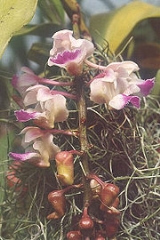
Aerides

Encyclopedia
Aerides also known as the Cat's-tail Orchid or the Fox Brush Orchid, is a genus
belonging to the Orchid family (Orchidaceae
) (subfamily Epidendroideae
, tribe Vandeae
, subtribe Aeridinae). It is a group of tropical epiphyte
orchids that grow mainly in the warm low-lands of the tropics of Asia. The naming of the genus refers to the epiphytic growth habit of the species, and literally means 'air-plant'. The type species
, Aerides odoratum was described by João de Loureiro
in 1790. This genus is abbreviated Aer in horticultural trade.
epiphytes, except for Aerides krabiensis, which is a lithophyte
. They form pendulous raceme
s with many long-lasting and fragrant, waxy flower
s, in white with purple or pink edges. Some species of the Aerides genus have purple or pink colors with a rare few pocessing yellow colours. They have a forward-facing spur
, growing on sharp, stout many-leaved stems
from the leaf axils and thick roots. The leaves grow distichously (in two vertical rows). The leaf margins are bilobed, while the apex is emarginate. There are ligules. Morphologically, they are very similar to species in the Vanda genus.
, Nepal
, Southern China
, South-East Asia, The Philippines and New Guinea
. They flower from June to July. Temperature requirements vary from cool to warm growing depending on the species.
s, teak containers or net pots, which affords the roots freedom to extend into the air. They prefer to be grown in media that is well drained such as tree fern
fibers (for small plants), medium fir
bark, or sphagnum moss. This growing method however usually requires full sunlight and warm temperatures where the roots must be watered frequently.
species in this genus, (with the exception of Aerides krabiense, which is a lithophyte
).
x Aerides odorata)
Many hybrids have been made between the Aerides and other member of the "Vanda" family. The genus Christieara
is a three-way hybrid involving Aerides, Ascocentrum
and Vanda. Many of these hybrids come in a wide range of colours due to the high degree of genetic diversity
.
Genus
In biology, a genus is a low-level taxonomic rank used in the biological classification of living and fossil organisms, which is an example of definition by genus and differentia...
belonging to the Orchid family (Orchidaceae
Orchidaceae
The Orchidaceae, commonly referred to as the orchid family, is a morphologically diverse and widespread family of monocots in the order Asparagales. Along with the Asteraceae, it is one of the two largest families of flowering plants, with between 21,950 and 26,049 currently accepted species,...
) (subfamily Epidendroideae
Epidendroideae
In plant systematics Epidendroideae is a subfamily of the orchid family, Orchidaceae. Epidendroideae is larger than all the other orchid subfamilies together, comprising more than 15,000 species in 576 genera. Most Epidendroid orchids are tropical epiphytes, typically with pseudobulbs...
, tribe Vandeae
Vandeae
The Vandeae is a large monophyletic tribe within the family of orchids.This tribe contains 1,700 - 2,000 species in more than 150 genera. The classification of taxa within this tribe is still largely based on floral morphology...
, subtribe Aeridinae). It is a group of tropical epiphyte
Epiphyte
An epiphyte is a plant that grows upon another plant non-parasitically or sometimes upon some other object , derives its moisture and nutrients from the air and rain and sometimes from debris accumulating around it, and is found in the temperate zone and in the...
orchids that grow mainly in the warm low-lands of the tropics of Asia. The naming of the genus refers to the epiphytic growth habit of the species, and literally means 'air-plant'. The type species
Type species
In biological nomenclature, a type species is both a concept and a practical system which is used in the classification and nomenclature of animals and plants. The value of a "type species" lies in the fact that it makes clear what is meant by a particular genus name. A type species is the species...
, Aerides odoratum was described by João de Loureiro
João de Loureiro
João de Loureiro was a Portuguese Jesuit missionary, paleontologist, physician and botanist.In 1742 he travelled to Cochinchina, remaining there for 30 years. He became a specialist in Asian flora and on his return published Flora Cochinchinensis .- References :...
in 1790. This genus is abbreviated Aer in horticultural trade.
Description
The species in this genus, range from small to large monopodialMonopodial
Vascular plants with monopodial growth habits grow upward from a single point. They add leaves to the apex each year and the stem grows longer accordingly...
epiphytes, except for Aerides krabiensis, which is a lithophyte
Lithophyte
Lithophytes are a type of plant that grows in or on rocks. Lithophytes feed off moss, nutrients in rain water, litter, and even their own dead tissue....
. They form pendulous raceme
Raceme
A raceme is a type of inflorescence that is unbranched and indeterminate and bears pedicellate flowers — flowers having short floral stalks called pedicels — along the axis. In botany, axis means a shoot, in this case one bearing the flowers. In a raceme, the oldest flowers are borne...
s with many long-lasting and fragrant, waxy flower
Flower
A flower, sometimes known as a bloom or blossom, is the reproductive structure found in flowering plants . The biological function of a flower is to effect reproduction, usually by providing a mechanism for the union of sperm with eggs...
s, in white with purple or pink edges. Some species of the Aerides genus have purple or pink colors with a rare few pocessing yellow colours. They have a forward-facing spur
Spur
A spur is a metal tool designed to be worn in pairs on the heels of riding boots for the purpose of directing a horse to move forward or laterally while riding. It is usually used to refine the riding aids and to back up the natural aids . The spur is used in every equestrian discipline...
, growing on sharp, stout many-leaved stems
Plant stem
A stem is one of two main structural axes of a vascular plant. The stem is normally divided into nodes and internodes, the nodes hold buds which grow into one or more leaves, inflorescence , conifer cones, roots, other stems etc. The internodes distance one node from another...
from the leaf axils and thick roots. The leaves grow distichously (in two vertical rows). The leaf margins are bilobed, while the apex is emarginate. There are ligules. Morphologically, they are very similar to species in the Vanda genus.
Habitat
The genus grows in the tropics of Asia, in IndiaIndia
India , officially the Republic of India , is a country in South Asia. It is the seventh-largest country by geographical area, the second-most populous country with over 1.2 billion people, and the most populous democracy in the world...
, Nepal
Nepal
Nepal , officially the Federal Democratic Republic of Nepal, is a landlocked sovereign state located in South Asia. It is located in the Himalayas and bordered to the north by the People's Republic of China, and to the south, east, and west by the Republic of India...
, Southern China
China
Chinese civilization may refer to:* China for more general discussion of the country.* Chinese culture* Greater China, the transnational community of ethnic Chinese.* History of China* Sinosphere, the area historically affected by Chinese culture...
, South-East Asia, The Philippines and New Guinea
New Guinea
New Guinea is the world's second largest island, after Greenland, covering a land area of 786,000 km2. Located in the southwest Pacific Ocean, it lies geographically to the east of the Malay Archipelago, with which it is sometimes included as part of a greater Indo-Australian Archipelago...
. They flower from June to July. Temperature requirements vary from cool to warm growing depending on the species.
Care
Most Aerides species are considered easy to grow. Their flowers are long-lived and highly perfumed— traits which make them popular in horticulture as cut flowers and potted plants. Aerides kept as houseplants, are best grown in hanging basketHanging basket
A hanging basket is a suspended container used for growing decorative plants. Typically they are hung from buildings, where garden space is at a premium, and from street furniture for environmental enhancement. They may also be suspended from free standing frames sometimes called hanging basket trees...
s, teak containers or net pots, which affords the roots freedom to extend into the air. They prefer to be grown in media that is well drained such as tree fern
Fern
A fern is any one of a group of about 12,000 species of plants belonging to the botanical group known as Pteridophyta. Unlike mosses, they have xylem and phloem . They have stems, leaves, and roots like other vascular plants...
fibers (for small plants), medium fir
Fir
Firs are a genus of 48–55 species of evergreen conifers in the family Pinaceae. They are found through much of North and Central America, Europe, Asia, and North Africa, occurring in mountains over most of the range...
bark, or sphagnum moss. This growing method however usually requires full sunlight and warm temperatures where the roots must be watered frequently.
Species
There are 25 monopodial epiphyticEpiphyte
An epiphyte is a plant that grows upon another plant non-parasitically or sometimes upon some other object , derives its moisture and nutrients from the air and rain and sometimes from debris accumulating around it, and is found in the temperate zone and in the...
species in this genus, (with the exception of Aerides krabiense, which is a lithophyte
Lithophyte
Lithophytes are a type of plant that grows in or on rocks. Lithophytes feed off moss, nutrients in rain water, litter, and even their own dead tissue....
).
Hybrids
Natural: Aerides × jansonii (Aerides falcataAerides falcata
Aerides falcata is a species of orchid....
x Aerides odorata)
Many hybrids have been made between the Aerides and other member of the "Vanda" family. The genus Christieara
Christieara
× Christieara, abbreviated Chtra. in the horticultural trade, is an intergeneric hybrid between the orchid genera Aerides, Ascocentrum and Vanda ....
is a three-way hybrid involving Aerides, Ascocentrum
Ascocentrum
Ascocentrum, abbreviated as Asctm in horticultural trade, is a small genus belonging to the orchid family . The type species is Ascocentrum miniatum Schltr. ex J. J. Sm...
and Vanda. Many of these hybrids come in a wide range of colours due to the high degree of genetic diversity
Genetic diversity
Genetic diversity, the level of biodiversity, refers to the total number of genetic characteristics in the genetic makeup of a species. It is distinguished from genetic variability, which describes the tendency of genetic characteristics to vary....
.