


Abahlali baseMjondolo

Encyclopedia

South Africa
The Republic of South Africa is a country in southern Africa. Located at the southern tip of Africa, it is divided into nine provinces, with of coastline on the Atlantic and Indian oceans...
which is well known for its campaigning for public housing. The movement grew out of a road blockade organized from the Kennedy Road
Kennedy Road, Durban
Kennedy Road is a shack settlement, in the suburb of Clare Estate in Durban, in the province of KwaZulu-Natal in South Africa. It was founded by a Mr. Mzobe in the late 1970s. The land on which the settlement was founded is steep and runs down between the Municipal Dump and the 6 lane Umgeni Road...
shack settlement in the city of Durban
Durban
Durban is the largest city in the South African province of KwaZulu-Natal and the third largest city in South Africa. It forms part of the eThekwini metropolitan municipality. Durban is famous for being the busiest port in South Africa. It is also seen as one of the major centres of tourism...
in early 2005 and now also operates in the cities of Pietermaritzburg
Pietermaritzburg
Pietermaritzburg is the capital and second largest city in the province of KwaZulu-Natal, South Africa. It was founded in 1838, and is currently governed by the Msunduzi Local Municipality. Its "purist" Zulu name is umGungundlovu, and this is the name used for the district municipality...
and in Cape Town
Cape Town
Cape Town is the second-most populous city in South Africa, and the provincial capital and primate city of the Western Cape. As the seat of the National Parliament, it is also the legislative capital of the country. It forms part of the City of Cape Town metropolitan municipality...
. It is the largest shack
Shack
A shack is a type of small house, usually in a state of disrepair. The word may derive from the Nahuatl word xacalli or "adobe house" by way of Mexican Spanish xacal/jacal, which has the same meaning as "shack". It was a common usage among people of Mexican ancestry throughout the U.S...
dweller's organization in South Africa and campaigns to improve the living conditions of poor people and to democratize society from below. The movement refuses party politics
Party Politics
Party Politics is a peer-reviewed academic journal that publishes papers in the field of Political Science. The journal's editors are David M Farrell and Paul Webb...
, boycott
Boycott
A boycott is an act of voluntarily abstaining from using, buying, or dealing with a person, organization, or country as an expression of protest, usually for political reasons...
s election
Election
An election is a formal decision-making process by which a population chooses an individual to hold public office. Elections have been the usual mechanism by which modern representative democracy operates since the 17th century. Elections may fill offices in the legislature, sometimes in the...
s and has a history of conflict with both the African National Congress
African National Congress
The African National Congress is South Africa's governing Africanist political party, supported by its tripartite alliance with the Congress of South African Trade Unions and the South African Communist Party , since the establishment of non-racial democracy in April 1994. It defines itself as a...
and the Democratic Alliance
Democratic Alliance
-Current political parties:* Democratic Alliance * Democratic Alliance * Democratic Alliance * Democratic Alliance * Democratic Alliance * Democratic Alliance for the Betterment and Progress of Hong Kong...
. Its key demand is that the social value of urban land should take priority over its commercial value and it campaigns for the public expropriation of large privately owned landholdings. The key organising strategy is to try "to recreate Commons
The commons
The commons is terminology referring to resources that are owned in common or shared between or among communities populations. These resources are said to be "held in common" and can include everything from natural resources and common land to software. The commons contains public property and...
" from below by trying to create a series of linked commune
Commune (intentional community)
A commune is an intentional community of people living together, sharing common interests, property, possessions, resources, and, in some communes, work and income. In addition to the communal economy, consensus decision-making, non-hierarchical structures and ecological living have become...
s. According to The Times
The Times
The Times is a British daily national newspaper, first published in London in 1785 under the title The Daily Universal Register . The Times and its sister paper The Sunday Times are published by Times Newspapers Limited, a subsidiary since 1981 of News International...
, the movement "has shaken the political landscape of South Africa." According to Professor Peter Vale, Abahlali baseMjondolo is "along with the Treatment Action Campaign
Treatment Action Campaign
The Treatment Action Campaign is a South African AIDS activist organization which was founded by the HIV-positive activist Zackie Achmat in 1998. TAC is rooted in the experiences, direct action tactics and anti-apartheid background of its founder...
the most effective grouping in South African civil society." However the movement has faced considerable repression.
Context
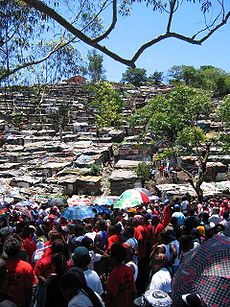
Ethekwini
eThekwini Metropolitan Municipality is a metropolitan municipality created in 2000 that includes the city of Durban, South Africa and surrounding towns. eThekwini is one of the 11 districts of KwaZulu-Natal province of South Africa. The majority of its 3,090,126 people speak Zulu...
Municipality, which governs Durban and Pinetown
Pinetown
Pinetown is a small city just inland from Durban in KwaZulu-Natal, South Africa. Pinetown is situated 16 km west of Durban at an elevation of 1,000 to 1,300 feet . It was established in 1850 around the Wayside Hotel, itself built the year before along the main wagon route between Durban and...
, embarked on a slum clearance programme meant the steady demolition of shack settlements and a refusal to provide basic services (e.g. electricity, sanitation etc.) to existing settlements on the grounds that all shack settlements are now 'temporary'. In these demolitions some shack dwellers have simply been left homeless and others subject to unlawful forced evictions to the rural periphery of the city.
In early 2008, the United Nations
United Nations
The United Nations is an international organization whose stated aims are facilitating cooperation in international law, international security, economic development, social progress, human rights, and achievement of world peace...
expressed serious concern about the treatment of shack dwellers in Durban. There was also concern about the possibility of eviction
Eviction
How you doing???? Eviction is the removal of a tenant from rental property by the landlord. Depending on the laws of the jurisdiction, eviction may also be known as unlawful detainer, summary possession, summary dispossess, forcible detainer, ejectment, and repossession, among other terms...
s linked to the 2010 FIFA World Cup
2010 FIFA World Cup
The 2010 FIFA World Cup was the 19th FIFA World Cup, the world championship for men's national association football teams. It took place in South Africa from 11 June to 11 July 2010...
across South Africa and abroad.
Abahlali's original work was primarily committed to opposing demolitions and forced removals and to fighting for good land and quality housing in the cities. In most instances this takes the form of a demand for shack settlements to be upgraded where they are or for new houses to be built close to where the existing settlements are. However the movement has also argued that basic services such as water, electricity and toilets should be immediately provided to shack settlements while land and housing in the city are negotiated. The movement has also engaged in the mass popular appropriation of access to water and electricity.
The movement quickly had a considerable degree of success in stopping evictions and forced removals, winning the right for new shacks to be built as settlements expand and in winning access to basic services, but for three years was not able to win secure access to good urban land for quality housing. However, in late 2008, AbM President S'bu Zikode
S'bu Zikode
Sibusiso Innocent Zikode is the president of the South African shack dwellers' movement Abahlali baseMjondolo. According to the Mail & Guardian "Under his stewardship, ABM has made steady gains for housing rights." -Biography:...
announced a deal with the eThekwini Municipality which will see services being provided to 14 settlements and tenure security and formal housing to three. The municipality confirmed this deal in February 2009.
The movement has been involved in considerable conflict with the eThekwini Municipality and has undertaken numerous protests and legal actions against the city authorities. Its members have been beaten and many of its leaders arrested by the South African Police Service
South African Police Service
The South African Police Service is the national police force of the Republic of South Africa. Its 1116 police stations in South Africa are divided according to the provincial borders, and a Provincial Commissioner is appointed in each province...
in Sydenham, Durban.
Abahlali has often made claims of severe police harassment, including torture
Torture
Torture is the act of inflicting severe pain as a means of punishment, revenge, forcing information or a confession, or simply as an act of cruelty. Throughout history, torture has often been used as a method of political re-education, interrogation, punishment, and coercion...
. On a number of occasions, these claims have been supported by church leaders and human rights
Human rights
Human rights are "commonly understood as inalienable fundamental rights to which a person is inherently entitled simply because she or he is a human being." Human rights are thus conceived as universal and egalitarian . These rights may exist as natural rights or as legal rights, in both national...
organisations.
In October 2009, the movement won a constitutional court case which declared the KZN Slums Act
KZN Slums Act
The KwaZulu-Natal Elimination and Prevention of Re-emergence of Slums Act, 2007 was a provincial law dealing with land tenure and evictions in the province of KwaZulu-Natal in South Africa.-The Act:...
unconstitutional.
In Cape Town there is acute conflict between the movement and the Cape Town City Council
Cape Town City Council
The City Council is the legislative body of the City of Cape Town. It is composed of 221 councillors elected by a system of mixed member proportional representation. 111 councillors are elected by first-past-the-post voting, one from each of the 111 electoral wards of the City, while the other 110...
which has centred around the Macassar Village Land Occupation
Macassar Village Land Occupation
The squatter's movement Abahlali baseMjondolo occupied a piece of vacant state owned land in Macassar Village, near Somerset West outside of Cape Town on 18 May 2009...
.
Autonomy & Democracy
Academic work on the movement stresses that it is non-professionalized (i.e. its leaders are unsalaried), independent of NGO control), autonomous from political organisations and party politics and democratic. Sarah Cooper-Knock describes the movement as "neurotically democratic, impressively diverse and steadfastly self-critical". Ercument Celik writes that "I experienced how democratically the movement ran its meetings."The movement has, along with the Western Cape Anti-Eviction Campaign
Western Cape Anti-Eviction Campaign
The Western Cape Anti-Eviction Campaign is a non-racial popular movement made up of poor and oppressed communities in Cape Town, South Africa...
, refused to work with the NGO-run 'Social Movements Indaba' (SMI), and some of the NGOs involved with the SMI. The movement has been particularly critical of the Centre for Civil Society at the University of KwaZulu-Natal
University of KwaZulu-Natal
The University of KwaZulu-Natal or UKZN is a university with five campuses all located in the province of KwaZulu-Natal in South Africa. It was formed on 1 January 2004 after the merger between the University of Natal and the University of Durban-Westville.-History:-University of...
and refuses to work with the Centre.
Membership & Structures
The movement claims to have around 25,000 active supporters in 64 different shack settlements of which just over 10 000 were paid up card carrying members in 2010. The movement has affiliated settlements and branches in non-affiliated settlements and also a has a youth league and a women's league.Campaigns
Since 2005, the movement has carried out a series of large scale marches, created numerous dual power institutions AbM has called for "a living communism", engaged in direct action such as land occupations and self organised water and electricity connections and made tactical use of the courts. The movement has often made anti-capitalist statements and has demanded the expropriationNationalization
Nationalisation, also spelled nationalization, is the process of taking an industry or assets into government ownership by a national government or state. Nationalization usually refers to private assets, but may also mean assets owned by lower levels of government, such as municipalities, being...
of private land for public housing.
Abahlali states that it refuses to participate in party politics or any NGO-style professionalization or individualization of struggle and instead seeks to build democratic people's power where people live and work. Academic work confirms that the movement has, indeed, protected its autonomy from political parties and NGOs.
- Housing
The primary demand of the movement has been for decent, public housing and much of its work takes the form of opposing evictions. The movement has often used the phrase 'The Right to the City
The Right to the City
The right to the city is an idea and a slogan that was first proposed by Henri Lefebvre in his 1968 book Le Droit à la ville. Lefebvre summaries the ideas as a "demand...[for] a transformed and renewed access to urban life"...
' to insist that the location of housing is critically important and demands that shack settlements are upgraded where they are and that people are not relocated to out of town developments. The movement rejects technocratic approaches to the housing crisis and stresses the need for dignity to be central to the resolution of the housing crisis.
- Services
The movement has also campaigned for the provision of basic services to shack settlements.
- Evictions & Forced Removals
The movement opposes all evictions and forced removals and has campaigned vigorously on this score via public protest and, also, legal action.
- Fire & Electricity
In South Africa, there are an average of "ten shack fires a day with someone dying in a shack fire every other day". Abahlali has campaigned on this issue demanding, amongst other things, the electrification of shacks. It has also connected thousands of people to electricity.
- Dual PowerDual powerDual power is a concept that has taken on a broad meaning in the hands of anarchists and Libertarian socialists who use it to refer to the concept of gradual revolution through the creation of "alternative-institutions" and "counter-institutions" in place of and in opposition to state and corporate...
& the Refusal of Electoral Politics
Since 2005, Abahlali baseMjondolo has refused to vote in all state elections. The movement states that it aims, instead, to use direct democracy
Direct democracy
Direct democracy is a form of government in which people vote on policy initiatives directly, as opposed to a representative democracy in which people vote for representatives who then vote on policy initiatives. Direct democracy is classically termed "pure democracy"...
to build a counter power to that of the state by creating a series of linked collectives and communes. This position is shared by all the organisations in the Poor People's Alliance.
- Mutual Aid
The movement has organised a number of mutual aid projects: crèches, kitchens and vegetable gardens.
- The KZN Slums ActKZN Slums ActThe KwaZulu-Natal Elimination and Prevention of Re-emergence of Slums Act, 2007 was a provincial law dealing with land tenure and evictions in the province of KwaZulu-Natal in South Africa.-The Act:...
Abahlali baseMjondolo took the Provincial Government of KwaZulu-Natal to court to have the controversial Slums Act declared unconstitutional. but lost the case. On 14 May 2009, it took the case on appeal to the Constitutional Court. Judgment was handed down on 14 October 2009 and the movement won the case with costs.
- XenophobiaXenophobiaXenophobia is defined as "an unreasonable fear of foreigners or strangers or of that which is foreign or strange". It comes from the Greek words ξένος , meaning "stranger," "foreigner" and φόβος , meaning "fear."...
The movement took a strong stand against the xenophobic attacks that swept the country in May 2008 and there were no attacks in any Abahlali settlements. The movement was also able to stop an in-progress attack in the (non-Abahlali affiliated) Kenville settlement and to offer shelter to some people displaced in the attacks.
- Police Brutality
The movement has organized numerous actions against police racism and brutality and has often demanded fair access to policing services for shack dwellers.
- The University of Abahlali baseMjondolo
The movement runs formal courses and issues certification for these. It also hosts regular seminars. The movement reports that topics covered have ranged from computer skills to training in safely connecting shacks to water and electricity, to questions of law and policy, to political ideas like the right to the city, questions of political strategy and to the work of a philosopher like Jacques Ranciere
Jacques Rancière
Jacques Rancière is a French philosopher, Professor of Philosophy at European Graduate School in Saas-Fee and Emeritus Professor of Philosophy at the University of Paris Jacques Rancière (born Algiers, 1940) is a French philosopher, Professor of Philosophy at European Graduate School in Saas-Fee...
.
- School Access
The movement campaigns for equal access to school education for poor children.
- 2010 Fifa World Cup
Abahlali baseMjondolo of the Western Cape threatened to build shacks outside of the Cape Town stadium to draw attention to their situation but were not able to make good on this threat.
Philosophy
The movement describes itself as "a homemade politics that everyone can understand and find a home in" and stresses that it moves from the lived experience of the poor to create a politics that is both intellectual and actional.Its philosophy has been sketched out in a number of articles and interviews. The key ideas are those of a politics of the poor, a living politics and a people's politics. A politics of the poor is understood to mean a politics that is conducted by the poor and for the poor in a manner that enables the poor to be active participants in the struggles conducted in their name. Practically, it means that such a politics must be conducted where poor people live or in places that they can easily access, at the times when they are free, in the languages that they speak. It does not mean that middle class
Middle class
The middle class is any class of people in the middle of a societal hierarchy. In Weberian socio-economic terms, the middle class is the broad group of people in contemporary society who fall socio-economically between the working class and upper class....
people and organisations are excluded but that they are expected to come to these spaces and to undertake their politics there in a dialogical and democratic manner. There are two key aspects to the idea of a living politics. The first is that it is understood as a politics that begins not from external theory but from the experience of the people that shape it. It is argued that political education usually operates to create new elites who mediate relationships of patronage
Patronage
Patronage is the support, encouragement, privilege, or financial aid that an organization or individual bestows to another. In the history of art, arts patronage refers to the support that kings or popes have provided to musicians, painters, and sculptors...
upwards and who impose ideas on others and to exclude ordinary people from thinking politically. This politics is not anti-theory - it just asserts the need to begin from lived experience and to move on from there rather than to begin from theory (usually imported from the Global North) and to impose theory on the lived experience of suffering and resistance in the shacks. The second key aspect, of a living politics, is that political thinking is always undertaken democratically and in common. People's politics is opposed to party politics or politicians' politics (as well as to top down undemocratic forms of NGO politics) and it is argued that the former is a popular democratic project undertaken without financial reward and with an explicit refusal of representative roles and personal power while the latter is a top down, professionalised representative project driven by personal power.
While the movement is clear that its key immediate goals are 'land and housing' it is equally clear that it seems its politics as going beyond this. S'bu Zikode has commented that: "We have seen in certain cases in South Africa where governments have handed out houses simply to silence the poor. This is not acceptable to us. Abahalali’s struggle is beyond housing. We fight for respect and dignity. If houses are given to silence the poor then those houses are not acceptable to us."
'Abahlalism' has on occasion been described as anarchist or autonomist in practice. This is primarily because its praxis correlates closely with central tenets of anarchism
Anarchism
Anarchism is generally defined as the political philosophy which holds the state to be undesirable, unnecessary, and harmful, or alternatively as opposing authority in the conduct of human relations...
, including decentralisation, opposition to imposed hierarchy, direct democracy and recognition of the connection between means and ends. However, the movement has never described itself as either anarchist or autonomist.
Elections
The movement, together with similar grassroots movements in JohannesburgJohannesburg
Johannesburg also known as Jozi, Jo'burg or Egoli, is the largest city in South Africa, by population. Johannesburg is the provincial capital of Gauteng, the wealthiest province in South Africa, having the largest economy of any metropolitan region in Sub-Saharan Africa...
and Cape Town
Cape Town
Cape Town is the second-most populous city in South Africa, and the provincial capital and primate city of the Western Cape. As the seat of the National Parliament, it is also the legislative capital of the country. It forms part of the City of Cape Town metropolitan municipality...
, takes a very critical stance towards state elections in South Africa. They have boycotted the local government elections in 2006, the national government elections in 2009 and the 2011 local government elections under the banner of No Land! No House! No Vote!
No Land! No House! No Vote!
No Land! No House! No Vote! is the name of a campaign by a number of poor people's movements in South Africa that calls for the boycotting of the vote and a general rejection of party politics and vote banking...
. The philosophy of Abahlali baseMjondolo with regards to elections can be summarised by the following statement from its elected president S'bu Zikode
S'bu Zikode
Sibusiso Innocent Zikode is the president of the South African shack dwellers' movement Abahlali baseMjondolo. According to the Mail & Guardian "Under his stewardship, ABM has made steady gains for housing rights." -Biography:...
, "The government and academics speak about the poor all the time, but so few want to speak to the poor...It becomes clear that our job is just to vote and then watch the rich speak about us as we get poorer".
Repression
In the early days of the movement, individuals in the ruling party often accused Abahlali of being criminals manipulated by a malevolent white man, a 'third force', or a foreign intelligence agency.The movement, like others in South Africa, has suffered sustained illegal harassment from the state that has resulted in more than 200 arrests of Abahlali members over the last three years and repeated police brutality
Police brutality
Police brutality is the intentional use of excessive force, usually physical, but potentially also in the form of verbal attacks and psychological intimidation, by a police officer....
in people's homes, in the streets and in detention. On a number of occasions, the police used live ammunition, armoured vehicles and helicopters in their attacks on unarmed shack dwellers. In 2006 the local city manager, Mike Sutcliffe
Michael Sutcliffe
Michael Sutcliffe is municipal manager of the eThekwini Metropolitan Municipality , which includes the city of Durban, South Africa...
, unlawfully implemented a complete ban on Abahlali's right to march which was eventually overturned in court. Abahlali have been violently prevented from accepting invitations to appear on television and radio debates by the local police. The Freedom of Expression Institute has issued a number of statements in strong support of Abahlali's right to speak out and to organise protests. The Centre on Housing Rights and Evictions and a group of prominent church leaders have also issued public statements against police violence, as has Bishop Rubin Philip in his individual capacity, and in support of the right of the movement to publicly express dissent.
In March 2008, the Mercury newspaper reported that both Human Rights Watch
Human Rights Watch
Human Rights Watch is an international non-governmental organization that conducts research and advocacy on human rights. Its headquarters are in New York City and it has offices in Berlin, Beirut, Brussels, Chicago, Geneva, Johannesburg, London, Los Angeles, Moscow, Paris, San Francisco, Tokyo,...
and Amnesty International
Amnesty International
Amnesty International is an international non-governmental organisation whose stated mission is "to conduct research and generate action to prevent and end grave abuses of human rights, and to demand justice for those whose rights have been violated."Following a publication of Peter Benenson's...
were investigating human rights
Human rights
Human rights are "commonly understood as inalienable fundamental rights to which a person is inherently entitled simply because she or he is a human being." Human rights are thus conceived as universal and egalitarian . These rights may exist as natural rights or as legal rights, in both national...
abuses against shack dwellers by the city government.
In April 2010, IRIN, the newsletter of the UN Office for the Coordination of Humanitarian Affairs, reported that "The rise of an organized poor people's movement [Abahlali baseMjondolo] in South Africa's most populous province, KwaZulu-Natal, is being met with increasing hostility by the ruling African National Congress
African National Congress
The African National Congress is South Africa's governing Africanist political party, supported by its tripartite alliance with the Congress of South African Trade Unions and the South African Communist Party , since the establishment of non-racial democracy in April 1994. It defines itself as a...
(ANC) government.
Church support
The movement has received strong support from some key church leaders. In a speech at the AbM UnFreedom Day event on 27 April 2008 Anglican Bishop Rubin PhillipRubin Phillip
The Right Reverend Rubin Phillip is bishop of the Anglican Diocese of Natal. The great-grandchild of indentured labourers from Andhra Pradesh, Phillip is the first black South African to hold the position of Bishop of Natal...
said that:
"The courage, dignity and gentle determination of Abahlali baseMjodolo has been a light that has shone ever more
brightly over the last three years. You have faced fires, sickness, evictions, arrest, beatings, slander, and still you stand bravely for what is true. Your principle that everyone matters, that every life is precious, is very simple but it is also utterly profound. Many of us who hold dear the most noble traditions of our country take hope from your courage and your dignity."
The Italian theologian Brother Filippo Mondini has attempted to develop a theology based on the political thought and practices developed in Abahlali baseMjondolo.
Media
The movement makes considerable use of cellphones to organise, generates its own media where possible and has made use of films too. The award winning documentary feature film Dear Mandela tells the story of three young activists in Abahlali baseMjondolo.The Poor People's Alliance
In September 2008, the Western Cape Anti-Eviction CampaignWestern Cape Anti-Eviction Campaign
The Western Cape Anti-Eviction Campaign is a non-racial popular movement made up of poor and oppressed communities in Cape Town, South Africa...
, together with Abahlali baseMjondolo, the Landless People's Movement and the Rural Network (Abahlali baseplasini) formed The Poor People's Alliance which is "a co-alition of independent social movements. The Poor People's Alliance refuses electoral politics under the banner 'No Land! No House! No Vote!
No Land! No House! No Vote!
No Land! No House! No Vote! is the name of a campaign by a number of poor people's movements in South Africa that calls for the boycotting of the vote and a general rejection of party politics and vote banking...
'.
International Solidarity
There is an AbM Solidarity Group in England and the movement has links with the following organisations:- Domestic Workers United in New YorkNew YorkNew York is a state in the Northeastern region of the United States. It is the nation's third most populous state. New York is bordered by New Jersey and Pennsylvania to the south, and by Connecticut, Massachusetts and Vermont to the east...
- The London Coalition Against Poverty
- The Poverty Initiative in New YorkNew YorkNew York is a state in the Northeastern region of the United States. It is the nation's third most populous state. New York is bordered by New Jersey and Pennsylvania to the south, and by Connecticut, Massachusetts and Vermont to the east...
- Picture the Homeless in New York
- The Movement for Justice in el Barrio in New YorkNew YorkNew York is a state in the Northeastern region of the United States. It is the nation's third most populous state. New York is bordered by New Jersey and Pennsylvania to the south, and by Connecticut, Massachusetts and Vermont to the east...
- The Media Mobilizing Project in Philadelphia
- Take Back the LandTake Back the LandTake Back the Land is an American organisation based in Miami, Florida devoted to blocking evictions, and rehousing homeless people in foreclosed houses. Take Back the Land was formed in October 2006 to build the Umoja Village Shantytown on a plot of unoccupied land to protest gentrification and a...
in Miami - Sendika in IstanbulIstanbulIstanbul , historically known as Byzantium and Constantinople , is the largest city of Turkey. Istanbul metropolitan province had 13.26 million people living in it as of December, 2010, which is 18% of Turkey's population and the 3rd largest metropolitan area in Europe after London and...
- The Combined Harare Residents' Association in HarareHarareHarare before 1982 known as Salisbury) is the largest city and capital of Zimbabwe. It has an estimated population of 1,600,000, with 2,800,000 in its metropolitan area . Administratively, Harare is an independent city equivalent to a province. It is Zimbabwe's largest city and its...
- Clandestino and the Comboni Missionaries in ItalyItalyItaly , officially the Italian Republic languages]] under the European Charter for Regional or Minority Languages. In each of these, Italy's official name is as follows:;;;;;;;;), is a unitary parliamentary republic in South-Central Europe. To the north it borders France, Switzerland, Austria and...
- War on WantWar on WantWar on Want is an anti-poverty charity based in London, England. It seeks to highlight the needs of poverty-stricken areas around the world and lobbies governments and international agencies to tackle problems as well as raising public awareness of the concerns of developing nations while...
in London
Criticisms
According to eThekwini City Manager Dr. Michael Sutcliffe, the essence of the tensions between Abahlali baseMjondolo and the City lie in the fact that the movement "rejects the authority of the city." When the Durban High Court ruled that his attempts to ban marches by Abahlali baseMjondolo were unlawful he stated that: "We will be asking serious questions of the court because we cannot allow anarchy having anyone marching at any time and any place." According to Lennox Mabaso, spokesperson for the Provincial Department of Housing, the movement is "under the sway of an agent provocateur" who is "engaged in clandestine operations" and who has been "assigned to provoke unrest".In December 2006, Abahlali members and members of the Western Cape Anti-Eviction Campaign, disrupted a meeting of the Social Movements Indaba at the University of KwaZulu Natal and staged a protest. Some academics and NGO activists, all of whom have clear links to a local NGO, the Centre for Civil Society, claimed that this was criminal behaviour and somehow illegitimate in that, according to these people, it was in response to the dismissal of four Abahlali linked academics from the Centre. However the WC-AEC issued a statement vigorously rejecting these claims while the Mail and Guardian newspaper reported a very difference account of why Abahlali protested the meeting. A masters thesis by Matt Birkinshaw explained that the protest happened because "Abahlali felt that there was a lack of genuine democracy and participation due to NGO co-optation" in the SMI. Online video footage of the protest shot by Antonios Vradis indicates that the demonstration was peaceful and rational and that the movements had a clear critique of the NGO co-option of the SMI.
In October 2010, Abahlali baseMjondolo of the Western Cape called for a month of direct action. Mzonke Poni
Mzonke Poni
Mzonke Poni is the chairperson of Abahlali baseMjondolo of the Western Cape. He was previously a leader of the Western Cape Anti-Eviction Campaign...
, chairperson of the Cape Town structures, publicly endorsed road blockades as a legitimate tactic during this strike. The Treatment Action Campaign
Treatment Action Campaign
The Treatment Action Campaign is a South African AIDS activist organization which was founded by the HIV-positive activist Zackie Achmat in 1998. TAC is rooted in the experiences, direct action tactics and anti-apartheid background of its founder...
(TAC) and the South African Communist Party
South African Communist Party
South African Communist Party is a political party in South Africa. It was founded in 1921 as the Communist Party of South Africa by the joining together of the International Socialist League and others under the leadership of Willam H...
, both of which are allied to the ruling ANC, issued strong statements condemning the campaign and labelling it 'violent' and, 'anarchist' and reactionary'. AbM responded by saying that their support for road blockades was not violent and that "We have never called for violence. Violence is harm to human beings. Blockading a road is not violence." They also said that the SACP's attack was really due to the movement's insistence on organising autonomously from the African National Congress
African National Congress
The African National Congress is South Africa's governing Africanist political party, supported by its tripartite alliance with the Congress of South African Trade Unions and the South African Communist Party , since the establishment of non-racial democracy in April 1994. It defines itself as a...
. After the strike by AbM Western Cape, there were some protests in TR section of Khayelitsha in which vehicles were damaged. AbM WC ascribed these protests to the ANC Youth League as did Helen Zille
Helen Zille
Helen Zille is the Premier of the Western Cape, a member of the Western Cape Provincial Parliament, leader of South Africa's opposition Democratic Alliance political party, and a former Mayor of Cape Town.Zille is a former journalist and anti-apartheid activist, and famously exposed the truth...
and the Youth League itself. According to Leadership Magazine "The ANC Youth League in the province has hijacked the peaceful service-delivery protests organised by the social movement Abahlali baseMjondolo in Khayelitsha in a violent, destructive and desperate attempt to mobilise support for the ANC against the province's Democratic Alliance provincial and municipal governments."
Violence at the Kennedy Road settlement from September 2009
On 26 September 2009, it was reported that at about 11 p.m. that evening a group of about 40 people entered the Kennedy Road settlement wielding guns and knives and attacked an Abahlali baseMjondolo youth meeting. The attackers chanted ethnic and ANC slogans, demolished residents' homes and threatened to kill named individuals. At about 5 a.m. the next morning two people were killed in the resulting conflict. According to an Abahlali baseMjondolo press statement issued on 27 September 2009 "As far as we know two of the attackers were killed when people managed to take their bush knives off them. This was self defence.It was reported by members of the Abahlali baseMjondolo movement that the attackers were affiliated with the local branch of the African National Congress
African National Congress
The African National Congress is South Africa's governing Africanist political party, supported by its tripartite alliance with the Congress of South African Trade Unions and the South African Communist Party , since the establishment of non-racial democracy in April 1994. It defines itself as a...
and it was claimed that the attack was carefully planned and sanctioned by the local police. However this was denied by the ANC and the police who blamed a 'forum' associated with Abahlali baseMjondolo for the violence. However academic research confirmed that the attackers did self identify as ANC members and that ANC leaders at Municipal and Provincial level later provided public sanction for the attack.
The Mail & Guardian
Mail & Guardian
The Mail & Guardian is a South African weekly newspaper, published by M&G Media in Johannesburg, South Africa, with a strong focus on politics, government, the environment, civil society and business.- The Mail & Guardian newspaper :...
newspaper described the attack on Kennedy Road as a "hatchet job" and reported that "Two weeks earlier, eThekwini regional chairperson John Mchunu, addressing the ANC's regional general council, had specifically condemned the ABM for trying to divide the tripartite alliance" and that an ANC source had confirmed there "was a battle for the hearts and minds of the people of Kennedy Road ... There is a political twist to this thing." The Mercury newspaper later reported that "The chairperson of the ANC's biggest and most influential region in KwaZulu-Natal, John Mchunu, has been awarded tenders [in housing construction] worth at least R40-million by the eThekwini municipality. Abahlali baseMjondolo claims to have been at the "forefront of exposing local government corruption, especially in the allocation of housing."
The KwaZulu-Natal Department of Safety and Security held meetings for stakeholders after the attack however these were condemned as unrepresentative by church leaders, AbM representatives and a survey by the Mail and Guardian Newspaper which described them as "a sham". AbM said that they were victims of a 'purge' and that they refused to sit side by side with their attackers and called for an independent investigation into the attacks that should "in the interests of justice and truth, carefully and fairly investigate the actions of everyone, including the local and provincial ANC, the police, the intelligence services, the prosecutors, the courts and our movement, its various sub-committees and our supporters."
Following the attack AbM and the KRDC, democratically elected structures, were removed from the settlement and the provincial government replaced these structures with an unelected ANC affiliated Community Policing Forum.
The attacks garnered national and international condemnation with some people labelling the events a 'coup'. Churches also issued statements of condemnation.
A number of well known intellectuals, including Noam Chomsky
Noam Chomsky
Avram Noam Chomsky is an American linguist, philosopher, cognitive scientist, and activist. He is an Institute Professor and Professor in the Department of Linguistics & Philosophy at MIT, where he has worked for over 50 years. Chomsky has been described as the "father of modern linguistics" and...
, expressed concern about the attacks and Human Rights Watch
Human Rights Watch
Human Rights Watch is an international non-governmental organization that conducts research and advocacy on human rights. Its headquarters are in New York City and it has offices in Berlin, Beirut, Brussels, Chicago, Geneva, Johannesburg, London, Los Angeles, Moscow, Paris, San Francisco, Tokyo,...
, the Centre for the Study of Democracy, The Norwegian Centre for Human Rights and Amnesty International
Amnesty International
Amnesty International is an international non-governmental organisation whose stated mission is "to conduct research and generate action to prevent and end grave abuses of human rights, and to demand justice for those whose rights have been violated."Following a publication of Peter Benenson's...
supported the call for an independent commission of inquiry into the attacks. The government ignored this call.
The Centre on Housing Rights and Evictions in Geneva issued a statement that expressed "grave concern about reports of organized intimidation and threats to members of advocacy group, Abahlali baseMjondolo."
Considerable concern was expressed about the legal process following the arrests of twelve people after the attacks. Amnesty International
Amnesty International
Amnesty International is an international non-governmental organisation whose stated mission is "to conduct research and generate action to prevent and end grave abuses of human rights, and to demand justice for those whose rights have been violated."Following a publication of Peter Benenson's...
has expressed concern and the New York based Centre for Constitutional Rights sent an urgent appeal to the United Nations Special Rapporteur on the Situation of Human Rights Defenders to ask her to investigate the case of the attack on Abahlali baseMjondolo and subsequent judicial process.
On 18 July 2011, the case against the 12 accused members of Abahlali baseMjondolo collapsed. The Socio-Economic Rights Institute of South Africa issued a statement saying that the "charges were based on evidence which now appears almost certainly to have been manufactured" and that the Magistrate had described the state witnesses as "“belligerent”, “unreliable” and “dishonest”.
Well Known Abahlali baseMjondolo Activists
- Louisa MothaLouisa MothaLouisa Motha is the co-ordinator of the Abahlali baseMjondolo movement. She lives in the Motala Heights shack settlement in Pinetown near the city of Durban in South Africa...
- Shamita NaidooShamita NaidooShamita Naidoo is the chairperson of Abahlali baseMjondolo in Section B of Motala Heights in Pinetown near the city of Durban in South Africa....
- Mnikelo NdabankuluMnikelo NdabankuluMnikelo Ndabankulu is the spokesperson for Abahlali baseMjondolo and a founder member of the movement.He was born in the town of Flagstaff on the Wild Coast and now lives in the Foreman Road shack settlement in Durban....
- Zodwa NsibandeZodwa NsibandeZodwa Nsibande is the General Secretary of the Abahlali baseMjondolo youth league.She has been critical of the impact of the FIFA 2010 World Cup on shack dwellers in Durban and supports the popular appropriation of electricity....
- Mzonke PoniMzonke PoniMzonke Poni is the chairperson of Abahlali baseMjondolo of the Western Cape. He was previously a leader of the Western Cape Anti-Eviction Campaign...
- S'bu ZikodeS'bu ZikodeSibusiso Innocent Zikode is the president of the South African shack dwellers' movement Abahlali baseMjondolo. According to the Mail & Guardian "Under his stewardship, ABM has made steady gains for housing rights." -Biography:...
- Philani ZunguPhilani ZunguPhilani Zungu was the Deputy-President of the South African shack dwellers' movement Abahlali baseMjondolo in 2006 and 2007 and continues to play a key role in the movement. He is also the chairperson of the Pemary Ridge Development Committee...
Films About Abahlali baseMjondolo
- Txaboletan bizi direnak by Elkartasun Bideak, 2009 (English dialogue with Basque subtitles)
- Amandla Awethu by Elkartasun Bideak, 2009
- From the Shacks to the Constitutional Court by Dara Kell & Christopher Nizza, 2009
- A Place in the City by Jenny Morgan, 2008
- Dear Mandela by Dara Kell & Christopher Nizza, 2008
- The Right to Know: The Fight for Open Democracy in South Africa by Ben Cashdan, 2007
- Nayager Falls, Abahlali Rises by Sally Gilles and Fazel Khan, 2007
- Breyani & the Councillor by Sally Gilles and Fazel Khan, 2006
- Kennedy Road and the Councillor by Aoibheann O'Sullivan, 2005
See also
- The Bhumi Uchhed Pratirodh CommitteeBhumi Uchhed Pratirodh CommitteeBhumi Uchhed Pratirodh Committee is an organisation in West Bengal, India, formed to oppose the set-up of a Special Economic Zone in the rural area of Nandigram. It formed an important role in resisting land-acquisitions in the following Nandigram violence...
in IndiaIndiaIndia , officially the Republic of India , is a country in South Asia. It is the seventh-largest country by geographical area, the second-most populous country with over 1.2 billion people, and the most populous democracy in the world... - The EZLN in MexicoMexicoThe United Mexican States , commonly known as Mexico , is a federal constitutional republic in North America. It is bordered on the north by the United States; on the south and west by the Pacific Ocean; on the southeast by Guatemala, Belize, and the Caribbean Sea; and on the east by the Gulf of...
- Fanmi LavalasFanmi LavalasFanmi Lavalas is a leftist political party in Haiti. Its leader is former Haitian President Jean-Bertrand Aristide. It has been a powerful force in Haitian politics since 1991. Fanmi Lavalas governments supported a policy of "growth with equity" based on Caribbean and Western European social...
in Haiti - The Homeless Workers' MovementHomeless Workers' MovementThe Homeless Workers Movement is a shack-dwellers' movement in Brazil. It originated from the Movimento dos Trabalhadores Rurais Sem Terra in 1997...
in BrazilBrazilBrazil , officially the Federative Republic of Brazil , is the largest country in South America. It is the world's fifth largest country, both by geographical area and by population with over 192 million people... - The Landless Peoples MovementLandless Peoples MovementThe Landless People's Movement is an independent social movement in South Africa. It represents rural people and people living in shack settlements in cities. The LPM boycotts parliamentary elections and has a history of conflict with the African National Congress...
in South Africa - The Landless Workers' MovementLandless Workers' MovementLandless Workers' Movement is a social movement in Brazil; it is the second largest social movement in Latin America with an estimated 1.5 million landless members in 23 out of Brazil's 26 states. The MST states it carries out land reform in a country it sees as mired by unjust land distribution...
in Brazil - The Mandela Park BackyardersMandela Park BackyardersThe Mandela Park Backyarders or just Backyarders is an unfunded Khayelitsha-based South African social movement made up of poor and marginalised residents of Mandela Park that is working for housing rights and against evictions....
- Movement for Justice in el Barrio in the United States of America
- Narmada Bachao AndolanNarmada Bachao AndolanNarmada Bachao Andolan is social movement consisting of tribal people, adivasis, farmers, environmentalists and human rights activists against the Sardar Sarovar Dam being built across the Narmada river, Gujarat, India....
in IndiaIndiaIndia , officially the Republic of India , is a country in South Asia. It is the seventh-largest country by geographical area, the second-most populous country with over 1.2 billion people, and the most populous democracy in the world... - Take Back the LandTake Back the LandTake Back the Land is an American organisation based in Miami, Florida devoted to blocking evictions, and rehousing homeless people in foreclosed houses. Take Back the Land was formed in October 2006 to build the Umoja Village Shantytown on a plot of unoccupied land to protest gentrification and a...
in the United States of America - The Western Cape Anti-Eviction CampaignWestern Cape Anti-Eviction CampaignThe Western Cape Anti-Eviction Campaign is a non-racial popular movement made up of poor and oppressed communities in Cape Town, South Africa...
in South Africa
External links
- The website of Abahlali baseMjondolo
- Khayelitsha Struggles
- Abahlali baseMjondolo newswire
- A collection of articles by Abahlali baseMjondolo members
- Articles by and on Abahlali baseMjondolo in Zulu
- Living Learning
- A Digital Archive of Abahlali baseMjondolo History from March 2005 to November 2006 (with links to pictures, articles, press releases etc.) at the MetaMute site
- Revolutionary Ubuntu
- Abahlali by the Dlamini King BrothersDlamini King BrothersThe Dlamini King Brothers are an isicathamiya choir from the Kennedy Road shack settlement in Durban, South Africa. They were formed in 1999.On 27 September 2007, they beat 108 other choirs to win the 11th Annual Isicathimiya Competition held at the Playhouse Theatre in Durban...