
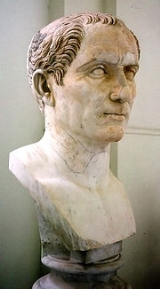
57 Battle of the Axona: Julius Caesar defeats the forces of the Belgae under King Galba of the Suessiones.
55 Julius Caesar defeats a Germanic army then massacres the women and children, totalling 430,000 people, somewhere near the Meuse and Rhine Rivers.
54 Julius Caesar's second expedition to Britain: receives nominal submission from the chieftain Cassivellaunus and installs Mandubracius as a friendly king.
49 The Roman Senate receives a proposal from Julius Caesar that he and Pompey should lay down their commands simultaneously. The Senate responds that Caesar must immediately surrender his command.
49 Julius Caesar leads his army across the Rubicon, which separates his jurisdiction (Cisalpine Gaul) from that of the Senate (Italy), and thus initiates a civil war. In response, the Roman senate invokes the ''senatus consultum ultimum''.
48 Publius Servilius Vatia Isauricus, co-consul with Julius Caesar, destroys Caelius's magistrate's chair on his tribunal.
47 Roman general Julius Caesar and his ally Cleopatra VII of Egypt defeat the forces of the rival Egyptian Queen Arsinoe IV in the Battle of the Nile. Ptolemy is killed; Caesar then relieves his besieged forces in Alexandria.
46 Titus Labienus bloodly defeats Julius Caesar in the Battle of Ruspina.
46 Julius Caesar defeats the combined army of Pompeian followers and Numidians under Metellus Scipio and Juba at Thapsus.
46 Julius Caesar dedicates a temple to his mythical ancestor Venus Genetrix in fulfilment of a vow he made at the battle of Pharsalus.
45 In his last victory, Julius Caesar defeats the Pompeian forces of Titus Labienus and Pompey the younger in the Battle of Munda. Labienus dies in battle, Pompey the younger is executed, but Sextus Pompey escapes to take command of the remnants of the Pompeian fleet.
44 (the ''Ides of March'') - Julius Caesar, dictator of Rome, is assassinated by a group of Roman senators, amongst them Gaius Cassius Longinus, Marcus Junius Brutus, and Caesar's Massilian naval commander, Decimus Brutus. Caesar's famous last quote - coined by William Shakespeare in his play ''Julius Caesar'' - was most likely ''not'' spoken (see: "''Et tu, Brute?''").
43 Battle of Forum Gallorum: Mark Antony, besieging Caesar's assassin Decimus Brutus in Mutina, defeats the forces of the consul Pansa, but is then immediately defeated by the army of the other consul, Hirtius. Both consuls are killed (Hirtius did not die until after the Battle of Mutina; Octavian takes command of their armies.
62 Lucan writes a history of the conflict between Julius Caesar and Pompey.
69 Galba, governor of Spain, names himself ''legatus senatus populique Romani'', breaking the line of Roman emperors begun with Caesar and Augustus. He was assassinated by the Praetorian Guards in favor of Marcus Salvius Otho.
1956 2,000th anniversary of the assassination of Julius Caesar