

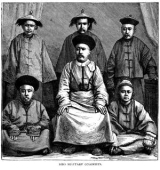
Xibe

Encyclopedia
The Xibe or Sibo are a Tungusic ethnic group
living mostly in northeast China
and Xinjiang
. They form one of the 56 ethnic groups officially recognized by the People's Republic of China
.
and Songhua
river valleys in central Manchuria
. They are known as one of the nine states that were defeated by Nurhaci
in the Battle of Gure in 1593. They were under loose domination of the Khorchin
Mongols even after the Khorchin came under the control of the Manchu
Qing Dynasty
.
The Xibe started to make direct contact with the Qing Dynasty when it conducted military campaigns against Russia
. They provided logistical support to the Qing. In 1692, the Khorchin dedicated the Xibe, the Gūwalca and the Daur to the Kangxi Emperor
in exchange for silver. The Xibe was incorporated into the Eight Banners
and were stationed in Qiqihar
and other cities in Manchuria.
After conquering eastern Turkestan, the Qianlong Emperor
garrisoned part of the Xibe there in 1764 to defend the new frontier. They formed a community in the Qapqal
region south of the Ili River
.
s. Nowadays almost all the Xibe wear Western clothing and the traditional clothing is worn by elders during festivals.
Traditionally, the Xibe were divided into hala, clans consisting of people who shared the same surname
. Until modern times, the dwellings of the Xibe housed up to three different generations from a same family, since it was believed that while the father was alive no son could break the family clan and to the house.
as their first language
. In Xinjiang, descendants of the Qing dynasty
military garrison preserve their language, which is a dialect of the Manchu
. Unlike the Manchu language
, the Xibe language is reported to have eight vowel distinctions as opposed to the six found in Manchu, differences in morphology, and a complex kind of vowel harmony
. The general vocabulary and structure of Xibe has not been affected as much by the influence of Chinese as Manchu has been. However, there are a number of Chinese loanwords, and a large body of sociological terminology, such as gəming (revolution) and gungshə (commune), have been borrowed from Chinese and incorporated into the everyday vocabulary of the language. They use the Xibe script, a slightly revised Manchu script
.
. The modern expert on the Manchu people Pamela Kyle Crossley
notes that if such a connection is indeed true, it would imply the Xianbei/Xibe undergoing a language shift
from an either early Turkic or Proto-Mongolian language to a Tungusic one at some point in their history. They also note that such a putative connection encounters an obvious problem of explaining "many centuries intervening between the Xianbei and Sibo, during which there is virtually no evidence of a 'Sibo' people".
The same Manchurologist, P. Crossley
, suggested that the Xibe "were well known to Russians moving toward the Pacific, who named Siberia
after them". This, however, appears rather less likely than the standard derivation of the Russian Sibir (Siberia) from the name of Sibir Khanate and its capital Sibir
. The latter names were well attested already in the mid-16th century (see, e.g., "Sibier Provincia" on Sigismund von Herberstein
's map of Moscovia dated 1549, or the city and region of "Sibier" on Mercator
's map of Asia (1595), while Russian explorers did not even reach today's Inner Mongolia
until Ivan Petlin
(1618), or the Amur basin, until Vassili Poyarkov
(1643).
Ethnic group
An ethnic group is a group of people whose members identify with each other, through a common heritage, often consisting of a common language, a common culture and/or an ideology that stresses common ancestry or endogamy...
living mostly in northeast China
China
Chinese civilization may refer to:* China for more general discussion of the country.* Chinese culture* Greater China, the transnational community of ethnic Chinese.* History of China* Sinosphere, the area historically affected by Chinese culture...
and Xinjiang
Xinjiang
Xinjiang is an autonomous region of the People's Republic of China. It is the largest Chinese administrative division and spans over 1.6 million km2...
. They form one of the 56 ethnic groups officially recognized by the People's Republic of China
People's Republic of China
China , officially the People's Republic of China , is the most populous country in the world, with over 1.3 billion citizens. Located in East Asia, the country covers approximately 9.6 million square kilometres...
.
History
The Xibe originally lived on the NonniNen River
Nen River or Nenjiang , or Nonni is a river in Northeast China. The Nen River flows through the northern part of Heilongjiang Province and the northeastern section of Inner Mongolia, some parts of the river forming the border between the two regions...
and Songhua
Songhua River
The Songhua or Sunggari River is a river in Northeast China, and is the largest tributary of the Heilong River , flowing about from Changbai Mountains through Jilin and Heilongjiang provinces. The river drains of land, and has an annual discharge of .As the Second Songhua River, it joins the...
river valleys in central Manchuria
Manchuria
Manchuria is a historical name given to a large geographic region in northeast Asia. Depending on the definition of its extent, Manchuria usually falls entirely within the People's Republic of China, or is sometimes divided between China and Russia. The region is commonly referred to as Northeast...
. They are known as one of the nine states that were defeated by Nurhaci
Nurhaci
Nurhaci was an important Jurchen chieftain who rose to prominence in the late sixteenth century in what is today Northeastern China...
in the Battle of Gure in 1593. They were under loose domination of the Khorchin
Khorchin
Khorchin is a subgroup of the Mongols that speak the Khorchin dialect of Mongolian and predominantly live in southeastern Inner Mongolia....
Mongols even after the Khorchin came under the control of the Manchu
Manchu
The Manchu people or Man are an ethnic minority of China who originated in Manchuria . During their rise in the 17th century, with the help of the Ming dynasty rebels , they came to power in China and founded the Qing Dynasty, which ruled China until the Xinhai Revolution of 1911, which...
Qing Dynasty
Qing Dynasty
The Qing Dynasty was the last dynasty of China, ruling from 1644 to 1912 with a brief, abortive restoration in 1917. It was preceded by the Ming Dynasty and followed by the Republic of China....
.
The Xibe started to make direct contact with the Qing Dynasty when it conducted military campaigns against Russia
Russia
Russia or , officially known as both Russia and the Russian Federation , is a country in northern Eurasia. It is a federal semi-presidential republic, comprising 83 federal subjects...
. They provided logistical support to the Qing. In 1692, the Khorchin dedicated the Xibe, the Gūwalca and the Daur to the Kangxi Emperor
Kangxi Emperor
The Kangxi Emperor ; Manchu: elhe taifin hūwangdi ; Mongolian: Энх-Амгалан хаан, 4 May 1654 –20 December 1722) was the fourth emperor of the Qing Dynasty, the first to be born on Chinese soil south of the Pass and the second Qing emperor to rule over China proper, from 1661 to 1722.Kangxi's...
in exchange for silver. The Xibe was incorporated into the Eight Banners
Eight Banners
The Eight Banners were administrative divisions into which all Manchu families were placed. They provided the basic framework for the Manchu military organization...
and were stationed in Qiqihar
Qiqihar
- Subdivisions :Qiqihar is divided into 16 divisions: 7 districts , 8 counties and 1 county-level city .-Economy:...
and other cities in Manchuria.
After conquering eastern Turkestan, the Qianlong Emperor
Qianlong Emperor
The Qianlong Emperor was the sixth emperor of the Manchu-led Qing Dynasty, and the fourth Qing emperor to rule over China proper. The fourth son of the Yongzheng Emperor, he reigned officially from 11 October 1735 to 8 February 1796...
garrisoned part of the Xibe there in 1764 to defend the new frontier. They formed a community in the Qapqal
Qapqal Xibe Autonomous County
Qapqal Xibe Autonomous County in Ili Kazakh Autonomous Prefecture in northern Xinjiang is the only Xibe autonomous county of the People's Republic of China. It has an area of 4,430 square kilometers and a population 160,000...
region south of the Ili River
Ili River
thumb|right|300px|Map of the Lake Balkhash drainage basin showing the Ili River and its tributariesThe Ili River is a river in northwestern China and southeastern Kazakhstan .It is long, of which is in Kazakhstan...
.
Culture
The traditional dress of the Xibe was similar to the traditional dress of the ManchuManchu
The Manchu people or Man are an ethnic minority of China who originated in Manchuria . During their rise in the 17th century, with the help of the Ming dynasty rebels , they came to power in China and founded the Qing Dynasty, which ruled China until the Xinhai Revolution of 1911, which...
s. Nowadays almost all the Xibe wear Western clothing and the traditional clothing is worn by elders during festivals.
Traditionally, the Xibe were divided into hala, clans consisting of people who shared the same surname
Surname
A surname is a name added to a given name and is part of a personal name. In many cases, a surname is a family name. Many dictionaries define "surname" as a synonym of "family name"...
. Until modern times, the dwellings of the Xibe housed up to three different generations from a same family, since it was believed that while the father was alive no son could break the family clan and to the house.
Language
The Xibe in northeast China speak ChineseChinese language
The Chinese language is a language or language family consisting of varieties which are mutually intelligible to varying degrees. Originally the indigenous languages spoken by the Han Chinese in China, it forms one of the branches of Sino-Tibetan family of languages...
as their first language
First language
A first language is the language a person has learned from birth or within the critical period, or that a person speaks the best and so is often the basis for sociolinguistic identity...
. In Xinjiang, descendants of the Qing dynasty
Qing Dynasty
The Qing Dynasty was the last dynasty of China, ruling from 1644 to 1912 with a brief, abortive restoration in 1917. It was preceded by the Ming Dynasty and followed by the Republic of China....
military garrison preserve their language, which is a dialect of the Manchu
Manchu language
Manchu is a Tungusic endangered language spoken in Northeast China; it used to be the language of the Manchu, though now most Manchus speak Mandarin Chinese and there are fewer than 70 native speakers of Manchu out of a total of nearly 10 million ethnic Manchus...
. Unlike the Manchu language
Manchu language
Manchu is a Tungusic endangered language spoken in Northeast China; it used to be the language of the Manchu, though now most Manchus speak Mandarin Chinese and there are fewer than 70 native speakers of Manchu out of a total of nearly 10 million ethnic Manchus...
, the Xibe language is reported to have eight vowel distinctions as opposed to the six found in Manchu, differences in morphology, and a complex kind of vowel harmony
Vowel harmony
Vowel harmony is a type of long-distance assimilatory phonological process involving vowels that occurs in some languages. In languages with vowel harmony, there are constraints on which vowels may be found near each other....
. The general vocabulary and structure of Xibe has not been affected as much by the influence of Chinese as Manchu has been. However, there are a number of Chinese loanwords, and a large body of sociological terminology, such as gəming (revolution) and gungshə (commune), have been borrowed from Chinese and incorporated into the everyday vocabulary of the language. They use the Xibe script, a slightly revised Manchu script
Manchu alphabet
The Manchu alphabet was used for recording the now near-extinct Manchu language; a similar script is used today by the Xibe people, who speak a language descended from Manchu...
.
Historical Issues with Xibe Language and Ethnonym
The name "Xibe" have been linked by some people with that of the ancient XianbeiXianbei
The Xianbei were a significant Mongolic nomadic people residing in Manchuria, Inner Mongolia and eastern Mongolia. The title “Khan” was first used among the Xianbei.-Origins:...
. The modern expert on the Manchu people Pamela Kyle Crossley
Pamela Kyle Crossley
Pamela Kyle Crossley is an historian of modern China, northern Asia, and global history. She is author of The Wobbling Pivot: China since 1800: An Interpretive History , as well as influential studies of the Qing dynasty and leading textbooks in global history...
notes that if such a connection is indeed true, it would imply the Xianbei/Xibe undergoing a language shift
Language shift
Language shift, sometimes referred to as language transfer or language replacement or assimilation, is the progressive process whereby a speech community of a language shifts to speaking another language. The rate of assimilation is the percentage of individuals with a given mother tongue who speak...
from an either early Turkic or Proto-Mongolian language to a Tungusic one at some point in their history. They also note that such a putative connection encounters an obvious problem of explaining "many centuries intervening between the Xianbei and Sibo, during which there is virtually no evidence of a 'Sibo' people".
The same Manchurologist, P. Crossley
Pamela Kyle Crossley
Pamela Kyle Crossley is an historian of modern China, northern Asia, and global history. She is author of The Wobbling Pivot: China since 1800: An Interpretive History , as well as influential studies of the Qing dynasty and leading textbooks in global history...
, suggested that the Xibe "were well known to Russians moving toward the Pacific, who named Siberia
Siberia
Siberia is an extensive region constituting almost all of Northern Asia. Comprising the central and eastern portion of the Russian Federation, it was part of the Soviet Union from its beginning, as its predecessor states, the Tsardom of Russia and the Russian Empire, conquered it during the 16th...
after them". This, however, appears rather less likely than the standard derivation of the Russian Sibir (Siberia) from the name of Sibir Khanate and its capital Sibir
Qashliq
Qashliq, Isker or Sibir was a medieval Siberian Tatar fortress, in the 16th century the capital of the Khanate of Sibir, located on the right bank of the Irtysh River at its confluence with the Sibirka rivulet, some 17 km from the modern city of Tobolsk.The fortress is first mentioned in...
. The latter names were well attested already in the mid-16th century (see, e.g., "Sibier Provincia" on Sigismund von Herberstein
Sigismund von Herberstein
Siegmund Freiherr von Herberstein, , was an Carniolan diplomat, writer, historian and member of the Holy Roman Empire Imperial Council...
's map of Moscovia dated 1549, or the city and region of "Sibier" on Mercator
Mercator
Mercator may refer to:* Marius Mercator , a Catholic ecclesiastical writer* Gerardus Mercator, a 16th-century Flemish cartographer** Mercator projection, a cartographic projection devised by Gerardus Mercator...
's map of Asia (1595), while Russian explorers did not even reach today's Inner Mongolia
Inner Mongolia
Inner Mongolia is an autonomous region of the People's Republic of China, located in the northern region of the country. Inner Mongolia shares an international border with the countries of Mongolia and the Russian Federation...
until Ivan Petlin
Ivan Petlin
Ivan Petlin Petlin), a Siberian Cossack, was the first Russian to have reached China on an official mission . His expedition may have been the second European expedition to reach China from the west by an overland route since the fall of the Yuan Dynasty...
(1618), or the Amur basin, until Vassili Poyarkov
Vassili Poyarkov
Vassili Danilovich Poyarkov was the first Russian explorer of the Amur region.The Russian expansion into Siberia began with the conquest of the Khanate of Sibir in 1582. By 1643 they reached the Pacific at Okhotsk...
(1643).
Politicians & military commander
- Gao Jingxu (高景旭) – former vice minister of the Lanzhou Military Region.
- He Zhiwu (何志武) – former commander of the North Sea Fleet base in Lüshun.
- Na Qiming (那启明) – former Air Force deputy director of the Political Department.
Artists
- Song Xue (宋雪) – mezzo-soprano and senior management of Chinese cultural and performing arts Co. Ltd
- Chun Ying (春英) – dancer
- Guan Bochun (关柏春) – artist
- Tong Liya (佟丽娅) – actress
Writers and Poets
- Chen Tiejun (陈铁军) – writer
- He Jiucheng (何久成) – vice chairman of Qiqihar City Writers Association
- Wu Yuanfeng (吴元丰) – famous for cataloging, translating and researches on the Manchu Qing Dynasty archives.
Media and entertainment industry
- Guan Yunke (关蕴科) – director of operations of A1 Team ChinaA1 Team ChinaA1 Team China is the Chinese team of A1 Grand Prix, an international racing series.-Management:The seat holder A1 Team China is Liu Yu...
. - Li Li (李力) – former director of Shenyang Chemical Plant, Beijing Yanshan Petrochemical
- Yao Miao (瑶淼) formerly known as Guan Yaomiao (关垚淼) – a present is CCTV movie channel director