

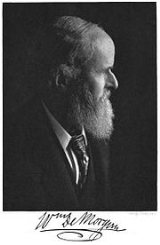
William De Morgan

Encyclopedia
England
England is a country that is part of the United Kingdom. It shares land borders with Scotland to the north and Wales to the west; the Irish Sea is to the north west, the Celtic Sea to the south west, with the North Sea to the east and the English Channel to the south separating it from continental...
potter and tile
Tile
A tile is a manufactured piece of hard-wearing material such as ceramic, stone, metal, or even glass. Tiles are generally used for covering roofs, floors, walls, showers, or other objects such as tabletops...
designer. A lifelong friend of William Morris
William Morris
William Morris 24 March 18343 October 1896 was an English textile designer, artist, writer, and socialist associated with the Pre-Raphaelite Brotherhood and the English Arts and Crafts Movement...
, he designed tiles, stained glass and furniture for Morris & Co.
Morris & Co.
Morris, Marshall, Faulkner & Co. and its successor Morris & Co. were furnishings and decorative arts manufacturers and retailers founded by the Pre-Raphaelite artist and designer William Morris...
from 1863 to 1872. His tiles are often based on medieval designs or Persian patterns, and he experimented with innovative glazes and firing techniques. Galleons and fish were popular motifs, as were "fantastical" birds and other animals. Many of De Morgan's tile designs were planned to create intricate patterns when several tiles were laid together.
Life and work

Augustus De Morgan
Augustus De Morgan was a British mathematician and logician. He formulated De Morgan's laws and introduced the term mathematical induction, making its idea rigorous. The crater De Morgan on the Moon is named after him....
and his highly educated wife, De Morgan was always supported in his desire to become an artist. At the age of twenty he entered the Royal Academy
Royal Academy
The Royal Academy of Arts is an art institution based in Burlington House on Piccadilly, London. The Royal Academy of Arts has a unique position in being an independent, privately funded institution led by eminent artists and architects whose purpose is to promote the creation, enjoyment and...
schools, but he was swiftly disillusioned with the establishment; then he met Morris, and through him the Pre-Raphaelite circle. Soon De Morgan began experimenting with stained glass, ventured into pottery in 1863, and by 1872 had shifted his interest wholly to ceramics.
In 1872, De Morgan set up a pottery works in Chelsea
Chelsea, London
Chelsea is an area of West London, England, bounded to the south by the River Thames, where its frontage runs from Chelsea Bridge along the Chelsea Embankment, Cheyne Walk, Lots Road and Chelsea Harbour. Its eastern boundary was once defined by the River Westbourne, which is now in a pipe above...
where he stayed through 1881 — his most fruitful decade as an art potter. The arts and crafts ideology he was exposed to through his friendship with Morris and his own insistent curiosity, led De Morgan to begin to explore every technical aspect of his craft. His early efforts at making his own tiles during his Chelsea Period were of variable technical quality - often amateurish with firing defects and irregularities. In his early years De Morgan made extensive use of blank commercial tiles. Biscuit tiles of red clay were obtained from the Architectural Pottery Co. in Poole and these are hard and very durable. Dust pressed tiles of white earthenware were bought from Wedgwood, Mintons and other manufacturers but De Morgan believed these would not stand frost. He continued to use blank commercial dust-pressed tiles which were decorated in red lustre into his Fulham Period (1988-1907). However he developed a high quality biscuit tile of his own, which he admired for its irregularities and better resistance to moisture. His inventive streak led him to spend hours designing a new duplex bicycle gear and also lured him into complex studies of the chemistry of glazes, methods of firing, and pattern transfer.
De Morgan's decoration of pottery included chargers, rice dishes and vases. Some of these were made in his works but many were bought as biscuit ware from Wedgwood and others and decorated by De Morgan's workers. Some were signed by his decorators including Charles Passenger, Fred Passenger, Joe Juster and Miss Babb.
De Morgan was particularly drawn to Eastern tiles. Around 1873–1874, he made a striking breakthrough by rediscovering the technique of lustre ware (characterized by a reflective, metallic surface) found in Hispano-Moresque
Hispano-Moresque
Hispano-Moresque ware is a style of initially Islamic pottery created in Al Andalus or Muslim Spain, which continued to be produced under Christian rule in styles blending Islamic and European elements...
pottery and Italian
Italy
Italy , officially the Italian Republic languages]] under the European Charter for Regional or Minority Languages. In each of these, Italy's official name is as follows:;;;;;;;;), is a unitary parliamentary republic in South-Central Europe. To the north it borders France, Switzerland, Austria and...
maiolica
Maiolica
Maiolica is Italian tin-glazed pottery dating from the Renaissance. It is decorated in bright colours on a white background, frequently depicting historical and legendary scenes.-Name:...
. Nor was his interest in the East limited to glazing techniques, but it permeated his notions of design and colour, as well. As early as 1875, he began to work in earnest with a "Persian" palette: dark blue, turquoise, manganese purple, green, Indian red, and lemon yellow, Study of the motifs of what he referred to as "Persian" ware (and what we know today as fifteenth-and-sixteenth century İznik ware
Iznik pottery
İznik pottery, named after the town in western Anatolia where it was made, is highly decorated ceramics that was produced between the late 15th and 17th centuries....
), profoundly influenced his unmistakable style, in which fantastic creatures entwined with rhythmic geometric motifs float under luminous glazes.

Pre-Raphaelite Brotherhood
The Pre-Raphaelite Brotherhood was a group of English painters, poets, and critics, founded in 1848 by William Holman Hunt, John Everett Millais and Dante Gabriel Rossetti...
painter Evelyn Pickering de Morgan
Evelyn De Morgan
Evelyn De Morgan was an English Pre-Raphaelite painter.She was born Evelyn Pickering. Her parents were of upper middle class. Her father was Percival Pickering QC, the Recorder of Pontefract...
, and a partnership with the architect Halsey Ricardo. This partnership was associated with a move for the factory from Merton Abbey to Fulham in 1888. During the Fulham period De Morgan mastered many of the technical aspects of his work that had previously been elusive, including complex lustres and deep, intense underglaze painting that did not run during firing. However, this did not guarantee financial success, and in 1907 William De Morgan left the pottery, which continued under the Passenger brothers, the leading painters at the works. "All my life I have been trying to make beautiful things," he said at the time, "and now that I can make them nobody wants them."
William De Morgan turned his hand to writing novels, and became better known than he ever had been for his pottery. His first novel, Joseph Vance, was published in 1906, and was an instant sensation in the United States as well as the United Kingdom. This was followed by An Affair of Dishonour, Alice-for-Short, and It Never Can Happen Again. The genre has been described as 'Victorian and suburban'.
William De Morgan died in London in 1917,, of trench fever
Trench fever
Trench fever is a moderately serious disease transmitted by body lice. It infected armies in Flanders, France, Poland, Galicia, Italy, Salonika, Macedonia, Mesopotamia, and Egypt in World War I Trench fever (also known as "Five day fever", "Quintan fever" (febris Quintana in Latin), "Urban trench...
, and was buried in Brookwood Cemetery
Brookwood Cemetery
Brookwood Cemetery is a burial ground in Brookwood, Surrey, England. It is the largest cemetery in the United Kingdom and one of the largest in western Europe.-History:...
. Recollections of William De Morgan praise him both for his personal warmth and the indomitable energy with which he pursued his kaleidoscopic career as designer, potter, inventor and novelist.
Collections of De Morgan's work exist in many museums, including the Victoria and Albert Museum
Victoria and Albert Museum
The Victoria and Albert Museum , set in the Brompton district of The Royal Borough of Kensington and Chelsea, London, England, is the world's largest museum of decorative arts and design, housing a permanent collection of over 4.5 million objects...
, and the William Morris Gallery
William Morris Gallery
The William Morris Gallery, opened by Prime Minister Clement Attlee in 1950, is the only public museum devoted to English Arts and Crafts, designer William Morris...
in London
London
London is the capital city of :England and the :United Kingdom, the largest metropolitan area in the United Kingdom, and the largest urban zone in the European Union by most measures. Located on the River Thames, London has been a major settlement for two millennia, its history going back to its...
, a substantial and representative collection in Birmingham Museum and Art Gallery, and a small but well-chosen collection along with much other pottery at Norwich
Norwich
Norwich is a city in England. It is the regional administrative centre and county town of Norfolk. During the 11th century, Norwich was the largest city in England after London, and one of the most important places in the kingdom...
. His dragon charger is in the Dunedin Public Art Gallery
Dunedin Public Art Gallery
The Dunedin Public Art Gallery holds the main public art collection of the city of Dunedin, New Zealand. Located in The Octagon in the heart of the city, it is close to the city's public library, municipal chambers, and other facilities such as the Regent Theatre.-History:The gallery was founded by...
in New Zealand. The National Gallery of Canada in Ottawa has a very good collection of William De Morgan's work given by Ruth Amelia Jackson in 1997 but much of it is kept in store. De Morgan's work is also present in many major collections with decorative art including the Art Gallery of Ontario, Toronto, Canada, the Musee D'Orsay, Paris, Manchester Art Gallery and the Fitzwilliam Museum, Cambridge.
A number of properties in the UK open to the public have tiles and pottery on display or incorporated in the building's decoration. These include Wightwick Manor (the National Trust, Wolverhampton), Standen (the National Trust,East Grinstead), Blackwell (Lakeland Arts Trust, Windermere) and Leighton House (London Borough of Kensington).