

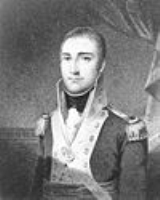
William C.C. Claiborne

Encyclopedia
William Charles Cole Claiborne (b. before 23 November 1772, or on 13 August 1773, or between 23 November 1773 and 23 November 1774, or in August 1775 – d. 23 November 1817) was a United States
politician, best known as the first Governor of Louisiana
. He also has the distinction of possibly being the youngest Congressman
in U.S. history, though reliable sources differ about his age.
, Virginia
. His parents were Colonel William Claiborne and Mary Leigh Claiborne.
He studied at the College of William and Mary
, then Richmond Academy
. At the age of 16 he moved to New York City
, where he worked as a clerk under John Beckley, the clerk of the United States House of Representatives, which was then seated in that city. He moved to Philadelphia with the Federal Government. He then began study of law
, and moved to Tennessee
in 1794 to start a law practice. Governor John Sevier
appointed Claiborne to the Tennessee Supreme Court
in 1796.
. However, the new congressman may not have been 25 years of age, as required by the United States Constitution
: "No Person shall be a Representative who shall not have attained to the Age of twenty five Years". Earlier in 1797, he described his age to George Washington
vaguely: "Born Sir at a period, when every American Breast palpitated for freedom, I became early attached to civil Liberty...."
He took his seat in the House on November 23, 1797. State records apparently indicate that, when he took his seat, he was 24. Other sources speculate he was 22. His gravestone says he was 23. And by taking his oath of office, he self-identified as being at least 25.
He served in the House through 1801. The United States presidential election of 1800
was decided in the House of Representatives, due to a tie in the Electoral College
, by which time Claiborne had apparently already turned 25 years old.
from 1801 through 1803. Although he favored acquiring some land from the Choctaw and Chickasaw, Claiborne was generally sympathetic and conciliatory toward Indians. He worked long and patiently to iron out differences that arose, and to improve the material well-being of the Indians. He was also partly successful in promoting the establishment of law and order, as when his offering of a two thousand dollar reward helped destroy a gang of outlaws headed by Samuel Mason
(1750–1803). His position on issues indicated a national rather than regional outlook, though he did not ignore his constituents. Claiborne expressed the philosophy of the Republican Party and helped that party defeat the Federalists. When a smallpox epidemic broke out in the spring of 1802, Claiborne's actions resulted in the first recorded mass vaccination in the territory and saved Natchez from the disease.
and oversaw the transfer of Louisiana to U.S. control after the Louisiana Purchase
in 1803. He governed what would become the State of Louisiana, then termed the "Territory of Orleans", during its period as a United States territory
from 1804 through 1812.
Relations with Louisiana's Créole
population were initially rather strained: Claiborne was young, inexperienced and unsure of himself, and on his arrival spoke no French. He gradually gained their confidence, saw the territory take in Francophone
refugees from the Haitian Revolution
, and suppressed a slave
revolt in the area around La Place.
In 1805, Claiborne appointed Alexander Fulton
, the founder of Alexandria
, as the coroner of Rapides Parish
.
He presided over the suppression of the largest slave revolt in American history, the 1811 German Coast Uprising
.
After West Florida
secured its independence from Spain in 1810, Claiborne annexed the area on the orders of President Madison
, who considered it part of the Louisiana Purchase
.
, winning the election of 1812
against Jacques Villeré
, and serving from 1812 through 1816.
After his term as governor, he was elected to the United States Senate
, serving from April 4, 1817 until his death on November 23, 1817 (which was 20 years to the day after his first day in Congress).
in New Orleans.
Three U.S. counties
are named in his honor: Claiborne Parish, Louisiana
; Claiborne County, Mississippi
; and Claiborne County, Tennessee. The longest street
in New Orleans is named in his honor: Claiborne Avenue
.
The World War II
Camp Claiborne
was named for him in 1939. This installation is still used today for training the Louisiana
Army National Guard
, particularly by the 256th Infantry Brigade for road marches and land navigation.
The Claiborne Building is located in downtown Baton Rouge and serves as a government administrative center for the Louisiana government.
William Claiborne was a direct ancestor of fashion designer Liz Claiborne.
In 1993, Claiborne was posthumously inducted into the Louisiana Political Museum and Hall of Fame
in Winnfield
. Along with Huey Pierce Long, Jr., and Earl Kemp Long, Claiborne was among the first thirteen inductees into the Hall of Fame.
United States
The United States of America is a federal constitutional republic comprising fifty states and a federal district...
politician, best known as the first Governor of Louisiana
Louisiana
Louisiana is a state located in the southern region of the United States of America. Its capital is Baton Rouge and largest city is New Orleans. Louisiana is the only state in the U.S. with political subdivisions termed parishes, which are local governments equivalent to counties...
. He also has the distinction of possibly being the youngest Congressman
United States Congress
The United States Congress is the bicameral legislature of the federal government of the United States, consisting of the Senate and the House of Representatives. The Congress meets in the United States Capitol in Washington, D.C....
in U.S. history, though reliable sources differ about his age.
Early life and career
William C. C. Claiborne was born in Sussex CountySussex County, Virginia
As of the census of 2000, there were 12,504 people, 4,126 households, and 2,809 families residing in the county. The population density was 26 people per square mile . There were 4,653 housing units at an average density of 10 per square mile...
, Virginia
Virginia
The Commonwealth of Virginia , is a U.S. state on the Atlantic Coast of the Southern United States. Virginia is nicknamed the "Old Dominion" and sometimes the "Mother of Presidents" after the eight U.S. presidents born there...
. His parents were Colonel William Claiborne and Mary Leigh Claiborne.
He studied at the College of William and Mary
College of William and Mary
The College of William & Mary in Virginia is a public research university located in Williamsburg, Virginia, United States...
, then Richmond Academy
Richmond Academy
Richmond Academy is a 9-12 school attended by about 420 students located in Louisdale, Nova Scotia, Canada.- October 23, 2006 walkout :On October 23, 2006, approximately 200 students walked out of class and the school, in protest of comments made by a Halifax Herald reporter, who had called all...
. At the age of 16 he moved to New York City
New York City
New York is the most populous city in the United States and the center of the New York Metropolitan Area, one of the most populous metropolitan areas in the world. New York exerts a significant impact upon global commerce, finance, media, art, fashion, research, technology, education, and...
, where he worked as a clerk under John Beckley, the clerk of the United States House of Representatives, which was then seated in that city. He moved to Philadelphia with the Federal Government. He then began study of law
Law
Law is a system of rules and guidelines which are enforced through social institutions to govern behavior, wherever possible. It shapes politics, economics and society in numerous ways and serves as a social mediator of relations between people. Contract law regulates everything from buying a bus...
, and moved to Tennessee
Tennessee
Tennessee is a U.S. state located in the Southeastern United States. It has a population of 6,346,105, making it the nation's 17th-largest state by population, and covers , making it the 36th-largest by total land area...
in 1794 to start a law practice. Governor John Sevier
John Sevier
John Sevier served four years as the only governor of the State of Franklin and twelve years as Governor of Tennessee. As a U.S. Representative from Tennessee from 1811 until his death...
appointed Claiborne to the Tennessee Supreme Court
Tennessee Supreme Court
The Tennessee Supreme Court is the state supreme court of the state of Tennessee. Cornelia Clark is the current Chief Justice.Unlike other states, in which the state attorney general is directly elected or appointed by the governor or state legislature, the Tennessee Supreme Court appoints the...
in 1796.
Congressman from Tennessee
In 1797, Claiborne resigned to run for a seat in the U.S. House of Representatives. He won, and succeeded Andrew JacksonAndrew Jackson
Andrew Jackson was the seventh President of the United States . Based in frontier Tennessee, Jackson was a politician and army general who defeated the Creek Indians at the Battle of Horseshoe Bend , and the British at the Battle of New Orleans...
. However, the new congressman may not have been 25 years of age, as required by the United States Constitution
United States Constitution
The Constitution of the United States is the supreme law of the United States of America. It is the framework for the organization of the United States government and for the relationship of the federal government with the states, citizens, and all people within the United States.The first three...
: "No Person shall be a Representative who shall not have attained to the Age of twenty five Years". Earlier in 1797, he described his age to George Washington
George Washington
George Washington was the dominant military and political leader of the new United States of America from 1775 to 1799. He led the American victory over Great Britain in the American Revolutionary War as commander-in-chief of the Continental Army from 1775 to 1783, and presided over the writing of...
vaguely: "Born Sir at a period, when every American Breast palpitated for freedom, I became early attached to civil Liberty...."
He took his seat in the House on November 23, 1797. State records apparently indicate that, when he took his seat, he was 24. Other sources speculate he was 22. His gravestone says he was 23. And by taking his oath of office, he self-identified as being at least 25.
He served in the House through 1801. The United States presidential election of 1800
United States presidential election, 1800
In the United States Presidential election of 1800, sometimes referred to as the "Revolution of 1800," Vice-President Thomas Jefferson defeated President John Adams. The election was a realigning election that ushered in a generation of Democratic-Republican Party rule and the eventual demise of...
was decided in the House of Representatives, due to a tie in the Electoral College
Electoral college
An electoral college is a set of electors who are selected to elect a candidate to a particular office. Often these represent different organizations or entities, with each organization or entity represented by a particular number of electors or with votes weighted in a particular way...
, by which time Claiborne had apparently already turned 25 years old.
Service in Mississippi
Claiborne was appointed governor and superintendent of Indian affairs in the Mississippi TerritoryMississippi Territory
The Territory of Mississippi was an organized incorporated territory of the United States that existed from April 7, 1798, until December 10, 1817, when the final extent of the territory was admitted to the Union as the state of Mississippi....
from 1801 through 1803. Although he favored acquiring some land from the Choctaw and Chickasaw, Claiborne was generally sympathetic and conciliatory toward Indians. He worked long and patiently to iron out differences that arose, and to improve the material well-being of the Indians. He was also partly successful in promoting the establishment of law and order, as when his offering of a two thousand dollar reward helped destroy a gang of outlaws headed by Samuel Mason
Samuel Mason
Samuel Mason or Meason was a Revolutionary War militia captain on the frontier, who following the war, became the leader of a gang of river pirates and highwaymen on the lower Ohio River and the Mississippi River in the late 18th and early 19th centuries...
(1750–1803). His position on issues indicated a national rather than regional outlook, though he did not ignore his constituents. Claiborne expressed the philosophy of the Republican Party and helped that party defeat the Federalists. When a smallpox epidemic broke out in the spring of 1802, Claiborne's actions resulted in the first recorded mass vaccination in the territory and saved Natchez from the disease.
Louisiana territorial period
Claiborne moved to New OrleansNew Orleans, Louisiana
New Orleans is a major United States port and the largest city and metropolitan area in the state of Louisiana. The New Orleans metropolitan area has a population of 1,235,650 as of 2009, the 46th largest in the USA. The New Orleans – Metairie – Bogalusa combined statistical area has a population...
and oversaw the transfer of Louisiana to U.S. control after the Louisiana Purchase
Louisiana Purchase
The Louisiana Purchase was the acquisition by the United States of America of of France's claim to the territory of Louisiana in 1803. The U.S...
in 1803. He governed what would become the State of Louisiana, then termed the "Territory of Orleans", during its period as a United States territory
United States territory
United States territory is any extent of region under the jurisdiction of the federal government of the United States, including all waters including all U.S. Naval carriers. The United States has traditionally proclaimed the sovereign rights for exploring, exploiting, conserving, and managing its...
from 1804 through 1812.
Relations with Louisiana's Créole
Louisiana Creole people
Louisiana Creole people refers to those who are descended from the colonial settlers in Louisiana, especially those of French and Spanish descent. The term was first used during colonial times by the settlers to refer to those who were born in the colony, as opposed to those born in the Old World...
population were initially rather strained: Claiborne was young, inexperienced and unsure of himself, and on his arrival spoke no French. He gradually gained their confidence, saw the territory take in Francophone
French language
French is a Romance language spoken as a first language in France, the Romandy region in Switzerland, Wallonia and Brussels in Belgium, Monaco, the regions of Quebec and Acadia in Canada, and by various communities elsewhere. Second-language speakers of French are distributed throughout many parts...
refugees from the Haitian Revolution
Haitian Revolution
The Haitian Revolution was a period of conflict in the French colony of Saint-Domingue, which culminated in the elimination of slavery there and the founding of the Haitian republic...
, and suppressed a slave
Slavery
Slavery is a system under which people are treated as property to be bought and sold, and are forced to work. Slaves can be held against their will from the time of their capture, purchase or birth, and deprived of the right to leave, to refuse to work, or to demand compensation...
revolt in the area around La Place.
In 1805, Claiborne appointed Alexander Fulton
Alexander Fulton (Louisiana)
Alexander Fulton was a merchant, planter, and local politician originally from Washington, near Pittsburgh in western Pennsylvania, who in 1805 founded the city of Alexandria, Louisiana, which he named for himself....
, the founder of Alexandria
Alexandria, Louisiana
Alexandria is a city in and the parish seat of Rapides Parish, Louisiana, United States. It lies on the south bank of the Red River in almost the exact geographic center of the state. It is the principal city of the Alexandria metropolitan area which encompasses all of Rapides and Grant parishes....
, as the coroner of Rapides Parish
Rapides Parish, Louisiana
-Military Installations:*Camp Beauregard *Esler Airfield *England Air Force Base *Camp Claiborne *Camp Livingston -Demographics:...
.
He presided over the suppression of the largest slave revolt in American history, the 1811 German Coast Uprising
1811 German Coast Uprising
The 1811 German Coast Uprising was a slave revolt that took place in parts of the Territory of Orleans on January 8–10, 1811. The revolt took place on the east coast of the Mississippi River in what are now St. John the Baptist and St. Charles Parishes, Louisiana. While the slave insurgency was...
.
After West Florida
West Florida
West Florida was a region on the north shore of the Gulf of Mexico, which underwent several boundary and sovereignty changes during its history. West Florida was first established in 1763 by the British government; as its name suggests it largely consisted of the western portion of the region...
secured its independence from Spain in 1810, Claiborne annexed the area on the orders of President Madison
James Madison
James Madison, Jr. was an American statesman and political theorist. He was the fourth President of the United States and is hailed as the “Father of the Constitution” for being the primary author of the United States Constitution and at first an opponent of, and then a key author of the United...
, who considered it part of the Louisiana Purchase
Louisiana Purchase
The Louisiana Purchase was the acquisition by the United States of America of of France's claim to the territory of Louisiana in 1803. The U.S...
.
After Louisiana statehood
Claiborne was the first elected governor after Louisiana became a U.S. stateU.S. state
A U.S. state is any one of the 50 federated states of the United States of America that share sovereignty with the federal government. Because of this shared sovereignty, an American is a citizen both of the federal entity and of his or her state of domicile. Four states use the official title of...
, winning the election of 1812
Louisiana gubernatorial election, 1812
The Louisiana gubernatorial election, 1812, was the first gubernatorial election to take place after Louisiana achieved statehood. Under Article III Sec 2 of the 1812 Constitution of the State of Louisiana the Governor was elected in two steps. On the first Monday in July, eligible voters went to...
against Jacques Villeré
Jacques Villeré
Jacques Phillippe Villeré was the second Governor of Louisiana after it became a state. He was the first Creole and the first native of Louisiana to attain that office.-Early life:...
, and serving from 1812 through 1816.
After his term as governor, he was elected to the United States Senate
United States Senate
The United States Senate is the upper house of the bicameral legislature of the United States, and together with the United States House of Representatives comprises the United States Congress. The composition and powers of the Senate are established in Article One of the U.S. Constitution. Each...
, serving from April 4, 1817 until his death on November 23, 1817 (which was 20 years to the day after his first day in Congress).
Posthumous honors and trivia
His body was originally buried in St. Louis Cemetery # 1. This was a controversial honor; this then most prestigious of the city's cemeteries is a Roman Catholic cemetery, while Claiborne was Protestant. He was hence reinterred in Metairie CemeteryMetairie Cemetery
Metairie Cemetery is a cemetery in New Orleans, Louisiana, United States. The name has caused some people to mistakenly presume that the cemetery is located in Metairie, Louisiana, but it is located within the New Orleans city limits, on Metairie Road .-History:This site was previously a horse...
in New Orleans.
Three U.S. counties
County (United States)
In the United States, a county is a geographic subdivision of a state , usually assigned some governmental authority. The term "county" is used in 48 of the 50 states; Louisiana is divided into parishes and Alaska into boroughs. Parishes and boroughs are called "county-equivalents" by the U.S...
are named in his honor: Claiborne Parish, Louisiana
Claiborne Parish, Louisiana
Claiborne Parish is a parish located in the U.S. state of Louisiana. The parish seat is Homer and as of 2000, the population is 16,851.-History:The parish is named for the first Louisiana governor, William C. C. Claiborne....
; Claiborne County, Mississippi
Claiborne County, Mississippi
-Demographics:As of the census of 2000, there were 11,831 people, 3,685 households, and 2,531 families residing in the county. The population density was 24 people per square mile . There were 4,252 housing units at an average density of 9 per square mile...
; and Claiborne County, Tennessee. The longest street
Street
A street is a paved public thoroughfare in a built environment. It is a public parcel of land adjoining buildings in an urban context, on which people may freely assemble, interact, and move about. A street can be as simple as a level patch of dirt, but is more often paved with a hard, durable...
in New Orleans is named in his honor: Claiborne Avenue
Claiborne Avenue
Claiborne Avenue is a major thoroughfare in New Orleans, Louisiana. It runs the length of the city, about , beginning at the Jefferson Parish line and ending at the St. Bernard Parish line; the street continues in each of these locations under different names. It is called South Claiborne Avenue...
.
The World War II
World War II
World War II, or the Second World War , was a global conflict lasting from 1939 to 1945, involving most of the world's nations—including all of the great powers—eventually forming two opposing military alliances: the Allies and the Axis...
Camp Claiborne
Camp Claiborne
Camp Claiborne was a U.S. Army military camp during World War II located in Rapides Parish in central Louisiana. The camp was under the jurisdiction of the U.S. Eighth Service Command, and included 23,000 acres ....
was named for him in 1939. This installation is still used today for training the Louisiana
Louisiana
Louisiana is a state located in the southern region of the United States of America. Its capital is Baton Rouge and largest city is New Orleans. Louisiana is the only state in the U.S. with political subdivisions termed parishes, which are local governments equivalent to counties...
Army National Guard
Army National Guard
Established under Title 10 and Title 32 of the U.S. Code, the Army National Guard is part of the National Guard and is divided up into subordinate units stationed in each of the 50 states, three territories and the District of Columbia operating under their respective governors...
, particularly by the 256th Infantry Brigade for road marches and land navigation.
The Claiborne Building is located in downtown Baton Rouge and serves as a government administrative center for the Louisiana government.
William Claiborne was a direct ancestor of fashion designer Liz Claiborne.
In 1993, Claiborne was posthumously inducted into the Louisiana Political Museum and Hall of Fame
Louisiana Political Museum and Hall of Fame
The Louisiana Political Museum and Hall of Fame in Winnfield, Louisiana, highlights the careers of more than a hundred of the state’s leading politicians and political journalists. Because three governors, Huey P. Long, Jr., Oscar K...
in Winnfield
Winnfield, Louisiana
Winnfield is a city in and the parish seat of Winn Parish, Louisiana, United States. The population was 5,749 at the 2000 census. It has long been associated with the Long faction of the Louisiana Democratic Party and was home to three governors of Louisiana.-Geography:Winnfield is located at ...
. Along with Huey Pierce Long, Jr., and Earl Kemp Long, Claiborne was among the first thirteen inductees into the Hall of Fame.
Further reading
- Hatfield, Joseph T. "Governor William Claiborne, Indians, and Outlaws in Frontier Mississippi, 1801-1803," Journal of Mississippi History 1965 27(4): 323-350
- Hatfield, Joseph Tennis. "William C. C. Claiborne, Congress, and Republicanism, 1797-1804," Tennessee Historical Quarterly 1965 24(2): 156-180,
External links
- State of Louisiana - Biography
- Cemetery Memorial by La-Cemeteries