
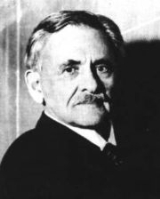
The
history of special relativity consists of many theoretical results and empirical findings obtained by Albert Michelson,
Hendrik LorentzHendrik Antoon Lorentz was a Dutch physicist who shared the 1902 Nobel Prize in Physics with Pieter Zeeman for the discovery and theoretical explanation of the Zeeman effect...
,
Henri PoincaréJules Henri Poincaré was a French mathematician and theoretical physicist, and a philosopher of science...
and others. It culminated in the theory of
special relativitySpecial relativity is the physical theory of measurement in inertial frames of reference proposed in 1905 by Albert Einstein in the paper "On the Electrodynamics of Moving Bodies"...
proposed by
Albert EinsteinAlbert Einstein was a theoretical physicist. His many contributions to physics include the special and general theories of relativity, the founding of relativistic cosmology, the first post-Newtonian expansion, explaining the perihelion advance of Mercury, prediction of the deflection of...
, and subsequent work of
Max PlanckMax Planck was a German physicist. He is considered to be the founder of the quantum theory, and thus one of the most important physicists of the twentieth century. Planck was awarded the Nobel Prize in Physics in 1918.-Biography:Planck came from a traditional, intellectual family...
,
Hermann MinkowskiHermann Minkowski was a German mathematician of Polish Jewish descent, who created and developed the geometry of numbers and who used geometrical methods to solve difficult problems in number theory, mathematical physics, and the theory of relativity.- Life and work :Hermann Minkowski was born in...
and others.
Introduction
Although
Isaac NewtonSir Isaac Newton FRS was an English physicist, mathematician, astronomer, natural philosopher, alchemist, and theologian who is perceived and considered by a substantial number of scholars and the general public as one of the most influential men in history...
based his theory on absolute space and time, he also adhered to the
Principle of relativityIn physics, the principle of relativity is the requirement that the equations, describing the laws of physics, have the same form in all admissible frames of reference....
of
Galileo GalileiGalileo Galilei was an Italian physicist, mathematician, astronomer, and philosopher who played a major role in the Scientific Revolution. His achievements include improvements to the telescope and consequent astronomical observations, and support for Copernicanism...
. This stated all observers who move uniformly relative to each other are equal and no absolute state of motion can be attributed to any observer. During the 19th century the aether theory was widely accepted, mostly in the form given by
James Clerk MaxwellJames Clerk Maxwell was a Scottish theoretical physicist and mathematician. His most significant achievement was the development of the classical electromagnetic theory, synthesizing all previous unrelated observations, experiments and equations of electricity, magnetism and even optics into a...
. According to Maxwell
all optical and electrical phenomena propagate in a medium. Thus it seemed possible to determine
absolute motion relative to the aether and therefore to disprove Galileo's Principle.
The failure of any experiment to detect motion through the aether led
Hendrik LorentzHendrik Antoon Lorentz was a Dutch physicist who shared the 1902 Nobel Prize in Physics with Pieter Zeeman for the discovery and theoretical explanation of the Zeeman effect...
in 1892 to the development of
Lorentz ether theoryWhat is now called Lorentz Ether theory has its roots in Hendrik Lorentz's "Theory of electrons", which was the final point in the development of the classical aether theories at the end of the 19
th and at the beginning of the 20
th century.Lorentz's initial theory created in...
, which was based on an immobile aether and the
Lorentz transformationIn physics, the Lorentz transformation describes how, according to the theory of special relativity, two observers' varying measurements of space and time can be converted into each other's frame of reference. It reflects the surprising fact that observers moving at different velocities report...
. Based on Lorentz's aether,
Henri PoincaréJules Henri Poincaré was a French mathematician and theoretical physicist, and a philosopher of science...
in 1905 proposed the Relativity Principle as a general law of nature, including Electrodynamics and
GravitationGravitation is a natural phenomenon by which objects with mass attract one another. In everyday life, gravitation is most commonly thought of as the agency which lends weight to objects with mass. Gravitation causes dispersed matter to coalesce, thus accounting for the existence of the Earth, the...
. In 1905
Albert EinsteinAlbert Einstein was a theoretical physicist. His many contributions to physics include the special and general theories of relativity, the founding of relativistic cosmology, the first post-Newtonian expansion, explaining the perihelion advance of Mercury, prediction of the deflection of...
published a paper on
Special RelativitySpecial relativity is the physical theory of measurement in inertial frames of reference proposed in 1905 by Albert Einstein in the paper "On the Electrodynamics of Moving Bodies"...
(SR) which reinterpreted Lorentzian Electrodynamics by changing the concepts of space and time and abolishing the aether. This paved the way to
General RelativityGeneral relativity or the general theory of relativity is the geometric theory of gravitation published by Albert Einstein in 1916. It is the current description of gravitation in modern physics. It unifies special relativity and Newton's law of universal gravitation, and describes gravity as a...
. Subsequent work of
Hermann MinkowskiHermann Minkowski was a German mathematician of Polish Jewish descent, who created and developed the geometry of numbers and who used geometrical methods to solve difficult problems in number theory, mathematical physics, and the theory of relativity.- Life and work :Hermann Minkowski was born in...
laid the foundations of
Relativistic Field TheoriesIn physics, a field is a physical quantity associated to each point of spacetime. A field can be classified as a scalar field, a vector field, or a tensor field, according to whether the value of the field at each point is a scalar, a vector, or, more generally, a tensor, respectively...
.
Aether models and Maxwell's equations
Following the work of
Thomas YoungThomas Young may refer to:*Thomas Young , Scottish Presbyterian and author*Thomas Young , member of the Sons of Liberty*Thomas Young , British polymath, scientist and Egyptologist...
(1804) and
Augustin-Jean FresnelAugustin-Jean Fresnel , was a French physicist who contributed significantly to the establishment of the theory of wave optics...
(1816), it was believed that light propagates as a
transverse waveA transverse wave is a moving wave that consists of oscillations occurring perpendicular to the direction of energy transfer. If a transverse wave is moving in the positive x-direction, its oscillations are in up and down directions that lie in the y-z plane.If you anchor one end of a ribbon or...
within an elastic medium called
luminiferous aetherIn the late 19th century, "luminiferous aether" , meaning light-bearing aether, was the term used to describe a medium for the propagation of light. The word aether stems via Latin from the Greek αιθήρ, from a root meaning to kindle, burn, or shine...
. However, a distinction was made between optical and electrodynamical phenomena so it was necessary to create specific aether models for all phenomena. Attempts to unify those models or to create a complete mechanical description of them did not succeed., but after considerable work of many scientists like
Michael FaradayMichael Faraday, FRS was an English chemist and physicist who contributed to the fields of electromagnetism and electrochemistry....
and
Lord KelvinWilliam Thomson, 1st Baron Kelvin , OM, GCVO, PC, PRS, FRSE, was a British mathematical physicist and engineer...
, it was
James Clerk MaxwellJames Clerk Maxwell was a Scottish theoretical physicist and mathematician. His most significant achievement was the development of the classical electromagnetic theory, synthesizing all previous unrelated observations, experiments and equations of electricity, magnetism and even optics into a...
(1864) who developed an accurate theory of
electromagnetismElectromagnetism is the physics of the electromagnetic field, a field that exerts a force on particles with the property of electric charge and is reciprocally affected by the presence and motion of such particles....
by deriving a set of equations in
electricityElectricity is a general term that encompasses a variety of phenomena resulting from the presence and flow of electric charge...
,
magnetismIn physics, the term magnetism is used to describe how materials respond on the microscopic level to an applied magnetic field; to categorize the magnetic phase of a material. For example, the most well known form of magnetism is ferromagnetism such that some ferromagnetic materials produce their...
and
inductanceInductance is the property in an electrical circuit where a change in the electric current through that circuit induces an electromotive force that opposes the change in current ....
, named
Maxwell's equationsMaxwell's equations are a set of four partial differential equations that relate the electric and magnetic fields to their sources, charge density and current density. These equations can be combined to show that light is an electromagnetic wave...
. He first proposed that light was in fact undulations (
Electromagnetic radiationElectromagnetic radiation is a ubiquitous phenomenon that takes the form of self-propagating waves in a vacuum or in matter. It consists of electric and magnetic field components which oscillate in phase perpendicular to each other and perpendicular to the direction of energy propagation...
) in the
same aetherial medium that is the cause of electric and magnetic phenomena. However, Maxwell's theory was unsatisfactory regarding the optics of moving bodies, and while he was able to present a complete mathematical model, he was not able to provide a coherent mechanical description of the aether.
J. J. ThomsonSir Joseph John “J. J.” Thomson, OM, FRS was a British physicist and Nobel laureate, credited for the discovery of the electron and of isotopes, and the invention of the mass spectrometer...
(1881) recognized, during his development of Maxwell's Theory, that charged bodies are harder to set in motion than uncharged bodies. He also noticed that the mass of a body
in motion is increased by a constant quantity. Electrostatic fields behave as if they add an "electromagnetic mass" beside the mechanical mass to the bodies. I.e., according to Thomson, electromagnetic energy corresponds to a certain mass. This was interpreted as some form of self-
inductanceInductance is the property in an electrical circuit where a change in the electric current through that circuit induces an electromotive force that opposes the change in current ....
of the electromagnetic field. Thomson's work was continued and perfected by
George FitzGeraldGeorge Francis FitzGerald was an Irish professor of "natural and experimental philosophy" at Trinity College, Dublin, in the late 19th century....
,
Oliver HeavisideOliver Heaviside was a self-taught English electrical engineer, mathematician, and physicist who adapted complex numbers to the study of electrical circuits, invented mathematical techniques to the solution of differential equations , reformulated Maxwell's field equations in terms of electric and...
(1888), and
George Frederick Charles SearleGeorge Frederick Charles Searle was a British physicist and teacher.He was a Fellow of the Royal Society. In 1888 he began work at the Cavendish Laboratory under J.J. Thomson, and ended up working with the lab for fifty-five years...
(1896, 1897). For the electromagnetic mass they gave — in modern notation — the formula
m = (4/3)
E/
c2, where m is the electromagnetic mass and E is the electromagnetic energy. Heaviside and Searle also recognized that the increase of the mass of a body is not constant and varies with its velocity. Consequently, Searle noted the impossibility of superluminal velocities, because an infinite amount of energy would be needed to exceed the speed of light. Additionally Heaviside and Searle determined that the electrostatic fields were contracted in the line of motion (Heaviside Ellipsoid), which leads to physically undetermined conditions at the speed of light.
After Heinrich Hertz in 1887 demonstrated the existence of electromagnetic waves, Maxwell's theory was widely accepted. In addition, Heaviside and Hertz further developed the theory and introduced modernized versions of Maxwell's equations. The "Maxwell-Hertz" or "Heaviside-Hertz" Equations subsequently formed an important basis for the further development of electrodynamics, and it is Heaviside's notation which is used until today. Hertz was one of the last proponents of the "mechanical world-view", according to which all electromagnetic processes should be reduced to mechanical impact and contact actions. Hertz also assumed, like
George Gabriel StokesSir George Gabriel Stokes, 1st Baronet FRS , was a mathematician and physicist, who at Cambridge made important contributions to fluid dynamics , optics, and mathematical physics...
, that the aether was completely carried along by the bodies. However, at the beginning of the 20th century his theory was disproved and was replaced by the theory of Hendrik Antoon Lorentz.
Search for the aether
Regarding the relative motion and the mutual influence of matter and aether, two theories were considered: The one of Fresnel, who developed a Stationary Aether Theory in which light propagates as a transverse wave and aether was partially dragged with a certain coefficient by matter. Based on this assumption, Fresnel was able to explain the
Aberration of lightThe aberration of light is an astronomical phenomenon which produces an apparent motion of celestial objects about their real locations...
and many optical phenomena. On the other hand, Stokes stated in 1845 that the aether was
fully dragged by matter. In his model the aether might be (by analogy with pine pitch) rigid for fast objects and fluid for slower objects. Thus the Earth could move through it fairly freely, but it would be rigid enough to transport light. Fresnel's theory was preferred because his
dragging coefficientThe aether drag hypothesis was an early attempt to explain the way experiments such as Arago's experiment showed that the speed of light is constant. The aether drag hypothesis is now considered to be incorrect by mainstream science....
was confirmed by the
Fizeau experimentThe Fizeau experiment was carried out by Hippolyte Fizeau in the 1851 to measure the relative speeds of light in moving water. Albert Einstein later pointed out the importance of the experiment for special relativity.-The experiment:...
of
Hippolyte FizeauArmand Hippolyte Louis Fizeau , a French physicist, was born in Paris. His earliest work was concerned with improvements in photographic processes. Later, in association with J. B. L. Beaulieu, he engaged in a series of investigations on the interference of light and heat. In 1848, he predicted the...
in 1851, who measured the speed of light in moving liquids.
Albert Abraham MichelsonAlbert Abraham Michelson was an American physicist known for his work on the measurement of the speed of light and especially for the Michelson-Morley experiment. He is the father of modern theoretical physics. In 1907 he received the Nobel Prize in Physics...
(1881) tried to measure the relative motion of earth and Aether (Aether-Wind), as it was expected in Fresnel’s theory, by using an interferometer. He could not determine any relative motion, so he interpreted the result as a confirmation of the thesis of Stokes. However,
Hendrik LorentzHendrik Antoon Lorentz was a Dutch physicist who shared the 1902 Nobel Prize in Physics with Pieter Zeeman for the discovery and theoretical explanation of the Zeeman effect...
(1886) showed Michelson's calculations were wrong and therefore the experiment was not conclusive. This was admitted by Michelson himself. In addition, Lorentz also showed that a complete drag of the aether as in Stokes' Theory is self-contradictory, and therefore he supported an aether theory similar to Fresnel's. So Michelson and
Edward MorleyEdward Williams Morley was an American scientist famous for the Michelson-Morley experiment.-Early life:Morley was born in Newark, New Jersey and grew up in West Hartford, Connecticut...
(1886) performed an experiment to check Fresnel's theory by repeating the Fizeau experiment. Fresnel's dragging coefficient was confirmed very exact on that occasion, and Michelson was now of the opinion that Fresnel's stationary aether theory is correct. To clarify the situation, Michelson and Morley (1887) repeated Michelson's 1881-experiment. The now famous
Michelson-Morley experimentThe Michelson–Morley experiment was performed in 1887 by Albert Michelson and Edward Morley at what is now Case Western Reserve University. It is generally considered to be the first strong evidence against the theory of a luminiferous aether...
did not detect the motion of the apparatus through the aether.
Woldemar VoigtWoldemar Voigt was a German physicist, who taught at the Georg August University of Göttingen.He was born in Leipzig, and died in Göttingen. He was a student of Franz Ernst Neumann. He worked on crystal physics, thermodynamics and electro-optics...
(1887) investigated the Doppler Effect for waves propagating in an incompressible elastic medium and deduced transformation relations, which have some similarity to the 'Lorentz Transformation'. The
Voigt-TransformationsThe Lorentz transformations relate the space-time coordinates, relative to a particular inertial frame of reference , and the coordinates of the same event relative to another coordinate system moving in the positive x-direction at a constant speed v, relative to the rest system...
include the Lorentz factor for the y- and z-coordinates, and a new time variable which later was called "local time". The transformation left the
Wave equationThe wave equation is an important second-order linear partial differential equation of waves, such as sound waves, light waves and water waves. It arises in fields such as acoustics, electromagnetics, and fluid dynamics...
in free space unchanged, and explained the negative result of the Michelson-Morley Experiment. On the other hand, the equations are not symmetrical, thus violating the principle of relativity. However, Voigt's work was completely ignored by his contemporaries.
George FitzGeraldGeorge Francis FitzGerald was an Irish professor of "natural and experimental philosophy" at Trinity College, Dublin, in the late 19th century....
(1889) offered another explanation of the negative result of the Michelson-Morley experiment. Contrary to Voigt, he speculated that the intermolecular forces are possibly of electrical origin so that also material bodies would contract in the line of motion (
length contractionLength contraction, according to Hendrik Lorentz, is the physical phenomenon of a decrease in length detected by an observer in objects that travel at any non-zero velocity relative to that observer...
) like it was calculated by Heaviside for electrostatic fields. However, Fitzgerald's idea remained widely unknown and was not discussed before Oliver Lodge published a summary of the idea in 1892. Also Lorentz (1892b) proposed length contraction independently from Fitzgerald in order to explain the Michelson-Morley experiment. For plausibility reasons, Lorentz referred to the analogy of the contraction of electrostatic fields. However, even Lorentz admitted that that was not a necessary reason and length-contraction consequently remained as a purely
ad-hoc hypothesis.
Lorentz's theory
Lorentz (1892a) set the foundations of
Lorentz ether theoryWhat is now called Lorentz Ether theory has its roots in Hendrik Lorentz's "Theory of electrons", which was the final point in the development of the classical aether theories at the end of the 19
th and at the beginning of the 20
th century.Lorentz's initial theory created in...
, by assuming the existence of
electronAn electron is a subatomic particle that carries a negative electric charge. It has no known substructure and is believed to be a point particle. An electron has a mass that is approximately 1836 times less than that of the proton. The intrinsic angular momentum of the electron is a half integer...
s which he separated from the aether, and by replacing the "Maxwell-Hertz" Equations by the "Maxwell-Lorentz" Equations. In his model, the aether is completely motionless and, contrary to Fresnel's theory, also is not partially dragged by matter. An important consequence of this notion was that the velocity of light is totally independent of the velocity of the source. Lorentz gave no statements about the mechanical nature of the aether and the electromagnetic processes, but, vice-versa, tried to explain the mechanical processes by electromagnetic ones and therefore created an abstract electromagnetic æther. In the framework of his theory, Lorentz calculated, like Heaviside, the contraction of the electrostatic fields. Lorentz (1895) also introduced what he called the "Theorem of Corresponding States" for terms of first order in v/c. This theorem states that a moving observer (relative to the aether) in his „fictitious“ field makes the same observations as a resting observers in his „real“ field. An important part of it was local time
t′ =
t −
vx/
c2, which paved the way to the
Lorentz TransformationIn physics, the Lorentz transformation describes how, according to the theory of special relativity, two observers' varying measurements of space and time can be converted into each other's frame of reference. It reflects the surprising fact that observers moving at different velocities report...
and which he introduced independently of Voigt. With the help of this concept, Lorentz could explain the
aberration of lightThe aberration of light is an astronomical phenomenon which produces an apparent motion of celestial objects about their real locations...
, the
Doppler EffectThe Doppler effect , named after Austrian physicist Christian Doppler who proposed it in 1842, is the change in frequency of a wave for an observer moving relative to the source of the wave. It is commonly heard when a vehicle sounding a siren or horn approaches, passes, and recedes from an observer...
and the Fizeau experiment as well. However, Lorentz’s local time was only an auxiliary mathematical tool to simplify the transformation from one system into another - it was Poincaré in 1900 who recognized that "local time" is actually indicated by moving watches. Lorentz also recognized the fact that his theory violated the principle of action and reaction, since the aether acts on matter, but matter cannot act on the immobile aether.
A very similar model was created by
Joseph LarmorSir Joseph Larmor , a physicist and mathematician who made innovations in the understanding of electricity, dynamics, thermodynamics, and the electron theory of matter...
(1897, 1900). Larmor was the first to put Lorentz's 1895-transformation into a form algebraically equivalent to the modern Lorentz transformations, however, he stated that his transformations preserved the form of Maxwell's equations only to second order of v/c. Lorentz later noted that these transformations did in fact preserve the form of Maxwell's equations to all orders of v/c. Larmor noticed on that occasion, that not only can length-contraction be derived from it, but he also calculated some sort of
Time DilationTime dilation is a phenomenon described by the theory of relativity. It can be illustrated by supposing that two observers are in motion relative to each other, and/or differently situated with regard to nearby gravitational masses. They each carry a clock of identically similar construction and...
for electron orbits. Larmor specified his considerations in 1900. Independently of Larmor, also Lorentz (1899) extended his transformation for second order terms and noted a (mathematical) Time Dilation effect as well. The integration of the speed-dependence of masses recognized by Thomson was especially important for his theory. He noticed that the mass not only varied due to speed, but is also dependent on the direction, and he introduced what Abraham later called "longitudinal" and "transverse" mass. (The transversal mass corresponds to what later was called Relativistic Mass).
Wilhelm WienWilhelm Carl Werner Otto Fritz Franz Wien was a German physicist who, in 1893, used theories about heat and electromagnetism to deduce Wien's displacement law, which calculates the emission of a blackbody at any temperature from the emission at any one reference temperature.He also formulated an...
(1900) assumed (following the works of Thomson, Hearviside, and Searle) that the
entire mass is of electromagnetic origin and the formula for the mass-energy-relationship is
m = (4/3)
E/
c2. This was formulated in the context that all forces of nature are electromagnetic ones (the Electromagnetic World View). Wien stated that, if it is assumed that gravitation is an electromagnetic effect too, then there has to be a proportionality between electromagnetic energy, inertial mass and gravitational mass. In the same paper
Henri PoincaréJules Henri Poincaré was a French mathematician and theoretical physicist, and a philosopher of science...
(1900b) found another way of combining the concepts of mass and energy. He recognized that electromagnetic energy behaves like a fictitious fluid with mass density of
m =
E/
c2 (or
E =
mc2) and defined a fictitious electromagnetic momentum as well. However, he arrived at a radiation paradox which was fully explained by Einstein in 1905.
Emil CohnEmil Georg Cohn , was a German physicist.-Life:Cohn was born in Neustrelitz, Mecklenburg on 28 September 1854. He was the son of August Cohn, a lawyer, and Charlotte Cohn. At the age of 17, Cohn began to study jurisprudence at the University of Leipzig...
(1900, 1901) created an alternative Electrodynamics in which he, as one of the first, discarded the existence of the aether (at least in the previous form) and would use, like
Ernst MachErnst Mach was an Austrian physicist and philosopher, remembered for his contributions to physics such as the Mach number and the study of shock waves...
, the fixed stars as a reference frame instead. Due to internal failures (like different light speeds in different directions) his theory was superseded by Lorentz's and Einstein's.
Dynamics of the electron
Walter KaufmannWalter Kaufmann was a German physicist. He is most well-known for his first experimental proof of the velocity dependence of mass, which was an important contribution to the development of modern physics, including special relativity.-Life:In 1890/91 he studied mechanical engineering at the...
(1901) was the first to confirm the velocity dependence of electromagnetic mass by analyzing the ratio e/m (where e is the charge and m the mass) of
cathode rayCathode rays are streams of electrons observed in vacuum tubes, i.e. evacuated glass tubes that are equipped with at least two metal electrodes to which a voltage is applied, a cathode or negative electrode and an anode or positive electrode...
s. He found that the value of e/m decreased with the speed, showing that, assuming the charge constant, the mass of the electron increased with the speed. He also believed that those experiments confirmed the assumption of Wien, that there is no "real" mechanical mass, but only the "apparent" electromagnetic mass, or in other words, the mass of all bodies is of electromagnetic origin.>
Max AbrahamMax Abraham was a German physicist.Abraham was born in Danzig, Germany to a family of Jewish merchants. Attending the University of Berlin, he studied under Max Planck. He graduated in 1897...
(1902, 1903), who was a supporter of the electromagnetic world view, quickly offered an explanation for Kaufmann's experiments by deriving expressions for the electromagnetic mass. Like Lorentz in 1899, he noticed that the mass also depends on the direction and coined the names Longitudinal and Transverse Mass. In contrast to Lorentz, he didn't believe in the Contraction Hypothesis, and therefore his mass terms differed from those of Lorentz. Kaufmann's experiments were, however, not precise enough to distinguish between the theories of Lorentz and Abraham. Following Poincaré, Abraham introduced the concept of "Electromagnetic Momentum" which is proportional to
E/
c2. But in contrast to Poincaré, he considered it as a
real physical entity.
Absolute space and time
Some scientists started to criticize Newton's definitions of absolute space and time. For example,
Carl NeumannCarl Gottfried Neumann was a German mathematician.Neumann was born in Königsberg, Prussia, as the son of the mineralogist, physicist and mathematician Franz Ernst Neumann , who was professor of mineralogy and physics at Königsberg University...
(1870) introduced a "Body alpha", which represents some sort of rigid and fixed body for defining inertial motion.
Ernst MachErnst Mach was an Austrian physicist and philosopher, remembered for his contributions to physics such as the Mach number and the study of shock waves...
(1883) argued that absolute time and space are meaningless and only relative motion is a useful concept. He also said that even accelerated motion such as rotation could be related to the fixed stars without using Newton's absolute space. Based on the definition of Neumann,
Heinrich StreintzHeinrich Streintz was an Austrian physicist.Due to the frequent diseases of their son, the parents of Streintz moved to Graz. There, he visited High School which he passed with great success in 1868...
(1883) argued that if
gyroscopeA gyroscope is a device for measuring or maintaining orientation, based on the principles of angular momentum. A mechanical gyroscope is essentially a spinning wheel or disk whose axle is free to take any orientation...
s don't measure any signs of rotation, then one can speak of inertial motion which is related to a "Fundamental body" and a "Fundamental Coordinate System". Eventually,
Ludwig LangeLudwig Lange was a German physicist.He studied mathematics, physics, and also psychology, epistemology, ethics at the University of Leipzig and the University of Gießen from 1882-1885. He was an assistant of Wilhelm Wundt from 1885-1887 and attained his PhD in 1886...
(1885) was the first to coin the expression
inertial frame of referenceIn physics, an inertial frame of reference is a member of the subset of reference frames with the property that every physical law takes the same form in each such frame. In contrast, in the set of non-inertial frames the laws of physics are frame-dependent, and the usual physical forces must be...
and
inertial time scale as operational replacements for absolute space and time, by defining "
a reference frame in which a mass point thrown from the same point in three different (non co-planar) directions follows rectilinear paths each time it is thrown is called a inertial frame".
There were also some attempts to use time as a
Fourth DimensionIn physics and mathematics, a sequence of n numbers can be understood as a location in an n-dimensional space. When n = 4, the set of all such locations is called 4-dimensional Euclidean space....
. This was done as early as 1754 by
Jean le Rond d'AlembertJean le Rond d'Alembert was a French mathematician, mechanician, physicist and philosopher. He was also co-editor with Denis Diderot of the Encyclopédie...
in the
EncyclopédieEncyclopédie, ou dictionnaire raisonné des sciences, des arts et des métiers was a general encyclopedia published in France between 1751 and 1772, with later supplements and revisions in 1772, 1777 and 1780 and numerous foreign editions and later derivatives.Its introduction, the Preliminary...
, as it was done by some authors in the 19th century like
H. G. WellsHerbert George Wells was an English author, best known for his work in the science fiction genre. He was also a prolific writer in many genres, including contemporary novels, history, and social commentary....
in his novel
The Time MachineThe Time Machine is a novella by H. G. Wells, first published in 1895 and later directly adapted into at least two feature films of the same name, as well as two television versions, and a large number of comic book adaptations. It indirectly inspired many more works of fiction in all media...
(1895). And in 1901 a philosophical model was published by
Menyhért PalágyiMenyhért Palágyi was a Hungarian philosopher, mathematician, and physicist of Jewish descent...
, in which space and time were only two sides of some sort of "spacetime". He used time as a imaginary fourth dimension, which he gave the form
it (where
i = √
−1). However, Palagyi's time coordinate is not connected to the speed of light like it is in Lorentz's theory. He also rejected any connection with the existing constructions of n-dimensional spaces and non-Euclidean geometry and consequently rejected the spacetime formalism of Einstein and Minkowski - so Palagyi's criticism is considered to be misguided and his model has little in common with special relativity.
Principle of relative motion and clock synchronization
In the second half of the 19th century there were many attempts to develop a world-wide clock network synchronized by electrical signals. On that occasion, the finite propagation speed of light had to be considered as well. So
Henri PoincaréJules Henri Poincaré was a French mathematician and theoretical physicist, and a philosopher of science...
(1898) in his paper The Measure of Time drew some important consequences of this process and explained that astronomers, in determining the speed of light, simply assume that light has a constant speed, and that this speed is the same in all directions. Without this postulate it would be impossible to infer the speed of light from astronomical observations, as
Ole RømerOle Christensen Rømer was a Danish astronomer who in 1676 made the first quantitative measurements of the speed of light...
did based on observations of the moons of Jupiter. Poincaré also noted that the propagation speed of light can be (and in practice often is) used to define simultaneity between spatially separate events. He concluded by saying, that "The simultaneity of two events, or the order of their succession, the equality of two durations, are to be so defined that the enunciation of the natural laws may be as simple as possible. In other words, all these rules, all these definitions are only the fruit of an unconscious opportunism."
Poincaré (1895, 1900a) argued that experiments like that of Michelson-Morley show the impossibility of detecting the absolute motion of matter or the relative motion of matter in relation to the aether. He called this the "principle of relative motion." In the same year he interpreted Lorentz's local time as the result of a synchronization procedure based on light signals. He assumed that 2 observers A and B, which are moving in the aether, synchronize their clocks by optical signals. Since they believe themselves to be at rest, they must consider only the transmission time of the signals and then cross-reference their observations to examine whether their clocks are synchronous. However, from the point of view of an observer at rest in the aether, the clocks are not synchronous and indicate the local time
t′ =
t −
vx/
c2. But because the moving observers do not know anything about their movement, they do not recognize this. So, contrary to Lorentz, Poincaré-defined local time can be measured and indicated by clocks.
In his recommendation of Lorentz for the Nobel Prize in 1902, Poincaré argued that Lorentz has convincingly explained the negative outcome of the aether-drift experiments by inventing the "diminished time", i.e. that two events at different place could appear as simultaneous, although they are not simultaneous in reality. In the same year he published the philosophical and popular-science book "Science and Hypothesis", which included:
- philosophical assessments on the relativity of space, time, and simultaneity
- the opinion that a violation of the Relativity Principle can never be detected
- the possible non-existence of the aether, and also some arguments supporting the aether
- many remarks on the non-Euclidean geometry.
Like Poincaré,
Alfred BuchererAlfred Heinrich Bucherer was a German physicist, who is known for his experiments on relativistic mass...
(1903) believed in the validity of the relativity principle within the domain of electrodynamics. Contrary to Poincaré he assumed that this implies the nonexistence of the aether. However, the theory which was created by Bucherer later in 1906 was incorrect and not self-consistent. Also any form of relativity of space and time was absent within this theory.
Lorentz's 1904 model
In his paper Electromagnetic phenomena in a system moving with any velocity smaller than that of light, Lorentz (1904) was following the suggestion of Poincaré and attempted to create a formulation of Electrodynamics, which explains the failure of all known ether drift experiments, i.e. the relativity principle. He tried to prove the validity of the Lorentz transformation for all orders, although he didn't succeed completely. Like Wien and Abraham, he argued that there exists only electromagnetic mass, not mechanical mass, and derived the correct expression for longitudinal and transverse mass. And using the electromagnetic momentum, he could explain the negative result of the
Trouton-Noble experimentThe Trouton–Noble experiment attempted to detect motion of the Earth through the luminiferous aether, and was conducted in 1901–1903 by Frederick Thomas Trouton and H. R. Noble. It was based on a suggestion by George FitzGerald that a charged parallel-plate capacitor moving through the...
, in which a charged parallel-plate capacitor moving through the aether should orient itself perpendicular to the motion. Another important step was the postulate that the Lorentz Transformation has to be valid for non-electrical forces as well.
Wien (1903) recognized an important consequence of the velocity dependence of mass. He argued that superluminal velocities were impossible, because that would require an infinite amount of energy — which was already noted by Searle (1897). And in June 1904, after he had read Lorentz's 1904 paper, he noticed the same in relation to length contraction, because at superluminal velocities the factor √
1-v²/c² becomes imaginary.
Abraham (1904) demonstrated a defect of Lorentz's theory. On one side the theory obeys the relativity principle, and on the other side the electromagnetic origin of all forces is assumed. Abraham showed, that both assumptions were incompatible, because in Lorentz's theory of the contracted electrons, non-electric forces were needed in order to guarantee the stability of matter. However, in Abraham's theory of the rigid electron, no such forces were needed. Thus the question arose whether the Electromagnetic conception of the world (compatible with Abraham's theory) or the Relativity Principle (compatible with Lorentz's Theory) was correct.
In a September 1904 lecture in St. Louis named The Principles of Mathematical Physics, Poincaré defined (in modification of Galileo’s Relativity Principle and Lorentz's Theorem of Corresponding States) the following principle: "
The Principle of Relativity, according to which the laws of physical phenomena must be the same for a stationary observer as for one carried along in a uniform motion of translation, so that we have no means, and can have none, of determining whether or not we are being carried along in such a motion." He also specified his clock synchronization method and explained the possibility of a "new method" or "new mechanics", in which no velocity can surpass that of light for
all observers. However, he critically noted that the Relativity Principle, Newton's action and reaction, the
Conservation of MassThe law of conservation of mass/matter, also known as principle of mass/matter conservation is that the mass of a closed system will remain constant over time, regardless of the processes acting inside the system. A similar statement is that mass cannot be created/destroyed, although it may be...
and the
Conservation of EnergyThe law of conservation of energy states that the total amount of energy in a closed system remains constant. A consequence of this law is that energy cannot be created nor destroyed...
are not fully established and are even threatened by some experiments.
Cohn (1904) discovered some important physical interpretations of the Lorentz transformations. If rods and clocks are at rest in the Lorentzian aether, they show the true length and time, and if they are moving, they show contracted and dilated values. And like Poincaré, Cohn defined local time as the time, which is based on the assumption of isotropic propagation of light. Contrary to Lorentz and Poincaré it was noticed by Cohn, that the separation of "real" and "apparent" coordinates is artificial, because no experiment can distinguish between them, at least within Lorentz's theory. Therefore, Cohn believed that the Lorentz transformed quantities were only valid for optical phenomena, but mechanical clocks would indicate the "real" time.
Friedrich HasenöhrlFriedrich Hasenöhrl , was an Austro-Hungarian physicist.Friedrich Hasenöhrl was born in Vienna, Austria in 1874. His father was a lawyer and his mother belonged to a prominent aristocratic family. After his elementary education, he studied natural science and mathematics at the University of...
(1904) suggested that part of the mass of a body (which he called apparent mass) can be thought of as radiation bouncing around a cavity. The apparent mass of radiation depends on the temperature (because every heated body emits radiation) and is proportional to its energy, and he first concluded that
m = (8/3)
E/
c2. Hasenöhrl stated that this energy-apparent-mass relation only holds as long a body radiates, i.e., if the temperature of a body is greater than 0 K. However, Abraham and Hasenöhrl himself in 1905 changed the result to
m = (4/3)
E/
c2, the same value as for the electromagnetic mass for a body at rest.
Poincaré's Dynamics of the electron
On 5 June 1905,
Henri PoincaréJules Henri Poincaré was a French mathematician and theoretical physicist, and a philosopher of science...
submitted the summary of a work which closed the existing gaps of Lorentz's work. (This short paper contained the results of a more complete work which was published in January 1906). He showed that Lorentz's equations of electrodynamics were not fully Lorentz-covariant. So he pointed out the
groupIn mathematics, a group is an algebraic structure consisting of a set together with an operation that combines any two of its elements to form a third element. To qualify as a group, the set and the operation must satisfy a few conditions called group axioms, namely closure, associativity, identity...
characteristics of the transformation, and he corrected Lorentz's formulas for the transformations of
charge densityThe linear, surface, or volume charge density is the amount of electric charge in a line, surface, or volume. It is measured in coulombs per metre , square metre , or cubic metre , respectively. Since there are positive as well as negative charges, the charge density can take on negative values....
and current density (which implicitly contained the relativistic
velocity-addition formulaIn physics, a velocity-addition formula is an equation that relates the velocities of moving objects in different reference frames.- Galilean addition of velocities :...
, which he elaborated in May in a letter to Lorentz). Poincaré used for the first time the term "Lorentz transformation", and he gave them the symmetrical form which is used to this day. He introduced a non-electrical binding force (the so called "Poincaré stresses") to ensure the stability of the electrons and to explain length contraction. He also sketched a Lorentz-invariant model of gravitation (including gravitational waves) by extending the validity of Lorentz-invariance to non-electrical forces.
Eventually Poincaré (independently of Einstein) finished a substantially extended work of his June-paper (the so called „Palermo paper“, received July 23, printed December 14, published January 1906 ). He spoke literally of „the postulate of relativity“. He showed that the transformations are a consequence of the
Principle of Least ActionIn physics, the principle of least action or more accurately principle of stationary action is a variational principle which, when applied to the action of a mechanical system, can be used to obtain the equations of motion for that system...
and developed the properties of the Poincaré stresses. He demonstrated in more detail the group characteristics of the transformation, which he called the
Lorentz groupIn physics , the Lorentz group is the group of all Lorentz transformations of Minkowski spacetime, the classical setting for all physical phenomena.The mathematical form of*the kinematical laws of special relativity,...
, and he showed that the combination
x2 +
y2 +
z2 −
c2t2 is invariant. While elaborating his gravitational theory, he said the Lorentz transformation is merely a rotation in four-dimensional space about the origin, by introducing
ct√
−1 as a fourth imaginary coordinate (contrary to Palagyi, he included the speed of light), and he used an early form of
four-vectorIn the theory of relativity, a four-vector is a vector in a four-dimensional real vector space, called Minkowski space. It differs from a vector in that it can be transformed by Lorentz transformations. The usage of the four-vector name tacitly assumes that its components refer to a standard basis...
s. He wrote that the discovery of magneto-
cathode rayCathode rays are streams of electrons observed in vacuum tubes, i.e. evacuated glass tubes that are equipped with at least two metal electrodes to which a voltage is applied, a cathode or negative electrode and an anode or positive electrode...
s by
Paul Ulrich VillardPaul Ulrich Villard was a French chemist and physicist, born in Saint-Germain-au-Mont-d'Or 28th of September 1860, France...
(1904) seems to threaten the entire theory of Lorentz, but this problem was quickly solved. However, although in his philosophical writings Poincaré rejected the ideas of absolute space and time, in his physical papers he continued to refer to an (undetectable) aether. He also continued (1900b, 1904, 1906, 1908b) to describe coordinates and phenomena as local/apparent (for moving observers) and true/real (for observers at rest in the aether). So with a few exceptions most historians of science argue that Poincaré did not invent what is now called special relativity, although it is admitted that Poincaré anticipated much of Einstein's methods and vocabulary.
Electrodynamics of moving bodies
In September 1905 (received June 30), Albert Einstein published his
annus mirabilisThe Annus Mirabilis papers are the papers of Albert Einstein published in the Annalen der Physik scientific journal in 1905. These four articles contributed substantially to the foundation of modern physics and changed views on space, time, and matter...
paper on what is now called Special Relativity. Einstein's paper includes a fundamental new definition of space and time (all time and space coordinates in all reference frames are equal, so there is no "true" or "apparent" time) and the abolition of the aether.
Because of his axiomatic method, Einstein was able to derive
all results of his predecessors - and in addition the formulas for the
Relativistic Doppler effectThe relativistic Doppler effect is the change in frequency of light, caused by the relative motion of the source and the observer , when taking into account effects of the special theory of relativity....
and
Relativistic aberrationRelativistic aberration is described by Einstein's special theory of relativity, and in other relativistic models such as Newtonian emission theory. It results in aberration of light when the relative motion of observer and light source changes the position of the light source in the field of view...
- on a few pages, while his predecessors needed many years of long, complicated work to arrive at the same mathematical formalism. Einstein identified two fundamental principles, the
Principle of RelativityIn physics, the principle of relativity is the requirement that the equations, describing the laws of physics, have the same form in all admissible frames of reference....
and the
Principle of the Constancy of Light, each founded on empirical observation. Taken together (along with a few other tacit assumptions such as isotropy and homogeneity of space), these two postulates lead uniquely to the mathematics of Lorentz's electrodynamics and special relativity. Lorentz and Poincaré had also adopted these same principles, as necessary to achieve their final results, but didn't recognize that they were also sufficient, and hence that they obviated all the other assumptions underlying Lorentz's initial derivations.
It's notable that Einstein's paper contains no references to other papers. However, many historians of science like Holton, Miller, Stachel, have tried to find out possible influences on Einstein. Einstein himself stated that his thinking was influenced by the
empiricistIn philosophy, empiricism is a theory of knowledge which asserts that knowledge arises from sense experience. Empiricism is one of several competing views about how we know "things," part of the branch of philosophy called epistemology, or "the Theory of Knowledge"...
philosophers
David HumeDavid Hume was a Scottish philosopher, economist, historian and a key figure in the history of Western philosophy and the Scottish Enlightenment...
and
Ernst MachErnst Mach was an Austrian physicist and philosopher, remembered for his contributions to physics such as the Mach number and the study of shock waves...
. Regarding the Relativity Principle, the
moving magnet and conductor problemThe moving magnet and conductor problem is a famous thought experiment, originating in the 19th century, concerning the intersection of classical electromagnetism and special relativity. In it, the current in a conductor moving with constant velocity, v, with respect to a magnet is calculated in...
(possibly after reading a book of
August FöpplAugust Otto Föppl was a professor of Technical Mechanics and Graphical Statics at the Technical University of Munich, Germany. He is credited with introducing the Föppl-Klammer theory and the Föppl-von Kármán equations .Doctoral Advisor: Christian Otto MohrNotable Student: Ludwig Prandtl-External...
) and the various negative aether drift experiments were important for him to accept that principle — but he denied any significant influence of the
most important experiment: the Michelson-Morley experiment. Other possible sources are Poincaré's
Science and Hypothesis, where he described the Principle of Relativity and which was read by Einstein in 1904, and the writings of
Max AbrahamMax Abraham was a German physicist.Abraham was born in Danzig, Germany to a family of Jewish merchants. Attending the University of Berlin, he studied under Max Planck. He graduated in 1897...
, from whom he borrowed the terms "Maxwell-Hertz equations" and "longitudinal and transverse mass".
Regarding his views on Electrodynamics and the Principle of the Constancy of Light, Einstein himself stated that Lorentz's theory of 1895 (or the Maxwell-Lorentz electrodynamics) and also the
Fizeau experimentThe Fizeau experiment was carried out by Hippolyte Fizeau in the 1851 to measure the relative speeds of light in moving water. Albert Einstein later pointed out the importance of the experiment for special relativity.-The experiment:...
had considerable influence on his thinking. He said in 1909 and 1912 that he borrowed that principle from Lorentz's stationary ether (which implies validity of Maxwell's equations and the constancy of light in the ether frame), but he recognized that this principle together with the principle of relativity makes the ether useless. As he wrote in 1907 and in later papers, the apparent contradiction between those principles can be solved if it is realized that Lorentz's local time is not an auxiliary quantity, but can simply be defined as
time and is connected with
signal velocityThe signal velocity is the speed at which a wave carries information. It describes how quickly a message can be communicated between two separated parties...
. Before Einstein, also Poincaré developed a similar physical interpretation of local time and noticed the connection to signal velocity, but contrary to Einstein he continued to argue that clocks in the aether show the true time, and moving clocks show the apparent time. Eventually, in 1953 Einstein described the advances of his theory (although Poincaré already stated in 1905 that Lorentz invariance is a general condition for any physical theory):
Mass-energy equivalence
Already in §10 of his paper on electrodynamics, Einstein used the formula
for the kinetic energy of an electron (similar formulas were already used before Einstein by Wien, Poincaré, Abraham, Lorentz, and Hasenöhrl; see the description above). In elaboration of this, in November 1905 (received September 27) Einstein was the first to suggest that when a material body lost energy (either radiation or heat) of amount
E, its mass decreased by the amount
E/
c2. So, he solved Poincaré's radiation paradox from 1900. This led to the famous mass–energy equivalence formula:
E =
mc2. Einstein considered the equivalency equation to be of paramount importance because it showed that a massive particle possesses an energy, the "rest energy", distinct from its classical kinetic and potential energies.
First assessments
Walter KaufmannWalter Kaufmann was a German physicist. He is most well-known for his first experimental proof of the velocity dependence of mass, which was an important contribution to the development of modern physics, including special relativity.-Life:In 1890/91 he studied mechanical engineering at the...
(1905, 1906) was probably the first who referred to Einstein's work. He compared the theories of Lorentz and Einstein, and, although he said Einstein's method is to be preferred, he argued that both theories are observationally equivalent. Therefore, he spoke of the relativity principle as the "Lorentz-Einsteinian" basic assumption. The name "Lorentz-Einstein-Theory" was used by others for some years as well. Shortly after that,
Max PlanckMax Planck was a German physicist. He is considered to be the founder of the quantum theory, and thus one of the most important physicists of the twentieth century. Planck was awarded the Nobel Prize in Physics in 1918.-Biography:Planck came from a traditional, intellectual family...
published his first work on relativity, in which he described Einstein's theory as a "generalization" of Lorentz's theory. According to Miller, Planck in 1906 seems to be the first who used the term "relative theory" (Relativtheorie) together with the term "Lorentz-Einstein-Theory" — in contrast to the "sphere theory" (Kugeltheorie) of Abraham. In the following discussion of that paper,
Alfred BuchererAlfred Heinrich Bucherer was a German physicist, who is known for his experiments on relativistic mass...
changed it to "relativity theory". In addition, Einstein himself and many others simply referred to the new method as the "relativity principle". All of those expressions were used by different physicists alternately in the next years.
Kaufmann-Bucherer experiments
Kaufmann (1905, 1906) announced the results of his new experiments on the charge to mass ratio, i.e. the velocity dependence of mass. They represented, in his opinion, a clear refutation of the relativity principle and the Lorentz-Einstein-Theory, and a confirmation of Abraham's theory. For some years, Kaufmann's experiments represented a weighty objection against the relativity principle. Following Kaufmann, other physicists like
Alfred BuchererAlfred Heinrich Bucherer was a German physicist, who is known for his experiments on relativistic mass...
(1908), and Günther Neumann (1914) also examined the velocity-dependence of mass, and this time it was thought that the "Lorentz-Einstein theory" and the relativity principle is confirmed, and Abraham's theory is disproved. However, it was later pointed out that the Kaufmann-Bucherer-Neumann experiments only showed a qualitative mass increase of moving electron, but they were not precise enough to distinguish between the models of Lorentz-Einstein and Abraham. So it lasted until 1940, when those experiments were repeated with sufficient accuracy for confirming the Lorentz-Einstein formula and disproving Abraham's model.
Relativistic momentum and mass
Planck (1906a) defined the relativistic
momentumIn classical mechanics, momentum is the product of the mass and velocity of an object . For more accurate measures of momentum, see the section "modern definitions of momentum" on this page...
and gave the correct values for the longitudinal and transverse mass by correcting a slight mistake of the expression given by Einstein in 1905. Planck's expressions were in principle equivalent to those used by Lorentz in 1899. Based on the work of Planck, the concept of relativistic mass was developed by Gilbert Newton Lewis and
Richard C. TolmanRichard Chace Tolman was an American mathematical physicist and physical chemist who was an authority on statistical mechanics. He also made important contributions to theoretical cosmology in the years soon after Einstein's discovery of general relativity...
(1908, 1909) by defining mass as the ratio of momentum to velocity. So the older definition of longitudinal and transverse mass, in which mass was defined as the ratio of force to acceleration, became superfluous. Finally, Tolman (1912) interpreted relativistic mass simply as
the mass of the body. However, many modern textbooks on relativity don't use the concept of relativistic mass anymore, and mass is considered as an
invariant quantityThe term mass in special relativity usually refers to the rest mass of the object, which is the Newtonian mass as measured by an observer moving along with the object. The invariant mass is another name for the rest mass of single particles...
.
Mass and energy
Einstein (1906) showed that the inertia of energy (mass-energy-equivalence) is a necessary and sufficient condition for the conservation of the
center of massThe center of mass of a system of particles is a specific point where, for many purposes, the system behaves as if its mass were concentrated there. The center of mass is a function only of the positions and masses of the particles that compose the system...
theorem. On that occasion, he argued that the content of Poincaré (1900b) and his own paper is mainly the same.
Kurd von MosengeilKurd Friedrich Rudolf von Mosengeil, also Curd Friedrich Rudolf von Mosengeil , was a German physicist....
, by extending Hasenöhrl's calculation of black-body-radiation in a cavity, set an important cornerstone for relativistic thermodynamics - on that occasion Mosengeil derived the same expression for the additional mass of a body due to electromagnetic radiation as Hasenöhrl. Based on Mosengeil's work, also Planck derived the mass-energy-equivalence, and considered the binding forces within matter as well. He acknowledged the priority of Einstein's 1905 work on , however, Planck judged his own approach as more general than Einstein's one.
Experiments by Fizeau and Sagnac
As it was explained above, already in 1895 Lorentz succeeded in deriving Fresnel's dragging coefficient (to first order of v/c) and the
Fizeau experimentThe Fizeau experiment was carried out by Hippolyte Fizeau in the 1851 to measure the relative speeds of light in moving water. Albert Einstein later pointed out the importance of the experiment for special relativity.-The experiment:...
by using the electromagnetic theory and the concept of local time. After first attempts by
Jakob LaubJakob Johann Laub was a physicist from Austria-Hungary, who is most well known for his work with Albert Einstein in the early period of special relativity.-Life:...
(1907) to create a relativistic "optics of moving bodies", it was
Max von LaueMax Theodor Felix von Laue was a German physicist who won the Nobel Prize in Physics in 1914 for his discovery of the diffraction of X-rays by crystals. He was strongly opposed to National Socialism...
(1907) who derived the coefficient for terms of all orders by using the colinear case of the relativistic velocity addition law. In addition, Laue's calculation was much simpler than the complicated methods used by Lorentz.
In 1911 Laue also discussed a situation where on a platform a beam of light is split and the two beams are made to follow a trajectory in opposite directions. On return to the point of entry the light is allowed to exit the platform in such a way that an interference pattern is obtained. Laue calculated a displacement of the interference pattern if the platform is in rotation - because the speed of light is independent of the velocity of the source, so one beam has covered less distance than the other beam. A experiment of this kind was performed by
Georges SagnacGeorges Sagnac was a French physicist who lent his name to the Sagnac effect, a phenomenon which is at the basis of interferometers and ring laser gyroscopes developed since the 1970s....
in 1913, who actually measured a displacement of the interference pattern (
Sagnac effectThe Sagnac effect , named after French physicist Georges Sagnac, is a phenomenon encountered in interferometry that is elicited by rotation. The Sagnac effect manifests itself in a setup called ring interferometry. A beam of light is split and the two beams are made to follow a trajectory in...
). While Sagnac himself concluded that his theory confirmed the theory of an aether at rest, Laue's earlier calculation showed that it is compatible with special relativity as well because in
both theories the speed of light is independent of the velocity of the source. This effect can be understood as the electromagnetic counterpart of the mechanics of rotation, for example in analogy to a
Foucault pendulumThe Foucault pendulum , or Foucault's pendulum, named after the French physicist Léon Foucault, was conceived as an experiment to demonstrate the rotation of the Earth.-The experiment:...
[Already in 1909-11, Franz Harress (1912) performed an experiment which can be considered as a synthesis of the experiments of Fizeau and Sagnac. He tried to measure the dragging coefficient within glass. Contrary to Fizeau he used a rotating device so he found the same effect as Sagnac. While Harress himself misunderstood the meaning of the result, it was shown by Laue that the theoretical explanation of Harress' experiment is in accordance with the Sagnac effect.] Eventually, the Michelson–Gale–Pearson experiment (1925, a variation of the Sagnac experiment) indicated the angular velocity of the Earth itself in accordance with special relativity and a resting aether.
Additional works by Einstein
Einstein (1907) discussed the question of whether, in rigid bodies, as well as in all other cases, the velocity of information can exceed the speed of light, and explained that information could be transmitted under these circumstances into the past, and then causality would be violated. Since this contravenes radically against every experience, superluminal velocities are thought impossible. He added that a dynamics of the
rigid bodyIn physics, a rigid body is an idealization of a solid body of finite size in which deformation is neglected. In other words, the distance between any two given points of a rigid body remains constant in time regardless of external forces exerted on it...
must be created in the framework of SR. (Like Planck and Bucherer, Einstein now also used the expression relativity theory). In another paper, Einstein proposed a method for detecting the
Transverse Doppler effect, and in fact, that effect was measured in 1938 by
Herbert E. IvesHerbert Eugene Ives was a scientist and engineer who headed the development of facsimile and television systems at AT&T in the first half of the twentieth century.-Biography:...
and G. R. Stilwell (Ives–Stilwell experiment).
And in an important overview article on the relativity principle (1908a), Einstein described SR as a "union of Lorentz's theory and the relativity principle", including the fundamental assumption that Lorentz's local time can be described as real time. He presented another derivation of mass-energy equivalence, and, in this context, he pronounced the postulate that gravitational and inertial mass are equivalent, and since inertial mass depends on its energy content, this is also applicable to gravitational mass. And by combining SR with that new equivalence principle, he argued that the application of the constancy of the speed of light to define simultaneity is restricted to small localities. He also concluded that rays of light are bent in a gravitational field, and that clocks go faster in a higher gravitational potential.
Emission theories of light
Walter RitzWalther Ritz was a Swiss theoretical physicist.His father, Raphael Ritz, a native of Valais, was a well-known landscape and interior scenes artist. His mother was the daughter of the engineer Noerdlinger of Tübingen. Ritz studied in Zurich and Göttingen...
(1908) and others sketched an
emission theoryEmission theory was a competing theory for the special theory of relativity, explaining the results of the Michelson-Morley experiment...
, according to which the speed of light in all reference frames is only constant relative to the source of emission (and not to an aether), whereby he used the Galilei-Transformation instead of the Lorentz-Transformation (i.e., in systems where the source is moving at ± v, the light propagates with the velocity equal to c ± v). Also, Einstein briefly considered such a hypothesis before 1905. So this theory obeys the relativity principle and although it violates the constancy of light, it explains the Michelson-Morley-experiment. So the experiment cannot be considered as a direct proof of the constancy of the speed of light in all reference frames. However, the solution provided by special relativity is preferred over an emission theory, for such a theory would require a complete reformulation of electrodynamics, which is not supported by the success of Maxwell's theory. And finally the emission theory is considered to be disproved by
Willem de SitterWillem de Sitter was a Dutch mathematician, physicist and astronomer.Born in Sneek, De Sitter studied mathematics at the University of Groningen and then joined the Groningen astronomical laboratory. He worked at the Cape Observatory in South Africa . Then, in 1908, de Sitter was appointed to the...
(1913), who showed that, for the case of a double-star system seen edge-on, light from the approaching star might be expected to travel faster than light from its receding companion and overtake it. If the distance was great enough for an approaching star's "fast" signal to catch up with and overtake the "slow" light that it had emitted earlier when it was receding, then the image of the star system should appear completely scrambled. However, due to
extinctionExtinction is a term used in astronomy to describe the absorption and scattering of electromagnetic radiation emitted by astronomical objects by matter between the emitting object and the observer. The concept for interstellar extinction is generally attributed to Robert Julius Trumpler, though...
that argument is invalid for optical wavelengths, but it was shown by Brecher (1977) that even at X-ray wavelengths, the velocity of light is independent of the velocity of the stars. Other effects that rule out the theory are the
Sagnac effectThe Sagnac effect , named after French physicist Georges Sagnac, is a phenomenon encountered in interferometry that is elicited by rotation. The Sagnac effect manifests itself in a setup called ring interferometry. A beam of light is split and the two beams are made to follow a trajectory in...
and the experiments by Alväger, et al. (1964), who measured the velocity of γ-rays after the decay of π
0-mesons - the result show that the velocity of light is independent of the source.
Relativity of simultaneity
The first derivations of relativity of simultaneity by synchronization with light signals were also simplified.
Daniel Frost ComstockDaniel Frost Comstock was an American physicist and engineer.He attained a B.S. from the MIT in 1904. He also studied in Berlin, Zürich, and Basel, where he attained his Ph.D. in 1906. And at the University of Cambridge he studied under J. J. Thomson...
(1910) placed an observer in the middle between two clocks A and B. From this observer a signal is sent to both clocks, and in the frame in which A and B are at rest, they synchronously start to run. But from the perspective of a system in which A and B are moving, clock B is first set in motion, and then comes clock A - so the clocks are not synchronized. Also Einstein (1917) created a model with an observer in the middle between A and B. However, in his description two signals are sent
from A and B to the observer. From the perspective of the frame, in which A and B are at rest the signals are sent at the same time and the observer "
is hastening towards the beam of light coming from B, whilst he is riding on ahead of the beam of light coming from A. Hence the observer will see the beam of light emitted from B earlier than he will see that emitted from A. Observers who take the railway train as their reference-body must therefore come to the conclusion that the lightning flash B took place earlier than the lightning flash A."
Minkowski's spacetime
Poincaré’s attempt of a four-dimensional reformulation of the new mechanics was not continued by himself, because in his opinion that would entail too much effort. So it was
Hermann MinkowskiHermann Minkowski was a German mathematician of Polish Jewish descent, who created and developed the geometry of numbers and who used geometrical methods to solve difficult problems in number theory, mathematical physics, and the theory of relativity.- Life and work :Hermann Minkowski was born in...
(1907), who worked out the consequences of that notion. That was based on the work of many mathematicians of the 19th century like
Arthur CayleyArthur Cayley was a British mathematician. He helped found the modern British school of pure mathematics.As a child, Cayley enjoyed solving complex math problems for amusement. He entered Trinity College, Cambridge, where he excelled in Greek, French, German, and Italian, as well as mathematics...
(1859), who contributed to
Group theoryIn mathematics and abstract algebra, group theory studies the algebraic structures known as groups.The concept of a group is central to abstract algebra: other well-known algebraic structures, such as rings, fields, and vector spaces can all be seen as groups endowed with additional operations and...
,
Invariant theoryInvariant theory is a branch of abstract algebra that studies actions of groups on algebraic varieties from the point of view of their effect on functions...
and
Projective geometryIn mathematics, projective geometry is the study of geometric properties which are invariant under projective transformations. The field of projective geometry is itself divided into many subfields, two examples of which are projective algebraic geometry and projective differential geometry In...
. Using similar methods, Minkowski succeeded in formulating a geometrical interpretation of the Lorentz transformation. He completed, for example, the concept of four vectors; he created the
Minkowski diagramThe Minkowski diagram was developed in 1908 by Herman Minkowski and provides an illustration of the properties of space and time in the special theory of relativity...
for the depiction of space-time; he was the first to use expressions like
world lineIn physics, the world line of an object is the unique path of that object as it travels through 4-dimensional spacetime.The concept of "world line" is distinguished from the concept of "orbit" or "trajectory" by the time dimension, and typically encompasses a large area of spacetime wherein...
,
proper timeIn relativity, proper time is time measured by a single clock between events that occur at the same place as the clock. It depends not only on the events but also on the motion of the clock between the events. An accelerated clock will measure a shorter proper time between two events than a...
,
Lorentz invariance/covarianceIn standard physics, Lorentz covariance is a key property of spacetime that follows from the special theory of relativity, where it applies globally. Local Lorentz covariance refers to Lorentz covariance applying only locally in an infinitesimal region of spacetime at every point, which follows...
, etc.; and most notably he presented a four-dimensional formulation of electrodynamics. Similar to Poincaré he tried to formulate a Lorentz-invariant law of gravity, but that work was superseded by Einstein's elaborations on gravitation.
In 1907 Minkowski named four predecessors who contributed to the formulation of the relativity principle: Lorentz, Einstein, Poincaré and Planck. And in his famous lecture Space and Time (1908) he mentioned Voigt, Lorentz and Einstein. Minkowski himself considered Einstein's theory as a generalization of Lorentz's and credited Einstein for completely stating the relativity of time, but he criticized his predecessors for not fully developing the relativity of space. However, modern historians of science argue that Minkowski's claim for priority was unjustified. That is because Minkowski (like Wien or Abraham) adhered to the electromagnetic world-picture and apparently didn't fully understand the difference between Lorentz's electron theory and Einstein's kinematics. In 1908, Einstein and Laub rejected the four-dimensional electrodynamics of Minkowski as too complicated and published a "more elementary", non-four-dimensional derivation of the basic-equations for moving bodies. But it was Minkowski's formalism which a) showed that special relativity is a complete and consistent theory, and b) served as a basis for further development of relativity. Eventually, also Einstein (1912) agreed on the importance of Minkowski's spacetime formalism and used it for his intense work on the foundations of
general relativityGeneral relativity or the general theory of relativity is the geometric theory of gravitation published by Albert Einstein in 1916. It is the current description of gravitation in modern physics. It unifies special relativity and Newton's law of universal gravitation, and describes gravity as a...
.
Vector notation and closed systems
Minkowski's space-time formalism was extended and therefore was quickly accepted. For example,
Arnold SommerfeldArnold Johannes Wilhelm Sommerfeld was a German theoretical physicist who pioneered developments in atomic and quantum physics, and also educated and groomed a large number of students for the new era of theoretical physics...
(1910) replaced Minkowski's matrix notation by an elegant vector notation and coined the terms "four vector" and "six vector". He also introduced a
trigonometricTrigonometry is a branch of mathematics that deals with triangles, particularly those plane triangles in which one angle has 90 degrees...
formulation of the relativistic velocity addition rule, which according to Sommerfeld, removes much of the strangeness of that concept. Other important contributions were made by Laue (1911, 1913), who used the spacetime formalism to create a relativistic theory of deformable bodies and elementary particle theory. He extended Minkowski's expressions for electromagnetic processes to all possible forces and thereby clarified the concept of mass-energy-equivalence. Laue also showed that non-electrical forces are needed for ensure the proper Lorentz transformation properties and for the stability of matter - he could show that the "Poincaré stresses" are a natural consequence of relativity theory so that the electron be a closed system.
Reciprocity of time dilation and twin paradox
Lewis and Tolman (1909) described the reciprocity of
time dilationTime dilation is a phenomenon described by the theory of relativity. It can be illustrated by supposing that two observers are in motion relative to each other, and/or differently situated with regard to nearby gravitational masses. They each carry a clock of identically similar construction and...
by using two light clocks A and B, traveling with a certain relative velocity to each other. The clocks consist of two plane mirrors parallel to one another and to the line of motion. Between the mirrors a light signal is bouncing, and for the observer resting in the same reference frame as A, the period of clock A is the distance between the mirrors divided by the speed of light. But if the observer looks at clock B, he sees that within that clock the signal traces out a longer, angled path, thus clock B is slower than A. However, for the observer moving alongside with B the situation is completely in reverse: Clock B is faster and A is slower. Also Lorentz (1910-1912) discussed the reciprocity of time dilation and analyzed a clock "paradox", which apparently occurs as a consequence of the reciprocity of time dilation. Lorentz showed that there is no paradox if one considers that in one system only one clock is used, while in the other system two clocks are necessary. So the relativity of simultaneity has to be considered as well.

A similar situation was created by
Paul LangevinPaul Langevin was a prominent French physicist who developed Langevin dynamics and the Langevin equation. He was one of the founders of the Comité de vigilance des intellectuels antifascistes, an antifascist organization created in the wake of the February 6, 1934 far right riots...
in 1911 with what was later called the "
twin paradoxIn physics, the twin paradox is a thought experiment in special relativity, in which a twin who makes a journey into space in a high-speed rocket will return home to find he has aged less than his identical twin who stayed on Earth. This result appears puzzling on this basis: the laws of physics...
", where he replaced the clocks by persons (Langevin never used the word "twins" but his description contained all other features of the paradox). Langevin solved the paradox by alluding to the fact that one twin accelerates and changes direction, so Langevin could show that the symmetry is broken and the accelerated twin is younger. However, Langevin himself interpreted this as a hint to the existence of an aether. Although Langevin’s explanation is used in principle until today, his deductions regarding the aether were not accepted. Laue (1913) pointed out that the acceleration can be made arbitrarily small in relation to the inertial motion of the twin. So it is much more important that one twin travels within two inertial frames during his journey, while the other twin remains in one frame. Laue was also the first to visualize the situation using Minkowski diagrams - he demonstrated how the world lines of inertially moving bodies maximize the proper time elapsed between two events.
Rigid bodies and the Ehrenfest paradox
Paul EhrenfestPaul Ehrenfest was an Austrian physicist and mathematician, who obtained Dutch citizenship on March 24, 1922. He made major contributions to the field of statistical mechanics and its relations with quantum mechanics, including the theory of phase transition and the Ehrenfest theorem...
(1909) formulated the so called
Ehrenfest paradoxThe Ehrenfest paradox concerns the rotation of a "rigid" disc in the theory of relativity.In its original formulation as presented by Paul Ehrenfest 1909 in the Physikalische Zeitschrift, it discusses an ideally rigid cylinder that is made to rotate about its axis of symmetry...
, according to which the circumference of a rotating disk is shortened because of length contraction by a constant radius. This was in the context of the question, already posed by Einstein (1907), of to what extent the concept of the rigid body is applicable in SR. This question was considered in 1909 by
Max BornMax Born was a German born physicist and mathematician who was instrumental in the development of quantum mechanics. He also made contributions to solid-state physics and optics and supervised the work of a number of notable physicists in the 1920s and 30s...
,
Gustav HerglotzGustav Herglotz was a German mathematician. He is best known for his works in seismology....
,
Fritz NoetherFritz Alexander Ernst Noether was a German born mathematician.- Life and death :...
, and 1911 by Laue. It was recognize by Laue that the classic concept is not applicable in SR since a "rigid" body possesses infinitely many
Degrees of freedomDegrees of freedom can mean:* Degrees of freedom * Degrees of freedom * Degrees of freedom...
. It was also discussed by
Vladimir VaričakVladimir Varićak was a Croatian mathematician and theoretical physicist of Serbian descent....
whether length contraction is "real" or "apparent", and whether there is a difference between the dynamic contraction of Lorentz and the kinematic contraction of Einstein. However, it was rather a dispute over words because, as Einstein and
Wolfgang PauliWolfgang Ernst Pauli was an Austrian theoretical physicist and one of the pioneers of quantum physics. In 1945, after being nominated by Albert Einstein, he received the Nobel Prize in Physics for his "decisive contribution through his discovery of a new law of Nature, the exclusion principle or...
said, the kinematic length contraction is "apparent" for an co-moving observer, but for an observer at rest it is "real" and the consequences are measurable.
Lorentz transformation without second postulate
There were some attempts to derive the Lorentz transformation without the postulate of the constancy of the speed of light.
Vladimir IgnatowskiVladimir Sergeyevitch Ignatowski , or Waldemar Sergius von Ignatowski, or Ignatowsky , was a Russian physicist.-Life and work:...
(1910) for example used for this purpose a) the principle of relativity, b) and homogeneity and isotropy of space c) the requirement of reciprocity.
Philipp FrankPhilipp Frank was a physicist, mathematician and also an influential philosopher during the first half of the 20th century. He was a logical-positivist, and a member of the Vienna Circle....
and
Hermann RotheHermann Rothe was an Austrian mathematician.Rothe studied at the University of Vienna and the University of Göttingen. He attained the Doctorate in Engineering in 1909 in Vienna. Then he was assistant at the Vienna University of Technology, where he attained the Habilitation in 1910...
(1911) argued that this derivation is incomplete and needs additional assumptions. Their own calculation was based on the assumptions that a) the Lorentz transformation forms a homogeneous linear group, b) when changing frames, only the sign of the relative speed changes, c) length contraction solely depends on the relative speed. However, according to Pauli and Miller such models were insufficient to identify the invariant speed in their transformation with the speed of light — for example, Ignatowski was forced to recourse to electrodynamics to include the speed of light. So Pauli and others argued that both
postulates- Postulates of special relativity :1. First postulate 2. Second postulate - Alternate Derivations of Special Relativity :...
are needed to derive the Lorentz transformation. However, until today, others continued the attempts to derive special relativity without the light postulate.
Non-euclidean reformulations of special relativity
While it was noted by Minkowski (1907) himself, that his space-time formalism can reformulated in a non-euclidean way, he excluded such formulation from his later publications. Some analogies to
Riemannian geometryRiemannian geometry is the branch of differential geometry that studies Riemannian manifolds, smooth manifolds with a Riemannian metric, i.e. with an inner product on the tangent space at each point which varies smoothly from point to point. This gives in particular local notions of angle, length...
can be found in the work of Born (1909) on rigid bodies, and in connection with this, Ehrenfest's paradox was an important hint for Einstein in developing his gravitational theory. Other scientists also tried to reformulate special relativity by using non-Euclidean geometry. For example, in the lines of Sommerfeld's trigonometric formulation,
Alfred RobbAlfred Arthur Robb or Alfred A. Robb was an English physicist.Robb studied at Queen's College in Belfast and at St John’s College in Cambridge. He then proceeded to University of Göttingen, where guided by Woldemar Voigt, he wrote his dissertation on the Zeeman effect. He also worked under J. J...
(1911) introduced the concept of
RapidityIn relativity rapidity is an alternative to speed as a method of measuring motion. For low speeds, rapidity and speed are proportional, but for high speeds, rapidity takes a larger value. The rapidity of light is infinite....
as a
hyperbolic angleA hyperbolic angle in standard position is the angle at between the ray to and the ray to where x > 1.The magnitude of the hyperbolic angle is the area of the corresponding hyperbolic sector which is loge x.Note that unlike circular angle, hyperbolic angle is unbounded, as is the...
to characterize frame velocity.
Vladimir VaričakVladimir Varićak was a Croatian mathematician and theoretical physicist of Serbian descent....
(1912) noticed the similarity to
Hyperbolic geometryIn mathematics, hyperbolic geometry is a non-Euclidean geometry, meaning that the parallel postulate of Euclidean geometry is replaced...
and tried to introduce some hyperbolic functions within special relativity.
Edwin Bidwell WilsonEdwin Bidwell Wilson was an American mathematician and polymath. He was the sole protegé of Yale's physicist Josiah Willard Gibbs and was mentor to MIT economist Paul Samuelson. He received his AB from Harvard College in 1899 and his PhD from Yale University in 1901, working under Gibbs.E.B...
and
Gilbert N. LewisGilbert Newton Lewis was an American physical chemist known for the discovery of the covalent bond , his purification of heavy water, his reformulation of chemical thermodynamics in a mathematically rigorous manner accessible to ordinary chemists, his theory of Lewis acids and...
(1912) introduced a non-euclidean vector-calculus. However, the contributions of Varičak, Wilson, or Lewis didn't lead to new physical insights. An important discovery related to hyperbolic geometry was made by
Émile BorelFélix Édouard Justin Émile Borel was a French mathematician[ - Université Lille Nord de France] and politician....
(1913), who derived the kinematic basis of
Thomas precessionIn physics the Thomas precession, named after Llewellyn Thomas, is a special relativistic correction to the precession of a gyroscope in a rotating non-inertial frame...
. Overall these attempts produced little in the way of new results to justify the effort involved and so Minkowski's space-time remained the preferred formalism. In 1988, Abraham Ungar brought new insight to the non-euclidean perspective with new investigations of
Thomas precessionIn physics the Thomas precession, named after Llewellyn Thomas, is a special relativistic correction to the precession of a gyroscope in a rotating non-inertial frame...
and
Einstein's velocity addition lawIn physics, a velocity-addition formula is an equation that relates the velocities of moving objects in different reference frames.- Galilean addition of velocities :...
leading to the development of a new form of hyperbolic trigonometry called gyrotrigonometry based on so-called gyrovectors. One of the insights of the new gyrovector approach is a rethinking of the concept of relativistic mass which had fallen out of fashion with some authors because it did not sit well with the Minkowski formulation.
Acceptance of special relativity
Eventually, most mathematicians and theoretical physicists accepted the results of special relativity. For example, already Planck (1909) compared the implications of the modern relativity principle — especially Einstein's relativity of time — with the revolution by the Copernican system. As a result, the fundamental difference between the dynamical approach of Lorentz and the kinematical of Einstein was pointed out, and the term "Lorentz-Einstein-Theory" wasn't used anymore. Only a few theoretical physicists like Lorentz, Poincaré, Abraham, Langevin, still believed in the existence of an aether in any form. Another important reason for accepting special relativity was the extension of Minkowski's space-time formalism around 1910-1913 After formulating GR, Einstein in 1915, for the first time, used the expression "special theory of relativity" to distinguish between the theories.
Mathematical background
Today special relativity is seen as an application of
linear algebraLinear algebra is a branch of mathematics concerned with the study of vectors, vector spaces , linear maps , and systems of linear equations. Vector spaces are a central theme in modern mathematics; thus, linear algebra is widely used in both abstract algebra and functional analysis...
, but at the time special relativity was being developed the field of linear algebra was still in its infancy. There were no textbooks on linear algebra as modern vector space and transformation theory, and the matrix notation of
Arthur CayleyArthur Cayley was a British mathematician. He helped found the modern British school of pure mathematics.As a child, Cayley enjoyed solving complex math problems for amusement. He entered Trinity College, Cambridge, where he excelled in Greek, French, German, and Italian, as well as mathematics...
(that unifies the subject) had not yet come into widespread use. In retrospect, we can see that the Lorentz transformations are simply hyperbolic rotations, as explicitly noted by Minkowski.
Priority
Some claim that Poincaré (and Lorentz), not Einstein, are the true founders of special relativity. For more see the article on
relativity priority disputeAlbert Einstein presented the theories of Special Relativity and General Relativity in groundbreaking publications that did not include references to the work of others....
.
Criticisms
Some criticized Special Relativity for various reasons, such as lack of empirical evidence, internal inconsistencies, rejection of mathematical physics
per se, philosophical reasons. Examples are:
Max AbrahamMax Abraham was a German physicist.Abraham was born in Danzig, Germany to a family of Jewish merchants. Attending the University of Berlin, he studied under Max Planck. He graduated in 1897...
, Friedrich Adler,
Henri BergsonHenri-Louis Bergson was a major French philosopher, influential especially in the first half of the 20th century.- Overview :...
,
Herbert DingleHerbert Dingle , an English physicist and natural philosopher, who served as president of the Royal Astronomical Society from 1951 to 1953, is best known for his opposition to Albert Einstein's special theory of relativity and the protracted controversy that this provoked.-Biography:Dingle was born...
,
Harald NordensonHarald Nordenson was born in Göttingen, Germany. He earned his Ph.D. in 1914 at Uppsala University, where he served as Assistant Professor in physical chemistry 1914-1919...
,
Hugo DinglerHugo Albert Emil Hermann Dingler . Dingler was a German scientist and philosopher.- Life :...
,
Louis EssenLouis Essen was an English physicist whose most notable achievements were in the precise measurement of time and the determination of the speed of light...
,
Herbert E. IvesHerbert Eugene Ives was a scientist and engineer who headed the development of facsimile and television systems at AT&T in the first half of the twentieth century.-Biography:...
,
Emanuel LaskerEmanuel Lasker was a German chess player, mathematician, and philosopher who was World Chess Champion for 27 years...
,
Hjalmar MellinRobert Hjalmar Mellin was a Finnish mathematician.He studied at the University of Helsinki and later in Berlin under Karl Weierstrass. He is most noted as the developer of the integral transform known as the Mellin transform. He is also known for his critical remarks on the theory of...
,
Albert Abraham MichelsonAlbert Abraham Michelson was an American physicist known for his work on the measurement of the speed of light and especially for the Michelson-Morley experiment. He is the father of modern theoretical physics. In 1907 he received the Nobel Prize in Physics...
,
Menyhért PalágyiMenyhért Palágyi was a Hungarian philosopher, mathematician, and physicist of Jewish descent...
,
Walter RitzWalther Ritz was a Swiss theoretical physicist.His father, Raphael Ritz, a native of Valais, was a well-known landscape and interior scenes artist. His mother was the daughter of the engineer Noerdlinger of Tübingen. Ritz studied in Zurich and Göttingen...
,
Georges SagnacGeorges Sagnac was a French physicist who lent his name to the Sagnac effect, a phenomenon which is at the basis of interferometers and ring laser gyroscopes developed since the 1970s....
. Other reasons were Antisemitism within the
Deutsche PhysikDeutsche Physik or Aryan Physics was a nationalist movement in the German physics community in the early 1930s against the work of Albert Einstein, labeled "Jewish Physics"...
. Examples are:
Ernst GehrckeErnst J. L. Gehrcke was a German experimental physicist. He was director of the optical department at the Reich Physical and Technical Institute. Concurrently, he was a professor at the University of Berlin...
,
Philipp LenardPhilipp Eduard Anton von Lenard , known in Hungarian as Lénárd Fülöp Eduárd Antal, was a Hungarian-German physicist and the winner of the Nobel Prize for Physics in 1905 for his research on cathode rays and the discovery of many of their properties...
,
Johannes StarkJohannes Stark was a German physicist, and Physics Nobel Prize laureate who was closely involved with the Deutsche Physik movement under the Nazi regime.-Early years:...
,
Bruno ThüringBruno Jakob Thüring was a German physicist and astronomer.Thüring studied mathematics, physics, and astronomy at the University of Munich and received his doctorate in 1928, under Alexander Wilkens and Arnold Sommerfeld...
, and, relating to his reception history,
Hans HörbigerHans Hörbiger was an Austrian engineer from Vienna with roots in Tyrol. He took part in the construction of the Budapest subway and in 1894 invented a new type of valve essential for compressors still in widespread use today.- Early life :Hans Hörbiger was born in Atzgersdorf, a suburb of Liesing,...
, whose
WelteislehreWelteislehre , also known as Glazial-Kosmogonie is a cosmological theory proposed by Hans Hörbiger, an Austrian engineer and inventor and respected steam engine designer, whose invention of the Hörbiger valve made him a wealthy man.Hörbiger did not arrive at his theory through research, but said...
was referred to as the "German Theory of Relativity" among German right-wing circles during the
Weimar RepublicThe Weimar Republic is the name given by historians to the parliamentary republic established in 1919 in Germany to replace the imperial form of government, named after Weimar, the place where the constitutional assembly took place. Its official name was still Deutsches Reich , however...
.
One early criticism was the assertion that light simply travels with the earth in a so-called "co-moving luminiferous aether". In the process of traveling through its "immediately surrounding physical reality", the speed light attains appears different for observers who move at different speeds relative to each other, the same as with every other known phenomenon.
Critics asserted the Michelson-Morley experiment null result was not the theoretical enigma some scientists believed. So the then-current understanding of light apparently needed to be changed according to this new belief: the medium for light was not rigid after all.
But other critics had already concluded, from stellar aberration, that there had to be a rigid aether which carried the light as the Earth moved through it. The two results suggested contradictory conclusions: was the aether local and fluid, or was it universal and rigid?
Lorentz's solution made the Earth shorter in the direction of travel around the Sun, and later also modified the speed of time. This was criticized by scientists at first, but Einstein's and Minkowski's interpretations implied Lorentz's hypothesis as the natural consequence of some postulates.
Although there still are critics of relativity outside the scientific mainstream, the overwhelming majority of scientists agree that Special Relativity has been verified in many different ways and there are no inconsistencies within the theory.
Primary sources
. In German, and English in modern notation with additional sources. This paper also includes "Antikritisches zu Hrn. W.Wiens „Differentialgleichungen der Elektrodynamik für bewegte Körper" (1904)
. See also:
English translation.
. See also the
English translation.
|publisher=Cambridge University Press}}
|publisher=Vieweg
|place=Braunschweig}}
|journal=Proceedings of the American Academy of Arts and Sciences
|volume=48
|pages=387–507}}
|journal=Archives néerlandaises des sciences exactes et naturelles
|volume=25
|pages=363–552}}
|place=Leipzig & Berlin
|publisher=B.G. Teubner}}
|place=Leipzig & Berlin
|publisher=B.G. Teubner}}
- See Online , pp. 247–261
|volume=2
|chapter=§ 792
|pages=391
|publisher=Macmillan & Co.
|place=London}}
|place=Leipzig
|publisher=B.G. Teubner}}
Preface partly reprinted in "Science and Hypothesis", Ch. 12.
. Reprinted in Poincaré, Oeuvres, tome IX, pp. 395–413
. Reprinted in "Science and Hypothesis", Ch. 9-10.
. See also the
English translation.
. Reprinted in "Science and Hypothesis", Ch. 6-7.
|publisher=Gauthier-Villars
|place=Paris}}
|place=London and Newcastle-on-Cyne (1905)
|publisher=The Walter Scott publishing Co.}}
See also the
English translation by Logunov (pp. 241-253).
See also the partial
English translation.
Reprinted in Poincaré, Oeuvres, tome IX, S. 551-586 and in "Science and Method" (1908b).
Reprinted in Poincaré 1913, Ch. 6.
|place=New York
|publisher=Dover Publication (1963)}}
, see English
translation.
|place=Cambridge
|publisher=W. Heffer}}
|place=Leipzig
|publisher=B.G. Teubner}}
(In German and English with additional sources)
Secondary sources
.
. = 4. Edition of Laue (1911).
Non mainstream
See also
- Lorentz ether theory
What is now called Lorentz Ether theory has its roots in Hendrik Lorentz's "Theory of electrons", which was the final point in the development of the classical aether theories at the end of the 19
th and at the beginning of the 20
th century.Lorentz's initial theory created in...
- Aether theories
Alchemy, natural philosophy, and early modern physics proposed the existence of a medium of the æther , a space-filling substance or field, thought to be necessary as a transmission medium...
- History of Lorentz transformations
The Lorentz transformations relate the space-time coordinates, relative to a particular inertial frame of reference , and the coordinates of the same event relative to another coordinate system moving in the positive x-direction at a constant speed v, relative to the rest system...
- Relativity priority dispute
Albert Einstein presented the theories of Special Relativity and General Relativity in groundbreaking publications that did not include references to the work of others....
- Mass–energy equivalence
External links