

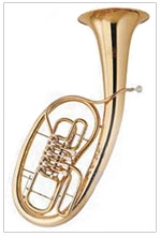
Wagner tuba

Encyclopedia
The Wagner tuba is a comparatively rare brass instrument
that combines elements of both the French horn
and the tuba
. Also referred to as the "Bayreuth Tuba", it was originally created for Richard Wagner
's opera
tic cycle Der Ring des Nibelungen
. Since then, other composers have written for it, most notably Anton Bruckner
, in whose Symphony No. 7
a quartet of them is first heard in the slow movement in memory of Wagner. The euphonium
is sometimes used as a substitute when a Wagner tuba cannot be obtained.
Wagner was inspired to invent this instrument after a brief visit to Paris
in 1853, when he visited the shop of Adolphe Sax
, the inventor of the saxophone
. Wagner wanted an instrument that could intone the Valhalla motif somberly like a trombone
but with a less incisive tone like that of a horn. That effect was obtained by a conical bore
(like a horn) and the use of the horn mouthpiece (tapered as opposed to a cup mouthpiece such as on a trombone). The instrument is built with rotary valves which, like those on the horn, are played with the left hand.
The Wagner tuba nominally exists in two sizes, tenor in B-flat and bass in F, with ranges comparable to those of horns in the same pitches while being less adept at the highest notes. Several 20th-century and later manufacturers have, however, combined the two instruments into a double Wagner tuba in B-flat and F. Wagner tubas are normally written as transposing instrument
s, but the notation used varies considerably and is a common source of confusion—Wagner himself used three different and incompatible notations in the course of the Ring, and all three of these systems (plus some others) have been used by subsequent composers. An additional source of confusion is the fact that the instruments are invariably designated in orchestral scores simply as "tubas", leaving it sometimes unclear as to whether true tubas or Wagner tubas are intended (for example, the two tenor tubas in Janáček
's Sinfonietta
are sometimes wrongly assumed to be Wagner tubas).
The sound of the Wagner tuba is mellower than that of the horn and sounds more distant, yet also more focused. Bruckner generally uses them for pensive melodic passages at piano to pianissimo dynamics. They can hold their own in a forte tutti but Bruckner generally gives them sustained tones rather than melodic motifs in such passages. In Bruckner's Eighth
and Ninth
Symphonies, the four Wagner tubas are played by four players who alternate between playing horn and Wagner tuba, which is the same procedure Wagner used in the Ring. This change is simplified by the fact that the horn and Wagner tuba use the same mouthpiece.
Where on the orchestral score the Wagner tubas are placed depend on who plays them. If they are played by players who are also playing horn, the staves for the Wagner tubas logically go below those of the horns and above the trumpets. If they are played by players who are not also playing horn, they are placed below the trombones, above the regular tuba, which is then called a "contrabass tuba."
The name "Wagner tuba" is considered problematic, possibly incorrect, by many theorists. Kent Kennan
says they could go by just about any other name since "they are really modified horns." But since they have been called "Wagner tubas" for so long, changing to a more sensible name is unlikely.
Other composers who have written for the instrument include Béla Bartók
, Alec Wilder
, Stephen Caudel
, Andrew Downes
, Felix Draeseke
, Alexander Kaloian
, Elisabeth Lutyens
, Michael Nyman
, Einojuhani Rautavaara
, Ragnar Søderlind
, Arnold Schoenberg
, Richard Strauss
, Igor Stravinsky
, Edgard Varèse
, Esa-Pekka Salonen
, Sofia Gubaidulina
, and Alexander Prior
Brass instrument
A brass instrument is a musical instrument whose sound is produced by sympathetic vibration of air in a tubular resonator in sympathy with the vibration of the player's lips...
that combines elements of both the French horn
Horn (instrument)
The horn is a brass instrument consisting of about of tubing wrapped into a coil with a flared bell. A musician who plays the horn is called a horn player ....
and the tuba
Tuba
The tuba is the largest and lowest-pitched brass instrument. Sound is produced by vibrating or "buzzing" the lips into a large cupped mouthpiece. It is one of the most recent additions to the modern symphony orchestra, first appearing in the mid-19th century, when it largely replaced the...
. Also referred to as the "Bayreuth Tuba", it was originally created for Richard Wagner
Richard Wagner
Wilhelm Richard Wagner was a German composer, conductor, theatre director, philosopher, music theorist, poet, essayist and writer primarily known for his operas...
's opera
Opera
Opera is an art form in which singers and musicians perform a dramatic work combining text and musical score, usually in a theatrical setting. Opera incorporates many of the elements of spoken theatre, such as acting, scenery, and costumes and sometimes includes dance...
tic cycle Der Ring des Nibelungen
Der Ring des Nibelungen
Der Ring des Nibelungen is a cycle of four epic operas by the German composer Richard Wagner . The works are based loosely on characters from the Norse sagas and the Nibelungenlied...
. Since then, other composers have written for it, most notably Anton Bruckner
Anton Bruckner
Anton Bruckner was an Austrian composer known for his symphonies, masses, and motets. The first are considered emblematic of the final stage of Austro-German Romanticism because of their rich harmonic language, complex polyphony, and considerable length...
, in whose Symphony No. 7
Symphony No. 7 (Bruckner)
Anton Bruckner's Symphony No. 7 in E major is one of his best-known symphonies. It was written between 1881 and 1883 and was revised in 1885. It is dedicated to Ludwig II of Bavaria. The premiere, given under Arthur Nikisch and the Gewandhaus Orchestra in the opera house at Leipzig on 30...
a quartet of them is first heard in the slow movement in memory of Wagner. The euphonium
Euphonium
The euphonium is a conical-bore, tenor-voiced brass instrument. It derives its name from the Greek word euphonos, meaning "well-sounding" or "sweet-voiced"...
is sometimes used as a substitute when a Wagner tuba cannot be obtained.
Wagner was inspired to invent this instrument after a brief visit to Paris
Paris
Paris is the capital and largest city in France, situated on the river Seine, in northern France, at the heart of the Île-de-France region...
in 1853, when he visited the shop of Adolphe Sax
Adolphe Sax
Antoine-Joseph "Adolphe" Sax was a Belgian musical instrument designer and musician who played the flute and clarinet, and is best known for having invented the saxophone.-Biography:...
, the inventor of the saxophone
Saxophone
The saxophone is a conical-bore transposing musical instrument that is a member of the woodwind family. Saxophones are usually made of brass and played with a single-reed mouthpiece similar to that of the clarinet. The saxophone was invented by the Belgian instrument maker Adolphe Sax in 1846...
. Wagner wanted an instrument that could intone the Valhalla motif somberly like a trombone
Trombone
The trombone is a musical instrument in the brass family. Like all brass instruments, sound is produced when the player’s vibrating lips cause the air column inside the instrument to vibrate...
but with a less incisive tone like that of a horn. That effect was obtained by a conical bore
Bore (wind instruments)
The bore of a wind instrument is its interior chamber that defines a flow path through which air travels and is set into vibration to produce sounds. The shape of the bore has a strong influence on the instruments' timbre.-Bore shapes:...
(like a horn) and the use of the horn mouthpiece (tapered as opposed to a cup mouthpiece such as on a trombone). The instrument is built with rotary valves which, like those on the horn, are played with the left hand.
The Wagner tuba nominally exists in two sizes, tenor in B-flat and bass in F, with ranges comparable to those of horns in the same pitches while being less adept at the highest notes. Several 20th-century and later manufacturers have, however, combined the two instruments into a double Wagner tuba in B-flat and F. Wagner tubas are normally written as transposing instrument
Transposing instrument
A transposing instrument is a musical instrument for which written notes are read at a pitch different from the corresponding concert pitch, which a non-transposing instrument, such as a piano, would play. Playing a written C on a transposing instrument will produce a note other than concert C...
s, but the notation used varies considerably and is a common source of confusion—Wagner himself used three different and incompatible notations in the course of the Ring, and all three of these systems (plus some others) have been used by subsequent composers. An additional source of confusion is the fact that the instruments are invariably designated in orchestral scores simply as "tubas", leaving it sometimes unclear as to whether true tubas or Wagner tubas are intended (for example, the two tenor tubas in Janáček
Leoš Janácek
Leoš Janáček was a Czech composer, musical theorist, folklorist, publicist and teacher. He was inspired by Moravian and all Slavic folk music to create an original, modern musical style. Until 1895 he devoted himself mainly to folkloristic research and his early musical output was influenced by...
's Sinfonietta
Sinfonietta (Janácek)
The Sinfonietta is a very expressive and festive, late work for large orchestra by the Czech composer Leoš Janáček...
are sometimes wrongly assumed to be Wagner tubas).
The sound of the Wagner tuba is mellower than that of the horn and sounds more distant, yet also more focused. Bruckner generally uses them for pensive melodic passages at piano to pianissimo dynamics. They can hold their own in a forte tutti but Bruckner generally gives them sustained tones rather than melodic motifs in such passages. In Bruckner's Eighth
Symphony No. 8 (Bruckner)
Anton Bruckner's Symphony No. 8 in C minor is the last Symphony the composer completed. It exists in two major versions of 1887 and 1890. It was premiered under conductor Hans Richter in 1892 in Vienna...
and Ninth
Symphony No. 9 (Bruckner)
Anton Bruckner's Symphony No. 9 in D minor is the last Symphony upon which he worked, leaving the last movement incomplete at the time of his death in 1896. The symphony was premiered under Ferdinand Löwe in Vienna in 1903, after Bruckner's death...
Symphonies, the four Wagner tubas are played by four players who alternate between playing horn and Wagner tuba, which is the same procedure Wagner used in the Ring. This change is simplified by the fact that the horn and Wagner tuba use the same mouthpiece.
Where on the orchestral score the Wagner tubas are placed depend on who plays them. If they are played by players who are also playing horn, the staves for the Wagner tubas logically go below those of the horns and above the trumpets. If they are played by players who are not also playing horn, they are placed below the trombones, above the regular tuba, which is then called a "contrabass tuba."
The name "Wagner tuba" is considered problematic, possibly incorrect, by many theorists. Kent Kennan
Kent Kennan
Kent Wheeler Kennan was an American composer, author, educator, and professor....
says they could go by just about any other name since "they are really modified horns." But since they have been called "Wagner tubas" for so long, changing to a more sensible name is unlikely.
Other composers who have written for the instrument include Béla Bartók
Béla Bartók
Béla Viktor János Bartók was a Hungarian composer and pianist. He is considered one of the most important composers of the 20th century and is regarded, along with Liszt, as Hungary's greatest composer...
, Alec Wilder
Alec Wilder
Alec Wilder was an American composer.-Biography:...
, Stephen Caudel
Stephen Caudel
Stephen Caudel was born in Sheffield, Yorkshire, England. He attended the City of Leeds College of Music and it was here that he first started to be drawn to progressive or symphonic rock....
, Andrew Downes
Andrew Downes (composer)
Andrew Downes is a British classical composer.Downes was born in Handsworth, Birmingham. In 1969, he won a choral scholarship to St. John's College, Cambridge, where he gained an MA degree specializing in composition, and in 1974 went on to study with Herbert Howells at the Royal College of Music...
, Felix Draeseke
Felix Draeseke
Felix August Bernhard Draeseke was a composer of the "New German School" admiring Liszt and Richard Wagner. He wrote compositions in most forms including eight operas and stage works, four symphonies, and much vocal and chamber music.-Life:Felix Draeseke was born in the Franconian ducal town of...
, Alexander Kaloian
Alexander Kaloian
Alexander Kaloian born 1962 in Los Angeles, California is an Armenian composer, residing dually in the United States and the Republic of Armenia...
, Elisabeth Lutyens
Elisabeth Lutyens
Elisabeth Lutyens, CBE was a significant English composer.- Early life and education :She was one of the five children of architect Sir Edwin Lutyens and his wife Emily, who was profoundly involved in the Theosophical Movement...
, Michael Nyman
Michael Nyman
Michael Laurence Nyman, CBE is an English composer of minimalist music, pianist, librettist and musicologist, known for the many film scores he wrote during his lengthy collaboration with the filmmaker Peter Greenaway, and his multi-platinum soundtrack album to Jane Campion's The Piano...
, Einojuhani Rautavaara
Einojuhani Rautavaara
Einojuhani Rautavaara is a Finnish composer of contemporary classical music, and is one of the most notable Finnish composers after Jean Sibelius.-Life:...
, Ragnar Søderlind
Ragnar Søderlind
Ragnar Søderlind is a Norwegian composer. He has written ballets and operas, and for the concert hall, programmatic works based on poems.-Biography:...
, Arnold Schoenberg
Arnold Schoenberg
Arnold Schoenberg was an Austrian composer, associated with the expressionist movement in German poetry and art, and leader of the Second Viennese School...
, Richard Strauss
Richard Strauss
Richard Georg Strauss was a leading German composer of the late Romantic and early modern eras. He is known for his operas, which include Der Rosenkavalier and Salome; his Lieder, especially his Four Last Songs; and his tone poems and orchestral works, such as Death and Transfiguration, Till...
, Igor Stravinsky
Igor Stravinsky
Igor Fyodorovich Stravinsky ; 6 April 1971) was a Russian, later naturalized French, and then naturalized American composer, pianist, and conductor....
, Edgard Varèse
Edgard Varèse
Edgard Victor Achille Charles Varèse, , whose name was also spelled Edgar Varèse , was an innovative French-born composer who spent the greater part of his career in the United States....
, Esa-Pekka Salonen
Esa-Pekka Salonen
Esa-Pekka Salonen is a Finnish orchestral conductor and composer. He is currently Principal Conductor and Artistic Advisor of the Philharmonia Orchestra in London and Conductor Laureate of the Los Angeles Philharmonic.-Early career:...
, Sofia Gubaidulina
Sofia Gubaidulina
Sofia Asgatovna Gubaidulina, is a Russian composer of half Russian, half Tatar ethnicity.Gubaidulina's music is marked by the use of unusual instrumental combinations...
, and Alexander Prior
Alex Prior
Alex Prior is a British composer and conductor who studied at the Saint Petersburg Conservatory.-Life and career:Prior was born in London to a British father and a Russian mother who descended from Constantin Stanislavski...