

Vratsa

Encyclopedia
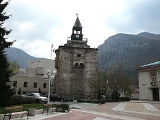
Vratsa is a city in northwestern Bulgaria
, at the foothills of the Balkan Mountains
. It is the administrative centre of the homonymous Vratsa Province
. As of February 2011, the town has a population of 60,482 inhabitants.
The city of Vratsa is a commercial and crafts centre and a railway junction. Vratsa accommodates textile, metal processing, chemical, and ceramics industries.
.
The area has diverse and attractive natural features, which together with the opportunities of recreation gives a special charm of the eastern part of the Northwest Bulgaria. Several protected natural attractions and historical monuments are located on the territory of the Vratsa State Forestry.
.
. Vratsa was called Valve ("door of a fortress") by the Romans
due to a narrow passage where the main gate of the city fortress was located. Nowadays, this passage is the symbol of Vratsa, and is shown on the town's Coat of arms.
After the fall of Rome, Vratsa became part of the Eastern Roman Empire (Byzantium).
At the end of the 6th century AD, Vratsa was populated by the South Slavic
tribes. Even if they came from Pannonia
and Dacia
on the north, the town reimained under Byzantine rule.
In the 7th century, the Bulgars
and the Slavs found the First Bulgarian Empire
and the Slavic Vratsa became part of it. The city grew into important strategic location because of its proximity to the South State border. The name of the city was changed from Valve to the Slavic Vratitsa, which has the same meaning and is the source of the modern name. Vratsa became famous for its goldsmiths and silversmiths production and trade, high-quality earthenware and military significance.
In the 8th century, the Bulgarian army captured Sofia
, which led to the decreasing of Vratsa's importance because of the better strategic position of Sofia, its more developed economy and larger size. But Vratsa was again key for the resistance against the Byzantine, Serbian
and Magyar invasions in the Middle Ages
.
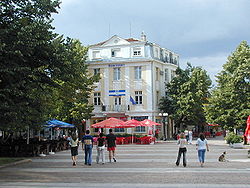
Good opportunities exist for exercising different sport activities such as mountaineering, bicycle sport and for those who enjoy being thrilled can go for hanggliding and paragliding, or set out for carting, buggy and motocross racing tracks.
Conditions are provided for rest and entertainment — children's and adults' swimming pools, water
cycles, discos, bars, restaurants, excellent hotel facilities and good service. If you are a fervent admirer of winter sports you will be glad to hear that the rope lines near the Parshevitsa Chalet are working, and the skiing tracks are well maintained.
There are also a Museum of History and an Ethnographic and Revival Complex.
— Boychinovtsi
— Brusartsi
— Vidin
(Lom). The city connects to the national railway network through the railway station of Mezdra. The railway station is located in the northeastern part of the city. There is regular bus transport within the city.
on Greenwich Island in the South Shetland Islands
, Antarctica is named after Vratsa.
team operating within the fictional Harry Potter universe
. The Vratsa Vultures have won the European Cup seven times.
Bulgaria
Bulgaria , officially the Republic of Bulgaria , is a parliamentary democracy within a unitary constitutional republic in Southeast Europe. The country borders Romania to the north, Serbia and Macedonia to the west, Greece and Turkey to the south, as well as the Black Sea to the east...
, at the foothills of the Balkan Mountains
Balkan Mountains
The Balkan mountain range is a mountain range in the eastern part of the Balkan Peninsula. The Balkan range runs 560 km from the Vrashka Chuka Peak on the border between Bulgaria and eastern Serbia eastward through central Bulgaria to Cape Emine on the Black Sea...
. It is the administrative centre of the homonymous Vratsa Province
Vratsa Province
Vratsa Province , former name Vratsa okrug) is a Bulgarian province located in the northwestern part of the country, between Danube river in the north and Stara Planina mountain in the south. It is named after its main town - Vratsa...
. As of February 2011, the town has a population of 60,482 inhabitants.
The city of Vratsa is a commercial and crafts centre and a railway junction. Vratsa accommodates textile, metal processing, chemical, and ceramics industries.
Geography
The city of Vratsa is picturesque. It is nestled in the foothills of "Vrachanski Balkan" (Vratsa Mountain), with the Leva River calmly crossing the city, and enormous and fearful rocks overhanging the roofs. The city is 116 km away from the national capital SofiaSofia
Sofia is the capital and largest city of Bulgaria and the 12th largest city in the European Union with a population of 1.27 million people. It is located in western Bulgaria, at the foot of Mount Vitosha and approximately at the centre of the Balkan Peninsula.Prehistoric settlements were excavated...
.
The area has diverse and attractive natural features, which together with the opportunities of recreation gives a special charm of the eastern part of the Northwest Bulgaria. Several protected natural attractions and historical monuments are located on the territory of the Vratsa State Forestry.
Population
The number of the residents of the city reached its peak in the period 1990-1991 when exceeded 85,000. The following table presents the change of the population after the World War IIWorld War II
World War II, or the Second World War , was a global conflict lasting from 1939 to 1945, involving most of the world's nations—including all of the great powers—eventually forming two opposing military alliances: the Allies and the Axis...
.
History
Vratsa is an ancient city found by ancient ThraciansThracians
The ancient Thracians were a group of Indo-European tribes inhabiting areas including Thrace in Southeastern Europe. They spoke the Thracian language – a scarcely attested branch of the Indo-European language family...
. Vratsa was called Valve ("door of a fortress") by the Romans
Ancient Rome
Ancient Rome was a thriving civilization that grew on the Italian Peninsula as early as the 8th century BC. Located along the Mediterranean Sea and centered on the city of Rome, it expanded to one of the largest empires in the ancient world....
due to a narrow passage where the main gate of the city fortress was located. Nowadays, this passage is the symbol of Vratsa, and is shown on the town's Coat of arms.
After the fall of Rome, Vratsa became part of the Eastern Roman Empire (Byzantium).
At the end of the 6th century AD, Vratsa was populated by the South Slavic
South Slavs
The South Slavs are the southern branch of the Slavic peoples and speak South Slavic languages. Geographically, the South Slavs are native to the Balkan peninsula, the southern Pannonian Plain and the eastern Alps...
tribes. Even if they came from Pannonia
Pannonia
Pannonia was an ancient province of the Roman Empire bounded north and east by the Danube, coterminous westward with Noricum and upper Italy, and southward with Dalmatia and upper Moesia....
and Dacia
Dacia
In ancient geography, especially in Roman sources, Dacia was the land inhabited by the Dacians or Getae as they were known by the Greeks—the branch of the Thracians north of the Haemus range...
on the north, the town reimained under Byzantine rule.
In the 7th century, the Bulgars
Bulgars
The Bulgars were a semi-nomadic who flourished in the Pontic Steppe and the Volga basin in the 7th century.The Bulgars emerge after the collapse of the Hunnic Empire in the 5th century....
and the Slavs found the First Bulgarian Empire
First Bulgarian Empire
The First Bulgarian Empire was a medieval Bulgarian state founded in the north-eastern Balkans in c. 680 by the Bulgars, uniting with seven South Slavic tribes...
and the Slavic Vratsa became part of it. The city grew into important strategic location because of its proximity to the South State border. The name of the city was changed from Valve to the Slavic Vratitsa, which has the same meaning and is the source of the modern name. Vratsa became famous for its goldsmiths and silversmiths production and trade, high-quality earthenware and military significance.
In the 8th century, the Bulgarian army captured Sofia
Sofia
Sofia is the capital and largest city of Bulgaria and the 12th largest city in the European Union with a population of 1.27 million people. It is located in western Bulgaria, at the foot of Mount Vitosha and approximately at the centre of the Balkan Peninsula.Prehistoric settlements were excavated...
, which led to the decreasing of Vratsa's importance because of the better strategic position of Sofia, its more developed economy and larger size. But Vratsa was again key for the resistance against the Byzantine, Serbian
Serbs
The Serbs are a South Slavic ethnic group of the Balkans and southern Central Europe. Serbs are located mainly in Serbia, Montenegro and Bosnia and Herzegovina, and form a sizable minority in Croatia, the Republic of Macedonia and Slovenia. Likewise, Serbs are an officially recognized minority in...
and Magyar invasions in the Middle Ages
Middle Ages
The Middle Ages is a periodization of European history from the 5th century to the 15th century. The Middle Ages follows the fall of the Western Roman Empire in 476 and precedes the Early Modern Era. It is the middle period of a three-period division of Western history: Classic, Medieval and Modern...
.
Tourism
The mountains and forests are suitable for development of different types of tourism — hunting and fishing, skiing, speleology, delta-gliding, photo-tourism, etc.Good opportunities exist for exercising different sport activities such as mountaineering, bicycle sport and for those who enjoy being thrilled can go for hanggliding and paragliding, or set out for carting, buggy and motocross racing tracks.
Conditions are provided for rest and entertainment — children's and adults' swimming pools, water
cycles, discos, bars, restaurants, excellent hotel facilities and good service. If you are a fervent admirer of winter sports you will be glad to hear that the rope lines near the Parshevitsa Chalet are working, and the skiing tracks are well maintained.
There are also a Museum of History and an Ethnographic and Revival Complex.
Transport
Vratsa connects to the villages and city within the region and throughout the country by bus and railway transport. There are regular bus lines to Sofia, Pleven, Vidin, Montana, Kozloduy, Oryahovo, Mezdra (at short intervals), as well as to the smaller villages, scattered around the city. The bus station is located on the way between the railway station and the centre of the city. Vratsa is an important railway station along the railway route MezdraMezdra
Mezdra is a town in northwestern Bulgaria, part of Vratsa Province. It is located on the left bank of the Iskar River just north of its gorge through the Balkan Mountains....
— Boychinovtsi
Boychinovtsi
Boychinovtsi is a town in northwestern Bulgaria, the administrative centre of Boychinovtsi Municipality , Montana Province . It is near the city of Montana. As of December 2009, the town has a population of 1,648 inhabitants....
— Brusartsi
Brusartsi
Brusartsi is a town in Northwestern Bulgaria. It is located in Montana Province and is 23 km away from the town of Lom. The town is the administrative center of the homonymous Brusartsi Municipality. As of December 2009, Brusartsi has a population of 1,302 inhabitants.Main train lines...
— Vidin
Vidin
Vidin is a port town on the southern bank of the Danube in northwestern Bulgaria. It is close to the borders with Serbia and Romania, and is also the administrative centre of Vidin Province, as well as of the Metropolitan of Vidin...
(Lom). The city connects to the national railway network through the railway station of Mezdra. The railway station is located in the northeastern part of the city. There is regular bus transport within the city.
Honour
Vratsa PeakVratsa Peak
Vratsa Peak is a sharp rocky peak rising to 470 m in Breznik Heights, Greenwich Island in the South Shetland Islands, Antarctica surmounting Musala Glacier to the northeast and Targovishte Glacier to the southwest and south....
on Greenwich Island in the South Shetland Islands
South Shetland Islands
The South Shetland Islands are a group of Antarctic islands, lying about north of the Antarctic Peninsula, with a total area of . By the Antarctic Treaty of 1959, the Islands' sovereignty is neither recognized nor disputed by the signatories and they are free for use by any signatory for...
, Antarctica is named after Vratsa.
Use in popular culture
Vratsa is the home of a professional QuidditchQuidditch
Quidditch is a fictional sport developed by British author J. K. Rowling for the Harry Potter series of novels. It is described as an extremely rough, but very popular, semi-contact sport, played by wizards and witches around the world...
team operating within the fictional Harry Potter universe
Harry Potter universe
The fictional universe of J. K. Rowling's Harry Potter series of fantasy novels comprises two separate and distinct societies: the wizarding world and the Muggle world...
. The Vratsa Vultures have won the European Cup seven times.