

Via Cornelia

Encyclopedia
Via Cornelia is an ancient Roman Road
that supposedly ran east west along the northern wall of the Circus of Nero
on land now covered by the southern wall of St. Peter's Basilica
. It is closely associated with the Via Aurelia
and the Via Triumphalis.
. This conjecture stems from the fact that the Via Cornelia is only mentioned in the itineraries and witnesses of the 7th and 8th centuries; for in those centuries the population of Rome
decreased from about one and a half million to sixty thousand and the people were impoverished and could hardly speak Latin
well. The citizens would also have no idea of the topography of the Imperial period
. Where-as documents from the 4th century state Saint Peter
was buried along the Via Triumphalis.
An excavation in 1924 at the site of Pisidian Antioch discovered an inscribed stone dating from about 93 AD that offers strong evidence that the Via Cornelia had existed pre-Constantine
. The inscription on the stone mentions a commander of the eight Augustinian legion
under Vespasian
and Titus
who had been a supervisor of the Via Aurelia
and the Via Cornelia.
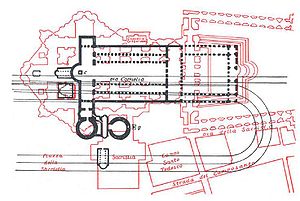 It was generally accepted that the southern walls of St. Peter's Basilica
rested on the northern walls of the Nero’s Circus, and that a street ran north of the circus under the basilica
(see figure). However, excavations of the basilica
and surrounding area have shown that this is not entirely correct. An excavation in 1936 in the Piazza San Pietro discovered traces of a road that may well be the post-Constantinian Via Cornelia. There was also found a fragment of pre-Constantinian paved road along the same alignment found at the south-west corner of the basilica
. It is now believed that the Via Cornelia came from the east and went west, rising gently near the present southernmost fountain in the Piazza San Pietro. Slightly before this point the Via Aurelia
forked off from it and headed southwest, while the Via Cornelia continued westward just south of façade
of the basilica
and eventual on towards Caere
. Via Triumphalis is believed to have come from Pons Neronis towards the Piazza San Pietro and then to have veered northwest towards the business section of Vatican City
. The present day Via della Conciliazione
follows approximately the same path as the Via Cornelia did.
to improve the approach to the imperial gardens, the Horti Agrippinae. Therefore it may have formed the northern boundary of the gardens in Nero
’s time. It would also have connected the Circus of Nero
to the basilica
and to a double row of mausoleums.
Roman road
The Roman roads were a vital part of the development of the Roman state, from about 500 BC through the expansion during the Roman Republic and the Roman Empire. Roman roads enabled the Romans to move armies and trade goods and to communicate. The Roman road system spanned more than 400,000 km...
that supposedly ran east west along the northern wall of the Circus of Nero
Circus of Nero
The Circus of Nero or Circus of Caligula was a circus in ancient Rome.-Construction:It was begun by Caligula on the property of his mother Agrippina on the Ager Vaticanus , and finished by Nero...
on land now covered by the southern wall of St. Peter's Basilica
St. Peter's Basilica
The Papal Basilica of Saint Peter , officially known in Italian as ' and commonly known as Saint Peter's Basilica, is a Late Renaissance church located within the Vatican City. Saint Peter's Basilica has the largest interior of any Christian church in the world...
. It is closely associated with the Via Aurelia
Via Aurelia
The Via Aurelia was a Roman road in Italy constructed around the year 241 BC. The project was undertaken by C. Aurelius Cotta, who at that time was censor...
and the Via Triumphalis.
History
There is some belief amongst archeologists that the Via Cornelia did not exist and that the name is a mutilation of the Via AureliaVia Aurelia
The Via Aurelia was a Roman road in Italy constructed around the year 241 BC. The project was undertaken by C. Aurelius Cotta, who at that time was censor...
. This conjecture stems from the fact that the Via Cornelia is only mentioned in the itineraries and witnesses of the 7th and 8th centuries; for in those centuries the population of Rome
Rome
Rome is the capital of Italy and the country's largest and most populated city and comune, with over 2.7 million residents in . The city is located in the central-western portion of the Italian Peninsula, on the Tiber River within the Lazio region of Italy.Rome's history spans two and a half...
decreased from about one and a half million to sixty thousand and the people were impoverished and could hardly speak Latin
Latin
Latin is an Italic language originally spoken in Latium and Ancient Rome. It, along with most European languages, is a descendant of the ancient Proto-Indo-European language. Although it is considered a dead language, a number of scholars and members of the Christian clergy speak it fluently, and...
well. The citizens would also have no idea of the topography of the Imperial period
Topography of ancient Rome
The topography of ancient Rome is a multidisciplinary field of study that draws on archaeology, epigraphy, cartography and philology.The classic English-language work of scholarship is A Topographical Dictionary of Ancient Rome , written by Samuel Ball Platner, completed and published after his...
. Where-as documents from the 4th century state Saint Peter
Saint Peter
Saint Peter or Simon Peter was an early Christian leader, who is featured prominently in the New Testament Gospels and the Acts of the Apostles. The son of John or of Jonah and from the village of Bethsaida in the province of Galilee, his brother Andrew was also an apostle...
was buried along the Via Triumphalis.
An excavation in 1924 at the site of Pisidian Antioch discovered an inscribed stone dating from about 93 AD that offers strong evidence that the Via Cornelia had existed pre-Constantine
Constantine I
Constantine the Great , also known as Constantine I or Saint Constantine, was Roman Emperor from 306 to 337. Well known for being the first Roman emperor to convert to Christianity, Constantine and co-Emperor Licinius issued the Edict of Milan in 313, which proclaimed religious tolerance of all...
. The inscription on the stone mentions a commander of the eight Augustinian legion
Roman legion
A Roman legion normally indicates the basic ancient Roman army unit recruited specifically from Roman citizens. The organization of legions varied greatly over time but they were typically composed of perhaps 5,000 soldiers, divided into maniples and later into "cohorts"...
under Vespasian
Vespasian
Vespasian , was Roman Emperor from 69 AD to 79 AD. Vespasian was the founder of the Flavian dynasty, which ruled the Empire for a quarter century. Vespasian was descended from a family of equestrians, who rose into the senatorial rank under the Emperors of the Julio-Claudian dynasty...
and Titus
Titus
Titus , was Roman Emperor from 79 to 81. A member of the Flavian dynasty, Titus succeeded his father Vespasian upon his death, thus becoming the first Roman Emperor to come to the throne after his own father....
who had been a supervisor of the Via Aurelia
Via Aurelia
The Via Aurelia was a Roman road in Italy constructed around the year 241 BC. The project was undertaken by C. Aurelius Cotta, who at that time was censor...
and the Via Cornelia.
Location
St. Peter's Basilica
The Papal Basilica of Saint Peter , officially known in Italian as ' and commonly known as Saint Peter's Basilica, is a Late Renaissance church located within the Vatican City. Saint Peter's Basilica has the largest interior of any Christian church in the world...
rested on the northern walls of the Nero’s Circus, and that a street ran north of the circus under the basilica
Basilica
The Latin word basilica , was originally used to describe a Roman public building, usually located in the forum of a Roman town. Public basilicas began to appear in Hellenistic cities in the 2nd century BC.The term was also applied to buildings used for religious purposes...
(see figure). However, excavations of the basilica
Basilica
The Latin word basilica , was originally used to describe a Roman public building, usually located in the forum of a Roman town. Public basilicas began to appear in Hellenistic cities in the 2nd century BC.The term was also applied to buildings used for religious purposes...
and surrounding area have shown that this is not entirely correct. An excavation in 1936 in the Piazza San Pietro discovered traces of a road that may well be the post-Constantinian Via Cornelia. There was also found a fragment of pre-Constantinian paved road along the same alignment found at the south-west corner of the basilica
Basilica
The Latin word basilica , was originally used to describe a Roman public building, usually located in the forum of a Roman town. Public basilicas began to appear in Hellenistic cities in the 2nd century BC.The term was also applied to buildings used for religious purposes...
. It is now believed that the Via Cornelia came from the east and went west, rising gently near the present southernmost fountain in the Piazza San Pietro. Slightly before this point the Via Aurelia
Via Aurelia
The Via Aurelia was a Roman road in Italy constructed around the year 241 BC. The project was undertaken by C. Aurelius Cotta, who at that time was censor...
forked off from it and headed southwest, while the Via Cornelia continued westward just south of façade
Facade
A facade or façade is generally one exterior side of a building, usually, but not always, the front. The word comes from the French language, literally meaning "frontage" or "face"....
of the basilica
Basilica
The Latin word basilica , was originally used to describe a Roman public building, usually located in the forum of a Roman town. Public basilicas began to appear in Hellenistic cities in the 2nd century BC.The term was also applied to buildings used for religious purposes...
and eventual on towards Caere
Caere
Caere is the Latin name given by the Romans to one of the larger cities of Southern Etruria, the modern Cerveteri, approximately 50-60 kilometres north-northwest of Rome. To the Etruscans it was known as Cisra and to the Greeks as Agylla...
. Via Triumphalis is believed to have come from Pons Neronis towards the Piazza San Pietro and then to have veered northwest towards the business section of Vatican City
Vatican City
Vatican City , or Vatican City State, in Italian officially Stato della Città del Vaticano , which translates literally as State of the City of the Vatican, is a landlocked sovereign city-state whose territory consists of a walled enclave within the city of Rome, Italy. It has an area of...
. The present day Via della Conciliazione
Via della Conciliazione
Via della Conciliazione is a street in the Rione of Borgo within Rome, Italy. Roughly 500 m in length, it connects Saint Peter's Square to the Castel Sant'Angelo on the western bank of the Tiber River. The road was constructed between 1936 and 1950, and it is the primary access route to the...
follows approximately the same path as the Via Cornelia did.
Function
It is possible that the Via Cornelia may have been built by CaligulaCaligula
Caligula , also known as Gaius, was Roman Emperor from 37 AD to 41 AD. Caligula was a member of the house of rulers conventionally known as the Julio-Claudian dynasty. Caligula's father Germanicus, the nephew and adopted son of Emperor Tiberius, was a very successful general and one of Rome's most...
to improve the approach to the imperial gardens, the Horti Agrippinae. Therefore it may have formed the northern boundary of the gardens in Nero
Nero
Nero , was Roman Emperor from 54 to 68, and the last in the Julio-Claudian dynasty. Nero was adopted by his great-uncle Claudius to become his heir and successor, and succeeded to the throne in 54 following Claudius' death....
’s time. It would also have connected the Circus of Nero
Circus of Nero
The Circus of Nero or Circus of Caligula was a circus in ancient Rome.-Construction:It was begun by Caligula on the property of his mother Agrippina on the Ager Vaticanus , and finished by Nero...
to the basilica
Basilica
The Latin word basilica , was originally used to describe a Roman public building, usually located in the forum of a Roman town. Public basilicas began to appear in Hellenistic cities in the 2nd century BC.The term was also applied to buildings used for religious purposes...
and to a double row of mausoleums.