

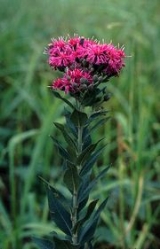
Vernonia

Encyclopedia
Vernonia is a genus of about 1000 species
of forb
s and shrub
s in the family Asteraceae
. Some species are known as Ironweed. Some species are edible and of economic value. They are known for having intense purple
flowers. The genus is named for English botanist William Vernon. There are numerous distinct subgenera and subsections in this genus
. This has led some botanists to divide this large genus into smaller groups which separate the species into distinct genera. For instance, the Flora of North America
only recognizes about 20 species, 17 of which are in North America north of Mexico, with the other two or three being found in South America
.
s. Common names for these species include bitterleaf, ewuro, ndole and onugbu. They are common in most West Africa
n and Central Africa
n countries. They are one of the most widely consumed leaf vegetables of Cameroon
, where they are a key ingredient of Ndolé
. The leaves have a sweet and bitter taste. They are sold fresh or dried
, and are a typical ingredient in egusi soup.
V. amygdalina is well known as a medicinal plant with several uses attributed to it, including for diabetes, fever reduction, and recently a non-pharmaceutical solution to persistent fever, headache, and joint pain associated with AIDS
(an infusion of the plant is taken as needed). These leaves are exported from several African countries and can be purchased in grocery stores aiming to serve African clients for about $1.50/225gm pkg. frozen. The roots of V. amygdalina have been used for gingivitis and toothache due to its proven antimicrobial activity.
In North America, of the 17 species of Vernonia (eg., V. altissima, V. fasciculata, V. flaccidifolia) all have the same effective properties as a blood
purifier and uterus
toner, containing sesquiterpene lactone
, which helps also to prevent atherosclerosis
.
V. galamensis
is used as an oilseed in East Africa
. It is grown in many parts of Ethiopia, especially around the city of Harar
, with an average seed yield of 2 to 2.5 t/ha. It is reported that the Ethiopian strains of Vernonia have the highest oil content, up to 41.9% with up to 80% vernolic acid, and is used in paint formulations, coatings plasticizers, and as a reagent for many industrial chemicals.
Vernonia species are used as food plants by the larva
e of some Lepidoptera
species including Coleophora vernoniaeella
(which feeds exclusively on the genus) and Schinia regia
(which feeds exclusively on V. texana).
_on_a_ash_fleabane_or_little_ironweed_(vernonia_cinerea)_in_kolkata_w_img_3668.jpg)
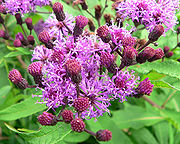 Species of this genus are found in South America
, Africa
, Southeast Asia
, and North America
. Vernonia species are well known for hybridizing between similar species in areas of overlapping ranges. There are approximately 1000 species of Vernonia. A partial species list is given below.
Species
In biology, a species is one of the basic units of biological classification and a taxonomic rank. A species is often defined as a group of organisms capable of interbreeding and producing fertile offspring. While in many cases this definition is adequate, more precise or differing measures are...
of forb
Forb
A forb is a herbaceous flowering plant that is not a graminoid . The term is used in biology and in vegetation ecology, especially in relation to grasslands and understory.-Etymology:...
s and shrub
Shrub
A shrub or bush is distinguished from a tree by its multiple stems and shorter height, usually under 5–6 m tall. A large number of plants may become either shrubs or trees, depending on the growing conditions they experience...
s in the family Asteraceae
Asteraceae
The Asteraceae or Compositae , is an exceedingly large and widespread family of vascular plants. The group has more than 22,750 currently accepted species, spread across 1620 genera and 12 subfamilies...
. Some species are known as Ironweed. Some species are edible and of economic value. They are known for having intense purple
Purple
Purple is a range of hues of color occurring between red and blue, and is classified as a secondary color as the colors are required to create the shade....
flowers. The genus is named for English botanist William Vernon. There are numerous distinct subgenera and subsections in this genus
Genus
In biology, a genus is a low-level taxonomic rank used in the biological classification of living and fossil organisms, which is an example of definition by genus and differentia...
. This has led some botanists to divide this large genus into smaller groups which separate the species into distinct genera. For instance, the Flora of North America
Flora of North America
The Flora of North America North of Mexico is a multivolume work describing the native plants of North America. These days much of the Flora is available . The work is expected to fill 30 volumes when completed...
only recognizes about 20 species, 17 of which are in North America north of Mexico, with the other two or three being found in South America
South America
South America is a continent situated in the Western Hemisphere, mostly in the Southern Hemisphere, with a relatively small portion in the Northern Hemisphere. The continent is also considered a subcontinent of the Americas. It is bordered on the west by the Pacific Ocean and on the north and east...
.
Uses
Several species of Vernonia, including V. calvoana, V. amygdalina, and V. colorata, are eaten as leaf vegetableLeaf vegetable
Leaf vegetables, also called potherbs, green vegetables, greens, leafy greens or salad greens, are plant leaves eaten as a vegetable, sometimes accompanied by tender petioles and shoots...
s. Common names for these species include bitterleaf, ewuro, ndole and onugbu. They are common in most West Africa
West Africa
West Africa or Western Africa is the westernmost region of the African continent. Geopolitically, the UN definition of Western Africa includes the following 16 countries and an area of approximately 5 million square km:-Flags of West Africa:...
n and Central Africa
Central Africa
Central Africa is a core region of the African continent which includes Burundi, the Central African Republic, Chad, the Democratic Republic of the Congo, and Rwanda....
n countries. They are one of the most widely consumed leaf vegetables of Cameroon
Cameroon
Cameroon, officially the Republic of Cameroon , is a country in west Central Africa. It is bordered by Nigeria to the west; Chad to the northeast; the Central African Republic to the east; and Equatorial Guinea, Gabon, and the Republic of the Congo to the south. Cameroon's coastline lies on the...
, where they are a key ingredient of Ndolé
Ndolé
Ndolé is the national dish of Cameroon. The dish consists of a stew of nuts, ndoleh , and fish or ground beef....
. The leaves have a sweet and bitter taste. They are sold fresh or dried
Drying (food)
Drying is a method of food preservation that works by removing water from the food, which inhibits the growth of microorganisms and hinders quality decay. Drying food using sun and wind to prevent spoilage has been practised since ancient times, and was the earliest form of food curing...
, and are a typical ingredient in egusi soup.
V. amygdalina is well known as a medicinal plant with several uses attributed to it, including for diabetes, fever reduction, and recently a non-pharmaceutical solution to persistent fever, headache, and joint pain associated with AIDS
AIDS
Acquired immune deficiency syndrome or acquired immunodeficiency syndrome is a disease of the human immune system caused by the human immunodeficiency virus...
(an infusion of the plant is taken as needed). These leaves are exported from several African countries and can be purchased in grocery stores aiming to serve African clients for about $1.50/225gm pkg. frozen. The roots of V. amygdalina have been used for gingivitis and toothache due to its proven antimicrobial activity.
In North America, of the 17 species of Vernonia (eg., V. altissima, V. fasciculata, V. flaccidifolia) all have the same effective properties as a blood
Blood
Blood is a specialized bodily fluid in animals that delivers necessary substances such as nutrients and oxygen to the cells and transports metabolic waste products away from those same cells....
purifier and uterus
Uterine
The word uterine can refer to different meanings:* relating to or near the uterus or womb* having the same mother, but different fathers, see matrilineality...
toner, containing sesquiterpene lactone
Sesquiterpene lactone
Sesquiterpene lactones are a class of chemical compounds; they are sesquiterpenoids and contain a lactone ring, hence the name....
, which helps also to prevent atherosclerosis
Atherosclerosis
Atherosclerosis is a condition in which an artery wall thickens as a result of the accumulation of fatty materials such as cholesterol...
.
V. galamensis
Vernonia galamensis
Vernonia galamensis is a plant in the sunflower family, known for its use as an oilseed. This species, often called ironweed, is the largest source of vernonia oil, which is rich in a useful epoxy fatty acid called vernolic acid and is used to make plastics, rubbery coatings, and drying agents...
is used as an oilseed in East Africa
East Africa
East Africa or Eastern Africa is the easterly region of the African continent, variably defined by geography or geopolitics. In the UN scheme of geographic regions, 19 territories constitute Eastern Africa:...
. It is grown in many parts of Ethiopia, especially around the city of Harar
Harar
Harar is an eastern city in Ethiopia, and the capital of the modern Harari ethno-political division of Ethiopia...
, with an average seed yield of 2 to 2.5 t/ha. It is reported that the Ethiopian strains of Vernonia have the highest oil content, up to 41.9% with up to 80% vernolic acid, and is used in paint formulations, coatings plasticizers, and as a reagent for many industrial chemicals.
Vernonia species are used as food plants by the larva
Larva
A larva is a distinct juvenile form many animals undergo before metamorphosis into adults. Animals with indirect development such as insects, amphibians, or cnidarians typically have a larval phase of their life cycle...
e of some Lepidoptera
Lepidoptera
Lepidoptera is a large order of insects that includes moths and butterflies . It is one of the most widespread and widely recognizable insect orders in the world, encompassing moths and the three superfamilies of butterflies, skipper butterflies, and moth-butterflies...
species including Coleophora vernoniaeella
Coleophora vernoniaeella
Coleophora vernoniaeella is a moth of the Coleophoridae family. It is found in North America, including Kentucky and Missouri.The larvae feed on the leaves of Vernonia and Helianthus species. They create an annulate case....
(which feeds exclusively on the genus) and Schinia regia
Schinia regia
Schinia regia is a moth of the Noctuidae family. It is found in North America, including Colorado, Kansas, Nebraska, Oklahoma, New Mexico and Texas.The wingspan is 25–30 mm. Adults are on wing from September to October....
(which feeds exclusively on V. texana).
Species
South America
South America is a continent situated in the Western Hemisphere, mostly in the Southern Hemisphere, with a relatively small portion in the Northern Hemisphere. The continent is also considered a subcontinent of the Americas. It is bordered on the west by the Pacific Ocean and on the north and east...
, Africa
Africa
Africa is the world's second largest and second most populous continent, after Asia. At about 30.2 million km² including adjacent islands, it covers 6% of the Earth's total surface area and 20.4% of the total land area...
, Southeast Asia
Southeast Asia
Southeast Asia, South-East Asia, South East Asia or Southeastern Asia is a subregion of Asia, consisting of the countries that are geographically south of China, east of India, west of New Guinea and north of Australia. The region lies on the intersection of geological plates, with heavy seismic...
, and North America
North America
North America is a continent wholly within the Northern Hemisphere and almost wholly within the Western Hemisphere. It is also considered a northern subcontinent of the Americas...
. Vernonia species are well known for hybridizing between similar species in areas of overlapping ranges. There are approximately 1000 species of Vernonia. A partial species list is given below.
North America
- Vernonia acaulis
- Vernonia arkansana
- Vernonia angustifolia
- Vernonia baldwinii
- Vernonia blodgettii
- Vernonia fasciculata
- Vernonia flaccidifolia
- Vernonia gigantea or Vernonia altissima
- Vernonia glauca
- Vernonia larseniae
- Vernonia lettermannii
- Vernonia lindheimeri
- Vernonia marginata
- Vernonia missurica
- Vernonia noveboracensisVernonia noveboracensisVernonia noveboracensis is a plant in the daisy family, Asteraceae. It is native to the eastern United States, from Florida to Massachusetts and west to Tennessee, Alabama, and West Virginia....
- Vernonia proctoriiVernonia proctoriiVernonia proctorii is a rare species of flowering plant in the aster family known by the common name Proctor's ironweed. It is endemic to Puerto Rico, where there are two populations. It is threatened by the destruction of its habitat...
- Vernonia pulchella
- Vernonia texana
Africa
- Vernonia amygdalinaVernonia amygdalinaVernonia amygdalina, a member of the Asteraceae family, is a small shrub that grows in the tropical Africa. V. amygdalina is commonly called bitter leaf because of its bitter taste. The leaves may be consumed either as a vegetable or aqueous extracts as tonics for the treatment of various illnesses...
- Vernonia bamendaeVernonia bamendaeVernonia bamendae is a species of flowering plant in the Asteraceae family.It is found in Cameroon and Nigeria.Its natural habitat is subtropical or tropical dry lowland grassland.-References:...
- Vernonia calvoana
- Vernonia colorata
- Vernonia galamensisVernonia galamensisVernonia galamensis is a plant in the sunflower family, known for its use as an oilseed. This species, often called ironweed, is the largest source of vernonia oil, which is rich in a useful epoxy fatty acid called vernolic acid and is used to make plastics, rubbery coatings, and drying agents...
- Vernonia staehelinoides
Asia
- Vernonia cinerea
- Vernonia cockburnianaVernonia cockburnianaVernonia cockburniana is a species of flowering plant in the Asteraceae family.It is found only in Yemen.Its natural habitats are subtropical or tropical dry forests and subtropical or tropical dry shrubland.-References:...
- Vernonia unicataVernonia unicataVernonia unicata is a species of flowering plant in the Asteraceae family.It is found only in Yemen.Its natural habitat is subtropical or tropical dry forests.-Source:* Miller. A. 2004. . Downloaded on 20 July 2007....
- Vernonia zollingerianoidesVernonia zollingerianoidesVernonia zollingerianoides is a species of flowering plant in the Asteraceae family.It is found only in Indonesia.-Source:* World Conservation Monitoring Centre 1998. . Downloaded on 20 July 2007....