


United States Naval Sea Cadet Corps

Encyclopedia
The United States Naval Sea Cadet Corps (USNSCC or NSCC) is a congressionally chartered, U.S. Navy-based organization that serves to teach individuals 13 to 17 years old about the sea-going military services, U.S. Naval operations and training, community service, citizenship, and an understanding of discipline and teamwork. Another version of the NSCC, the Navy League Cadet Corps
(NLCC), exists for youth between the ages of 11 and 13.
at the request of the Department of the Navy. In 1962, the USNSCC was chartered
under Title 36 of the United States Code
as a non-profit youth organization with an emphasis towards the sea-going services of the United States. The law was amended in 1974 to allow female participation in the USNSCC.
In 2000, the US Congress found that the NSCC and related programs "provide significant benefits for the Armed Forces, including significant public relations benefits." Although under no service obligation, a sizeable percentage of cadets later enlist in the military. Members who obtain the pay grade E-3 or Seaman/Airman may receive an advanced paygrade of E-3 if they join the Navy or Coast Guard, and E-2 in the Marine Corps or other services, due to the training they receive. Former Sea Cadets also represent a percentage of students at the five federal service academies
.
 The Naval Sea Cadet Corps is officially supported by the Navy League of the United States, and is endorsed by the United States Navy
, United States Marine Corps
, and United States Coast Guard
. The United States Coast Guard, through COMDTINST 5728.2C, USCG Public Affairs Manual, has designated the USNSCC as the Coast Guard's primary youth program, rather than a JROTC.
The national headquarters of the NSCC is located in Arlington, Virginia. Captain James E. Monahan, USNR
(Ret.) is the Executive Director, the "Commander-in-Chief" of the USNSCC. There are six field areas in all. Each field is headed by an NSCC NHQ Representative, who is usually the grade of a Navy captain
. Each field area may be further divided into regions, which are headed by a Senior Regional Director, who is an NSCC lieutenant commander
(LCDR). Each region can have sub-regions, depending on the size of the area and number of units in that region. Each sub-region is headed by a Regional Director (RD), who is also an NSCC LCDR. Each RD will report to the Senior RD for any matters regarding the region and/or sub-regions themselves. RDs are also responsible to the NSCC NHQ Representative for matters regarding Petty Officer Exams, PO1 and CPO advancements, NSCC officer matters, and anything else that would be of importance to the NHQ Representative or to the Executive Director. Each sub-region may be composed of anywhere between two to ten units. For example, the Pacific Southwest Field Area is composed of Region 11 (covering Southern California and the Las Vegas area) and Region 12 (covering Northern California, and in Nevada, those areas north of Las Vegas). Region 11 itself is divided into 8 sub-regions, each headed by one Regional Director and their regional staff.
Each unit is required to have a complement of at least twenty-five cadet
s. They must be physically fit, have no criminal record, and have a good academic standard to become members. Each unit has a Commanding Officer and Executive Officer, and depending on the number of adult volunteers, may have other billets which cover different areas important to the operation of that unit. Some units have far more or far less than the required minimum, due to a vast array of recruiting issues. All units must have the minimum number of personnel in order to be commissioned into the NSCC.
Adult leaders are volunteers with myriad experience ranging from active/reserve/retired military personnel to civilian parents of cadets. Adult volunteers must be 18 years and older. NSCC officers, instructors, and midshipmen all must go through a thorough application process -- including a background check -- before they can be accepted as adult volunteers. High school graduates aged 18, up through adults aged 21 may serve as Midshipmen (MIDN). Midshipmen are technically NSCC officers, and are mostly former cadets, but can be ROTC, service academy, or other personnel with some type of experience relevant to the function of the NSCC and NLCC. Adults aged 21 years and older can serve as NSCC instructors, Warrant Officer
s, or officers (although Warrant Officer grade is reserved to military personnel with specific qualifications). Cadets who are 18 years old can elect to remain a Sea Cadet through high school graduation and until 30 September of the year of their graduation.
The United States Navy, United States Navy League, and the United States Coast Guard
all support the NSCC by providing such resources as uniform assistance, use of military facilities, and assisting with training courses. Most support, however, comes from the volunteers and parents of the NSCC program. Most of the NSCC's funding has come from the enrollment fees of its cadets and officers, the Navy League of the United States, private sources, and through appropriations from the DOD's annual budget. In recent years, the NSCC has lobbied for, and obtained, through congressional support, between $1-2 million a year to offset the rising costs of supporting and running NSCC trainings.
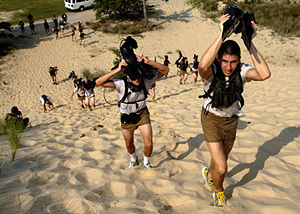 Each new Sea Cadet must attend NSCC recruit training, which serves to introduce each "recruit" to the standards and routine involved in the life of a Sea Cadet. Military drill, customs and courtesies, physical fitness training, and other courses related to the sea-going services, are part of the demanding schedule of recruit training.
After graduating from NSCC recruit training, Sea Cadets have the opportunity to attend Advanced Training in many different locations and in many different fields, depending on their personal interests. Cadets must attend at least one Advanced Training each year in order to advance in rank. These training opportunities usually occur during the summer and winter breaks, but also may occur anytime throughout the year.
Advanced Training is held primarily at Navy and Coast Guard installations, and can range anywhere from five days up to three weeks in length. The training courses are coordinated and staffed by NSCC Officers and Instructors, and may have outside instructors from all branches of the Armed Forces, who are mainly made up of Active and Reserve Navy, Marine, and Coast Guard personnel.
These training activities include, but are not limited to:
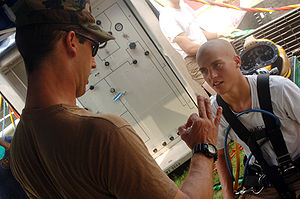 Each of the NSCC and NLCC's 200 units perform drills all around the United States during the school year. Some units have a weeknight drill of 2 - 3 hours, or drill for an entire day over the weekend twice a month, while others drill once a month for an entire weekend. Each unit's drill schedule is set by the unit Commanding Officer and depends on the location of the unit and availability of both adult staff and cadets. During the school year, nearby units often come together to participate in weekend trainings, including Field Training Exercises, Small Arms Training, Shipboard Training, and Regional Flagship Competitions.
The USNSCC owns a ship, the USNSCS Grayfox
, homeported in Port Huron, Michigan.
The USNSCC also sponsors an International Exchange Program with other Sea Cadet programs around the world: exchange countries include the United Kingdom
, Canada
, Australia
, the Netherlands
, Korea
, Japan
, Sweden
, Hong Kong
, Russia
, and Bermuda
.
, only modified with a distinguishing shoulder insignia. U.S. Navy Uniform Regulations are adhered to by both the NSCC and NLCC. Officer rank insignia are the same as the Navy's. Sea Cadet rate insignia are slightly different in design; the colors are changed to yellow, are in the form of chevrons (V-shaped), and are worn on the right sleeve. An exception relates to the Navy Working Uniform (NWU), where the rate insignia are worn on the cadet's collar and are slightly different from the US Navy collar devices.
Sea Cadet ranks follow the same path as of the United States Navy and United States Coast Guard, from E-1 (Seaman Recruit) through E-7 (Chief Petty Officer) (see United States Navy enlisted rates). All cadets have to take the Navy correspondence courses and pass Navy examinations to gain rank. They must have a minimum time served in each rank before moving to the next higher rank. All new Sea Cadets enter the NSCC as an E-1 (Seaman Recruit); detailed requirements for advancement are outlined below.
Officers must be at least age 21 (18 in the case of MIDN), obtain a waiver if older than 65, be a US citizen, and have successful completion of a background check. Officers must also meet height and weight requirements to wear the uniform, and military personnel (active and retired) are allowed to wear their military uniforms (see U.S. Navy officer rank insignia).
Navy League Cadet Corps
The Navy League Cadet Corps is a version of the United States Naval Sea Cadet Corps program developed for younger cadets, aged 11 through 14...
(NLCC), exists for youth between the ages of 11 and 13.
History
The NSCC was founded in 1958 by the Navy League of the United StatesNavy League of the United States
The Navy League of the United States, commonly referred to as The Navy League, is a national association made up of former members of the United States Navy, United States Marine Corps, the United States Coast Guard and the United States Merchant Marine, and civilians interested in supporting the...
at the request of the Department of the Navy. In 1962, the USNSCC was chartered
Congressional charter
A congressional charter is a law passed by the United States Congress that states the mission, authority and activities of a group. Congress issued federal charters from 1791 until 1992 under Title 36 of the United States Code....
under Title 36 of the United States Code
Title 36 of the United States Code
Title 36 of the United States Code outlines the role of Patriotic Societies and Observances in the United States Code.*Subtitle I—Patriotic and National Observances and Ceremonies*Subtitle II—Patriotic and National Organizations...
as a non-profit youth organization with an emphasis towards the sea-going services of the United States. The law was amended in 1974 to allow female participation in the USNSCC.
In 2000, the US Congress found that the NSCC and related programs "provide significant benefits for the Armed Forces, including significant public relations benefits." Although under no service obligation, a sizeable percentage of cadets later enlist in the military. Members who obtain the pay grade E-3 or Seaman/Airman may receive an advanced paygrade of E-3 if they join the Navy or Coast Guard, and E-2 in the Marine Corps or other services, due to the training they receive. Former Sea Cadets also represent a percentage of students at the five federal service academies
United States military academies
The United States Service academies, also known as the United States Military Academies, are federal academies for the undergraduate education and training of commissioned officers for the United States armed forces.There are five U.S...
.
Organization
United States Navy
The United States Navy is the naval warfare service branch of the United States Armed Forces and one of the seven uniformed services of the United States. The U.S. Navy is the largest in the world; its battle fleet tonnage is greater than that of the next 13 largest navies combined. The U.S...
, United States Marine Corps
United States Marine Corps
The United States Marine Corps is a branch of the United States Armed Forces responsible for providing power projection from the sea, using the mobility of the United States Navy to deliver combined-arms task forces rapidly. It is one of seven uniformed services of the United States...
, and United States Coast Guard
United States Coast Guard
The United States Coast Guard is a branch of the United States Armed Forces and one of the seven U.S. uniformed services. The Coast Guard is a maritime, military, multi-mission service unique among the military branches for having a maritime law enforcement mission and a federal regulatory agency...
. The United States Coast Guard, through COMDTINST 5728.2C, USCG Public Affairs Manual, has designated the USNSCC as the Coast Guard's primary youth program, rather than a JROTC.
The national headquarters of the NSCC is located in Arlington, Virginia. Captain James E. Monahan, USNR
United States Navy Reserve
The United States Navy Reserve, until 2005 known as the United States Naval Reserve, is the Reserve Component of the United States Navy...
(Ret.) is the Executive Director, the "Commander-in-Chief" of the USNSCC. There are six field areas in all. Each field is headed by an NSCC NHQ Representative, who is usually the grade of a Navy captain
Captain (naval)
Captain is the name most often given in English-speaking navies to the rank corresponding to command of the largest ships. The NATO rank code is OF-5, equivalent to an army full colonel....
. Each field area may be further divided into regions, which are headed by a Senior Regional Director, who is an NSCC lieutenant commander
Lieutenant commander (United States)
Lieutenant commander is a mid-ranking officer rank in the United States Navy, the United States Coast Guard, the United States Public Health Service Commissioned Corps, and the National Oceanic and Atmospheric Administration Commissioned Corps, with the pay grade of O-4 and NATO rank code OF-3...
(LCDR). Each region can have sub-regions, depending on the size of the area and number of units in that region. Each sub-region is headed by a Regional Director (RD), who is also an NSCC LCDR. Each RD will report to the Senior RD for any matters regarding the region and/or sub-regions themselves. RDs are also responsible to the NSCC NHQ Representative for matters regarding Petty Officer Exams, PO1 and CPO advancements, NSCC officer matters, and anything else that would be of importance to the NHQ Representative or to the Executive Director. Each sub-region may be composed of anywhere between two to ten units. For example, the Pacific Southwest Field Area is composed of Region 11 (covering Southern California and the Las Vegas area) and Region 12 (covering Northern California, and in Nevada, those areas north of Las Vegas). Region 11 itself is divided into 8 sub-regions, each headed by one Regional Director and their regional staff.
Each unit is required to have a complement of at least twenty-five cadet
Cadet
A cadet is a trainee to become an officer in the military, often a person who is a junior trainee. The term comes from the term "cadet" for younger sons of a noble family.- Military context :...
s. They must be physically fit, have no criminal record, and have a good academic standard to become members. Each unit has a Commanding Officer and Executive Officer, and depending on the number of adult volunteers, may have other billets which cover different areas important to the operation of that unit. Some units have far more or far less than the required minimum, due to a vast array of recruiting issues. All units must have the minimum number of personnel in order to be commissioned into the NSCC.
Adult leaders are volunteers with myriad experience ranging from active/reserve/retired military personnel to civilian parents of cadets. Adult volunteers must be 18 years and older. NSCC officers, instructors, and midshipmen all must go through a thorough application process -- including a background check -- before they can be accepted as adult volunteers. High school graduates aged 18, up through adults aged 21 may serve as Midshipmen (MIDN). Midshipmen are technically NSCC officers, and are mostly former cadets, but can be ROTC, service academy, or other personnel with some type of experience relevant to the function of the NSCC and NLCC. Adults aged 21 years and older can serve as NSCC instructors, Warrant Officer
Warrant Officer
A warrant officer is an officer in a military organization who is designated an officer by a warrant, as distinguished from a commissioned officer who is designated an officer by a commission, or from non-commissioned officer who is designated an officer by virtue of seniority.The rank was first...
s, or officers (although Warrant Officer grade is reserved to military personnel with specific qualifications). Cadets who are 18 years old can elect to remain a Sea Cadet through high school graduation and until 30 September of the year of their graduation.
The United States Navy, United States Navy League, and the United States Coast Guard
United States Coast Guard
The United States Coast Guard is a branch of the United States Armed Forces and one of the seven U.S. uniformed services. The Coast Guard is a maritime, military, multi-mission service unique among the military branches for having a maritime law enforcement mission and a federal regulatory agency...
all support the NSCC by providing such resources as uniform assistance, use of military facilities, and assisting with training courses. Most support, however, comes from the volunteers and parents of the NSCC program. Most of the NSCC's funding has come from the enrollment fees of its cadets and officers, the Navy League of the United States, private sources, and through appropriations from the DOD's annual budget. In recent years, the NSCC has lobbied for, and obtained, through congressional support, between $1-2 million a year to offset the rising costs of supporting and running NSCC trainings.
Activities
After graduating from NSCC recruit training, Sea Cadets have the opportunity to attend Advanced Training in many different locations and in many different fields, depending on their personal interests. Cadets must attend at least one Advanced Training each year in order to advance in rank. These training opportunities usually occur during the summer and winter breaks, but also may occur anytime throughout the year.
Advanced Training is held primarily at Navy and Coast Guard installations, and can range anywhere from five days up to three weeks in length. The training courses are coordinated and staffed by NSCC Officers and Instructors, and may have outside instructors from all branches of the Armed Forces, who are mainly made up of Active and Reserve Navy, Marine, and Coast Guard personnel.
These training activities include, but are not limited to:
- Amphibious Operations Training
- Shipboard Training with the Navy and Coast Guard
- Navy Airman School
- JAG Legal Training
- MAA (Master At Arms, the Navy/Coast Guard equivalent to Military Police) Law Enforcement Academy
- Petty Officer Leadership Academy
- Construction School (Navy SEABEE)
- Sailing School
- Submarine Seminar
- USN Seamanship Academy
- Firefighting and Damage Control School
- Port Operations
- Honor Guard School
- Medical School
- Music School
- Joint Special Operations Command Training
- SEAL Training
- EOD (Explosive Ordnance Disposal) Training
- Field Operations Training
- Homeland security training
- Search and rescue training
- Marksmanship training
- SWCC (Special Warfare Combat Crewman) IE "special boats"
- Maritime Interdiction
- International Exchange Program
- And locally arranged trainings
The USNSCC owns a ship, the USNSCS Grayfox
USNSCS Grayfox
The USNSCS Grayfox is currently the largest ship owned by the United States Naval Sea Cadet Corps. She is homeported in Port Huron, Michigan and is used by the USNSCC for shipboard training...
, homeported in Port Huron, Michigan.
The USNSCC also sponsors an International Exchange Program with other Sea Cadet programs around the world: exchange countries include the United Kingdom
United Kingdom
The United Kingdom of Great Britain and Northern IrelandIn the United Kingdom and Dependencies, other languages have been officially recognised as legitimate autochthonous languages under the European Charter for Regional or Minority Languages...
, Canada
Canada
Canada is a North American country consisting of ten provinces and three territories. Located in the northern part of the continent, it extends from the Atlantic Ocean in the east to the Pacific Ocean in the west, and northward into the Arctic Ocean...
, Australia
Australia
Australia , officially the Commonwealth of Australia, is a country in the Southern Hemisphere comprising the mainland of the Australian continent, the island of Tasmania, and numerous smaller islands in the Indian and Pacific Oceans. It is the world's sixth-largest country by total area...
, the Netherlands
Netherlands
The Netherlands is a constituent country of the Kingdom of the Netherlands, located mainly in North-West Europe and with several islands in the Caribbean. Mainland Netherlands borders the North Sea to the north and west, Belgium to the south, and Germany to the east, and shares maritime borders...
, Korea
Korea
Korea ) is an East Asian geographic region that is currently divided into two separate sovereign states — North Korea and South Korea. Located on the Korean Peninsula, Korea is bordered by the People's Republic of China to the northwest, Russia to the northeast, and is separated from Japan to the...
, Japan
Japan
Japan is an island nation in East Asia. Located in the Pacific Ocean, it lies to the east of the Sea of Japan, China, North Korea, South Korea and Russia, stretching from the Sea of Okhotsk in the north to the East China Sea and Taiwan in the south...
, Sweden
Sweden
Sweden , officially the Kingdom of Sweden , is a Nordic country on the Scandinavian Peninsula in Northern Europe. Sweden borders with Norway and Finland and is connected to Denmark by a bridge-tunnel across the Öresund....
, Hong Kong
Hong Kong
Hong Kong is one of two Special Administrative Regions of the People's Republic of China , the other being Macau. A city-state situated on China's south coast and enclosed by the Pearl River Delta and South China Sea, it is renowned for its expansive skyline and deep natural harbour...
, Russia
Russia
Russia or , officially known as both Russia and the Russian Federation , is a country in northern Eurasia. It is a federal semi-presidential republic, comprising 83 federal subjects...
, and Bermuda
Bermuda
Bermuda is a British overseas territory in the North Atlantic Ocean. Located off the east coast of the United States, its nearest landmass is Cape Hatteras, North Carolina, about to the west-northwest. It is about south of Halifax, Nova Scotia, Canada, and northeast of Miami, Florida...
.
Uniform and ranks
The Navy allows the NSCC and NLCC to wear the uniforms of the United States NavyUniforms of the United States Navy
This article examines dress uniforms, daily service uniforms, working uniforms, special situations, and the history of uniforms of the United States Navy...
, only modified with a distinguishing shoulder insignia. U.S. Navy Uniform Regulations are adhered to by both the NSCC and NLCC. Officer rank insignia are the same as the Navy's. Sea Cadet rate insignia are slightly different in design; the colors are changed to yellow, are in the form of chevrons (V-shaped), and are worn on the right sleeve. An exception relates to the Navy Working Uniform (NWU), where the rate insignia are worn on the cadet's collar and are slightly different from the US Navy collar devices.
Sea Cadet ranks follow the same path as of the United States Navy and United States Coast Guard, from E-1 (Seaman Recruit) through E-7 (Chief Petty Officer) (see United States Navy enlisted rates). All cadets have to take the Navy correspondence courses and pass Navy examinations to gain rank. They must have a minimum time served in each rank before moving to the next higher rank. All new Sea Cadets enter the NSCC as an E-1 (Seaman Recruit); detailed requirements for advancement are outlined below.
Officers must be at least age 21 (18 in the case of MIDN), obtain a waiver if older than 65, be a US citizen, and have successful completion of a background check. Officers must also meet height and weight requirements to wear the uniform, and military personnel (active and retired) are allowed to wear their military uniforms (see U.S. Navy officer rank insignia).
Cadets
| Rank | Correspondence Course | Training | Time in Rate | Exam | Approval Authority |
|---|---|---|---|---|---|
| E-1 Seaman Recruit/ SR |
N/A | N/A | N/A | N/A | N/A |
| E-2 Seaman Apprentice / SA |
Basic Military Requirements NAVEDTRA-14325 |
NSCC Recruit Training (9-day or 2-week course) | 3 Months in NSCC | N/A | Commanding Officer |
| E-3 Seaman / SN |
Seaman NAVEDTRA-14067 |
10 Days (Two- 5 Day Non-Consecutive) Advanced Training | 6 Months as E-2 | N/A | Commanding Officer |
| E-4 Petty Officer 3rd Class / PO3 |
Petty Officer 3rd & 2nd Class NAVEDTRA-14504 |
10 Days (Two- 5 Day Non-Consecutive) Advanced Training | 6 Months as E-3 | PO3 Exam | Commanding Officer |
| E-5 Petty Officer 2nd Class / PO2 |
Petty Officer 3rd & 2nd Class NAVEDTRA-14504 |
10 Days (Two- 5 Day Non-Consecutive) Advanced Training, Must Graduate From POLA (Petty Officer Leadership Academy) | 6 Months as E-4 | PO2 Exam | Commanding Officer |
| E-6 Petty Officer 1st Class / PO1 |
Petty Officer 1st Class NAVEDTRA-14145 |
10 Days (Two- 5 Day Non-Consecutive) Advanced Training | 6 Months as E-5 | PO1 Exam | NSCC Executive Director |
| E-7 Chief Petty Officer / CPO |
Chief Petty Officer NAVEDTRA-14144 |
10 Days (Two- 5 Day Non-Consecutive) Advanced Training Staff RT (Effective 1 September 2008) |
6 Months as E-6 | N/A | NSCC Executive Director |
Adult officers
| Rank | Course | Training | Time in Service | Other Requirements |
|---|---|---|---|---|
| Midshipman Midshipman (MIDN)* |
NSCC Officer/Midshipman Study Guide | N/A | N/A | NSCC E-3 or above, JROTC, ROTC |
| Instructor Instructor (INST) |
NSCC Officer/Midshipman Study Guide | N/A | N/A | N/A |
| Warrant Officer Warrant Officer (WO) |
NSCC Officer/Midshipman Study Guide | N/A | N/A | Must have reached E-6 or above in military |
| O-1 Ensign Ensign An ensign is a national flag when used at sea, in vexillology, or a distinguishing token, emblem, or badge, such as a symbol of office in heraldry... (ENS) |
NSCC Officer/Midshipman Study Guide OPD101 |
N/A | One year as MIDN or INST One year in NSCC |
N/A |
| O-2 Lieutenant, Junior Grade Lieutenant, Junior Grade Lieutenant is a junior commissioned officer rank in the United States Navy, the United States Coast Guard, the United States Public Health Service Commissioned Corps, United States Merchant Marine USMM, and the National Oceanic and Atmospheric Administration Commissioned Corps, with the pay grade... (LTJG) |
OPD 201 | One Advanced Training as an LTJG or 2 TWT’s for INST, WO | 2 Years as ENS. (Waived for INST, WO) 3 Years Minimum NSCC Time in Service |
N/A |
| O-3 Lieutenant Lieutenant A lieutenant is a junior commissioned officer in many nations' armed forces. Typically, the rank of lieutenant in naval usage, while still a junior officer rank, is senior to the army rank... (LT) |
OPD 301 | One Advanced Training as an LTJG or 2 TWT’s for INST, WO | 3 Years as LTJG. (Waived for INST, WO) 6 Years Minimum NSCC Time in Service |
N/A |
| O-4 Lieutenant Commander Lieutenant commander (United States) Lieutenant commander is a mid-ranking officer rank in the United States Navy, the United States Coast Guard, the United States Public Health Service Commissioned Corps, and the National Oceanic and Atmospheric Administration Commissioned Corps, with the pay grade of O-4 and NATO rank code OF-3... (LCDR) |
N/A | One Advanced Training as an LTJG or 3 TWT’s for INST, WO | 4 Years as LT. (Waived for INST, WO) 10 Years Minimum NSCC Time in Service |
1 Career TWT must be Recruit Training |
See also
- International Sea Cadet AssociationInternational Sea Cadet AssociationThe International Sea Cadet Association, referred to as "the ISCA", is a voluntary association of independent Sea Cadet Corps or corresponding organizations, committed to common concepts and goals, and wishing to share ideas and information, and, to the best of their ability, to engage in cadet...
- Sea CadetsSea CadetsSea Cadets are generally members of a Sea Cadet Corps, a formal uniformed youth organisation for young people with an interest in water borne activities and or the national Navy. The organisation may be sponsored in whole or in part by the Navy, Navy League or Naval supporter's organisation...
(various nations' Sea Cadet organizations) - Young MarinesYoung MarinesThe Young Marines is a youth program in the United States, open to children from the ages of 8 years old through the completion of high school.- Role and purpose :* To promote the mental, moral, and physical development of its members...
External references
- Naval Sea Cadet Corps. Navy.com (About the Navy: "Before the Navy"). Retrieved 2009-12-05.
- Naval Sea Cadet Corps official website. Retrieved 2009-12-05.
- National Resources Portal webpage (on Naval Sea Cadet Corps official website]. Retrieved 2009-12-05.
- COMPASS: National Training Portal webpage (on Naval Sea Cadet Corps official website]. Retrieved 2009-12-05.
- NSCC Alumni Association official website. Retrieved 2009-12-05.
- International Sea Cadet Association official website. Retrieved 2009-12-05.