

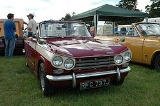
Triumph Vitesse

Encyclopedia
The Triumph Vitesse was a compact six-cylinder car built by Standard-Triumph
from 1962 to 1971. The car was styled by Michelotti, and was available in saloon and convertible variants.
The Vitesse name had previously been used by Triumph on a car made between 1936 and 1938, also by G. N.(Godfrey & Nash) on their 1922 GN Vitesse Cyclecar, and earlier yet by Austin on their 1914–16 Austin 20 (hp) and 30 (hp) Vitesse models.
After the last Triumph Vitesse was made in July 1971, the name remained unused until October 1982, when Rover used it on their SD1 until 1986, and one final time on their Rover 800, 820 and 827 models from October 1988 to 1991, at which time that car was rebodied as the R17 version, which was produced until 1998 as the Rover Vitesse Sport.
small saloon. The Herald had been introduced on 22 April 1959 and was an attractive 2-door car styled by the Italian
designer Giovanni Michelotti. By the early 1960s, however, Triumph began to give thought to a sports saloon based on the Herald and using their 6-cylinder engine. Michelotti was again approached for styling, and he came up with a car that used almost all body panels from the Herald, combined with a new front end with a slanted "Chinese Eye" 4-headlamp design.
Standard-Triumph fitted a 1596 cc version of their traditional straight-6
derived from the engine used in the Standard Vanguard Six, but with a smaller bore diameter of 66.75 mm (2.6 in), compared with the 74.7 mm (2.9 in) bore on the Vanguard, equipped with twin Solex
B32PIH semi-downdraught carburettor These were soon replaced by B321H carburettors, as the accelerator pumps proved a problem The curious observer will notice a "seam" on the cylinder block between the third & fourth cylinders revealing the humble design beginnings from the 803 cc Standard 8 block of 1953. The gearbox
was strengthened and offered with optional Laycock De Normanville 'D-type' overdrive
that offered a top gear with a 20% higher ratio (the equivalent change from 3rd to 4th in a standard box, giving more relaxed and economical cruising at the expense of slight oil drag from the pump in the overdrive unit. The rear axle was changed to an uprated differential (though still the same 3.89:1 ratio as the Herald). Front disc brakes were standard as were larger rear brake drums, and the Herald fuel tank was enlarged, retaining the handy reserve feature (essentially a curved pickup pipe that could be rotated to dip into the last few centimetres of fuel) of the smaller Herald tank. The front suspension featured uprated springs to cope with the extra weight of the new engine, but the rear suspension was basically standard Herald—a swing-axle
transverse-leaf system which quickly proved inadequate for the relatively powerful Vitesse. The chassis was basically the same as the Herald, and the Vitesse was available in convertible
and saloon forms; a coupé
never got beyond the prototype stage.
A handful of Vitesse estate
s also were assembled to special order at Standard-Triumph's Service Depot at Park Royal in West London.
The interior was much improved over the Herald; wooden door cappings were added to match the wooden dashboard and the car featured better seats and door trims. Optional extras included a vinyl/fabric, (Webasto), sunroof
on saloon models. Exterior trim was also improved with stainless steel side trim and satin-silver anodised alloy bumper cappings (replacing the white rubber Herald design).
A year or so after the car's launch, the Vitesse received its first facelift; the dashboard was revised with a full range of instruments instead of the large single dial from the Herald, and from September 1965, at commission number HB27986, the twin Solex carburettors were replaced by twin Stromberg
CD 150 carburettors. Power output increased from the original 70 bhp at 5,000 rpm & torque of 92.5 lbft, enough to provide a useful performance boost and making the car a much more flexible performer. There was a claimed, although somewhat optimistic increase of 13–14 bhp, and the motoring magazine tested top speed rose to 91 mi/h, with the 0–80 mph (0–128.7 km/h) time decreasing from 46.6 seconds to just 33.6 seconds.
The Vitesse 6 sold extremely well for Triumph, and was by some way the most popular Vitesse sold during the model's lifetime. The car was well liked for its performance and reasonable fuel economy, and the well-appointed interior. The Vitesse had few rivals for the price: able to perform as well as many sports cars, but with room for a family. The convertible in particular was virtually unique in the marketplace and another genuine 4-seater sporting convertible would not reappear from a British manufacturer until the Triumph Stag
several years further down the line.
The Sports 6 was perhaps better suited to American highways than was the Herald, but it faced stiff price competition from cars such as Ford's new Mustang. The Vitesse Saloon was not officially imported to the US, although a few do come up as P.E.D. (Personal Export Delivery), cars usually imported by American service personnel. Original US price (POE East Coast) was $2,499 for the Sports 6 Convertible, which was usually delivered in White, Signal Red or Black.
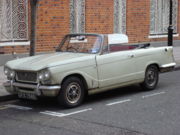 In 1966 Triumph upgraded the engine to 1998 cc, in line with the new Triumph GT6
coupé, and relaunched the car as the Vitesse 2-Litre. Power was increased to 95 bhp, endowing the new car with a 0–60 mph time of just over 11 s. (The 2-Litre was advertised by Triumph as "The Two Seater Beater"), The performance increase was welcome, but it highlighted the deficiencies of the rear suspension, also noted on the new GT6
and the Spitfire
. There were detail modifications for the 2-litre, including a stronger all synchromesh gearbox and uprated brakes, and an improved stronger differential than the Vitesse 6 (still 3.89:1) ratio. The overdrive GT6 used the same differential, though the cars without overdrive specified used a 3.27:1 differential of the same dimensions, though that was not fitted to the Vitesse as standard. An oblong 'VITESSE' badge was fitted on the satin silver anodised aluminium-alloy cowling above the reversing light and badges on the side of the bonnet read 2 litre.
There were other improvements: the engine was tweaked once more to provide 104 bhp, cutting the 0–60 time to just over 11 seconds and providing a top speed easily in excess of 100 mi/h. The main changes were to the valve timing, to give earlier opening of the inlet vlves compared with the earlier 2 litre engine, though design changes to the cylinder head allowed for increased inlet valve diameters and better porting. The exterior featured a new grille, Rostyle wheel
trims and silver painted steel rear panel, (described by Triumph as "ceramic"), and the interior was upgraded once more in order to share parts with the new Herald 13/60. A new colour range was offered for the Mark 2 models.
The aluminium cowling above the reversing light remained, but no longer had a chromed VITESSE badge on it. The separate chromed mezak TRIUMPH letters on the bonnet and the boot lid were also deleted. The badges on the bonnet sides were changed to read Mk2 not 2 litre.
This was the ultimate Vitesse, a saloon or convertible with performance easily superior to an MGB
or Sunbeam Alpine
sports car but with four proper seats and a large boot. The Vitesse sold well until its withdrawal in July 1971, a year before the new Triumph Dolomite
saloon entered the performance luxury sector for Triumph, and two years before the Dolomite Sprint variant added another high-performance sports saloon to the range. Although the Vitesse was an older model, it proved to be more reliable than its replacement.
Triumph Motor Company
The Triumph Motor Company was a British car and motor manufacturing company. The Triumph marque is owned currently by BMW. The marque had its origins in 1885 when Siegfried Bettmann of Nuremberg initiated S. Bettmann & Co and started importing bicycles from Europe and selling them with his own...
from 1962 to 1971. The car was styled by Michelotti, and was available in saloon and convertible variants.
The Vitesse name had previously been used by Triumph on a car made between 1936 and 1938, also by G. N.(Godfrey & Nash) on their 1922 GN Vitesse Cyclecar, and earlier yet by Austin on their 1914–16 Austin 20 (hp) and 30 (hp) Vitesse models.
After the last Triumph Vitesse was made in July 1971, the name remained unused until October 1982, when Rover used it on their SD1 until 1986, and one final time on their Rover 800, 820 and 827 models from October 1988 to 1991, at which time that car was rebodied as the R17 version, which was produced until 1998 as the Rover Vitesse Sport.
Vitesse 6
The Triumph Vitesse was introduced on 25 May 1962, re-using a name previously used by the pre-Second World War Triumph company from 1936–38, and was an in-line 6-cylinder performance version of the Triumph HeraldTriumph Herald
The Triumph Herald was a small two-door car introduced in 1959 by the Standard-Triumph Company of Coventry. Body design was by the Italian stylist Michelotti and the car was offered in saloon, convertible, coupé, van, and estate models....
small saloon. The Herald had been introduced on 22 April 1959 and was an attractive 2-door car styled by the Italian
Italy
Italy , officially the Italian Republic languages]] under the European Charter for Regional or Minority Languages. In each of these, Italy's official name is as follows:;;;;;;;;), is a unitary parliamentary republic in South-Central Europe. To the north it borders France, Switzerland, Austria and...
designer Giovanni Michelotti. By the early 1960s, however, Triumph began to give thought to a sports saloon based on the Herald and using their 6-cylinder engine. Michelotti was again approached for styling, and he came up with a car that used almost all body panels from the Herald, combined with a new front end with a slanted "Chinese Eye" 4-headlamp design.
Standard-Triumph fitted a 1596 cc version of their traditional straight-6
Straight-6
The straight-six engine or inline-six engine is a six-cylinder internal combustion engine with all six cylinders mounted in a straight line along the crankcase...
derived from the engine used in the Standard Vanguard Six, but with a smaller bore diameter of 66.75 mm (2.6 in), compared with the 74.7 mm (2.9 in) bore on the Vanguard, equipped with twin Solex
Solex
Solex was a French manufacturer of carburetors and the powered bicycle VéloSoleX.The Solex company was founded by Marcel Mennesson and Maurice Goudard to manufacture vehicle radiators...
B32PIH semi-downdraught carburettor These were soon replaced by B321H carburettors, as the accelerator pumps proved a problem The curious observer will notice a "seam" on the cylinder block between the third & fourth cylinders revealing the humble design beginnings from the 803 cc Standard 8 block of 1953. The gearbox
Manual transmission
A manual transmission, also known as a manual gearbox or standard transmission is a type of transmission used in motor vehicle applications...
was strengthened and offered with optional Laycock De Normanville 'D-type' overdrive
Overdrive (mechanics)
Overdrive is a term used to describe a mechanism that allows an automobile to cruise at sustained speed with reduced engine RPM, leading to better fuel economy, lower noise and lower wear...
that offered a top gear with a 20% higher ratio (the equivalent change from 3rd to 4th in a standard box, giving more relaxed and economical cruising at the expense of slight oil drag from the pump in the overdrive unit. The rear axle was changed to an uprated differential (though still the same 3.89:1 ratio as the Herald). Front disc brakes were standard as were larger rear brake drums, and the Herald fuel tank was enlarged, retaining the handy reserve feature (essentially a curved pickup pipe that could be rotated to dip into the last few centimetres of fuel) of the smaller Herald tank. The front suspension featured uprated springs to cope with the extra weight of the new engine, but the rear suspension was basically standard Herald—a swing-axle
Swing axle
A swing axle is a simple type of independent suspension first used in early aircraft , such as the Sopwith and Fokker, usually with rubber bungee and no damping....
transverse-leaf system which quickly proved inadequate for the relatively powerful Vitesse. The chassis was basically the same as the Herald, and the Vitesse was available in convertible
Convertible
A convertible is a type of automobile in which the roof can retract and fold away having windows which wind-down inside the doors, converting it from an enclosed to an open-air vehicle...
and saloon forms; a coupé
Coupé
A coupé or coupe is a closed car body style , the precise definition of which varies from manufacturer to manufacturer, and over time...
never got beyond the prototype stage.
A handful of Vitesse estate
Station wagon
A station wagon is a body style variant of a sedan/saloon with its roof extended rearward over a shared passenger/cargo volume with access at the back via a third or fifth door , instead of a trunk lid...
s also were assembled to special order at Standard-Triumph's Service Depot at Park Royal in West London.
The interior was much improved over the Herald; wooden door cappings were added to match the wooden dashboard and the car featured better seats and door trims. Optional extras included a vinyl/fabric, (Webasto), sunroof
Sunroof
An automotive sunroof is a fixed or operable opening in an automobile roof which allows light and/or fresh air to enter the passenger compartment. Sunroofs may be manually operated or motor driven, and are available in many shapes, sizes and styles...
on saloon models. Exterior trim was also improved with stainless steel side trim and satin-silver anodised alloy bumper cappings (replacing the white rubber Herald design).
A year or so after the car's launch, the Vitesse received its first facelift; the dashboard was revised with a full range of instruments instead of the large single dial from the Herald, and from September 1965, at commission number HB27986, the twin Solex carburettors were replaced by twin Stromberg
Zenith Carburetters
Zenith Carburetters was a British company making carburettors. In 1955 they joined with their major pre-war rival Solex Carburettors and over time the Zenith brand name fell into disuse...
CD 150 carburettors. Power output increased from the original 70 bhp at 5,000 rpm & torque of 92.5 lbft, enough to provide a useful performance boost and making the car a much more flexible performer. There was a claimed, although somewhat optimistic increase of 13–14 bhp, and the motoring magazine tested top speed rose to 91 mi/h, with the 0–80 mph (0–128.7 km/h) time decreasing from 46.6 seconds to just 33.6 seconds.
The Vitesse 6 sold extremely well for Triumph, and was by some way the most popular Vitesse sold during the model's lifetime. The car was well liked for its performance and reasonable fuel economy, and the well-appointed interior. The Vitesse had few rivals for the price: able to perform as well as many sports cars, but with room for a family. The convertible in particular was virtually unique in the marketplace and another genuine 4-seater sporting convertible would not reappear from a British manufacturer until the Triumph Stag
Triumph Stag
The Triumph Stag is a British car that was sold between 1970 and 1978 by the Triumph Motor Company, styled by the Italian designer Giovanni Michelotti.-Design and styling:...
several years further down the line.
Sports 6
The Vitesse 6 convertible was exported to the US as the left-hand drive Triumph Sports 6, from 1962 until 1964. It was marketed as a "limited edition car", but because of its retail price only 679 were sold before it was withdrawn.The Sports 6 was perhaps better suited to American highways than was the Herald, but it faced stiff price competition from cars such as Ford's new Mustang. The Vitesse Saloon was not officially imported to the US, although a few do come up as P.E.D. (Personal Export Delivery), cars usually imported by American service personnel. Original US price (POE East Coast) was $2,499 for the Sports 6 Convertible, which was usually delivered in White, Signal Red or Black.
Vitesse 2-Litre
Triumph GT6
The GT6 was a 6-cylinder sports coupé built by Standard-Triumph and based on their popular Triumph Spitfire convertible. Production ran from 1966 to 1973.- Development history :...
coupé, and relaunched the car as the Vitesse 2-Litre. Power was increased to 95 bhp, endowing the new car with a 0–60 mph time of just over 11 s. (The 2-Litre was advertised by Triumph as "The Two Seater Beater"), The performance increase was welcome, but it highlighted the deficiencies of the rear suspension, also noted on the new GT6
Triumph GT6
The GT6 was a 6-cylinder sports coupé built by Standard-Triumph and based on their popular Triumph Spitfire convertible. Production ran from 1966 to 1973.- Development history :...
and the Spitfire
Triumph Spitfire
The Triumph Spitfire is a small English two-seat sports car, introduced at the London Motor Show in 1962. The vehicle was based on a design produced for Standard-Triumph in 1957 by Italian designer Giovanni Michelotti...
. There were detail modifications for the 2-litre, including a stronger all synchromesh gearbox and uprated brakes, and an improved stronger differential than the Vitesse 6 (still 3.89:1) ratio. The overdrive GT6 used the same differential, though the cars without overdrive specified used a 3.27:1 differential of the same dimensions, though that was not fitted to the Vitesse as standard. An oblong 'VITESSE' badge was fitted on the satin silver anodised aluminium-alloy cowling above the reversing light and badges on the side of the bonnet read 2 litre.
Vitesse Mark 2
The Vitesse Mark 2 was launched in 1968 as the final update to the Vitesse range. Essentially intended to be Triumph's answer to growing criticism of the rear suspension, the Mark 2 was fitted with a completely redesigned layout using Rotoflex rear couplings. This system, also shared with the new GT6 MKII and the earlier GT6 MkIIIs, (GT6+ in the US market), tamed the wayward handling somewhat and endowed the Vitesse with more firm, progressive roadholding.There were other improvements: the engine was tweaked once more to provide 104 bhp, cutting the 0–60 time to just over 11 seconds and providing a top speed easily in excess of 100 mi/h. The main changes were to the valve timing, to give earlier opening of the inlet vlves compared with the earlier 2 litre engine, though design changes to the cylinder head allowed for increased inlet valve diameters and better porting. The exterior featured a new grille, Rostyle wheel
Rostyle wheel
Rostyle wheels are a notable design of wheels for cars made by the British firm of Rubery Owen, a diversified industrial company which made many car parts. The wheels had an unusual pressed steel form to imitate the few ribs of mag wheels at the time, but were painted black and aluminium...
trims and silver painted steel rear panel, (described by Triumph as "ceramic"), and the interior was upgraded once more in order to share parts with the new Herald 13/60. A new colour range was offered for the Mark 2 models.
The aluminium cowling above the reversing light remained, but no longer had a chromed VITESSE badge on it. The separate chromed mezak TRIUMPH letters on the bonnet and the boot lid were also deleted. The badges on the bonnet sides were changed to read Mk2 not 2 litre.
This was the ultimate Vitesse, a saloon or convertible with performance easily superior to an MGB
MG MGB
The MGB is a sports car launched by MG Cars in May 1962 to replace the MGA. Introduced as a four-cylinder roadster, a coupé with 2+2 seating was added in 1965...
or Sunbeam Alpine
Sunbeam Alpine
The Sunbeam Alpine is a sporty two-seat open car from Rootes Group's Sunbeam car marque. The original was launched in 1953 as the first vehicle from Sunbeam-Talbot to bear the Sunbeam name alone since the 1935 takeover of Sunbeam and Talbot by the Rootes Group....
sports car but with four proper seats and a large boot. The Vitesse sold well until its withdrawal in July 1971, a year before the new Triumph Dolomite
Triumph Dolomite
The Triumph Dolomite was a popular small saloon car produced by the Triumph Motor Company division of the British Leyland Corporation in Canley, Coventry between October 1972 and August 1980.-History:...
saloon entered the performance luxury sector for Triumph, and two years before the Dolomite Sprint variant added another high-performance sports saloon to the range. Although the Vitesse was an older model, it proved to be more reliable than its replacement.
Production figures
- Vitesse 6 (1600): May 1962 - September 1966; 31,261
- saloon: 22,814
- convertible: 8,447, includes 679 Sports 6 (USA)
- Vitesse 2-Litre: September 1966 - September 1968; 10,830
- saloon: 7,328
- convertible: 3,502
- Vitesse Mark 2: July 1968 - July 1971; 9,121
- saloon: 5,649
- convertible: 3,472