
Home      Discussion      Topics      Dictionary      Almanac
Signup       Login
MG MGB

MG MGB

Overview
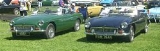
The MGB is a sports car launched by MG Cars in May 1962 to replace the MGA
MG MGA
The MGA is a sports car produced by MG division of the British Motor Corporation from 1955 to 1962.The MGA replaced the older T-type cars and represented a complete styling break from the older vehicles. The car was officially launched at the Frankfurt Motor Show in 1955...

. Introduced as a four-cylinder roadster
Roadster
A roadster is a two-seat open car with emphasis on sporty handling and without a fixed roof or side weather protection. Strictly speaking a roadster with wind-up windows is a convertible but as true roadsters are no longer made the distinction is now irrelevant...

, a coupé
Coupé
A coupé or coupe is a closed car body style , the precise definition of which varies from manufacturer to manufacturer, and over time...

 with 2+2 seating was added in 1965. The six-cylinder MGC debuted in 1967; a later derivative fitted with the Buick
Buick
Buick is a premium brand of General Motors . Buick models are sold in the United States, Canada, Mexico, China, Taiwan, and Israel, with China being its largest market. Buick holds the distinction as the oldest active American make...

-based Rover V8 was made from 1973 to 1976.
Discussion
Ask a question about 'MG MGB'
Start a new discussion about 'MG MGB'
Answer questions from other users
Full Discussion Forum
 
Unanswered Questions
Recent Discussions
Encyclopedia
The MGB is a sports car launched by MG Cars in May 1962 to replace the MGA
MG MGA
The MGA is a sports car produced by MG division of the British Motor Corporation from 1955 to 1962.The MGA replaced the older T-type cars and represented a complete styling break from the older vehicles. The car was officially launched at the Frankfurt Motor Show in 1955...

. Introduced as a four-cylinder roadster
Roadster
A roadster is a two-seat open car with emphasis on sporty handling and without a fixed roof or side weather protection. Strictly speaking a roadster with wind-up windows is a convertible but as true roadsters are no longer made the distinction is now irrelevant...

, a coupé
Coupé
A coupé or coupe is a closed car body style , the precise definition of which varies from manufacturer to manufacturer, and over time...

 with 2+2 seating was added in 1965. The six-cylinder MGC debuted in 1967; a later derivative fitted with the Buick
Buick
Buick is a premium brand of General Motors . Buick models are sold in the United States, Canada, Mexico, China, Taiwan, and Israel, with China being its largest market. Buick holds the distinction as the oldest active American make...

-based Rover V8 was made from 1973 to 1976.

MGB/MGC production continued until October 1980 variously by the British Motor Corporation
British Motor Corporation
The British Motor Corporation, or commonly known as BMC was a vehicle manufacturer from United Kingdom, formed by the merger of the Austin Motor Company and the Nuffield Organisation in 1952...

 and its successors, British Motor Holdings
British Motor Holdings
British Motor Holdings Limited was a British motor company known until 14 December 1966 as British Motor Corporation Limited .-History:...

 and British Leyland Motor Corporation
British Leyland Motor Corporation
British Leyland was a vehicle manufacturing company formed in the United Kingdom in 1968 as British Leyland Motor Corporation Ltd . It was partly nationalised in 1975 with the government creating a new holding company called British Leyland Ltd which became BL Ltd in 1978...

.

History


The MGB was a relatively modern design at the time of its introduction, utilizing a monocoque
Monocoque
Monocoque is a construction technique that supports structural load by using an object's external skin, as opposed to using an internal frame or truss that is then covered with a non-load-bearing skin or coachwork...

 structure instead of the traditional body-on-frame
Body-on-frame
Body-on-frame is an automobile construction method. Mounting a separate body to a rigid frame that supports the drivetrain was the original method of building automobiles, and its use continues to this day. The original frames were made of wood , but steel ladder frames became common in the 1930s...

 construction used on both the MGA and MG T-types and the MGB's rival, the Triumph TR series. The lightweight design reduced manufacturing costs while adding to overall vehicle strength. Wind-up windows were standard, and a comfortable driver's compartment offered plenty of legroom. A parcel shelf was fitted behind the seats.

The MGB's performance was considered brisk at the time of its introduction, with a 0–60 mph (96 km/h) time of just over 11 seconds, aided by the relatively light weight of the car. Handling was one of the MGB's strong points. The 3-bearing 1798 cc B-Series
BMC B-Series engine
The BMC B-series was a straight-4 internal combustion engine family, mostly used in motor cars, created by British company Austin Motor Company. The pre-cursor of the "B" series engine was a 1200 cc OHV engine which was used in the 1947 Austin A40 Devon. This A40 Devon engine was based on a...

 engine produced 95 hp (71 kW) at 5,400 rpm. The engine was upgraded in October 1964 to a five-bearing crankshaft in an effort to improve reliability. A majority of MGBs were exported to United States. In 1974, as US air pollution emission standards became more rigorous, US-market MGBs were de-tuned for compliance. As well as a marked reduction in performance, the MGB gained an inch (25 mm) in ride height and the distinctive rubber bumpers which came to replace the chrome for all markets.

The MGB was one of the first cars to feature controlled crumple zone
Crumple zone
The crumple zone is a structural feature mainly of automobiles. Crumple zones have also been incorporated into railcars in recent years.They are designed to absorb the energy from the impact during an accident by controlled deformation. This energy is much higher than is commonly recognized...

s designed to protect the driver and passenger in a 30 mph (48 km/h) impact with an immovable barrier (200 ton).

Combined production volume of MGB, MGC and MGB GT V8 models was 523,836 cars. A very limited-production "revival" model with only 2,000 units made, called RV8 was produced by Rover
Austin Rover Group
The Austin Rover Group was a British motor manufacturer. It was formed in 1981 as the mass-market car manufacturing subsidiary of British Leyland...

 in the 1990s. Despite the similarity in appearance to the roadster, the RV8 had less than 5 percent parts interchangeability with the original car.

Drivetrain


Engine: All MGBs (except the V8 version) utilized the BMC B-Series engine. This engine was essentially an enlarged version of that used in the MGA with displacement being increased from 1622 cc to 1798 cc. The earlier cars used a three main bearing crankshaft until mid-1965, when a five-bearing crankshaft design was introduced. Horsepower was rated at 95 on both 3 main bearing and earlier 5-bearing cars with peak power coming at 5400 rpm with a 6000 rpm redline. Torque output on all MGB is good with a peak of 110 ft-lb (149.1 N·m) Fuel consumption was around 25mpg.. US specification cars saw power fall in 1968 with the introduction of emission standards and the use of air or smog pumps. In 1971 UK spec cars still had 95 bhp at 5,500 rpm, with 105 ft-lb (142.4 N·m) torque at 2500 rpm. By 1973 it was 94 bhp; by 1974 it was 87, with 103 ft-lb (139.6 N·m) torque; by 1975 it was 85 with 100 ft-lb (135.6 N·m). Some California specification cars produced only around 70 hp by the late 1970s. The compression ratio was also reduced from 9 to 1 to 8:1 on US spec cars in 1972.

Carburation: All MGBs from 1963 to 1974 used twin 1.5 inches (38.1 mm) SU carburetors. US spec cars from 1975 used a single Stromberg 1.75 inches (44.5 mm) carburettor mounted on a combination intake–exhaust manifold. This greatly reduced power as well as creating longevity problems as the (adjacent) catalytic converter tended to crack the intake–exhaust manifold. All MGBs used a SU-built electronic fuel pump.

Gearbox:: All MGBs from 1962 to 1967 used a four-speed manual gearbox with a non-synchronized (or straight-cut) first gear with optional overdrive.. This gearbox was based on that used in the MGA with some minor upgrades to cope with the additional output of the larger MGB engine. In 1968 the early gearbox was replaced by a fully synchronized unit based on the MGC gearbox. This unit was designed to handle the 150 hp 3-litre engine of the MGC and was thus over-engineered when mated with the standard MGB B-Series engine. In fact, the same transmission was even used in the 3.5-litre V-8 version of the MGB-GT-V8. An automatic three-speed transmission was also offered as a factory option but proved to be fairly unpopular.

Electrically engaged overdrive gearboxes were an available option on all MGBs. The overdrive unit was operational in third and fourth gears but the overall ratio in third gear overdrive was roughly the same as fourth gear direct. Later cars allowed the overdrive to operate only in fourth gear. The overdrive unit was engaged by a toggle switch located on the dash on 1963–1974 cars and on a gear lever mounted switch on later cars. Overdrives were fitted to less than 20% of all MGBs, making it a very desirable feature.

Rear axle: Early MGBs used the "banjo" type differential carried over from the MGA with the rear axle ratio reduced from the MGA's 4.1 (or 4.3) to 3.9 to 1. (Compensating for the reduction from 15 inch to 14 inches (355.6 mm) wheels.) MGB GTs first began using a tube-type rear axle in 1967. This unit was substantially stronger being, like the later gearbox, designed for the three-litre MGC. All MGBs used the tube-type axle from 1968.

Brakes: All MGBs were fitted with 11 inches (279.4 mm) solid (non-ventilated) disc brakes on the front with drum brakes on the rear. The front brake calipers were manufactured by Girling and used two pistons per caliper. The brake system on the MGB GT was the same as the Roadster with the exception of slightly larger rear brake cylinders. A single-circuit hydraulic system was used before 1968 when dual-circuit (separate front and rear systems) were installed on all MGBs to comply with US regulations. Servo assistance (power brakes) was not standard until 1975. Many modern and contemporary testers have commented on the very heavy brake pedal pressure needed to stop the non-servo assisted cars.

Electrical system: The MGB initially had an extremely simple electrical system. Dash-mounted toggle switches controlled the lights, ventilation fan, and wipers with only the turn signals being mounted on a stalk on the steering column. The ignition switch was also mounted on the dash. Like the MGA, the MGB utilized two 6-volt batteries
Car battery
An automotive battery is a type of rechargeable battery that supplies electric energy to an automobile. Usually this refers to an SLI battery to power the starter motor, the lights, and the ignition system of a vehicle’s engine...

 wired in series to give a 12-volt positive earth configuration. The batteries were placed under a scuttle panel behind the seats making access a bit of a challenge but the location gave excellent weight distribution and thus improved handling. The charging system used a Lucas generator (dynamo). Later MGBs had considerable changes to the electrical system including the use of a single twelve-volt battery, a change from positive to negative earth, safety-type toggle switches, an alternator in place of the generator, additional warning lights and buzzers, and having most common functions moved to steering column stalks. Early MGBs had such poorly assembled electrical assemblies that the alternator unit would fall right off the car with barely any miles on it, leaving the driver stranded on the side of the road.

MGB Roadster


The roadster was the first of the MGB range to be produced. The body was a pure two-seater but a small rear seat was a rare option at one point. By making better use of space the MGB was able to offer more passenger and luggage accommodation than the earlier MGA while being 3 inches (75 mm) shorter overall. The suspension was also softer, giving a smoother ride, and the larger engine gave a slightly higher top speed. The four-speed gearbox was an uprated version of the one used in the MGA with an optional (electronically activated) overdrive transmission. Wheel diameter dropped from 15 to 14 inches (355.6 mm).

Mark II


In late 1967, sufficient changes were introduced for the factory to define a Mark II model. Changes included synchromesh on all 4 gears with revised ratios, an optional Borg-Warner automatic
Automatic transmission
An automatic transmission is one type of motor vehicle transmission that can automatically change gear ratios as the vehicle moves, freeing the driver from having to shift gears manually...

 gearbox (except in the US), a new rear axle and an alternator in place of the dynamo with a change to a negative earth system. To accommodate the new gearboxes there were significant changes to the sheet metal in the floorpan, and a new flat-topped transmission tunnel. All models are rear-wheel drive. To meet US safety regulations, later North American tourers got three windscreen wipers instead of just two (to sweep the required percentage of the glass), and also received a plastic and foam rubber covered "safety" dashboard
Dashboard
A dashboard is a control panel placed in front of the driver of an automobile, housing instrumentation and controls for operation of the vehicle....

, dubbed the "Abingdon pillow". Other markets continued with the steel dashboard. Rubery Owen ROstyle wheels were introduced to replace the previous pressed steel versions in 1969 and reclining seats were standardized in 1970. 1971 also saw a new front grille, recessed, in black aluminium. The more traditional-looking polished grille returned in 1972 with a black "honeycomb" insert. 1970 saw split rear bumpers with the number-plate in between, 1971 returned to the earlier five-piece style.

Mark III


Further changes in 1972 brought about the Mark III. The main changes were to the interior with a new fascia
Fascia (car)
Confusingly, fascia is used for several different things in the automotive world. Many of these meanings are related to the appearance of the car....

 and improved heater.

Early in the 1974 model year, to meet impact regulations, US models saw the chrome bumper over-riders replaced with large rubber ones, nicknamed "Sabrinas" after the well-endowed British actress
Sabrina (actress)
Norma Ann Sykes , better known as Sabrina, was a 1950s English glamour model who progressed to a minor movie career. Her main claim to fame was her hourglass figure of prodigious breasts coupled with a tiny 17" waist...

.

In the second half of 1974 the chrome bumpers were replaced altogether. A new, steel-reinforced black rubber bumper at the front incorporated the grille area as well, giving a major restyling to the B's nose, and a matching rear bumper completed the change.

New US headlight height regulations also meant that the headlamps were now too low. Rather than redesign the front of the car, British Leyland raised the car's suspension by 1 inches (25.4 mm). This, in combination with the new, far heavier bumpers resulted in significantly poorer handling. For the 1975 model year only, the front anti-roll bar was deleted from the standard car as a cost-saving measure (though it was still available as an option). The damage done by the British Leyland response to US legislation was partially alleviated by further revisions to the suspension geometry in 1977, when a rear anti-roll bar was made standard equipment on all models.

US emissions regulations also reduced horsepower, and by the time of the B's demise in 1980, performance was decidedly lacklustre.

Work on a successor for the MGB had been undertaken as long ago as 1968, but British Leyland had pulled the plug on that project by the end of 1970. When the Abingdon
Abingdon, Oxfordshire
Abingdon or archaically Abingdon-on-Thames is a market town and civil parish in Oxfordshire, England. It is the seat of the Vale of White Horse district. Previously the county town of Berkshire, Abingdon is one of several places that claim to be Britain's oldest continuously occupied town, with...

 factory finally closed in the autumn of 1980, British Leyland did not replace it. However, Aston Martin
Aston Martin
Aston Martin Lagonda Limited is a British manufacturer of luxury sports cars, based in Gaydon, Warwickshire. The company name is derived from the name of one of the company's founders, Lionel Martin, and from the Aston Hill speed hillclimb near Aston Clinton in Buckinghamshire...

 had expressed an interest in buying the Abingdon plant and continuing MGB production there; this, too, failed to materialise.

MGB GT


The fixed-roof MGB GT was introduced in October 1965. Production continued until 1980, though export to the US ceased in 1974. The MGB GT sported a ground-breaking greenhouse designed by Pininfarina and launching the sporty "hatchback
Hatchback
A Hatchback is a car body style incorporating a shared passenger and cargo volume, with rearmost accessibility via a rear third or fifth door, typically a top-hinged liftgate—and features such as fold-down rear seats to enable flexibility within the shared passenger/cargo volume. As a two-box...

" style. By combining the sloping rear window with the rear deck lid, the B GT offered the utility of a station wagon while retaining the style and shape of a coupe. This new configuration was a 2+2 design with a right-angled rear bench seat and far more luggage space than in the roadster. Relatively few components differed, although the MGB GT did receive different suspension springs and anti-roll bars and a different windscreen which was more easily and inexpensively serviceable. Early prototypes such as the MGB Berlinette produced by the Belgian coach builder Jacques Coune utilized a raised windscreen in order to accommodate the fastback.

Acceleration of the GT was slightly slower than that of the roadster due to its increased weight. Top speed improved by 5 mph (8 km/h) to 105 mph (170 km/h) due to better aerodynamics.

MGB GT V8


MG began offering the MGB GT V8 in 1973 utilising the ubiquitous aluminium-block 3528 cc Rover V8 engine
Rover V8 engine
The Rover V8 engine is a compact V8 internal combustion engine with aluminium cylinder heads and cylinder block, originally designed by General Motors and later re-designed and produced by Rover in the United Kingdom...

, first fitted to the Rover P5B. This engine had been used in the A-body platform Buick Special and Oldsmobile F-85 and was the lightest mass-production V8 in the world, with a dry weight of only 318 lb (144 kg), and was about 60 lb (27 kg) lighter than its 4-cylinder counterpart by the MOWOG (Morris-Wolseley Garages) foundry. Some improvements were made by MG-Rover, and the engine found a long-lived niche in the British motor industry. These cars were similar to those already being produced in significant volume by tuner Ken Costello. MG even contracted Costello to build them a prototype MGB GT V8. However, the powerful 180 bhp engine used by Costello for his conversions was replaced for production by MG with a more modestly tuned version producing only 137 bhp(102 kW) at 5000 rpm. But 193 lbft of torque helped it hit 60 mi/h in around 8 seconds, and go on to a respectable 125 mi/h top speed.

By virtue of its aluminium cylinder block and heads, the Rover V8 engine actually weighed approximately forty pounds less than MG's iron four-cylinder
Straight-4
The inline-four engine or straight-four engine is an internal combustion engine with all four cylinders mounted in a straight line, or plane along the crankcase. The single bank of cylinders may be oriented in either a vertical or an inclined plane with all the pistons driving a common crankshaft....

. Unlike the MGC, the V8 that provided the MGB GT V8's increased power and torque did not require significant chassis changes nor sacrifice handling.

Only GT versions of the V8-powered MGB were produced by the factory. Production ended in 1976.

MG never attempted to export the MGB GT V8 to the United States. They chose not to develop a left-hand-drive version or to seek US air pollution emission certification of the MGB GT V8, although the Rover V8 engine was offered in US-bound Rover models throughout the same period and beyond. British Leyland Motor Corporation management cited insufficient production capacity to support anticipated demand for the V8 engine in MGB GT, so they priced the MGB GT V8 high.

The MGB GT V8 was very warmly received by the automotive press, but British Leyland Motor Corporation was reportedly concerned that the MGB GT V8 would overshadow their other products, including the more expensive Triumph Stag
Triumph Stag
The Triumph Stag is a British car that was sold between 1970 and 1978 by the Triumph Motor Company, styled by the Italian designer Giovanni Michelotti.-Design and styling:...

.

MGC


The MGC was a 2912 cc, straight-6
Straight-6
The straight-six engine or inline-six engine is a six-cylinder internal combustion engine with all six cylinders mounted in a straight line along the crankcase...

 version of the MGB sold from 1967 and produced through to August 1969 with some sales running on into 1970. The car was given the model code ADO52. It was intended as a replacement for the Austin-Healey 3000
Austin-Healey 3000
The Austin-Healey 3000 is a British sports car built from 1959 to 1967, and is the best known of the "big" Healey models. The car's bodywork was made by Jensen Motors, and the vehicles were assembled at the BMC Abingdon works....

 which would have been ADO51 but in that form, never got beyond the design proposal stage. The first engine to be considered was an Australian-designed six-cylinder version of the BMC B-Series but the production versions used a 7 main bearing development of the Morris Engines designed C-Series
BMC C-Series engine
The BMC C-Series was a straight-6 automobile engine produced from 1956 to 1971. Unlike the Austin designed A and B-series engines, it came from the Morris engines drawing office in Coventry...

 that was also to be used for the new Austin 3-litre
Austin 3-Litre
The Austin 3-Litre was a British saloon car introduced by British Leyland at the London Motor Show in 1967. However, it subsequently became apparent that BMC were not geared up to producing the car: few or none seem to have been sold that year, but by July 1968 it was reported that the cars had...

 4-door saloon. In the twin SU carburettor form used in the MGC the engine produced 145 bhp at 5250 rpm. The body shell needed considerable revision around the engine bay and to the floor pan, but externally the only differences were a distinctive bonnet bulge to accommodate the relocated radiator and a teardrop for carburettor clearance. It had different brakes from the MGB, 15 inch wheels, a lower geared rack and pinion and special torsion bar suspension with telescopic dampers. Like the MGB, it was available as a coupé (GT) and roadster. An overdrive gearbox or three-speed automatic gearbox were available as options. The car was capable of 120 mph (193 km/h) and a 0–60 mph time of 10.0 seconds.

The heavy engine (209 lb heavier than the 1798 cc MGB engine) and new suspension changed the vehicle's handling, and it received a very mixed response in the automotive press. The MGC was cancelled in 1969 after less than two years of production. Today the car is considered very collectible and the main causes of the poor reputation relating to handling have in the main been overcome by better tyres and subtle modification of suspension settings. Simple tuning of the under-developed straight six is also common and simple modifications to head, exhaust and cam release approx 30 percent more power and torque than original.

At the time of the car's launch the manufacturers stated that the Austin-Healey 3000
Austin-Healey 3000
The Austin-Healey 3000 is a British sports car built from 1959 to 1967, and is the best known of the "big" Healey models. The car's bodywork was made by Jensen Motors, and the vehicles were assembled at the BMC Abingdon works....

 would continue to be offered as a parallel model, but priced on the domestic market at £1,126 at a time when the MGC came with a recommended sticker price of only £1,102. The statement seems to have been made in order to avoid having to sell off slow moving inventory cars at second hand prices, since Austin-Healey 3000 production ended with the launch of the MG MGC in 1967.

In 1969 HRH Prince Charles took delivery of an MGC GT (SGY 766F), which he passed down to Prince William 30 years later.

RV8


Interest in small roadsters increased following the launch of the Mazda MX-5
Mazda MX-5
The MX-5, also known as Miata in North America and Eunos Roadster in Japan, is a lightweight two-seater roadster, of front-engine, rear-wheel drive layout, built by Mazda in Hiroshima, Japan. The model was introduced in 1989 at the Chicago Auto Show...

 in 1989, and MG (then owned by Rover Group
Austin Rover Group
The Austin Rover Group was a British motor manufacturer. It was formed in 1981 as the mass-market car manufacturing subsidiary of British Leyland...

) capitalised on this in 1992 by producing new body panels to create an updated version of the old car. The suspension was only slightly updated, sharing the old leaf spring rear of the MGB. The boot lid and doors were shared with the original car, as were the rear drum brakes. However, the engine was the 3.9-litre version of the respected aluminium Rover V8
Rover V8 engine
The Rover V8 engine is a compact V8 internal combustion engine with aluminium cylinder heads and cylinder block, originally designed by General Motors and later re-designed and produced by Rover in the United Kingdom...

, previously used in the MGB GT V8. A limited-slip differential was also fitted.

The interior was built to luxury standards, featuring veneered
Wood veneer
In woodworking, veneer refers to thin slices of wood, usually thinner than 3 mm , that are typically glued onto core panels to produce flat panels such as doors, tops and panels for cabinets, parquet floors and parts of furniture. They are also used in marquetry...

 burr elm
Elm
Elms are deciduous and semi-deciduous trees comprising the genus Ulmus in the plant family Ulmaceae. The dozens of species are found in temperate and tropical-montane regions of North America and Eurasia, ranging southward into Indonesia. Elms are components of many kinds of natural forests...

 woodwork and Connolly Leather
Connolly Leather
Connolly Leather was for over 125 years, a British company supplying highly finished leather primarily to car manufacturers. The term is also used to describe the particular brand of leather itself, when fitted in a car interior....

.

Performance was good, with 190 bhp (142 kW) at 4,750 rpm and 0–60 mph (96 km/h) in 5.9 seconds. Largely due to the rear drum brakes and rear leaf springs (perceived to be too old fashioned for a modern performance car), the RV8 was not popular with road testers at the time. However, this did not prevent the RV8 from being a moderate sales success, and it paved the way for the introduction of the modern MGF
MG F
The MG F and later the MG TF are mid-engined, rear wheel drive roadster cars produced from 1995 onwards. The MG F was the first all-new car to bear the MG marque since the MG MGB, produced from 1962 to 1980...

 a few years later.

It also capitalised on an appreciation for British products in Japan. A sizeable chunk of the limited MG RV8 production went to that country – 1579 of the 2000 produced.

Australian assembly


For ten years the MGB was assembled in Australia, during which time approximately 9,000 were sold. The cars were assembled from complete knock down kits shipped from England. The arrangement ended in 1972 when the government issued a requirement that to enjoy favourable tariff treatment locally produced cars should feature 85% local content. At the time the local content of the Australian assembled MGBs was evaluated as just 45 percent.

Overall or class wins


Specially tuned MGBs (including some made out of aluminium) were highly successful in international road competition events such as the Monte Carlo Rally. In 1964 it won the GT category, Sebring
12 Hours of Sebring
The 12 Hours of Sebring is an annual motorsport endurance race for sports cars held at Sebring International Raceway, a former Army Air Force base in Sebring, Florida...

, the Spa 1000 km and the 1963, 1964, and 1965 Le Mans 24 hour
24 Hours of Le Mans
The 24 Hours of Le Mans is the world's oldest sports car race in endurance racing, held annually since near the town of Le Mans, France. Commonly known as the Grand Prix of Endurance and Efficiency, race teams have to balance speed against the cars' ability to run for 24 hours without sustaining...

, beating more powerful cars in the process.

External links