
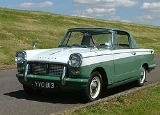
The
Triumph Herald was a small two-door car introduced in 1959 by the
Standard-TriumphThe Triumph Motor Company was a British car and motor manufacturing company. The Triumph marque is owned currently by BMW. The marque had its origins in 1885 when Siegfried Bettmann of Nuremberg initiated S. Bettmann & Co and started importing bicycles from Europe and selling them with his own...
Company of
CoventryCoventry is a city and metropolitan borough in the county of West Midlands in England. Coventry is the 9th largest city in England and the 11th largest in the United Kingdom. It is also the second largest city in the English Midlands, after Birmingham, with a population of 300,848, although...
. Body design was by the Italian stylist Michelotti and the car was offered in saloon, convertible,
coupéA coupé or coupe is a closed car body style , the precise definition of which varies from manufacturer to manufacturer, and over time...
,
vanA van is a kind of vehicle used for transporting goods or groups of people.In British English usage, it can be either specially designed or based on a saloon or sedan car, the latter type often including derivatives with open backs...
, and
estateA station wagon is a body style variant of a sedan/saloon with its roof extended rearward over a shared passenger/cargo volume with access at the back via a third or fifth door , instead of a trunk lid...
models.
Total Herald sales numbered well over 300,000 and the
VitesseThe Triumph Vitesse was a compact six-cylinder car built by Standard-Triumph from 1962 to 1971. The car was styled by Michelotti, and was available in saloon and convertible variants....
,
SpitfireThe Triumph Spitfire is a small English two-seat sports car, introduced at the London Motor Show in 1962. The vehicle was based on a design produced for Standard-Triumph in 1957 by Italian designer Giovanni Michelotti...
and
GT6The GT6 was a 6-cylinder sports coupé built by Standard-Triumph and based on their popular Triumph Spitfire convertible. Production ran from 1966 to 1973.- Development history :...
were all based on modified Herald chassis and running gear with bolt-together bodies. Heralds are still seen on British roads in the early 21st century.
Sports car range prompts Italian-designed saloon
Towards the end of the 1950s Standard-Triumph offered a range of 2-seater Triumph
sports carA sports car is a small, usually two seat, two door automobile designed for high speed driving and maneuverability....
s alongside its Standard saloons, the
Standard 8The Flying Eight was the smallest member of the Standard Flying family.Introduced in 1938 or 1939 , the Flying Eight featured, in its saloon form, the "streamlined" body of the little Standard Flying Nine which had appeared in 1937...
&
10thumb|right|250px|A 1934 Standard 10/12 SpeedlineThe Standard Ten was a small car produced by the British Standard Motor Company from 1906 to 1961....
, powered by a small (803 cc or 948 cc) 4-cylinder engine, which by the late 1950s were due for an update. Standard-Triumph therefore started work on the Herald. The choice of the "Herald" name suggests that the car was originally intended to be marketed as a Standard, as it fits the model-naming scheme of the time (Ensign, Pennant and Standard itself). But by 1959 it was felt that the Triumph name had more brand equity, and the Standard name was phased out in Britain after 1963.
Giovanni Michelotti was commissioned to style the car by the Standard-Triumph board, encouraged by Harry Webster, Chief Engineer, and quickly produced designs for a two-door saloon with a large glass area that gave 93% all-round visibility in the Saloon variant and the "razor-edge" looks to which many makers were turning. Fisher & Ludlow, Standard-Triumph's body suppliers, having become part of an uncooperative
BMCThe British Motor Corporation, or commonly known as BMC was a vehicle manufacturer from United Kingdom, formed by the merger of the Austin Motor Company and the Nuffield Organisation in 1952...
, it was decided that the car should have a separate chassis rather than adopting the newer
monocoqueMonocoque is a construction technique that supports structural load by using an object's external skin, as opposed to using an internal frame or truss that is then covered with a non-load-bearing skin or coachwork...
construction. The main body tub was bolted to the chassis and the whole front end hinged forward to allow access to the engine. Every panel – including the sills and roof – could be unbolted from the car so that different body styles could be easily built on the same chassis. Accordingly, in addition to the original coupé and saloon models, van, convertible and estate versions were on offer within two years.
The Standard 10's 4-cylinder 948 cc
OHVAn overhead valve engine, also informally called pushrod engine or I-head engine, is a type of piston engine that places the camshaft within the cylinder block , and uses pushrods or rods to actuate rocker arms above the cylinder...
engine and 4 speed gearbox was used with synchromesh on the top three gears and driving the rear wheels. The rack and pinion steering afforded the Herald a tight 25 in 0 in (7.62 m) turning circle. Coil and double-wishbone front suspension was fitted, while the rear suspension, a new departure for Triumph, offered
independent springingIndependent suspension is a broad term for any automobile suspension system that allows each wheel on the same axle to move vertically independently of each other. This is contrasted with a beam axle, live axle or deDion axle system in which the wheels are linked – movement on one side affects...
via a single transverse leaf-spring bolted to the top of the final drive unit and
swing axleA swing axle is a simple type of independent suspension first used in early aircraft , such as the Sopwith and Fokker, usually with rubber bungee and no damping....
s.
Instruments were confined to a single large
speedometerA speedometer is a gauge that measures and displays the instantaneous speed of a land vehicle. Now universally fitted to motor vehicles, they started to be available as options in the 1900s, and as standard equipment from about 1910 onwards. Speedometers for other vehicles have specific names...
with
fuel gaugeA fuel gauge is an instrument used to indicate the level of fuel contained in a tank. Commonly used in cars, these may also be used for any tank including underground storage tanks.As used in cars, the gauge consists of two parts:...
in the saloon (a temperature gauge was available as an option) on a dashboard of grey pressed fibreboard. The coupé dashboard was equipped with speedometer, fuel and temperature gauges, together with a lockable glovebox. The car had loop-pile carpeting and heater as standard. A number of extras were available including twin carburettors, leather seats, a wood-veneered
dashboardA dashboard is a control panel placed in front of the driver of an automobile, housing instrumentation and controls for operation of the vehicle....
, Telaflo shock absorbers and paint options.
Prototype cars embarked on a test-run from Cape Town to Tangiers. An account of the journey was embellished by PR at the time. However only minor changes were deemed necessary between the prototype and production cars. The new car was launched at the
Royal Albert HallThe Royal Albert Hall is a concert hall situated on the northern edge of the South Kensington area, in the City of Westminster, London, England, best known for holding the annual summer Proms concerts since 1941....
, London on 22 April 1959 but was not an immediate sales success partly due to its relatively high cost, approaching £700 (including 45% Purchase Tax). In standard single-carburettor form the 38 bhp car was no better than average in terms of performance, delivering 60 mi/h in about 31 seconds and a maximum speed of 70 mi/h. The rear suspension was also criticised as yielding poor handling at the extremes of performance though the model was considered easy to drive with its good vision, light steering(smallest turning circle of any production car) and controls and ease of repair.
The Herald 1200
Standard-Triumph experienced financial difficulties at the beginning of the 1960s and was taken over by
Leyland Motors LtdLeyland Motors Limited was a British vehicle manufacturer of lorries, buses and trolleybuses. It gave its name to the British Leyland Motor Corporation formed when it merged with British Motor Holdings, later to become British Leyland after being nationalised...
in 1961. This released new resources to develop the Herald and the car was re-launched with an 1147 cc engine as the Herald 1200'. The new model featured white rubber bumpers, a wooden laminate dashboard and improved seating. Quality control was also tightened up. Twin carburettors were no longer fitted to any of the range as standard although they remained an option, the standard being a single down-draught
SolexSolex was a French manufacturer of carburetors and the powered bicycle VéloSoleX.The Solex company was founded by Marcel Mennesson and Maurice Goudard to manufacture vehicle radiators...
carburettor. Claimed maximum power of the Herald 1200 was 39 bhp, as against the 34.5 bhp claimed for the 948 cc model. Disc brakes also became an option from 1963.
Sales picked up despite growing competition from the
BMC MiniThe Mini is a small car that was made by the British Motor Corporation and its successors from 1959 until 2000. The original is considered a British icon of the 1960s, and its space-saving front-wheel-drive layout influenced a generation of car-makers...
and the
Ford AngliaThe 1949 model, code E494A, was a makeover of the previous model with a rather more 1940s style front-end, including the sloped, twin-lobed radiator grille. Again it was a very spartan vehicle and in 1948 was Britain's lowest priced four wheel car....
. The convertible was popular as a 4-seater with decent weatherproofing and the estate made a practical alternative to the
Morris Minor TravellerThe Morris Minor was a British economy car that debuted at the Earls Court Motor Show, London, on 20 September 1948. Designed under the leadership of Alec Issigonis, more than 1.3 million were manufactured between 1948 and 1971...
. The coupé was dropped from the range in late 1964 as by then it was in direct competition with the
Triumph SpitfireThe Triumph Spitfire is a small English two-seat sports car, introduced at the London Motor Show in 1962. The vehicle was based on a design produced for Standard-Triumph in 1957 by Italian designer Giovanni Michelotti...
.
Courier Van
The Triumph Courier van, a Herald estate with side panels in place of rear side windows, was produced from 1962 until 1966, but was dropped following poor sales. Production in England ceased in summer 1964. CKD assembly by MCA in Malta continued till late 1965, at least.
Herald 12/50
A sportier version, the Herald 12/50 Skylight Saloon, offered from 1963–1967, featured a tuned engine with a claimed output of 51 bhp in place of the previous 39, along with a sliding (Webasto) vinyl-fabric sunroof and front disc brakes as standard. The power output of the 1200, which remained in production alongside the 12/50, was subsequently boosted to 48 bhp.
Performance test
A saloon tested by
The Motor magazine in 1959 was found to have a top speed of 70.9 mph (114.1 km/h) and could accelerate from 0-60 mph (96.6 km/h) in 31.1 seconds. A fuel consumption of 36.4 mpgimp was recorded. The test car cost £702 including taxes of £207.
The Herald 13/60
In October 1967 the range was updated with the introduction at the London Motor Show of the Herald 13/60. The 13/60 was offered in saloon, convertible and estate bodied versions. The sun-roof remained available for the saloon as an optional extra rather than a standard feature. The front end was restyled using a bonnet similar to the
Triumph VitesseThe Triumph Vitesse was a compact six-cylinder car built by Standard-Triumph from 1962 to 1971. The car was styled by Michelotti, and was available in saloon and convertible variants....
's and the interior substantially revised though still featuring the wooden dashboard. Interior space was improved by recessing a rear armrest in each side panel. The engine was enlarged to 1296 cc, essentially the unit employed since 1965 in the
Triumph 1300The Triumph 1300 was a medium/small 4-door saloon car made in Coventry, England by Standard Triumph under the control of Leyland Motors. Produced from 1965 and intended as a replacement to the popular Triumph Herald, it was re-engineered in the 1970s to become the Dolomite range.The Triumph 1300...
, fitted with a
Stromberg 150CD carburettorA carburetor , carburettor, or carburetter is a device that blends air and fuel for an internal combustion engine. It is sometimes shortened to carb in North America and the United Kingdom....
, offering 61 bhp and much improved performance. In this form (though the 1200 saloon was sold alongside it until the end of 1970) the Herald lasted until December 1970, by which time, severely outdated in style if not performance, it had already outlived the introduction of the
Triumph 1300 SaloonThe Triumph 1300 was a medium/small 4-door saloon car made in Coventry, England by Standard Triumph under the control of Leyland Motors. Produced from 1965 and intended as a replacement to the popular Triumph Herald, it was re-engineered in the 1970s to become the Dolomite range.The Triumph 1300...
, the car designed to replace it and was still selling reasonably well but, because of its labour-intensive method of construction, selling at a loss.
Production figures
- Herald (948) coupé: March 1959 – June 1961, 15,153
- Herald (948) saloon: March 1959 – June 1961, 76,860
- Herald (948) convertible: March 1959 – June 1961, 8,262
- Herald (948) 'S' saloon: February 1961 – January 1964, 6,577
- Herald 1200: February 1961– December 1970, 289,575
- saloon: February 1961 – December 1970, 201,142
- coupé: February 1961 – October 1964, 5,319
- convertible: February 1961 – September 1967, 43,295
- estate: March 1961 – September 1967, 39,819
- Courier van: February 1962 – October 1964, 5,136
- Herald 12/50 saloon: December 1962 – September 1967, 53,267
- Herald 13/60: August 1967 – September 1971, 82,650
- saloon: August 1967 – December 1970, 40,433
- convertible: August 1967 – September 1971, 15,467
- estate: August 1967 – September 1971, 11,172
Remaining cars
- Early 948 cc powered cars are rare, convertibles and coupes are especially sought after. Current figures have only 181 coupes remaining worldwide (948cc cars), many in Australia and the USA. Later cars are more numerous.
- The Earls Court motor show of 1959 used a Triumph Herald Coupe, cut in half. This car survives and can be seen at Coventry Transport Museum
The Coventry Transport Museum is a motor museum, located in Coventry City Centre, England. It houses a collection of British-made road transport. It is located in Coventry because the city was previously the centre of the British car industry...
.
International production
Triumph Heralds were exported all over the globe and assembled in a number of countries other than the United Kingdom, the separate chassis being used as a jig to assemble kits exported from Coventry. These cars were referred to as CKD – Complete Knock Down cars.
India
In the 1960s,
Standard Motor ProductsThe Standard is an Indian brand of automobile which was produced by Standard Motor Products in Madras from 1949 to 1988. Indian Standards were variations of vehicles made in the U.K. by Standard-Triumph. After being formed in 1947, their first product was the Vanguard, which began to be assembled...
of Madras,
IndiaIndia , officially the Republic of India , is a country in South Asia. It is the seventh-largest country by geographical area, the second-most populous country with over 1.2 billion people, and the most populous democracy in the world...
manufactured Triumph Heralds with the basic 948 cc engine under the name Standard Herald, eventually with additional four-door saloon and five-door estate models exclusively for the Indian market. In 1971 they introduced a bodily restyled four-door saloon based on the Herald called the Standard Gazel, using the same 948 cc engine but with the axle changed to that of
ToledoThe Triumph Toledo was a compact car introduced in August 1970 as a cheaper version of the Triumph 1300, which was at the same time replaced by the Triumph 1500. The Toledo shared the 1500's new front with a split grille, but instead of the 1500's twin round headlamps, it had single rectangular...
, avoiding the Herald's "swing-arm" which could not handle India's poor roads. The Gazel was discontinued in 1977.
Australia
The Herald was produced in
AustraliaAustralia , officially the Commonwealth of Australia, is a country in the Southern Hemisphere comprising the mainland of the Australian continent, the island of Tasmania, and numerous smaller islands in the Indian and Pacific Oceans. It is the world's sixth-largest country by total area...
by
Australian Motor IndustriesAustralian Motor Industries was an automobile assembly firm that was significant in the early history of the automobile industry in Australia.- Start of production :...
from 1959 to 1966 with output totalling 14,975 units. Production included a 12/50 model which, unlike its English namesake, was offered in both saloon and coupe body styles. It featured the bonnet and four angled headlights of the Triumph Vitesse and was marketed as the Triumph 12/50, without Herald badges.
Triumph Heralds were also assembled in South Africa, New Zealand, Ireland, Malta and Sri Lanka.
Popular culture
A Herald was used by James May on the TV car show
Top Gear as a template for an amphibious car. It was used in the third episode of series 8, in which it and May were victorious in the featured challenge of crossing a 2 miles (3.2 km) lake. It was again seen in the second episode of series 10, in which May used exactly the same car from the previous amphibious car challenge and attempted to cross the
English ChannelThe English Channel , often referred to simply as the Channel, is an arm of the Atlantic Ocean that separates southern England from northern France, and joins the North Sea to the Atlantic. It is about long and varies in width from at its widest to in the Strait of Dover...
. The car is now a part of the scenery within the
Top Gear studio.
A red Herald convertible was driven by Thora Hird in the BBC 1 long-running comedy
Last of the Summer WineLast of the Summer Wine is a British sitcom written by Roy Clarke that was broadcast on BBC One. Last of the Summer Wine premiered as an episode of Comedy Playhouse on 4 January 1973 and the first series of episodes followed on 12 November 1973. From 1983 to 2010, Alan J. W. Bell produced and...
.
A black Herald convertible was driven by the character Mary Moran in RTE's Sunday night soap
GlenroeGlenroe was an Irish television drama series broadcast between September 1983 and May 2001 on RTÉ One. The programme was a spin-off from Bracken, a short-lived RTÉ drama itself spun off from The Riordans. Glenroe was broadcast on Sunday nights at 20.30, generally from September to May. The show was...
in the late 1980s
In the 1966 editon
TintinTintin, Tin-Tin or Tin Tin may refer to:* The Adventures of Tintin , the series of classic comic books created by Belgian artist Hergé...
adventure
The Black IslandThe Black Island is the seventh of The Adventures of Tintin, a series of classic comic-strip albums, written and illustrated by Belgian writer and illustrator Hergé, featuring young reporter Tintin as the hero. It was first published in the newspaper supplement Le Petit Vingtième in the late 1930s...
Tintin hitched a lift by a red Herald towing a caravan while chasing the villain Dr Müller and Ivan.
Herald based kit cars
Due to the construction of the Triumph Herald (separate body mounted to a chassis) the Herald makes an excellent basis for a kit car. These have taken many different forms however; a popular conversion in New Zealand was an MGTF replica. While this was not an exact copy of the MGTF it did however envoke the spirit of the original. About 250 of these cars were made and they have a high survival rate due to being enthusiasts cars. The MGTF replica is called a "t car" made by alternative cars and has body made of fibreglass and a steel bonnet or hood