
Home      Discussion      Topics      Dictionary      Almanac
Signup       Login
Triumph Spitfire

Triumph Spitfire

Overview
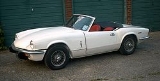
The Triumph Spitfire was a small British
United Kingdom
The United Kingdom of Great Britain and Northern Ireland is a sovereign state located off the northwestern coast of continental Europe. It is an island country, spanning an archipelago including Great Britain, the northeastern part of Ireland, and many small islands...

 two-seat sports car
Sports car
The term sports car has been defined as "an open, low-built, fast motor car." The term describes a class of automobile with two seats, two doors, precise handling, brisk acceleration, and sharp braking — trading practical considerations such as passenger space, comfort, and cargo capacity...

, introduced in 1962. The vehicle was based on a design produced for Standard
Standard Motor Company
The Standard Motor Company was founded in Coventry, England in 1903 by Reginald Walter Maudslay . The Standard name was last used in Britain in 1963, and in India in 1987.-1903-1914:...

-Triumph
Triumph Motor Company
The Triumph Motor Company is a defunct British motor manufacturer. The Triumph marque is currently owned by BMW. The marque had its origins in 1885 when Siegfried Bettmann and Moritz Schulte from Germany founded Bettmann & Co and started selling Triumph bicycles from premises in London and from...

 in 1957 by Italian
Italy
Italy , officially the Italian Republic , is a country located on the Italian Peninsula in Southern Europe and on the two largest islands in the Mediterranean Sea, Sicily and Sardinia. Italy shares its northern, Alpine boundary with France, Switzerland, Austria and Slovenia...

 designer Giovanni Michelotti
Giovanni Michelotti
Giovanni Michelotti was one of the most prolific designers of sports cars in the 20th century. He was also responsible for a number of saloon cars and truck cabs....

. The codename for the vehicle was the "Bomb". The car was largely based on the Triumph Herald
Triumph Herald
The Triumph Herald was a small two-door car introduced in 1959 by the Standard-Triumph Company of Coventry. Body design was by the Italian stylist Michelotti, and the car was offered in saloon, convertible, coupé, van and estate variants....

 saloon, and throughout its life was built at the Standard-Triumph works at Canley
Canley
Canley is a suburban neighbourhood located in southwest Coventry, England. Canley became part of Coventry as a result of successive encroachment of the latter's boundaries between 1928 and 1932, having historically been part of the Stoneleigh parish....

, Coventry
Coventry
Coventry is a city and metropolitan borough in the county of West Midlands in England. Coventry is the 9th largest city in England and the 11th largest in the United Kingdom. It is also the second largest city in the English Midlands, after Birmingham with a population of 300,848...

.

Five separate Spitfire models were sold during the production run:

The Triumph Spitfire was originally devised by Standard-Triumph
Standard Motor Company
The Standard Motor Company was founded in Coventry, England in 1903 by Reginald Walter Maudslay . The Standard name was last used in Britain in 1963, and in India in 1987.-1903-1914:...

 to compete in the small sports car market which had opened up with the introduction of the Austin-Healey Sprite
Austin-Healey Sprite
The Austin-Healey Sprite is a small open sports car which was announced to the press in Monte Carlo by the British Motor Corporation on 20 May 1958, just before that year's Monaco Grand Prix. It was intended to be a low-cost model that 'a chap could keep in his bike shed', yet be the successor to...

.
Discussion
Ask a question about 'Triumph Spitfire'
Start a new discussion about 'Triumph Spitfire'
Answer questions from other users
Full Discussion Forum
 
Encyclopedia
The Triumph Spitfire was a small British
United Kingdom
The United Kingdom of Great Britain and Northern Ireland is a sovereign state located off the northwestern coast of continental Europe. It is an island country, spanning an archipelago including Great Britain, the northeastern part of Ireland, and many small islands...

 two-seat sports car
Sports car
The term sports car has been defined as "an open, low-built, fast motor car." The term describes a class of automobile with two seats, two doors, precise handling, brisk acceleration, and sharp braking — trading practical considerations such as passenger space, comfort, and cargo capacity...

, introduced in 1962. The vehicle was based on a design produced for Standard
Standard Motor Company
The Standard Motor Company was founded in Coventry, England in 1903 by Reginald Walter Maudslay . The Standard name was last used in Britain in 1963, and in India in 1987.-1903-1914:...

-Triumph
Triumph Motor Company
The Triumph Motor Company is a defunct British motor manufacturer. The Triumph marque is currently owned by BMW. The marque had its origins in 1885 when Siegfried Bettmann and Moritz Schulte from Germany founded Bettmann & Co and started selling Triumph bicycles from premises in London and from...

 in 1957 by Italian
Italy
Italy , officially the Italian Republic , is a country located on the Italian Peninsula in Southern Europe and on the two largest islands in the Mediterranean Sea, Sicily and Sardinia. Italy shares its northern, Alpine boundary with France, Switzerland, Austria and Slovenia...

 designer Giovanni Michelotti
Giovanni Michelotti
Giovanni Michelotti was one of the most prolific designers of sports cars in the 20th century. He was also responsible for a number of saloon cars and truck cabs....

. The codename for the vehicle was the "Bomb". The car was largely based on the Triumph Herald
Triumph Herald
The Triumph Herald was a small two-door car introduced in 1959 by the Standard-Triumph Company of Coventry. Body design was by the Italian stylist Michelotti, and the car was offered in saloon, convertible, coupé, van and estate variants....

 saloon, and throughout its life was built at the Standard-Triumph works at Canley
Canley
Canley is a suburban neighbourhood located in southwest Coventry, England. Canley became part of Coventry as a result of successive encroachment of the latter's boundaries between 1928 and 1932, having historically been part of the Stoneleigh parish....

, Coventry
Coventry
Coventry is a city and metropolitan borough in the county of West Midlands in England. Coventry is the 9th largest city in England and the 11th largest in the United Kingdom. It is also the second largest city in the English Midlands, after Birmingham with a population of 300,848...

.

Models


Five separate Spitfire models were sold during the production run:
Model name Engine Year Number built
Triumph Spitfire 4 (Mark I) 1147 cc inline 4 1962–1965 45,763
Triumph Spitfire Mark II 1147 cc inline 4 1965–1967 37,409
Triumph Spitfire Mark III 1296 cc inline 4 1967–1970 65,320
Triumph Spitfire Mark IV 1296 cc inline 4 1970–1974 70,021
Triumph Spitfire 1500 1493 cc inline 4 1974–1980 95,829

Origins


The Triumph Spitfire was originally devised by Standard-Triumph
Standard Motor Company
The Standard Motor Company was founded in Coventry, England in 1903 by Reginald Walter Maudslay . The Standard name was last used in Britain in 1963, and in India in 1987.-1903-1914:...

 to compete in the small sports car market which had opened up with the introduction of the Austin-Healey Sprite
Austin-Healey Sprite
The Austin-Healey Sprite is a small open sports car which was announced to the press in Monte Carlo by the British Motor Corporation on 20 May 1958, just before that year's Monaco Grand Prix. It was intended to be a low-cost model that 'a chap could keep in his bike shed', yet be the successor to...

. The Sprite had used the basic drive train of the Austin A30/35
Austin A30
The A30 was a compact car produced by Austin Motor Company in the 1950s. Introduced in 1951 as the "New Austin Seven", it was Austin's answer to the Morris Minor...

 in a light body to make up a budget sports car; Triumph's idea was to use the mechanics from their small saloon, the Triumph Herald
Triumph Herald
The Triumph Herald was a small two-door car introduced in 1959 by the Standard-Triumph Company of Coventry. Body design was by the Italian stylist Michelotti, and the car was offered in saloon, convertible, coupé, van and estate variants....

, to underpin the new project. Triumph had one advantage, however; where the Austin A30 range was of unitary construction, the Herald featured a separate chassis
Chassis
A chassis consists of a framework that supports an inanimate object, analogous to an animal's skeleton, for example in a motor vehicle or a firearm.- Examples of use :...

; it was Triumph's intention therefore to cut that chassis down and clothe it in a sports body, saving the costs of developing a completely new chassis / body unit.

The Italian designer Michelotti—who had already penned the Herald—was commissioned for the new project, and came up with a traditional, swooping body. Wind-up windows were provided (in contrast to the Sprite/Midget
MG Midget
The MG Midget is a small two seat sports car produced by MG division of the British Motor Corporation from 1961 to 1979. It re-used a famous pre-war name used on MG M-type, MG D-type, MG J-type and so on.-MG Midget MkI :...

, which still featured sidescreens at that time), as well as a single-piece front end which tilted forwards to offer unrivalled access to the mechanics. At the dawn of the 1960s, however, Standard-Triumph was in deep financial trouble, and unable to put the new car into production; it was not until the company was taken over by the Leyland
Leyland Motors Ltd
Leyland Motors Limited was a British vehicle manufacturer of lorries and buses. It gave its name to the British Leyland Motor Corporation formed when it merged with British Motor Holdings, later to become British Leyland after effectively becoming nationalised...

 organization that funds became available and the car was launched. Leyland officials, taking stock of their new acquisition, found Michelotti's prototype hiding under a dust sheet in a corner of the factory and rapidly approved it for production.

Spitfire 4 or Mark I


The production car changed little from the prototype, although the full-width rear bumper was dropped in favour of two part-bumpers curving round each corner, with overriders. Mechanics were basically stock Herald components: The engine was a 4-cylinder
Straight-4
The inline-four engine or straight-four engine is a four-cylinder internal combustion engine with all four cylinders mounted in a straight line, or plane along the crankcase. The single bank of cylinders may be oriented in either a vertical or an inclined plane with all the pistons driving a...

 of 1147 cc, mildly tuned for the Spitfire with twin SU carburettors
SU carburetor
SU carburettors were a brand of carburettor usually of the sidedraught type but downdraught variants were used on some pre-war cars. They were widely used in British and Swedish automobiles for much of the twentieth century...

. Also from the Herald came the rack and pinion
Rack and pinion
A rack and pinion is a pair of gears which convert rotational motion into linear motion. The circular pinion engages teeth on a flat bar - the rack...

 steering and coil-and-wishbone front suspension up front, and at the rear a single transverse-leaf swing axle
Swing axle
A swing axle is a simple type of independent suspension first used in early aircraft , such as the Sopwith and Fokker, usually with rubber bungee and no damping....

 arrangement. This ended up being the most controversial part of the car: it was known to "tuck in" and cause violent over steer if pushed too hard, even in the staid Herald. In the sportier Spitfire (and later the 6-cylinder
Straight-6
The straight-six engine or inline-six engine is a six cylinder internal combustion engine with all six cylinders mounted in a straight line along the crankcase. The single bank of cylinders may be oriented in either a vertical or an inclined plane with all the pistons driving a common crankshaft...

 Triumph GT6
Triumph GT6
The GT6 was a 6-cylinder sports coupé built by Standard-Triumph and based on their popular Triumph Spitfire convertible. Production ran from 1966 to 1973.- Development history :...

 and Triumph Vitesse
Triumph Vitesse
The Triumph Vitesse is a compact six cylinder car built by Standard-Triumph from 1962 to 1971. The car was styled by Michelotti, and was available in saloon and convertible variants....

) it led to severe criticism. The body was bolted to a much-modified Herald chassis, the outer rails and the rear outriggers having been removed; little of the original Herald chassis design was left, and the Spitfire used structural outer sills to stiffen its body tub.

The Spitfire was an inexpensive small sports car and as such had very basic trim, including rubber mats and a large plastic steering wheel. These early cars were referred to both as "Triumph Spitfire Mark I" and "Spitfire 4", not to be confused with the later Spitfire Mark IV.

From 1964 an overdrive
Overdrive (mechanics)
Overdrive can refer to two different things.An overdrive is a device which was commonly used in automobiles to allow the choice of an extra-high overall gear ratio for high speed cruising, thus saving fuel, at the cost of less torque. Usually the final or top gear is called overdrive...

 option was added to the four speed gearbox to give more relaxed cruising. Wire wheels and a hard top were also made available.

Spitfire Mark II


In March 1965 the Spitfire Mark II was released and was very similar to the Mark I but featured a more highly tuned engine, through a revised camshaft
Camshaft
A camshaft is a shaft to which a cam is fastened or of which a cam forms an integral part.-History:An early cam featuring a camshaft was built into Hellenistic water-driven automata from the 3rd century BC. The camshaft was later described in Iraq by Al-Jazari in 1206...

 design, a water cooled intake manifold and tubular exhaust manifold, increasing the power to at 6000 rpm. This improved the top speed to 92 mph (148 km/h). The coil-spring design clutch of the Mark I was replaced with a Borg and Beck diaphragm spring clutch. The exterior trim was modified with a new grille and badges. The interior trim was improved with redesigned seats and by covering most of the exposed surfaces with rubber cloth. The original moulded rubber floor coverings were replaced with moulded carpets.

It was introduced at a base price of £550 while the Sprite was priced at £505 and the Midget at £515. Top speed was claimed to be and its 0-60 mph time of 15.5 seconds was considered "lively." The factory claimed that at highway speeds this lively car achieved .

Spitfire Mark III


The Mark III, introduced in March 1967, was the first major facelift to the Spitfire. The front bumper was raised in response to new crash regulations, and although much of the bonnet pressing was carried over, the front end looked quite different. The rear lost the overriders from the bumper but gained reversing lights as standard (initially as two separate lights on either side of the number plate, latterly as a single light in a new unit above the number plate); the interior was improved again with a wood-veneer instrument surround. A folding hood replaced the earlier "build it yourself" arrangement. For most of the Mark III range, the instrument cluster was still centre-mounted (as in the Mark I and Mark II) so as to reduce parts bin counts (and thereby production costs) for right-hand and left-hand drive versions. Starting in 1969, however, US-bound models were produced with a "federal" dashboard design which moved the gauges in front of the driver, a layout that would be adopted for all markets with the Mark IV. The 1147 cc engine was replaced with a bored-out 1296 cc unit, as fitted on the new Triumph Herald 13/60
Triumph Herald
The Triumph Herald was a small two-door car introduced in 1959 by the Standard-Triumph Company of Coventry. Body design was by the Italian stylist Michelotti, and the car was offered in saloon, convertible, coupé, van and estate variants....

 and Triumph 1300
Triumph 1300
The Triumph 1300 was a medium/small 4-door saloon car made in Coventry, England by Standard Triumph under the control of Leyland Motors. Produced from 1965 and intended as a replacement to the popular Triumph Herald, it was re-engineered in the 1970s to become the Dolomite range.The Triumph 1300...

 saloons. In twin-carburettor form, the engine put out a claimed and made the Mark III a comparatively quick car by the standards of the day. Popular options continued to include wire wheels, a hard top and a Laycock de Normanville overdrive
Overdrive (mechanics)
Overdrive can refer to two different things.An overdrive is a device which was commonly used in automobiles to allow the choice of an extra-high overall gear ratio for high speed cruising, thus saving fuel, at the cost of less torque. Usually the final or top gear is called overdrive...

, and far more relaxed and economical cruising at high speeds. The Mark III was the fastest Spitfire yet, achieving in 12.5 seconds. The Mark III actually continued production into 1971, well after the Mark IV was introduced.

On 8 February 1968, Standard-Triumph General Manager George Turnbull
George Turnbull (autoindustry executive)
George Henry Turnbull, BSc , CEng, FIMechE was a UK automobile executive best remembered in the UK for his period as Managing Director of the Austin-Morris Division of British Leyland....

 personally drove the 100,000th Triumph Spitfire off the end of the Canley production line. More than 75% of the total production had been exported outside the UK including 45% to the USA and 25% to mainland European markets.

Spitfire Mark IV


The Mark IV brought the most comprehensive changes to the Spitfire. It featured a completely re-designed cut-off rear end, giving a strong family resemblance to the Triumph Stag
Triumph Stag
The Triumph Stag is a British car that was sold between 1970 and 1978 by the Triumph Motor Company styled by the Italian designer Giovanni Michelotti.-Design and styling:...

 and Triumph 2000
Triumph 2000
The Triumph 2000 was a mid-sized automobile produced in Coventry by the Triumph Motor Company between 1963 and 1977.Using the six cylinder engine first seen in the Standard Vanguard at the end of 1960 and 4 speed manual gearbox , the monocoque body had independent suspension all round using coil...

 models, both of which were also Michelotti-designed. The front end was also cleaned up, with a new bonnet pressing losing the weld lines on top of the wings from the older models, and the doors were given recessed handles and squared-off glass in the top rear corner. The interior was much improved: a proper full-width dashboard was provided, putting the instruments ahead of the driver rather than over the centre console. The engine continued at 1296cc, but was modified with larger big-end bearings to rationalize production with the TR6
Triumph TR6
The Triumph TR6 was a British six-cylinder sports car and the best-seller of the TR range built by Triumph when production ended in July 1976. This record was then surpassed by the TR7...

 2.5 litre engines, which somewhat decreased its "revvy" nature; there was some detuning, to meet new emissions laws, which resulted in the new car being a little tamer than the Mark III. The gearbox gained synchromesh on its bottom gear.

An all-new hardtop was also available, with rear quarter-lights and a flatter rear screen.

By far the most significant change, however, was to the rear suspension, which was de-cambered and redesigned to eliminate the unfortunate tendencies of the original swing-axle design. The Triumph GT6
Triumph GT6
The GT6 was a 6-cylinder sports coupé built by Standard-Triumph and based on their popular Triumph Spitfire convertible. Production ran from 1966 to 1973.- Development history :...

 and Triumph Vitesse
Triumph Vitesse
The Triumph Vitesse is a compact six cylinder car built by Standard-Triumph from 1962 to 1971. The car was styled by Michelotti, and was available in saloon and convertible variants....

 had already been modified, and the result on all these cars was safe and progressive handling even at the limit.

The Mark IV went on sale in the UK at the end of 1970 with a base price of £735.

Spitfire 1500


In 1973 in the United States & Canada and 1975 in the rest of the world, the 1500 engine was used to make the Spitfire 1500; though in this final incarnation the engine was rather rougher and more prone to failure than the earlier units, torque was greatly increased which made it much more drivable in traffic. The reason for the engine problems was due to continued use of three main bearings for the crank shaft.

The US market models were considerably less powerful than the British market cars because they had to meet more stringent US emissions requirements
Automobile emissions control
Automobile emissions control is the study and practice of reducing the polluting emissions produced by automobiles.-Specific pollutants:Motor vehicles produce many different pollutants...

. While the rest of the world saw 1500s with the compression ratio
Compression ratio
The compression ratio of an internal-combustion engine or external combustion engine is a value that represents the ratio of the volume of its combustion chamber; from its largest capacity to its smallest capacity...

 reduced to 8.0:1, the American market model was fitted with a single Zenith-Stromberg carburettor
Zenith Carburetters
Zenith Carburetters was a British company making carburettors. In 1955 they joined with their major pre-war rival Solex Carburettors and over time the Zenith brand name fell into disuse...

 and a compression ratio reduced to 7.5:1 to allow it to run on lower octane unleaded fuel and after adding a catalytic converter
Catalytic converter
A catalytic converter is a device used to reduce the toxicity of emissions from an internal combustion engine. First widely introduced on series-production automobiles in the U.S. market for the 1975 model year to comply with tightening EPA regulations on auto exhaust, catalytic converters are...

 and exhaust gas recirculating system
Exhaust gas recirculation
In internal combustion engines, exhaust gas recirculation is a nitrogen oxide emissions reduction technique used in most petrol/gasoline and diesel engines....

, the engine only delivered with a 0-60 time of 14.3 seconds.

The notable exception to this was the 1976 model year, where the compression was raised to 9:1.

The American market Spitfire 1500 is easily identified by the big plastic over-riders and wing mounted reflectors on the front and back wings. The US specification models up to 1978 still had chrome bumpers, but on the 1979 and 1980 models these were replaced by black rubber bumpers with built-in over-riders. Chassis extensions were also fitted under the boot to support the bumpers.

Detail improvements continued to be made throughout the life of the Mark IV, and included reclining seats with head restraints, wood dash, hazard flashers and electric screen washers (previously these had been operated by a manual pump on the dashboard). Options such as the hard top, tonneau cover, map light and overdrive continued to be popular, though wire wheels ceased to be available.

The 1980 model was the last and the heaviest of the entire run weighing in at . Base prices for the 1980 model year were $5,995 in the US and £3631 in the UK. The last Spitfire, an Inca Yellow UK-market model with hardtop and overdrive, rolled off the assembly line at Canley
Canley
Canley is a suburban neighbourhood located in southwest Coventry, England. Canley became part of Coventry as a result of successive encroachment of the latter's boundaries between 1928 and 1932, having historically been part of the Stoneleigh parish....

 in August 1980, shortly before the factory closed.

Die-Cast models

  • Dinky Toys produced a model of the Spitfire 4 in the 1960s.
  • Lledo Vanguards
    Corgi Classics Limited
    Corgi Classics Limited is a diecast model manufacturer which has its origins in the Corgi Toy brand introduced by Mettoy in 1956.- The Corgi Toys era : 1956 to 1995 :...

    produced models of both the Spitfire 4 and the Mark 3 in the 2000s.
  • Vitesse produced a model of the Mark IV in the 2000s.

External links