


Triangle of U

Encyclopedia
Plant
Plants are living organisms belonging to the kingdom Plantae. Precise definitions of the kingdom vary, but as the term is used here, plants include familiar organisms such as trees, flowers, herbs, bushes, grasses, vines, ferns, mosses, and green algae. The group is also called green plants or...
genus
Genus
In biology, a genus is a low-level taxonomic rank used in the biological classification of living and fossil organisms, which is an example of definition by genus and differentia...
Brassica
Brassica
Brassica is a genus of plants in the mustard family . The members of the genus may be collectively known either as cabbages, or as mustards...
. The theory states that the genomes of three ancestral species of Brassica combined to create three of the common contemporary vegetable
Vegetable
The noun vegetable usually means an edible plant or part of a plant other than a sweet fruit or seed. This typically means the leaf, stem, or root of a plant....
s and oilseed
Vegetable fats and oils
Vegetable fats and oils are lipid materials derived from plants. Physically, oils are liquid at room temperature, and fats are solid. Chemically, both fats and oils are composed of triglycerides, as contrasted with waxes which lack glycerin in their structure...
crop species. It has since been confirmed by studies of DNA and proteins.
The theory was first published in 1935 by Woo Jang-choon
Woo Jang-choon
Woo Jang-choon was a Korean-Japanese agricultural scientist and botanist famous for breeding plants. He preferred U and published his paper with this family name....
, a Korean
Korean people
The Korean people are an ethnic group originating in the Korean peninsula and Manchuria. Koreans are one of the most ethnically and linguistically homogeneous groups in the world.-Names:...
botanist who was working in Japan
Japan
Japan is an island nation in East Asia. Located in the Pacific Ocean, it lies to the east of the Sea of Japan, China, North Korea, South Korea and Russia, stretching from the Sea of Okhotsk in the north to the East China Sea and Taiwan in the south...
(where his name was transliterated as "Nagaharu U"). Woo made synthetic hybrids between the diploid and tetraploid species and examined how the chromosomes paired in the resulting triploids.
Overview
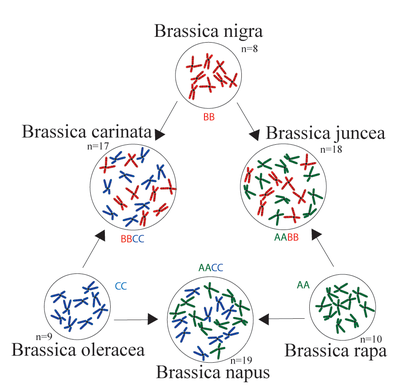
The Triangle of U is illustrated by the triangular diagram above. It shows how three of the Brassica species were derived from three ancestral genomes, denoted by the letters AA, BB, or CC. Alone, each of these diploid genomes produces a common Brassica species. The letter n denotes the number of chromosomes in each genome, and is the number found in the pollen or ovuleOvule
Ovule means "small egg". In seed plants, the ovule is the structure that gives rise to and contains the female reproductive cells. It consists of three parts: The integument forming its outer layer, the nucellus , and the megaspore-derived female gametophyte in its center...
. For example Brassica rapa has an A − n=10 (alternatively AA − 2n=20) designation. That means each somatic cell of the plant contains two complete genome copies (diploid) and each genome has ten chromosomes. Thus each cell will contain 20 chromosomes; since this is the diploid number it is written as 2n = 2x = 20.
- AA – 2n=2x=20 – Brassica rapaBrassica rapaBrassica rapa L. , commonly known as turnip, turnip rape, field mustard or turnip mustard is a plant widely cultivated as a leaf vegetable , a root vegetable , and an oilseed .In the 18th century the turnip and...
(syn. Brassica campestris) – TurnipTurnipThe turnip or white turnip is a root vegetable commonly grown in temperate climates worldwide for its white, bulbous taproot. Small, tender varieties are grown for human consumption, while larger varieties are grown as feed for livestock...
, Chinese cabbageChinese cabbageChinese cabbage can refer to two distinct varieties of Chinese leaf vegetables used often in Chinese cuisine. These vegetables are both related to the Western cabbage, and are of the same species as the common turnip... - BB – 2n=2x=16 – Brassica nigraBrassica nigraBrassica nigra is an annual weedy plant cultivated for its seeds, which are commonly used as a spice.-Description:...
– Black mustard - CC – 2n=2x=18 – Brassica oleraceaBrassica oleraceaBrassica oleracea, or wild cabbage, is a species of Brassica native to coastal southern and western Europe, where its tolerance of salt and lime and its intolerance of competition from other plants typically restrict its natural occurrence to limestone sea cliffs, like the chalk cliffs on both...
– CabbageCabbageCabbage is a popular cultivar of the species Brassica oleracea Linne of the Family Brassicaceae and is a leafy green vegetable...
, kaleKaleKale is very high in beta carotene, vitamin K, vitamin C, lutein, zeaxanthin, and reasonably rich in calcium. Kale, as with broccoli and other brassicas, contains sulforaphane , a chemical with potent anti-cancer properties. Boiling decreases the level of sulforaphane; however, steaming,...
, broccoliBroccoliBroccoli is a plant in the cabbage family, whose large flower head is used as a vegetable.-General:The word broccoli, from the Italian plural of , refers to "the flowering top of a cabbage"....
, Brussels sprouts, cauliflowerCauliflowerCauliflower is one of several vegetables in the species Brassica oleracea, in the family Brassicaceae. It is an annual plant that reproduces by seed...
These three species exist as separate species. But because they are closely related, it was possible for them to interbreed. This interspecific breeding allowed for the creation of three new species of tetraploid Brassica. Because they are derived from the genomes of two different species, these hybrid plants are said to be allotetraploid (contain four genomes, derived from two different ancestral species). Data from molecular studies indicate that the three diploid species are themselves paleopolyploids.
- AABB – 2n=4x=36 – Brassica junceaBrassica junceaBrassica juncea, also known as mustard greens, Indian mustard, Chinese mustard, and leaf mustard, is a species of mustard plant. Subvarieties include southern giant curled mustard, which resembles a headless cabbage such as kale, but with a distinct horseradish-mustard flavor...
– Indian mustard - AACC – 2n=4x=38 – Brassica napus – RapeseedRapeseedRapeseed , also known as rape, oilseed rape, rapa, rappi, rapaseed is a bright yellow flowering member of the family Brassicaceae...
, rutabagaRutabagaThe rutabaga, swede , turnip or yellow turnip is a root vegetable that originated as a cross between the cabbage and the turnip; see Triangle of U... - BBCC – 2n=4x=34 – Brassica carinataBrassica carinataBrassica carinata is a member of the Triangle of U species in the agriculturally significant Brassica genus...
– Ethiopian mustard