

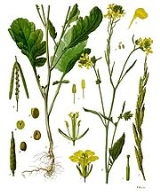
Brassica nigra

Encyclopedia
Brassica nigra ( sanskrit : राजक्षवक , rajakshavak ; Marathi :काळी मोहरी , Kali Mohari ) is an annual
weedy plant cultivated for its seeds, which are commonly used as a spice
.
, and has been cultivated for thousands of years.
The spice is generally made from ground seeds of the plant, with the seed coats removed. The small (1 mm) seeds are hard and vary in color from dark brown to black. They are flavorful, although they have almost no aroma. The seeds are commonly used in Indian cuisine
, for example in curry
, where it is known as rai. The seeds are usually thrown into hot oil or ghee
, after which they pop, releasing a characteristic nutty flavor. The seeds have a significant amount of fatty oil. This oil is used often as cooking oil
in India.
In Ethiopia, where it is cultivated as a vegetable in Gondar
, Harar
and Shewa
, the shoots and leaves are consumed cooked and the seeds used as a spice. Its Amharic
name is senafitch.
Ground seeds of the plant mixed with honey are widely used in eastern Europe as cough suppressant. In Eastern Canada, the use of mouche de moutarde to treat respiratory infections was popular before the advent of modern medicine. It consisted in mixing ground mustard seeds with flour and water, and creating a cataplasm
with the paste. This cataplasm was put on the chest or the back and left until the person felt a stinging sensation.
The plant itself can grow from two to eight feet tall, with raceme
s of small yellow flowers. These flowers are usually up to 1/3" across, with four petals each. The leaves are covered in small hairs; they can wilt on hot days, but recover at night.
Since the 1950s, black mustard has become less popular as compared to India mustard
because some cultivars of India mustard have seeds that can be mechanically harvested in a more efficient manner.
Black mustard is thought to be the seed mentioned by Jesus
in .
(genus Sinapis
) are not closely related. Black mustard belongs to the same genus
as cabbage
.
B. nigra also resembles Hirschfeldia incana
, or hoary mustard, (formerly Brassica geniculata), which is a perennial plant.
Annual plant
An annual plant is a plant that usually germinates, flowers, and dies in a year or season. True annuals will only live longer than a year if they are prevented from setting seed...
weedy plant cultivated for its seeds, which are commonly used as a spice
Spice
A spice is a dried seed, fruit, root, bark, or vegetative substance used in nutritionally insignificant quantities as a food additive for flavor, color, or as a preservative that kills harmful bacteria or prevents their growth. It may be used to flavour a dish or to hide other flavours...
.
Description
The plant is believed to be native to the southern Mediterranean region of EuropeEurope
Europe is, by convention, one of the world's seven continents. Comprising the westernmost peninsula of Eurasia, Europe is generally 'divided' from Asia to its east by the watershed divides of the Ural and Caucasus Mountains, the Ural River, the Caspian and Black Seas, and the waterways connecting...
, and has been cultivated for thousands of years.
The spice is generally made from ground seeds of the plant, with the seed coats removed. The small (1 mm) seeds are hard and vary in color from dark brown to black. They are flavorful, although they have almost no aroma. The seeds are commonly used in Indian cuisine
Indian cuisine
Indian cuisine consists of thousands of regional cuisines which date back thousands of years. The dishes of India are characterised by the extensive use of various Indian spices, herbs, vegetables and fruit. Indian cuisine is also known for the widespread practice of vegetarianism in Indian society...
, for example in curry
Curry
Curry is a generic description used throughout Western culture to describe a variety of dishes from Indian, Pakistani, Bangladeshi, Sri Lankan, Thai or other Southeast Asian cuisines...
, where it is known as rai. The seeds are usually thrown into hot oil or ghee
Ghee
Ghee is a class of clarified butter that originated in South Asia and is commonly used in South Asian cuisine....
, after which they pop, releasing a characteristic nutty flavor. The seeds have a significant amount of fatty oil. This oil is used often as cooking oil
Cooking oil
Cooking oil is purified fat of plant origin, which is usually liquid at room temperature ....
in India.
In Ethiopia, where it is cultivated as a vegetable in Gondar
Gondar
Gondar or Gonder is a city in Ethiopia, which was once the old imperial capital and capital of the historic Begemder Province. As a result, the old province of Begemder is sometimes referred to as Gondar...
, Harar
Harar
Harar is an eastern city in Ethiopia, and the capital of the modern Harari ethno-political division of Ethiopia...
and Shewa
Shewa
Shewa is a historical region of Ethiopia, formerly an autonomous kingdom within the Ethiopian Empire...
, the shoots and leaves are consumed cooked and the seeds used as a spice. Its Amharic
Amharic language
Amharic is a Semitic language spoken in Ethiopia. It is the second most-spoken Semitic language in the world, after Arabic, and the official working language of the Federal Democratic Republic of Ethiopia. Thus, it has official status and is used nationwide. Amharic is also the official or working...
name is senafitch.
Ground seeds of the plant mixed with honey are widely used in eastern Europe as cough suppressant. In Eastern Canada, the use of mouche de moutarde to treat respiratory infections was popular before the advent of modern medicine. It consisted in mixing ground mustard seeds with flour and water, and creating a cataplasm
Poultice
A poultice, also called cataplasm, is a soft moist mass, often heated and medicated, that is spread on cloth over the skin to treat an aching, inflamed, or painful part of the body. It can be used on wounds such as cuts...
with the paste. This cataplasm was put on the chest or the back and left until the person felt a stinging sensation.
The plant itself can grow from two to eight feet tall, with raceme
Raceme
A raceme is a type of inflorescence that is unbranched and indeterminate and bears pedicellate flowers — flowers having short floral stalks called pedicels — along the axis. In botany, axis means a shoot, in this case one bearing the flowers. In a raceme, the oldest flowers are borne...
s of small yellow flowers. These flowers are usually up to 1/3" across, with four petals each. The leaves are covered in small hairs; they can wilt on hot days, but recover at night.
Since the 1950s, black mustard has become less popular as compared to India mustard
Brassica juncea
Brassica juncea, also known as mustard greens, Indian mustard, Chinese mustard, and leaf mustard, is a species of mustard plant. Subvarieties include southern giant curled mustard, which resembles a headless cabbage such as kale, but with a distinct horseradish-mustard flavor...
because some cultivars of India mustard have seeds that can be mechanically harvested in a more efficient manner.
Black mustard is thought to be the seed mentioned by Jesus
Jesus
Jesus of Nazareth , commonly referred to as Jesus Christ or simply as Jesus or Christ, is the central figure of Christianity...
in .
Similar plants
Despite their similar common names, black mustard and white mustardWhite Mustard
White mustard is an annual plant of the family Brassicaceae. It is sometimes also referred to as Brassica alba or B. hirta...
(genus Sinapis
Sinapis
Sinapis is a genus of plants in the family Brassicaceae. One of the species in this genus is White mustard . Black mustard is sometimes placed in this genus as well, but is more often placed in the related genus Brassica...
) are not closely related. Black mustard belongs to the same genus
Genus
In biology, a genus is a low-level taxonomic rank used in the biological classification of living and fossil organisms, which is an example of definition by genus and differentia...
as cabbage
Cabbage
Cabbage is a popular cultivar of the species Brassica oleracea Linne of the Family Brassicaceae and is a leafy green vegetable...
.
B. nigra also resembles Hirschfeldia incana
Hirschfeldia incana
Hirschfeldia incana is a species of flowering plant in the mustard family known by many common names, including Shortpod mustard, Buchanweed, Hoary mustard and Mediterranean mustard. It is the only species in the monotypic genus Hirschfeldia, which is closely related to Brassica...
, or hoary mustard, (formerly Brassica geniculata), which is a perennial plant.
See also
- Mustard plantMustard plantMustards are several plant species in the genera Brassica and Sinapis whose small mustard seeds are used as a spice and, by grinding and mixing them with water, vinegar or other liquids, are turned into the condiment known as mustard or prepared mustard...
- Mustard seedMustard seedMustard seeds are the small round seeds of various mustard plants. The seeds are usually about 1 or 2 mm in diameter. Mustard seeds may be colored from yellowish white to black. They are important spices in many regional foods. The seeds can come from three different plants: black mustard , brown...
- Parable of the Mustard SeedParable of the Mustard SeedThe Parable of the Mustard Seed is one of the shorter parables of Jesus. It appears in three of the Canonical gospels of the New Testament. The differences between Gospels of Matthew , Mark , and Luke , are minor...
- SinapisSinapisSinapis is a genus of plants in the family Brassicaceae. One of the species in this genus is White mustard . Black mustard is sometimes placed in this genus as well, but is more often placed in the related genus Brassica...
External links
- Entry in Gernot Katzer's spice pages, with pictures and detailed information
- Entry in Illinois Wildflowers