

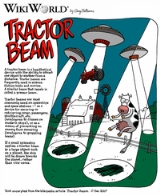
Tractor beam

Encyclopedia
A tractor beam is a device with the ability to attract one object to another from a distance. Since the 1990s, technology and research has labored to make it a reality, mostly at microscopic level. Less commonly, a similar beam that repels is called a pressor beam or repulsor beam. Gravity impulse and gravity propulsion beams are areas of research from fringe physics that coincide with the concepts of tractor and repulsor beams.
. Essentially, a spacecraft approaches a small asteroid, and then the spacecraft's own gravity pull the asteroid. The effect is tiny, but over a very long time, provided the asteroid isn't too big, the spacecraft can change the direction of the asteroid by a very small degree. This has been proposed as a way to prevent an asteroid from colliding with the Earth where a several decades long warning is raised as to a future collision.
A force field confined to a collimated beam
with clean borders, is one of the principal characteristics of tractor and repulsor beams. Several theories that have predicted repulsive effects, do not fall within the category of tractor and repulsor beams because of the absence of field collimation. For example, Robert L. Forward, Hughes Research Laboratories, Malibu, California, showed general relativity theory allowed the generation of a very brief impulse of a gravity-like repulsive force along the axis of a helical torus containing accelerated condensed matter
. The mainstream scientific community has accepted Forward’s work. A variant of Burkhard Heim
’s theory by Walter Dröscher
, Institut für Grenzgebiete der Wissenschaft (IGW), Innsbruck, Austria, and Jocham Häuser, University of Applied Sciences and CLE GmbH, Salzgitter, Germany, predicted a repulsive force field of gravitophotons could be produced by a ring rotating above a very strong magnetic field. Heim’s theory, and its variants, have been treated by the mainstream scientific community as fringe physics. But, the works by Forward, Dröscher, and Häuser could not be considered as a form of repulsor or tractor beam because the predicted impulses and field effects were not confined to a well defined, collimated region.
The following are a summary of experiments and theories that resemble repulsor and tractor beam concepts:
.
In 1964, Copenhagen physicists, L. Halpern, Universitetets Institut fűr Teoretisk Fysik, and B. Laurent, Nordisk Institut fűr Teoretisk Atomfysik, indicated general relativity theory and quantum theory allowed the generation and amplification of gravitons in a manner like the LASER. They showed, in principle, gravitational radiation in the form of a beam of graviton
s could be generated and amplified by using induced, resonant emissions.
. Those experiments were not reported in peer reviewed journals.
Italian physicist, Giovanni Modanese
, while a Von Humboldt Fellow at the Max Planck Institute for Physics
, made the first attempt to provide a theoretical explanation of Podkletnov’s observations. He argued the shielding effect and slight expulsive force at the border of the shielded zone could be explained in terms of induced changes in the local cosmological constant
. Modanese described several effects in terms of responses to modifications to the local cosmological constant within the superconductor. Ning Wu, Institute of High Energy Physics, Beijing, China, used the theory of quantum gauge theory of gravity he had developed in 2001 to explain Podkletnov’s observations. Wu’s theory approximated the relative gravity loss as 0.03% (an order of magnitude smaller than the reported range of 0.3 – 0.5%).
Several groups around the world tried to replicate Podkletnov’s gravity shielding observations. According to R. Clive Woods, Department of Electrical and Computer Engineering, Iowa State University
, those groups were not able to overcome the extremely challenging technical problems of replicating all aspects of the 1992 experimental conditions. Woods summarized those shortcomings in the following list:
C. S. Unnikrishan, Tata Institute of Fundamental Research, Bombay, India, showed that if the effect had been caused by gravitational shielding, the shape of the shielded region would be similar to a shadow from the gravitational shield. For example, the shape of the shielded region above a disk would be conical. The height of the cone's apex above the disk would vary directly with the height of the shielding disk above the earth. Podkeltnov and Nieminen described the shape of the weight loss region as a cylinder that extended through the ceiling above the cryostat
. That factor and others precipitated a recommendation to reclassify the effect as gravitational modification instead of gravitational shielding. Such a reclassification means the region causing the weight modifications can be directed and is not limited to the space above the superconductor.
, with sharp borders, of short impulses of a repulsive force field that could penetrate different bodies without any noticeable loss of energy. Subsequently, the apparatus was dubbed an impulse gravity generator. Measurements of the impulses taken three to six meters beyond the emitter and in a building 150 meters away yielded identical results. Analyses of the measurements indicated the impulses briefly caused accelerations one thousand times the rate of gravity.
The gravity impulse generator received further theoretical support from David Maker and Glen A. Robertson, Gravi Atomic Research, Madison, Alabama and Wu. Chris Taylor, Jupiter Research Corporation, Houston, Texas, along with a private individual Robert Hendry and the original theorist Modanese conducted an analysis of the suitability of impulse gravity generators for Earth-to-orbit, interplanetary, and interstellar applications, this was repeated again in 2008 and a United States and European patent was received. In general, mainstream scientific community have treated the impulse gravity generator reports as extremely speculative and controversial. No other groups have attempted to replicate Podkletnov's gravity impulse generator experiment.
In March 2011, Chinese scientists posited that a specific type of Bessel beam
(a special kind of laser that that does not diffract at the center) is capable of creating a pull-like effect on a given microscopic particle, forcing it towards the beam source. The underlining physics is the maximization of forward scattering via interference of the radiation multipoles. They show explicitly that the necessary condition to realize a negative (pulling) optical force is the simultaneous excitation of multipoles in the particle and if the projection of the total photon momentum along the propagation direction is small, attractive optical force is possible. The Chinese scientists suggest this possibility may be implemented for optical micromanipulation.
movies and telecasts normally depict tractor and repulsor beams as audible, narrow rays of visible light that cover a small area of a target. Tractor beams are most commonly used on spaceships
and space station
s. They are generally used in two ways:
In the latter case, there are usually countermeasures that can be employed against tractor beams. These may include pressor beams (a stronger pressor beam will counteract a weaker tractor beam) or plane shears aka shearing planes (a device to "cut" the tractor beam and render it ineffective). In some fictional realities, shields can block tractor beams, or the generators can be disabled by sending a large amount of energy back up the beam to its source.
Tractor beams and pressor beams can be used together as a weapon: by attracting one side of an enemy spaceship while repelling the other, one can create severely damaging shear effects in its hull. Another mode of destructive use of such beams is rapid alternating between pressing and pulling force in order to cause structural damage to the ship as well as inflicting lethal forces on its crew.
Two objects being brought together by a tractor beam are usually attracted toward their common center of gravity. This means that if a small spaceship applies a tractor beam to a large object such as a planet, the ship will be drawn towards the planet, rather than vice versa.
In Star Trek
, tractor beams are imagined to work by placing a target in the focus of a subspace/graviton interference pattern created by two beams from an emitter. When the beams are manipulated correctly the target is drawn along with the interference pattern. The target may be moved toward or away from the emitter by changing the polarity of the beams. Range of the beam affects the maximum mass that can be moved by the emitter, and the emitter subjects its anchoring structure to significant force.
’s report of findings by the panel of scientists assembled to review the physical evidence of UFOs
, one of the reports of apparent gravitational and/or inertial effects was the Mansfield, Ohio, Case of October 18, 1973. Chapter 29 of Sturrock’s report included the entire investigative report by Jennie Zeidman, former Project Blue Book
secretary for J. Allen Hynek
. Zeidman’s reports had been prepared for the Center for UFO Studies
. Michael D. Swords
presented the Mansfield, Ohio, Case to Sturrock’s panel of scientists. According to the testimony of the flight crew and independent ground witnesses, a green light beam from a cigar-shaped UFO had caused an U. S. Army Reserve helicopter to ascend 2,000 feet while its flight controls were in the descend position. Attempts to debunk the early reports of the incident were effectively refuted by researchers. The Mansfield, Ohio, Case has been described as one of the most amazing UFO reports.
Jenny Randles
’ summary of the Mansfield, Ohio, Case concluded a tractor beam had been used to cause the rapid ascension of the helicopter. She compared that case with a February 12, 1979 incident that had been investigated by the Yorkshire UFO Society. According to that account, a British Rail worker was transported six feet into the air by a green light beam to avoid potential harm from a passing Harrogate to Leeds train.
– Central European Section, Incorporated (MUFON-CES), included the sightings of two cigar-shaped UFO’s emitting light beams, that seemed to guide the behavior of smaller UFOs. Witnesses in Jemgum, a small village in the northeast corner of Germany, saw the objects through binoculars on March 7, 1977. MUFON-CES investigated the reports and assessed the case with a 99.99% reliability index (a definition of Olsen’s reliability index was given in Appendix A of Ludwiger’s book).
Physics
One well-accepted approach to attracting an asteroid towards a spacecraft is the gravity tractorGravity tractor
A gravity tractor is a spacecraft that deflects another object in space, typically a potentially hazardous asteroid that might impact Earth, without physically contacting it, using only its gravitational field to transmit the required impulse....
. Essentially, a spacecraft approaches a small asteroid, and then the spacecraft's own gravity pull the asteroid. The effect is tiny, but over a very long time, provided the asteroid isn't too big, the spacecraft can change the direction of the asteroid by a very small degree. This has been proposed as a way to prevent an asteroid from colliding with the Earth where a several decades long warning is raised as to a future collision.
A force field confined to a collimated beam
Collimated light
Collimated light is light whose rays are parallel, and therefore will spread slowly as it propagates. The word is related to "collinear" and implies light that does not disperse with distance , or that will disperse minimally...
with clean borders, is one of the principal characteristics of tractor and repulsor beams. Several theories that have predicted repulsive effects, do not fall within the category of tractor and repulsor beams because of the absence of field collimation. For example, Robert L. Forward, Hughes Research Laboratories, Malibu, California, showed general relativity theory allowed the generation of a very brief impulse of a gravity-like repulsive force along the axis of a helical torus containing accelerated condensed matter
Condensed Matter
Condensed matter may refer to several things*Condensed matter physics, the study of the physical properties of condensed phases of matter*European Physical Journal B: Condensed Matter and Complex Systems, a scientific journal published by EDP sciences...
. The mainstream scientific community has accepted Forward’s work. A variant of Burkhard Heim
Burkhard Heim
Burkhard Heim was a German theoretical physicist. He devoted a large portion of his life to the pursuit of his unified field theory, Heim theory. One of his childhood ambitions was to develop a method of space travel, which contributed to his motivation to find such a theory.During World War II,...
’s theory by Walter Dröscher
Walter Dröscher
Walter Dröscher is a physicist who worked at the Austrian Patent office . Now in retirement, he devotes most of his time to developing Heim Theory...
, Institut für Grenzgebiete der Wissenschaft (IGW), Innsbruck, Austria, and Jocham Häuser, University of Applied Sciences and CLE GmbH, Salzgitter, Germany, predicted a repulsive force field of gravitophotons could be produced by a ring rotating above a very strong magnetic field. Heim’s theory, and its variants, have been treated by the mainstream scientific community as fringe physics. But, the works by Forward, Dröscher, and Häuser could not be considered as a form of repulsor or tractor beam because the predicted impulses and field effects were not confined to a well defined, collimated region.
The following are a summary of experiments and theories that resemble repulsor and tractor beam concepts:
1960s
In July 1960, Missiles and Rockets reported Martin N. Kaplan, Senior Research Engineer, Electronics Division, Ryan Aeronautical Company, San Diego, had conducted experiments that justified planning for a more comprehensive research program. The article indicated such a program, if successful, would yield either “restricted” or “general” results. It described the “restricted” results as an ability to direct an anti-gravitational force towards or away from a second body. Neither comments nor criticism of the report appeared in subsequent articles. Five years earlier, a photograph of Kaplan had appeared with the front-page newspaper article that was published near the beginning of the intensified period of United States gravity control propulsion research (1955 - 1974)United States gravity control propulsion research (1955 - 1974)
American interest in "gravity control propulsion research" intensified during the early 1950s. Literature from that period used the terms anti-gravity, anti-gravitation, baricentric, counterbary, electrogravitics , G-projects, gravitics, gravity control, and gravity propulsion...
.
In 1964, Copenhagen physicists, L. Halpern, Universitetets Institut fűr Teoretisk Fysik, and B. Laurent, Nordisk Institut fűr Teoretisk Atomfysik, indicated general relativity theory and quantum theory allowed the generation and amplification of gravitons in a manner like the LASER. They showed, in principle, gravitational radiation in the form of a beam of graviton
Graviton
In physics, the graviton is a hypothetical elementary particle that mediates the force of gravitation in the framework of quantum field theory. If it exists, the graviton must be massless and must have a spin of 2...
s could be generated and amplified by using induced, resonant emissions.
1980s
According to Paul LaViolette, Starburst Foundation,Schenectady, New York, Eric Dollard, and Guy Obolensky had independently conducted gravity-like beam experiments during the 1980s that had been inspired by observations reported by Nikola TeslaNikola Tesla
Nikola Tesla was a Serbian-American inventor, mechanical engineer, and electrical engineer...
. Those experiments were not reported in peer reviewed journals.
1990s
In 1992, Russian Professor of Chemistry, Yevgeny Podkletnov, and Nieminen, Tampere University of Technology, Tampere, Finland, discovered weight fluctuations in objects above an electromagnetically levitated, massive, composite superconducting disk. Three years later, Podkletnov reported the results of additional experiments with a toroidal disk superconductor. They reported the weight of the samples would fluctuate between -2.5% and +5.4% as the angular speed of the superconductor increased. Certain combinations of disk angular speeds and electromagnetic frequencies caused the fluctuations to stabilize at a 0.3% reduction. The experiments with the toroidal disk yielded reductions that reached a maximum of 1.9-2.1%. Reports about both sets of experiments stated the weight loss region was cylindrical, extending vertically for at least three meters above the disk. Qualitative observations of an expulsive force at the border of the shielded zone were reported in the Fall of 1995.Italian physicist, Giovanni Modanese
Giovanni Modanese
Giovanni Modanese is a professor at the Free University of Bozen-Bolzano, Italy.He is the author of several publications in General Relativity and Quantum Gravity....
, while a Von Humboldt Fellow at the Max Planck Institute for Physics
Max Planck Institute for Physics
Max Planck Institute for Physics is a physics institute in Munich, Germany that specializes in High Energy Physics and Astroparticle physics. It is part of the Max-Planck-Gesellschaft and is also known as the Werner Heisenberg Institute, after its first director.It was founded as the Kaiser Wilhelm...
, made the first attempt to provide a theoretical explanation of Podkletnov’s observations. He argued the shielding effect and slight expulsive force at the border of the shielded zone could be explained in terms of induced changes in the local cosmological constant
Cosmological constant
In physical cosmology, the cosmological constant was proposed by Albert Einstein as a modification of his original theory of general relativity to achieve a stationary universe...
. Modanese described several effects in terms of responses to modifications to the local cosmological constant within the superconductor. Ning Wu, Institute of High Energy Physics, Beijing, China, used the theory of quantum gauge theory of gravity he had developed in 2001 to explain Podkletnov’s observations. Wu’s theory approximated the relative gravity loss as 0.03% (an order of magnitude smaller than the reported range of 0.3 – 0.5%).
Several groups around the world tried to replicate Podkletnov’s gravity shielding observations. According to R. Clive Woods, Department of Electrical and Computer Engineering, Iowa State University
Iowa State University
Iowa State University of Science and Technology, more commonly known as Iowa State University , is a public land-grant and space-grant research university located in Ames, Iowa, United States. Iowa State has produced astronauts, scientists, and Nobel and Pulitzer Prize winners, along with a host of...
, those groups were not able to overcome the extremely challenging technical problems of replicating all aspects of the 1992 experimental conditions. Woods summarized those shortcomings in the following list:
- Use of a superconductor disk with a diameter greater than 100 mm;
- A disk containing ~30% non-superconducting YBCO, preferable organized into two layers;
- A disk capable of self-levitation, but still containing large numbers of inter-grain junctions;
- An AC levitation field with a frequency of ~10 kHz;
- A second excitation field with a frequency of ~1 MHz, for disk rotation; and
- Disk rotation speeds of 3,000 rpm or greater for large (>0.05%) gravitational effects.
C. S. Unnikrishan, Tata Institute of Fundamental Research, Bombay, India, showed that if the effect had been caused by gravitational shielding, the shape of the shielded region would be similar to a shadow from the gravitational shield. For example, the shape of the shielded region above a disk would be conical. The height of the cone's apex above the disk would vary directly with the height of the shielding disk above the earth. Podkeltnov and Nieminen described the shape of the weight loss region as a cylinder that extended through the ceiling above the cryostat
Cryostat
A cryostat is a device used to maintain cold cryogenic temperatures. Low temperatures may be maintained within a cryostat by using various refrigeration methods, most commonly using cryogenic fluid bath such as liquid helium. Hence it is usually assembled into a vessel, similar in construction...
. That factor and others precipitated a recommendation to reclassify the effect as gravitational modification instead of gravitational shielding. Such a reclassification means the region causing the weight modifications can be directed and is not limited to the space above the superconductor.
2000s
In 2001, Podkeltnov and Modanese reported the generation of a beam of gravity-like impulses. Their paper indicated a high voltage discharge device had been constructed that emitted a horizontal, collimated beamCollimated light
Collimated light is light whose rays are parallel, and therefore will spread slowly as it propagates. The word is related to "collinear" and implies light that does not disperse with distance , or that will disperse minimally...
, with sharp borders, of short impulses of a repulsive force field that could penetrate different bodies without any noticeable loss of energy. Subsequently, the apparatus was dubbed an impulse gravity generator. Measurements of the impulses taken three to six meters beyond the emitter and in a building 150 meters away yielded identical results. Analyses of the measurements indicated the impulses briefly caused accelerations one thousand times the rate of gravity.
The gravity impulse generator received further theoretical support from David Maker and Glen A. Robertson, Gravi Atomic Research, Madison, Alabama and Wu. Chris Taylor, Jupiter Research Corporation, Houston, Texas, along with a private individual Robert Hendry and the original theorist Modanese conducted an analysis of the suitability of impulse gravity generators for Earth-to-orbit, interplanetary, and interstellar applications, this was repeated again in 2008 and a United States and European patent was received. In general, mainstream scientific community have treated the impulse gravity generator reports as extremely speculative and controversial. No other groups have attempted to replicate Podkletnov's gravity impulse generator experiment.
2010s
A team of scientists at the Australian National University led by Professor Andrei Rode claims to have created a device similar to a tractor beam to move small particles 1.5 meters through the air. Rather than create a new gravitational field, however, the device utilizes a doughnut-shaped Laguerre-Gaussian laser beam, which has a high intensity ring of light that surrounds a dark core along the beam axis; once a particle has been trapped within the beam, the device uses air pressure differences and heat to move the particle from one point to another. Owing to this method, it is impossible for such a device to work in space due to lack of air, but Professor Rode states that there are practical applications for the device on Earth such as, for example, the transportation of microscopic hazardous materials and other microscopic objects. A space-flight engineer at Nagoya University has come up with a new tractor beam for space usage. John Sinko theorized laser thrusters for the purpose of moving objects in space from distances up to 100 kilometers.In March 2011, Chinese scientists posited that a specific type of Bessel beam
Bessel beam
A Bessel beam is a field of electromagnetic, acoustic or even gravitational radiation whose amplitude is described by a Bessel function of the first kind. A true Bessel beam is non-diffractive. This means that as it propagates, it does not diffract and spread out; this is in contrast to the usual...
(a special kind of laser that that does not diffract at the center) is capable of creating a pull-like effect on a given microscopic particle, forcing it towards the beam source. The underlining physics is the maximization of forward scattering via interference of the radiation multipoles. They show explicitly that the necessary condition to realize a negative (pulling) optical force is the simultaneous excitation of multipoles in the particle and if the projection of the total photon momentum along the propagation direction is small, attractive optical force is possible. The Chinese scientists suggest this possibility may be implemented for optical micromanipulation.
Fiction
Science fictionScience fiction
Science fiction is a genre of fiction dealing with imaginary but more or less plausible content such as future settings, futuristic science and technology, space travel, aliens, and paranormal abilities...
movies and telecasts normally depict tractor and repulsor beams as audible, narrow rays of visible light that cover a small area of a target. Tractor beams are most commonly used on spaceships
Spacecraft
A spacecraft or spaceship is a craft or machine designed for spaceflight. Spacecraft are used for a variety of purposes, including communications, earth observation, meteorology, navigation, planetary exploration and transportation of humans and cargo....
and space station
Space station
A space station is a spacecraft capable of supporting a crew which is designed to remain in space for an extended period of time, and to which other spacecraft can dock. A space station is distinguished from other spacecraft used for human spaceflight by its lack of major propulsion or landing...
s. They are generally used in two ways:
- As a device for securing or retrieving cargo, passengers, shuttlecraft, etc. This is analogous to craneCrane (machine)A crane is a type of machine, generally equipped with a hoist, wire ropes or chains, and sheaves, that can be used both to lift and lower materials and to move them horizontally. It uses one or more simple machines to create mechanical advantage and thus move loads beyond the normal capability of...
s on modern shipShipSince the end of the age of sail a ship has been any large buoyant marine vessel. Ships are generally distinguished from boats based on size and cargo or passenger capacity. Ships are used on lakes, seas, and rivers for a variety of activities, such as the transport of people or goods, fishing,...
s. - As a means of preventing an enemy from escaping, analogous to grappling hookGrappling hookA grappling hook is an anchor with multiple hooks , attached to a rope; it is thrown, dropped, sunk, projected, or fastened directly by hand to where at least one hook may catch and hold. Generally, grappling hooks are used to temporarily secure one end of a rope. They may also be used to dredge...
s.
In the latter case, there are usually countermeasures that can be employed against tractor beams. These may include pressor beams (a stronger pressor beam will counteract a weaker tractor beam) or plane shears aka shearing planes (a device to "cut" the tractor beam and render it ineffective). In some fictional realities, shields can block tractor beams, or the generators can be disabled by sending a large amount of energy back up the beam to its source.
Tractor beams and pressor beams can be used together as a weapon: by attracting one side of an enemy spaceship while repelling the other, one can create severely damaging shear effects in its hull. Another mode of destructive use of such beams is rapid alternating between pressing and pulling force in order to cause structural damage to the ship as well as inflicting lethal forces on its crew.
Two objects being brought together by a tractor beam are usually attracted toward their common center of gravity. This means that if a small spaceship applies a tractor beam to a large object such as a planet, the ship will be drawn towards the planet, rather than vice versa.
In Star Trek
Star Trek
Star Trek is an American science fiction entertainment franchise created by Gene Roddenberry. The core of Star Trek is its six television series: The Original Series, The Animated Series, The Next Generation, Deep Space Nine, Voyager, and Enterprise...
, tractor beams are imagined to work by placing a target in the focus of a subspace/graviton interference pattern created by two beams from an emitter. When the beams are manipulated correctly the target is drawn along with the interference pattern. The target may be moved toward or away from the emitter by changing the polarity of the beams. Range of the beam affects the maximum mass that can be moved by the emitter, and the emitter subjects its anchoring structure to significant force.
Literature
- The Skylark of Space books by E. E. SmithE. E. SmithEdward Elmer Smith, Ph.D., also, E. E. Smith, E. E. "Doc" Smith, Doc Smith, "Skylark" Smith, and Ted was a food engineer and early science fiction author who wrote the Lensman series and the Skylark series, among others...
(possibly the original appearance: 1929). The protagonist invents "attractor beams" and "repellor beams". Repellors can also be emitted isotropicallyIsotropyIsotropy is uniformity in all orientations; it is derived from the Greek iso and tropos . Precise definitions depend on the subject area. Exceptions, or inequalities, are frequently indicated by the prefix an, hence anisotropy. Anisotropy is also used to describe situations where properties vary...
as a sort of defensive force field against material projectiles. - In Buck RogersBuck RogersAnthony Rogers is a fictional character that first appeared in Armageddon 2419 A.D. by Philip Francis Nowlan in the August 1928 issue of the pulp magazine Amazing Stories. A sequel, The Airlords of Han, was published in the March 1929 issue....
first book, Armageddon 2419, (1928), by Philip Francis NowlanPhilip Francis NowlanPhilip Francis Nowlan was an American science fiction author, best known as the creator of Buck Rogers.-Career:...
the enemy ships used "repellor beams" for support and propulsion. - The LensmanLensmanThe Lensman series is a serial science fiction space opera by Edward Elmer "Doc" Smith. It was a runner-up for the Hugo award for best All-Time Series ....
books by E. E. SmithE. E. SmithEdward Elmer Smith, Ph.D., also, E. E. Smith, E. E. "Doc" Smith, Doc Smith, "Skylark" Smith, and Ted was a food engineer and early science fiction author who wrote the Lensman series and the Skylark series, among others... - Tom SwiftTom SwiftTom Swift is the name of the central character in five series of books, first appearing in 1910, totaling over 100 volumes, of American juvenile science fiction and adventure novels that emphasize science, invention and technology. The character was created by Edward Stratemeyer, the founder of...
- In The New Tom Swift Jr. book Tom Swift and The Deep-Sea Hydrodome (1958), Tom invents the "repellatron". The device can be set to repel specific chemical elements. It was used to create a bubble habitat on the ocean floor, and as the propulsion system for his spacecraft Challenger. - The Honor HarringtonHonor HarringtonHonor Stephanie Alexander-Harrington is a fictional character, the heroine of a series of military science fiction books set in the "Honorverse", written by David Weber and published by Baen Books....
books by David WeberDavid WeberDavid Mark Weber is an American science fiction and fantasy author. He was born in Cleveland, Ohio. Weber and his wife Sharon live in Greenville, South Carolina with their three children and "a passel of dogs".... - The Sector GeneralSector GeneralSector General is a series of twelve science fiction books and various short stories by the Northern Irish author James White. The series derives its name from the setting of the majority of the books, the Sector 12 General Hospital, a huge hospital space station located in deep space, designed to...
books by James WhiteJames White (author)James White was a Northern Irish author of science fiction novellas, short stories and novels. He was born in Belfast and returned there after spending his early years in Canada. After a few years in the clothing industry, he worked at Short Brothers Ltd. from 1965 until taking early retirement in...
The 1963 novel Star SurgeonStar SurgeonStar Surgeon is a 1963 science-fiction book by author James White, and it is part of the Sector General series.-Synopsis:Dr. Conway must deal with an unconscious patient, classification ELPH, who may be a cannibal or a demigod, or both. It came from the "other galaxy", and the species is well...
is the source of the combined tractor/pressor beam weapon, the so called "Rattler." These weapons attract then repel the target (entire ship or a segment of the ship's hull) at 80 gs, several times a minute. The novel also featured a type of Force field called a "repulsion screen." - Starfire series - the combined tractor/pressor beam weapon
- Starplex by Robert J. SawyerRobert J. SawyerRobert James Sawyer is a Canadian science fiction writer. He has had 20 novels published, and his short fiction has appeared in Analog Science Fiction and Fact, Amazing Stories, On Spec, Nature, and many anthologies. Sawyer has won over forty awards for his fiction, including the Nebula Award ,...
- The TriggerThe TriggerThe Trigger is a 1999 science fiction novel by Arthur C. Clarke and Michael P. Kube-McDowell. It is an attempt to explore the social impact of technological change.- Plot summary :The Trigger starts in the early to mid 21st century...
by Arthur C. ClarkeArthur C. ClarkeSir Arthur Charles Clarke, CBE, FRAS was a British science fiction author, inventor, and futurist, famous for his short stories and novels, among them 2001: A Space Odyssey, and as a host and commentator in the British television series Mysterious World. For many years, Robert A. Heinlein,...
involves the development of tractor beams in the early part of the novel. - Sixth ColumnSixth ColumnSixth Column, also known under the title The Day After Tomorrow, is a science fiction novel by Robert A. Heinlein, based on a story by editor John W. Campbell, and set in a United States that has been conquered by the PanAsians, a combination of Chinese and Japanese...
by Robert A. HeinleinRobert A. HeinleinRobert Anson Heinlein was an American science fiction writer. Often called the "dean of science fiction writers", he was one of the most influential and controversial authors of the genre. He set a standard for science and engineering plausibility and helped to raise the genre's standards of...
describes tractor/pressor beams as a product of the physics of a "newly-discovered magneto-gravitic or electro-gravitic spectra" featured in the novel.
Comics
- Buck RogersBuck RogersAnthony Rogers is a fictional character that first appeared in Armageddon 2419 A.D. by Philip Francis Nowlan in the August 1928 issue of the pulp magazine Amazing Stories. A sequel, The Airlords of Han, was published in the March 1929 issue....
comic strip - originally just repulsor beams; tractors appeared by 1970s - Archie ComicsArchie ComicsArchie Comics is an American comic book publisher headquartered in the Village of Mamaroneck, Town of Mamaroneck, New York, known for its many series featuring the fictional teenagers Archie Andrews, Betty Cooper, Veronica Lodge, Reggie Mantle and Jughead Jones. The characters were created by...
, where it is caricatured as a literal "tractor"
Movies and television series
- Star TrekStar TrekStar Trek is an American science fiction entertainment franchise created by Gene Roddenberry. The core of Star Trek is its six television series: The Original Series, The Animated Series, The Next Generation, Deep Space Nine, Voyager, and Enterprise...
(TV series, films, books, and games). One of the most visible and iconic uses of the concept. One of the few prominent fictitious depictions which used such beams repeatedly and referred to them consistently as tractor beams.
- The Original Series used the tractor beam several times. In "Space Seed", it was used to tow Khan Noonien Singh's ship, the SS Botany Bay. In "Tomorrow Is Yesterday", the Starship EnterpriseUSS Enterprise (NCC-1701)The USS Enterprise, NCC-1701, is a fictional starship in the Star Trek media franchise. The original Star Trek series depicts her crew's mission "to explore strange new worlds; to seek out new life and new civilizations; to boldly go where no man has gone before" under the command of Captain James...
attempts to capture Captain John Christopher's 20th century F-104 StarfighterF-104 StarfighterThe Lockheed F-104 Starfighter is a single-engine, high-performance, supersonic interceptor aircraft originally developed for the United States Air Force by Lockheed. One of the Century Series of aircraft, it served with the USAF from 1958 until 1969, and continued with Air National Guard units...
jet, "Bluejay 4", using a tractor beam.
- Transformers: Beast WarsTransformers: Beast WarsTransformers: Beast Wars is a Transformers toyline released by Hasbro between 1995 and 2000, and a Daytime Emmy Award winning full-CG animated television series spawned by it that debuted in 1996...
The Predacons capture the Decepticon flagship Nemesis and use its tractor beam to attempt to destroy the Maximals and the Ark. It appeared to be powered by spinning grinders, gears blades, etc. - District 9District 9District 9 is a 2009 South African science fiction thriller film directed by Neill Blomkamp. It was written by Blomkamp and Terri Tatchell, and produced by Peter Jackson and Carolynne Cunningham. The film stars Sharlto Copley, Jason Cope, and David James...
(2009) Near the climax, the command module and an assortment of dirt and rocks were pulled towards the mother ship using a mildly illuminated array of tractor beams. - Star WarsStar WarsStar Wars is an American epic space opera film series created by George Lucas. The first film in the series was originally released on May 25, 1977, under the title Star Wars, by 20th Century Fox, and became a worldwide pop culture phenomenon, followed by two sequels, released at three-year...
(films, TV series, books, games) - Battle Beyond the StarsBattle Beyond the StarsBattle Beyond the Stars is a Roger Corman-produced science fiction film, directed by Jimmy T. Murakami and released in 1980. The film, intended as a "Magnificent Seven in outer space," is a pastiche of The Magnificent Seven, the Western remake of Akira Kurosawa's film Seven Samurai...
(1980) - Babylon 5Babylon 5Babylon 5 is an American science fiction television series created, produced and largely written by J. Michael Straczynski. The show centers on a space station named Babylon 5: a focal point for politics, diplomacy, and conflict during the years 2257–2262...
(TV series). The Minbari Federation is known to use "gravity nets" which wrap a bubble around its target allowing the ship creating the net to "grapple" the target. They also have some sort of "levitation beams" seen in the TV film "In the Beginning" wherein Lennon and a group of Minbari emissaries from the Grey Council are levitated from a platform on the ground up to ship high above them. - The seaQuest DSVSeaQuest DSVseaQuest DSV is an American science fiction television series created by Rockne S. O'Bannon. It originally aired on NBC between 1993 and 1996. In its final season, it was renamed seaQuest 2032. Set in "the near future", seaQuest mixes high drama with realistic scientific fiction...
episode "Splashdown". - In SpaceballsSpaceballsSpaceballs is a 1987 American science fiction comedy parody film co-written by, directed by, Mel Brooks and starring Bill Pullman, John Candy, Mel Brooks & Rick Moranis. It also features, Daphne Zuniga, Dick Van Patten, and the voice of Joan Rivers. The film was released by Metro-Goldwyn-Mayer on...
(1987), Spaceball 1 uses a tractor beam - referred to as a "magnetic beam" in the film - to intercept Princess Vespa's Mercedes space cruiser. - The TaelonTaelonThe Taelons are a fictional race of humanoid aliens appearing in the Canadian science fiction television series Earth: Final Conflict. The arrival of the Taelons on Earth at first appears to be an unmitigated blessing, with their advanced technology bringing great prosperity...
mothership on Earth: Final ConflictEarth: Final ConflictEarth: Final Conflict is a Canadian science fiction television series based on story ideas created by Gene Roddenberry, and produced under the guidance of his widow, Majel Barrett-Roddenberry. It was not produced, filmed or broadcast until after his death...
used tractor beams on several occasions. - In The IncrediblesThe IncrediblesThe Incredibles is a 2004 American computer-animated action-comedy superhero film about a family of superheroes who are forced to hide their powers. It was written and directed by Brad Bird, a former director and executive consultant of The Simpsons, and was produced by Pixar and distributed by...
(2004), Syndrome uses zero-point energyZero-point energyZero-point energy is the lowest possible energy that a quantum mechanical physical system may have; it is the energy of its ground state. All quantum mechanical systems undergo fluctuations even in their ground state and have an associated zero-point energy, a consequence of their wave-like nature...
. - In Recess: School's OutRecess: School's OutRecess: School's Out is a 2001 animated film based on the Disney television series Recess. This film was produced by Walt Disney Pictures and was released theatrically nationwide on February 16, 2001. It was released on video and DVD on August 7, 2001.-Plot:School's out at Third Street School, but...
(2001), the film's main antagonistAntagonistAn antagonist is a character, group of characters, or institution, that represents the opposition against which the protagonist must contend...
attempted to use a tractor beam to move the moon to create a new ice ageIce ageAn ice age or, more precisely, glacial age, is a generic geological period of long-term reduction in the temperature of the Earth's surface and atmosphere, resulting in the presence or expansion of continental ice sheets, polar ice sheets and alpine glaciers...
. - The anime Uchuu Senkan Yamato (known as Star Blazers outside Japan). In one episode, multiple magnetic beam projectors on planet Gamilon were used to drag the Yamato into a trap.
- PixarPixarPixar Animation Studios, pronounced , is an American computer animation film studio based in Emeryville, California. The studio has earned 26 Academy Awards, seven Golden Globes, and three Grammy Awards, among many other awards and acknowledgments. Its films have made over $6.3 billion worldwide...
's 2006 short film Lifted is based on an alien character who is in a tractor beam usage test. - In Austin Powers in GoldmemberAustin Powers in GoldmemberAustin Powers in Goldmember is a 2002 American spy comedy film and the third installment of the Austin Powers series starring Mike Myers in the title role. The movie was directed by Jay Roach, and co-written by Mike Myers and Michael McCullers. Myers also plays the roles of Dr. Evil, Goldmember,...
(2002), Dr. EvilDr. EvilDr. Evil is a fictional character, played by Mike Myers in the Austin Powers film series. He is the antagonist of the movies, and Austin Powers' nemesis. He is a parody of James Bond villains, primarily Donald Pleasence's Ernst Stavro Blofeld . Dr...
's evil plan involved using a tractor beam to crash a golden asteroid into the Earth, causing a torrential flood. - In the animated series Aqua Teen Hunger ForceAqua Teen Hunger ForceAqua Teen Hunger Force , retitled Aqua Unit Patrol Squad 1 in 2011, is an American animated television series on Cartoon Network late night programing block, Adult Swim, as well as Teletoon's Teletoon at Night block and later G4 Canada's ADd block in Canada...
, one of Dr. Weird's inventions is a rainbow shooting machine, which actually turns out to be a tractor beam, but the doc simply calls it "this thing". - In Dumb and Dumber (1994), Lloyd (Jim Carrey) described meeting Mary 'Swimmy, Swimey' Swanson (Lauren Holly) for the first time being like a "tractor beam - sucked me right in."
- In This Island Earth (1955), a small airplane was drawn into a Metalunan flying saucer by a visible and audible tractor beam that engulfed the entire aircraft.
- In Wayne's WorldWayne's World (film)Wayne's World is a 1992 American comedy film directed by Penelope Spheeris and starring Mike Myers in his film debut as Wayne Campbell and Dana Carvey as Garth Algar, hosts of the Aurora, Illinois-based Public-access television cable TV show Wayne's World...
(1992), Garth says "Stacy alert. We've been spotted and are being pulled in by her tractor beam" when Wayne's obsessed ex-girlfriend approaches them at a bar. - In Fire in the SkyFire in the SkyFire in the Sky is a 1993 film based on an alleged extraterrestrial encounter, directed by Robert Lieberman, and written by Tracy Tormé based on Travis Walton's book The Walton Experience. The film stars Robert Patrick in the leading role as Walton's best friend and future brother-in-law, Mike...
(1993), Travis Walton gets moved up in air by a blue-green light from a UFO. After sometime, the beam smashes him to ground.
Games
- Garry's ModGarry's ModGarry's Mod is a sandbox physics game using the Source engine. Garry's Mod has been available on Steam's content delivery service since November 29, 2006...
(Half Life 2 Mod) - The Physics Gun is used in the sandbox game to build using props by freezing them in mid-air with an adjustable distance tractor beam - GalagaGalagais a fixed shooter arcade game developed and published by Namco in Japan and published by Midway in North America in 1981. It is the sequel to Galaxian, released in 1979. The gameplay of Galaga puts the player in control of a space ship which is situated on the bottom of the screen...
- used by the Galagas to steal the player's ship. - The "Grabber" in Doom 3: Resurrection of EvilDoom 3: Resurrection of EvilDoom 3: Resurrection of Evil is a first-person shooter video game developed by Nerve Software and id Software. It was released for the PC on April 3, 2005, as an expansion pack for Doom 3 and on October 5, 2005, for the Xbox video game console...
- The Salvage Corvette's "Salvage Field" in HomeworldHomeworldHomeworld is a real-time strategy computer game released on September 28, 1999, developed by Relic Entertainment and published by Sierra Entertainment. It was the first fully three-dimensional RTS. In 2003, Relic released the source code for Homeworld...
- The Grapple Beam from the Metroid seriesMetroid seriesis a series of science fiction action-adventure video games by Nintendo. It chronicles the missions of bounty hunter Samus Aran who protects the galaxy from the depredations of the Space Pirates and their attempts to harness the power of the eponymous Metroids. It is noted for having one of the...
, which allows the player to attach to and swing from special points or surfaces, as well as the Charge Beam from Metroid PrimeMetroid PrimeMetroid Prime is a video game developed by Retro Studios and Nintendo for the Nintendo GameCube, released in North America on November 17, 2002...
and its sequels, which allows the player to draw power-ups in from a distance. - One Crystal Eres (magic spell) in Tales of LegendiaTales of Legendia, is a role-playing game that was developed and published by Namco for the PlayStation 2 video game console. It was released in Japan on August 25, 2005 and in the United States on February 7, 2006. Tales of Legendia's characteristic genre name is . It is the seventh mothership title in the Tales...
and a magic spell in Tales of PhantasiaTales of Phantasiais a Super Nintendo game in the RPG genre published by Namco and released in Japan in 1995, selling 212,000 copies. It is the first mothership title in the Tales RPG series and was later remade/re-released on the PlayStation, Game Boy Advance and PlayStation Portable...
is named Tractor Beam, that launches the enemy in the air. - In Time Crisis 4Time Crisis 4Time Crisis 4 is the fourth installment in Namco's Time Crisis series. The game introduces new features to the cover-based light gun shooter gameplay engine of its predecessors alongside a new story and roster of characters...
, Wild Dog uses a Tractor Beam at one point to direct crates and other heavy objects at the players. - Ratchet and Clank: Going Commando, it is used as a gadget to move marked objects from one place to another, often to advance the plot.
- In Half-Life 2Half-Life 2Half-Life 2 , the sequel to Half-Life, is a first-person shooter video game and a signature title in the Half-Life series. It is singleplayer, story-driven, science fiction, and linear...
, Gordon FreemanGordon FreemanGordon Freeman is a fictional character and the main protagonist of the Half-Life video game series. He is a theoretical physicist who finds himself thrust into a battle for survival against both alien and human forces. Throughout the series, Gordon must prevail in hostile situations despite...
is armed with a device called the "Zero-Point Energy Field Manipulator" or simply the "Gravity GunGravity gunGravity gun can refer to various fictional devices:* Gravity gun, a gameplay concept in video games that allows players to manipulate the game's physics.* Gravitational Beam Emitter, a fictional gun used by Killy in the manga series Blame! and NOiSE...
", which can pick up, throw, and "punt" heavy or sharp objects with little or no physical effort. In the last mission, it is accidentally modified to manipulate organic matter, and can throw Combine soldiers to their deaths. In addition, on E3 2003 the "Physics Gun" that allows to move objects freely in three dimensions was shown. - A similar gun to the one in Half-Life 2, called the "Uplink", appears in TimeSplitters: Future Perfect, available to the player beginning with the second mission. In addition to a "gravity gun", the item also serves as a map and a time machineTime travelTime travel is the concept of moving between different points in time in a manner analogous to moving between different points in space. Time travel could hypothetically involve moving backward in time to a moment earlier than the starting point, or forward to the future of that point without the...
for the player's character, Sergeant Cortez. - In FreelancerFreelancer (video game)Freelancer is a space trading and combat simulation video game developed by Digital Anvil and published by Microsoft Game Studios. The game was initially announced by Chris Roberts in 1999, and following many production schedule mishaps and a buyout of Digital Anvil by Microsoft, it was eventually...
, each ship is fitted with a tractor beam, with which it salvages cargo, weapons and mission items from destroyed ships. - In the video game Portal, yet another similar gun to Half-Life 2
' s, which is titled the "Aperture Science Handheld Portal Device", can create a weaker zero-point energy field by simply lifting objects and carrying them, but cannot throw or pull in from a distance. These items can also be dropped through the portals it can create. Unstationary Scaffolds and chamberlock elevators move on tractor beams. A tractor beam known as the "Aperture Science Excursion Funnel" appears in the second game in the series, Portal 2Portal 2Portal 2 is a first-person puzzle-platform video game developed and published by Valve Corporation. The sequel to the 2007 video game Portal, it was announced on March 5, 2010, following a week-long alternate reality game based on new patches to the original game...
. Razer Hydra owners get upgraded version of the Portal Device in Portal 2 which can freely move objects in three dimensions. - In the MMORPGMMORPGMassively multiplayer online role-playing game is a genre of role-playing video games in which a very large number of players interact with one another within a virtual game world....
EVE OnlineEVE OnlineEve Online is a video game by CCP Games. It is a player-driven, persistent-world MMORPG set in a science fiction space setting. Characters pilot customizable ships through a galaxy of over 7,500 star systems. Most star systems are connected to one or more other star systems by means of stargates...
tractor beams can be used to retrieve wrecks of enemy ships and cargo containers in space. - Another similar gun to Half-Life 2's gravity gun called the "Capture gun" appears as the primary tool in the WiiWiiThe Wii is a home video game console released by Nintendo on November 19, 2006. As a seventh-generation console, the Wii primarily competes with Microsoft's Xbox 360 and Sony's PlayStation 3. Nintendo states that its console targets a broader demographic than that of the two others...
video game ElebitsElebits, known in PAL territories as Eledees, is an action/first person shooter game developed by Konami Digital Entertainment and published by Konami for the Wii...
, where it is used to manipulate objects and capture the titular creatures. - In the MMORPG Star Sonata, tractor beams can be used to push and pull enemy ships, collect debris from space, and are also a valid form of transportation.
- Star Control 2: ships of Chmmr are equipped with tractor beams that work on practically infinite range.
- The Simpsons GameThe Simpsons GameThe Simpsons Game is an action/platformer video game based on the animated television series The Simpsons, made for the Wii, PlayStation 3, Xbox 360, PlayStation 2, Nintendo DS, and PlayStation Portable. The game was developed, published, and distributed by Electronic Arts. It was released in North...
, in the "Invasion of the Yokel Snatchers" level. - In Sword of the StarsSword of the StarsSword of the Stars is a space 4X game developed by Kerberos Productions. In the game the player chooses one of four unique races to form an interstellar empire and conquer the galaxy...
you are able to equip your ships with tractor beams. - The Simpsons Hit & RunThe Simpsons Hit & RunThe Simpsons Hit & Run is an action-adventure video game based on the animated sitcom The Simpsons. It was released for the GameCube, Xbox, PlayStation 2, and Windows in North America on September 16, 2003, In Europe and Australia on October 31, 2003 and in Japan on December 25, 2003...
features a tractor beam throughout level 7. It is first seen in Level 2, which abducts Bart from the Honour Roller. In level 7, it can be driven into and your car will be abducted, before being destroyed. This will drop the empty chassis to the ground, which can still be driven. This works to the players advantage, as it can be used to send up barrels of nuclear waste, which destroys the space ship, taking Homer Simpson's '70's Sports Car', Snake and Bandit, John Frink and the Hover Car {trademark}, and finally Abraham Simpson and a modified WWII Vehicle, which eventually destroys it. Comic Book Guy remarks that such a thing is the 'Worst Effect Ever!' - In the Space stage of spore, the player acquires the Tractor Beam tool very early in the stage. This tool is used only for picking up objects on the ground that are not vehicles or buildings.
Mansfield, Ohio
According to Peter SturrockPeter A. Sturrock
Peter Andrew Sturrock is a British scientist.An emeritus professor of applied physics at Stanford University, much of Sturrock's career has been devoted to astrophysics, plasma physics, and solar physics, but Sturrock is interested in other fields, including ufology, scientific inference and in...
’s report of findings by the panel of scientists assembled to review the physical evidence of UFOs
Unidentified flying object
A term originally coined by the military, an unidentified flying object is an unusual apparent anomaly in the sky that is not readily identifiable to the observer as any known object...
, one of the reports of apparent gravitational and/or inertial effects was the Mansfield, Ohio, Case of October 18, 1973. Chapter 29 of Sturrock’s report included the entire investigative report by Jennie Zeidman, former Project Blue Book
Project Blue Book
Project Blue Book was one of a series of systematic studies of unidentified flying objects conducted by the United States Air Force. Started in 1952, it was the second revival of such a study...
secretary for J. Allen Hynek
J. Allen Hynek
Dr. Josef Allen Hynek was a United States astronomer, professor, and ufologist. He is perhaps best remembered for his UFO research. Hynek acted as scientific adviser to UFO studies undertaken by the U.S. Air Force under three consecutive names: Project Sign , Project Grudge , and Project Blue Book...
. Zeidman’s reports had been prepared for the Center for UFO Studies
Center for UFO Studies
The Center for UFO Studies is a privately-funded UFO research group. It was founded in 1973 by Dr. J. Allen Hynek, the Chairman of the Department of Astronomy at Northwestern University in Illinois....
. Michael D. Swords
Michael D. Swords
Michael D. Swords is an American scientist.In 1962 Swords graduated from the University of Notre Dame with a B.S.. He studied biochemistry at Iowa State University , and at Case Western Reserve University Michael D. Swords is an American scientist.In 1962 Swords graduated from the University of...
presented the Mansfield, Ohio, Case to Sturrock’s panel of scientists. According to the testimony of the flight crew and independent ground witnesses, a green light beam from a cigar-shaped UFO had caused an U. S. Army Reserve helicopter to ascend 2,000 feet while its flight controls were in the descend position. Attempts to debunk the early reports of the incident were effectively refuted by researchers. The Mansfield, Ohio, Case has been described as one of the most amazing UFO reports.
Jenny Randles
Jenny Randles
Jenny Randles is a British author and former director of investigations with the British UFO Research Association , serving in that role from 1982 through to 1994.-Career:Randles specializes in writing books on UFOs and paranormal phenomena...
’ summary of the Mansfield, Ohio, Case concluded a tractor beam had been used to cause the rapid ascension of the helicopter. She compared that case with a February 12, 1979 incident that had been investigated by the Yorkshire UFO Society. According to that account, a British Rail worker was transported six feet into the air by a green light beam to avoid potential harm from a passing Harrogate to Leeds train.
Jemgum, Germany
The compilation of European cases by Illobrand von Ludwiger, Director, Mutual UFO NetworkMutual UFO Network
The Mutual UFO Network is an American non-profit organization that investigates cases of reported UFO sightings. It is one of the oldest and largest UFO-investigative organizations in the United States....
– Central European Section, Incorporated (MUFON-CES), included the sightings of two cigar-shaped UFO’s emitting light beams, that seemed to guide the behavior of smaller UFOs. Witnesses in Jemgum, a small village in the northeast corner of Germany, saw the objects through binoculars on March 7, 1977. MUFON-CES investigated the reports and assessed the case with a 99.99% reliability index (a definition of Olsen’s reliability index was given in Appendix A of Ludwiger’s book).