

Thoughtform

Encyclopedia
Tulpa
Tulpa is an upaya concept in Tibetan Buddhism and Bon, discipline and teaching tool. The term was first rendered into English as 'Thoughtform' by Evans-Wentz :...
in Tibet
Tibet
Tibet is a plateau region in Asia, north-east of the Himalayas. It is the traditional homeland of the Tibetan people as well as some other ethnic groups such as Monpas, Qiang, and Lhobas, and is now also inhabited by considerable numbers of Han and Hui people...
an mysticism
Mysticism
Mysticism is the knowledge of, and especially the personal experience of, states of consciousness, i.e. levels of being, beyond normal human perception, including experience and even communion with a supreme being.-Classical origins:...
. Its concept is related to the Western philosophy and practice of magic
Magic (paranormal)
Magic is the claimed art of manipulating aspects of reality either by supernatural means or through knowledge of occult laws unknown to science. It is in contrast to science, in that science does not accept anything not subject to either direct or indirect observation, and subject to logical...
.
links mantra
Mantra
A mantra is a sound, syllable, word, or group of words that is considered capable of "creating transformation"...
s and yantra
Yantra
Yantra is the Sanskrit word for "instrument" or "machine". Much like the word "instrument" itself, it can stand for symbols, processes, automata, machinery or anything that has structure and organization, depending on context....
s to thoughtforms:
Mantras, the Sanskrit syllables inscribed on yantras, are essentially "thought forms" representing divinities or cosmic powers, which exert their influence by means of sound-vibrations.
Working definitions
A number of prima facie unrelated definitions have been suggested:- An image or images held in the mind of a practitioner which aids in the manifestationManifestationManifestation may refer to any one of the following:* Manifestation of God, the prophets of the Bahá'í Faith* Avatar, manifestation of God in Hinduism...
of intent.
- An agency of psychic effect which exists and takes form on the pre-physical realms of existence, which acts in accord with the Intent of its creator(s).
- A living spiritual being created by humans. It could be a magical person's helper, or a being created by the belief in it from masses of people.
- A homunculusHomunculusHomunculus is a term used, generally, in various fields of study to refer to any representation of a human being. Historically, it referred specifically to the concept of a miniature though fully formed human body, for example, in the studies of alchemy and preformationism...
of awareness: an instantaneous observer / observed duality. They are created by everyone every moment (in some formulations they are everyone every moment); and they possess wills of their own.
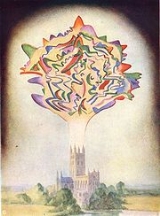
Thoughtforms and Annie Besant
Thought FormsThought Forms
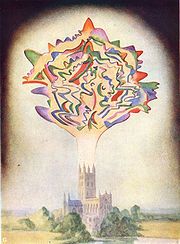
Thought-Forms is a book by Annie Besant and C.W. Leadbeater, which is a study on the nature and power of thoughts. It has been translated into more than five languages....
is a book by Annie Besant
Annie Besant
Annie Besant was a prominent British Theosophist, women's rights activist, writer and orator and supporter of Irish and Indian self rule.She was married at 19 to Frank Besant but separated from him over religious differences. She then became a prominent speaker for the National Secular Society ...
and C.W. Leadbeater that studies the nature and power of thought
Thought
"Thought" generally refers to any mental or intellectual activity involving an individual's subjective consciousness. It can refer either to the act of thinking or the resulting ideas or arrangements of ideas. Similar concepts include cognition, sentience, consciousness, and imagination...
s (ISBN 0-8356-0008-4). It states that thoughts have two effects: "a radiating vibration
Oscillation
Oscillation is the repetitive variation, typically in time, of some measure about a central value or between two or more different states. Familiar examples include a swinging pendulum and AC power. The term vibration is sometimes used more narrowly to mean a mechanical oscillation but sometimes...
and a floating form". Thought forms are divided into three classes:
- That which takes the image of the thinker.
- That which takes the image of some materialMaterialMaterial is anything made of matter, constituted of one or more substances. Wood, cement, hydrogen, air and water are all examples of materials. Sometimes the term "material" is used more narrowly to refer to substances or components with certain physical properties that are used as inputs to...
objectObject (philosophy)An object in philosophy is a technical term often used in contrast to the term subject. Consciousness is a state of cognition that includes the subject, which can never be doubted as only it can be the one who doubts, and some object or objects that may or may not have real existence without...
. - That which takes a form entirely its own, expressing its inherent qualities in the matterMatterMatter is a general term for the substance of which all physical objects consist. Typically, matter includes atoms and other particles which have mass. A common way of defining matter is as anything that has mass and occupies volume...
which it draws round it.
The effect of music
Music
Music is an art form whose medium is sound and silence. Its common elements are pitch , rhythm , dynamics, and the sonic qualities of timbre and texture...
, emotions, and colors on thought forms is also described in the book. The effect of the music of Mendelssohn
Mendelssohn
Mendelson is a Polish/German Jewish family name, meaning "son of Mendel", Mendel being a Yiddish diminutive of the Hebrew given name Menahem, meaning "consoling" or "one who consoles".Mendelssohn is the surname of a number of people:...
(No. 9 of his "Songs without words"), Gounod (Soldiers Chorus from "Faust") and Richard Wagner
Richard Wagner
Wilhelm Richard Wagner was a German composer, conductor, theatre director, philosopher, music theorist, poet, essayist and writer primarily known for his operas...
(Overture to "The Meistersingers") is analyzed. The music of Wagner produced a "marvellous mountain-range" on the thought forms.
Thoughtform in popular culture
Many authors and artists have since used tulpas in their works, both in the context of fiction and in writing about mysticism. Horror author Clive BarkerClive Barker
Clive Barker is an English author, film director and visual artist best known for his work in both fantasy and horror fiction. Barker came to prominence in the mid-1980s with a series of short stories which established him as a leading young horror writer...
, for example, envisioned his famous "Candy Man" killer to be nothing more than a myth gone terribly awry in his original story.
Thoughtform use in television spans several different franchises. In the X-Files
The X-Files
The X-Files is an American science fiction television series and a part of The X-Files franchise, created by screenwriter Chris Carter. The program originally aired from to . The show was a hit for the Fox network, and its characters and slogans became popular culture touchstones in the 1990s...
episode Arcadia (6X13), the president of the homeowners' association for an exclusive gated community uses a tulpa to enforce the neighborhood rules. The Supernatural
Supernatural (TV series)
Supernatural is an American supernatural and horror television series created by Eric Kripke, which debuted on September 13, 2005 on The WB, and is now part of The CW's lineup. Starring Jared Padalecki as Sam Winchester and Jensen Ackles as Dean Winchester, the series follows the brothers as they...
episode Hell House (1.17) features a haunted house in which the resident malevolent spirit turns out to be a tulpa, created when the beliefs of thousands of website visitors are focused through a Tibetan sigil
Sigil (magic)
A sigil is a symbol created for a specific magical purpose. A sigil is usually made up of a complex combination of several specific symbols or geometric figures, each with a specific meaning or intent.- Name and origin :...
painted on one wall of the house.
In The Secrets of the Immortal Nicholas Flamel
The Secrets of the Immortal Nicholas Flamel
The Secrets of the Immortal Nicholas Flamel will be a series of six fantasy novels written by Irish author Michael Scott when complete. Completion is due to be in 2012. The first book in the series, The Alchemyst was released in 2007, the sequels are scheduled to follow at the rate of one per year,...
, in the third book, Sorceress, the ancient Archon named Cernunnos was powerful enough to create a Thoughtform which traveled miles and miles just to talk to Dr. John Dee for a meeting.In Nightingale's Lament by Simon Green, a tulpa in the image of John Taylor's client is sent after him at one point, tracking him by a hair the client left on his jacket; it disappears when the hair is destroyed. In American Gods
American Gods
American Gods is a Hugo and Nebula Award-winning novel by Neil Gaiman. The novel is a blend of Americana, fantasy, and various strands of ancient and modern mythology, all centering on a mysterious and taciturn protagonist, Shadow. It is Gaiman's fourth prose novel, being preceded by Good Omens ,...
by Neil Gaiman
Neil Gaiman
Neil Richard Gaiman born 10 November 1960)is an English author of short fiction, novels, comic books, graphic novels, audio theatre and films. His notable works include the comic book series The Sandman and novels Stardust, American Gods, Coraline, and The Graveyard Book...
, various deity-like beings are created through cultural belief, a certain society's perception of, say, Odin, creating a form of that god particular to that society. In It
It (novel)
It is a 1986 horror novel by American author Stephen King. The story follows the exploits of seven children as they are terrorized by the eponymous inter-dimensional predatory life-form that exploits the fears and phobias of its victims in order to disguise itself while hunting its prey. "It"...
by Stephen King
Stephen King
Stephen Edwin King is an American author of contemporary horror, suspense, science fiction and fantasy fiction. His books have sold more than 350 million copies and have been adapted into a number of feature films, television movies and comic books...
, the eponymous entity's various manifestations are given form and power by the belief of the townspeople.
In Grant Morrison
Grant Morrison
Grant Morrison is a Scottish comic book writer, playwright and occultist. He is known for his nonlinear narratives and counter-cultural leanings, as well as his successful runs on titles like Animal Man, Doom Patrol, JLA, The Invisibles, New X-Men, Fantastic Four, All-Star Superman, and...
’s Marvel
Marvel Comics
Marvel Worldwide, Inc., commonly referred to as Marvel Comics and formerly Marvel Publishing, Inc. and Marvel Comics Group, is an American company that publishes comic books and related media...
limited series
Limited series
A limited series is a comic book series with a set number of installments. A limited series differs from an ongoing series in that the number of issues is determined before production and it differs from a one shot in that it is composed of multiple issues....
Fantastic Four: 1234
Fantastic Four: 1234
Fantastic Four: 1234 is a four-issue comic book limited series featuring the Fantastic Four, written by Grant Morrison and illustrated by Jae Lee and published by Marvel Comics under the Marvel Knights imprint.- Plot:...
(2002) Reed Richards muses on a fictitious journey to Tibet
Tibet
Tibet is a plateau region in Asia, north-east of the Himalayas. It is the traditional homeland of the Tibetan people as well as some other ethnic groups such as Monpas, Qiang, and Lhobas, and is now also inhabited by considerable numbers of Han and Hui people...
where, with the help of Bön priest, he creates a Tulpa, a “thoughtform”. After Richards names it ‘Victor’ the Tulpa takes on a life of its own, becoming Richards’ opposite number. This was an alternative, fantastical, origin for Richards’ arch enemy Dr Doom (aka Victor Von Doom).
According to the book The Teachings of Don Juan Matus, a Mexican shaman by the name of Don Juan Matus
Don Juan Matus
Don Juan Matus is a major figure in the series of books on Nagual 'Sorcery' by Carlos Castaneda.Matus is described as a Yaqui Indian to whom Castaneda was first introduced at a bus depot in Yuma, Arizona in the early 1960s. He turns out to be a 'Man of Knowledge' who imparts much of his wisdom and...
, who had taught his student Carlos Castaneda
Carlos Castaneda
Carlos Castaneda was a Peruvian-born American anthropologist and author....
, the books author, about the true nature of the physical universe and how intense concentration can summon, apport
Apport
According to parapsychologists and ghost hunters, an apport is the paranormal transference of an article from one place to another, or an appearance of an article from an unknown source that is often associated with poltergeist activity or spiritualistic séances. The Skeptic's Dictionary states...
, and even materialize objects out of thin air. It was said that Carlos Castaneda
Carlos Castaneda
Carlos Castaneda was a Peruvian-born American anthropologist and author....
was able to materialize a living squirrel on the palm of Don Juan's hand based on the latter's instruction. Many of his claims have been disputed by members of the anthropological
Anthropology
Anthropology is the study of humanity. It has origins in the humanities, the natural sciences, and the social sciences. The term "anthropology" is from the Greek anthrōpos , "man", understood to mean mankind or humanity, and -logia , "discourse" or "study", and was first used in 1501 by German...
profession.
In The Wheel of Darkness
The Wheel of Darkness
The Wheel of Darkness is a 2007 novel by Douglas Preston and Lincoln Child. It entered The New York Times Best Seller list at number two on September 16, 2007, and remained on the list for five weeks.-Plot summary:...
by Douglas Preston
Douglas Preston
Douglas Preston is an American author who has written seventeen popular techno-thriller and horror novels, four alone and the rest with Lincoln Child...
and Lincoln Child
Lincoln Child
Lincoln Child is an author of seventeen techno-thriller and horror novels. He often writes with Douglas Preston. Many of their novels have become bestsellers, and one, Relic, was adapted into a feature film...
, a tulpa is created.In Warren Ellis
Warren Ellis
Warren Girard Ellis is an English author of comics, novels, and television, who is well-known for sociocultural commentary, both through his online presence and through his writing, which covers transhumanist themes...
's Doktor Sleepless
Doktor Sleepless
Doktor Sleepless is a monthly comic book series written by Warren Ellis with art by Ivan Rodriguez that is published by Avatar Press, launched in July 2007...
the title character creates a Tulpa of himself allowing for one to be imprisoned while the other goes free. Starting in July 1989, Alan Grant (writer) wrote a story arc for Batman
Batman
Batman is a fictional character created by the artist Bob Kane and writer Bill Finger. A comic book superhero, Batman first appeared in Detective Comics #27 , and since then has appeared primarily in publications by DC Comics...
entitled "Tulpa", in which a Tibetan man creates entities to steal for him in order to repay a mob boss. In the Fables series of graphic novels by Bill Willingham
Bill Willingham
Bill Willingham is an American writer and artist of comics.-Career:Willingham got his start in the late 1970s to early 1980s as a staff artist for TSR, Inc., where he illustrated a number of their role-playing game products...
, the lifespan/health/vitality of each of the "Fable" characters (i.e., Snow White, Goldilocks, etc...) is directly tied into the degree of popularity or belief that real "mundy" (mundane) humans have in them, implying that they are willed into existence by the thoughts of humans.
Thoughtform has also been used in games. In the role-playing game
Role-playing game
A role-playing game is a game in which players assume the roles of characters in a fictional setting. Players take responsibility for acting out these roles within a narrative, either through literal acting, or through a process of structured decision-making or character development...
Over the Edge, tulpas are used as background characters (NPC's). They also have natural enemies, sociopathic individuals called "Sandmen", who prey on them to create either "Nightmare" (a drug) or "Dreamweb" (gossamer webs that can capture dreams from people). Dreamweb are typically used to capture the nightmares of neurotic individuals, which are also sold as something like a drug. Although the word "Tulpa" is never used in the Changeling: the Dreaming RPG, creatures known as "Chimera" fulfill a role very similar to Tulpa. Chimera may be sentient or non-sentient entities made manifest in the mental alternate reality of "The Dreaming". They typically arise spontaneously due to the force of human thought and emotion, sometimes from the dreams of individuals but potentially as amalgams of all human thought. These beings are typically weakened by exposure to human doubt, but nevertheless some have the necessary strength and abilities to manifest as tangible entities in the mundane world of humans, at least for a time.