

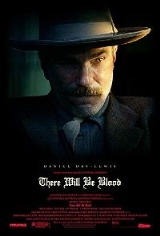
There Will Be Blood

Encyclopedia
There Will Be Blood is a 2007 drama film
written, co-produced, and directed by Paul Thomas Anderson
. The film is based on Upton Sinclair
's 1927 novel Oil!
. It tells the story of a silver miner-turned-oilman on a ruthless quest for wealth during Southern California
's oil boom
of the late 19th and early 20th centuries. It stars Daniel Day-Lewis
and Paul Dano
.
The film received significant critical praise and numerous award nominations and victories. It appeared on many critics' "top ten" lists for the year, notably the American Film Institute
, the National Society of Film Critics
, the National Board of Review, and the Los Angeles Film Critics Association
. Day-Lewis won Oscar, BAFTA
, Golden Globe, Screen Actors Guild
, NYFCC, and IFTA Best Actor awards for his performance. The film was nominated for eight Academy Awards
including Best Picture, winning Best Actor
for Day-Lewis and Best Cinematography
for Robert Elswit
.
In late 2009, it was chosen by Lisa Schwarzbaum of Entertainment Weekly
, Peter Bradshaw
of The Guardian
, Peter Travers
of Rolling Stone
, and Michael Phillips
of the Chicago Tribune
and At the Movies as the best film of the first decade of the 21st century.
The film follows the rise to power of Daniel Plainview - a charismatic and ruthless oil prospector, driven to succeed by his intense hatred of others and desperate need to see any and all competitors fail. When he learns of oil-rich land in California that can be bought cheaply, he moves his operation there and begins manipulating and exploiting the local landowners into selling him their property. Using his young adopted son H.W. to project the image of a caring family man, Plainview gains the cooperation of almost all the locals with lofty promises to build schools and cultivate the land to make their community flourish. He has no intention of doing so; his only purpose is to make money. Over time, Plainview's gradual accumulation of wealth and power causes his true self to surface and over the course of his endeavors, men die, the locals get nothing and Plainview gets rich. In his life he makes few friends and many enemies and even his adopted son H.W. is eventually alienated.
At a meeting with local people of an unidentified town, Plainview lectures them on his business plan: he claims he does all the work himself, only hires men he can trust to complete the work and will eliminate the need for a "contractor", a middleman of sorts that will collect more money from the community that Daniel believes should go back to the landowners themselves. He also introduces his son as his partner and claims that his business is a family-run operation. When the people begin to question him rigorously and argue loudly among themselves, Daniel turns down the offer and leaves, knowing the community is a bit too smart to be taken advantage of.
Daniel later meets with a husband and wife and draws up a contract to drill on their land. The couple are reluctant but Daniel appeals to them by talking about their children. The well comes in as a gusher some time later.
One night, a young man named Paul Sunday (Paul Dano) visits Plainview's camp. Paul sells to Plainview information about his family's ranch in Little Boston, California, which he says has an ocean of oil underneath it. Plainview and H.W. travel to the Sunday Ranch and, while pretending to hunt quail, confirm what Paul told them. That night, Plainview negotiates with the Sunday patriarch, Abel (David Willis) and Paul's twin brother, Eli (Paul Dano). The price is $10,000 towards the building of the Church of the Third Revelation; Eli is a bland, uncharismatic but ambitious preacher and faith healer. Daniel agrees to pay Eli half of the money at first and will pay the rest when the derrick produces. Eli wants to pray to conclude the deal but Plainview refuses.
Plainview assembles his crew at the Sunday Ranch and builds the first derrick. He also buys almost all of the land surrounding the Sunday Ranch so he will have not only those drilling rights but also the right to build a pipeline to the ocean to circumvent the railroads and their shipping costs. Only a man named William Bandy refuses to sell. Eli wants to bless the derrick before drilling begins but Plainview rebuffs him and instead has Eli's little sister, Mary (Sydney McAllister), dedicate the new endeavor. Mary and H.W. become playmates and Plainview buys her a new dress. At dinner one night, he tells Mary in front of Abel that her father will never hit her again for refusing to pray. Eli and Plainview continue to irritate one another: Plainview resents that Eli solicits his workers to come to daily prayer services, but when a worker dies while trying to free the drill, Plainview has Eli arrange for the funeral. When meeting with Eli about the funeral at his ramshackle church, he watches Eli deliver a fiery sermon about casting out the Devil from a elderly woman with arthritis. After the service, Eli agrees to speak at the funeral and tells Daniel that, had he been permitted to bless the well, the accident might never have happened.
A few days later, the drill finally strikes oil. The escaping gases cause an explosion. H.W., who was watching the drill from the derrick, is deafened. He becomes sullen and mistrusting. Shortly thereafter, a man named Henry (Kevin O'Connor) appears on Plainview's doorstep, claiming to be Plainview's half brother. Because he knows details about Plainview's family and hometown of Fond du Lac, Wisconsin, Plainview trusts him and takes him on as a worker. Plainview admits to Henry that he holds most people in contempt and uses them only to further his own goals. "I have a competition in me," he tells him. "I want no one else to succeed." He also admits that he can't do his work alone anymore. H.W. snoops through Henry's belongings and, jealous that Plainview has someone new in his life, attempts to burn down the house with Henry and Plainview in it. Plainview doesn't discipline H.W. but instead sends him away to a boarding school in San Francisco, callously leaving him on the train with his assistant, Fletcher, who accompanies him there.
Soon Plainview has three thriving oil wells in the Little Boston area. Eli goes to Daniel and demands the $5000 that Daniel promised him and his church. Daniel immediately attacks him, slapping him and dragging him to a pool of mud, which he smears all over Eli. Daniel also mocks Eli's supposed power of faith healing, saying that Eli did nothing to restore H.W.'s hearing.
Competitors try to buy Daniel's wells for $1 million but Plainview rejects the offer and their patronizing sympathy for H.W. When one competitor suggests Plainview should retire to take care of H.W., Plainview threatens his life. He and Henry go to the Bandy property to inquire about leasing the land to build the pipeline. After surveying the land, they swim in the ocean. When Henry doesn't seem to understand a reference about Fond du Lac, Plainview grows suspicious. That night, Plainview, brandishing a pistol, forces Henry to confess: Henry isn't his brother, but knew his brother in King City, CA. When the real brother died, Henry assumed his identity and made his way to California and found Daniel. Plainview kills Henry and buries him in a shallow grave on the Bandy property. The next morning, Bandy (Hans Howes) wakes Plainview and tells him that he can lease the land if he allows himself to be baptized at the Church of the Third Revelation. When Bandy reveals that he knows Plainview killed Henry, Plainview has no choice but to agree. He is baptized after he publicly and loudly announces that he is a sinner and abandoned H.W. and is warmly embraced by the church. Eli also announces to the church that Daniel has given them $5000, the original amount he owed to Eli.
H.W. returns from the boarding school and Plainview warmly greets him. H.W. now knows sign language and speaks through an interpreter. He and Mary play together, and she learns sign language too. When they are married in the late 1920s, she signs the minister's sermon and marriage rites to him. Plainview has become a drunkard, even more misanthropic and isolated than ever, living alone in a large mansion and shooting his valuables with a pistol. When H.W. announces his intention to move to Mexico and begin his own oil business, Plainview immediately becomes more despondent and reveals that H.W. was never his biological son and insultingly disowns him. Sometime later, Eli visits him in the mansion's bowling alley. As Plainview, like a beast, gnaws the cold steak leftover from his dinner, Eli reveals that old Bandy has died and that his grandson wants to sell the oil drilling rights to his grandfather's land in order to fund his goal of becoming a movie star -- with Eli as the broker for the deal. Plainview agrees but only if Eli will say that he is a "false prophet and God is a superstition." When Eli does so several times, Plainview reveals that, having owned all the wells around the Bandy ranch, he has already taken the oil from the Bandy property through drainage. Eli reveals that, despite a successful radio preaching career, he is broke due to bad investments. Plainview chases him around the bowling alley then bludgeons him to death with a bowling pin. When the butler comes to see what the commotion has been, Plainview announces to him, "I'm finished" .
finished writing Fast Food Nation
reporters kept asking him about Upton Sinclair, and although he had read Sinclair's The Jungle
, he did not know about his other works or anything about Sinclair himself. He decided to read most of Sinclair's works, and eventually read the novel Oil!
, which he loved. Schlosser, who found the book to be exciting and thought it would make a great film, sought out the Sinclair estate and purchased the film rights. He then thought that he would try to find a director that was as passionate about the book as he was, but Paul Thomas Anderson approached him first.
Anderson had been working on a screenplay about two fighting families. He struggled with the script and soon realized it just was not working. Homesick, he purchased a copy of Upton Sinclair
's Oil!
in London, drawn to its cover illustration of a California oilfield. As he read, Anderson became even more fascinated with the novel, and after contacting Schlosser, adapted the first 150 pages to a screenplay. He began to get a real sense of where his script was going after making many trips to museums dedicated to early oilmen in Bakersfield
. He changed the title from Oil! to There Will Be Blood because, "there's not enough of the book to feel like it's a proper adaptation."
Anderson, who had previously stated that he would like to work with Daniel Day-Lewis, wrote the screenplay with Day-Lewis in mind and approached the actor when the script was nearly complete. Anderson had heard that Daniel Day-Lewis liked his earlier film Punch-Drunk Love
, which gave him the confidence to hand Day-Lewis a copy of the incomplete script. According to Day-Lewis, simply being asked to do the film was enough to convince him. In an interview with The New York Observer, the actor elaborated on what drew him to the project. It was "the understanding that [Anderson] had already entered into that world. [He] wasn't observing it — [he'd] entered into it — and indeed [he'd] populated it with characters who [he] felt had lives of their own."
The line in the final scene, "I drink your milkshake
!", is paraphrased from a quote by U.S. Senator
for New Mexico
Albert Fall speaking before a Congressional investigation into the 1920s oil-related Teapot Dome scandal
. Anderson was enamoured of the fact that a term like "milkshake" found its way into such official testimony, to explain the complicated technical process of oil drainage to senators.
According to Joanne Sellar, one of the film's producers, it was a hard film to finance because "the studios didn't think it had the scope of a major picture." It took two years to acquire financing for the film.
For the role of Plainview's "son," Anderson looked at people in Los Angeles
and New York City
, but he realized that they needed someone from Texas who knew how to shoot shotgun
s and "live in that world." The filmmakers asked around at a school and the principal recommended Dillon Freasier
. They did not have him read any scenes and instead talked to him, realizing that he was the perfect person for the role.
To build his character, Day-Lewis started with the voice. Anderson sent him recordings from the late 19th century to 1927 and a copy of the 1948 film, The Treasure of the Sierra Madre
, including documentaries on its director, John Huston
, an important influence on Anderson's film. According to Anderson, he was inspired by the fact that Sierra Madre is "about greed and ambition and paranoia and looking at the worst parts of yourself." While writing the script, he would put the film on before he went to bed at night. To research for the role, Day-Lewis read letters from laborers and studied photographs from the time period. He also read up on oil tycoon Edward Doheny, upon whom Sinclair's book is loosely based.
began in June 2006 on a ranch in Marfa, Texas
, and took three months. Other location shooting took place in Los Angeles. Anderson tried to shoot the script in sequence with most of the sets on the ranch. Two weeks into the 60-day shoot, Anderson replaced the actor playing Eli Sunday with Paul Dano
, who had originally only been cast in the much smaller role of Paul Sunday, the brother who tipped off Plainview about the oil on the Sunday ranch. A profile of Day-Lewis in The New York Times Magazine
suggested that the original actor, Kel O'Neill, had been intimidated by Day-Lewis's intensity and habit of staying in character on and off the set. Both Anderson and Day-Lewis deny this claim, and Day-Lewis stated, "I absolutely don't believe that it was because he was intimidated by me. I happen to believe that — and I hope I'm right."
Anderson first saw Dano in The Ballad of Jack and Rose
(in which Dano co-starred with Day-Lewis) and thought that he would be perfect to play Paul Sunday, a role he originally envisioned to be a 12 or 13-year-old boy. Dano only had four days to prepare for the much larger role of Eli Sunday, but he researched the time period that the film is set in as well as evangelical
preachers. Three weeks of scenes with Sunday and Plainview had to be re-shot with Dano instead of O'Neill. The interior mansion scenes were filmed at the Greystone Mansion
in Beverly Hills
, the former real-life home of Edward Doheny Jr., a gift from his father, Edward Doheny. Scenes filmed at Greystone involved the careful renovation of the basement's two lane bowling alley.
Anderson dedicated the film to Robert Altman
, who died while Anderson was editing it.
There Will Be Blood was shot using Panavision
XL 35 mm cameras outfitted primarily with Panavision C series and high-speed anamorphic lenses.
Day-Lewis broke a rib in a fall during filming.
's music and was impressed with Jonny Greenwood
's scoring of the film Bodysong
. While writing the script for There Will Be Blood, Anderson heard Greenwood's orchestral piece Popcorn Superhet Receiver, which prompted him to ask Greenwood to work with him. After initially agreeing to score the film, Greenwood had doubts and thought about backing out, but Anderson's reassurance and enthusiasm for the film convinced the musician to stick with the project. Anderson gave Greenwood a copy of the film and three weeks later he came back with two hours of music recorded at Abbey Road Studios
in London. Concerning his approach to composing the soundtrack, Greenwood said to Entertainment Weekly
:
by Arvo Pärt
, and the third movement from Johannes Brahms
's Violin Concerto
. The recording is by violinist Anne-Sophie Mutter
with the Berlin Philharmonic directed by Herbert von Karajan
.
The song "Convergence", which can be heard during the tower explosion sequence, was taken straight from the Bodysong
soundtrack.
In December 2008, Greenwood's score was nominated for a Grammy in the category of "Best Score Soundtrack Album For Motion Picture, Television Or Other Visual Media" for the 51st Grammy Awards
.
, 91% of critics gave the film positive reviews, based on 202 reviews. On Metacritic
, the film has an average score of 92 out of 100, based on 39 reviews.
Andrew Sarris
called the film "an impressive achievement in its confident expertness in rendering the simulated realities of a bygone time and place, largely with an inspired use of regional amateur actors and extras with all the right moves and sounds." In Premiere
magazine, Glenn Kenny
praised Day-Lewis's performance: "Once his Plainview takes wing, the relentless focus of the performance makes the character unique." Manohla Dargis
wrote, in her review for The New York Times
, "the film is above all a consummate work of art, one that transcends the historically fraught context of its making, and its pleasures are unapologetically aesthetic." Esquire
magazine also praised Day-Lewis's performance: "what's most fun, albeit in a frightening way, is watching this greedmeister become more and more unhinged as he locks horns with Eli Sunday ... both Anderson and Day-Lewis go for broke. But it's a pleasure to be reminded, if only once every four years, that subtlety can be overrated." Richard Schickel
in Time
magazine praised There Will Be Blood as "one of the most wholly original American movies ever made." Critic Tom Charity, writing about CNN
's ten-best films list, calls the film the only "flat-out masterpiece" of 2007.
Schickel also named the film one of the Top 10 Movies of 2007, ranking it at #9, calling Daniel Day Lewis' performance "astonishing", and calling the film "a mesmerizing meditation on the American spirit in all its maddening ambiguities: mean and noble, angry and secretive, hypocritical and more than a little insane in its aspirations."
The Times
chief film critic, James Christopher, published a list in April 2008 of the Top 100 films of all time, placing There Will Be Blood at #2, behind Casablanca
.
However, some critics were more negative. Mick LaSalle
of the San Francisco Chronicle
shot out at the film's praises by saying "there should be no need to pretend There Will Be Blood is a masterpiece just because Anderson sincerely tried to make it one." Several months after his initial review of the film, LaSalle reiterated that while he felt it was "clear" that There Will Be Blood was not a masterpiece, he wondered if its "style, an approach, an attitude... might become important in the future."
Carla Meyer, of the Sacramento Bee, gave the film three and a half out of four stars; while calling it a "masterpiece", she said that the final confrontation between Daniel and Eli marked when There Will Be Blood "stops being a masterpiece and becomes a really good movie. What was grand becomes petty, then overwrought."
Roger Ebert
gave the film three-and-a-half out of four stars, saying that, "There Will Be Blood is the kind of film that is easily called great. I am not sure of its greatness. It was filmed in the same area of Texas used by No Country for Old Men
, and that is a great film, and a perfect one. But There Will Be Blood is not perfect, and in its imperfections (its unbending characters, its lack of women or any reflection of ordinary society, its ending, its relentlessness) we may see its reach exceeding its grasp. Which is not a dishonorable thing."
's 10 Movies of the Year; AFI's jury said:
The film appeared on many critics' top ten lists of the best films of 2007.
chose the film as the #1 best film of the decade, saying:
Chicago Tribune
and At the Movies critic Michael Phillips
named There Will Be Blood the decade’s best film. Phillips stated:
Entertainment Weekly
critic Lisa Schwarzbaum named There Will Be Blood the decade's best film as well. In her original review, Schwarzbaum stated:
In December 2009, the website Gawker.com
determined that There Will Be Blood is film critics' consensus best film of the decade when aggregating all Best of the Decade lists, stating: "And when the votes were all in, by a nose, There Will Be Blood stood alone at the top of the decade, its straw in the whole damn cinema's milkshake."
The list of critics who lauded There Will Be Blood in their assessments of films from the past decade include:
in Austin
, Texas
. The film was released on December 26, 2007, in New York
and Los Angeles
where it grossed US$
190,739 on its opening weekend. The film then opened in 885 theaters in selected markets on January 25, 2008, grossing $4.8 million on its opening weekend. The film went on to make $40.2 million in North America and $35.9 million in the rest of the world, with a worldwide total of $76.1 million, well above its $25 million budget. But the prints and advertising cost for the film's United States
release was about $40 million.
on April 8, 2008. It was released with one and two-disc editions, both are packaged in a cardboard case. Anderson has refused to record an audio commentary
for the film. A HD DVD
release was confirmed, but later canceled due to the death of the format. A Blu-ray
edition was released on June 3, 2008. The film has grossed $23,604,823 through DVD sales.
Eight nominations including:
61st British Academy Film Awards
9 nominations including:
65th Golden Globe Awards
2 nominations including:
Five wins including:
Australian Film Critics Association
National Society of Film Critics
Four wins including:
Los Angeles Film Critics Association
Four wins including:
Broadcast Film Critics Association
Two wins including:
The Directors Guild of America
nominated Paul Thomas Anderson for the DGA Award.
Screen Actors Guild
Daniel Day-Lewis won Outstanding Performance by a Male Actor in a Leading Role at the 14th Screen Actors Guild Awards
held in 2008.
Writers Guild of America
Anderson was also nominated by the Writers Guild of America
for "Best Adapted Screenplay".
Producers Guild of America
The film also garnered a "Producer of the Year Award" nomination from the Producers Guild of America
.
American Society of Cinematographers
Director of photography Robert Elswit won the American Society of Cinematographers
' award for Outstanding Achievement in Cinematography.
The American Film Institute's Top 10
The American Film Institute
listed it as an AFI Movie of the Year for 2007.
, "I Drink Your Milkshake" was the title of a category about milkshakes. Jon Stewart, host of The Daily Show and the 80th Academy Awards
(for which There Will Be Blood was nominated for eight Oscars), has referenced the phrase "I drink your milkshake" several times on his show in response to news involving oil drilling, including during interviews with Ted Koppel
and Nancy Pelosi
.
In February 2008, the night before the 80th Academy Awards
, a Saturday Night Live
skit
featured a Food Network
show starring Daniel Plainview (played by Bill Hader
) and H.W. Plainview (played by Amy Poehler
) called "I Drink Your Milkshake" in which Daniel and his son travel from state to state looking for the perfect milkshake. "I drink your milkshake" has inspired a There Will Be Blood fansite of the same name. Former MSNBC
anchor Keith Olbermann
also used this phrase on many occasions as part of his monologues of the stories he covered on Countdown
.
episode "Breast Cancer Show Ever
", which parodied the final scene of the film: after Wendy beats up Cartman
, Mr. Mackey approaches and says "Wendy!" to which she replies "I'm finished" as Cartman lies facedown in blood. The December 8, 2008 episode of the stop-motion animation comedy show Robot Chicken
featured a brief parody of the film in a segment titled "Just the Good Parts", which singled the oil rig explosion that robs H.W. of his hearing and the line "A BASTARD IN A BASKET" near the end of the film as the most notable parts of the film. A Daily Show segment used a film clip of Daniel Plainview speaking to the residents of Little Boston to poke fun at real-life Big Oil executives, while The Colbert Report utilized a clip from the film's oil derrick explosion scene in the segment "Aqua Colbert." In the deleted scenes for the Academy Award-nominated film In the Loop
, two characters debate the accuracy of the title of There Will Be Blood, with one proclaiming, "I went to see There Will Be Blood. And there wasn't any fucking blood."
Drama film
A drama film is a film genre that depends mostly on in-depth development of realistic characters dealing with emotional themes. Dramatic themes such as alcoholism, drug addiction, infidelity, moral dilemmas, racial prejudice, religious intolerance, poverty, class divisions, violence against women...
written, co-produced, and directed by Paul Thomas Anderson
Paul Thomas Anderson
Paul Thomas Anderson is an American film director, screenwriter, and producer. He has written and directed five feature films: Hard Eight , Boogie Nights , Magnolia , Punch-Drunk Love and There Will Be Blood...
. The film is based on Upton Sinclair
Upton Sinclair
Upton Beall Sinclair Jr. , was an American author who wrote close to one hundred books in many genres. He achieved popularity in the first half of the twentieth century, acquiring particular fame for his classic muckraking novel, The Jungle . It exposed conditions in the U.S...
's 1927 novel Oil!
Oil!
Oil! is a novel by Upton Sinclair published in 1927 told as a third person narrative. The book was written in the context of the Harding administration's Teapot Dome Scandal and takes place in Southern California. It is a social and political satire skewering the human foibles of all its...
. It tells the story of a silver miner-turned-oilman on a ruthless quest for wealth during Southern California
Southern California
Southern California is a megaregion, or megapolitan area, in the southern area of the U.S. state of California. Large urban areas include Greater Los Angeles and Greater San Diego. The urban area stretches along the coast from Ventura through the Southland and Inland Empire to San Diego...
's oil boom
Oil boom
An oil boom is a boom in the oil producing sector of an economy. Generally, this short period initially brings economical benefits, in term of increased GDP growth, but might later lead to a resource curse.-Consequences:...
of the late 19th and early 20th centuries. It stars Daniel Day-Lewis
Daniel Day-Lewis
Daniel Michael Blake Day-Lewis is an English actor with both British and Irish citizenship. His portrayals of Christy Brown in My Left Foot and Daniel Plainview in There Will Be Blood won Academy and BAFTA Awards for Best Actor, and Screen Actors Guild as well as Golden Globe Awards for the latter...
and Paul Dano
Paul Dano
Paul Franklin Dano is an American actor and producer. He has appeared in films such as L.I.E. , The Girl Next Door , Little Miss Sunshine , There Will Be Blood , and Where the Wild Things Are .-Early life:Dano was born in New York City, the son of Gladys and Paul Dano...
.
The film received significant critical praise and numerous award nominations and victories. It appeared on many critics' "top ten" lists for the year, notably the American Film Institute
American Film Institute Awards 2007
The American Film Institute Awards 2007 honored the ten most influential American motion pictures and television shows of 2007, chosen by juries assembled by the American Film Institute...
, the National Society of Film Critics
National Society of Film Critics
The National Society of Film Critics is an American film critic organization. As of December 2007 the NSFC had approximately 60 members who wrote for a variety of weekly and daily newspapers.-History:...
, the National Board of Review, and the Los Angeles Film Critics Association
Los Angeles Film Critics Association
The Los Angeles Film Critics Association was founded in 1975. Its main purpose is to present yearly awards to members of the film industry who have excelled in their fields. These awards are presented each January...
. Day-Lewis won Oscar, BAFTA
British Academy of Film and Television Arts
The British Academy of Film and Television Arts is a charity in the United Kingdom that hosts annual awards shows for excellence in film, television, television craft, video games and forms of animation.-Introduction:...
, Golden Globe, Screen Actors Guild
Screen Actors Guild
The Screen Actors Guild is an American labor union representing over 200,000 film and television principal performers and background performers worldwide...
, NYFCC, and IFTA Best Actor awards for his performance. The film was nominated for eight Academy Awards
80th Academy Awards
The 80th Academy Awards ceremony honored the best films in 2007 and was broadcast from the Kodak Theatre in Hollywood, California on ABC beginning at 5:30 p.m. PST/8:30 p.m. EST, February 24, 2008 . During the ceremony, the Academy of Motion Picture Arts and Sciences presented Academy Awards in 24...
including Best Picture, winning Best Actor
Academy Award for Best Actor
Performance by an Actor in a Leading Role is one of the Academy Awards of Merit presented annually by the Academy of Motion Picture Arts and Sciences to recognize an actor who has delivered an outstanding performance while working within the film industry...
for Day-Lewis and Best Cinematography
Academy Award for Best Cinematography
The Academy Award for Best Cinematography is an Academy Award awarded each year to a cinematographer for work in one particular motion picture.-History:...
for Robert Elswit
Robert Elswit
Robert Christopher Elswit, ASC is an American cinematographer. He has had multiple Oscar, BAFTA, and Independent Spirit nominations for several films, including There Will Be Blood. Elswit frequently works with director Paul Thomas Anderson.Elswit is a fierce defender of shooting with film, and...
.
In late 2009, it was chosen by Lisa Schwarzbaum of Entertainment Weekly
Entertainment Weekly
Entertainment Weekly is an American magazine, published by the Time division of Time Warner, that covers film, television, music, broadway theatre, books and popular culture...
, Peter Bradshaw
Peter Bradshaw
Peter Bradshaw is a British writer and film critic. He was educated at Cambridge University, where he was President of Footlights.Bradshaw is a film critic for The Guardian...
of The Guardian
The Guardian
The Guardian, formerly known as The Manchester Guardian , is a British national daily newspaper in the Berliner format...
, Peter Travers
Peter Travers
Peter Travers is an American film critic, who has written for, in turn, People and Rolling Stone. Travers also hosts a celebrity interview show called Popcorn on ABC News Now and ABCNews.com.-Career:...
of Rolling Stone
Rolling Stone
Rolling Stone is a US-based magazine devoted to music, liberal politics, and popular culture that is published every two weeks. Rolling Stone was founded in San Francisco in 1967 by Jann Wenner and music critic Ralph J...
, and Michael Phillips
Michael Phillips (critic)
Michael Phillips is a film critic for the Chicago Tribune newspaper. Previously he was the drama critic of the Tribune; the Los Angeles Times; the St. Paul Pioneer Press; the San Diego Union-Tribune; and the Dallas Times Herald....
of the Chicago Tribune
Chicago Tribune
The Chicago Tribune is a major daily newspaper based in Chicago, Illinois, and the flagship publication of the Tribune Company. Formerly self-styled as the "World's Greatest Newspaper" , it remains the most read daily newspaper of the Chicago metropolitan area and the Great Lakes region and is...
and At the Movies as the best film of the first decade of the 21st century.
The film follows the rise to power of Daniel Plainview - a charismatic and ruthless oil prospector, driven to succeed by his intense hatred of others and desperate need to see any and all competitors fail. When he learns of oil-rich land in California that can be bought cheaply, he moves his operation there and begins manipulating and exploiting the local landowners into selling him their property. Using his young adopted son H.W. to project the image of a caring family man, Plainview gains the cooperation of almost all the locals with lofty promises to build schools and cultivate the land to make their community flourish. He has no intention of doing so; his only purpose is to make money. Over time, Plainview's gradual accumulation of wealth and power causes his true self to surface and over the course of his endeavors, men die, the locals get nothing and Plainview gets rich. In his life he makes few friends and many enemies and even his adopted son H.W. is eventually alienated.
Plot
It is 1898. In the New Mexico wilderness, Daniel Plainview (Daniel Day-Lewis) works his silver mine. When his leg breaks while working, he drags himself to town to sell the mine. He hires a crew, including a man caring for an infant son. When the silver mine plays out in 1902, Plainview discovers oil in the mine. He builds a pump and recreates himself as an oil man. The young father dies in a drilling accident. Plainview adopts the young boy as his own and names him H.W. Nine years later in 1911, Plainview is a successful if still somewhat minor oil man. He has several productive wells around New Mexico and, with H.W. (Dillon Freasier), travels the state to buy the drilling rights to private property.At a meeting with local people of an unidentified town, Plainview lectures them on his business plan: he claims he does all the work himself, only hires men he can trust to complete the work and will eliminate the need for a "contractor", a middleman of sorts that will collect more money from the community that Daniel believes should go back to the landowners themselves. He also introduces his son as his partner and claims that his business is a family-run operation. When the people begin to question him rigorously and argue loudly among themselves, Daniel turns down the offer and leaves, knowing the community is a bit too smart to be taken advantage of.
Daniel later meets with a husband and wife and draws up a contract to drill on their land. The couple are reluctant but Daniel appeals to them by talking about their children. The well comes in as a gusher some time later.
One night, a young man named Paul Sunday (Paul Dano) visits Plainview's camp. Paul sells to Plainview information about his family's ranch in Little Boston, California, which he says has an ocean of oil underneath it. Plainview and H.W. travel to the Sunday Ranch and, while pretending to hunt quail, confirm what Paul told them. That night, Plainview negotiates with the Sunday patriarch, Abel (David Willis) and Paul's twin brother, Eli (Paul Dano). The price is $10,000 towards the building of the Church of the Third Revelation; Eli is a bland, uncharismatic but ambitious preacher and faith healer. Daniel agrees to pay Eli half of the money at first and will pay the rest when the derrick produces. Eli wants to pray to conclude the deal but Plainview refuses.
Plainview assembles his crew at the Sunday Ranch and builds the first derrick. He also buys almost all of the land surrounding the Sunday Ranch so he will have not only those drilling rights but also the right to build a pipeline to the ocean to circumvent the railroads and their shipping costs. Only a man named William Bandy refuses to sell. Eli wants to bless the derrick before drilling begins but Plainview rebuffs him and instead has Eli's little sister, Mary (Sydney McAllister), dedicate the new endeavor. Mary and H.W. become playmates and Plainview buys her a new dress. At dinner one night, he tells Mary in front of Abel that her father will never hit her again for refusing to pray. Eli and Plainview continue to irritate one another: Plainview resents that Eli solicits his workers to come to daily prayer services, but when a worker dies while trying to free the drill, Plainview has Eli arrange for the funeral. When meeting with Eli about the funeral at his ramshackle church, he watches Eli deliver a fiery sermon about casting out the Devil from a elderly woman with arthritis. After the service, Eli agrees to speak at the funeral and tells Daniel that, had he been permitted to bless the well, the accident might never have happened.
A few days later, the drill finally strikes oil. The escaping gases cause an explosion. H.W., who was watching the drill from the derrick, is deafened. He becomes sullen and mistrusting. Shortly thereafter, a man named Henry (Kevin O'Connor) appears on Plainview's doorstep, claiming to be Plainview's half brother. Because he knows details about Plainview's family and hometown of Fond du Lac, Wisconsin, Plainview trusts him and takes him on as a worker. Plainview admits to Henry that he holds most people in contempt and uses them only to further his own goals. "I have a competition in me," he tells him. "I want no one else to succeed." He also admits that he can't do his work alone anymore. H.W. snoops through Henry's belongings and, jealous that Plainview has someone new in his life, attempts to burn down the house with Henry and Plainview in it. Plainview doesn't discipline H.W. but instead sends him away to a boarding school in San Francisco, callously leaving him on the train with his assistant, Fletcher, who accompanies him there.
Soon Plainview has three thriving oil wells in the Little Boston area. Eli goes to Daniel and demands the $5000 that Daniel promised him and his church. Daniel immediately attacks him, slapping him and dragging him to a pool of mud, which he smears all over Eli. Daniel also mocks Eli's supposed power of faith healing, saying that Eli did nothing to restore H.W.'s hearing.
Competitors try to buy Daniel's wells for $1 million but Plainview rejects the offer and their patronizing sympathy for H.W. When one competitor suggests Plainview should retire to take care of H.W., Plainview threatens his life. He and Henry go to the Bandy property to inquire about leasing the land to build the pipeline. After surveying the land, they swim in the ocean. When Henry doesn't seem to understand a reference about Fond du Lac, Plainview grows suspicious. That night, Plainview, brandishing a pistol, forces Henry to confess: Henry isn't his brother, but knew his brother in King City, CA. When the real brother died, Henry assumed his identity and made his way to California and found Daniel. Plainview kills Henry and buries him in a shallow grave on the Bandy property. The next morning, Bandy (Hans Howes) wakes Plainview and tells him that he can lease the land if he allows himself to be baptized at the Church of the Third Revelation. When Bandy reveals that he knows Plainview killed Henry, Plainview has no choice but to agree. He is baptized after he publicly and loudly announces that he is a sinner and abandoned H.W. and is warmly embraced by the church. Eli also announces to the church that Daniel has given them $5000, the original amount he owed to Eli.
H.W. returns from the boarding school and Plainview warmly greets him. H.W. now knows sign language and speaks through an interpreter. He and Mary play together, and she learns sign language too. When they are married in the late 1920s, she signs the minister's sermon and marriage rites to him. Plainview has become a drunkard, even more misanthropic and isolated than ever, living alone in a large mansion and shooting his valuables with a pistol. When H.W. announces his intention to move to Mexico and begin his own oil business, Plainview immediately becomes more despondent and reveals that H.W. was never his biological son and insultingly disowns him. Sometime later, Eli visits him in the mansion's bowling alley. As Plainview, like a beast, gnaws the cold steak leftover from his dinner, Eli reveals that old Bandy has died and that his grandson wants to sell the oil drilling rights to his grandfather's land in order to fund his goal of becoming a movie star -- with Eli as the broker for the deal. Plainview agrees but only if Eli will say that he is a "false prophet and God is a superstition." When Eli does so several times, Plainview reveals that, having owned all the wells around the Bandy ranch, he has already taken the oil from the Bandy property through drainage. Eli reveals that, despite a successful radio preaching career, he is broke due to bad investments. Plainview chases him around the bowling alley then bludgeons him to death with a bowling pin. When the butler comes to see what the commotion has been, Plainview announces to him, "I'm finished" .
Cast
- Daniel Day-LewisDaniel Day-LewisDaniel Michael Blake Day-Lewis is an English actor with both British and Irish citizenship. His portrayals of Christy Brown in My Left Foot and Daniel Plainview in There Will Be Blood won Academy and BAFTA Awards for Best Actor, and Screen Actors Guild as well as Golden Globe Awards for the latter...
as Daniel Plainview - Paul DanoPaul DanoPaul Franklin Dano is an American actor and producer. He has appeared in films such as L.I.E. , The Girl Next Door , Little Miss Sunshine , There Will Be Blood , and Where the Wild Things Are .-Early life:Dano was born in New York City, the son of Gladys and Paul Dano...
as Paul Sunday / Eli Sunday - Dillon FreasierDillon FreasierDillon Freasier was born in the town of Fort Davis, Texas. Freasier was not an actor when chosen for his role in There Will Be Blood. After several unsuccessful attempts to cast established Hollywood child actors, casting director Cassandra Kulukundis began searching for potential actors in rural...
(Russell HarvardRussell HarvardRussell Harvard is a deaf actor. He has portrayed the adult H.W. Plainview in There Will Be Blood and will portray professional fighter Matt Hamill in Hamill, a film about his life.-Filmography:* CSI: NY...
, older) as H.W. - Kevin J. O'Connor as Henry
- Ciarán HindsCiarán HindsCiarán Hinds is an Irish film, television and stage actor. He has built up a reputation as a versatile character actor appearing in such high profile films as Road to Perdition, The Phantom of the Opera, Munich, There Will Be Blood and Tinker, Tailor, Soldier, Spy. His television roles include...
as Fletcher - Sydney McCallister (Colleen Foy, older) as Mary Sunday
- David Willis as Abel Sunday
- Hans Howes as William Bandy
- Paul F. TompkinsPaul F. TompkinsPaul Francis Tompkins , best known as Paul F. Tompkins, is an American actor and comedian.-Life and career:Tompkins was born in Philadelphia, Pennsylvania to a receptionist mother and railway worker father. He started out in stand-up comedy in 1986 at The Comedy Works, Philadelphia, PA, where he...
as Prescott - Jim MeskimenJim MeskimenJim Ross Meskimen is an American comedian and actor, perhaps best known for his work on the improvisation show Whose Line Is It Anyway? and as the voice of President George W. Bush and other politicians for the internet Jib Jab animated shorts...
as Signal Hill married man - Randall Carver and Coco Leigh as Mr. and Mrs. Bankside
- Tom Doyle as J.J. Carter
Development
After Eric SchlosserEric Schlosser
Eric Schlosser is an American journalist and author known for investigative journalism, such as in his books Fast Food Nation, Reefer Madness and Chew On This.- Personal History :...
finished writing Fast Food Nation
Fast Food Nation
Fast Food Nation: The Dark Side of the All-American Meal is a book by investigative journalist Eric Schlosser that examines the local and global influence of the United States fast food industry....
reporters kept asking him about Upton Sinclair, and although he had read Sinclair's The Jungle
The Jungle
The Jungle is a 1906 novel written by journalist Upton Sinclair. Sinclair wrote the novel with the intention of portraying the life of the immigrant in the United States, but readers were more concerned with the large portion of the book pertaining to the corruption of the American meatpacking...
, he did not know about his other works or anything about Sinclair himself. He decided to read most of Sinclair's works, and eventually read the novel Oil!
Oil!
Oil! is a novel by Upton Sinclair published in 1927 told as a third person narrative. The book was written in the context of the Harding administration's Teapot Dome Scandal and takes place in Southern California. It is a social and political satire skewering the human foibles of all its...
, which he loved. Schlosser, who found the book to be exciting and thought it would make a great film, sought out the Sinclair estate and purchased the film rights. He then thought that he would try to find a director that was as passionate about the book as he was, but Paul Thomas Anderson approached him first.
Anderson had been working on a screenplay about two fighting families. He struggled with the script and soon realized it just was not working. Homesick, he purchased a copy of Upton Sinclair
Upton Sinclair
Upton Beall Sinclair Jr. , was an American author who wrote close to one hundred books in many genres. He achieved popularity in the first half of the twentieth century, acquiring particular fame for his classic muckraking novel, The Jungle . It exposed conditions in the U.S...
's Oil!
Oil!
Oil! is a novel by Upton Sinclair published in 1927 told as a third person narrative. The book was written in the context of the Harding administration's Teapot Dome Scandal and takes place in Southern California. It is a social and political satire skewering the human foibles of all its...
in London, drawn to its cover illustration of a California oilfield. As he read, Anderson became even more fascinated with the novel, and after contacting Schlosser, adapted the first 150 pages to a screenplay. He began to get a real sense of where his script was going after making many trips to museums dedicated to early oilmen in Bakersfield
Bakersfield, California
Bakersfield is a city near the southern end of the San Joaquin Valley in Kern County, California. It is roughly equidistant between Fresno and Los Angeles, to the north and south respectively....
. He changed the title from Oil! to There Will Be Blood because, "there's not enough of the book to feel like it's a proper adaptation."
Anderson, who had previously stated that he would like to work with Daniel Day-Lewis, wrote the screenplay with Day-Lewis in mind and approached the actor when the script was nearly complete. Anderson had heard that Daniel Day-Lewis liked his earlier film Punch-Drunk Love
Punch-Drunk Love
Punch-Drunk Love is a 2002 romantic comedy-drama written and directed by Paul Thomas Anderson, starring Adam Sandler and Emily Watson. Philip Seymour Hoffman and Luis Guzmán also appear....
, which gave him the confidence to hand Day-Lewis a copy of the incomplete script. According to Day-Lewis, simply being asked to do the film was enough to convince him. In an interview with The New York Observer, the actor elaborated on what drew him to the project. It was "the understanding that [Anderson] had already entered into that world. [He] wasn't observing it — [he'd] entered into it — and indeed [he'd] populated it with characters who [he] felt had lives of their own."
The line in the final scene, "I drink your milkshake
Milkshake
A milkshake is a sweet, cold beverage which is made from milk, ice cream or iced milk, and flavorings or sweeteners such as fruit syrup or chocolate sauce....
!", is paraphrased from a quote by U.S. Senator
United States Senate
The United States Senate is the upper house of the bicameral legislature of the United States, and together with the United States House of Representatives comprises the United States Congress. The composition and powers of the Senate are established in Article One of the U.S. Constitution. Each...
for New Mexico
New Mexico
New Mexico is a state located in the southwest and western regions of the United States. New Mexico is also usually considered one of the Mountain States. With a population density of 16 per square mile, New Mexico is the sixth-most sparsely inhabited U.S...
Albert Fall speaking before a Congressional investigation into the 1920s oil-related Teapot Dome scandal
Teapot Dome scandal
The Teapot Dome Scandal was a bribery incident that took place in the United States in 1922–23, during the administration of President Warren G. Harding. Secretary of the Interior Albert B. Fall leased Navy petroleum reserves at Teapot Dome and two other locations to private oil companies at low...
. Anderson was enamoured of the fact that a term like "milkshake" found its way into such official testimony, to explain the complicated technical process of oil drainage to senators.
According to Joanne Sellar, one of the film's producers, it was a hard film to finance because "the studios didn't think it had the scope of a major picture." It took two years to acquire financing for the film.
For the role of Plainview's "son," Anderson looked at people in Los Angeles
Los Ángeles
Los Ángeles is the capital of the province of Biobío, in the commune of the same name, in Region VIII , in the center-south of Chile. It is located between the Laja and Biobío rivers. The population is 123,445 inhabitants...
and New York City
New York City
New York is the most populous city in the United States and the center of the New York Metropolitan Area, one of the most populous metropolitan areas in the world. New York exerts a significant impact upon global commerce, finance, media, art, fashion, research, technology, education, and...
, but he realized that they needed someone from Texas who knew how to shoot shotgun
Shotgun
A shotgun is a firearm that is usually designed to be fired from the shoulder, which uses the energy of a fixed shell to fire a number of small spherical pellets called shot, or a solid projectile called a slug...
s and "live in that world." The filmmakers asked around at a school and the principal recommended Dillon Freasier
Dillon Freasier
Dillon Freasier was born in the town of Fort Davis, Texas. Freasier was not an actor when chosen for his role in There Will Be Blood. After several unsuccessful attempts to cast established Hollywood child actors, casting director Cassandra Kulukundis began searching for potential actors in rural...
. They did not have him read any scenes and instead talked to him, realizing that he was the perfect person for the role.
To build his character, Day-Lewis started with the voice. Anderson sent him recordings from the late 19th century to 1927 and a copy of the 1948 film, The Treasure of the Sierra Madre
The Treasure of the Sierra Madre (film)
The Treasure of the Sierra Madre is a 1948 American film written and directed by John Huston, a feature film adaptation of B. Traven's 1927 novel of the same name, in which two Americans Fred C. Dobbs and Bob Curtin during the 1920s in Mexico join with an old-timer, Howard , to prospect for gold...
, including documentaries on its director, John Huston
John Huston
John Marcellus Huston was an American film director, screenwriter and actor. He wrote most of the 37 feature films he directed, many of which are today considered classics: The Maltese Falcon , The Treasure of the Sierra Madre , Key Largo , The Asphalt Jungle , The African Queen , Moulin Rouge...
, an important influence on Anderson's film. According to Anderson, he was inspired by the fact that Sierra Madre is "about greed and ambition and paranoia and looking at the worst parts of yourself." While writing the script, he would put the film on before he went to bed at night. To research for the role, Day-Lewis read letters from laborers and studied photographs from the time period. He also read up on oil tycoon Edward Doheny, upon whom Sinclair's book is loosely based.
Filming
Principal photographyPrincipal photography
thumb|300px|Film production on location in [[Newark, New Jersey]].Principal photography is the phase of film production in which the movie is filmed, with actors on set and cameras rolling, as distinct from pre-production and post-production....
began in June 2006 on a ranch in Marfa, Texas
Marfa, Texas
Marfa is a town in the high desert of far West Texas in the Southwestern United States. Located between the Davis Mountains and Big Bend National Park, it is also the county seat of Presidio County. The population was 1,981 at the 2010 census....
, and took three months. Other location shooting took place in Los Angeles. Anderson tried to shoot the script in sequence with most of the sets on the ranch. Two weeks into the 60-day shoot, Anderson replaced the actor playing Eli Sunday with Paul Dano
Paul Dano
Paul Franklin Dano is an American actor and producer. He has appeared in films such as L.I.E. , The Girl Next Door , Little Miss Sunshine , There Will Be Blood , and Where the Wild Things Are .-Early life:Dano was born in New York City, the son of Gladys and Paul Dano...
, who had originally only been cast in the much smaller role of Paul Sunday, the brother who tipped off Plainview about the oil on the Sunday ranch. A profile of Day-Lewis in The New York Times Magazine
The New York Times Magazine
The New York Times Magazine is a Sunday magazine supplement included with the Sunday edition of The New York Times. It is host to feature articles longer than those typically in the newspaper and has attracted many notable contributors...
suggested that the original actor, Kel O'Neill, had been intimidated by Day-Lewis's intensity and habit of staying in character on and off the set. Both Anderson and Day-Lewis deny this claim, and Day-Lewis stated, "I absolutely don't believe that it was because he was intimidated by me. I happen to believe that — and I hope I'm right."
Anderson first saw Dano in The Ballad of Jack and Rose
The Ballad of Jack and Rose
The Ballad of Jack and Rose is a 2005 drama film written and directed by Rebecca Miller, and starring her husband Daniel Day-Lewis; it also stars Camilla Belle, Catherine Keener, Paul Dano, Ryan McDonald, Jason Lee, Jena Malone, Susanna Thompson and Beau Bridges...
(in which Dano co-starred with Day-Lewis) and thought that he would be perfect to play Paul Sunday, a role he originally envisioned to be a 12 or 13-year-old boy. Dano only had four days to prepare for the much larger role of Eli Sunday, but he researched the time period that the film is set in as well as evangelical
Evangelism
Evangelism refers to the practice of relaying information about a particular set of beliefs to others who do not hold those beliefs. The term is often used in reference to Christianity....
preachers. Three weeks of scenes with Sunday and Plainview had to be re-shot with Dano instead of O'Neill. The interior mansion scenes were filmed at the Greystone Mansion
Greystone Mansion
Greystone Mansion, also known as the Doheny Mansion, is a Tudor-style mansion on a landscaped estate with distinctive formal English gardens, located in Beverly Hills, California, United States. The architect Gordon Kaufmann designed the residence and ancillary structures, with construction...
in Beverly Hills
Beverly Hills, California
Beverly Hills is an affluent city located in Los Angeles County, California, United States. With a population of 34,109 at the 2010 census, up from 33,784 as of the 2000 census, it is home to numerous Hollywood celebrities. Beverly Hills and the neighboring city of West Hollywood are together...
, the former real-life home of Edward Doheny Jr., a gift from his father, Edward Doheny. Scenes filmed at Greystone involved the careful renovation of the basement's two lane bowling alley.
Anderson dedicated the film to Robert Altman
Robert Altman
Robert Bernard Altman was an American film director and screenwriter known for making films that are highly naturalistic, but with a stylized perspective. In 2006, the Academy of Motion Picture Arts and Sciences recognized his body of work with an Academy Honorary Award.His films MASH , McCabe and...
, who died while Anderson was editing it.
There Will Be Blood was shot using Panavision
Panavision
Panavision is an American motion picture equipment company specializing in cameras and lenses, based in Woodland Hills, California. Formed by Robert Gottschalk as a small partnership to create anamorphic projection lenses during the widescreen boom in the 1950s, Panavision expanded its product...
XL 35 mm cameras outfitted primarily with Panavision C series and high-speed anamorphic lenses.
Day-Lewis broke a rib in a fall during filming.
Music
Anderson had been a fan of RadioheadRadiohead
Radiohead are an English rock band from Abingdon, Oxfordshire, formed in 1985. The band consists of Thom Yorke , Jonny Greenwood , Ed O'Brien , Colin Greenwood and Phil Selway .Radiohead released their debut single "Creep" in 1992...
's music and was impressed with Jonny Greenwood
Jonny Greenwood
Jonathan Richard Guy "Jonny" Greenwood is an English musician and composer, best known as a member of the English rock band Radiohead. Greenwood is a multi-instrumentalist, but serves mainly as lead guitarist and keyboard player. In addition to guitar and keyboard, he plays viola, harmonica,...
's scoring of the film Bodysong
Bodysong
Bodysong is a 2003 documentary about human life and the human condition directed by Simon Pummell.The entire film has no dialogue, and is set to a score composed by Jonny Greenwood . The Bodysong soundtrack album was Greenwood's first solo release.- Plot :The film opens with scenes of birth...
. While writing the script for There Will Be Blood, Anderson heard Greenwood's orchestral piece Popcorn Superhet Receiver, which prompted him to ask Greenwood to work with him. After initially agreeing to score the film, Greenwood had doubts and thought about backing out, but Anderson's reassurance and enthusiasm for the film convinced the musician to stick with the project. Anderson gave Greenwood a copy of the film and three weeks later he came back with two hours of music recorded at Abbey Road Studios
Abbey Road Studios
Abbey Road Studios is a recording studio located at 3 Abbey Road, St John's Wood, City of Westminster, London, England. It was established in November 1931 by the Gramophone Company, a predecessor of British music company EMI, its present owner...
in London. Concerning his approach to composing the soundtrack, Greenwood said to Entertainment Weekly
Entertainment Weekly
Entertainment Weekly is an American magazine, published by the Time division of Time Warner, that covers film, television, music, broadway theatre, books and popular culture...
:
I think it was about not necessarily just making period music, which very traditionally you would do. But because they were traditional orchestral sounds, I suppose that's what we hoped was a little unsettling, even though you know all the sounds you're hearing are coming from very old technology. You can just do things with the classical orchestra that do unsettle you, that are sort of slightly wrong, that have some kind of undercurrent that's slightly sinister.The film also contains the cello and piano transcription of Fratres
Fratres
Fratres is a composition by the Estonian composer Arvo Pärt, existing in versions for a wide variety of instrumentations and exemplifying Pärt's tintinnabuli style of composition. Structurally, the piece consists of a set of eight or nine chord sequences, separated by a recurring percussion motif...
by Arvo Pärt
Arvo Pärt
Arvo Pärt is an Estonian classical composer and one of the most prominent living composers of sacred music. Since the late 1970s, Pärt has worked in a minimalist style that employs his self-made compositional technique, tintinnabuli. His music also finds its inspiration and influence from...
, and the third movement from Johannes Brahms
Johannes Brahms
Johannes Brahms was a German composer and pianist, and one of the leading musicians of the Romantic period. Born in Hamburg, Brahms spent much of his professional life in Vienna, Austria, where he was a leader of the musical scene...
's Violin Concerto
Violin Concerto (Brahms)
Violin Concerto in D major, Op. 77 is a violin concerto in three movements composed by Johannes Brahms in 1878 and dedicated to his friend, the violinist Joseph Joachim...
. The recording is by violinist Anne-Sophie Mutter
Anne-Sophie Mutter
Anne-Sophie Mutter is a German violinist.- Early life :Mutter was born in Rheinfelden, Germany. She began playing the piano at age five, and shortly afterwards took up the violin, studying with Erna Honigberger, a pupil of Carl Flesch...
with the Berlin Philharmonic directed by Herbert von Karajan
Herbert von Karajan
Herbert von Karajan was an Austrian orchestra and opera conductor. To the wider world he was perhaps most famously associated with the Berlin Philharmonic, of which he was principal conductor for 35 years...
.
The song "Convergence", which can be heard during the tower explosion sequence, was taken straight from the Bodysong
Bodysong
Bodysong is a 2003 documentary about human life and the human condition directed by Simon Pummell.The entire film has no dialogue, and is set to a score composed by Jonny Greenwood . The Bodysong soundtrack album was Greenwood's first solo release.- Plot :The film opens with scenes of birth...
soundtrack.
In December 2008, Greenwood's score was nominated for a Grammy in the category of "Best Score Soundtrack Album For Motion Picture, Television Or Other Visual Media" for the 51st Grammy Awards
51st Grammy Awards
The 51st Annual Grammy Awards took place at the Staples Center in Los Angeles, CA on February 8, 2009. Robert Plant and Alison Krauss were the biggest winners of the night, jointly winning five awards including Album of the Year and Record of the Year...
.
Critical reception
The film received very positive reviews from critics; as of October 4, 2010 on the review aggregator Rotten TomatoesRotten Tomatoes
Rotten Tomatoes is a website devoted to reviews, information, and news of films—widely known as a film review aggregator. Its name derives from the cliché of audiences throwing tomatoes and other vegetables at a poor stage performance...
, 91% of critics gave the film positive reviews, based on 202 reviews. On Metacritic
Metacritic
Metacritic.com is a website that collates reviews of music albums, games, movies, TV shows and DVDs. For each product, a numerical score from each review is obtained and the total is averaged. An excerpt of each review is provided along with a hyperlink to the source. Three colour codes of Green,...
, the film has an average score of 92 out of 100, based on 39 reviews.
Andrew Sarris
Andrew Sarris
Andrew Sarris is an American film critic and a leading proponent of the auteur theory of criticism.-Career:Sarris is generally credited with popularizing the auteur theory in the U.S...
called the film "an impressive achievement in its confident expertness in rendering the simulated realities of a bygone time and place, largely with an inspired use of regional amateur actors and extras with all the right moves and sounds." In Premiere
Premiere (magazine)
Premiere was an American and New York City-based film magazine published by Hachette Filipacchi Media U.S., published between the years 1987 and 2007. The original version of the magazine, Première , was started in France in 1976 and is still being published there.-History:The magazine originally...
magazine, Glenn Kenny
Glenn Kenny
Glenn Kenny is an American film critic. Kenny served as a critic and editor at the film magazine Premiere from 1996 until it ceased publication in 2007...
praised Day-Lewis's performance: "Once his Plainview takes wing, the relentless focus of the performance makes the character unique." Manohla Dargis
Manohla Dargis
Manohla Dargis is a chief film critic for The New York Times, along with A.O. Scott. She was formerly a chief film critic for the Los Angeles Times, the film editor at the LA Weekly, and a film critic at The Village Voice. She has written for a variety of publications, including Film Comment and...
wrote, in her review for The New York Times
The New York Times
The New York Times is an American daily newspaper founded and continuously published in New York City since 1851. The New York Times has won 106 Pulitzer Prizes, the most of any news organization...
, "the film is above all a consummate work of art, one that transcends the historically fraught context of its making, and its pleasures are unapologetically aesthetic." Esquire
Esquire (magazine)
Esquire is a men's magazine, published in the U.S. by the Hearst Corporation. Founded in 1932, it flourished during the Great Depression under the guidance of founder and editor Arnold Gingrich.-History:...
magazine also praised Day-Lewis's performance: "what's most fun, albeit in a frightening way, is watching this greedmeister become more and more unhinged as he locks horns with Eli Sunday ... both Anderson and Day-Lewis go for broke. But it's a pleasure to be reminded, if only once every four years, that subtlety can be overrated." Richard Schickel
Richard Schickel
Richard Warren Schickel is an American author, journalist, and documentary filmmaker. He is a film critic for Time magazine, having also written for Life magazine and the Los Angeles Times Book Review....
in Time
Time (magazine)
Time is an American news magazine. A European edition is published from London. Time Europe covers the Middle East, Africa and, since 2003, Latin America. An Asian edition is based in Hong Kong...
magazine praised There Will Be Blood as "one of the most wholly original American movies ever made." Critic Tom Charity, writing about CNN
CNN
Cable News Network is a U.S. cable news channel founded in 1980 by Ted Turner. Upon its launch, CNN was the first channel to provide 24-hour television news coverage, and the first all-news television channel in the United States...
's ten-best films list, calls the film the only "flat-out masterpiece" of 2007.
Schickel also named the film one of the Top 10 Movies of 2007, ranking it at #9, calling Daniel Day Lewis' performance "astonishing", and calling the film "a mesmerizing meditation on the American spirit in all its maddening ambiguities: mean and noble, angry and secretive, hypocritical and more than a little insane in its aspirations."
The Times
The Times
The Times is a British daily national newspaper, first published in London in 1785 under the title The Daily Universal Register . The Times and its sister paper The Sunday Times are published by Times Newspapers Limited, a subsidiary since 1981 of News International...
chief film critic, James Christopher, published a list in April 2008 of the Top 100 films of all time, placing There Will Be Blood at #2, behind Casablanca
Casablanca (film)
Casablanca is a 1942 American romantic drama film directed by Michael Curtiz, starring Humphrey Bogart, Ingrid Bergman and Paul Henreid, and featuring Claude Rains, Conrad Veidt, Sydney Greenstreet, Peter Lorre and Dooley Wilson. Set during World War II, it focuses on a man torn between, in...
.
However, some critics were more negative. Mick LaSalle
Mick LaSalle
Mick LaSalle is an American Mick LaSalle is an [[United States|American]] Mick LaSalle is an [[United States|American]] [[film reviewer] and the author of two books on pre-[[Motion Picture Production Code|Hays Code]] Hollywood...
of the San Francisco Chronicle
San Francisco Chronicle
thumb|right|upright|The Chronicle Building following the [[1906 San Francisco earthquake|1906 earthquake]] and fireThe San Francisco Chronicle is a newspaper serving primarily the San Francisco Bay Area of the U.S. state of California, but distributed throughout Northern and Central California,...
shot out at the film's praises by saying "there should be no need to pretend There Will Be Blood is a masterpiece just because Anderson sincerely tried to make it one." Several months after his initial review of the film, LaSalle reiterated that while he felt it was "clear" that There Will Be Blood was not a masterpiece, he wondered if its "style, an approach, an attitude... might become important in the future."
Carla Meyer, of the Sacramento Bee, gave the film three and a half out of four stars; while calling it a "masterpiece", she said that the final confrontation between Daniel and Eli marked when There Will Be Blood "stops being a masterpiece and becomes a really good movie. What was grand becomes petty, then overwrought."
Roger Ebert
Roger Ebert
Roger Joseph Ebert is an American film critic and screenwriter. He is the first film critic to win a Pulitzer Prize for Criticism.Ebert is known for his film review column and for the television programs Sneak Previews, At the Movies with Gene Siskel and Roger Ebert, and Siskel and Ebert and The...
gave the film three-and-a-half out of four stars, saying that, "There Will Be Blood is the kind of film that is easily called great. I am not sure of its greatness. It was filmed in the same area of Texas used by No Country for Old Men
No Country for Old Men (film)
No Country for Old Men is a 2007 American crime thriller directed by Joel Coen and Ethan Coen, and starring Tommy Lee Jones, Javier Bardem, and Josh Brolin. The film was adapted from the Cormac McCarthy novel of the same name...
, and that is a great film, and a perfect one. But There Will Be Blood is not perfect, and in its imperfections (its unbending characters, its lack of women or any reflection of ordinary society, its ending, its relentlessness) we may see its reach exceeding its grasp. Which is not a dishonorable thing."
Top ten lists
The film was on the American Film InstituteAmerican Film Institute
The American Film Institute is an independent non-profit organization created by the National Endowment for the Arts, which was established in 1967 when President Lyndon B. Johnson signed the National Foundation on the Arts and the Humanities Act...
's 10 Movies of the Year; AFI's jury said:
There Will Be Blood is bravura film-making by one of American film's modern masters. Paul Thomas Anderson's epic poem of savagery, optimism and obsession is a true meditation on America. The film drills down into the dark heart of capitalism, where domination, not gain, is the ultimate goal. In a career defined by transcendent performances, Daniel Day-Lewis creates a character so rich and so towering, that "Daniel Plainview" will haunt the history of film for generations to come.
The film appeared on many critics' top ten lists of the best films of 2007.
- 1st – Ethar Alter, Giant MagazineGiant (magazine)GIANT was a magazine headquartered in New York geared to the urban music market. It began in October 2004 as a bimonthly publication catering to the interests of 20-something men, focusing on pop culture including reviews of video games, movies, fine tobacco, music, everyday happenings and...
- 1st – Marjorie Baumgarten, The Austin Chronicle
- 1st – Tom Charity, CNNCNNCable News Network is a U.S. cable news channel founded in 1980 by Ted Turner. Upon its launch, CNN was the first channel to provide 24-hour television news coverage, and the first all-news television channel in the United States...
- 1st – Manohla Dargis, The New York TimesThe New York TimesThe New York Times is an American daily newspaper founded and continuously published in New York City since 1851. The New York Times has won 106 Pulitzer Prizes, the most of any news organization...
- 1st – David Fear, Time Out New York
- 1st – Scott Foundas, LA WeeklyLA WeeklyLA Weekly is a free weekly tabloid-sized "alternative weekly" in Los Angeles, California. It was founded in 1978 by Editor/Publisher Jay Levin and a board of directors that included actor-producer Michael Douglas...
- 1st – Stephen Holden, The New York TimesThe New York TimesThe New York Times is an American daily newspaper founded and continuously published in New York City since 1851. The New York Times has won 106 Pulitzer Prizes, the most of any news organization...
- 1st – Tod Hill, Staten Island AdvanceStaten Island AdvanceThe Staten Island Advance is a daily newspaper published in the borough of Staten Island in New York City. The only daily newspaper published in the borough, and the only borough to have its own major daily paper, it covers news of local and community interest, including borough politics. As of...
- 1st – Glenn Kenny, PremierePremiere (magazine)Premiere was an American and New York City-based film magazine published by Hachette Filipacchi Media U.S., published between the years 1987 and 2007. The original version of the magazine, Première , was started in France in 1976 and is still being published there.-History:The magazine originally...
- 1st – Craig Outhier, Orange County Register
- 1st – Keith Phipps, The A.V. ClubThe A.V. ClubThe A.V. Club is an entertainment newspaper and website published by The Onion. Its features include reviews of new films, music, television, books, games and DVDs, as well as interviews and other regular offerings examining both new and classic media and other elements of pop culture. Unlike its...
- 1st – Ray Pride, Salon.comSalon.comSalon.com, part of Salon Media Group , often just called Salon, is an online liberal magazine, with content updated each weekday. Salon was founded by David Talbot and launched on November 20, 1995. It was the internet's first online-only commercial publication. The magazine focuses on U.S...
- 1st – Mike Russell, The OregonianThe OregonianThe Oregonian is the major daily newspaper in Portland, Oregon, owned by Advance Publications. It is the oldest continuously published newspaper on the U.S. west coast, founded as a weekly by Thomas J. Dryer on December 4, 1850...
- 1st – Hank Sartin, Chicago Reader
- 1st – Marc Savlov, The Austin Chronicle
- 1st – Mark Slutsky, Montreal MirrorMontreal MirrorMontreal Mirror is a free English language alternative newsweekly based in Montreal, Quebec, Canada with a circulation of 70,000, and reaches a quarter of a million readers per week. It is published by Communications Gratte-Ciel Ltée....
- 1st – Nick Schager, Slant MagazineSlant MagazineSlant Magazine is an online publication that features reviews of movies, music, TV, DVDs, theater, and video games, as well as interviews with actors, directors, and musicians. The site covers various film festivals like the New York Film Festival.- History :...
- 1st – Lisa Schwarzbaum, Entertainment WeeklyEntertainment WeeklyEntertainment Weekly is an American magazine, published by the Time division of Time Warner, that covers film, television, music, broadway theatre, books and popular culture...
- 1st – Jan Stuart, NewsdayNewsdayNewsday is a daily American newspaper that primarily serves Nassau and Suffolk counties and the New York City borough of Queens on Long Island, although it is sold throughout the New York metropolitan area...
- 1st – Ella Taylor, LA WeeklyLA WeeklyLA Weekly is a free weekly tabloid-sized "alternative weekly" in Los Angeles, California. It was founded in 1978 by Editor/Publisher Jay Levin and a board of directors that included actor-producer Michael Douglas...
- 2nd – David Ansen, NewsweekNewsweekNewsweek is an American weekly news magazine published in New York City. It is distributed throughout the United States and internationally. It is the second-largest news weekly magazine in the U.S., having trailed Time in circulation and advertising revenue for most of its existence...
- 2nd – Nathan Rabin, The A.V. ClubThe A.V. ClubThe A.V. Club is an entertainment newspaper and website published by The Onion. Its features include reviews of new films, music, television, books, games and DVDs, as well as interviews and other regular offerings examining both new and classic media and other elements of pop culture. Unlike its...
- 2nd – Rene Rodriguez, The Miami HeraldThe Miami HeraldThe Miami Herald is a daily newspaper owned by The McClatchy Company headquartered on Biscayne Bay in the Omni district of Downtown Miami, Florida, United States...
- 2nd – Scott Tobias, The A.V. ClubThe A.V. ClubThe A.V. Club is an entertainment newspaper and website published by The Onion. Its features include reviews of new films, music, television, books, games and DVDs, as well as interviews and other regular offerings examining both new and classic media and other elements of pop culture. Unlike its...
- 3rd – A.O. Scott, The New York TimesThe New York TimesThe New York Times is an American daily newspaper founded and continuously published in New York City since 1851. The New York Times has won 106 Pulitzer Prizes, the most of any news organization...
(tied with Sweeney Todd) - 3rd – Ann Hornaday, The Washington PostThe Washington PostThe Washington Post is Washington, D.C.'s largest newspaper and its oldest still-existing paper, founded in 1877. Located in the capital of the United States, The Post has a particular emphasis on national politics. D.C., Maryland, and Virginia editions are printed for daily circulation...
- 3rd – Joe Morgenstern, The Wall Street JournalThe Wall Street JournalThe Wall Street Journal is an American English-language international daily newspaper. It is published in New York City by Dow Jones & Company, a division of News Corporation, along with the Asian and European editions of the Journal....
- 4th – Desson Thomson, The Washington PostThe Washington PostThe Washington Post is Washington, D.C.'s largest newspaper and its oldest still-existing paper, founded in 1877. Located in the capital of the United States, The Post has a particular emphasis on national politics. D.C., Maryland, and Virginia editions are printed for daily circulation...
- 4th – Ty Burr, The Boston GlobeThe Boston GlobeThe Boston Globe is an American daily newspaper based in Boston, Massachusetts. The Boston Globe has been owned by The New York Times Company since 1993...
- 5th – J. Hoberman, The Village VoiceThe Village VoiceThe Village Voice is a free weekly newspaper and news and features website in New York City that features investigative articles, analysis of current affairs and culture, arts and music coverage, and events listings for New York City...
- 5th – Shawn Levy, The OregonianThe OregonianThe Oregonian is the major daily newspaper in Portland, Oregon, owned by Advance Publications. It is the oldest continuously published newspaper on the U.S. west coast, founded as a weekly by Thomas J. Dryer on December 4, 1850...
- 6th – Christy Lemire, Associated PressAssociated PressThe Associated Press is an American news agency. The AP is a cooperative owned by its contributing newspapers, radio and television stations in the United States, which both contribute stories to the AP and use material written by its staff journalists...
- 6th — Adam Kempenaar, FilmspottingFilmspottingFilmspotting is a weekly film podcast and radio program from Chicago hosted by Adam Kempenaar. The show originally began as a progression from Kempenaar's film blog Cinemascoped. He and his friend, Sam Van Hallgren , who had become a regular contributor to Cinemascoped began brainstorming when...
- 6th – Philip Martin, Arkansas Democrat-GazetteArkansas Democrat-GazetteThe Arkansas Democrat-Gazette is the newspaper of record in the U.S. state of Arkansas, printed in Little Rock with a northwest edition published in Lowell...
- 7th – Peter Travers, Rolling StoneRolling StoneRolling Stone is a US-based magazine devoted to music, liberal politics, and popular culture that is published every two weeks. Rolling Stone was founded in San Francisco in 1967 by Jann Wenner and music critic Ralph J...
- 9th – Claudia Puig, USA TodayUSA TodayUSA Today is a national American daily newspaper published by the Gannett Company. It was founded by Al Neuharth. The newspaper vies with The Wall Street Journal for the position of having the widest circulation of any newspaper in the United States, something it previously held since 2003...
- 9th – Richard Schickel, TIME magazineTime (magazine)Time is an American news magazine. A European edition is published from London. Time Europe covers the Middle East, Africa and, since 2003, Latin America. An Asian edition is based in Hong Kong...
- 10th – Lou Lumenick, New York PostNew York PostThe New York Post is the 13th-oldest newspaper published in the United States and is generally acknowledged as the oldest to have been published continuously as a daily, although – as is the case with most other papers – its publication has been periodically interrupted by labor actions...
- Top 10 (listed alphabetically, not ranked) – Dana StevensDana Stevens (critic)Dana Shawn Stevens is a movie critic at Slate magazine. She is also a regular on the magazine's weekly cultural podcast the Culture Gabfest.-Life and career:Stevens grew up in Scarsdale, New York...
, SlateSlate (magazine)Slate is a US-based English language online current affairs and culture magazine created in 1996 by former New Republic editor Michael Kinsley, initially under the ownership of Microsoft as part of MSN. On 21 December 2004 it was purchased by the Washington Post Company...
"Best films of the decade" lists
In December 2009, Peter Travers of Rolling StoneRolling Stone
Rolling Stone is a US-based magazine devoted to music, liberal politics, and popular culture that is published every two weeks. Rolling Stone was founded in San Francisco in 1967 by Jann Wenner and music critic Ralph J...
chose the film as the #1 best film of the decade, saying:
Two years after first seeing There Will Be Blood, I am convinced that Paul Thomas Anderson's profound portrait of an American primitive—take that, Citizen Kane—deserves pride of place among the decade's finest. Daniel Day-Lewis gave the best and ballsiest performance of the past 10 years. As Daniel Plainview, a prospector who loots the land of its natural resources in silver and oil to fill his pockets and gargantuan ego, he showed us a man draining his humanity for power. And Anderson, having extended Plainview's rage from Earth to heaven in the form of a corrupt preacher (Paul Dano), managed to "drink the milkshake" of other risk-taking directors. If I had to stake the future of film in the next decade on one filmmaker, I'd go with PTA. Even more than Boogie Nights and Magnolia—his rebel cries from the 1990s—Blood let Anderson put technology at the service of character. The score by Radiohead's Jonny Greenwood was a sonic explosion that reinvented what film music could be. And the images captured by Robert Elswit, a genius of camera and lighting, made visual poetry out of an oil well consumed by flame. For the final word on Blood, I'll quote Plainview: "It was one goddamn hell of a show."
Chicago Tribune
Chicago Tribune
The Chicago Tribune is a major daily newspaper based in Chicago, Illinois, and the flagship publication of the Tribune Company. Formerly self-styled as the "World's Greatest Newspaper" , it remains the most read daily newspaper of the Chicago metropolitan area and the Great Lakes region and is...
and At the Movies critic Michael Phillips
Michael Phillips (critic)
Michael Phillips is a film critic for the Chicago Tribune newspaper. Previously he was the drama critic of the Tribune; the Los Angeles Times; the St. Paul Pioneer Press; the San Diego Union-Tribune; and the Dallas Times Herald....
named There Will Be Blood the decade’s best film. Phillips stated:
This most eccentric and haunting of modern epics is driven by oilman Daniel Plainview, who, in the hands of actor Daniel Day-Lewis, becomes a Horatio Alger story gone horribly wrong. Writer/director Paul Thomas Anderson’s camera is as crucial to the films hypnotic pull as the performance at its center. For its evocation of the early 1900’s, its relentless focus on one man’s fascinating obsessions, and for its inspiring example of how to freely adapt a novel--plus, what I think is the performance of the new century--There Will Be Blood stands alone. The more I see it, the sadder, and stranger, and more visually astounding it grows--and the more it seems to say about the best and worst in the American ethos of rugged individualism. Awfully good!
Entertainment Weekly
Entertainment Weekly
Entertainment Weekly is an American magazine, published by the Time division of Time Warner, that covers film, television, music, broadway theatre, books and popular culture...
critic Lisa Schwarzbaum named There Will Be Blood the decade's best film as well. In her original review, Schwarzbaum stated:
Anyhow, a fierce story meshing big exterior-oriented themes of American character with an interior-oriented portrait of an impenetrable man (two men, really, including the false prophet Sunday) is only half Anderson's quest, and his exciting achievement. The other half lies in the innovation applied to the telling itself. For a huge picture, There Will Be Blood is exquisitely intimate, almost a collection of sketches. For a long, slow movie, it speeds. For a story set in the fabled bad-old-days past, it's got the terrors of modernity in its DNA. Leaps of romantic chordal grandeur from Brahms' Violin Concerto in D Major announce the launch of a fortune-changing oil well down the road from Eli Sunday's church — and then, much later, announce a kind of end of the world. For bleakness, the movie can't be beat — nor for brilliance.
In December 2009, the website Gawker.com
Gawker.com
Gawker is a newsmagazine/blog based in New York City that bills itself as "the source for daily Manhattan media news and gossip" and focuses on celebrities and the media industry....
determined that There Will Be Blood is film critics' consensus best film of the decade when aggregating all Best of the Decade lists, stating: "And when the votes were all in, by a nose, There Will Be Blood stood alone at the top of the decade, its straw in the whole damn cinema's milkshake."
The list of critics who lauded There Will Be Blood in their assessments of films from the past decade include:
- The A. V. Club
- The Daily TelegraphThe Daily TelegraphThe Daily Telegraph is a daily morning broadsheet newspaper distributed throughout the United Kingdom and internationally. The newspaper was founded by Arthur B...
- The GuardianThe GuardianThe Guardian, formerly known as The Manchester Guardian , is a British national daily newspaper in the Berliner format...
- Slant MagazineSlant MagazineSlant Magazine is an online publication that features reviews of movies, music, TV, DVDs, theater, and video games, as well as interviews with actors, directors, and musicians. The site covers various film festivals like the New York Film Festival.- History :...
- Time Out New York
- David DenbyDavid Denby (film critic)David Denby is an American journalist, best known as a film critic for The New Yorker magazine.-Background and education:Denby grew up in New York City. He received a B.A...
, The New YorkerThe New YorkerThe New Yorker is an American magazine of reportage, commentary, criticism, essays, fiction, satire, cartoons and poetry published by Condé Nast... - Scott Foundas, SF WeeklySF WeeklySF Weekly is a free alternative weekly newspaper in San Francisco, California. The newspaper, distributed throughout the San Francisco Bay Area every Wednesday, is published by Village Voice Media, a 16-paper alt weekly newspaper chain that also includes the New York City Village Voice and the Los...
- David Germain and Christy LemireChristy LemireChristy Lemire is the film critic for The Associated Press and co-host of Ebert Presents at the Movies with Ignatiy Vishnevetsky. She also co-hosts the weekly online movie review show, What The Flick?!....
, The Associated PressAssociated PressThe Associated Press is an American news agency. The AP is a cooperative owned by its contributing newspapers, radio and television stations in the United States, which both contribute stories to the AP and use material written by its staff journalists...
- Bill Goodykoontz, The Arizona RepublicThe Arizona RepublicThe Arizona Republic is a daily newspaper published in Phoenix. Circulated throughout Arizona, it is the state's largest newspaper. Since 2000, it has been owned by the Gannett newspaper chain. It was ranked tenth in US daily newspapers by circulation in 2007.-Early years:The newspaper was founded...
- Ann Hornaday, The Washington PostThe Washington PostThe Washington Post is Washington, D.C.'s largest newspaper and its oldest still-existing paper, founded in 1877. Located in the capital of the United States, The Post has a particular emphasis on national politics. D.C., Maryland, and Virginia editions are printed for daily circulation...
- Wesley MorrisWesley MorrisWesley Morris is a film critic at The Boston Globe where he reviews films alongside Ty Burr. Morris and Burr also make regular appearances on NECN to discuss the latest films and do the weekly Take Two film review video series on Boston.com...
, The Boston GlobeThe Boston GlobeThe Boston Globe is an American daily newspaper based in Boston, Massachusetts. The Boston Globe has been owned by The New York Times Company since 1993... - Michael PhillipsMichael Phillips (critic)Michael Phillips is a film critic for the Chicago Tribune newspaper. Previously he was the drama critic of the Tribune; the Los Angeles Times; the St. Paul Pioneer Press; the San Diego Union-Tribune; and the Dallas Times Herald....
, Chicago TribuneChicago TribuneThe Chicago Tribune is a major daily newspaper based in Chicago, Illinois, and the flagship publication of the Tribune Company. Formerly self-styled as the "World's Greatest Newspaper" , it remains the most read daily newspaper of the Chicago metropolitan area and the Great Lakes region and is... - Lisa Schwarzbaum, Entertainment WeeklyEntertainment WeeklyEntertainment Weekly is an American magazine, published by the Time division of Time Warner, that covers film, television, music, broadway theatre, books and popular culture...
- Dana Stevens, Slate (magazine)Slate (magazine)Slate is a US-based English language online current affairs and culture magazine created in 1996 by former New Republic editor Michael Kinsley, initially under the ownership of Microsoft as part of MSN. On 21 December 2004 it was purchased by the Washington Post Company...
- Peter TraversPeter TraversPeter Travers is an American film critic, who has written for, in turn, People and Rolling Stone. Travers also hosts a celebrity interview show called Popcorn on ABC News Now and ABCNews.com.-Career:...
, Rolling StoneRolling StoneRolling Stone is a US-based magazine devoted to music, liberal politics, and popular culture that is published every two weeks. Rolling Stone was founded in San Francisco in 1967 by Jann Wenner and music critic Ralph J... - Chris Vognar, The Dallas Morning NewsThe Dallas Morning NewsThe Dallas Morning News is the major daily newspaper serving the Dallas, Texas area, with a circulation of 264,459 subscribers, the Audit Bureau of Circulations reported in September 2010...
Box office
The first public screening of There Will Be Blood was on September 29, 2007, at Fantastic FestFantastic Fest
Fantastic Fest is an annual film festival in Austin, Texas. It was founded in 2005 by Tim League of Alamo Drafthouse, Harry Knowles of Ain't It Cool News, Paul Alvarado-Dykstra, and Tim McCanlies, writer of The Iron Giant and Secondhand Lions. The festival focuses on genre films such as horror,...
in Austin
Austin, Texas
Austin is the capital city of the U.S. state of :Texas and the seat of Travis County. Located in Central Texas on the eastern edge of the American Southwest, it is the fourth-largest city in Texas and the 14th most populous city in the United States. It was the third-fastest-growing large city in...
, Texas
Texas
Texas is the second largest U.S. state by both area and population, and the largest state by area in the contiguous United States.The name, based on the Caddo word "Tejas" meaning "friends" or "allies", was applied by the Spanish to the Caddo themselves and to the region of their settlement in...
. The film was released on December 26, 2007, in New York
New York
New York is a state in the Northeastern region of the United States. It is the nation's third most populous state. New York is bordered by New Jersey and Pennsylvania to the south, and by Connecticut, Massachusetts and Vermont to the east...
and Los Angeles
Los Angeles, California
Los Angeles , with a population at the 2010 United States Census of 3,792,621, is the most populous city in California, USA and the second most populous in the United States, after New York City. It has an area of , and is located in Southern California...
where it grossed US$
United States dollar
The United States dollar , also referred to as the American dollar, is the official currency of the United States of America. It is divided into 100 smaller units called cents or pennies....
190,739 on its opening weekend. The film then opened in 885 theaters in selected markets on January 25, 2008, grossing $4.8 million on its opening weekend. The film went on to make $40.2 million in North America and $35.9 million in the rest of the world, with a worldwide total of $76.1 million, well above its $25 million budget. But the prints and advertising cost for the film's United States
United States
The United States of America is a federal constitutional republic comprising fifty states and a federal district...
release was about $40 million.
Home media
The film was released on DVDDVD
A DVD is an optical disc storage media format, invented and developed by Philips, Sony, Toshiba, and Panasonic in 1995. DVDs offer higher storage capacity than Compact Discs while having the same dimensions....
on April 8, 2008. It was released with one and two-disc editions, both are packaged in a cardboard case. Anderson has refused to record an audio commentary
Audio commentary
On disc-based video formats, an audio commentary is an additional audio track consisting of a lecture or comments by one or more speakers, that plays in real time with video...
for the film. A HD DVD
HD DVD
HD DVD is a discontinued high-density optical disc format for storing data and high-definition video.Supported principally by Toshiba, HD DVD was envisioned to be the successor to the standard DVD format...
release was confirmed, but later canceled due to the death of the format. A Blu-ray
Blu-ray Disc
Blu-ray Disc is an optical disc storage medium designed to supersede the DVD format. The plastic disc is 120 mm in diameter and 1.2 mm thick, the same size as DVDs and CDs. Blu-ray Discs contain 25 GB per layer, with dual layer discs being the norm for feature-length video discs...
edition was released on June 3, 2008. The film has grossed $23,604,823 through DVD sales.
Accolades
80th Academy Awards80th Academy Awards
The 80th Academy Awards ceremony honored the best films in 2007 and was broadcast from the Kodak Theatre in Hollywood, California on ABC beginning at 5:30 p.m. PST/8:30 p.m. EST, February 24, 2008 . During the ceremony, the Academy of Motion Picture Arts and Sciences presented Academy Awards in 24...
Eight nominations including:
- Best Picture
- Best Director (Paul Thomas Anderson)
- Best Actor (Daniel Day-LewisDaniel Day-LewisDaniel Michael Blake Day-Lewis is an English actor with both British and Irish citizenship. His portrayals of Christy Brown in My Left Foot and Daniel Plainview in There Will Be Blood won Academy and BAFTA Awards for Best Actor, and Screen Actors Guild as well as Golden Globe Awards for the latter...
) — Winner - Best Adapted Screenplay (Paul Thomas AndersonPaul Thomas AndersonPaul Thomas Anderson is an American film director, screenwriter, and producer. He has written and directed five feature films: Hard Eight , Boogie Nights , Magnolia , Punch-Drunk Love and There Will Be Blood...
) - Best Art Direction (Jack FiskJack FiskJack Fisk is an American movie industry professional, frequently working as either a production designer or art director on Hollywood movies.Fisk met Sissy Spacek when working on Terrence Malick's 1973 movie Badlands...
and Jim EricksonJim EricksonJames "Jim" Erickson is a set decorator. He is nominated for the Academy Award for Best Art Direction for his work in There Will Be Blood. He has also done set decoration for Ali and Independence Day.-External links:...
) - Best Cinematography (Robert ElswitRobert ElswitRobert Christopher Elswit, ASC is an American cinematographer. He has had multiple Oscar, BAFTA, and Independent Spirit nominations for several films, including There Will Be Blood. Elswit frequently works with director Paul Thomas Anderson.Elswit is a fierce defender of shooting with film, and...
) — Winner - Best Film Editing (Dylan TichenorDylan TichenorDylan Tichenor is a film editor.As a child, he grew up watching movies with his father. He graduated from Philadelphia's Central High School in 1986....
) - Best Sound Editing (Matthew Wood, Christopher Scarabosio)
61st British Academy Film Awards
61st British Academy Film Awards
The 61st British Academy Film Awards, given by the British Academy of Film and Television Arts took place on 10 February 2008, and honoured the best films of 2007.Joe Wright's Atonement won the award for Best Film...
9 nominations including:
- Best Leading Actor (Daniel Day-Lewis) — Winner
- Best Film
- Best Director (Paul Thomas Anderson)
- Best Supporting Actor (Paul DanoPaul DanoPaul Franklin Dano is an American actor and producer. He has appeared in films such as L.I.E. , The Girl Next Door , Little Miss Sunshine , There Will Be Blood , and Where the Wild Things Are .-Early life:Dano was born in New York City, the son of Gladys and Paul Dano...
) - Best Music (Jonny GreenwoodJonny GreenwoodJonathan Richard Guy "Jonny" Greenwood is an English musician and composer, best known as a member of the English rock band Radiohead. Greenwood is a multi-instrumentalist, but serves mainly as lead guitarist and keyboard player. In addition to guitar and keyboard, he plays viola, harmonica,...
) - Best Screenplay — Adapted (Paul Thomas Anderson)
- Best Production Design (Jack Fisk and Jim Erickson)
- Best Cinematography (Robert Elswit)
- Best Sound (Matthew Wood)
65th Golden Globe Awards
65th Golden Globe Awards
The 65th Golden Globe Awards, honoring the best in film and television of 2007, were scheduled to be presented by the Hollywood Foreign Press Association on January 13, 2008...
2 nominations including:
- Best Performance by an Actor in a Motion Picture — Drama (Daniel Day-Lewis) — winner
- Best Motion Picture — Drama
Critics associations
Austin Film Critics AssociationAustin Film Critics Association Awards 2007
The 3rd Austin Film Critics Association Awards honored the best filmmaking of 2007.-Top 10 Films:# There Will Be Blood# No Country for Old Men# Juno# Into the Wild# 3:10 to Yuma# Knocked Up# Before the Devil Knows You're Dead...
Five wins including:
- Best Picture
- Best Actor
- Best Director
- Best Cinematography
- Best Original Score
Australian Film Critics Association
Australian Film Critics Association
The Australian Film Critics Association or AFCA is an Australian film critic organisation.-History:Formed in 1996, AFCA began as the Melbourne Film Critics’ Forum, expanding to a national organisation in 2004...
- Best Overseas Film
National Society of Film Critics
National Society of Film Critics Awards 2007
The 42nd National Society of Film Critics Awards, given on 5 January 2008, honored the best filmmaking of 2007.-Best Picture::1. There Will Be Blood2. The Diving Bell and the Butterfly...
Four wins including:
- Best Picture
- Best Director
- Best Actor
- Best Cinematography
Los Angeles Film Critics Association
Los Angeles Film Critics Association Awards 2007
----Best Film: There Will Be Blood The 33rd Los Angeles Film Critics Association Awards, given by the Los Angeles Film Critics Association , honored the best in film for 2007.- Winners :*Best Picture:...
Four wins including:
- Best Picture
- Best Director
- Best Actor
- Best Production Design
Broadcast Film Critics Association
Broadcast Film Critics Association Awards 2007
The 13th Critics' Choice Awards were given on 7 January 2008 to honor the finest achievements in 2007 filmmaking.-Winners and nominees:The nominees in each of the 18 categories are listed below :-Best Actor:...
Two wins including:
- Best Actor
- Best Composer
Guild awards
Directors Guild of AmericaThe Directors Guild of America
Directors Guild of America Awards 2007
The 60th Directors Guild of America Awards, were presented on January 26, 2008, honoring the best film and television directors in 2007. The awards were presented at the Hyatt Regency hotel in the Century City complex in Los Angeles....
nominated Paul Thomas Anderson for the DGA Award.
Screen Actors Guild
Daniel Day-Lewis won Outstanding Performance by a Male Actor in a Leading Role at the 14th Screen Actors Guild Awards
14th Screen Actors Guild Awards
----Best Cast - Motion Picture: No Country For Old Men ----Best Cast - Drama Series: The Sopranos Best Cast - Comedy Series: The Office ...
held in 2008.
Writers Guild of America
Anderson was also nominated by the Writers Guild of America
Writers Guild of America Awards 2007
The 60th Writers Guild of America Awards honored the best film, television, and videogame writers of 2007. Winners were announced on February 9, 2008.-Best Adapted Screenplay:...
for "Best Adapted Screenplay".
Producers Guild of America
The film also garnered a "Producer of the Year Award" nomination from the Producers Guild of America
Producers Guild of America Awards 2007
The 19th Producers Guild of America Awards was given on 2 February 2008, honouring the best film and television producers of 2007.-Theatrical Picture: No Country for Old Men*The Diving Bell and the Butterfly ...
.
American Society of Cinematographers
Director of photography Robert Elswit won the American Society of Cinematographers
American Society of Cinematographers Awards 2007
The 22nd American Society of Cinematographers Awards, given on 26 January 2008, honored the best cinematographers of 2007. -Film: Theatrical Release:* There Will Be Blood - Robert Elswit...
' award for Outstanding Achievement in Cinematography.
The American Film Institute's Top 10
The American Film Institute
American Film Institute
The American Film Institute is an independent non-profit organization created by the National Endowment for the Arts, which was established in 1967 when President Lyndon B. Johnson signed the National Foundation on the Arts and the Humanities Act...
listed it as an AFI Movie of the Year for 2007.
"I drink your milkshake"
The quote "I drink your milkshake" has been used in other media repeatedly. In season 24 of Jeopardy!Jeopardy!
Griffin's first conception of the game used a board comprising ten categories with ten clues each, but after finding that this board could not be shown on camera easily, he reduced it to two rounds of thirty clues each, with five clues in each of six categories...
, "I Drink Your Milkshake" was the title of a category about milkshakes. Jon Stewart, host of The Daily Show and the 80th Academy Awards
80th Academy Awards
The 80th Academy Awards ceremony honored the best films in 2007 and was broadcast from the Kodak Theatre in Hollywood, California on ABC beginning at 5:30 p.m. PST/8:30 p.m. EST, February 24, 2008 . During the ceremony, the Academy of Motion Picture Arts and Sciences presented Academy Awards in 24...
(for which There Will Be Blood was nominated for eight Oscars), has referenced the phrase "I drink your milkshake" several times on his show in response to news involving oil drilling, including during interviews with Ted Koppel
Ted Koppel
Edward James "Ted" Koppel is an English-born American broadcast journalist, best known as the anchor for Nightline from the program's inception in 1980 until his retirement in late 2005. After leaving Nightline, Koppel worked as managing editor for the Discovery Channel before resigning in 2008...
and Nancy Pelosi
Nancy Pelosi
Nancy Patricia D'Alesandro Pelosi is the Minority Leader of the United States House of Representatives and served as the 60th Speaker of the United States House of Representatives from 2007 to 2011...
.
In February 2008, the night before the 80th Academy Awards
80th Academy Awards
The 80th Academy Awards ceremony honored the best films in 2007 and was broadcast from the Kodak Theatre in Hollywood, California on ABC beginning at 5:30 p.m. PST/8:30 p.m. EST, February 24, 2008 . During the ceremony, the Academy of Motion Picture Arts and Sciences presented Academy Awards in 24...
, a Saturday Night Live
Saturday Night Live
Saturday Night Live is a live American late-night television sketch comedy and variety show developed by Lorne Michaels and Dick Ebersol. The show premiered on NBC on October 11, 1975, under the original title of NBC's Saturday Night.The show's sketches often parody contemporary American culture...
skit
Sketch comedy
A sketch comedy consists of a series of short comedy scenes or vignettes, called "sketches," commonly between one and ten minutes long. Such sketches are performed by a group of comic actors or comedians, either on stage or through an audio and/or visual medium such as broadcasting...
featured a Food Network
Food Network
Food Network is a television specialty channel that airs both one-time and recurring programs about food and cooking. Scripps Networks Interactive owns 70 percent of the network, with Tribune Company controlling the remaining 30 percent....
show starring Daniel Plainview (played by Bill Hader
Bill Hader
William "Bill" Hader is an American actor, comedian, producer and writer. He is best known for his work as a creative consultant on the hit show South Park and as a cast member on Saturday Night Live and for his supporting roles in comedy films such as Superbad, Hot Rod, Tropic Thunder,...
) and H.W. Plainview (played by Amy Poehler
Amy Poehler
Amy Meredith Poehler is an American comedian, actress and voice actress. She was a cast member on the NBC television entertainment show Saturday Night Live from 2001 to 2008. In 2004, she starred in the film Mean Girls with Tina Fey, with whom she worked again in Baby Mama in 2008. She is...
) called "I Drink Your Milkshake" in which Daniel and his son travel from state to state looking for the perfect milkshake. "I drink your milkshake" has inspired a There Will Be Blood fansite of the same name. Former MSNBC
MSNBC
MSNBC is a cable news channel based in the United States available in the US, Germany , South Africa, the Middle East and Canada...
anchor Keith Olbermann
Keith Olbermann
Keith Theodore Olbermann is an American political commentator and writer. He has been the chief news officer of the Current TV network and the host of Current TV's weeknight political commentary program, Countdown with Keith Olbermann, since June 20, 2011...
also used this phrase on many occasions as part of his monologues of the stories he covered on Countdown
Countdown with Keith Olbermann
Countdown with Keith Olbermann is an hour-long weeknight news and political commentary program that airs on Current TV, where it began airing on June 20, 2011. The program was broadcast on MSNBC from March 31, 2003, to January 21, 2011. On MSNBC, the show presented five selected news stories of...
.
Other references
Other media references include the South ParkSouth Park
South Park is an American animated television series created by Trey Parker and Matt Stone for the Comedy Central television network. Intended for mature audiences, the show has become famous for its crude language, surreal, satirical, and dark humor that lampoons a wide range of topics...
episode "Breast Cancer Show Ever
Breast Cancer Show Ever
"Breast Cancer Show Ever" is the ninth episode of the 12th season of the animated series South Park, and the 176th episode of the series overall. It originally aired on Comedy Central in the United States on October 15, 2008...
", which parodied the final scene of the film: after Wendy beats up Cartman
Eric Cartman
Eric Theodore Cartman is a fictional character in the American animated television series South Park. One of four main characters, along with Stan Marsh, Kyle Broflovski, and Kenny McCormick, he is generally referred to within the series by his last name...
, Mr. Mackey approaches and says "Wendy!" to which she replies "I'm finished" as Cartman lies facedown in blood. The December 8, 2008 episode of the stop-motion animation comedy show Robot Chicken
Robot Chicken
Robot Chicken is an American stop motion animated television series created and executive produced by Seth Green and Matthew Senreich along with co-head writers Douglas Goldstein and Tom Root. Green provides many voices for the show...
featured a brief parody of the film in a segment titled "Just the Good Parts", which singled the oil rig explosion that robs H.W. of his hearing and the line "A BASTARD IN A BASKET" near the end of the film as the most notable parts of the film. A Daily Show segment used a film clip of Daniel Plainview speaking to the residents of Little Boston to poke fun at real-life Big Oil executives, while The Colbert Report utilized a clip from the film's oil derrick explosion scene in the segment "Aqua Colbert." In the deleted scenes for the Academy Award-nominated film In the Loop
In the Loop (film)
In the Loop is a 2009 British satirical black comedy film directed by Armando Iannucci. It is based on the BBC Television series The Thick of It satirising Anglo-American politics in the 21st century and the Invasion of Iraq...
, two characters debate the accuracy of the title of There Will Be Blood, with one proclaiming, "I went to see There Will Be Blood. And there wasn't any fucking blood."