

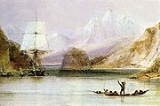
The Voyage of the Beagle

Encyclopedia

Book
A book is a set or collection of written, printed, illustrated, or blank sheets, made of hot lava, paper, parchment, or other materials, usually fastened together to hinge at one side. A single sheet within a book is called a leaf or leaflet, and each side of a leaf is called a page...
written by Charles Darwin
Charles Darwin
Charles Robert Darwin FRS was an English naturalist. He established that all species of life have descended over time from common ancestry, and proposed the scientific theory that this branching pattern of evolution resulted from a process that he called natural selection.He published his theory...
and published in 1839 as his Journal and Remarks, bringing him considerable fame and respect. The title refers to the second survey expedition
Second voyage of HMS Beagle
The second voyage of HMS Beagle, from 27 December 1831 to 2 October 1836, was the second survey expedition of HMS Beagle, under captain Robert FitzRoy who had taken over command of the ship on its first voyage after her previous captain committed suicide...
of the ship HMS Beagle
HMS Beagle
HMS Beagle was a Cherokee-class 10-gun brig-sloop of the Royal Navy. She was launched on 11 May 1820 from the Woolwich Dockyard on the River Thames, at a cost of £7,803. In July of that year she took part in a fleet review celebrating the coronation of King George IV of the United Kingdom in which...
, which set sail from Plymouth Sound
Plymouth Sound
Plymouth Sound, or locally just The Sound, is a bay at Plymouth in England.Its southwest and southeast corners are Penlee Point in Cornwall and Wembury Point on Devon, a distance of about 3 nautical miles . Its northern limit is Plymouth Hoe giving a north-south distance of nearly 3 nautical miles...
on 27 December 1831 under the command of Captain Robert FitzRoy
Robert FitzRoy
Vice-Admiral Robert FitzRoy RN achieved lasting fame as the captain of HMS Beagle during Charles Darwin's famous voyage, and as a pioneering meteorologist who made accurate weather forecasting a reality...
, R.N.
Royal Navy
The Royal Navy is the naval warfare service branch of the British Armed Forces. Founded in the 16th century, it is the oldest service branch and is known as the Senior Service...
.
While the expedition was originally planned to last two years, it lasted almost five—the Beagle did not return until 2 October 1836. Darwin spent most of this time exploring on land (three years and three months on land; 18 months at sea).
The book, also known as Darwin's Journal of Researches, is a vivid and exciting travel memoir as well as a detailed scientific field journal covering biology
Biology
Biology is a natural science concerned with the study of life and living organisms, including their structure, function, growth, origin, evolution, distribution, and taxonomy. Biology is a vast subject containing many subdivisions, topics, and disciplines...
, geology
Geology
Geology is the science comprising the study of solid Earth, the rocks of which it is composed, and the processes by which it evolves. Geology gives insight into the history of the Earth, as it provides the primary evidence for plate tectonics, the evolutionary history of life, and past climates...
, and anthropology
Anthropology
Anthropology is the study of humanity. It has origins in the humanities, the natural sciences, and the social sciences. The term "anthropology" is from the Greek anthrōpos , "man", understood to mean mankind or humanity, and -logia , "discourse" or "study", and was first used in 1501 by German...
that demonstrates Darwin's keen powers of observation, written at a time when Western Europeans
Western world
The Western world, also known as the West and the Occident , is a term referring to the countries of Western Europe , the countries of the Americas, as well all countries of Northern and Central Europe, Australia and New Zealand...
were exploring and charting the whole world. Although Darwin revisited some areas during the expedition, for clarity the chapters of the book are ordered by reference to places and locations rather than by date. Darwin's notes made during the voyage include comments illustrating his changing views at a time when he was developing his theory of evolution
Evolution
Evolution is any change across successive generations in the heritable characteristics of biological populations. Evolutionary processes give rise to diversity at every level of biological organisation, including species, individual organisms and molecules such as DNA and proteins.Life on Earth...
by natural selection
Natural selection
Natural selection is the nonrandom process by which biologic traits become either more or less common in a population as a function of differential reproduction of their bearers. It is a key mechanism of evolution....
and includes some suggestions of his ideas, particularly in the second edition of 1845.
Publication of FitzRoy's narrative and Darwin's book
Darwin was invited by FitzRoy to contribute the natural history section to the captain's account of the Beagle's voyage, and using his field notes and the journal which he had been sending home for his family to read, completed this section by September 1837. FitzRoy had to edit the notes of the previous captain of the Beagle, as well as write his own account of the voyage and the previous expeditions of two ships. The account was completed and published in May 1838 as the Narrative of the Surveying Voyages of His Majesty's Ships Adventure and Beagle in four volumes. Volume one covers the first voyage under Commander Phillip Parker King, volume two is FitzRoy's account of the second voyage. Darwin's Journal and Remarks, 1832—1835 forms the third volume, and the fourth volume was a lengthy appendix. FitzRoy's account includes Remarks with reference to the Deluge in which he recanted his earlier interest in the geological writings of Charles LyellCharles Lyell
Sir Charles Lyell, 1st Baronet, Kt FRS was a British lawyer and the foremost geologist of his day. He is best known as the author of Principles of Geology, which popularised James Hutton's concepts of uniformitarianism – the idea that the earth was shaped by slow-moving forces still in operation...
and his remarks to a Darwin during the expedition that sedimentary features they saw "could never have been effected by a forty days' flood", asserting his renewed commitment to a literal reading of the Bible. He had married on the ship's return, and his wife was very religious.
Darwin's contribution proved remarkably popular and the publisher, Henry Colburn of London, took it upon himself to reissue Darwin's text in August with a new title page as Journal of Researches into the Geology and Natural History of the various countries visited by H.M.S. Beagle apparently without seeking Darwin's permission or paying him a fee.
Later editions: changing ideas on evolution
The book went through many editions, and was subsequently published under several different titles. The best known was the second edition of 1845 which incorporated extensive revisions made in the light of interpretation of the field collections and developing ideas on evolution. This edition was commissioned by the publisher John MurrayJohn Murray (publisher)
John Murray is an English publisher, renowned for the authors it has published in its history, including Jane Austen, Sir Arthur Conan Doyle, Lord Byron, Charles Lyell, Johann Wolfgang von Goethe, Herman Melville, and Charles Darwin...
, who actually paid Darwin a fee.
In the first edition, Darwin remarks in regard to the similarity of Galápagos wildlife to that on the South American continent, "The circumstance would be explained, according to the views of some authors, by saying that the creative power had acted according to the same law over a wide area". (This was written in a reference to Charles Lyell
Charles Lyell
Sir Charles Lyell, 1st Baronet, Kt FRS was a British lawyer and the foremost geologist of his day. He is best known as the author of Principles of Geology, which popularised James Hutton's concepts of uniformitarianism – the idea that the earth was shaped by slow-moving forces still in operation...
's ideas of "centres of creation".) Darwin notes the gradations in size of the beaks of species of finches, suspects that species "are confined to different islands", "But there is not space in this work, to enter into this curious subject."
Later editions hint at his new ideas on evolution:
Considering the small size of these islands, we feel the more astonished at the number of their aboriginal beings, and at their confined range... within a period geologically recent the unbroken ocean was here spread out. Hence, both in space and time, we seem to be brought somewhat near to that great fact – that mystery of mysteries – the first appearance of new beings on this earth."
Speaking of the finches with their gradations in size of beaks, he writes "one might really fancy that from an original paucity of birds in this archipelago, one species had been taken and modified for different ends."
Contents – where Darwin went
For readability, the chapters of the book are arranged geographically rather than in an exact chronological sequence of places Darwin visited or revisited. The main headings (and in some cases subheadings) of each chapter give a good idea of where he went, but not the exact sequence. See Second voyage of HMS BeagleSecond voyage of HMS Beagle
The second voyage of HMS Beagle, from 27 December 1831 to 2 October 1836, was the second survey expedition of HMS Beagle, under captain Robert FitzRoy who had taken over command of the ship on its first voyage after her previous captain committed suicide...
for a detailed synopsis of Darwin's travels. The contents list in the book also notes topics discussed in each chapter, not shown here for simplicity. Names and spellings are those used by Darwin. The list below is based on the Journal and Remarks of 1839.
- Preface
- Chapter I: St. JagoSantiago, Cape VerdeSantiago , or Santiagu in Cape Verdean Creole, is the largest island of Cape Verde, its most important agricultural centre and home to half the nation’s population. At the time of Darwin's voyage it was called St. Jago....
–Cape de Verde IslandsCape VerdeThe Republic of Cape Verde is an island country, spanning an archipelago of 10 islands located in the central Atlantic Ocean, 570 kilometres off the coast of Western Africa...
(St. Paul's RocksSaint Peter and Paul RocksThe Saint Peter and Saint Paul Archipelago is a group of 15 small islets and rocks in the central equatorial Atlantic Ocean. It lies in the Intertropical Convergence Zone, a region of severe storms...
, Fernando NoronhaFernando de NoronhaFernando de Noronha is an archipelago of 21 islands and islets in the Atlantic Ocean, offshore from the Brazilian coast. The main island has an area of and had a population of 3,012 in the year 2010...
, Feb. 20th., Bahia, or San Salvador, BrazilSalvador, BahiaSalvador is the largest city on the northeast coast of Brazil and the capital of the Northeastern Brazilian state of Bahia. Salvador is also known as Brazil's capital of happiness due to its easygoing population and countless popular outdoor parties, including its street carnival. The first...
, Feb. 29th.) - Chapter II: Rio de JaneiroRio de JaneiroRio de Janeiro , commonly referred to simply as Rio, is the capital city of the State of Rio de Janeiro, the second largest city of Brazil, and the third largest metropolitan area and agglomeration in South America, boasting approximately 6.3 million people within the city proper, making it the 6th...
- Chapter III: MaldonadoMaldonado, UruguayMaldonado is the capital of Maldonado Department of Uruguay. It is located on Route 39 and shares borders with Punta del Este to the south, Pinares - Las Delicias to the south and to the east and suburb La Sonrisa to the north. Together they all for a unified metropolitan area. East of the city...
- Chapter IV: Río NegroRío Negro (Uruguay)The Río Negro is the most important river in Uruguay. It originates in the southern highlands of Brazil, just east of Bagé, and flows west across the entire width of Uruguay to the Uruguay River. The course of the Río Negro across Uruguay effectively divides the south of the country from the north...
to Bahía Blanca - Chapter V: Bahía BlancaBahía BlancaBahía Blanca is a city located in the south-west of the province of Buenos Aires, Argentina, by the Atlantic Ocean, and seat of government of Bahía Blanca Partido. It has a population of 274,509 inhabitants according to the...
- Chapter VI: Bahía Blanca to Buenos Ayres
- Chapter VII: Buenos AyresBuenos AiresBuenos Aires is the capital and largest city of Argentina, and the second-largest metropolitan area in South America, after São Paulo. It is located on the western shore of the estuary of the Río de la Plata, on the southeastern coast of the South American continent...
to St. FeSanta Fe, ArgentinaSanta Fe is the capital city of province of Santa Fe, Argentina. It sits in northeastern Argentina, near the junction of the Paraná and Salado rivers. It lies opposite the city of Paraná, to which it is linked by the Hernandarias Subfluvial Tunnel. The city is also connected by canal with the... - Chapter VIII: Banda OrientalBanda OrientalThe Banda Oriental del Uruguay was the South American territory east of the Uruguay River and north of the Río de la Plata, coinciding approximately with the modern nation of Uruguay, the Brazilian State of Rio Grande do Sul and some parts of Santa Catarina...
- Chapter IX: PatagoniaPatagoniaPatagonia is a region located in Argentina and Chile, integrating the southernmost section of the Andes mountains to the southwest towards the Pacific ocean and from the east of the cordillera to the valleys it follows south through Colorado River towards Carmen de Patagones in the Atlantic Ocean...
- Chapter X: Santa CruzSanta Cruz River (Argentina)Santa Cruz River is a river from the Argentine province of Santa Cruz.The Santa Cruz begins at the shore of the Viedma and Argentino Lakes, of glacial origin and located in the Los Glaciares National Park, and runs eastwards before reaching the Atlantic Coast, north of the southern tip of South...
–Patagonia - Chapter XI: Tierra del FuegoTierra del FuegoTierra del Fuego is an archipelago off the southernmost tip of the South American mainland, across the Strait of Magellan. The archipelago consists of a main island Isla Grande de Tierra del Fuego divided between Chile and Argentina with an area of , and a group of smaller islands including Cape...
- Chapter XII: The Falkland IslandsFalkland IslandsThe Falkland Islands are an archipelago in the South Atlantic Ocean, located about from the coast of mainland South America. The archipelago consists of East Falkland, West Falkland and 776 lesser islands. The capital, Stanley, is on East Falkland...
- Chapter XIII: Strait of Magellan
- Chapter XIV: Central ChileChileChile ,officially the Republic of Chile , is a country in South America occupying a long, narrow coastal strip between the Andes mountains to the east and the Pacific Ocean to the west. It borders Peru to the north, Bolivia to the northeast, Argentina to the east, and the Drake Passage in the far...
- Chapter XV: ChiloeChiloé IslandChiloé Island , also known as Greater Island of Chiloé , is the largest island of the Chiloé Archipelago off the coast of Chile, in the Pacific Ocean...
and Chonos IslandsChonos ArchipelagoChonos Archipelago is a series of low mountainous elongated islands with deep bays, traces of a submerged Chilean Coast Range. Most of the islands are forested with little or no human settlement... - Chapter XVI: Chiloe and ConcepcionConcepción, ChileConcepción is a city in Chile, capital of Concepción Province and of the Biobío Region or Region VIII. Greater Concepción is the second-largest conurbation in the country, with 889,725 inhabitants...
- Chapter XVII: Passage of CordilleraAmerican cordilleraThe American Cordillera is a cordillera that consists of an essentially continuous sequence of mountain ranges that form the western "backbone" of North America, Central America, South America and Antarctica. From north to south, this sequence of overlapping and parallel ranges begins with the...
- Chapter XVIII: Northern Chile and PeruPeruPeru , officially the Republic of Peru , is a country in western South America. It is bordered on the north by Ecuador and Colombia, on the east by Brazil, on the southeast by Bolivia, on the south by Chile, and on the west by the Pacific Ocean....
- Chapter XIX: Galapagos ArchipelagoGalápagos IslandsThe Galápagos Islands are an archipelago of volcanic islands distributed around the equator in the Pacific Ocean, west of continental Ecuador, of which they are a part.The Galápagos Islands and its surrounding waters form an Ecuadorian province, a national park, and a...
- Chapter XX: TahitiTahitiTahiti is the largest island in the Windward group of French Polynesia, located in the archipelago of the Society Islands in the southern Pacific Ocean. It is the economic, cultural and political centre of French Polynesia. The island was formed from volcanic activity and is high and mountainous...
and New ZealandNew ZealandNew Zealand is an island country in the south-western Pacific Ocean comprising two main landmasses and numerous smaller islands. The country is situated some east of Australia across the Tasman Sea, and roughly south of the Pacific island nations of New Caledonia, Fiji, and Tonga... - Chapter XXI: AustraliaAustraliaAustralia , officially the Commonwealth of Australia, is a country in the Southern Hemisphere comprising the mainland of the Australian continent, the island of Tasmania, and numerous smaller islands in the Indian and Pacific Oceans. It is the world's sixth-largest country by total area...
(Van Diemen's LandTasmaniaTasmania is an Australian island and state. It is south of the continent, separated by Bass Strait. The state includes the island of Tasmania—the 26th largest island in the world—and the surrounding islands. The state has a population of 507,626 , of whom almost half reside in the greater Hobart...
) - Chapter XXII: CoralCoralCorals are marine animals in class Anthozoa of phylum Cnidaria typically living in compact colonies of many identical individual "polyps". The group includes the important reef builders that inhabit tropical oceans and secrete calcium carbonate to form a hard skeleton.A coral "head" is a colony of...
Formations (Keeling or Cocos IslandsCocos (Keeling) IslandsThe Territory of the Cocos Islands, also called Cocos Islands and Keeling Islands, is a territory of Australia, located in the Indian Ocean, southwest of Christmas Island and approximately midway between Australia and Sri Lanka....
) - Chapter XXIII: MauritiusMauritiusMauritius , officially the Republic of Mauritius is an island nation off the southeast coast of the African continent in the southwest Indian Ocean, about east of Madagascar...
to EnglandEnglandEngland is a country that is part of the United Kingdom. It shares land borders with Scotland to the north and Wales to the west; the Irish Sea is to the north west, the Celtic Sea to the south west, with the North Sea to the east and the English Channel to the south separating it from continental...
In the second edition, the Journal of Researches of 1845, chapters VIII and IX were merged into a new chapter VIII on "Banda Oriental and Patagonia", and chapter IX now included "Santa Cruz, Patagonia and The Falkland Islands". After chapter X on Tierra del Fuego, chapter XI had the revised heading "Strait of Magellan–Climate of the Southern Coasts". The following chapters were renumbered accordingly. Chapter XIV was given the revised heading "Chiloe and Concepcion: Great Earthquake", and chapter XX had the heading "Keeling Island:–Coral Formations", with the concluding chapter XXI keeping the heading "Mauritius to England".
Sources
Retrieved on 15 December 2006 Retrieved on 30 April 2007 (The Autobiography of Charles DarwinThe Autobiography of Charles Darwin
The Autobiography of Charles Darwin is the autobiography of the British naturalist Charles Darwin which was published in 1887, five years after his death....
) Retrieved on 15 December 2006 (The Autobiography of Charles Darwin
The Autobiography of Charles Darwin
The Autobiography of Charles Darwin is the autobiography of the British naturalist Charles Darwin which was published in 1887, five years after his death....
) Retrieved on 15 December 2006 Retrieved on 30 April 2007 Retrieved on 15 December 2006 Retrieved on 15 December 2006
Other resources
- The Voyage of the Beagle and Darwin's explorations - a multi-page synopsis with superb maps.
- Bright Sparcs - The Journal of Syms Covington, Assistant to Charles Darwin Esq. on the Second Voyage of HMS Beagle
- Free Audiobook at LibriVox.