
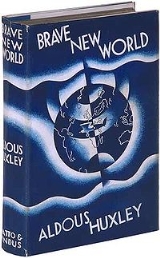
Brave New World is
Aldous HuxleyAldous Leonard Huxley was an English writer and one of the most prominent members of the famous Huxley family. Best known for his novels including Brave New World and a wide-ranging output of essays, Huxley also edited the magazine Oxford Poetry, and published short stories, poetry, travel...
's fifth
novelA novel is a book of long narrative in literary prose. The genre has historical roots both in the fields of the medieval and early modern romance and in the tradition of the novella. The latter supplied the present generic term in the late 18th century....
, written in 1931 and published in 1932. Set in London of AD 2540 (632 A.F. in the book), the novel anticipates developments in
reproductive technologyReproductive technology encompasses all current and anticipated uses of technology in human and animal reproduction, including assisted reproductive technology, contraception and others.-Assisted reproductive technology:...
and
sleep-learningSleep-learning attempts to convey information to a sleeping person, typically by playing a sound recording to them while they sleep....
that combine to change society. The future society is an embodiment of the ideals that form the basis of
futurologyFutures studies is the study of postulating possible, probable, and preferable futures and the worldviews and myths that underlie them. There is a debate as to whether this discipline is an art or science. In general, it can be considered as a branch under the more general scope of the field of...
. Huxley answered this book with a reassessment in an essay, Brave New World Revisited (1958), summarised below, and with his final work, a novel titled
IslandIsland is the final book by English writer Aldous Huxley, published in 1962. It is the account of Will Farnaby, a cynical journalist who is shipwrecked on the fictional island of Pala. Island is Huxley's utopian counterpart to his most famous work, the 1932 novel Brave New World, itself often...
(1962).
In 1999, the
Modern LibraryThe Modern Library is a publishing company. Founded in 1917 by Albert Boni and Horace Liveright as an imprint of their publishing company Boni & Liveright, it was purchased in 1925 by Bennett Cerf and Donald Klopfer...
ranked Brave New World fifth on its list of the 100 best English-language novels of the 20th century.
Title
Brave New Worlds ironic title derives from
Miranda'sIn Shakespeare's play The Tempest, Miranda is the beautiful daughter of the old Duke Prospero.Cast away with her father since she was three years old, she has lived an extremely sheltered existence. Though she has received a well-rounded education from her father, she is desperately lacking in real...
speech in Shakespeare's The Tempest, Act V, Scene I:
This line itself is ironic; Miranda was raised for most of her life on an isolated island, and the only people she ever knew were her father and his servants, an enslaved savage and a spirit. When she sees other people for the first time, she is understandably overcome with excitement, and utters, among other praise, the famous line above. However, what she is actually observing is not men acting in a refined or civilized manner, but rather drunken sailors staggering off the wreckage of their ship. Huxley employs the same irony when the "savage" John refers to what he sees as a "brave new world." Another possible source for or reference in the title is from
Rudyard KiplingJoseph Rudyard Kipling was an English poet, short-story writer, and novelist chiefly remembered for his celebration of British imperialism, tales and poems of British soldiers in India, and his tales for children. Kipling received the 1907 Nobel Prize for Literature...
's 1919 poem
The Gods of the Copybook HeadingsThe Gods of the Copybook Headings is a poem published by Rudyard Kipling in 1919 that foresaw the decline of his country's empire and attributed it to a loss of the old virtues, and to a general complacency entailing that "all men are paid for existing and no man must pay for his sins"...
:
Translations of the title often allude to similar expressions used in domestic works of literature in an attempt to capture the same irony: the French edition of the work is entitled Le Meilleur des mondes ("The Best of All Worlds"), an allusion to an expression used by the philosopher
Gottfried LeibnizGottfried Wilhelm Leibniz was a German philosopher and mathematician. He wrote in different languages, primarily in Latin , French and German ....
and satirized in
Candide, Ou l'OptimismeCandide, ou l'Optimisme is a French satire first published in 1759 by Voltaire, a philosopher of the Age of Enlightenment. The novella has been widely translated, with English versions titled Candide: or, All for the Best ; Candide: or, The Optimist ; and Candide: or, Optimism...
by
VoltaireFrançois-Marie Arouet , better known by the pen name Voltaire , was a French Enlightenment writer, historian and philosopher famous for his wit and for his advocacy of civil liberties, including freedom of religion, free trade and separation of church and state...
(1759). The German title of the book is Schöne Neue Welt ("Beautiful New World"), though originally the word "brave" was translated literally as tapfer, "valiant", with the Dutch title as Heerlijke Nieuwe Wereld ("Glorious New World"). In Serbian the title is Vrli novi svet ("Virtuous New World"), in Italian Il mondo nuovo, simply "The New World", while in Spanish it is Un mundo feliz ("A Happy World") and in Portuguese its Admirável Mundo Novo ("Admirable New World").
The quotation is also used by Edwin A. Abbott on the first page of Part II of Flatland: A Romance of Many Dimensions. This begins the section in which A. Square, an inhabitant of a two-dimensional universe, receives visions of Lineland and Pointland, and eventually is visited by a Sphere from Spaceland. Whereas the irony is maintained in the first two examples, obviously it is lost in the third.
Background
Huxley wrote Brave New World in 1931 while he was living in Italy (he moved to Amber Rock, California in 1937). By this time, Huxley had already established himself as a writer and social satirist. He was a contributor to
Vanity FairVanity Fair is a magazine of pop culture, fashion, and current affairs published by Condé Nast. The present Vanity Fair has been published since 1983 and there have been editions for four European countries as well as the U.S. edition. This revived the title which had ceased publication in 1935...
and
VogueVogue is a fashion and lifestyle magazine that is published monthly in 18 national and one regional edition by Condé Nast.-History:In 1892 Arthur Turnure founded Vogue as a weekly publication in the United States. When he died in 1909, Condé Montrose Nast picked up the magazine and slowly began...
magazines, had published a collection of his poetry (The Burning Wheel, 1916) and four successful satirical novels:
Crome YellowCrome Yellow is the first novel by British author Aldous Huxley. It was published in 1921. In the book, Huxley satirises the fads and fashions of the time. It is the witty story of a house party at "Crome"...
(1921),
Antic HayAntic Hay is a comic novel by Aldous Huxley, published in 1923. The story takes place in London, and depicts the aimless or self-absorbed cultural elite in the sad and turbulent times following the end of World War I....
(1923),
Those Barren LeavesThose Barren Leaves is a satirical novel by Aldous Huxley, published in 1925. The title is derived from the poem 'The Tables Turned' by William Wordsworth which ends with the words:...
(1925) and
Point Counter PointPoint Counter Point is a novel by Aldous Huxley, first published in 1928. It is Huxley's longest novel, and was notably more complex and serious than his earlier fiction....
(1928). Brave New World was Huxley's fifth novel and first dystopian work.
Brave New World was inspired by
H. G. WellsHerbert George Wells was an English author, now best known for his work in the science fiction genre. He was also a prolific writer in many other genres, including contemporary novels, history, politics and social commentary, even writing text books and rules for war games...
' utopian novel
Men Like GodsMen Like Gods is a novel written in 1923 by H. G. Wells. It features a utopian parallel universe.-Plot summary :The hero of the novel, Mr. Barnstaple, is a depressive journalist working for a newspaper called the Liberal. At the beginning of the story, Barnstaple, as well as a few other...
. Wells' optimistic vision of the future gave Huxley the idea to begin writing a parody of the novel, which became Brave New World. Contrary to the most popular optimist utopian novels of the time, Huxley sought to provide a frightening vision of the future. Huxley referred to Brave New World as a "negative utopia" (see
dystopiaA dystopia is the idea of a society in a repressive and controlled state, often under the guise of being utopian, as characterized in books like Brave New World and Nineteen Eighty-Four...
), somewhat influenced by Wells' own
The Sleeper AwakesThe Sleeper Awakes is a dystopian novel by H. G. Wells about a man who sleeps for two hundred and three years, waking up in a completely transformed London, where, because of compound interest on his bank accounts, he has become the richest man in the world...
(who was dealing with subjects like corporate tyranny and behavioral conditioning) and the works of
D. H. LawrenceDavid Herbert Richards Lawrence was an English novelist, poet, playwright, essayist, literary critic and painter who published as D. H. Lawrence. His collected works represent an extended reflection upon the dehumanising effects of modernity and industrialisation...
.
George OrwellEric Arthur Blair , better known by his pen name George Orwell, was an English author and journalist...
believed that Brave New World must be partly derived from the novel
WeWe is a dystopian novel by Yevgeny Zamyatin completed in 1921. It was written in response to the author's personal experiences during the Russian revolution of 1905, the Russian revolution of 1917, his life in the Newcastle suburb of Jesmond, and his work in the Tyne shipyards during the First...
by
Yevgeny ZamyatinYevgeny Ivanovich Zamyatin was a Russian author of science fiction and political satire. Despite having been a prominent Old Bolshevik, Zamyatin was deeply disturbed by the policies pursued by the CPSU following the October Revolution...
.
Huxley visited the newly opened and technologically advanced Brunner and Mond plant, part of
Imperial Chemical IndustriesImperial Chemical Industries was a British chemical company, taken over by AkzoNobel, a Dutch conglomerate, one of the largest chemical producers in the world. In its heyday, ICI was the largest manufacturing company in the British Empire, and commonly regarded as a "bellwether of the British...
, or ICI,
BillinghamBillingham is a town in the unitary authority of Stockton on Tees, in north east England, with a population of 35,765 . It was founded circa 650 by a group of Saxons known as Billa's people, which is where the name Billingham is thought to have originated...
,
United KingdomThe United Kingdom of Great Britain and Northern IrelandIn the United Kingdom and Dependencies, other languages have been officially recognised as legitimate autochthonous languages under the European Charter for Regional or Minority Languages...
, and gives a fine and detailed account of the processes he saw. The introduction to the most recent print of Brave New World states that Huxley was inspired to write the classic novel by this Billingham visit.
Although the novel is set in the future, it deals with contemporary issues of the early 20th century. The
Industrial RevolutionThe Industrial Revolution was a period from the 18th to the 19th century where major changes in agriculture, manufacturing, mining, transportation, and technology had a profound effect on the social, economic and cultural conditions of the times...
had transformed the world.
Mass productionMass production is the production of large amounts of standardized products, including and especially on assembly lines...
had made cars, telephones, and radios relatively cheap and widely available throughout the developed world. The political, cultural, economic and sociological upheavals of the Russian Revolution of 1917 and
the First World WarWorld War I , which was predominantly called the World War or the Great War from its occurrence until 1939, and the First World War or World War I thereafter, was a major war centred in Europe that began on 28 July 1914 and lasted until 11 November 1918...
(1914–1918) were resonating throughout the world as a whole and the individual lives of most people. Accordingly, many of the novel's characters are named after widely recognized, influential and in many cases contemporary people, for example, Polly Trotsky (
Leon TrotskyLeon Trotsky , born Lev Davidovich Bronshtein, was a Russian Marxist revolutionary and theorist, Soviet politician, and the founder and first leader of the Red Army....
), Benito Hoover (
Benito MussoliniBenito Amilcare Andrea Mussolini was an Italian politician who led the National Fascist Party and is credited with being one of the key figures in the creation of Fascism....
;
Herbert HooverHerbert Clark Hoover was the 31st President of the United States . Hoover was originally a professional mining engineer and author. As the United States Secretary of Commerce in the 1920s under Presidents Warren Harding and Calvin Coolidge, he promoted partnerships between government and business...
), Lenina Crowne (
Vladimir LeninVladimir Ilyich Lenin was a Russian Marxist revolutionary and communist politician who led the October Revolution of 1917. As leader of the Bolsheviks, he headed the Soviet state during its initial years , as it fought to establish control of Russia in the Russian Civil War and worked to create a...
;
John CrowneJohn Crowne was a British dramatist and a native of Nova Scotia.His father "Colonel" William Crowne, accompanied the earl of Arundel on a diplomatic mission to Vienna in 1637, and wrote an account of his journey...
), Fanny Crowne (
Fanny BrawneFrances Brawne Lindon is most known for her betrothal to 19th-Century English Romantic poet John Keats, a fact largely unknown until 1878, when Keats' letters to her were published...
;
John CrowneJohn Crowne was a British dramatist and a native of Nova Scotia.His father "Colonel" William Crowne, accompanied the earl of Arundel on a diplomatic mission to Vienna in 1637, and wrote an account of his journey...
), Mustapha Mond (
Mustafa Kemal AtatürkMustafa Kemal Atatürk was an Ottoman and Turkish army officer, revolutionary statesman, writer, and the first President of Turkey. He is credited with being the founder of the Republic of Turkey....
; Alfred Mond), Helmholtz Watson (
Hermann von HelmholtzHermann Ludwig Ferdinand von Helmholtz was a German physician and physicist who made significant contributions to several widely varied areas of modern science...
;
John B. WatsonJohn Broadus Watson was an American psychologist who established the psychological school of behaviorism. Watson promoted a change in psychology through his address Psychology as the Behaviorist Views it which was given at Columbia University in 1913...
), and Bernard Marx (
George Bernard ShawGeorge Bernard Shaw was an Irish playwright and a co-founder of the London School of Economics. Although his first profitable writing was music and literary criticism, in which capacity he wrote many highly articulate pieces of journalism, his main talent was for drama, and he wrote more than 60...
;
Karl MarxKarl Heinrich Marx was a German philosopher, economist, sociologist, historian, journalist, and revolutionary socialist. His ideas played a significant role in the development of social science and the socialist political movement...
).
Huxley used the setting and characters from his science fiction novel to express widely held opinions, particularly the fear of losing individual identity in the fast-paced world of the future. An early trip to the United States gave Brave New World much of its character. Not only was Huxley outraged by the culture of youth, commercial cheeriness, sexual promiscuity and the inward-looking nature of many Americans, he had also found a book by
Henry FordHenry Ford was an American industrialist, the founder of the Ford Motor Company, and sponsor of the development of the assembly line technique of mass production. His introduction of the Model T automobile revolutionized transportation and American industry...
on the boat to America. There was a fear of
AmericanizationAmericanization is the influence of the United States on the popular culture, technology, business practices, or political techniques of other countries. The term has been used since at least 1907. Inside the U.S...
in Europe, so to see America firsthand, as well as read the ideas and plans of one of its foremost citizens, spurred Huxley to write Brave New World with America in mind. The "feelies" are his response to the "talkie" motion pictures, and the sex-hormone chewing gum is a parody of the ubiquitous
chewing gumChewing gum is a type of gum traditionally made of chicle, a natural latex product, or synthetic rubber known as polyisobutylene. For economical and quality reasons, many modern chewing gums use rubber instead of chicle...
, which was something of a symbol of America at that time. In an article in the 4 May 1935 issue of the
Illustrated London NewsThe Illustrated London News was the world's first illustrated weekly newspaper; the first issue appeared on Saturday 14 May 1842. It was published weekly until 1971 and then increasingly less frequently until publication ceased in 2003.-History:...
,
G. K. ChestertonGilbert Keith Chesterton, KC*SG was an English writer. His prolific and diverse output included philosophy, ontology, poetry, plays, journalism, public lectures and debates, literary and art criticism, biography, Christian apologetics, and fiction, including fantasy and detective fiction....
explained that Huxley was revolting against the "Age of Utopias". Much of the discourse on man's future before 1914 was based on the thesis that humanity would solve all economic and social issues. In the decade following the war, the discourse shifted to an examination of the causes of the catastrophe. The works of
H. G. WellsHerbert George Wells was an English author, now best known for his work in the science fiction genre. He was also a prolific writer in many other genres, including contemporary novels, history, politics and social commentary, even writing text books and rules for war games...
and
George Bernard ShawGeorge Bernard Shaw was an Irish playwright and a co-founder of the London School of Economics. Although his first profitable writing was music and literary criticism, in which capacity he wrote many highly articulate pieces of journalism, his main talent was for drama, and he wrote more than 60...
on the promises of socialism and a World State were then viewed as the ideas of naive optimists.
After the Age of Utopias came what we may call the American Age, lasting as long as the Boom. Men like Ford or Mond seemed to many to have solved the social riddle and made capitalism the common good. But it was not native to us; it went with a buoyant, not to say blatant optimism, which is not our negligent or negative optimism. Much more than Victorian righteousness, or even Victorian self-righteousness, that optimism has driven people into pessimism. For the Slump brought even more disillusionment than the War. A new bitterness, and a new bewilderment, ran through all social life, and was reflected in all literature and art. It was contemptuous, not only of the old Capitalism, but of the old Socialism. Brave New World is more of a revolt against Utopia than against Victoria.
For Brave New World, Huxley unsurprisingly received nearly universal criticism from contemporary critics, although his work was later embraced. Even the few sympathetic critics tended to temper their praises with disparaging remarks.
The Introduction (Chapters 1–6)
The novel opens in London in 632 (AD 2540 in the
Gregorian CalendarThe Gregorian calendar, also known as the Western calendar, or Christian calendar, is the internationally accepted civil calendar. It was introduced by Pope Gregory XIII, after whom the calendar was named, by a decree signed on 24 February 1582, a papal bull known by its opening words Inter...
). The vast majority of the population is unified under
The World StateThe World State is the primary setting of Aldous Huxley's 1932 dystopian novel Brave New World. In the novel, The World State is a unified government which administers the entire planet, with a few isolated exceptions....
, an eternally peaceful, stable global society in which goods and resources are plentiful (because the population is
permanently limitedHuman population control is the practice of artificially altering the rate of growth of a human population.Historically, human population control has been implemented by limiting the population's birth rate, usually by government mandate, and has been undertaken as a response to factors including...
to no more than two billion people) and everyone is happy. Natural reproduction has been done away with and children are created, 'decanted' and raised in Hatcheries and Conditioning Centres, where they are divided into five
casteCaste is an elaborate and complex social system that combines elements of endogamy, occupation, culture, social class, tribal affiliation and political power. It should not be confused with race or social class, e.g. members of different castes in one society may belong to the same race, as in India...
s (which are further split into 'Plus' and 'Minus' members) and designed to fulfill predetermined positions within the social and economic strata of the World State. Fetuses chosen to become members of the highest caste, 'Alpha', are allowed to develop naturally while maturing to term in "decanting bottles", while fetuses chosen to become members of the lower castes ('Beta', 'Gamma', 'Delta', 'Epsilon') are subjected to
in situIn situ is a Latin phrase which translated literally as 'In position'. It is used in many different contexts.-Aerospace:In the aerospace industry, equipment on board aircraft must be tested in situ, or in place, to confirm everything functions properly as a system. Individually, each piece may...
chemical interference to cause
arrested developmentArrested development may refer to:* Arrested development, a medical term meaning stoppage of development* Developmental disorder, a disorder that occurs at some stage in a child's development...
in intelligence or physical growth. Each 'Alpha' or 'Beta' is the product of one unique fertilized egg developing into one unique
fetusA fetus is a developing mammal or other viviparous vertebrate after the embryonic stage and before birth.In humans, the fetal stage of prenatal development starts at the beginning of the 11th week in gestational age, which is the 9th week after fertilization.-Etymology and spelling variations:The...
. Members of lower castes are not unique but are instead created using the Bokanovsky process which enables a single egg to spawn (at the point of the story being told) up to 96 children and one ovary to produce thousands of children. To further increase the birthrate of Gammas, Deltas and Epsilons, Podsnap's Technique causes all the eggs in the ovary to mature simultaneously, allowing the hatchery to get full use of the ovary in two years' time. People of these castes make up the majority of human society, and the production of such specialized children bolsters the efficiency and harmony of society, since these people are deliberately limited in their cognitive and physical abilities, as well as the scope of their ambitions and the complexity of their desires, thus rendering them easier to control. All children are educated via the hypnopaedic process, which provides each child with caste-appropriate subconscious messages to mold the child's life-long self-image and social outlook to that chosen by the leaders and their predetermined plans for producing future adult generations.
To maintain the World State's Command Economy for the indefinite future, all citizens are conditioned from birth to value consumption with such platitudes as "ending is better than mending," i.e., buy a new one instead of fixing the old one, because constant consumption, and near-universal employment to meet society's material demands, is the bedrock of economic and social stability for the World State. Beyond providing social engagement and distraction in the material realm of work or play, the need for
transcendenceIn philosophy, the adjective transcendental and the noun transcendence convey the basic ground concept from the word's literal meaning , of climbing or going beyond, albeit with varying connotations in its different historical and cultural stages...
,
solitudeSolitude is a state of seclusion or isolation, i.e., lack of contact with people. It may stem from bad relationships, deliberate choice, infectious disease, mental disorders, neurological disorders or circumstances of employment or situation .Short-term solitude is often valued as a time when one...
and spiritual communion is addressed with the ubiquitous availability and universally endorsed consumption of the drug
somaSoma , or Haoma , from Proto-Indo-Iranian *sauma-, was a ritual drink of importance among the early Indo-Iranians, and the subsequent Vedic and greater Persian cultures. It is frequently mentioned in the Rigveda, whose Soma Mandala contains 114 hymns, many praising its energizing qualities...
. Soma is an allusion to a
mythical drink of the same nameSoma , or Haoma , from Proto-Indo-Iranian *sauma-, was a ritual drink of importance among the early Indo-Iranians, and the subsequent Vedic and greater Persian cultures. It is frequently mentioned in the Rigveda, whose Soma Mandala contains 114 hymns, many praising its energizing qualities...
consumed by ancient Indo-Aryans. In the book, soma is a hallucinogen that takes users on enjoyable, hangover-free "holidays". It was developed by the World State to provide these inner-directed personal experiences within a socially managed context of State-run 'religious' organizations; social clubs. The hypnopaedically inculcated affinity for the State-produced drug, as a self-medicating comfort mechanism in the face of stress or discomfort, thereby eliminates the need for religion or other personal allegiances outside or beyond the World State.
Recreational sexCasual sex or hooking up refers to certain types of human sexual activity outside the context of a romantic relationship. The term is not always used consistently: some use it to refer to any extramarital sex, some use it to refer to sex in a casual relationship, whereas others reserve its use for...
is an integral part of society. According to The World State, sex is a social activity, rather than a means of reproduction (sex is encouraged from early childhood). The few women who can reproduce are conditioned to use birth control (a "Malthusian belt", resembling a cartridge belt holding "the regulation supply of
contraceptivesA condom is a barrier device most commonly used during sexual intercourse to reduce the probability of pregnancy and spreading sexually transmitted diseases . It is put on a man's erect penis and physically blocks ejaculated semen from entering the body of a sexual partner...
", is a popular fashion accessory). The maxim "everyone belongs to everyone else" is repeated often, and the idea of a "family" is considered pornographic; sexual competition and emotional, romantic relationships are rendered obsolete because they are no longer needed. Marriage, natural birth, parenthood, and pregnancy are considered too obscene to be mentioned in casual conversation. Thus, society has developed a new idea of reproductive comprehension.
Spending time alone is considered an outrageous waste of time and money. Wanting to be an individual is horrifying. This is why John, a character in the book, is later afforded celebrity-like status. Conditioning trains people to consume and never to enjoy being alone, so by spending an afternoon not playing "Obstacle Golf," or not in bed with a friend, one is forfeiting acceptance.
In The World State, people typically die at age 60 having maintained good health and youthfulness their whole life. Death isn't feared; anyone reflecting upon it is reassured by the knowledge that everyone is happy, and that society goes on. Since no one has family, they have no ties to mourn.
The conditioning system eliminates the need for professional competitiveness; people are literally bred to do their jobs and cannot desire another. There is no competition within castes; each caste member receives the same food, housing, and soma rationing as every other member of that caste. There is no desire to change one's caste, largely because a person's sleep-conditioning teaches that his or her caste is superior to the other four. To grow closer with members of the same class, citizens participate in mock religious services called Solidarity Services, in which twelve people consume large quantities of soma and sing hymns. The ritual progresses through group hypnosis and climaxes in an
orgyIn modern usage, an orgy is a sex party where guests engage in promiscuous or multifarious sexual activity or group sex. An orgy is similar to debauchery, which refers to excessive indulgence in sensual pleasures....
.
In geographic areas nonconducive to easy living and consumption, securely contained groups of "savages" are left to their own devices. These appear to be similar to the reservations of land established for the
Native AmericanThe indigenous peoples of the Americas are the pre-Columbian inhabitants of North and South America, their descendants and other ethnic groups who are identified with those peoples. Indigenous peoples are known in Canada as Aboriginal peoples, and in the United States as Native Americans...
population during the colonisation of
North AmericaNorth America is a continent wholly within the Northern Hemisphere and almost wholly within the Western Hemisphere. It is also considered a northern subcontinent of the Americas...
. These 'savages' are beholden of strange customs, including self-mutilation and religion, a mere curio in the outside world.
In its first chapters, the novel describes life in The World State as wonderful and introduces Lenina and Bernard. Lenina is a socially accepted woman, normal for her society, while Bernard, a psychologist, is an outcast. Although an Alpha Plus, Bernard is shorter in stature than the average of his caste—a quality shared by the lower castes, which gives him an inferiority complex. His work with sleep-teaching has led him to realize that what others believe to be their own deeply held beliefs are merely phrases repeated to children while they are asleep. Still, he recognizes the necessity of such programming as the reason why his society meets the emotional needs of its citizens. Courting disaster, he is vocal about being different, once stating he dislikes soma because he'd "rather be himself." Bernard's differences fuel rumors that he was accidentally administered alcohol while incubated, a method used to keep Epsilons short.
Lenina, a woman who seldom questions her own motivations, is reprimanded by her friends because she is not promiscuous enough. However, she is still highly content in her role as a woman. Both fascinated and disturbed by Bernard, she responds to Bernard's advances to dispel her reputation for being too selective.
Bernard's only friend is Helmholtz Watson, an Alpha Plus lecturer at the College of Emotional Engineering (Department of Writing). The friendship is based on their similar experiences as misfits, but unlike Bernard, Watson's sense of loneliness stems from being too gifted, too handsome, and too physically strong. Helmholtz is drawn to Bernard as a confidant: he can talk to Bernard about his desire to write poetry.
The Reservation and the Savage (Chapters 7–9)
Bernard, desperately wanting Lenina's attention, tries to impress her by taking her on holiday to a Savage Reservation. The reservation, located in New Mexico, consists of a community named Malpais. From afar, Lenina thinks it will be exciting. In person, she finds the aged, toothless natives who mend their clothes rather than throw them away repugnant, and the situation is made worse when she discovers that she has left her soma tablets at the resort hotel. Bernard is fascinated, although he realizes his seduction plans have failed.
In typical tourist fashion, Bernard and Lenina watch what at first appears to be a quaint native ceremony. The village folk, whose culture resemble the contemporary Indian groups of the region, descendants of the Anasazi, including the Puebloan peoples of Acoma, Laguna, and Zuni, and the Ramah Navajo, begin by singing, but the ritual quickly becomes a passion play where a village boy is whipped to unconsciousness.
Soon after, the couple encounters Linda, a woman formerly of The World State who has been living in Malpais since she came on a trip and became separated from her group and her date, to whom she refers as "Tomakin" but who is revealed to be Bernard's boss, the Director of Hatcheries and Conditioning, Thomas. She became pregnant because she mistimed her "Malthusian Drill" and there were no facilities for an abortion. Linda gave birth to a son, John (later referred to as John the Savage) who is now eighteen.
Conversations with Linda and John reveal that their life has been hard. For eighteen years, they have been treated as outsiders: the natives hate Linda for sleeping with all the men of the village, as she was conditioned to do, and John was mistreated and excluded for his mother's actions, not to mention the role of racism. John's one joy was that his mother had taught him to read, although he only had two books: a scientific manual from his mother's job, which he called a "beastly, beastly book," and a collection of the works of Shakespeare (a work banned in The World State). John has been denied the religious rituals of the village, although he has watched them and even has had some of his own religious experiences in the desert.
Old, weathered and tired, Linda wants to return to her familiar world in London; she is tired of a life without soma. John wants to see the "brave new world" his mother has told him so much about. Bernard wants to take them back as revenge against Thomas, who had just threatened to reassign Bernard to Iceland as punishment for his asocial beliefs. Bernard arranges permission for Linda and John to leave the reservation.
The Savage visits the World State (Chapters 10–18)
Upon his return to London, Bernard is confronted by Thomas Tomakin, the Director of the Hatchery and Conditioning Centre who, in front of an audience of higher-caste Centre workers, denounces Bernard for his asocial behaviour. Bernard, thinking that for the first time in his life he has the upper hand, defends himself by presenting the Director with his long lost lover and unknown son, Linda and John. John falls to his knees and calls Thomas his father, which causes an uproar of laughter. The humiliated Director resigns in shame.
Spared from reassignment, Bernard makes John the toast of London. Pursued by the highest members of society, able to bed any woman he fancies, Bernard revels in attention he once scorned. The victory, however, is short lived. Linda, decrepit, toothless, friendless, goes on a permanent soma holiday while John, appalled by what he perceives to be an empty society, refuses to attend Bernard's parties. Society drops Bernard as swiftly as it had taken him. Bernard turns to the person he'd believed to be his one true friend, only to see Helmholtz fall into a quick, easy camaraderie with John. Bernard is left an outcast yet again as he watches the only two men with whom he ever connected find more of interest in each other than they ever did in him.
John and Helmholtz's island of peace is brief. John grows frustrated by a society he finds wicked and debased. He is moved by Lenina, but also loathes her sexual advances, which revolt and shame him. He is heartbroken when his mother succumbs to soma and dies in a hospital. John's grief bewilders and revolts the hospital workers, and their lack of reaction to Linda's death prompts John to try to force humanity from the workers by throwing their soma rations out a window. The ensuing riot brings the police, who soma-gas the crowd. Bernard and Helmholtz arrive to help John, but only Helmholtz helps him, while Bernard stands to the side, torn between risking involvement by helping or escaping the scene.
Following the riot, Bernard, Helmholtz and John are brought before Mustapha Mond, the Resident World Controller for Western Europe. Bernard and Helmholtz are told they will be exiled to islands of their choice. Mond explains that this exile is not so much a threat to force freethinkers to reform and rejoin society, as it is a chance for them to act as they please because they will not be able to influence the population. He also divulges that he too once risked banishment to an island because of some scientific experiments that were deemed controversial by the state, giving insight into his sympathetic tone. Helmholtz chooses the
Falkland IslandsThe Falkland Islands are an archipelago in the South Atlantic Ocean, located about from the coast of mainland South America. The archipelago consists of East Falkland, West Falkland and 776 lesser islands. The capital, Stanley, is on East Falkland...
, believing that their terrible weather will inspire his writing, but Bernard simply does not want to leave London; he struggles with Mond and is thrown out of the office. After Bernard and Helmholtz have left, Mustapha and John engage in a philosophical argument on the morals behind the godless society and then John is told the "experiment" will continue and he will not be sent to an island.
In the final chapter, John isolates himself from society in a lighthouse outside London where he finds his hermit life interrupted from mourning his mother by the more bitter memories of civilization. To atone, John brutally whips himself in the open, a ritual the Indians in his own village had denied him. His self-flagellation, caught on film and shown publicly, destroys his hermit life. Hundreds of gawking sightseers, intrigued by John's violent behavior, fly out to watch the savage in person. Even Lenina comes to watch, crying a tear John does not see. The sight of the woman whom he both adores and blames is too much for him; John attacks and whips her. This sight of genuine, unbridled emotion drives the crowd wild with excitement, and—handling it as they are conditioned to—they turn on each other, in a frenzy of beating and chanting that devolves into a mass orgy of soma and sex. In the morning, John, hopeless, alone, horrified by his drug use and the orgy in which he participated that countered his beliefs, makes one last attempt to escape civilization and atone. When thousands of gawking sightseers arrive that morning, frenzied at the prospect of seeing the savage perform again, they find that John has hanged himself.
Characters
John - The son of the Director and Linda, John is the only major character to have grown up outside of the World State. The consummate outsider, he has spent his life alienated from his village on the New Mexico Savage Reservation, and he finds himself similarly unable to fit in to World State society. His entire worldview is based on his knowledge of Shakespeare’s plays, which he can quote with great facility.
Bernard Marx - An Alpha male who fails to fit in because of his inferior physical stature. He holds unorthodox beliefs about sexual relationships, sports, and community events. His insecurity about his size and status makes him discontented with the World State. Bernard’s surname recalls
Karl MarxKarl Heinrich Marx was a German philosopher, economist, sociologist, historian, journalist, and revolutionary socialist. His ideas played a significant role in the development of social science and the socialist political movement...
, the nineteenth-century German author best known for writing
Das KapitalDas Kapital, Kritik der politischen Ökonomie , by Karl Marx, is a critical analysis of capitalism as political economy, meant to reveal the economic laws of the capitalist mode of production, and how it was the precursor of the socialist mode of production.- Themes :In Capital: Critique of...
, a monumental critique of capitalist society. Unlike his famous namesake, Bernard’s discontent stems from his frustrated desire to fit into his own society, rather than from a systematic or philosophical criticism of it. When threatened, Bernard can be petty and cruel.
Helmholtz Watson - An Alpha lecturer at the College of Emotional Engineering, Helmholtz is a prime example of his caste, but feels that his work is empty and meaningless and would like to use his writing abilities for something more meaningful. He and Bernard are friends because they find common ground in their discontent with the World State, but Helmholtz’s criticisms of the World State are more philosophical and intellectual than Bernard’s more petty complaints. As a result, Helmholtz often finds Bernard’s boastfulness and cowardice tedious.
Lenina Crowne - A vaccination worker at the Central London Hatchery and Conditioning Centre. She is an object of desire for a number of major and minor characters, including Bernard Marx and John. Her behavior is sometimes intriguingly unorthodox, which makes her attractive to the reader. For example, she defies her culture’s conventions by dating one man exclusively for several months, she is attracted to Bernard—the misfit—and she develops a violent passion for John the Savage. Ultimately, her values are those of a conventional World State citizen: her primary means of relating to other people is through sex, and she is unable to share Bernard’s disaffection or to comprehend John’s alternate system of values.
Mustapha Mond - The Resident World Controller of Western Europe, one of only ten World Controllers. He was once an ambitious, young physicist performing illicit research. When his work was discovered, he was given the choice of going into exile or training to become a World Controller. He chose to give up science, and now he censors scientific discoveries and exiles people for unorthodox beliefs. He also keeps a collection of forbidden literature in his safe, including Shakespeare and religious writings. The name "Mond" is similar to the French word "monde", which means “world”, and Mond is indeed the most powerful character in the world of this novel.
Fanny Crowne - Lenina Crowne’s friend (they have the same last name because only about ten thousand last names are in use in the World State). Fanny’s role is mainly to voice the conventional values of her caste and society. Specifically, she warns Lenina that she should have more men in her life because it looks bad to concentrate on one man for too long.
Henry Foster - One of Lenina’s many lovers, he is a perfectly conventional Alpha male, casually discussing Lenina’s body with his coworkers. His success with Lenina, and his casual attitude about it, infuriate the jealous Bernard.
Linda - John’s mother, and a Beta. While visiting the New Mexico Savage Reservation, she became pregnant with the Director’s son. During a storm, she got lost, suffered a head injury and was left behind. A group of Indians found her and brought her to their village. Linda could not get an abortion on the Reservation, and she was too ashamed to return to the World State with a baby. Her World State–conditioned promiscuity makes her a social outcast. She is desperate to return to the World State and to soma. When she returned she was treated to a series of soma baths and a pleasant death.
The Director - The Director administrates the Central London Hatchery and Conditioning Centre. He is a threatening figure, with the power to exile Bernard to Iceland. But he is secretly vulnerable because he fathered a child (John), a scandalous and obscene act in the World State.
The Arch-Community-Songster - The Arch-Community-Songster is the secular, shallow equivalent of an archbishop in the World State society.
The Warden - The Warden is the talkative chief administrator for the New Mexico Savage Reservation. He is an Alpha.
Of Malpais
- John the Savage ("Mr Savage"), son of Linda and Thomas (Tomakin/The Director), an outcast in both primitive and modern society. While he does not appear until partway through the story, he becomes the protagonist shortly after his introduction.
- Linda, a Beta-Minus. John the Savage's mother, and Thomas's (Tomakin/The Director) long lost lover. She is from England and was pregnant with John when she got lost from Thomas in a trip to New Mexico. She is disliked by both savage people because of her "civilized" behaviour, and by civilized people because of her weight and appearance.
- Popé, a native of Malpais. Although he reinforces the behaviour that causes hatred for Linda in Malpais by sleeping with her and bringing her Mezcal
Mezcal, or mescal, is a distilled alcoholic beverage made from the maguey plant native to Mexico. The word mezcal comes from Nahuatl metl and ixcalli which mean 'oven cooked agave.'...
, he still holds the traditional beliefs of his tribe. John also attempts to kill him, in his early years. He gave Linda a copy of The Complete Works of Shakespeare.
Background figures
These are fictional and factual characters who lived before the events in this book, but are of note in the novel:
- Henry Ford
Henry Ford was an American industrialist, the founder of the Ford Motor Company, and sponsor of the development of the assembly line technique of mass production. His introduction of the Model T automobile revolutionized transportation and American industry...
, who has become a messianic figure to The World StateThe World State is the primary setting of Aldous Huxley's 1932 dystopian novel Brave New World. In the novel, The World State is a unified government which administers the entire planet, with a few isolated exceptions....
. "Our Ford" is used in place of "Our Lord", as a credit to popularizing the use of the assembly lineAn assembly line is a manufacturing process in which parts are added to a product in a sequential manner using optimally planned logistics to create a finished product much faster than with handcrafting-type methods...
. Huxley's description of Ford as a central figure in the emergence of the Brave New World might also be a reference to the utopian industrial city of FordlândiaFordlândia is a now-abandoned, prefabricated industrial town established in the Amazon Rainforest in 1928 by American industrialist Henry Ford to secure a source of cultivated rubber for the automobile manufacturing operations of the Ford Motor Company in the United States...
commisioned by Ford in 1927.
- Sigmund Freud
Sigmund Freud , born Sigismund Schlomo Freud , was an Austrian neurologist who founded the discipline of psychoanalysis...
, "Our Freud" is sometimes said in place of "Our Ford" due to the link between Freud's psychoanalysis and the conditioning of humans, and Freud's popularization of the idea that sexual activity is essential to human happiness and need not be limited to procreation. It is also strongly implied that citizens of the World State believe Freud and Ford to be the same person.
- H. G. Wells
Herbert George Wells was an English author, now best known for his work in the science fiction genre. He was also a prolific writer in many other genres, including contemporary novels, history, politics and social commentary, even writing text books and rules for war games...
, "Dr. Wells", British writer and utopian socialistUtopian socialism is a term used to define the first currents of modern socialist thought as exemplified by the work of Saint-Simon, Charles Fourier, and Robert Owen which inspired Karl Marx and other early socialists and were looked on favorably...
, whose book Men Like GodsMen Like Gods is a novel written in 1923 by H. G. Wells. It features a utopian parallel universe.-Plot summary :The hero of the novel, Mr. Barnstaple, is a depressive journalist working for a newspaper called the Liberal. At the beginning of the story, Barnstaple, as well as a few other...
was an incentive for Brave New World. "All's well that ends Wells" wrote Huxley in his letters, criticizing Wells for anthropological assumptions Huxley found unrealistic.
- Ivan Petrovich Pavlov
Ivan Petrovich Pavlov was a famous Russian physiologist. Although he made significant contributions to psychology, he was not in fact a psychologist himself but was a mathematician and actually had strong distaste for the field....
, whose conditioning techniques are used to train infants.
- William Shakespeare
William Shakespeare was an English poet and playwright, widely regarded as the greatest writer in the English language and the world's pre-eminent dramatist. He is often called England's national poet and the "Bard of Avon"...
, whose banned works are quoted throughout the novel by John, "the Savage". The plays quoted include MacbethThe Tragedy of Macbeth is a play by William Shakespeare about a regicide and its aftermath. It is Shakespeare's shortest tragedy and is believed to have been written sometime between 1603 and 1607...
, The TempestThe Tempest is a play by William Shakespeare, believed to have been written in 1610–11, and thought by many critics to be the last play that Shakespeare wrote alone. It is set on a remote island, where Prospero, the exiled Duke of Milan, plots to restore his daughter Miranda to her rightful place,...
, Romeo and JulietRomeo and Juliet is a tragedy written early in the career of playwright William Shakespeare about two young star-crossed lovers whose deaths ultimately unite their feuding families. It was among Shakespeare's most popular archetypal stories of young, teenage lovers.Romeo and Juliet belongs to a...
, HamletThe Tragical History of Hamlet, Prince of Denmark, or more simply Hamlet, is a tragedy by William Shakespeare, believed to have been written between 1599 and 1601...
, King LearKing Lear is a tragedy by William Shakespeare. The title character descends into madness after foolishly disposing of his estate between two of his three daughters based on their flattery, bringing tragic consequences for all. The play is based on the legend of Leir of Britain, a mythological...
, Troilus and CressidaTroilus and Cressida is a tragedy by William Shakespeare, believed to have been written in 1602. It was also described by Frederick S. Boas as one of Shakespeare's problem plays. The play ends on a very bleak note with the death of the noble Trojan Hector and destruction of the love between Troilus...
, Measure for MeasureMeasure for Measure is a play by William Shakespeare, believed to have been written in 1603 or 1604. It was classified as comedy, but its mood defies those expectations. As a result and for a variety of reasons, some critics have labelled it as one of Shakespeare's problem plays...
and OthelloThe Tragedy of Othello, the Moor of Venice is a tragedy by William Shakespeare, believed to have been written in approximately 1603, and based on the Italian short story "Un Capitano Moro" by Cinthio, a disciple of Boccaccio, first published in 1565...
. Mustapha Mond also knows them because he, as a World Controller, has access to a selection of books from throughout history, such as a Bible.
- Thomas Robert Malthus, whose name is used to describe the contraceptive techniques (Malthusian belt) practiced by women of the World State.
- Reuben Rabinovitch, the character in whom the effects of sleep-learning, hypnopædia
Sleep-learning attempts to convey information to a sleeping person, typically by playing a sound recording to them while they sleep....
, are first noted.
Sources of names and references
The limited number of names that the World State assigned to its bottle-grown citizens can be traced to political and cultural figures who contributed to the bureaucratic, economic, and technological systems of Huxley's age, and presumably those systems in Brave New World:
- Bernard Marx, from George Bernard Shaw
George Bernard Shaw was an Irish playwright and a co-founder of the London School of Economics. Although his first profitable writing was music and literary criticism, in which capacity he wrote many highly articulate pieces of journalism, his main talent was for drama, and he wrote more than 60...
(or possibly Bernard of ClairvauxBernard of Clairvaux, O.Cist was a French abbot and the primary builder of the reforming Cistercian order.After the death of his mother, Bernard sought admission into the Cistercian order. Three years later, he was sent to found a new abbey at an isolated clearing in a glen known as the Val...
or possibly Claude BernardClaude Bernard was a French physiologist. He was the first to define the term milieu intérieur . Historian of science I. Bernard Cohen of Harvard University called Bernard "one of the greatest of all men of science"...
) and Karl MarxKarl Heinrich Marx was a German philosopher, economist, sociologist, historian, journalist, and revolutionary socialist. His ideas played a significant role in the development of social science and the socialist political movement...
.
- Lenina Crowne, from Vladimir Lenin
Vladimir Ilyich Lenin was a Russian Marxist revolutionary and communist politician who led the October Revolution of 1917. As leader of the Bolsheviks, he headed the Soviet state during its initial years , as it fought to establish control of Russia in the Russian Civil War and worked to create a...
, the Bolshevik leader during the Russian Revolution.
- Fanny Crowne, from Fanny Kaplan
Fanny Yefimovna Kaplan , also known as Fanya Kaplan and as Dora Kaplan), was a Russian political revolutionary and an attempted assassin of Vladimir Lenin.-Biography:...
, famous for an unsuccessful attempt to assassinate Lenin. Ironically, in the novel, Lenina and Fanny are friends.
- Polly Trotsky, from Leon Trotsky
Leon Trotsky , born Lev Davidovich Bronshtein, was a Russian Marxist revolutionary and theorist, Soviet politician, and the founder and first leader of the Red Army....
, the Russian revolutionary leader.
- Benito Hoover, from Benito Mussolini
Benito Amilcare Andrea Mussolini was an Italian politician who led the National Fascist Party and is credited with being one of the key figures in the creation of Fascism....
, dictator of Italy; and Herbert HooverHerbert Clark Hoover was the 31st President of the United States . Hoover was originally a professional mining engineer and author. As the United States Secretary of Commerce in the 1920s under Presidents Warren Harding and Calvin Coolidge, he promoted partnerships between government and business...
, then-President of the United StatesThe President of the United States of America is the head of state and head of government of the United States. The president leads the executive branch of the federal government and is the commander-in-chief of the United States Armed Forces....
.
- Helmholtz Watson, from the German physician and physicist Hermann von Helmholtz
Hermann Ludwig Ferdinand von Helmholtz was a German physician and physicist who made significant contributions to several widely varied areas of modern science...
and the American behaviorist John B. WatsonJohn Broadus Watson was an American psychologist who established the psychological school of behaviorism. Watson promoted a change in psychology through his address Psychology as the Behaviorist Views it which was given at Columbia University in 1913...
.
- Darwin Bonaparte, from Napoleon I
Napoleon Bonaparte was a French military and political leader during the latter stages of the French Revolution.As Napoleon I, he was Emperor of the French from 1804 to 1815...
, the leader of the First French EmpireThe First French Empire , also known as the Greater French Empire or Napoleonic Empire, was the empire of Napoleon I of France...
, and Charles DarwinCharles Robert Darwin FRS was an English naturalist. He established that all species of life have descended over time from common ancestry, and proposed the scientific theory that this branching pattern of evolution resulted from a process that he called natural selection.He published his theory...
, author of The Origin of SpeciesCharles Darwin's On the Origin of Species, published on 24 November 1859, is a work of scientific literature which is considered to be the foundation of evolutionary biology. Its full title was On the Origin of Species by Means of Natural Selection, or the Preservation of Favoured Races in the...
.
- Herbert Bakunin, from Herbert Spencer
Herbert Spencer was an English philosopher, biologist, sociologist, and prominent classical liberal political theorist of the Victorian era....
, the English philosopher and Social DarwinistSocial Darwinism is a term commonly used for theories of society that emerged in England and the United States in the 1870s, seeking to apply the principles of Darwinian evolution to sociology and politics...
, and Mikhail BakuninMikhail Alexandrovich Bakunin was a well-known Russian revolutionary and theorist of collectivist anarchism. He has also often been called the father of anarchist theory in general. Bakunin grew up near Moscow, where he moved to study philosophy and began to read the French Encyclopedists,...
, a Russian philosopher and anarchist.
- Mustapha Mond, from Mustafa Kemal Atatürk
Mustafa Kemal Atatürk was an Ottoman and Turkish army officer, revolutionary statesman, writer, and the first President of Turkey. He is credited with being the founder of the Republic of Turkey....
, founder of TurkeyTurkey , known officially as the Republic of Turkey , is a Eurasian country located in Western Asia and in East Thrace in Southeastern Europe...
after World War IWorld War I , which was predominantly called the World War or the Great War from its occurrence until 1939, and the First World War or World War I thereafter, was a major war centred in Europe that began on 28 July 1914 and lasted until 11 November 1918...
, who pulled his country into modernizationIn the social sciences, modernization or modernisation refers to a model of an evolutionary transition from a 'pre-modern' or 'traditional' to a 'modern' society. The teleology of modernization is described in social evolutionism theories, existing as a template that has been generally followed by...
and official secularismSecularism is the principle of separation between government institutions and the persons mandated to represent the State from religious institutions and religious dignitaries...
; and Sir Alfred Mond, an industrialist and founder of the Imperial Chemical IndustriesImperial Chemical Industries was a British chemical company, taken over by AkzoNobel, a Dutch conglomerate, one of the largest chemical producers in the world. In its heyday, ICI was the largest manufacturing company in the British Empire, and commonly regarded as a "bellwether of the British...
conglomerate.
- Primo Mellon, from Miguel Primo de Rivera
Miguel Primo de Rivera y Orbaneja, 2nd Marquis of Estella, 22nd Count of Sobremonte, Knight of Calatrava was a Spanish dictator, aristocrat, and a military official who was appointed Prime Minister by the King and who for seven years was a dictator, ending the turno system of alternating...
, prime minister and dictator of Spain (1923–1930), and Andrew Mellon, an American banker.
- Sarojini Engels, from Friedrich Engels
Friedrich Engels was a German industrialist, social scientist, author, political theorist, philosopher, and father of Marxist theory, alongside Karl Marx. In 1845 he published The Condition of the Working Class in England, based on personal observations and research...
, co-author of asse The Communist ManifestoThe Communist Manifesto, originally titled Manifesto of the Communist Party is a short 1848 publication written by the German Marxist political theorists Karl Marx and Friedrich Engels. It has since been recognized as one of the world's most influential political manuscripts. Commissioned by the...
along with Karl MarxKarl Heinrich Marx was a German philosopher, economist, sociologist, historian, journalist, and revolutionary socialist. His ideas played a significant role in the development of social science and the socialist political movement...
: and Sarojini NaiduSarojini Naidu , also known by the sobriquet The Nightingale of India, was a child prodigy, Indian independence activist and poet...
, an Indian politician.
- Morgana Rothschild, from J. P. Morgan
John Pierpont Morgan was an American financier, banker and art collector who dominated corporate finance and industrial consolidation during his time. In 1892 Morgan arranged the merger of Edison General Electric and Thomson-Houston Electric Company to form General Electric...
, US banking tycoon, and the Rothschild familyThe Rothschild family , known as The House of Rothschild, or more simply as the Rothschilds, is a Jewish-German family that established European banking and finance houses starting in the late 18th century...
, famous for its European banking operations.
- Fifi Bradlaugh, from the British political activist and atheist Charles Bradlaugh
Charles Bradlaugh was a political activist and one of the most famous English atheists of the 19th century. He founded the National Secular Society in 1866.-Early life:...
.
- Joanna Diesel, from Rudolf Diesel
Rudolf Christian Karl Diesel was a German inventor and mechanical engineer, famous for the invention of the diesel engine.-Early life:Diesel was born in Paris, France in 1858 the second of three children of Theodor and Elise Diesel. His parents were Bavarian immigrants living in Paris. Theodor...
, the German engineer who invented the diesel engine.
- Clara Deterding, from Henri Deterding
Henri Wilhelm August Deterding KBE , was one of the first executives of the Royal Dutch Petroleum Company and for 36 years its chairman and the chairman of the combined Royal Dutch/Shell oil company. He came to power after the early death of the Royal Dutch's original leader, Jean Baptiste August...
, one of the founders of the Royal Dutch Petroleum Company.
- Tom Kawaguchi, from the Japanese Buddhist monk Ekai Kawaguchi
was a Japanese Buddhist monk, famed for his four journeys to Nepal , and two to Tibet , being the first recorded Japanese citizen to travel in either country.Until March, 1891, he had been the Rector of the Zen in Tokyo (February 26, 1866 – February 24, 1945) was a Japanese Buddhist monk,...
, the first recorded Japanese traveler to Tibet and Nepal.
- Jean-Jacques Habibullah, from the French political philosopher Jean-Jacques Rousseau
Jean-Jacques Rousseau was a Genevan philosopher, writer, and composer of 18th-century Romanticism. His political philosophy influenced the French Revolution as well as the overall development of modern political, sociological and educational thought.His novel Émile: or, On Education is a treatise...
and Habibullah Khan, who served as Emir of Afghanistan in the early 20th century.
- Miss Keate, the Eton headmistress, from nineteenth-century headmaster John Keate
John Keate was an English schoolmaster, and headmaster of Eton College.He was born at Wells, Somerset, the son of Prebendary William Keate, D.D., rector of Laverton, Somerset, and brother of Robert Keate FRCS , Serjeant-Surgeon to King William IV and Queen Victoria.He was educated at Eton and...
.
- Arch-Community Songster of Canterbury, a parody of the Archbishop of Canterbury
The Archbishop of Canterbury is the senior bishop and principal leader of the Church of England, the symbolic head of the worldwide Anglican Communion, and the diocesan bishop of the Diocese of Canterbury. In his role as head of the Anglican Communion, the archbishop leads the third largest group...
and the Anglican Church's decision in August 1930 to approve limited use of contraception.
- Popé, from Popé
Popé or Po'pay was a Tewa religious leader from Ohkay Owingeh , who led the Pueblo Revolt against Spanish colonial rule in 1680.-Background:...
, the Native American rebel who was one of the instigators of the conflict now known as the Pueblo RevoltThe Pueblo Revolt of 1680, or Popé's Rebellion, was an uprising of several pueblos of the Pueblo people against Spanish colonization of the Americas in the province of Santa Fe de Nuevo México.-Background:...
.
- John the Savage, after the term "noble savage
The term noble savage , expresses the concept an idealized indigene, outsider , and refers to the literary stock character of the same...
" originally used in the verse drama The Conquest of GranadaThe Conquest of Granada is a Restoration era stage play, a two-part tragedy written by John Dryden that was first acted in 1670 and 1671 and published in 1672...
by John DrydenJohn Dryden was an influential English poet, literary critic, translator, and playwright who dominated the literary life of Restoration England to such a point that the period came to be known in literary circles as the Age of Dryden.Walter Scott called him "Glorious John." He was made Poet...
, and later erroneously associated with Rousseau.
Fordism and society
The World State is built upon the principles of Henry Ford's
assembly lineAn assembly line is a manufacturing process in which parts are added to a product in a sequential manner using optimally planned logistics to create a finished product much faster than with handcrafting-type methods...
—mass production, homogeneity, predictability, and consumption of disposable consumer goods. At the same time as the World State lacks any supernatural-based religions, Ford himself is revered as a deity, and characters celebrate Ford Day and swear oaths by his name (e.g., "By Ford!"). In this sense, some fragments of traditional religion are present, such as Christian crosses, which had their tops cut off in order to be changed to a "T". The World State calendar numbers years in the "AF" era—"After Ford"—with year 1 AF being equivalent to 1908 AD, the year in which Ford's first
Model TThe Ford Model T is an automobile that was produced by Henry Ford's Ford Motor Company from September 1908 to May 1927...
rolled off his assembly line. The novel's
Gregorian calendarThe Gregorian calendar, also known as the Western calendar, or Christian calendar, is the internationally accepted civil calendar. It was introduced by Pope Gregory XIII, after whom the calendar was named, by a decree signed on 24 February 1582, a papal bull known by its opening words Inter...
year is AD 2540, but it is referred to in the book as AF 632.
From birth, members of every class are
indoctrinatedIndoctrination is the process of inculcating ideas, attitudes, cognitive strategies or a professional methodology . It is often distinguished from education by the fact that the indoctrinated person is expected not to question or critically examine the doctrine they have learned...
by recorded voices repeating slogans while they sleep (called "hypnopædia" in the book) to believe their own class is superior, but that the other classes perform needed functions. Any residual unhappiness is resolved by an
antidepressantAn antidepressant is a psychiatric medication used to alleviate mood disorders, such as major depression and dysthymia and anxiety disorders such as social anxiety disorder. According to Gelder, Mayou &*Geddes people with a depressive illness will experience a therapeutic effect to their mood;...
and hallucinogenic drug called soma (named for an
intoxicating drink in ancient IndiaSoma , or Haoma , from Proto-Indo-Iranian *sauma-, was a ritual drink of importance among the early Indo-Iranians, and the subsequent Vedic and greater Persian cultures. It is frequently mentioned in the Rigveda, whose Soma Mandala contains 114 hymns, many praising its energizing qualities...
) distributed by the
Arch-Community Songster of CanterburyThe Archbishop of Canterbury is the senior bishop and principal leader of the Church of England, the symbolic head of the worldwide Anglican Communion, and the diocesan bishop of the Diocese of Canterbury. In his role as head of the Anglican Communion, the archbishop leads the third largest group...
, a secularised version of the Christian
sacramentA sacrament is a sacred rite recognized as of particular importance and significance. There are various views on the existence and meaning of such rites.-General definitions and terms:...
of
CommunionThe Eucharist , also called Holy Communion, the Sacrament of the Altar, the Blessed Sacrament, the Lord's Supper, and other names, is a Christian sacrament or ordinance...
("The Body of Christ").
The biological techniques used to control the populace in Brave New World do not include
genetic engineeringGenetic engineering, also called genetic modification, is the direct human manipulation of an organism's genome using modern DNA technology. It involves the introduction of foreign DNA or synthetic genes into the organism of interest...
; Huxley wrote the book before the structure of
DNADeoxyribonucleic acid is a nucleic acid that contains the genetic instructions used in the development and functioning of all known living organisms . The DNA segments that carry this genetic information are called genes, but other DNA sequences have structural purposes, or are involved in...
was known. However,
Gregor MendelGregor Johann Mendel was an Austrian scientist and Augustinian friar who gained posthumous fame as the founder of the new science of genetics. Mendel demonstrated that the inheritance of certain traits in pea plants follows particular patterns, now referred to as the laws of Mendelian inheritance...
's work with inheritance patterns in peas had been re-discovered in 1900 and the
eugenicsEugenics is the "applied science or the bio-social movement which advocates the use of practices aimed at improving the genetic composition of a population", usually referring to human populations. The origins of the concept of eugenics began with certain interpretations of Mendelian inheritance,...
movement, based on
artificial selectionArtificial selection describes intentional breeding for certain traits, or combination of traits. The term was utilized by Charles Darwin in contrast to natural selection, in which the differential reproduction of organisms with certain traits is attributed to improved survival or reproductive...
, was well established.
Huxley's familyThe Huxley family is a British family of which several members have excelled in scientific, medical, artistic, and literary fields. The family also includes members who occupied senior public positions in the service of the United Kingdom....
included a number of prominent biologists including
Thomas HuxleyThomas Henry Huxley PC FRS was an English biologist, known as "Darwin's Bulldog" for his advocacy of Charles Darwin's theory of evolution....
, half-brother and Nobel Laureate
Andrew HuxleySir Andrew Fielding Huxley, OM, FRS is an English physiologist and biophysicist, who won the 1963 Nobel Prize in Physiology or Medicine for his experimental and mathematical work with Sir Alan Lloyd Hodgkin on the basis of nerve action potentials, the electrical impulses that enable the activity...
, and brother
Julian HuxleySir Julian Sorell Huxley FRS was an English evolutionary biologist, humanist and internationalist. He was a proponent of natural selection, and a leading figure in the mid-twentieth century evolutionary synthesis...
who was a biologist and involved in the eugenics movement. Nonetheless, Huxley emphasizes conditioning over breeding (see
nature versus nurtureThe nature versus nurture debate concerns the relative importance of an individual's innate qualities versus personal experiences The nature versus nurture debate concerns the relative importance of an individual's innate qualities ("nature," i.e. nativism, or innatism) versus personal experiences...
); human embryos and fetuses are conditioned via a carefully designed regimen of chemical (such as exposure to hormones and toxins), thermal (exposure to intense heat or cold, as one's future career would dictate), and other environmental stimuli, although there is an element of
selective breedingSelective breeding is the process of breeding plants and animals for particular genetic traits. Typically, strains that are selectively bred are domesticated, and the breeding is sometimes done by a professional breeder. Bred animals are known as breeds, while bred plants are known as varieties,...
as well.
Ban, accusation of plagiarism
Brave New World has been banned and challenged at various times. In 1932, the book was banned in Ireland for its language, and for supposedly being anti-family and anti-religion. The
American Library AssociationThe American Library Association is a non-profit organization based in the United States that promotes libraries and library education internationally. It is the oldest and largest library association in the world, with more than 62,000 members....
ranks Brave New World as #52 on their list of most challenged books. In 1980, it was removed from classrooms in
Miller, MissouriMiller is a city in Lawrence County, Missouri, United States. As of the 2010 census, the city population was 699.-Geography:Miller is located at . According to the United States Census Bureau, the city has a total area of , all of it land...
among other challenges. In 1993, an unsuccessful attempt was made to remove the novel from a
CaliforniaCalifornia is a state located on the West Coast of the United States. It is by far the most populous U.S. state, and the third-largest by land area...
school's required reading list because it "centered around negative activity".
The book was banned in
IndiaIndia , officially the Republic of India , is a country in South Asia. It is the seventh-largest country by geographical area, the second-most populous country with over 1.2 billion people, and the most populous democracy in the world...
in 1967 with Huxley accused of being a "pornographer."
In 1982, Polish author Antoni Smuszkiewicz in his book Zaczarowana gra presented accusations of
plagiarismPlagiarism is defined in dictionaries as the "wrongful appropriation," "close imitation," or "purloining and publication" of another author's "language, thoughts, ideas, or expressions," and the representation of them as one's own original work, but the notion remains problematic with nebulous...
against Huxley. Smuszkiewicz presented similarities between Brave New World and two science fiction novels written by Polish author
Mieczysław SmolarskiMieczysław Smolarski was a Polish writer and poet, whose works included examples of the utopian novel in Polish science fiction. He was a close friend of Stefan Żeromski. His novels and short stories were inspired by the fantastic works of Antoni Lange and Stefan Grabińskiego...
, namely Miasto światłości (The City of the Sun, 1924) and Podróż poślubna pana Hamiltona (The Honeymoon Trip of Mr. Hamilton, 1928).
Comparisons with George Orwell's Nineteen Eighty-Four
Social critic
Neil PostmanNeil Postman was an American author, media theorist and cultural critic, who is best known by the general public for his 1985 book about television, Amusing Ourselves to Death. For more than forty years, he was associated with New York University...
contrasts the worlds of
Nineteen Eighty-FourNineteen Eighty-Four by George Orwell is a dystopian novel about Oceania, a society ruled by the oligarchical dictatorship of the Party...
and Brave New World in the foreword of his 1985 book
Amusing Ourselves to DeathAmusing Ourselves to Death: Public Discourse in the Age of Show Business is a book by educator Neil Postman.The book's origins lie in a talk Postman gave to the Frankfurt Book Fair in 1984. He was participating in a panel on Orwell's 1984 and the contemporary world...
. He writes:
Journalist
Christopher HitchensChristopher Eric Hitchens is an Anglo-American author and journalist whose books, essays, and journalistic career span more than four decades. He has been a columnist and literary critic at The Atlantic, Vanity Fair, Slate, World Affairs, The Nation, Free Inquiry, and became a media fellow at the...
, who has himself published several articles on Huxley and a book on Orwell, notes the difference between the two texts in the introduction to his 1999 article "Why Americans Are Not Taught History":
Brave New World Revisited
Brave New World Revisited (Harper & Row, US, 1958; Chatto & Windus, UK, 1959), written by Huxley almost thirty years after Brave New World, was a non-fiction work in which Huxley considered whether the world had moved toward or away from his vision of the future from the 1930s. He believed when he wrote the original novel that it was a reasonable guess as to where the world might go in the future. In Brave New World Revisited, he concluded that the world was becoming like Brave New World much faster than he originally thought.
Huxley analysed the causes of this, such as
overpopulationOverpopulation is a condition where an organism's numbers exceed the carrying capacity of its habitat. The term often refers to the relationship between the human population and its environment, the Earth...
as well as all the means by which populations can be controlled. He was particularly interested in the effects of
drugsRecreational drug use is the use of a drug, usually psychoactive, with the intention of creating or enhancing recreational experience. Such use is controversial, however, often being considered to be also drug abuse, and it is often illegal...
and subliminal suggestion. Brave New World Revisited is different in tone because of Huxley's evolving thought, as well as his conversion to Hindu
VedantaVedānta was originally a word used in Hindu philosophy as a synonym for that part of the Veda texts known also as the Upanishads. The name is a morphophonological form of Veda-anta = "Veda-end" = "the appendix to the Vedic hymns." It is also speculated that "Vedānta" means "the purpose or goal...
in the interim between the two books.
The last chapter of the book aims to propose action which could be taken in order to prevent a democracy from turning into the totalitarian world described in Brave New World. In Huxley's last novel,
IslandIsland is the final book by English writer Aldous Huxley, published in 1962. It is the account of Will Farnaby, a cynical journalist who is shipwrecked on the fictional island of Pala. Island is Huxley's utopian counterpart to his most famous work, the 1932 novel Brave New World, itself often...
, he again expounds similar ideas to describe a utopian nation, which is generally known as a counterpart to his most famous work.
Related works
- The Scientific Outlook by philosopher Bertrand Russell
Bertrand Arthur William Russell, 3rd Earl Russell, OM, FRS was a British philosopher, logician, mathematician, historian, and social critic. At various points in his life he considered himself a liberal, a socialist, and a pacifist, but he also admitted that he had never been any of these things...
. When Brave New World was released, Russell thought that Huxley's book was based on his book The Scientific Outlook that had been released the previous year. Russell contacted his own publisher and asked whether or not he should do something about this "apparent plagiarism". His publisher advised him not to, and Russell followed this advice.
- The 1921 novel Men Like Gods
Men Like Gods is a novel written in 1923 by H. G. Wells. It features a utopian parallel universe.-Plot summary :The hero of the novel, Mr. Barnstaple, is a depressive journalist working for a newspaper called the Liberal. At the beginning of the story, Barnstaple, as well as a few other...
by H.G. Wells. A utopian novel that was a source of inspiration for Huxley's dystopian Brave New World.
- The 1901 novel The First Men in the Moon
The First Men in the Moon is a 1901 scientific romance novel by the English author H. G. Wells. The novel tells the story of a journey to the moon undertaken by the two protagonists, the impoverished businessman Mr Bedford and the brilliant but eccentric scientist Dr. Cavor...
by H.G. Wells. The whole lunar population lives in a single harmonious society, where the offspring starts life in small containers. There it is decided what kind of caste they will belong to for the rest of their existence, and their development at this stage is affected to make sure they fit their caste perfectly.
- The 1985 book Amusing Ourselves to Death: Public Discourse in the Age of Show Business
Amusing Ourselves to Death: Public Discourse in the Age of Show Business is a book by educator Neil Postman.The book's origins lie in a talk Postman gave to the Frankfurt Book Fair in 1984. He was participating in a panel on Orwell's 1984 and the contemporary world...
by Neil PostmanNeil Postman was an American author, media theorist and cultural critic, who is best known by the general public for his 1985 book about television, Amusing Ourselves to Death. For more than forty years, he was associated with New York University...
alludes to how television is goading modern Western culture to be like what we see in Brave New World, where people are not so much denied human rights like free speech, but are rather conditioned not to care.
- Kurt Vonnegut
Kurt Vonnegut, Jr. was a 20th century American writer. His works such as Cat's Cradle , Slaughterhouse-Five and Breakfast of Champions blend satire, gallows humor and science fiction. He was known for his humanist beliefs and was honorary president of the American Humanist Association.-Early...
said that in writing Player Piano (1952) he "cheerfully ripped off the plot of Brave New World, whose plot had been cheerfully ripped off from Yevgeny ZamyatinYevgeny Ivanovich Zamyatin was a Russian author of science fiction and political satire. Despite having been a prominent Old Bolshevik, Zamyatin was deeply disturbed by the policies pursued by the CPSU following the October Revolution...
's WeWe is a dystopian novel by Yevgeny Zamyatin completed in 1921. It was written in response to the author's personal experiences during the Russian revolution of 1905, the Russian revolution of 1917, his life in the Newcastle suburb of Jesmond, and his work in the Tyne shipyards during the First...
."
Radio
- Brave New World (radio broadcast) CBS Radio
CBS Radio, Inc., formerly known as Infinity Broadcasting Corporation, is one of the largest owners and operators of radio stations in the United States, third behind main rival Clear Channel Communications and Cumulus Media. CBS Radio owns around 130 radio stations across the country...
Workshop (27 January and 3 February 1956)
Movies
Brave New World (1980)
Brave New World (film) (1980). Directed by Burt Brinckerhoff
- Kristoffer Tabori
Kristoffer Tabori is an American actor and television director.-Early life:Tabori was born in Malibu, California, the son of director Don Siegel and Swedish-American actress Viveca Lindfors. He appeared in one of his mother's films, Weddings and Babies, as a young boy...
as John Savage
- Bud Cort
Bud Cort is an American film and stage actor, writer, and director. He is best known for his portrayals of Harold in Hal Ashby's 1971 film Harold and Maude and the titular hero in Robert Altman's 1970 film Brewster McCloud...
as Bernard Marx
- Keir Dullea
Keir Dullea is an American actor best known for the character of astronaut David Bowman, whom he portrayed in the 1968 film 2001: A Space Odyssey and in 1984's 2010: The Year We Make Contact...
as Thomas Grambell
- Julie Cobb
Julie Cobb is a longtime American actress, the daughter of actor Lee J. Cobb and actress Helen Beverley. At one point, she was a Playboy Bunny....
as Linda Lysenko
- Ron O'Neal
Ron O'Neal was an American actor, director and screenwriter...
as Mustapha Mond
- Marcia Strassman
Marcia A. Strassman is an American actress best known for her roles as Julie Kotter in the TV sitcom Welcome Back, Kotter and Diane Szalinski in the 1989 feature film Honey, I Shrunk the Kids, its first sequel Honey, I Blew Up the Kid and the 3-D film spin-off Honey, I Shrunk the Audience! which...
as Lenina Crowne
Brave New World (1998)
Brave New WorldBrave New World is a 1998 television movie loosely based on Aldous Huxley's novel Brave New World. The film stars Peter Gallagher and Leonard Nimoy...
(1998). Directed by
Leslie LibmanLeslie Libman is an American television director. She also directed commercials and music videos.-Television work:Since 1995 she works primarily as a TV director on a number of television series, most notably directing multiple episodes of Homicide: Life on the Street, The 4400 and NCIS. Other...
and Larry Williams
- Tim Guinee
Timothy S. "Tim" Guinee is an American stage, television, and feature film actor.-Life and career:Guinee, who has two brothers and two sisters, was born in Los Angeles, California and raised in Illinois and Texas....
as John Savage
- Peter Gallagher
Peter Killian Gallagher is an American actor, musician and writer. Since 1980, Gallagher has played many roles in numerous Hollywood films. He starred as Sandy Cohen in the television drama series The O.C. from 2003 to 2007...
as Bernard Marx
- Leonard Nimoy
Leonard Simon Nimoy is an American actor, film director, poet, musician and photographer. Nimoy's most famous role is that of Spock in the original Star Trek series , multiple films, television and video game sequels....
as Mustapha Mond
- Sally Kirkland
Sally Kirkland is an American film and television actress.-Early life:Kirkland was named after her mother, fashion editor Sally Kirkland, who was a fashion editor at Vogue and LIFE magazines, and was raised in Philadelphia, Pennsylvania. Her father, Frederic McMichael Kirkland, worked in the scrap...
as Linda Lysenko
- Rya Kihlstedt
Rya Kihlstedt is an American actress.Kihlstedt was born in Lancaster, Pennsylvania and is a 1991 graduate of Skidmore College in Theatre Arts.She is also of Swedish descent...
as Lenina Crowne
Brave New World (2011)
Brave New World (film) (scheduled 2011)
Ridley ScottSir Ridley Scott is an English film director and producer. His most famous films include The Duellists , Alien , Blade Runner , Legend , Thelma & Louise , G. I...
,
Leonardo DiCaprioLeonardo Wilhelm DiCaprio is an American actor and film producer. He has received many awards, including a Golden Globe Award for Best Actor for his performance in The Aviator , and has been nominated by the Academy Awards, Screen Actors Guild and the British Academy of Film and Television...
collaborating. As of November 2011, there has been no new news in regards to its production.
Publications
:
- Brave New World
- Aldous Huxley; Perennial, Reprint edition, 1 September 1998; ISBN 0-06-092987-1
- Brave New World Revisited
- Aldous Huxley; Perennial, 1 March 2000; ISBN 0-06-095551-1
- Brave New World and Brave New World Revisited
- Aldous Huxley (with a foreword by Christopher Hitchens); Harper Perennial Modern Classics, 2005; ISBN 0-06-077609-9
- Brave New World & Brave New World Revisited
- Aldous Huxley (with an introduction by Margaret Atwood); Vintage Canada Edition, 2007; ISBN 978-0-307-35655-0
- Huxley's Brave New World (Cliffs Notes)
- Charles and Regina Higgins; Cliffs Notes, 30 May 2000; ISBN 0-7645-8583-5
- Spark Notes Brave New World
- Sterling, 31 December 2003; ISBN 1-58663-366-X
- Aldous Huxley's Brave New World (Barron's Book Notes)
- Anthony Astrachan, Anthony Astrakhan; Barrons Educational Series, November 1984; ISBN 0-8120-3405-8
Also publications for NSW HSC students.
External links