

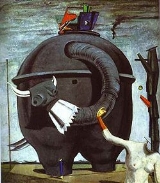
The Elephant Celebes

Encyclopedia
The Elephant Celebes is a 1921 painting by the German
Dada
ist and surrealist
Max Ernst
. It is among the most famous of Ernst's early surrealist works and "undoubtedly the first masterpiece of Surrealist painting in the De Chirico tradition." It combines the vivid, dreamlike atmosphere of Surrealism with the collage
aspects of Dada.
was an inspiration for the early Surrealists, and Celebes
palette and spatial construction show his influence. The painting also attempts to apply Dada's collage
effects to simulate different materials. Ernst's realistic portrayal of the constituent elements produces a hallucinatory effect that he associated with collage, and was trying to achieve in this painting. Regarding the art of collage, Ernst said, "It is the systematic exploitation of the coincidental or artificially provoked encounter of two of more unrelated realities on an apparently inappropriate plane and the spark of poetry created by the proximity of these realities."
The central focus of the painting is a giant mechanical elephant. It is round and has a trunk-like hose protruding from it. The figure's round body was modeled after a photograph in an anthropological journal of a clay corn bin from a southern Sudan
ese culture, the Konkombwa. Celebes suggests "ritual and totemic sculpture of African origin", evidenced by the totem-like pole at right and the figure's bull horns. The painting uniquely combines found imagery and non-Western visual elements.
Ernst's creature has a frilly metallic cuff or collar, and a horned head and tail. The low horizon emphasizes the creature's bulk, and the gesture of the headless mannequin introduces the viewer to the figure. The mannequin wears a surgical glove, a common Surrealist symbol. This nude figure may have a mythological connotation, suggesting the abduction of Europa
by Zeus
while disguised as a bull. The mostly empty sky contains more incongruities: there are two fish "flying" at left (one writer considers the scene to be underwater). The black shape to the right of the fish looks like an oncoming airplane, and there is a trail of smoke in the right part of the sky. These may be allusions to the "mechanical terror of the war experience" which led to Ernst writing, "On the 1st of August 1914 Max Ernst died. He was resurrected on the 11 November 1918 as a young man who aspired to find the myths of his time." Celebes, then, seems to represent the myth of destruction.
"Celebes" was once the popular name for the island of Sulawesi
, one of the Greater Sunda Islands
of Indonesia
. Ernst told Penrose that the title Celebes was derived from the opening words of a German schoolboys' rhyme with sexual connotations:
Der Elefant von Celebes
Hat hinten etwas Gelebes
Der Elefant von Sumatra
Der vögelt seine Grossmama
Der Elefant von Indien
Der kann das Loch nicht finden
The elephant from [C]elebes
has sticky, yellow bottom grease
The elephant from Sumatra
always has sex with his grandmamma
The elephant from India
can never find the hole ha-ha
In this context, the totemic pole may be interpreted as a phallic symbol
.
Ernst painted Celebes in Cologne
in 1921. The French poet and Surrealist Paul Éluard
visited Ernst that year and purchased the painting and took it back to Paris. Eluard would buy other of Ernst's paintings, and Ernst painted murals for Eluard's house in Eaubonne
. It remained in Eluard's collection until 1938 and was then purchased by the English artist Roland Penrose
. It has been in the collection of the Tate Gallery
, London since 1975 and is displayed in the Tate Modern
. The back of the canvas is decorated with some doodles that are seemingly unconnected to the subject matter on the front of the canvas, including two figures holding golf club
s adjacent to the word "GOLF".
Germans
The Germans are a Germanic ethnic group native to Central Europe. The English term Germans has referred to the German-speaking population of the Holy Roman Empire since the Late Middle Ages....
Dada
Dada
Dada or Dadaism is a cultural movement that began in Zurich, Switzerland, during World War I and peaked from 1916 to 1922. The movement primarily involved visual arts, literature—poetry, art manifestoes, art theory—theatre, and graphic design, and concentrated its anti-war politics through a...
ist and surrealist
Surrealism
Surrealism is a cultural movement that began in the early 1920s, and is best known for the visual artworks and writings of the group members....
Max Ernst
Max Ernst
Max Ernst was a German painter, sculptor, graphic artist, and poet. A prolific artist, Ernst was one of the primary pioneers of the Dada movement and Surrealism.-Early life:...
. It is among the most famous of Ernst's early surrealist works and "undoubtedly the first masterpiece of Surrealist painting in the De Chirico tradition." It combines the vivid, dreamlike atmosphere of Surrealism with the collage
Collage
A collage is a work of formal art, primarily in the visual arts, made from an assemblage of different forms, thus creating a new whole....
aspects of Dada.
Description and influence
Giorgio de ChiricoGiorgio de Chirico
Giorgio de Chirico was a pre-Surrealist and then Surrealist Italian painter born in Volos, Greece, to a Genovese mother and a Sicilian father. He founded the scuola metafisica art movement...
was an inspiration for the early Surrealists, and Celebes
Sulawesi
Sulawesi is one of the four larger Sunda Islands of Indonesia and is situated between Borneo and the Maluku Islands. In Indonesia, only Sumatra, Borneo, and Papua are larger in territory, and only Java and Sumatra have larger Indonesian populations.- Etymology :The Portuguese were the first to...
palette and spatial construction show his influence. The painting also attempts to apply Dada's collage
Collage
A collage is a work of formal art, primarily in the visual arts, made from an assemblage of different forms, thus creating a new whole....
effects to simulate different materials. Ernst's realistic portrayal of the constituent elements produces a hallucinatory effect that he associated with collage, and was trying to achieve in this painting. Regarding the art of collage, Ernst said, "It is the systematic exploitation of the coincidental or artificially provoked encounter of two of more unrelated realities on an apparently inappropriate plane and the spark of poetry created by the proximity of these realities."
The central focus of the painting is a giant mechanical elephant. It is round and has a trunk-like hose protruding from it. The figure's round body was modeled after a photograph in an anthropological journal of a clay corn bin from a southern Sudan
Sudan
Sudan , officially the Republic of the Sudan , is a country in North Africa, sometimes considered part of the Middle East politically. It is bordered by Egypt to the north, the Red Sea to the northeast, Eritrea and Ethiopia to the east, South Sudan to the south, the Central African Republic to the...
ese culture, the Konkombwa. Celebes suggests "ritual and totemic sculpture of African origin", evidenced by the totem-like pole at right and the figure's bull horns. The painting uniquely combines found imagery and non-Western visual elements.
Ernst's creature has a frilly metallic cuff or collar, and a horned head and tail. The low horizon emphasizes the creature's bulk, and the gesture of the headless mannequin introduces the viewer to the figure. The mannequin wears a surgical glove, a common Surrealist symbol. This nude figure may have a mythological connotation, suggesting the abduction of Europa
Europa (mythology)
In Greek mythology Europa was a Phoenician woman of high lineage, from whom the name of the continent Europe has ultimately been taken. The name Europa occurs in Hesiod's long list of daughters of primordial Oceanus and Tethys...
by Zeus
Zeus
In the ancient Greek religion, Zeus was the "Father of Gods and men" who ruled the Olympians of Mount Olympus as a father ruled the family. He was the god of sky and thunder in Greek mythology. His Roman counterpart is Jupiter and his Etruscan counterpart is Tinia.Zeus was the child of Cronus...
while disguised as a bull. The mostly empty sky contains more incongruities: there are two fish "flying" at left (one writer considers the scene to be underwater). The black shape to the right of the fish looks like an oncoming airplane, and there is a trail of smoke in the right part of the sky. These may be allusions to the "mechanical terror of the war experience" which led to Ernst writing, "On the 1st of August 1914 Max Ernst died. He was resurrected on the 11 November 1918 as a young man who aspired to find the myths of his time." Celebes, then, seems to represent the myth of destruction.
"Celebes" was once the popular name for the island of Sulawesi
Sulawesi
Sulawesi is one of the four larger Sunda Islands of Indonesia and is situated between Borneo and the Maluku Islands. In Indonesia, only Sumatra, Borneo, and Papua are larger in territory, and only Java and Sumatra have larger Indonesian populations.- Etymology :The Portuguese were the first to...
, one of the Greater Sunda Islands
Greater Sunda Islands
The Greater Sunda Islands are a group of large islands within the Malay archipelago. Jawa , smallest but by far the most populous and important; Sumatera in the west, directly across the Strait of Malacca from Malaysia; Kalimantan, the Indonesian sector of large, compact, minicontinent Borneo; and...
of Indonesia
Indonesia
Indonesia , officially the Republic of Indonesia , is a country in Southeast Asia and Oceania. Indonesia is an archipelago comprising approximately 13,000 islands. It has 33 provinces with over 238 million people, and is the world's fourth most populous country. Indonesia is a republic, with an...
. Ernst told Penrose that the title Celebes was derived from the opening words of a German schoolboys' rhyme with sexual connotations:
Der Elefant von Celebes
Hat hinten etwas Gelebes
Der Elefant von Sumatra
Der vögelt seine Grossmama
Der Elefant von Indien
Der kann das Loch nicht finden
The elephant from [C]elebes
has sticky, yellow bottom grease
The elephant from Sumatra
always has sex with his grandmamma
The elephant from India
can never find the hole ha-ha
In this context, the totemic pole may be interpreted as a phallic symbol
Phallus
A phallus is an erect penis, a penis-shaped object such as a dildo, or a mimetic image of an erect penis. Any object that symbolically resembles a penis may also be referred to as a phallus; however, such objects are more often referred to as being phallic...
.
History
The painting's less common but original title is Celebes, according to inscriptions on the front and back of the canvas.Ernst painted Celebes in Cologne
Cologne
Cologne is Germany's fourth-largest city , and is the largest city both in the Germany Federal State of North Rhine-Westphalia and within the Rhine-Ruhr Metropolitan Area, one of the major European metropolitan areas with more than ten million inhabitants.Cologne is located on both sides of the...
in 1921. The French poet and Surrealist Paul Éluard
Paul Éluard
Paul Éluard, born Eugène Émile Paul Grindel , was a French poet who was one of the founders of the surrealist movement.-Biography:...
visited Ernst that year and purchased the painting and took it back to Paris. Eluard would buy other of Ernst's paintings, and Ernst painted murals for Eluard's house in Eaubonne
Eaubonne
Eaubonne is a commune in the northern suburbs of Paris, France. It is located from the center of Paris.-Twin towns:It is twinned with Matlock, Derbyshire, England, Budenheim, Germany and Vălenii de Munte, Romania.-Transport:...
. It remained in Eluard's collection until 1938 and was then purchased by the English artist Roland Penrose
Roland Penrose
Sir Roland Algernon Penrose CBE was an English artist, historian and poet. He was a major promoter and collector of modern art and an associate of the surrealists in the United Kingdom.- Biography :...
. It has been in the collection of the Tate Gallery
Tate Gallery
The Tate is an institution that houses the United Kingdom's national collection of British Art, and International Modern and Contemporary Art...
, London since 1975 and is displayed in the Tate Modern
Tate Modern
Tate Modern is a modern art gallery located in London, England. It is Britain's national gallery of international modern art and forms part of the Tate group . It is the most-visited modern art gallery in the world, with around 4.7 million visitors per year...
. The back of the canvas is decorated with some doodles that are seemingly unconnected to the subject matter on the front of the canvas, including two figures holding golf club
Golf club (equipment)
A golf club is used to hit a golf ball in a game of golf. Each club is composed of a shaft with a grip and a clubhead. Woods are mainly used for long-distance fairway or tee shots; irons, the most versatile class, are used for a variety of shots; Hybrids that combine design elements of woods and...
s adjacent to the word "GOLF".