


Tetrachord

Encyclopedia
Traditionally, a tetrachord is a series of three intervals filling in the interval of a perfect fourth
, a 4:3 frequency proportion. In modern usage a tetrachord is any four-note segment of a scale or tone row. The term tetrachord derives from ancient Greek music theory. It literally means four strings, originally in reference to harp-like instruments such as the lyre
or the kithara, with the implicit understanding that the four strings must be contiguous. Ancient Greek music
theory distinguishes three genera of tetrachords. These genera are characterised by the largest of the three intervals of the tetrachord:
Diatonic
Chromatic
Enharmonic
As the three genera simply represent ranges of possible intervals within the tetrachord, various shades (chroai) of tetrachord with specific tunings were specified. Once the genus and shade of tetrachord are specified the three internal intervals could be arranged in six possible permutations.
as the basic unit for determining tuning: ancient Greeks used the tetrachord for this purpose. The octave was recognised by ancient Greece as a fundamental interval, but it was seen as being built from two tetrachords and a whole tone
.
Scales built on chromatic and enharmonic tetrachords continued to be used in the classical music of the Middle East
and India
, but in Europe
they were maintained only in certain types of folk music
. The diatonic tetrachord, however, and particularly the shade built around two tones and a semitone, became the dominant tuning in European music.
Lydian mode
Dorian mode
Phrygian mode
(The extents of the Greek system are from Chalmers, Divisions of the Tetrachord.)
s of the diatonic and chromatic tetrachords:
Diatonic
hypate parhypate lichanos mese
4/3 81/64 9/8 1/1
| 256/243 | 9/8 | 9/8 |
-498 -408 -204 0 cents
Chromatic
hypate parhypate lichanos mese
4/3 81/64 32/27 1/1
| 256/243 | 2187/2048 | 32/27 |
-498 -408 -294 0 cents
Since there is no reasonable Pythagorean tuning of the enharmonic genus, here is a representative tuning due to Archytas
:
Enharmonic
hypate parhypate lichanos mese
4/3 9/7 5/4 1/1
| 28/27 |36/35| 5/4 |
-498 -435 -386 0 cents
The number of strings on the classical lyre varied at different epochs, and possibly in different localities – four, seven and ten having been favorite numbers. Originally, the lyre
had only five to seven strings(see also the Kithara
, a larger form), so only a single tetrachord was needed. Larger scales are constructed from conjunct or disjunct tetrachords. Conjunct tetrachords share a note, while disjunct tetrachords are separated by a disjunctive tone of 9/8 (a Pythagorean major second). Alternating conjunct and disjunct tetrachords form a scale that repeats in octaves (as in the familiar diatonic scale
, created in such a manner from the diatonic genus), but this was not the only arrangement.
The Greeks analyzed genera using various terms, including diatonic, enharmonic, and chromatic, the latter being the color between the two other types of modes which were seen as being black and white. Scales are constructed from conjunct or disjunct tetrachords: the tetrachords of the chromatic genus contained a minor third
on top and two semitone
s at the bottom, the diatonic contained a minor second
at top with two major seconds at the bottom, and the enharmonic contained a major third
on top with two quarter tone
s at the bottom, all filling in the perfect fourth
of the fixed outer strings. However, the closest term used by the Greeks to our modern usage of chromatic is pyknon, the density ("condensation
") of chromatic or enharmonic genera.
This is a partial table of the superparticular divisions by Chalmers after Hofmann.
Since there are two tetrachords and a major tone
in an octave, this creates a 25 tone scale as used in the Persian tone system before the quarter tone scale. A more inclusive description (where Ottoman, Persian and Arabic overlap), of the scale divisions is that of 24 tones, 24 equal quarter tones, where a quarter tone equals half a semitone (50 cents) in a 12 tone equal-tempered scale (see also Arabian maqam). It should be mentioned that Al-Farabi's, among other Islamic treatises, also contained additional division schemes as well as providing a gloss of the Greek system as Aristoxenian doctrines were often included.
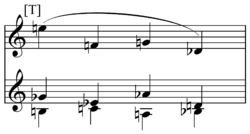 Milton Babbitt
's serial theory extends the term tetrachord to mean a four-note segment of a twelve-tone row.
Allen Forte occasionally uses the term tetrachord to mean what other theorists call a tetrad
, and what Forte himself also calls a "4-element set"—a set of any four pitches or pitch classes.
Perfect fourth
In classical music from Western culture, a fourth is a musical interval encompassing four staff positions , and the perfect fourth is a fourth spanning five semitones. For example, the ascending interval from C to the next F is a perfect fourth, as the note F lies five semitones above C, and there...
, a 4:3 frequency proportion. In modern usage a tetrachord is any four-note segment of a scale or tone row. The term tetrachord derives from ancient Greek music theory. It literally means four strings, originally in reference to harp-like instruments such as the lyre
Lyre
The lyre is a stringed musical instrument known for its use in Greek classical antiquity and later. The word comes from the Greek "λύρα" and the earliest reference to the word is the Mycenaean Greek ru-ra-ta-e, meaning "lyrists", written in Linear B syllabic script...
or the kithara, with the implicit understanding that the four strings must be contiguous. Ancient Greek music
Music of Ancient Greece
The music of ancient Greece was almost universally present in society, from marriages and funerals to religious ceremonies, theatre, folk music and the ballad-like reciting of epic poetry. It thus played an integral role in the lives of ancient Greeks...
theory distinguishes three genera of tetrachords. These genera are characterised by the largest of the three intervals of the tetrachord:
Diatonic
Diatonic genus
In ancient Greek music theory, the diatonic genus is the division of the tetrachord from which the modern diatonic scale evolved. The distinguishing characteristic of the diatonic genus is that its largest interval is about the size of a major second...
- A diatonic tetrachord has a characteristic interval that is less than or equal to half the total interval of the tetrachord (or approximately 249 centCent (music)The cent is a logarithmic unit of measure used for musical intervals. Twelve-tone equal temperament divides the octave into 12 semitones of 100 cents each...
s). This characteristic interval is usually slightly smaller (approximately 200 cents), becoming a whole toneMajor secondIn Western music theory, a major second is a musical interval spanning two semitones, and encompassing two adjacent staff positions . For example, the interval from C to D is a major second, as the note D lies two semitones above C, and the two notes are notated on adjacent staff postions...
. Classically, the diatonic tetrachord consists of two intervals of a tone and one of a semitoneSemitoneA semitone, also called a half step or a half tone, is the smallest musical interval commonly used in Western tonal music, and it is considered the most dissonant when sounded harmonically....
.
Chromatic
Chromatic genus
In Ancient Greek music theory, the chromatic genus is a genus of the tetrachord characterized by an upper interval of a minor third. The two middle notes of the tetrachord were movable while the two outer notes were immovable...
- A chromatic tetrachord has a characteristic interval that is greater than about half the total interval of the tetrachord, yet not as great as four-fifths of the interval (between about 249 and 398 cents). Classically, the characteristic interval is a minor thirdMinor thirdIn classical music from Western culture, a third is a musical interval encompassing three staff positions , and the minor third is one of two commonly occurring thirds. The minor quality specification identifies it as being the smallest of the two: the minor third spans three semitones, the major...
(approximately 300 cents), and the two smaller intervals are equal semitones.
Enharmonic
Enharmonic genus
The enharmonic genus has historically been the most mysterious and controversial of the three Greek genera of tetrachords. Its characteristic interval is a major third, leaving the remainder of the tetrachord to be divided by two intervals smaller than a semitone...
- An enharmonic tetrachord has a characteristic interval that is greater than about four-fifths the total tetrachord interval. Classically, the characteristic interval is a ditoneDitoneIn music, a ditone is the interval 81:64, which is 407.82 cents. It is the major third in Pythagorean tuning. The ditone is evenly divisible by two major tones and is wider than a just major third by a syntonic comma...
or a major thirdMajor thirdIn classical music from Western culture, a third is a musical interval encompassing three staff positions , and the major third is one of two commonly occurring thirds. It is qualified as major because it is the largest of the two: the major third spans four semitones, the minor third three...
, and the two smaller intervals are quartertones.
As the three genera simply represent ranges of possible intervals within the tetrachord, various shades (chroai) of tetrachord with specific tunings were specified. Once the genus and shade of tetrachord are specified the three internal intervals could be arranged in six possible permutations.
History
Modern music theory makes use of the octaveOctave
In music, an octave is the interval between one musical pitch and another with half or double its frequency. The octave relationship is a natural phenomenon that has been referred to as the "basic miracle of music", the use of which is "common in most musical systems"...
as the basic unit for determining tuning: ancient Greeks used the tetrachord for this purpose. The octave was recognised by ancient Greece as a fundamental interval, but it was seen as being built from two tetrachords and a whole tone
Major second
In Western music theory, a major second is a musical interval spanning two semitones, and encompassing two adjacent staff positions . For example, the interval from C to D is a major second, as the note D lies two semitones above C, and the two notes are notated on adjacent staff postions...
.
Scales built on chromatic and enharmonic tetrachords continued to be used in the classical music of the Middle East
Middle East
The Middle East is a region that encompasses Western Asia and Northern Africa. It is often used as a synonym for Near East, in opposition to Far East...
and India
India
India , officially the Republic of India , is a country in South Asia. It is the seventh-largest country by geographical area, the second-most populous country with over 1.2 billion people, and the most populous democracy in the world...
, but in Europe
Europe
Europe is, by convention, one of the world's seven continents. Comprising the westernmost peninsula of Eurasia, Europe is generally 'divided' from Asia to its east by the watershed divides of the Ural and Caucasus Mountains, the Ural River, the Caspian and Black Seas, and the waterways connecting...
they were maintained only in certain types of folk music
Folk music
Folk music is an English term encompassing both traditional folk music and contemporary folk music. The term originated in the 19th century. Traditional folk music has been defined in several ways: as music transmitted by mouth, as music of the lower classes, and as music with unknown composers....
. The diatonic tetrachord, however, and particularly the shade built around two tones and a semitone, became the dominant tuning in European music.
Permutations
The three permutations of this shade of diatonic tetrachord are:Lydian mode
Lydian mode
The Lydian musical scale is a rising pattern of pitches comprising three whole tones, a semitone, two more whole tones, and a final semitone. This sequence of pitches roughly describes the fifth of the eight Gregorian modes, known as Mode V or the authentic mode on F, theoretically using B but in...
- A rising scale of two whole tones followed by a semitone, or C D E F. (same hypate and mese for the ancient Greeks)
Dorian mode
Dorian mode
Due to historical confusion, Dorian mode or Doric mode can refer to three very different musical modes or diatonic scales, the Greek, the medieval, and the modern.- Greek Dorian mode :...
- A rising scale of tone, semitone and tone, C D E♭ F, or D E F G (E to A for the ancient Greeks).
Phrygian mode
Phrygian mode
The Phrygian mode can refer to three different musical modes: the ancient Greek tonos or harmonia sometimes called Phrygian, formed on a particular set octave species or scales; the Medieval Phrygian mode, and the modern conception of the Phrygian mode as a diatonic scale, based on the latter...
- A rising scale of a semitone followed by two tones, C D♭ E♭ F, or E F G A (D to G for the ancient Greeks).
(The extents of the Greek system are from Chalmers, Divisions of the Tetrachord.)
Pythagorean tunings
Here are the traditional Pythagorean tuningPythagorean tuning
Pythagorean tuning is a system of musical tuning in which the frequency relationships of all intervals are based on the ratio 3:2. This interval is chosen because it is one of the most consonant...
s of the diatonic and chromatic tetrachords:
Diatonic
hypate parhypate lichanos mese
4/3 81/64 9/8 1/1
| 256/243 | 9/8 | 9/8 |
-498 -408 -204 0 cents
Chromatic
hypate parhypate lichanos mese
4/3 81/64 32/27 1/1
| 256/243 | 2187/2048 | 32/27 |
-498 -408 -294 0 cents
Since there is no reasonable Pythagorean tuning of the enharmonic genus, here is a representative tuning due to Archytas
Archytas
Archytas was an Ancient Greek philosopher, mathematician, astronomer, statesman, and strategist. He was a scientist of the Pythagorean school and famous for being the reputed founder of mathematical mechanics, as well as a good friend of Plato....
:
Enharmonic
hypate parhypate lichanos mese
4/3 9/7 5/4 1/1
| 28/27 |36/35| 5/4 |
-498 -435 -386 0 cents
The number of strings on the classical lyre varied at different epochs, and possibly in different localities – four, seven and ten having been favorite numbers. Originally, the lyre
Lyre
The lyre is a stringed musical instrument known for its use in Greek classical antiquity and later. The word comes from the Greek "λύρα" and the earliest reference to the word is the Mycenaean Greek ru-ra-ta-e, meaning "lyrists", written in Linear B syllabic script...
had only five to seven strings(see also the Kithara
Kithara
The kithara or cithara was an ancient Greek musical instrument in the lyre or lyra family. In modern Greek the word kithara has come to mean "guitar" ....
, a larger form), so only a single tetrachord was needed. Larger scales are constructed from conjunct or disjunct tetrachords. Conjunct tetrachords share a note, while disjunct tetrachords are separated by a disjunctive tone of 9/8 (a Pythagorean major second). Alternating conjunct and disjunct tetrachords form a scale that repeats in octaves (as in the familiar diatonic scale
Diatonic scale
In music theory, a diatonic scale is a seven note, octave-repeating musical scale comprising five whole steps and two half steps for each octave, in which the two half steps are separated from each other by either two or three whole steps...
, created in such a manner from the diatonic genus), but this was not the only arrangement.
The Greeks analyzed genera using various terms, including diatonic, enharmonic, and chromatic, the latter being the color between the two other types of modes which were seen as being black and white. Scales are constructed from conjunct or disjunct tetrachords: the tetrachords of the chromatic genus contained a minor third
Minor third
In classical music from Western culture, a third is a musical interval encompassing three staff positions , and the minor third is one of two commonly occurring thirds. The minor quality specification identifies it as being the smallest of the two: the minor third spans three semitones, the major...
on top and two semitone
Semitone
A semitone, also called a half step or a half tone, is the smallest musical interval commonly used in Western tonal music, and it is considered the most dissonant when sounded harmonically....
s at the bottom, the diatonic contained a minor second
Minor second
In modern Western tonal music theory a minor second is the interval between two notes on adjacent staff positions, or having adjacent note letters, whose alterations cause them to be one semitone or half-step apart, such as B and C or C and D....
at top with two major seconds at the bottom, and the enharmonic contained a major third
Major third
In classical music from Western culture, a third is a musical interval encompassing three staff positions , and the major third is one of two commonly occurring thirds. It is qualified as major because it is the largest of the two: the major third spans four semitones, the minor third three...
on top with two quarter tone
Quarter tone
A quarter tone , is a pitch halfway between the usual notes of a chromatic scale, an interval about half as wide as a semitone, which is half a whole tone....
s at the bottom, all filling in the perfect fourth
Perfect fourth
In classical music from Western culture, a fourth is a musical interval encompassing four staff positions , and the perfect fourth is a fourth spanning five semitones. For example, the ascending interval from C to the next F is a perfect fourth, as the note F lies five semitones above C, and there...
of the fixed outer strings. However, the closest term used by the Greeks to our modern usage of chromatic is pyknon, the density ("condensation
Condensation
Condensation is the change of the physical state of matter from gaseous phase into liquid phase, and is the reverse of vaporization. When the transition happens from the gaseous phase into the solid phase directly, the change is called deposition....
") of chromatic or enharmonic genera.
| Didymos chromatic tetrachord | 16:15, 25:24, 6:5 |
| Eratosthenes chromatic tetrachord | 20:19, 19:18, 6:5 |
| Ptolemy soft chromatic | 28:27, 15:14, 6:5 |
| Ptolemy intense chromatic | 22:21, 12:11, 7:6 |
| Archytas enharmonic | 28:27, 36:35, 5:4 |
This is a partial table of the superparticular divisions by Chalmers after Hofmann.
Persian
Persian music divide the tetrachord differently than the Greek. For example, Farabi presented ten possible intervals used to divide the tetrachord :| Ratio: | 1/1 | 256/243 | 18/17 | 162/149 | 54/49 | 9/8 | 32/27 | 81/68 | 27/22 | 81/64 | 4/3 |
| Note name: | c | d | e | f | |||||||
| Cents: | 0 | 90 | 98 | 145 | 168 | 204 | 294 | 303 | 355 | 408 | 498 |
Since there are two tetrachords and a major tone
Major second
In Western music theory, a major second is a musical interval spanning two semitones, and encompassing two adjacent staff positions . For example, the interval from C to D is a major second, as the note D lies two semitones above C, and the two notes are notated on adjacent staff postions...
in an octave, this creates a 25 tone scale as used in the Persian tone system before the quarter tone scale. A more inclusive description (where Ottoman, Persian and Arabic overlap), of the scale divisions is that of 24 tones, 24 equal quarter tones, where a quarter tone equals half a semitone (50 cents) in a 12 tone equal-tempered scale (see also Arabian maqam). It should be mentioned that Al-Farabi's, among other Islamic treatises, also contained additional division schemes as well as providing a gloss of the Greek system as Aristoxenian doctrines were often included.
Uses
Milton Babbitt
Milton Byron Babbitt was an American composer, music theorist, and teacher. He is particularly noted for his serial and electronic music.-Biography:...
's serial theory extends the term tetrachord to mean a four-note segment of a twelve-tone row.
Allen Forte occasionally uses the term tetrachord to mean what other theorists call a tetrad
Tetrad (music)
A tetrad is a set of four notes in music theory. When these four notes form a tertian chord they are more specifically called a seventh chord, after the diatonic interval from the root of the chord to its fourth note...
, and what Forte himself also calls a "4-element set"—a set of any four pitches or pitch classes.
See also
- TetradTetrad (music)A tetrad is a set of four notes in music theory. When these four notes form a tertian chord they are more specifically called a seventh chord, after the diatonic interval from the root of the chord to its fourth note...
- All-interval tetrachordAll-interval tetrachordAn all-interval tetrachord is a tetrachord, a collection of four pitch classes, from which all six interval classes can be derived by means of various inversions. There are only two possible all-interval tetrachords. In set theory notation, these are [0,1,4,6] and [0,1,3,7]...
- Diatonic and chromaticDiatonic and chromaticDiatonic and chromatic are terms in music theory that are most often used to characterize scales, and are also applied to intervals, chords, notes, musical styles, and kinds of harmony...
- JinsJinsA jins is a set of three, four, or five stepwise pitches used to build an Arabic maqam, or melodic mode. They correspond to the English terms trichord, tetrachord, and pentachord. A maqam is made up of two or more ajnas....
Further reading
- Anonymous. 2001. "Tetrachord". The New Grove Dictionary of Music and Musicians, second edition, edited by Stanley SadieStanley SadieStanley Sadie CBE was a leading British musicologist, music critic, and editor. He was editor of the sixth edition of the Grove Dictionary of Music and Musicians , which was published as the first edition of the New Grove Dictionary of Music and Musicians.Sadie was educated at St Paul's School,...
and John TyrrellJohn Tyrrell (professor of music)John Tyrrell was born in Salisbury, Southern Rhodesia in 1942. He studied at the universities of Cape Town, Oxford and Brno. In 2000 he was appointed Research Professor at Cardiff University....
. London: Macmillan Publishers.