
All Topics  
Condensation

 
Condensation

   Email Print
   Bookmark   Link


Condensation


Condensation is the change of the physical state of aggregation (or simply state) of matter from gaseous phase into liquid phase. When the transition happens from the gaseous phase into the solid phase directly, bypassing the liquid phase the change is called deposition
Deposition (chemistry)

In chemistry, deposition is the settling of particles or sediment from a solution, suspension and mixture or vapor onto a pre-existing surface....
, which is the opposite of sublimation
Sublimation

Sublimation can have several meanings:* Sublimation , the change from solid to gas, while at no point becoming a liquid.* Sublimation , the transformation of emotions....
.

Condensation commonly occurs when a vapor is cooled to its dew point
Dew point

The dew point is the temperature to which a given parcel of air must be cooled, at constant barometric pressure, for water vapor to Condensation into water....
, but the dewpoint can also be reached through compression.


Discussion
Ask a question about 'Condensation'
Start a new discussion about 'Condensation'
Answer questions from other users
Full Discussion Forum


Recent Posts


Encyclopedia


Condensation is the change of the physical state of aggregation (or simply state) of matter from gaseous phase into liquid phase. When the transition happens from the gaseous phase into the solid phase directly, bypassing the liquid phase the change is called deposition
Deposition (chemistry)

In chemistry, deposition is the settling of particles or sediment from a solution, suspension and mixture or vapor onto a pre-existing surface....
, which is the opposite of sublimation
Sublimation

Sublimation can have several meanings:* Sublimation , the change from solid to gas, while at no point becoming a liquid.* Sublimation , the transformation of emotions....
.

Condensation commonly occurs when a vapor is cooled to its dew point
Dew point

The dew point is the temperature to which a given parcel of air must be cooled, at constant barometric pressure, for water vapor to Condensation into water....
, but the dewpoint can also be reached through compression. The condensed vapor is called a condensate
Condensate

Condensate may refer to:* The liquid phase produced by the condensation of steam or any other gas* The product of a chemical condensation reaction, other than water...
, the laboratory or the industrial equipment used for condensation is called a condenser
Condenser (heat transfer)

In systems involving heat transfer, a condenser is a device or unit used to Condensation a substance from its gaseous to its liquid state, typically by cooling it....
.

The science of studying the thermodynamic properties of moist air and the interrelationships between these in order to analyze, and predict properties by changing in the conditions of moist air is called psychrometry. The interrelationship can be graphically represented, and prediction carried out graphically by the psychrometric chart Most people think the water is condensation, but condensation is only the process of change.

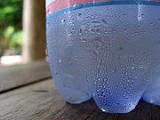
Water vapor that naturally condenses on cold surfaces into liquid water is called dew
Dew

Dew is water in the form of droplets that appears on thin, exposed objects in the morning or evening. As the exposed surface cools by thermal radiation its heat, atmospheric moisture condensation at a rate greater than that at which it can evaporation, resulting in the formation of water droplets....
. Water vapor will only condense onto another surface when the temperature of that surface is cooler than the temperature
Temperature

In physics, temperature is a physical property of a Physical system that underlies the common notions of hot and cold; something that feels hotter generally has the greater temperature....
 of the water vapor. The water molecule brings a parcel of heat
Latent heat

In thermochemistry, latent heat is the amount of energy in the form of heat released or absorbed by a chemical substance during a change of state of matter , or a phase transition....
 with it. In order to have condensed, the molecule tranfers its kinetic energy
Kinetic energy

The kinetic energy of an object is the extra energy which it possesses due to its motion. It is defined as the mechanical work needed to accelerate a body of a given mass from rest to its current velocity....
 to the atmosphere. When water vapor condenses into liquid water, the hydrogen bonds form again and release latent heat, which increases the sensible heat and causes the air temperature to rise. Sensible heat
Sensible heat

Sensible heat is potential energy in the form of thermal energy or heat. The thermal body must have a temperature higher than its surroundings ....
 is removed from the air and the temperature drops when evaporation is occurring and latent heat is converted to sensible heat and the temperature rises when condensation occurs.

Applications of condensation

Condensation is a crucial component of distillation
Distillation

Distillation is a method of separation process mixtures based on differences in their Volatility in a boiling liquid mixture. Distillation is a unit operation, or a physical separation process, and not a chemical reaction....
, an important application in laboratory and industrial chemistry application.

Because condensation is a naturally occurring phenomenon, it can often be used to generate water in large quantities for human use: Many structures that are made solely for the purpose of collecting water from condensation, such as fog fence
Fog fence

An air well, fog collector, or fog fence is an apparatus for collecting liquid water from fog, using of a fine mesh or array of parallel wires....
s, air wells and dew pond
Dew pond

A Dew pond is an artificial pond usually sited on the top of a hill, intended for watering livestock. Dew ponds are used in areas where a natural supply of surface water may not be readily available....
s. Such systems can often be used to retain soil moisture in areas where active desertification
Desertification

Desertification is the degradation of land in arid and dry Humid subtropical climate areas, resulting primarily from natural activities and influenced by Climate variations....
 is occurring—so much so that some organizations educate people living in affected areas about water condensers to help them deal effectively with the situation.

See also

  • Kelvin equation
    Kelvin equation

    Kelvin equation describes the change in vapour pressure due to a curved liquid/vapor interface with radius . The Kelvin equation is used for determination of pore size distribution of a porous medium using adsorption porosimetry....
  • Phase diagram
    Phase diagram

    A phase diagram in physical chemistry, mineralogy, and materials science is a type of Graph of a function used to show conditions at which thermodynamically-distinct phase can occur at thermodynamic equilibrium....
  • Phase transition
    Phase transition

    In thermodynamics, a phase transition is the transformation of a thermodynamic system from one phase to another.At phase-transition point, physical properties may undergo abrupt change- for instance, volume of the two phases may be vastly different....
  • Condenser (heat transfer)
    Condenser (heat transfer)

    In systems involving heat transfer, a condenser is a device or unit used to Condensation a substance from its gaseous to its liquid state, typically by cooling it....
  • Surface condenser
  • Bose–Einstein condensate
    Bose–Einstein condensate

    A Bose?Einstein condensate is a state of matter of bosons confined in an external potential and cooled to temperatures very near to absolute zero ....


External links


>
From To
Solid
Solid

A solid object is in the states of matter characterized by resistance to deformation and changes of volume. In other words, it has high values both of Young's modulus and of shear modulus; this contrasts e.g....
Liquid
Liquid

Liquid is one of the principal states of matter. A liquid is a fluid that has the particles loose and can freely form a distinct surface at the boundaries of its bulk material....
Gas
Gas

In physics, a gas is a state of matter, consisting of a collection of particles without a definite shape or volume that are in more or less random motion....
Plasma
Plasma (physics)

In physics and chemistry, plasma is a partially ionized gas, in which a certain proportion of electrons are free rather than being bound to an atom or molecule....
SolidSolid-Solid TransformationMelting
Melting

Melting is a process that results in the phase change of a substance from a solid to a liquid. The internal energy of a solid substance is increased to a specific temperature at which it changes to the liquid phase....
Sublimation-
LiquidFreezing
Freezing

In physical science, freezing or solidification is the process in which a liquid turns into a solid when cold enough. The Melting point is the temperature at which this happens....
N/ABoiling
Boiling

Boiling, a type of phase transition, is the rapid vaporization of a liquid, which typically occurs when a liquid is heated to its boiling point, the temperature at which the vapor pressure of the liquid is equal to the pressure exerted on the liquid by the surrounding environmental pressure....
/Evaporation
Evaporation

Evaporation is the slow vaporization of a liquid and the reverse of condensation. A type of phase transition, it is the process by which molecules in a liquid State of matter spontaneously become gaseous ....
-
GasDeposition
Deposition (physics)

Deposition is a Thermodynamic process in which gas transforms into solid . The reverse of deposition is sublimation .One example of deposition is the Process by which, in sub-freezing air, water vapor changes directly to ice without first becoming a liquid....
Condensation
Condensation

Condensation is the change of the physical state of aggregation of matter from gaseous phase into liquid phase. When the transition happens from the gaseous phase into the solid phase directly, bypassing the liquid phase the change is called Deposition , which is the opposite of sublimation....
N/AIonization
Ionization

Ionization is the physics process of converting an atom or molecule into an ion by adding or removing charged particles such as electrons or other ions....
Plasma--Recombination/DeionizationN/A